


病院、高層ビル、データセンター、風力タービンなどの多くの電気設備では、最も頻繁に登場する2つの名前があります:the シュナイダー・トライハル変圧器 と シーメンス・GEAFOL この. 。これらのユニットをプロジェクトに選んだエンジニアは、業界のフラッグシップであるキャストレジン乾式変圧器技術として、実績があり火災安全性の高い性能に精通しています。国際的なクライアントやエネルギー企業にとって、彼らは常に電圧、環境、コストの観点からどの技術がプロジェクトに最も適しているかを疑問に思い、一般の人々に知られているブランドがどれかということではありません。.
この記事の目的は、2つのブランドを比較することであり、具体的には構造と真空鋳造技術、電圧と電力能力、部分放電挙動の測定、IEC 60076-11規格に基づく火災および環境安全レベルの分類についてです。さらに、この記事では、業界で考慮されるブランドのロゴに選択を制限するのではなく、購入者が何を探すべきかを説明します。.
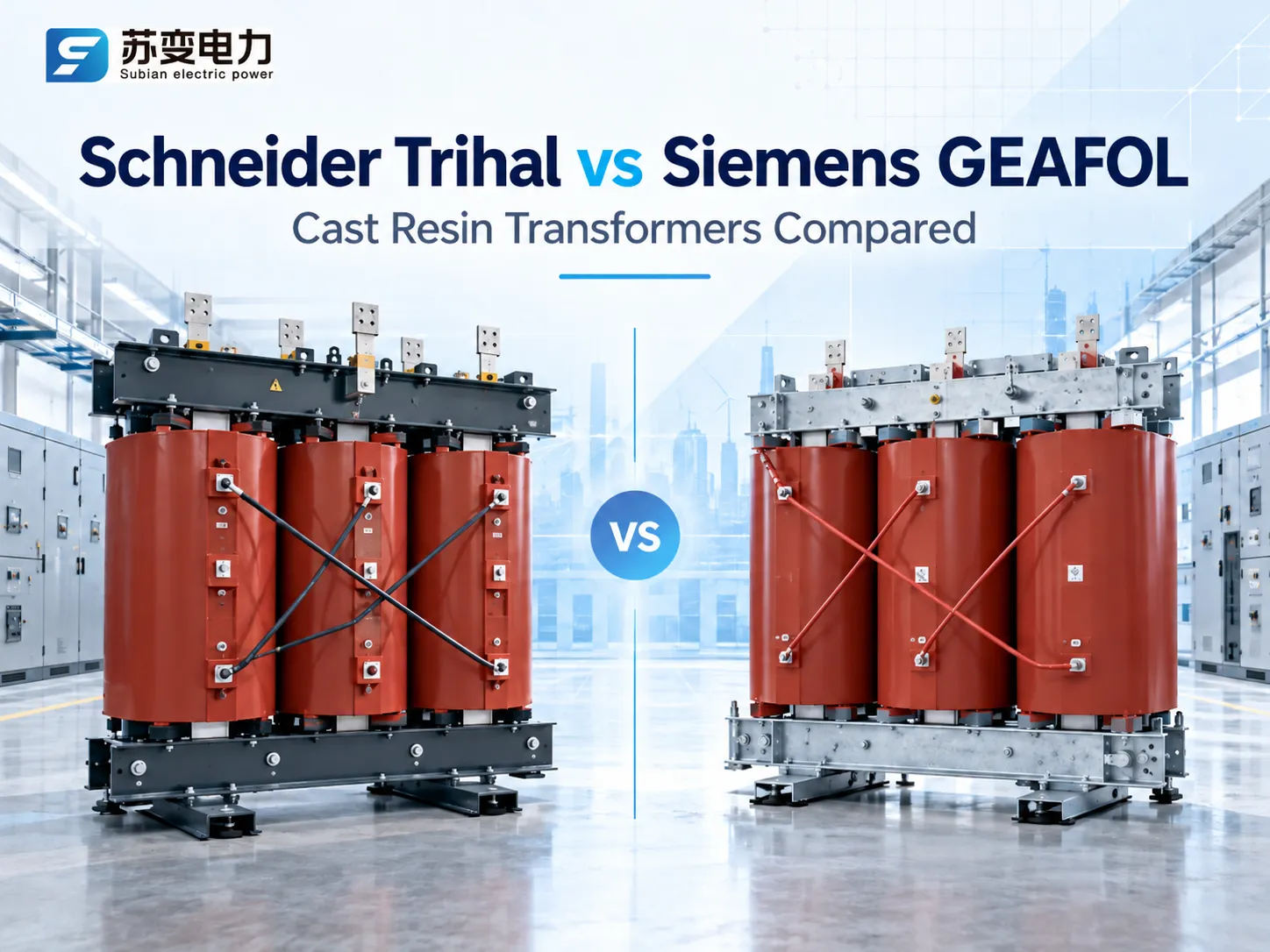
キャストレジン変圧器:それらを類似させるもの
�¤のブランドを比較する前に、共通点に焦点を当てる方が良いでしょう。キャストレジン変圧器は、オイルが存在しないため、これらの変圧器の設置は屋内、負荷の近く、または作業ゾーンでも行うことができます。.
エポキシ樹脂キャスト巻線の製造プロセス
エポキシ樹脂キャスト乾式変圧器では、高電圧巻線が製造され、型に注入され、その後真空条件下でエポキシ樹脂で満たされます。操作の重要な側面は、真空の存在により、樹脂内に閉じ込められた空気や湿気が樹脂が硬化する前に出て行くことができるという事実です。硬化した樹脂は、巻線の物理的保護と、さまざまな環境条件における湿気やほこりに対するシーリングを行います。.
オイル充填変圧器よりエポキシ樹脂キャストを選ぶ理由
オイル充填変圧器は屋外および厳しい用途において一般的な選択肢ですが、エポキシ樹脂キャスト変圧器は、設備の安全性が重要な建物への設置において有利です。可燃性の媒体がないため、火災負荷が少なく、オイルピットや containment を避ける必要がなく、建物の建設規則の遵守が容易になります。湿気のある環境での作業能力と、事前の乾燥なしでの運用再開がその魅力に寄与しています。これが、Schneider と Siemens が乾式変圧器の設計にエポキシ樹脂を選んだ理由を説明しています。.
Schneider Electric Trihal — 範囲と技術
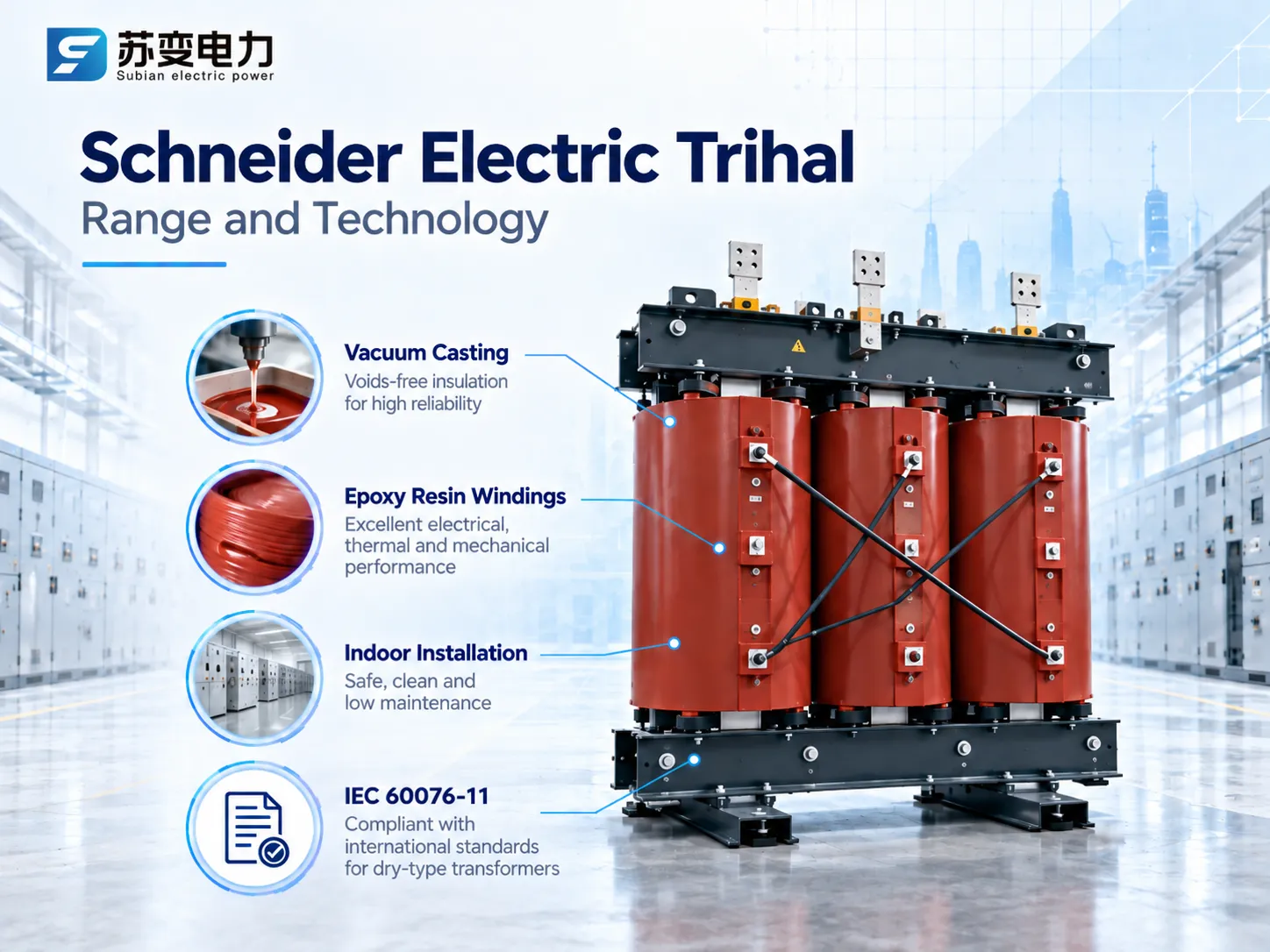
Trihal 変圧器 Schneider ElectricのSeTシリーズの乾式トランスの波を作り出します。Trihalは、グローバルカタログ、文書化されたSKUの配列、そしてヨーロッパにおける重要な設置基盤を持つ、よく知られた確立された製品であり、国際的な仕様における一般的な参照となっています。.
Trihal真空鋳造
Trihalは、三相樹脂から鋳造された乾式トランスであり、中圧巻線をエポキシ樹脂で真空鋳造し、低圧巻線を事前に浸漬することで製造されています。Schneiderは、標準機能としてアルミニウム巻線を挙げ、コアとフレームに腐食防止のためのコーティングを施しています。この製品を防火性としてマーケティングし、長寿命を保証し、通常の受入試験手順において部分放電がないことを保証しています。.
Trihalの特性、タイプ、および典型的な用途
Trihal製品の仕様は、約160,000 kVAから約15,000 kVAまでの容量に関する情報と、最大電圧36 kVを提供します。Schneiderによれば、この製品はシリコンフリーのソリューションによりF1火災クラスおよびIEC 60076-11の環境および気候クラスの要件を満たしています。Trihal製品の主要な用途分野は、商業不動産、病院、インフラストラクチャー、および屋内で必要とされる製造施設です。 Schneider乾式 トランス Trihal製品ラインは、多くの出版物に取り上げられているため、コンサルタントが競合他社から同等のソリューションを要求するための入札書類にTrihalを示すことが一般的です。.
Siemens GEAFOL — 範囲と技術
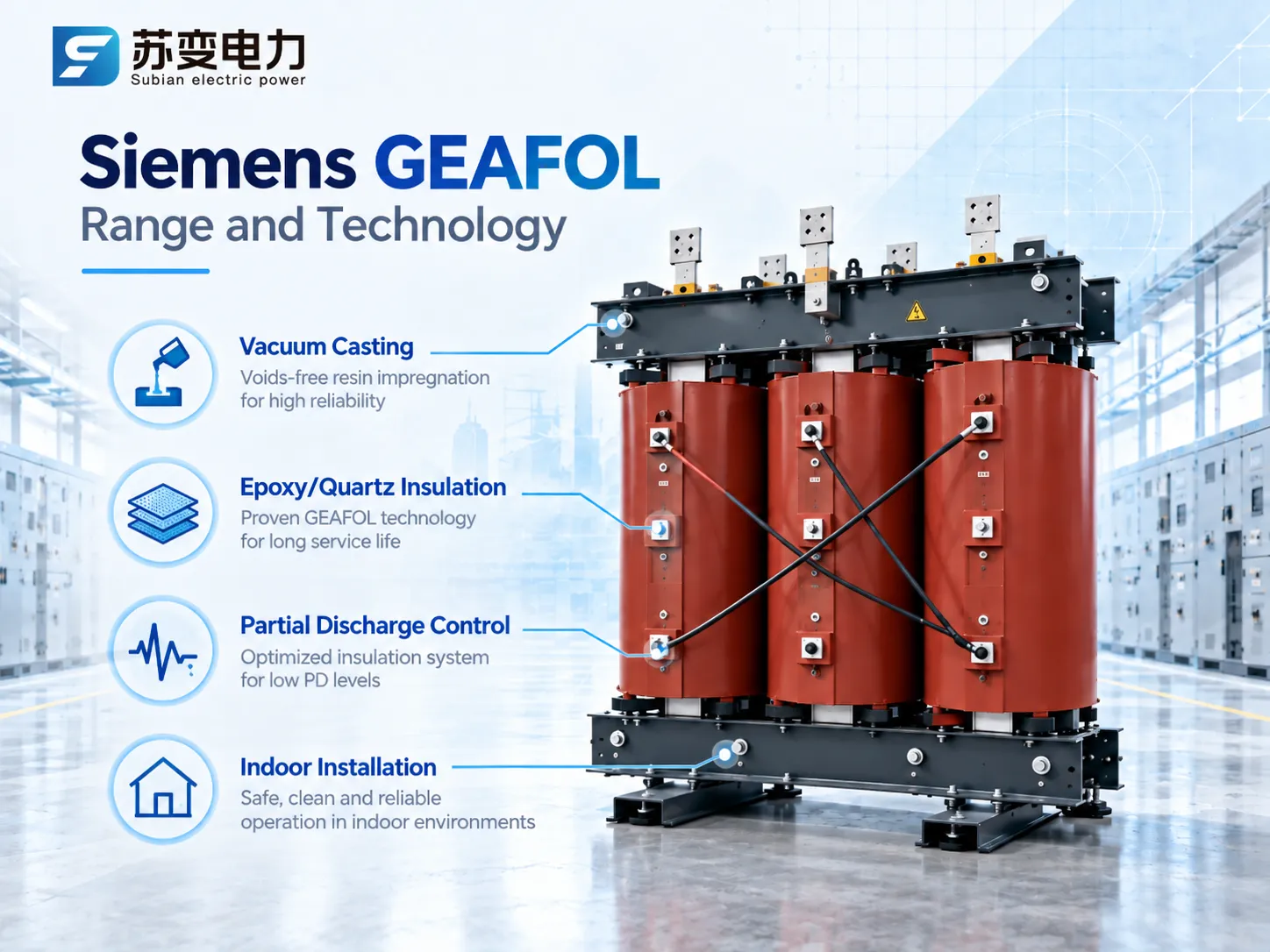
この GEAFOL鋳造樹脂トランス Siemens Energyの乾式機器の範囲に属し、鋳造プロセス、部分放電、SF6フリー絶縁構造の観点からも業界で最も広く参照される技術の1つと見なされています。GEAFOLの封入技術とエポキシ樹脂および石英からなる絶縁体。.
GEAFOLは、エポキシ樹脂と石英粉を絶縁材料として使用しています。高圧ラインは、高温の特別な真空炉を使用してプラグされています。Siemensは、真空プロセスがガスの混入を避け、定格電圧の2倍でも部分放電が完全にないことを結果としてもたらすと指摘しています。同社はアルミニウム箔タイプのコイルを使用しており、これはアルミニウムの熱膨張が鋳造樹脂のそれに似ているため、熱応力が最小限に抑えられるという利点があります。その結果、GEAFOLは非常に耐久性があり、その設計により最小限のメンテナンスが必要です。.
GEAFOLの用途、仕様、およびクラス
GEAFOLシリーズのトランスの適用範囲は、実際には多くの顧客が期待する以上のものであり、製品は約50から50 MVAの範囲で発電することができます。実際、GEAFOLシリーズのトランスは、E3、F1、C3を含むいくつかのクラスでIEC 60076-11に準拠しています。GEAFOLトランスの最も優れた点は、配電発電システムのリーダーであることです。.
Schneider Trihal対Siemens GEAFOL:直接対決
GEAFOLシリーズのトランスとSchneider製のTrihalシリーズのトランスには多くの類似点があります。両ブランドは、エポキシ樹脂を使用して真空封入されたトランスを製造し、IEC 60076-11の安全基準の最高基準を満たしています。影響力のある違いは、エンベロープの端部と絶縁仕様に見られます。.
電圧と電力範囲
Trihalは最大36 kVおよび約15 MVAに対応しており、一般的な中圧配電には十分です。GEAFOLは、より高い電圧(約52 kVまで)と電力(ほぼ50 MVA)を示しており、より強力なアプリケーションに対して十分な余裕があります。一般的な電圧が11 kV、22 kV、または33 kVのプロジェクトでは、両モデルを適用できますが、他の超高電圧または高電力要件にはGEAFOLを選択するかもしれません。.
絶縁タイプと部分放電
両方の範囲は、空隙を避けるために真空条件下で製造されており、良好な部分放電性能を実現しています。Siemensは、GEAFOLが二倍の定格電圧の条件下で部分放電がないことをテストされていると指摘していますが、Schneiderは、Trihalの部分放電に関する低ピコクーロン制限を通常および特別なテスト内で指摘しています。しかし、購入者にとって最も重要なポイントは、両モデルの部分放電が計算されており、その証拠はテストレポートにあり、メーカー名ではないということです。.
規格、火災および環境クラス
両モデルはIEC 60076-11規格を満たし、火災カテゴリーF1レベルを満たしており、これはトランス自体の特徴によって引き起こされる火災危険の最高レベルを示しています。要するに、仕様がF1の火災挙動とEおよびCの特定のクラスを要求する場合、両方の Trihalと GEAFOLキャストレジントランス はこれらの要件を満たすことができます。.
では、どのように異なるのでしょうか?
電圧と電力の制限:GEAFOLはより高い電圧と電力を提供し、Trihalは主に中圧配電に焦点を当てています。.
アプリケーションの多様性:GEAFOLは配電、電力、コンバータ、風力アプリケーションをカバーし、Trihalは配電のみに焦点を当てています。.
絶縁の詳細:GEAFOLはエポキシとクォーツの絶縁、箔コイルを使用し、部分放電テストが約二倍であると主張しています。TrihalはキャストHVとプレインプリケートされたLVおよびアルミニウム導体を使用しています。.
エコシステム:各トランスには独自のスイッチギア、モニタリング、および文書があり、単一ベンダーサイトの場合の体験に影響を与えます。.
可用性:リードタイム、市場サポート、およびコストは、地域やプロジェクトに応じて特定の定格に対して異なり、必要に応じてコメントする必要があります。.
電圧規格:なぜ11 kV、22 kV、33 kVが重要なのか
調達を複雑にする特徴の一つは電圧規格です。中国のカタログやプロジェクトでは中圧システムを10 kV、20 kV、35 kVシステムと呼ぶのに対し、イギリス、中東、アフリカ、そしてアジアの大部分を含む世界の大多数は11 kV、22 kV、33 kVのシステムを指します。これらは異なるラベルであり、単なる同義語ではありません。これらのラベルは異なるシステム電圧を表しています。 キャストレジン乾式変圧器 特定のシステム用に構築されなければなりません。TrihalおよびGEAFOLの変圧器は、製造者によって注文に特化してカスタマイズされています。しかし、正しい電圧値を注文時に提供するのはバイヤーの責任です。.
定格電圧と機器の最高電圧
もう一つの側面があります。例えば、33 kVという特定の値によって区別される定格システム電圧は、33 kVの場合、機器の最高電圧Umとは異なり、Umは約36 kVに等しいです。インパルスに対する保護レベルと電気的クリアランスはUm電圧に基づいています。これが、SchneiderおよびSiemensの製造業者が自社のラインを最大機器電圧に基づいて定義する理由であり、36 kVまたは52 kVのいずれかであり、定格システム電圧に基づいていない理由です。バイヤーは、選択を行う際に定格電圧値とUm電圧が自分のネットワーク要件に合致しているかを確認する必要があります。 シュナイダー・トライハル変圧器 または Siemens GEAFOL transformer.
Efficiency and Ecodesign expectations
In addition to safety requirements, buyers require compliance with efficiency now. Within Europe, dry-type transformers are subjected to Ecodesign minimum-efficiency requirements. All brands have designs that correspond to the profit of requirements. For ドライタイプ変圧器 the loss figures go along with real costs of operation (not only purchase). Therefore, comparing the values, it is important to base the calculations on loss figures, and not on purchase price.
How to Compare the Offers
The brand is important for the EPC contractor but good for the beginning only. Two units from different companies satisfying the same technical class of transformers are considered interchangeable for almost any project since they are installed according to the same specifications.
Match the specification, not the reputation
The proper comparison of any dry-type transformer becomes a minimal, easily verifiable list instead of a list of brands:
Nominal power (kVA or MVA), primary and secondary voltage, information about the use of 11 kV, 22 kV, 33 kV, or 10/20/35 kV.
Maximum voltage level for the equipment and the basic impulse level that is required by the network.
Vector group, short-circuit impedance, and tap-changing range.
Guaranteed no-load and load losses supported by the test report for the transformer.
IEC 60076-11 fire (F), environmental (E), and climate (C) classes that are required at the installation location.
Permitted level of partial discharge and testing of the temperature raise.
IP code of the transformer, the method of the cooling system active or passive, environmental temperature, and altitude.
With the understanding of these parameters, the decision turns into comparing engineering and commercial solutions and thus alternative suppliers get to compete. For a model-level view of how a Chinese cast resin series lines up against these international brands, see our companion guide, SCB13 vs International Cast Resin Transformers.
A Third Option: Factory-Direct Cast Resin Transformers from China
A number of instances in which a named Euro range is specified could sit better with a qualified Chinese manufacturer using the same IEC codes and selling at factory direct prices. One such manufacturer is Subian Electric. To be perfectly clear and fair, Subian Electric is not in any way affiliated, endorsed or authorized by Schneider Electric or Siemens, and the names Trihal and GEAFOL are owned by different companies and mentioned here only as a point of reference. Subian Electric does not claim that its products are the same as those of Euro manufacturers and asserts that any similarities should be established by comparing test reports of the specific units.
What Subian offers is a comparable technology class. Its 6–10 kV SCB series epoxy resin cast dry-type transformer and its 20–35 kV SCB series epoxy resin dry-type transformer are vacuum-cast cast resin transformer units built to IEC 60076-11 and Chinese GB standards, with low partial discharge, flame-retardant construction, and maintenance-free operation. For the lowest standby losses, its SCBHアモルファス合金乾式変圧器 targets ultra-low no-load loss. For an international buyer, the practical path is to fix the specification first, then request test reports and documentation from each candidate, branded or factory-direct, and compare on evidence.
よくある質問
Is the Schneider Trihal transformer better than the Siemens GEAFOL transformer?
Both devices cannot be described as superior to one another. Schneider Trihal transformer is designed for normal voltage distribution of mid-range voltage (up to 36kV), while シーメンス・GEAFOL この goes beyond those limits being capable of working with voltage interruptions of higher voltages up to 52kV and up to 50MVA. The choice of equipment for regular distribution projects can be made in favor of one or another device, while for applications that demand high-voltage or high-power solutions, it could be GEAFOL.
Are Trihal and GEAFOL the same technology?
Both share the same basic principle: the vacuum-cast epoxy resin dry-type transformer is within IEC 60076-11 standards at the F1 fire safety level. However, the specifics vary, as GEAFOL makes use of the epoxy/quartz casting tested to double its rated voltage for partial discharge purposes, while Trihal makes use of cast HV with pre-impregnated LV windings.
What voltage levels do these cast resin transformers cover?
Trihal has a publication range that goes to 36 kV which encloses 11 kV, 22 kV, and 33 kV networks as well as the 10/20/35 kV convention. GEAFOL continues up to approximately 52 kV. Therefore, always remember that nominal voltage mentioned in the system, as well as the highest voltage of the equipment, is different.
Can a Chinese SCB cast resin transformer replace a branded unit?
In theory, a キャストレジン乾式変圧器 made in accordance with IEC 60076-11 specifications and having proper loss values can fulfill the same function. Acceptance of this transformer as a substitute in a project will depend rather on the approved vendor, certifications required, and matching of specifications and test reports of both devices.
What documents should I request before buying any cast resin transformer?
Submit the routine-test reports which include no-load losses, load losses, temperature rise, dielectric withstand voltage, from partial discharge tests. You must also include IEC 60076-11 E, C, and F classes along with dimensional and connection diagrams and the relevant type-test documents. This is applicable to branded cast resin transformers and units directly manufactured from the factory.
Do these transformers support 11 kV, 22 kV, and 33 kV systems?
Affirmative. The Trihal cast resin transformer と GEAFOL鋳造樹脂トランス will be made according to the requested voltage between 11 kV, 22 kV, and 33 kV and will be no different compared to the standard convention of the 10/20/35 kV. Please inform the nominal voltage and maximum voltage requirements in your query so that we can make sure that the insulation class and winding class are correct.
参考文献
- IEC 60076-11 — Power transformers, Part 11: Dry-type transformers
- Wikipedia — Transformer types (cast resin dry-type)
- Electrical Engineering Portal — Dry-type transformers
Talk to Subian Electric
If your specifications for a project can be fulfilled by both a brand-name product and a factory model, it is advisable to compare them based on data instead of reputation. For an independent Chinese manufacturer of epoxy resin dry transformer と cast resin dry transformer, Subian Electric covers voltage ratings ranging from 6 kV to 35 kV in accordance with IEC 60076-11. In case you provide your requirements regarding voltage, capacity, losses, and IEC rating, the Subian engineers will present you with the options, as well as the necessary reports to ensure a fair comparison between a factory model and the brand-name products you are interested in.