


OLTCは、負荷時タップチェンジャーを表します。それが1つの質問に対する十分な情報かもしれませんが、この略語は通常単独では表示されません。代わりに、変圧器のデータシート、入札仕様書、またはサプライヤーの見積もりに見られます。したがって、それが何を意味するのかを尋ねるのではなく、このデバイスの操作、その必要性、可能な価格について尋ねる方が良いでしょう。.
したがって、全体の問題を詳細に見てみましょう:用語の解釈、タンク内で何が起こるか、OLTCの適用事例、OLTCが標準の配電変圧器で使用されるタップチェンジャーとどのように異なるか、それらが表す数字、そしてデバイスの主要な製造業者についても。.
OLTCは負荷時タップチェンジャーであり、変圧器が稼働している間にタップ位置を変更するメカニズムです。OLTCは、変圧器が稼働している間に電圧を維持するのに役立つため、変圧器の重要な側面です。一方、一般的な変圧器はOCTCを使用しており、これは変圧器がオフでない限り調整ができないタップチェンジャーの一種です。OLTCは変圧器の価格を約10-30%上昇させる可能性があります。OLTCのコストは、電圧クラスとタイプによって異なり、配電変圧器は約2000-8000ドル、送電変圧器は約15000-60000ドルかかります。この分野の主要な製造業者は、ヨーロッパのマシーネンファブリック・ラインハウゼン(MR)であり、日立エナジー、シーメンスエナジー、ABBなどの企業もあります。.
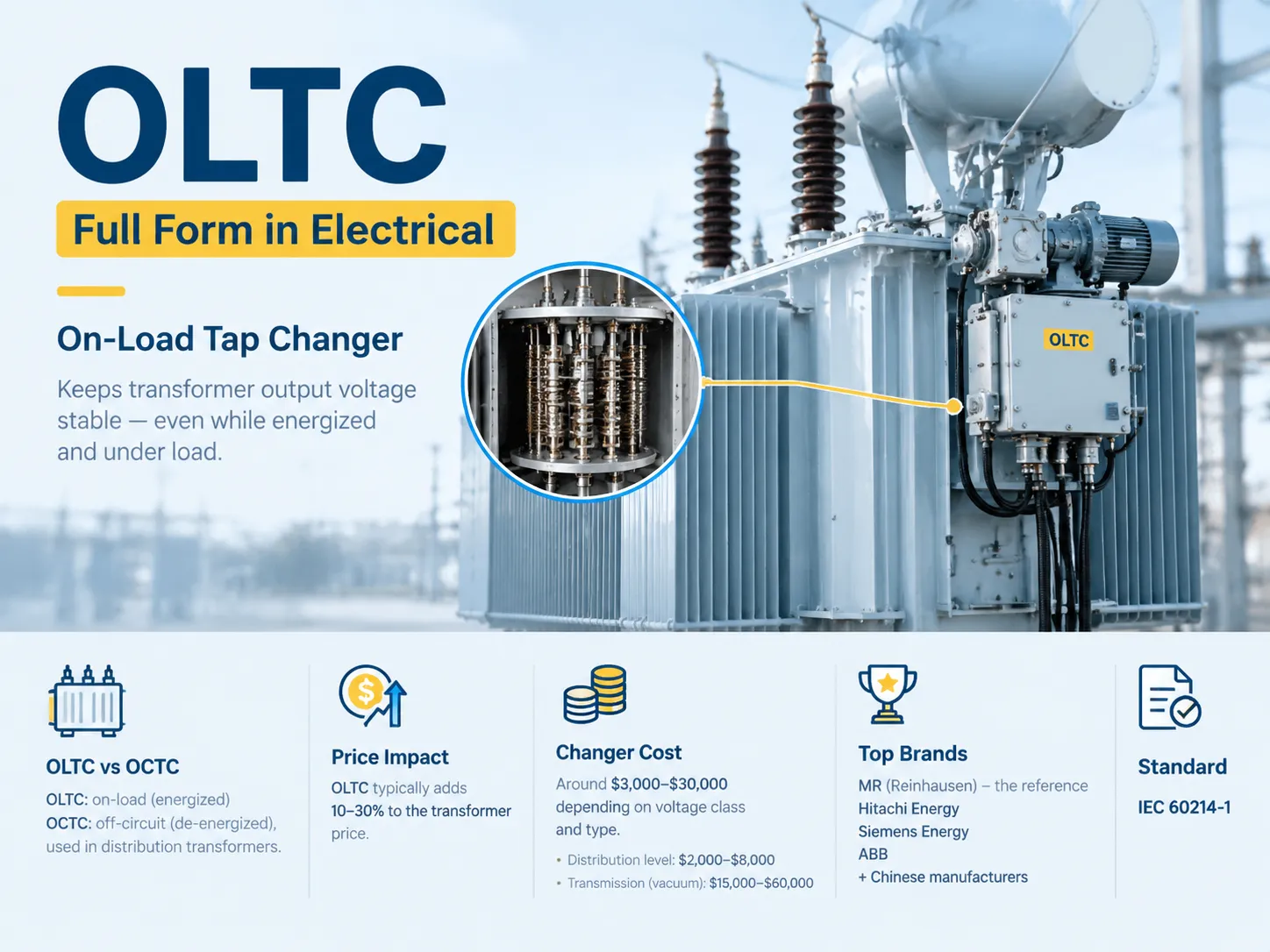
OLTCの意味、単語ごとに
説明の3つの単語は文字通り理解する必要があり、完全な名前は単なるトリビアの質問以上のものであることを示しています。.
- 負荷時 とは、変圧器がオフにならず、タップ変更が行われている間も負荷に電力を供給し続けることを意味します。停電なし、切り替えなし、現場にチームを送る必要もありません。これがデバイスの主な目的であり、価格がその価格である理由です。.
- タップ とは、高電圧巻線に作られた接続を指します。タップ変更は回路内の巻数を変更することを可能にし、これが巻比に影響を与え、結果として出力電圧に影響を与えます。このアイデアは、通常の配電変圧器の固定タップリンクのアイデアに似ており、唯一の違いは、OLTCが電流の流れの中でタップ変更を可能にするように設計されていることです。.
- チェンジャー とは、すべてのメカニズム部品が配置されているユニットであり、モーター駆動ユニット、垂直シャフト、セレクタースイッチ、ダイバータ、タップ変更プロセスを設定するための制御キュービクルが含まれています。現代の設計では、最近の価格とメンテナンスの改善に責任を持つ油浸接点の代わりに真空遮断器を使用したダイバータを使用することが一般的です。.
「オンロードタップチェンジデバイス」または「オンロードタップチェンジギア」、「OLTCトランスフォーマー」という用語は、これを装備したトランスフォーマーの同義語としてよく見かけます。意味は同じです。古い英国およびコモンウェルスの文書では、「オンロードタップチェンジャー」と書かれることが多く、北米では時々LTC(ロードタップチェンジャー)と呼ばれます。.
トランスフォーマー内部でOLTCが物理的に行うこと
コントローラーは二次電圧を監視し、デッドバンドから外れると—例えば、必要な電圧から1.25%以上ずれると—モータードライブを起動します。ダイバータースイッチが作動し、一時的に抵抗器またはリアクタを通る電流の流れが発生し、タップセレクターが別のタップに移動します。ダイバーターは新しい位置に留まります。.
遷移インピーダンスの理由は、全体のエンジニアリング問題です。負荷の下でタップを単に開くことはできないため、ダイバーターは抵抗器またはリアクタの助けを借りて、一時的に制御されたブリッジを作成し、電流が通過できるようにします。.
残りのセットアップは、電流を運ばないメイクビフォーブレイクデバイスであるタップセレクター、モータードライブ、ギア、位置指示器およびリミットスイッチ、さらに電圧リレー、SCADAおよびリモートコマンドに接続する自動制御システムで構成されています。.
通常のOLTCは、パワートランスフォーマーで約8または±1.25 %で動作し、したがって17の位置番号と約±10 %の電圧調整の度合いを持っています。ただし、±1.67 %の9や±0.625 %の16など、他の構成も作成できます。価格は、使用されるリードに影響を与えるステップ手順のサイズと、スイッチング要素に接続する必要があるタップトランスフォーマーのビューの両方に依存します。.
トランスフォーマーのファミリーにおけるOLTCの位置
言及されたデバイスの位置を明確にする必要があります。「OLTCトランスフォーマー」という用語はあいまいなものです。.
OLTCという用語は、トランスフォーマーの一種を指すのではなく、トランスフォーマーに取り付けられ、パワートランスフォーマー、大型トランスフォーマー変電所トランスフォーマー、整流器トランスフォーマー、位相シフトトランスフォーマーに見られるデバイスを指します。小型ポールトランスフォーマーや乾式トランスフォーマーにOLTCを取り付けることは経済的に実行可能ではないため、組み込まれることはありません。.
一般的な原則は、トランスフォーマーが大きく、負荷の変動が大きいほど、OLTCの必要性が高まるということです。30%から100%まで負荷が変動する変電所に接続された40 MVAトランスフォーマーはOLTCの適切な使用例ですが、エネルギー消費が一定の施設に電力を供給する1,000 kVAトランスフォーマーにはOLTCは必要ありません。.
これらのユニットが機能、冷却、用途によってどのように分類されるかの全体像を知りたい場合、その分類はこの概要に示されています。 パワートランスフォーマーがどのように分類され、各タイプがグリッドで何をするか。, そして、特定のものを購入する前に役立つフレームです。.
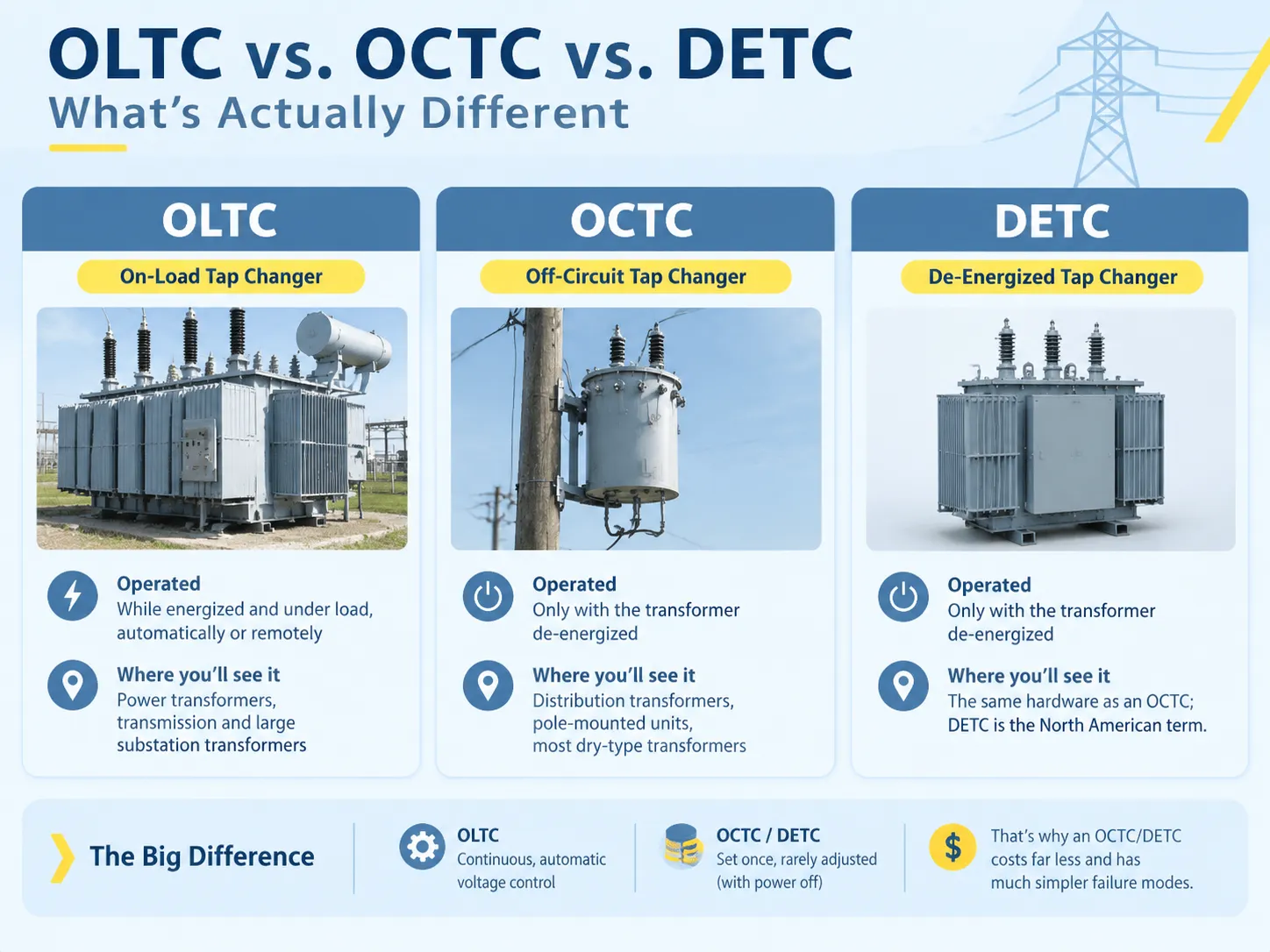
OLTC vs. OCTC vs. DETC: 実際に異なる点
ここが最も混乱が生じる場所であり、表にする価値があります。.
| デバイス | 完全な形式 | 操作された | どこで見ることができるか |
|---|---|---|---|
| OLTC | オンロードタップチェンジャー | エネルギー供給中かつ負荷がかかっている状態で、自動またはリモートで | パワートランス、送電および大型変電所用トランス |
| OCTC | オフサーキットタップチェンジャー | トランスが非エネルギー状態のときのみ | 配電トランス、ポールマウントユニット、ほとんどの乾式トランス |
| DETC | 非エネルギー状態タップチェンジャー | トランスが非エネルギー状態のときのみ | OCTCと同じハードウェア; DETCは北米の用語です |
OCTCとDETCは似ていますが、これらとOLTCの違いは単純ではありません。OCTCの直感は、システムが最初にオンにされたときや電圧プロファイルの季節変化があるときにのみ位置を変更するスイッチで構成されているということです。したがって、デバイスは事前にオフにして安全にシャットダウンする必要があります。.
対照的に、OLTCはこの操作を継続的に行います。数秒で電圧の変化に反応します。制御システムは、時間遅延を伴う電圧レギュレーターだけで構成される比較的単純なものか、電力因子、並列接続されたトランスの循環電流、または制御システムからのSCADA信号を考慮に入れたより複雑で適応的なものです。.
この違いの実際的な側面は設計の側面です。OCTCはほとんど変更されず、運用負荷がかかることはないため、遷移インピーダンス、アーク制御、またはモータードライブなどの特性は必要ありません。.
OLTCの主なタイプ
すべてのオンロードタップチェンジャーが同じではないため、選択または交換する際の違いを認識することが重要です。.
- 抵抗器タイプ。. ダイバータースイッチは、切り替えプロセスのために遷移抵抗器に接続されます。迅速でコンパクトで、配電および送電の両方においてヨーロッパとアジアで最も人気のある設計です。.
- リアクタンスタイプ。. 予防措置として自動変圧器を使用します。過去には米国市場で優勢でしたが、遅く、切り替えによる損失なしで高電流を処理できます。依然として古い大規模なアプリケーションで頻繁に使用されています。.
- 油絶縁ダイバーター。. ダイバータースイッチは独自の油コンパートメントで動作します。これは古い技術で信頼性がありますが、劣化のために操作ごとに油を定期的に交換する必要があります。.
- Vacuum diverter. The sealed vacuum interrupters perform the current transfer process. It provides protection from current breaks because it is performed in no oil, thus providing longer operational periods but at a little higher price. It is widely used nowadays in the bulk prices.
- In-tank vs. separate compartment. In-tank technology shares the oil with the transformer, while separate compartment keeps diverter oil in isolation to prevent contamination. For heavily loaded transformers separate implementation should be chosen despite higher costs.
- Reversing vs. coarse/fine. The reversing mechanism has a smaller design and can provide a wide range of tap changing in one section; whereas coarse/fine implementation gives a wider range but requires more winding.
The choice of the right model should depend on its working frequency, required breaking current, and availability of maintenance access.There’s a longer treatment of the trade-offs in this transformer tap changer selection guide if you’re at the point of comparing specific configurations rather than just understanding the categories.
Where OLTC Transformers Are Used
Voltage control is required constantly.
- Transmission substations where high voltage (220 or 110 kV) is changed to low voltage in order to deliver electricity to an everchanging load.
- Long rural feeders where voltage drop is big and demand varies according to the season or irrigation regime.
- Transformation stations for renewable generation since output of solar and wind plants fluctuates much quicker than that of traditional load, so the voltage needs to be kept within narrow limits.
- Traction and railway transformers due to constant variation of the load during train movement.
- Electric arc and rectifier transformers since big current load fluctuations happen all the time and result in continuous need for adjustment of voltage.
- Phase shifting transformers where electric parameters are managed using transformers with changing tappings.
An example from manufacturing will clarify this issue much better. A unit like this SZ11 31,500 kVA 35/10.5 kV oil-immersed on-load voltage regulating transformer is built specifically for the case where a 35 kV incoming supply has to deliver a stable 10.5 kV to a distribution network whose load varies throughout the day. That’s an OLTC application in one component and one sentence.
What an OLTC Costs
The price varies widely among various manufacturers in terms of rating, voltage class, and current, but the general frame of costs remains stable enough to perform assessments.
| アイテム | Typical range (USD) | 注記 |
|---|---|---|
| OCTC / DETC (off-circuit) | $500–$3,000 | The baseline. No motor drive, no transition impedance |
| Distribution-level OLTC (≤33 kV) | $2,000–$8,000 | Oil-insulated diverter, typically 9 to 17 positions |
| Transmission-level OLTC (≥110 kV) | $15,000–$60,000 | Vacuum types sit at the upper end |
| Resistor or vacuum type, mid-range | $6,000–$35,000 | Driven mainly by current rating and step count |
| OLTC as a share of transformer price | +10–30% | Compared with +2–5% for an OCTC |
| OLTC increment on a 10 MVA transformer | $10,000–$25,000 | Depends heavily on whether vacuum or oil diverter |
The first point to discuss concerning the table is that the cost of the changer is not all included in the price of an OLTC transformer. Apart from the changer, an OLTC transformer has to be equipped with a tap winding, its leads, a motor with a control unit, and so on, so if we evaluate the gap in terms of price per kVA, then it is observed that the OLTC as compared to the OCTC transformer costs much more.
The lubricant or oil for the oil lantern should not be considered as an irrelevant item as it requires frequent checks of the oil and sometimes its replacement. Thus, with every 50,000 to 100,000 operations, it has to be replaced every three or five years (depending on the load). The vacuum type of transformers extends this interval, which is why they allow to achieve savings in the cost over its lifespan.
To give an example of the costs, OLTC transformers of capacity 20 MVA and voltage of 110 kV typically cost 430,000-700,000 EUR from major European manufacturers, below 450, 000 EUR from Schneider, and below 320,000 EUR from Chinese manufacturers.
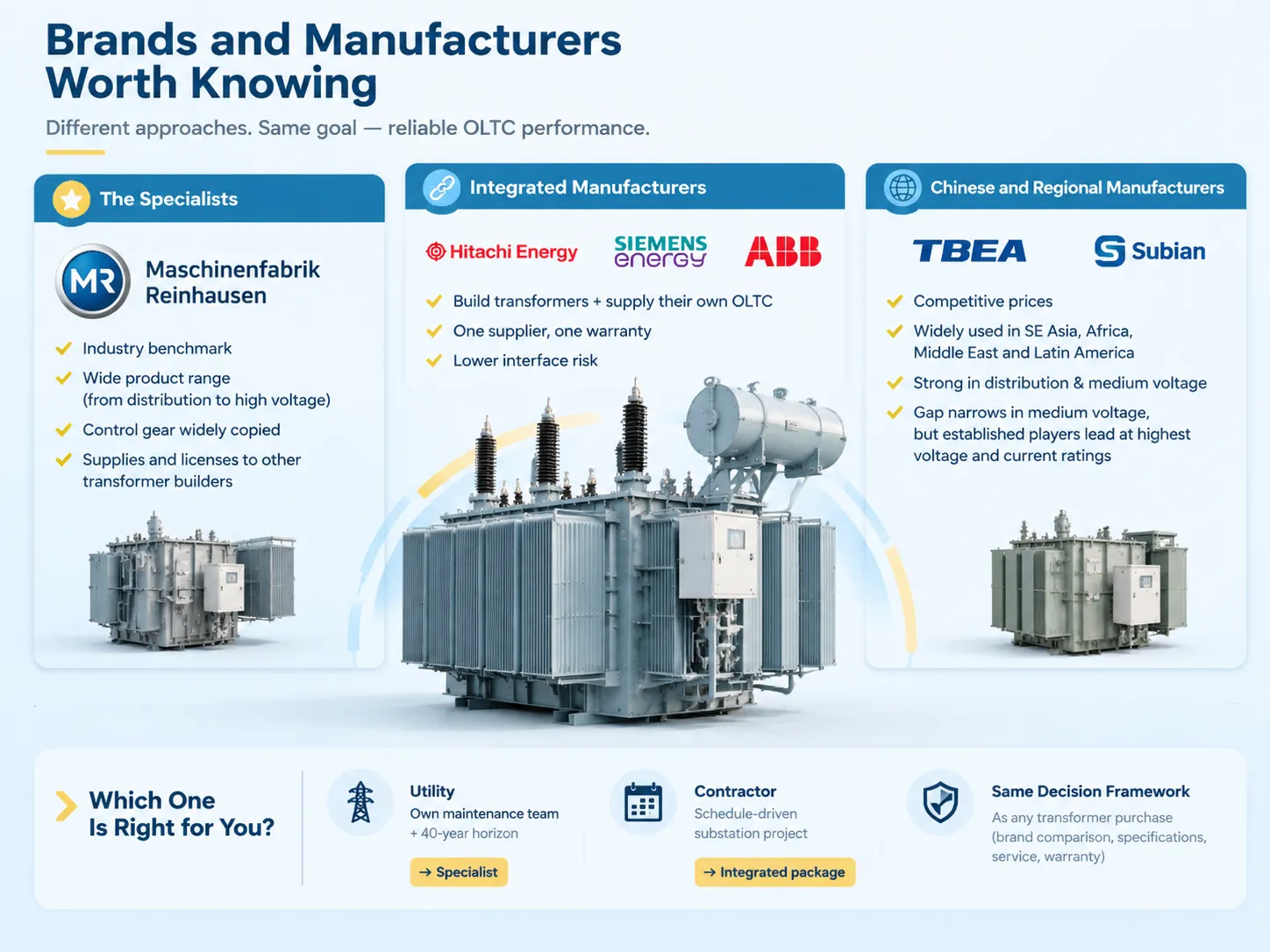
Brands and Manufacturers Worth Knowing
There are two very distinct categories of producers, and their customers generally must decide which one to go for.
Specialists. The Maschinenfabrik Reinhausen company is regarded as the market leader of the entire industry. If, in the call for tender, the specification reads “OLTC by MR or equal”, it signifies what exact product is intended. This manufacturer’s product portfolio includes everything from oil diverter products designed for the distribution voltag to vacuum devices suitable for the highest voltage classes, and their devices are widely imitated. Moreover, Reinhausen is engaged in licensing and supplying transformers to other manufacturers, which is why you can find tax changers of this manufacturer among transformers offered under various labels.
Integrated producers. Companies like Hitachi Energy, Siemens Energy and Alstom manufacture transformers and supply tap changing devices as one package. Hitachi Energy is particularly well known for this. This experience allows it to produce transformers along with tap-changing devices that comprise the product list offered. What is the key advantage of this approach? It is the single supplier who is responsible for the single warranty — a crucial benefit for the project with high uncertainty related to the interfaces.
Chinese and regional manufacturers. Due to their attractive price, TBEA, Subin and some other companies became successful in producing OLTC transformers. Due to their affordability these transformers can be applied in various projects implemented throughout Southeast Asia, Africa, Middle East and Latin America. The competition became fiercer with respect to medium voltage transformers, while the long-established specialists still retain the competitive edge in high voltage products and service network.
The primary consideration when making your decision should be the place where transformers will be delivered to and serviced. Companies that have well-developed infrastructures and capable personnel for maintenance usually opt for products manufactured by specialists. General contractors working at time-constrained projects usually prefer to purchase integrated products. Either way, the brand comparison exercise is the same one you’d run for any transformer purchase, and the frameworks in this buying guide for oil-immersed transformers with brand recommendations apply directly to OLTC-fitted units.
How to Specify One Without Regrets
If you’re developing a specification, the following parameters will determine whether you’ll get a practical device or merely an expensive ornament:
- Voltage regulation range and step size. Start with considering how much the supply voltage will fluctuate. A variation with a 10% accuracy range and a fluctuation of about 1.25% is what is needed in the majority of cases. Transmission and renewable connections may require higher accuracy or wider range.
- Number of operations per year. This number will determine whether to choose oil or vacuum, and whether to use tank installation or separate compartment. If a transformer is rated for 300,000 operations but is expected to run 20 cycles a day, it’ll mean regular servicing.
- Through-current through diverter. Voltage regulation is about breaking current load not only voltage. When it comes to this matter, oversizing is inexpensive compared to replacing contacts since it costs much less.
- Control philosophy. Will you have a stand-alone voltage regulation with a dead zone and time delay or coordinated control with parallel transformers and SCADA? The latter requires ensuring that control cubicles in both variants function properly and switching gears regulates current effectively.
- Parallel operation. In order to run two transformers in parallel, running both at the same tap position is necessary, and hence the need for either master-slave control or controlling circulating current in advance.
- Maintenance access. Having a separate tank might be costlier but make diverter service possible without draining the main tank. On a remote site, this might be the only deciding factor.
- Proof of compliance with the standards. You need to check documents in compliance with IEC 60214-1. Be not satisfied with copies of certificates and ask data on type test.
There is a longer walkthrough of these choices in this guide on how to select the on-load tap changer for a main power transformer, including how step size interacts with the tap winding and how the operating duty class should be matched to the project. If you’re specifying for the first time, start there rather than with the price list.
よくある質問
What is OLTC and OCTC?
OLTC stands for On-Load Tap Changer, while OCTC stands for Off-Circuit Tap Changer. The difference between the two is that OLTC operates while the transformer is energized and in operation; it will use motorized drive, a selector switch, and a diverter switch that works under transition resistance, which ensures that the current is not broken. An OCTC can operate only when the transformer is turned off and safe; thus, it will work using the link that is made at commissioning. OLTC is installed in transformers that ensure the continuous control of voltage in the system; whereas OCTC is installed in distribution transformers since it is more cost-efficient.
What are the types of OLTC?
The first distinction is in terms of the method of switching from one state to another with use of transition resistors in the case of the resistor type, which is commonly used in Europe, Asia, and the hybrid type using an autotransformer. Furthermore, the division is based on the switching medium and thus to oil insulated switching systems with the switching contacts located in the oil and taking special care of it, while there is the vacuum type of systems in case of which the switching is made by using enclosed vacuum interruptions and no routine maintenance is necessary. Construction-wise, the systems are divided into either in-tank or separate-compartment units, and depending on the design there might be linear, reversing and coarse/fine taps.
What is the difference between RTCC and OLTC?
The OLTC is the actual switching apparatus and the RTCC represents the layer of controls that tells it what to do. The RTCC or Remote Tap Changer Control (also known as Remote Tap Changer Controller) is an electronic relay or controller that receives the secondary voltage, compares it with the desired value and dead-band, implements a time delay on the operation in order to ignore temporary voltage drops, and produces “raise” or “lower” commands for the motor assembly. Some RTCCs carry out the operation of coordination of transformers in parallel, line-drop compensation as well as SCADA communication. So RTCC is not an alternative to OLTC — it is the unit that provides automatic function of the OLTC. You can use OLTC without a sophisticated RTCC — a simple voltage relay will suffice, but it is impossible to have automatic operation without both devices.
What does OLTC mean?
On-Load Tap Changer is referred to as OLTC. In electrical engineering, the term “on-load” emphasizes that the equipment is functioning while the transformer is energizing and transmitting current. This deviates from the term “off-circuit” or “de-energized” since those terms indicate that the transformer has to be turned off first and be isolated from other components. The tap changer is the equipment used for selecting the point of connection of the winding. It changes the connection point in order to modify the number of turns, which also in turn enables voltage modification. Consequently, OLTC is translated into “a device that makes taps changes while the transformer is under load.” The equivalent acronym used in North America is LTC (load tap changer).
Can an OLTC be retrofitted to an existing transformer?
In a technical sense retrofitting is possible, but for a practical application it does not really make sense. Retrofitting can be described as an operation involving opening up the tank to replace the wire and insulate the leads, installing a driving motor and a separate compartment to actually rerun the control circuit. What is more, the costs involved in retrofitting may exceed a big part of the price of a transformer of the same rating and it also means giving up all the state of affairs concerning factory type tests. In situations when voltage control during operation is really needed but the transformer can only provide OCTC, some of the options include installing a separate regulator, using the booster transformer or changing the transformer with a new one at the end of its technical lifespan.
参考文献
- IEC 60214-1 — Tap-changers, Part 1: Performance requirements and test methods — the governing standard for on-load and off-circuit tap changers
- マシーネンファブリック・ラインハウゼン (MR) — manufacturer information and technical literature on on-load tap changers
- Hitachi Energy — Transformers — integrated transformer and tap changer solutions
- シーメンスエナジー — industry context on equipment design and environmental regulation
- 米国エネルギー省 — grid equipment, transformer supply and reliability reporting
- National Electrical Manufacturers Association (NEMA) — electrical equipment standards and industry data
結論
OLTC denotes the On-Load Tap Changer. If the reader only recalls one sentence from this text, then that should be this one: it is the device that allows a transformer to self-correct its output voltage while current is still flowing; this is an outstanding feature compared to simple tap links of a standard distribution transformer.
The practical facts one needs to keep in mind while having a specification dialogue are as follows: expect to have ±8 up to ±16 steps with the step being between 0.625% and 1.67%; the price of the changer would range between $3,000 and $30,000 and would make the transformer cost by about 10%-30% more expensive; expect to see that while oil-insulated diverters would require servicing every few years, vacuum ones would serve for much longer; the standard you should be held to should be IEC 60214-1; and the name of MR Reinhausen will always be used as a benchmark.
The question of whether or not you need an OLTC boils down to one question. Is the voltage at the supply point fluctuating enough and often enough that you cannot regulate it by other means? In case the load profile is steady and the supply is stable, it is better to use an OCTC and spend money elsewhere.