


OLTC يمثل محول التحويل تحت الحمل. بينما قد تكون هذه معلومات كافية لسؤال واحد، فإن الاختصار لن يظهر عادة بمفرده. بدلاً من ذلك، ستجده في ورقة بيانات المحول، أو مواصفات العطاء، أو عرض الأسعار من المورد. لذلك، بدلاً من السؤال عما يعنيه، من الأفضل أن تسأل عن تشغيل هذا الجهاز، عن ضرورته وسعره المحتمل.
لذلك، دعنا نرى القضية كاملة بالتفصيل: تفسير المصطلح، ما يحدث داخل الخزان، حالات تطبيق OLTC، كيف يختلف OLTC عن محولات التحويل المستخدمة في الغالب في المحولات القياسية، ما الأرقام التي تمثلها، وأهم منتجي الأجهزة كذلك.
OLTC هو محول التحويل تحت الحمل، وهو آلية تعمل عن طريق تغيير موضع محول أثناء عمله. OLTC هو جانب مهم من المحول لأنه يساعده في الحفاظ على جهده أثناء تشغيل المحول. من ناحية أخرى، يستخدم المحول الشائع OCTC، وهو نوع من محولات التحويل حيث لا يمكن إجراء التعديلات إلا عندما يكون المحول متوقفًا. يمكن أن يزيد OLTC من سعر المحول بحوالي 10-30%. تتراوح تكلفة OLTC من $3,000-$30,000، اعتمادًا على فئة الجهد والنوع، بما في ذلك المحولات التوزيعية التي تكلف حوالي $2,000-$8,000 والمحولات النقل التي تكلف حوالي $15,000-$60,000. الشركة الأوروبية Maschinenfabrik Reinhausen (MR) هي الشركة الرائدة في هذا المجال، إلى جانب شركات مثل Hitachi Energy وSiemens Energy وABB، إلخ.
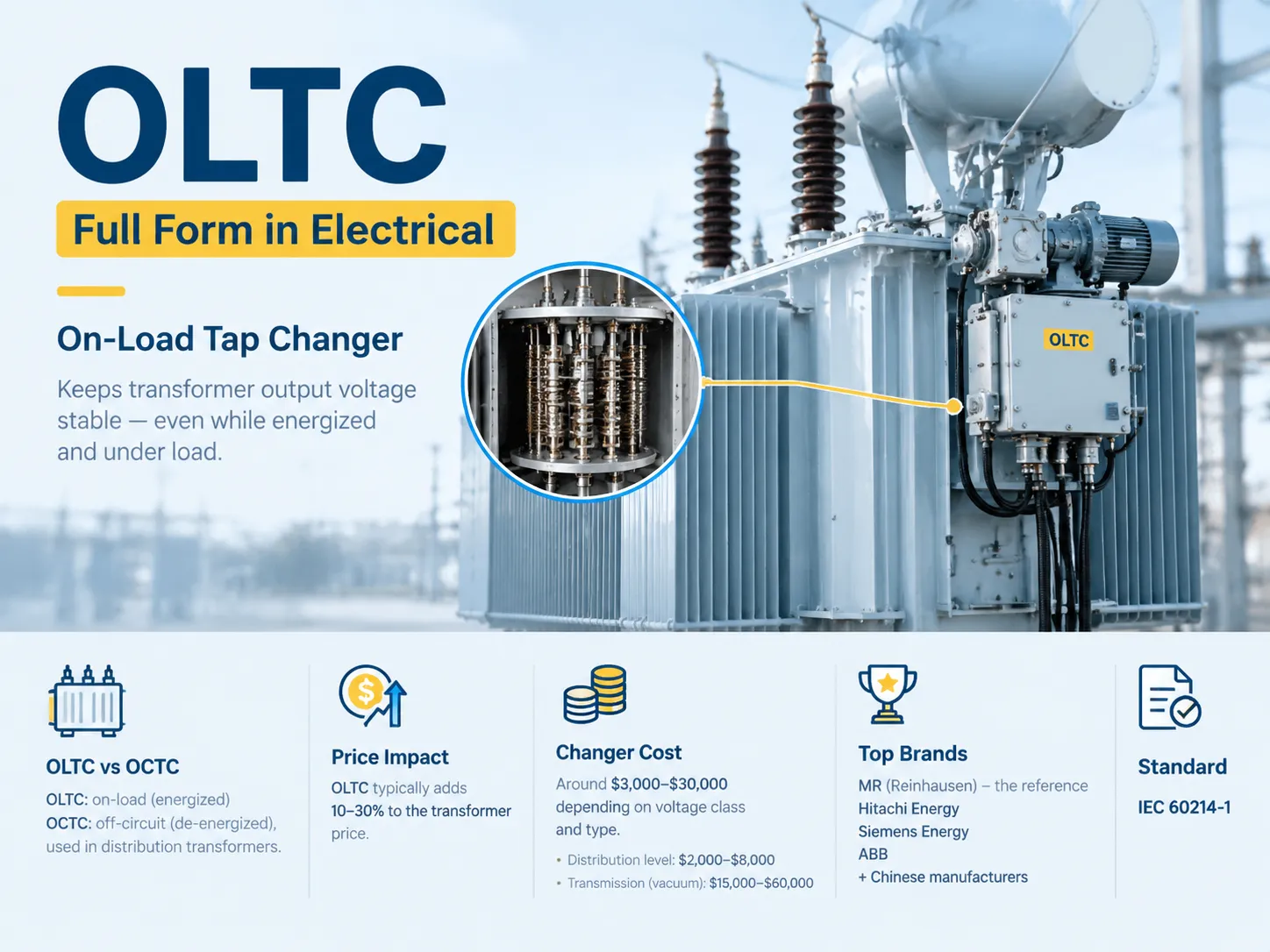
ما يعنيه OLTC، كلمة بكلمة
يجب فهم الكلمات الثلاث في الوصف حرفيًا، مما يعني أن الاسم الكامل هو أكثر من مجرد سؤال تافه.
- تحت الحمل يعني أن المحول لا يتوقف ويستمر في تزويد الأحمال أثناء حدوث تغيير في الموصل. لا انقطاع، لا تبديل، لا حاجة لإرسال فريق إلى الموقع. هذه هي الغرض الرئيسي من الجهاز والسبب في تكلفته.
- الموصل يشير إلى الاتصال الذي يتم على لف المحول عالي الجهد. يسمح تغيير الموصل بتغيير عدد اللفات في الدائرة، مما سيؤثر على نسبة اللفات، وبالتالي، الجهد الناتج. الفكرة مشابهة لفكرة الروابط الثابتة على محول توزيع عادي، مع الاختلاف الوحيد أن OLTC مصمم للسماح بتغيير الموصل أثناء تدفق التيار.
- المحول هو الوحدة التي تقع فيها جميع أجزاء الآلية: وحدة القيادة بالمحرك، العمود الرأسي، مفتاح الاختيار والمبدلات، إلى جانب كابينة التحكم لضبط عملية تغيير الموصل. غالبًا ما تعتمد التصاميم الحديثة على استخدام المبدل مع قواطع فراغ بدلاً من الموصلات المغمورة في الزيت، مما يساهم في تحسينات الأسعار والصيانة الأخيرة.
ستصادف غالبًا مصطلح “جهاز تغيير التوصيل تحت الحمل” أو “معدات تغيير التوصيل تحت الحمل”، و“محول OLTC” يُستخدم كمرادف للمحول المزود به. يعني نفس الشيء. في الوثائق البريطانية القديمة وبلدان الكومنولث، غالبًا ما يُكتب على أنه “مغير التوصيل تحت الحمل”، وفي أمريكا الشمالية حيث يُشار إليه أحيانًا باسم LTC (مغير التوصيل تحت الحمل).
ماذا يفعل OLTC فعليًا داخل المحول
يراقب المتحكم الجهد الثانوي وعندما يخرج من نطاق ميت — على سبيل المثال، إذا انحرف بأكثر من 1.25% عن الجهد المطلوب — يقوم بتشغيل محرك القيادة. يعمل مفتاح التحويل، ويحدث تدفق قصير من التيار عبر بعض المقاومات الانتقالية أو المفاعلات، وينتقل محدد التوصيل إلى توصيلة أخرى. يتمسك المحول بموقعه الجديد.
سبب مقاومة الانتقال هو المشكلة الهندسية الكاملة. لا يمكن فتح التوصيلة تحت الحمل، لذا يقوم المحول بإنشاء جسر مسيطر عليه لحظة بمساعدة المقاومة أو المفاعل الذي يسمح بمرور التيار.
يتكون باقي الإعداد من محدد التوصيل الذي هو جهاز يجعل قبل كسر لا يحمل التيار بنفسه؛ محرك القيادة، التروس؛ مؤشر الموقع ومفاتيح الحد، بالإضافة إلى نظام التحكم التلقائي، الذي يربط جميع الأجهزة الأخرى بمرحلة الجهد، SCADA والأوامر عن بُعد.
يعمل OLTC العادي على المحول الكهربائي مع 8 أو نحو ذلك +/– 1.25 %، وبالتالي لديه 17 رقمًا موضعيًا ودرجة من تعديل الجهد تبلغ حوالي +/- 10 %. ومع ذلك، يمكن أيضًا صنع بعض التكوينات الأخرى مثل 9 مع +/- 1.67 % أو 16 مع +/- 0.625 %. يعتمد السعر على كل من حجم إجراء الخطوة حيث يؤثر على الأسلاك المستخدمة وكذلك عرض المحول الذي يجب أن يتصل بعنصر التبديل.
أين يقع OLTC في عائلة المحولات
نحتاج إلى توضيح موضع الجهاز المذكور، حيث أن مصطلح “محول OLTC” هو مصطلح غامض.
لا يشير مصطلح OLTC إلى نوع من المحولات بل إلى جهاز متصل بالمحولات ويمكن العثور عليه في المحولات الكهربائية، ومحولات محطات التحويل الكبيرة، ومحولات التقويم، ومحولات تغيير الطور. لن يتم بناؤه في محول عمود صغير أو محول نوع جاف ببساطة لأنه لن يكون اقتصاديًا تركيب OLTC على مثل هذه المحولات.
المبدأ العام هو أنه كلما كان المحول أكبر وتغير الحمل أكثر، كان OLTC مبررًا أكثر. سيكون استخدام OLTC مناسبًا لمحول بقدرة 40 MVA متصل بمحطة تحويل حيث يتغير الحمل من 30% إلى 100%، لكن محول بقدرة 1,000 kVA يمد الطاقة لمنشأة حيث يكون استهلاك الطاقة ثابتًا لن يحتاج إلى OLTC.
إذا كنت تريد الصورة الأوسع حول كيفية تصنيف هذه الوحدات — حسب الوظيفة، حسب التبريد، حسب التطبيق — فإن هذه التصنيف موضح في هذا العرض العام عن كيفية تصنيف المحولات الكهربائية وما يفعله كل نوع في الشبكة, ، وهي إطار مفيد قبل أن تذهب للتسوق من أجل واحدة محددة.
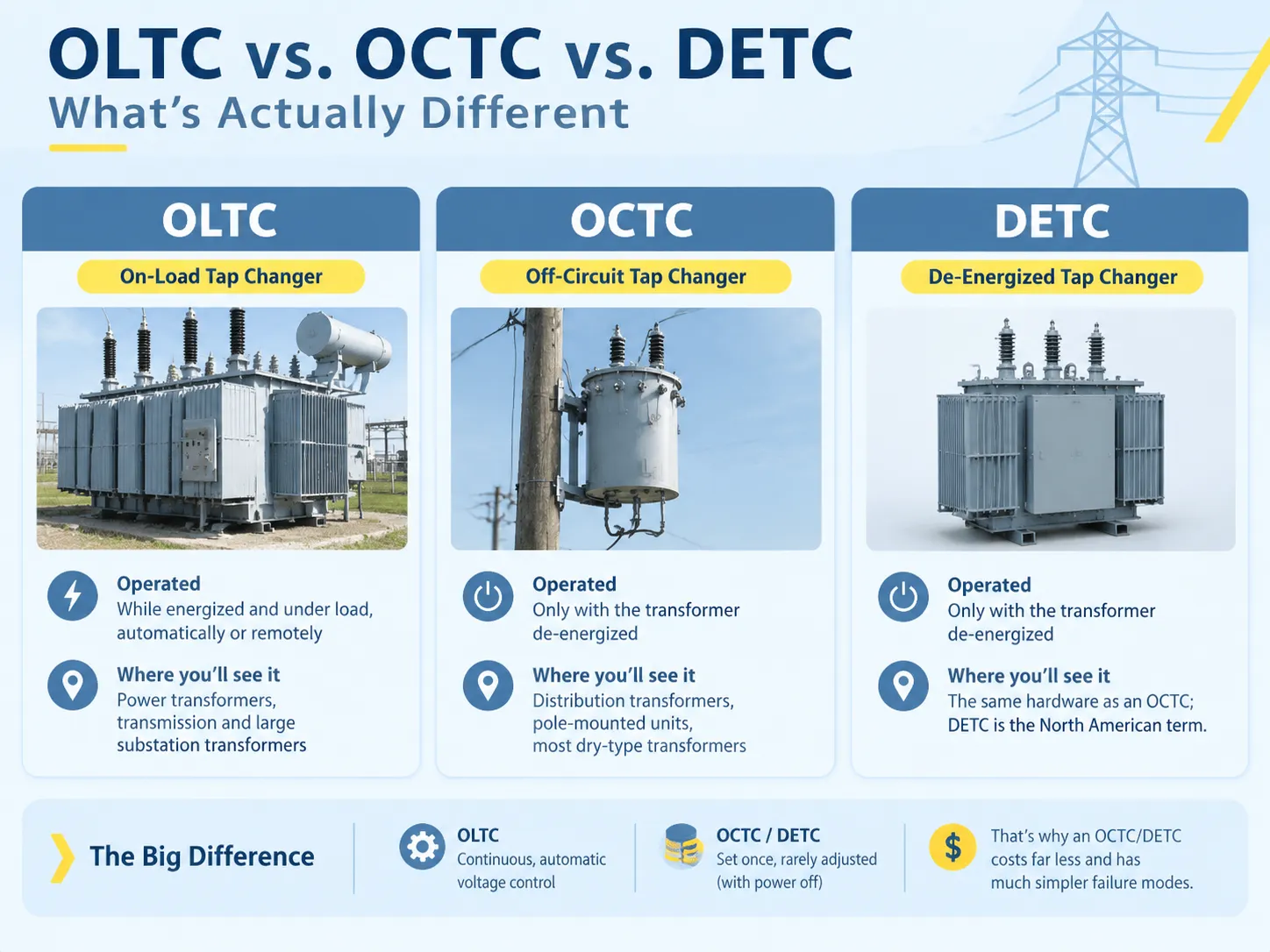
OLTC مقابل OCTC مقابل DETC: ما هو الاختلاف الفعلي
هنا حيث تعيش معظم الارتباكات، ومن الجدير وجود جدول.
| جهاز | الشكل الكامل | تم تشغيله | حيث سترى ذلك |
|---|---|---|---|
| OLTC | محول التحويل تحت الحمل | أثناء التشغيل وتحت الحمل، تلقائيًا أو عن بُعد | محولات الطاقة، ومحولات النقل ومحولات المحطات الكبيرة |
| أوكتك | محول التحويل خارج الدائرة | فقط مع فصل المحول عن الطاقة | محولات التوزيع، الوحدات المثبتة على الأعمدة، معظم المحولات من النوع الجاف |
| ديتك | محول التحويل غير النشط | فقط مع فصل المحول عن الطاقة | نفس الأجهزة مثل OCTC؛ DETC هو المصطلح المستخدم في أمريكا الشمالية |
OCTC و DETC متشابهتان على الرغم من أن الفرق بينهما و OLTC بعيد عن البساطة. الفكرة وراء OCTC هي أنها تتكون فقط من مفاتيح تغير موضعها فقط عندما يتم تشغيل النظام لأول مرة أو عندما يحدث تغيير موسمي في ملف الجهد. وبالتالي، يجب إيقاف تشغيل الجهاز وإيقافه بأمان مسبقًا.
بالمقابل، يقوم OLTC بتنفيذ هذه العملية بشكل مستمر. إنه يتفاعل مع التغيرات في الجهد في غضون ثوانٍ. يمكن أن يكون نظام التحكم بسيطًا نسبيًا يتكون فقط من منظم جهد مع تأخير زمني أو يمكن أن يكون أكثر تعقيدًا، متكيفًا، يأخذ في الاعتبار عامل القدرة، والتيار الدائر للمحولات المتصلة بالتوازي أو إشارات SCADA من نظام التحكم.
الجانب العملي من هذا الاختلاف هو الجانب التصميمي. نظرًا لأن OCTC نادرًا ما يتغير ولا يكون تحت تحميل تشغيلي، فلا حاجة في مثل هذه الخصائص مثل مقاومة الانتقال، التحكم في القوس أو محرك المحرك.
الأنواع الرئيسية من OLTC
ليست جميع محولات التحويل تحت الحمل متشابهة، لذا من المهم أن تكون على دراية بالاختلافات عند اختيارها أو استبدالها.
- نوع المقاومة. يتصل مفتاح التحويل عبر مقاومة انتقالية لعملية التبديل. سريع، مدمج، والأكثر شعبية في أوروبا وآسيا لكل من التوزيع والنقل.
- نوع المحاثة. يستخدم محولًا أوتوماتيكيًا كإجراء وقائي. كان سائدًا في السوق الأمريكية في الماضي ولكنه أبطأ ويمكنه التعامل مع تيارات عالية دون خسائر ناتجة عن التبديل. لا يزال يستخدم بشكل متكرر في التطبيقات القديمة والأكبر.
- محول التحويل المعزول بالزيت. يعمل مفتاح التحويل في حجرة زيت خاصة به. إنها تقنية قديمة، موثوقة، ولكن يجب استبدال الزيت دوريًا بعد كل عملية بسبب التدهور.
- Vacuum diverter. The sealed vacuum interrupters perform the current transfer process. It provides protection from current breaks because it is performed in no oil, thus providing longer operational periods but at a little higher price. It is widely used nowadays in the bulk prices.
- In-tank vs. separate compartment. In-tank technology shares the oil with the transformer, while separate compartment keeps diverter oil in isolation to prevent contamination. For heavily loaded transformers separate implementation should be chosen despite higher costs.
- Reversing vs. coarse/fine. The reversing mechanism has a smaller design and can provide a wide range of tap changing in one section; whereas coarse/fine implementation gives a wider range but requires more winding.
The choice of the right model should depend on its working frequency, required breaking current, and availability of maintenance access.There’s a longer treatment of the trade-offs in this transformer tap changer selection guide if you’re at the point of comparing specific configurations rather than just understanding the categories.
Where OLTC Transformers Are Used
Voltage control is required constantly.
- Transmission substations where high voltage (220 or 110 kV) is changed to low voltage in order to deliver electricity to an everchanging load.
- Long rural feeders where voltage drop is big and demand varies according to the season or irrigation regime.
- Transformation stations for renewable generation since output of solar and wind plants fluctuates much quicker than that of traditional load, so the voltage needs to be kept within narrow limits.
- Traction and railway transformers due to constant variation of the load during train movement.
- Electric arc and rectifier transformers since big current load fluctuations happen all the time and result in continuous need for adjustment of voltage.
- Phase shifting transformers where electric parameters are managed using transformers with changing tappings.
An example from manufacturing will clarify this issue much better. A unit like this SZ11 31,500 kVA 35/10.5 kV oil-immersed on-load voltage regulating transformer is built specifically for the case where a 35 kV incoming supply has to deliver a stable 10.5 kV to a distribution network whose load varies throughout the day. That’s an OLTC application in one component and one sentence.
What an OLTC Costs
The price varies widely among various manufacturers in terms of rating, voltage class, and current, but the general frame of costs remains stable enough to perform assessments.
| العنصر | Typical range (USD) | ملاحظات |
|---|---|---|
| OCTC / DETC (off-circuit) | $500–$3,000 | The baseline. No motor drive, no transition impedance |
| Distribution-level OLTC (≤33 kV) | $2,000–$8,000 | Oil-insulated diverter, typically 9 to 17 positions |
| Transmission-level OLTC (≥110 kV) | $15,000–$60,000 | Vacuum types sit at the upper end |
| Resistor or vacuum type, mid-range | $6,000–$35,000 | Driven mainly by current rating and step count |
| OLTC as a share of transformer price | +10–30% | Compared with +2–5% for an OCTC |
| OLTC increment on a 10 MVA transformer | $10,000–$25,000 | Depends heavily on whether vacuum or oil diverter |
The first point to discuss concerning the table is that the cost of the changer is not all included in the price of an OLTC transformer. Apart from the changer, an OLTC transformer has to be equipped with a tap winding, its leads, a motor with a control unit, and so on, so if we evaluate the gap in terms of price per kVA, then it is observed that the OLTC as compared to the OCTC transformer costs much more.
The lubricant or oil for the oil lantern should not be considered as an irrelevant item as it requires frequent checks of the oil and sometimes its replacement. Thus, with every 50,000 to 100,000 operations, it has to be replaced every three or five years (depending on the load). The vacuum type of transformers extends this interval, which is why they allow to achieve savings in the cost over its lifespan.
To give an example of the costs, OLTC transformers of capacity 20 MVA and voltage of 110 kV typically cost 430,000-700,000 EUR from major European manufacturers, below 450, 000 EUR from Schneider, and below 320,000 EUR from Chinese manufacturers.
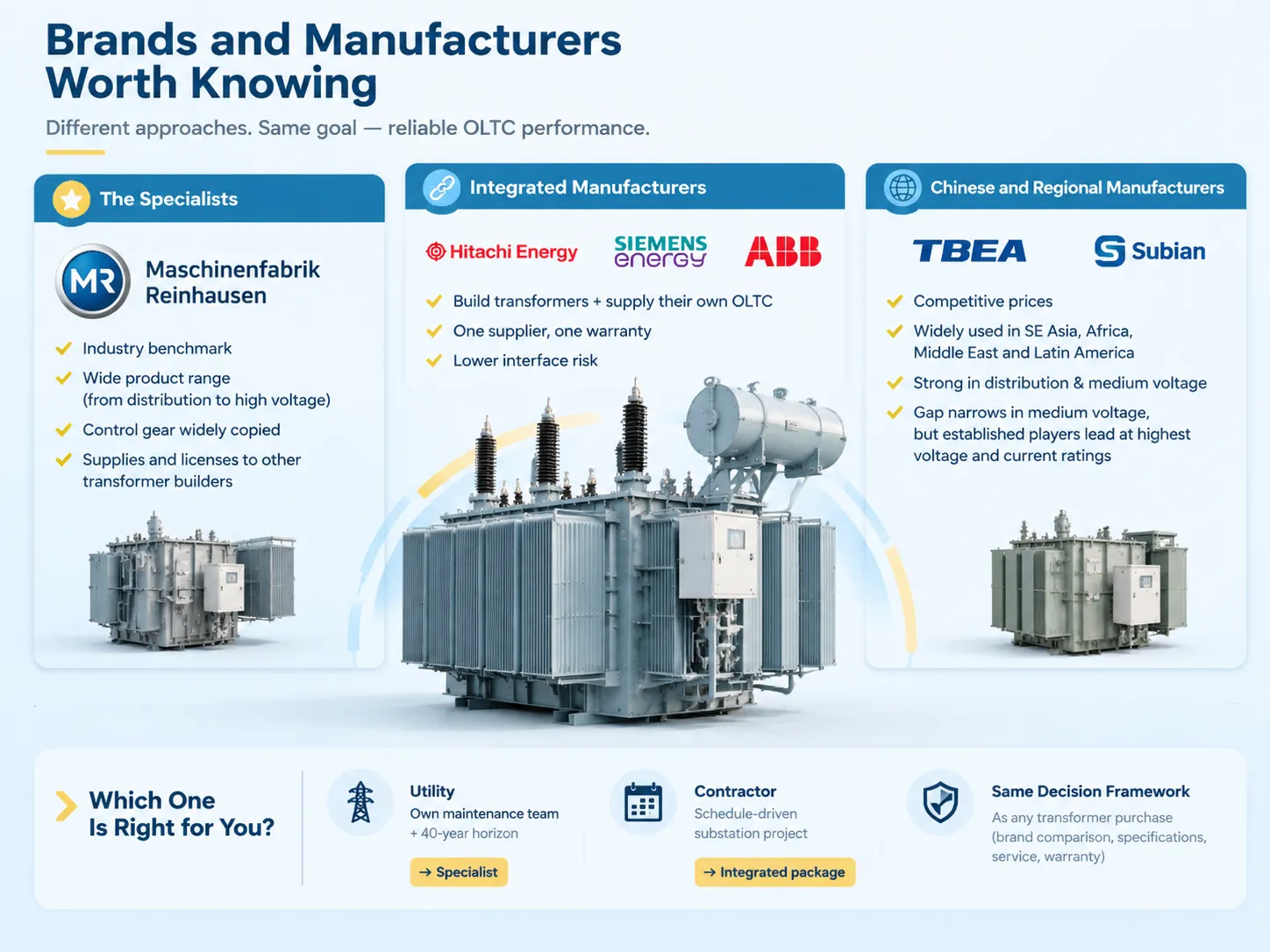
Brands and Manufacturers Worth Knowing
There are two very distinct categories of producers, and their customers generally must decide which one to go for.
Specialists. The Maschinenfabrik Reinhausen company is regarded as the market leader of the entire industry. If, in the call for tender, the specification reads “OLTC by MR or equal”, it signifies what exact product is intended. This manufacturer’s product portfolio includes everything from oil diverter products designed for the distribution voltag to vacuum devices suitable for the highest voltage classes, and their devices are widely imitated. Moreover, Reinhausen is engaged in licensing and supplying transformers to other manufacturers, which is why you can find tax changers of this manufacturer among transformers offered under various labels.
Integrated producers. Companies like Hitachi Energy, Siemens Energy and Alstom manufacture transformers and supply tap changing devices as one package. Hitachi Energy is particularly well known for this. This experience allows it to produce transformers along with tap-changing devices that comprise the product list offered. What is the key advantage of this approach? It is the single supplier who is responsible for the single warranty — a crucial benefit for the project with high uncertainty related to the interfaces.
Chinese and regional manufacturers. Due to their attractive price, TBEA, Subin and some other companies became successful in producing OLTC transformers. Due to their affordability these transformers can be applied in various projects implemented throughout Southeast Asia, Africa, Middle East and Latin America. The competition became fiercer with respect to medium voltage transformers, while the long-established specialists still retain the competitive edge in high voltage products and service network.
The primary consideration when making your decision should be the place where transformers will be delivered to and serviced. Companies that have well-developed infrastructures and capable personnel for maintenance usually opt for products manufactured by specialists. General contractors working at time-constrained projects usually prefer to purchase integrated products. Either way, the brand comparison exercise is the same one you’d run for any transformer purchase, and the frameworks in this buying guide for oil-immersed transformers with brand recommendations apply directly to OLTC-fitted units.
How to Specify One Without Regrets
If you’re developing a specification, the following parameters will determine whether you’ll get a practical device or merely an expensive ornament:
- Voltage regulation range and step size. Start with considering how much the supply voltage will fluctuate. A variation with a 10% accuracy range and a fluctuation of about 1.25% is what is needed in the majority of cases. Transmission and renewable connections may require higher accuracy or wider range.
- Number of operations per year. This number will determine whether to choose oil or vacuum, and whether to use tank installation or separate compartment. If a transformer is rated for 300,000 operations but is expected to run 20 cycles a day, it’ll mean regular servicing.
- Through-current through diverter. Voltage regulation is about breaking current load not only voltage. When it comes to this matter, oversizing is inexpensive compared to replacing contacts since it costs much less.
- Control philosophy. Will you have a stand-alone voltage regulation with a dead zone and time delay or coordinated control with parallel transformers and SCADA? The latter requires ensuring that control cubicles in both variants function properly and switching gears regulates current effectively.
- Parallel operation. In order to run two transformers in parallel, running both at the same tap position is necessary, and hence the need for either master-slave control or controlling circulating current in advance.
- Maintenance access. Having a separate tank might be costlier but make diverter service possible without draining the main tank. On a remote site, this might be the only deciding factor.
- Proof of compliance with the standards. You need to check documents in compliance with IEC 60214-1. Be not satisfied with copies of certificates and ask data on type test.
There is a longer walkthrough of these choices in this guide on how to select the on-load tap changer for a main power transformer, including how step size interacts with the tap winding and how the operating duty class should be matched to the project. If you’re specifying for the first time, start there rather than with the price list.
الأسئلة الشائعة
What is OLTC and OCTC?
OLTC stands for On-Load Tap Changer, while OCTC stands for Off-Circuit Tap Changer. The difference between the two is that OLTC operates while the transformer is energized and in operation; it will use motorized drive, a selector switch, and a diverter switch that works under transition resistance, which ensures that the current is not broken. An OCTC can operate only when the transformer is turned off and safe; thus, it will work using the link that is made at commissioning. OLTC is installed in transformers that ensure the continuous control of voltage in the system; whereas OCTC is installed in distribution transformers since it is more cost-efficient.
What are the types of OLTC?
The first distinction is in terms of the method of switching from one state to another with use of transition resistors in the case of the resistor type, which is commonly used in Europe, Asia, and the hybrid type using an autotransformer. Furthermore, the division is based on the switching medium and thus to oil insulated switching systems with the switching contacts located in the oil and taking special care of it, while there is the vacuum type of systems in case of which the switching is made by using enclosed vacuum interruptions and no routine maintenance is necessary. Construction-wise, the systems are divided into either in-tank or separate-compartment units, and depending on the design there might be linear, reversing and coarse/fine taps.
What is the difference between RTCC and OLTC?
The OLTC is the actual switching apparatus and the RTCC represents the layer of controls that tells it what to do. The RTCC or Remote Tap Changer Control (also known as Remote Tap Changer Controller) is an electronic relay or controller that receives the secondary voltage, compares it with the desired value and dead-band, implements a time delay on the operation in order to ignore temporary voltage drops, and produces “raise” or “lower” commands for the motor assembly. Some RTCCs carry out the operation of coordination of transformers in parallel, line-drop compensation as well as SCADA communication. So RTCC is not an alternative to OLTC — it is the unit that provides automatic function of the OLTC. You can use OLTC without a sophisticated RTCC — a simple voltage relay will suffice, but it is impossible to have automatic operation without both devices.
What does OLTC mean?
On-Load Tap Changer is referred to as OLTC. In electrical engineering, the term “on-load” emphasizes that the equipment is functioning while the transformer is energizing and transmitting current. This deviates from the term “off-circuit” or “de-energized” since those terms indicate that the transformer has to be turned off first and be isolated from other components. The tap changer is the equipment used for selecting the point of connection of the winding. It changes the connection point in order to modify the number of turns, which also in turn enables voltage modification. Consequently, OLTC is translated into “a device that makes taps changes while the transformer is under load.” The equivalent acronym used in North America is LTC (load tap changer).
Can an OLTC be retrofitted to an existing transformer?
In a technical sense retrofitting is possible, but for a practical application it does not really make sense. Retrofitting can be described as an operation involving opening up the tank to replace the wire and insulate the leads, installing a driving motor and a separate compartment to actually rerun the control circuit. What is more, the costs involved in retrofitting may exceed a big part of the price of a transformer of the same rating and it also means giving up all the state of affairs concerning factory type tests. In situations when voltage control during operation is really needed but the transformer can only provide OCTC, some of the options include installing a separate regulator, using the booster transformer or changing the transformer with a new one at the end of its technical lifespan.
المراجع
- IEC 60214-1 — Tap-changers, Part 1: Performance requirements and test methods — the governing standard for on-load and off-circuit tap changers
- مصنع ماكينات راينهوسن (MR) — manufacturer information and technical literature on on-load tap changers
- Hitachi Energy — Transformers — integrated transformer and tap changer solutions
- سيمنز للطاقة — industry context on equipment design and environmental regulation
- وزارة الطاقة الأمريكية — grid equipment, transformer supply and reliability reporting
- National Electrical Manufacturers Association (NEMA) — electrical equipment standards and industry data
الخاتمة
OLTC denotes the On-Load Tap Changer. If the reader only recalls one sentence from this text, then that should be this one: it is the device that allows a transformer to self-correct its output voltage while current is still flowing; this is an outstanding feature compared to simple tap links of a standard distribution transformer.
The practical facts one needs to keep in mind while having a specification dialogue are as follows: expect to have ±8 up to ±16 steps with the step being between 0.625% and 1.67%; the price of the changer would range between $3,000 and $30,000 and would make the transformer cost by about 10%-30% more expensive; expect to see that while oil-insulated diverters would require servicing every few years, vacuum ones would serve for much longer; the standard you should be held to should be IEC 60214-1; and the name of MR Reinhausen will always be used as a benchmark.
The question of whether or not you need an OLTC boils down to one question. Is the voltage at the supply point fluctuating enough and often enough that you cannot regulate it by other means? In case the load profile is steady and the supply is stable, it is better to use an OCTC and spend money elsewhere.