


OLTC steht für den Lastwechsel-Schalter. Während das möglicherweise genug Informationen für eine Frage sind, wird die Abkürzung normalerweise nicht allein auftauchen. Stattdessen finden Sie sie im Datenblatt des Transformators, in der Ausschreibung oder im Angebot des Lieferanten. Daher ist es besser, nicht zu fragen, wofür es steht, sondern nach der Funktionsweise dieses Geräts, seiner Notwendigkeit und dem möglichen Preis zu fragen.
Lassen Sie uns daher die gesamte Thematik im Detail betrachten: die Interpretation des Begriffs, was im Tank passiert, Anwendungsfälle von OLTC, wie sich OLTC von den Lastwechsel-Schaltern unterscheidet, die in den meisten Standardverteilungs-Transformatoren verwendet werden, welche Zahlen sie repräsentieren und die Hauptproduzenten der Geräte.
Ein OLTC ist ein Lastwechsel-Schalter, der ein Mechanismus ist, der funktioniert, indem er die Position des Transformatorabgriffs ändert, während er noch arbeitet. Ein OLTC ist ein wichtiger Aspekt eines Transformators, da er hilft, die Spannung aufrechtzuerhalten, während der Transformator läuft. Im Gegensatz dazu verwendet ein gewöhnlicher Transformator einen OCTC, eine Art von Lastwechsel-Schalter, bei dem Anpassungen nicht vorgenommen werden können, solange der Transformator nicht abgeschaltet ist. Ein OLTC kann den Preis des Transformators um etwa 10-30 % erhöhen. Die Kosten für den OLTC variieren von 3.000-30.000, abhängig von der Spannungsgruppe und dem Typ, einschließlich Verteilungs-Transformatoren, die etwa 2.000-8.000 kosten, und Übertragungs-Transformatoren, die etwa 15.000-60.000 kosten. Das europäische Unternehmen Maschinenfabrik Reinhausen (MR) ist der führende Hersteller in diesem Bereich, zusammen mit Firmen wie Hitachi Energy, Siemens Energy, ABB usw.
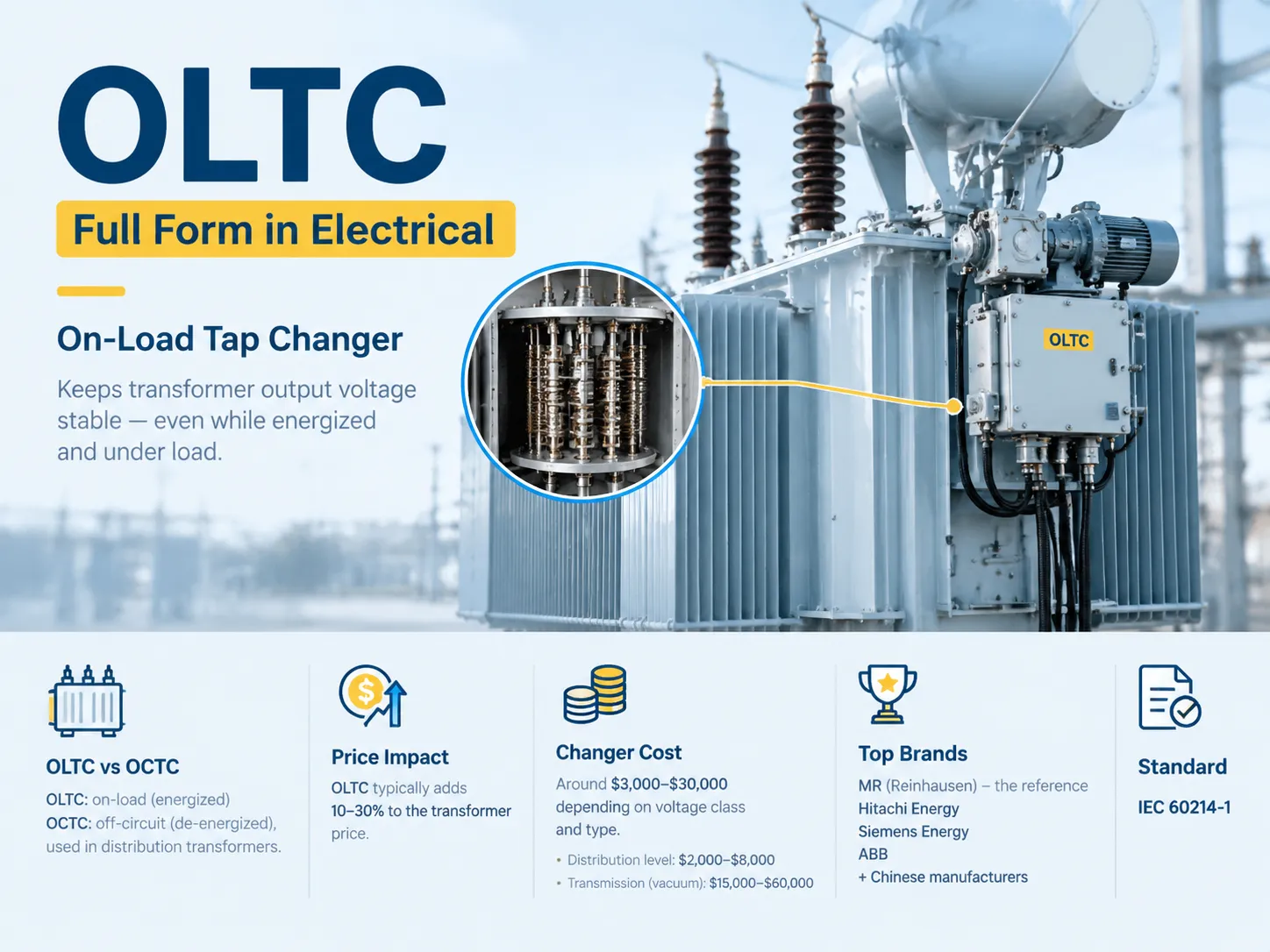
Was OLTC Wort für Wort bedeutet
Die drei Wörter der Beschreibung müssen wörtlich verstanden werden, was bedeutet, dass der vollständige Name mehr als eine einfache Trivia-Frage ist.
- Unter Last bedeutet, dass der Transformator nicht abgeschaltet wird und weiterhin Lasten versorgt, während der Lastwechsel erfolgt. Kein Ausfall, kein Ausschalten, kein Bedarf, ein Team zum Standort zu schicken. Dies ist der Hauptzweck des Geräts und der Grund, warum es so viel kostet.
- Abgriff bezieht sich auf die Verbindung, die an der Hochspannungswicklung hergestellt wird. Der Lastwechsel ermöglicht es, die Anzahl der Windungen im Stromkreis zu ändern, was das Übersetzungsverhältnis und folglich die Ausgangsspannung beeinflusst. Die Idee ist ähnlich der von festen Abgriffverbindungen an einem gewöhnlichen Verteilungs-Transformator, mit dem einzigen Unterschied, dass ein OLTC so konzipiert ist, dass er einen schnellen Wechsel während des Stromflusses ermöglicht.
- Schalter ist die Einheit, in der alle Teile des Mechanismus untergebracht sind: die Motorantriebseinheit, die vertikale Welle, der Selektorschalter und die Umleiter, zusammen mit dem Steuergehäuse zur Einstellung des Lastwechselprozesses. Moderne Designs verlassen sich oft auf die Verwendung des Umleiters mit Vakuumunterbrechern anstelle der ölgetauchten Kontakte, was für die jüngsten Preis- und Wartungsverbesserungen verantwortlich ist.
Sie werden häufig auf den Begriff “Lastabgriffwechselgerät” oder “Lastabgriffwechselmechanismus”, “OLTC-Transformator” stoßen, der als Synonym für den Transformator verwendet wird, der mit einem solchen ausgestattet ist. Es bedeutet dasselbe. In alten britischen und Commonwealth-Dokumenten wird oft “Lastabgriffwechsler” geschrieben, und in Nordamerika wird er manchmal als LTC (Lastabgriffwechsler) bezeichnet.
Was ein OLTC physisch in einem Transformator tut
Der Regler überwacht die Sekundärspannung und wenn sie aus einem Totband herausfällt – zum Beispiel, wenn sie um mehr als 1,25% von der erforderlichen Spannung abweicht – schaltet er den Motorantrieb ein. Der Umstellschalter wird betätigt, ein kurzer Stromfluss durch einen Übergangswiderstand oder Reaktor findet statt, und der Abgriffwähler bewegt sich zu einem anderen Abgriff. Der Umsteller bleibt in seiner neuen Position.
Der Grund für die Übergangsimpedanz ist das gesamte Ingenieurproblem. Man kann den Abgriff unter Last nicht einfach öffnen, daher schafft der Umsteller mit Hilfe des Widerstands oder Reaktors eine momentane kontrollierte Brücke, die den Strom durchlässt.
Der Rest der Einrichtung besteht aus dem Abgriffwähler, der das Make-before-break-Gerät ist, das selbst keinen Strom führt; Motorantrieb, Getriebe; Positionsanzeige und Grenzschalter sowie ein automatisches Steuerungssystem, das alle anderen Geräte mit dem Spannungsrelais, SCADA und Fernbefehlen verbindet.
Der gewöhnliche OLTC am Leistungstransformator arbeitet mit etwa 8 +/- 1,25 %, somit hat er 17 Positionsnummern und einen Spannungsanpassungsbereich von etwa +/- 10 %. Es können jedoch auch andere Konfigurationen wie 9 mit +/- 1,67 % oder 16 mit +/- 0,625 % erstellt werden. Der Preis hängt sowohl von der Größe des Schrittverfahrens ab, da es die verwendeten Leitungen beeinflusst, als auch von der Sicht des Abgrifftransformators, der mit dem Schaltelement verbunden werden muss.
Wo der OLTC in der Transformatorenfamilie sitzt
Wir müssen die Positionierung des genannten Geräts klären, da der Begriff “OLTC-Transformator” mehrdeutig ist.
Der Begriff OLTC bezieht sich nicht auf eine Art von Transformator, sondern auf ein Gerät, das an Transformatoren angebracht ist und in Leistungstransformatoren, großen Transformator-Umspannungsstationstransformatoren, Gleichrichtertransformatoren und Phasenverschiebungstransformatoren zu finden ist. Es wird nicht in einen kleinen Pfahltransformator oder Trockentransformator eingebaut, da es wirtschaftlich nicht rentabel wäre, den OLTC an solchen Transformatoren zu installieren.
Das allgemeine Prinzip ist, dass je größer der Transformator und je mehr die Last variiert, desto mehr ist der OLTC gerechtfertigt. Ein 40 MVA-Transformator, der an eine Umspannstation angeschlossen ist, wo die Last von 30% bis 100% variiert, wäre ein angemessener Einsatz eines OLTC, aber ein 1.000 kVA-Transformator, der eine Einrichtung mit konstantem Energieverbrauch versorgt, würde den OLTC nicht benötigen.
Wenn Sie das umfassendere Bild sehen möchten, wie diese Einheiten klassifiziert werden – nach Funktion, nach Kühlung, nach Anwendung – ist diese Taxonomie in diesem Überblick über wie Leistungstransformatoren klassifiziert werden und was jeder Typ im Netz tut, und es ist ein nützliches Rahmenwerk, bevor Sie nach einem spezifischen suchen.
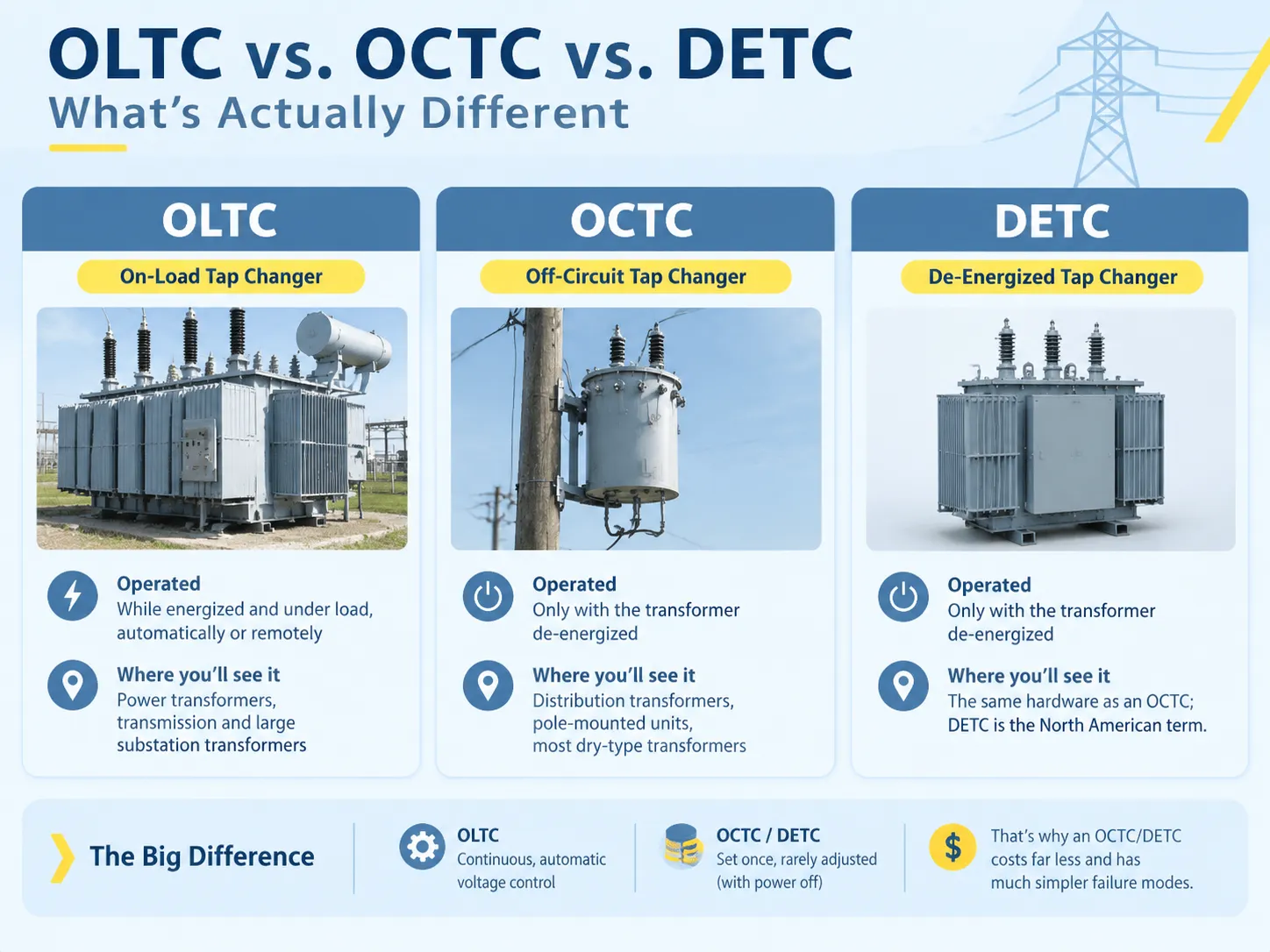
OLTC vs. OCTC vs. DETC: Was ist tatsächlich anders
Hier lebt die meiste Verwirrung, und es ist eine Tabelle wert.
| Gerät | Vollständige Form | Betrieben | Wo Sie es sehen werden |
|---|---|---|---|
| OLTC | Lastschalter im Betrieb | Während es unter Spannung und Last steht, automatisch oder fernbedient | Leistungstransformatoren, Übertragungs- und große Umspannungstransformatoren |
| OCTC | Lastschalter außerhalb des Stromkreises | Nur mit dem Transformator spannungslos | Verteilungstransformatoren, mastmontierte Einheiten, die meisten trocken-transformatoren |
| DETC | Entspannter Lastschalter | Nur mit dem Transformator spannungslos | Die gleiche Hardware wie ein OCTC; DETC ist der nordamerikanische Begriff |
OCTC und DETC sind ähnlich, obwohl der Unterschied zwischen diesen und OLTC alles andere als einfach ist. Die Intuition hinter einem OCTC ist, dass es nur Schalter enthält, die ihre Position nur ändern, wenn ein System zuerst eingeschaltet wird oder wenn es einen saisonalen Wechsel des Spannungsprofils gibt. Das Gerät muss daher vorher abgeschaltet und sicher heruntergefahren werden.
Im Gegensatz dazu führt ein OLTC diesen Vorgang kontinuierlich durch. Es reagiert innerhalb von Sekunden auf Änderungen der Spannung. Das Steuerungssystem kann entweder ein recht einfaches sein, das nur aus einem Spannungsregler mit Zeitverzögerung besteht, oder es kann komplexer und anpassungsfähig sein, wobei der Leistungsfaktor, der zirkulierende Strom von parallel geschalteten Transformatoren oder SCADA-Signale vom Steuerungssystem berücksichtigt werden.
Der praktische Aspekt dieses Unterschieds ist der Entwurfsaspekt. Da OCTC kaum verändert wird und niemals unter betrieblicher Last steht, besteht keine Notwendigkeit für solche Eigenschaften wie Übergangsimpedanz, Lichtbogenkontrolle oder Motorantrieb.
Die Haupttypen von OLTC
Nicht alle On-Load Tap Changer sind gleich, daher ist es wichtig, sich der Unterschiede bewusst zu sein, wenn man sie auswählt oder ersetzt.
- Widerstandstyp. Der Umleiterschalter verbindet sich über einen Übergangswiderstand für den Schaltprozess. Schnell, kompakt und das beliebteste Design in Europa und Asien sowohl für Verteilung als auch für Übertragung.
- Reaktanztyp. Verwendet einen Autotransformator als vorbeugende Maßnahme. Er war in der Vergangenheit auf dem US-Markt dominant, ist aber langsamer und kann hohe Ströme ohne durch das Schalten verursachte Verluste bewältigen. Immer noch häufig in älteren und größeren Anwendungen verwendet.
- Öl-isolierter Umleiter. Der Umleiterschalter arbeitet in seinem eigenen Ölkompartment. Es ist eine alte Technologie, zuverlässig, aber das Öl muss nach jeder Operation aufgrund von Degradation regelmäßig ersetzt werden.
- Vacuum diverter. The sealed vacuum interrupters perform the current transfer process. It provides protection from current breaks because it is performed in no oil, thus providing longer operational periods but at a little higher price. It is widely used nowadays in the bulk prices.
- In-tank vs. separate compartment. In-tank technology shares the oil with the transformer, while separate compartment keeps diverter oil in isolation to prevent contamination. For heavily loaded transformers separate implementation should be chosen despite higher costs.
- Reversing vs. coarse/fine. The reversing mechanism has a smaller design and can provide a wide range of tap changing in one section; whereas coarse/fine implementation gives a wider range but requires more winding.
The choice of the right model should depend on its working frequency, required breaking current, and availability of maintenance access.There’s a longer treatment of the trade-offs in this transformer tap changer selection guide if you’re at the point of comparing specific configurations rather than just understanding the categories.
Where OLTC Transformers Are Used
Voltage control is required constantly.
- Transmission substations where high voltage (220 or 110 kV) is changed to low voltage in order to deliver electricity to an everchanging load.
- Long rural feeders where voltage drop is big and demand varies according to the season or irrigation regime.
- Transformation stations for renewable generation since output of solar and wind plants fluctuates much quicker than that of traditional load, so the voltage needs to be kept within narrow limits.
- Traction and railway transformers due to constant variation of the load during train movement.
- Electric arc and rectifier transformers since big current load fluctuations happen all the time and result in continuous need for adjustment of voltage.
- Phase shifting transformers where electric parameters are managed using transformers with changing tappings.
An example from manufacturing will clarify this issue much better. A unit like this SZ11 31,500 kVA 35/10.5 kV oil-immersed on-load voltage regulating transformer is built specifically for the case where a 35 kV incoming supply has to deliver a stable 10.5 kV to a distribution network whose load varies throughout the day. That’s an OLTC application in one component and one sentence.
What an OLTC Costs
The price varies widely among various manufacturers in terms of rating, voltage class, and current, but the general frame of costs remains stable enough to perform assessments.
| Artikel | Typical range (USD) | Anmerkungen |
|---|---|---|
| OCTC / DETC (off-circuit) | $500–$3.000 | The baseline. No motor drive, no transition impedance |
| Distribution-level OLTC (≤33 kV) | $2.000–$8.000 | Oil-insulated diverter, typically 9 to 17 positions |
| Transmission-level OLTC (≥110 kV) | $15.000–$60.000 | Vacuum types sit at the upper end |
| Resistor or vacuum type, mid-range | $6,000–$35,000 | Driven mainly by current rating and step count |
| OLTC as a share of transformer price | +10–30% | Compared with +2–5% for an OCTC |
| OLTC increment on a 10 MVA transformer | $10,000–$25,000 | Depends heavily on whether vacuum or oil diverter |
The first point to discuss concerning the table is that the cost of the changer is not all included in the price of an OLTC transformer. Apart from the changer, an OLTC transformer has to be equipped with a tap winding, its leads, a motor with a control unit, and so on, so if we evaluate the gap in terms of price per kVA, then it is observed that the OLTC as compared to the OCTC transformer costs much more.
The lubricant or oil for the oil lantern should not be considered as an irrelevant item as it requires frequent checks of the oil and sometimes its replacement. Thus, with every 50,000 to 100,000 operations, it has to be replaced every three or five years (depending on the load). The vacuum type of transformers extends this interval, which is why they allow to achieve savings in the cost over its lifespan.
To give an example of the costs, OLTC transformers of capacity 20 MVA and voltage of 110 kV typically cost 430,000-700,000 EUR from major European manufacturers, below 450, 000 EUR from Schneider, and below 320,000 EUR from Chinese manufacturers.
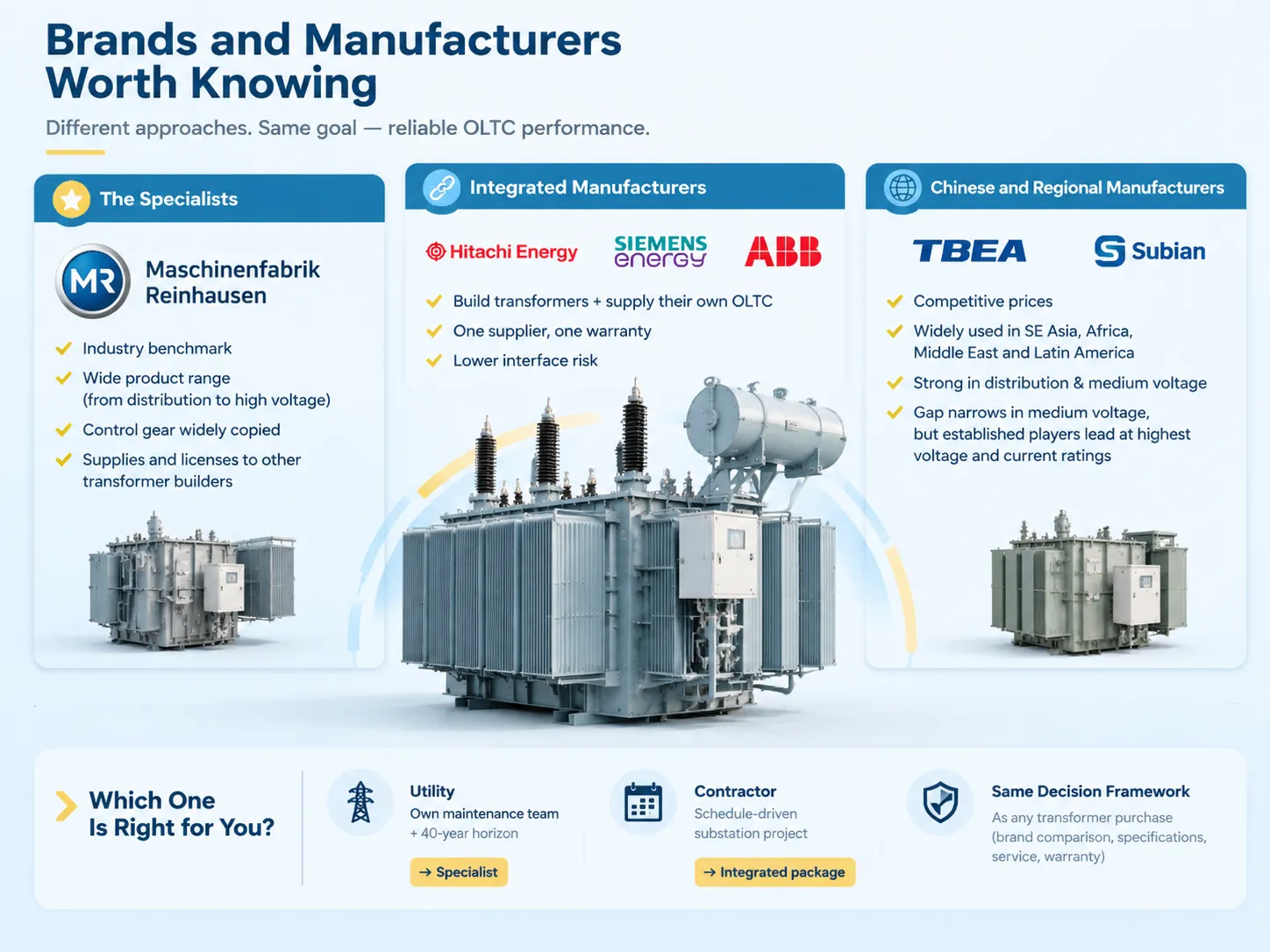
Brands and Manufacturers Worth Knowing
There are two very distinct categories of producers, and their customers generally must decide which one to go for.
Specialists. The Maschinenfabrik Reinhausen company is regarded as the market leader of the entire industry. If, in the call for tender, the specification reads “OLTC by MR or equal”, it signifies what exact product is intended. This manufacturer’s product portfolio includes everything from oil diverter products designed for the distribution voltag to vacuum devices suitable for the highest voltage classes, and their devices are widely imitated. Moreover, Reinhausen is engaged in licensing and supplying transformers to other manufacturers, which is why you can find tax changers of this manufacturer among transformers offered under various labels.
Integrated producers. Companies like Hitachi Energy, Siemens Energy and Alstom manufacture transformers and supply tap changing devices as one package. Hitachi Energy is particularly well known for this. This experience allows it to produce transformers along with tap-changing devices that comprise the product list offered. What is the key advantage of this approach? It is the single supplier who is responsible for the single warranty — a crucial benefit for the project with high uncertainty related to the interfaces.
Chinese and regional manufacturers. Due to their attractive price, TBEA, Subin and some other companies became successful in producing OLTC transformers. Due to their affordability these transformers can be applied in various projects implemented throughout Southeast Asia, Africa, Middle East and Latin America. The competition became fiercer with respect to medium voltage transformers, while the long-established specialists still retain the competitive edge in high voltage products and service network.
The primary consideration when making your decision should be the place where transformers will be delivered to and serviced. Companies that have well-developed infrastructures and capable personnel for maintenance usually opt for products manufactured by specialists. General contractors working at time-constrained projects usually prefer to purchase integrated products. Either way, the brand comparison exercise is the same one you’d run for any transformer purchase, and the frameworks in this buying guide for oil-immersed transformers with brand recommendations apply directly to OLTC-fitted units.
How to Specify One Without Regrets
If you’re developing a specification, the following parameters will determine whether you’ll get a practical device or merely an expensive ornament:
- Voltage regulation range and step size. Start with considering how much the supply voltage will fluctuate. A variation with a 10% accuracy range and a fluctuation of about 1.25% is what is needed in the majority of cases. Transmission and renewable connections may require higher accuracy or wider range.
- Number of operations per year. This number will determine whether to choose oil or vacuum, and whether to use tank installation or separate compartment. If a transformer is rated for 300,000 operations but is expected to run 20 cycles a day, it’ll mean regular servicing.
- Through-current through diverter. Voltage regulation is about breaking current load not only voltage. When it comes to this matter, oversizing is inexpensive compared to replacing contacts since it costs much less.
- Control philosophy. Will you have a stand-alone voltage regulation with a dead zone and time delay or coordinated control with parallel transformers and SCADA? The latter requires ensuring that control cubicles in both variants function properly and switching gears regulates current effectively.
- Parallel operation. In order to run two transformers in parallel, running both at the same tap position is necessary, and hence the need for either master-slave control or controlling circulating current in advance.
- Maintenance access. Having a separate tank might be costlier but make diverter service possible without draining the main tank. On a remote site, this might be the only deciding factor.
- Proof of compliance with the standards. You need to check documents in compliance with IEC 60214-1. Be not satisfied with copies of certificates and ask data on type test.
There is a longer walkthrough of these choices in this guide on how to select the on-load tap changer for a main power transformer, including how step size interacts with the tap winding and how the operating duty class should be matched to the project. If you’re specifying for the first time, start there rather than with the price list.
FAQ
What is OLTC and OCTC?
OLTC stands for On-Load Tap Changer, while OCTC stands for Off-Circuit Tap Changer. The difference between the two is that OLTC operates while the transformer is energized and in operation; it will use motorized drive, a selector switch, and a diverter switch that works under transition resistance, which ensures that the current is not broken. An OCTC can operate only when the transformer is turned off and safe; thus, it will work using the link that is made at commissioning. OLTC is installed in transformers that ensure the continuous control of voltage in the system; whereas OCTC is installed in distribution transformers since it is more cost-efficient.
What are the types of OLTC?
The first distinction is in terms of the method of switching from one state to another with use of transition resistors in the case of the resistor type, which is commonly used in Europe, Asia, and the hybrid type using an autotransformer. Furthermore, the division is based on the switching medium and thus to oil insulated switching systems with the switching contacts located in the oil and taking special care of it, while there is the vacuum type of systems in case of which the switching is made by using enclosed vacuum interruptions and no routine maintenance is necessary. Construction-wise, the systems are divided into either in-tank or separate-compartment units, and depending on the design there might be linear, reversing and coarse/fine taps.
What is the difference between RTCC and OLTC?
The OLTC is the actual switching apparatus and the RTCC represents the layer of controls that tells it what to do. The RTCC or Remote Tap Changer Control (also known as Remote Tap Changer Controller) is an electronic relay or controller that receives the secondary voltage, compares it with the desired value and dead-band, implements a time delay on the operation in order to ignore temporary voltage drops, and produces “raise” or “lower” commands for the motor assembly. Some RTCCs carry out the operation of coordination of transformers in parallel, line-drop compensation as well as SCADA communication. So RTCC is not an alternative to OLTC — it is the unit that provides automatic function of the OLTC. You can use OLTC without a sophisticated RTCC — a simple voltage relay will suffice, but it is impossible to have automatic operation without both devices.
What does OLTC mean?
On-Load Tap Changer is referred to as OLTC. In electrical engineering, the term “on-load” emphasizes that the equipment is functioning while the transformer is energizing and transmitting current. This deviates from the term “off-circuit” or “de-energized” since those terms indicate that the transformer has to be turned off first and be isolated from other components. The tap changer is the equipment used for selecting the point of connection of the winding. It changes the connection point in order to modify the number of turns, which also in turn enables voltage modification. Consequently, OLTC is translated into “a device that makes taps changes while the transformer is under load.” The equivalent acronym used in North America is LTC (load tap changer).
Can an OLTC be retrofitted to an existing transformer?
In a technical sense retrofitting is possible, but for a practical application it does not really make sense. Retrofitting can be described as an operation involving opening up the tank to replace the wire and insulate the leads, installing a driving motor and a separate compartment to actually rerun the control circuit. What is more, the costs involved in retrofitting may exceed a big part of the price of a transformer of the same rating and it also means giving up all the state of affairs concerning factory type tests. In situations when voltage control during operation is really needed but the transformer can only provide OCTC, some of the options include installing a separate regulator, using the booster transformer or changing the transformer with a new one at the end of its technical lifespan.
Referenzen
- IEC 60214-1 — Tap-changers, Part 1: Performance requirements and test methods — the governing standard for on-load and off-circuit tap changers
- Maschinenfabrik Reinhausen (MR) — manufacturer information and technical literature on on-load tap changers
- Hitachi Energy — Transformers — integrated transformer and tap changer solutions
- Siemens Energie — industry context on equipment design and environmental regulation
- Es ist auch wichtig, die Einhaltung von Standards wie IEC 60076, IEC 62271-200/202 und IEC 61439 durch Typprüfberichte zu überprüfen. — grid equipment, transformer supply and reliability reporting
- National Electrical Manufacturers Association (NEMA) — electrical equipment standards and industry data
Fazit
OLTC denotes the On-Load Tap Changer. If the reader only recalls one sentence from this text, then that should be this one: it is the device that allows a transformer to self-correct its output voltage while current is still flowing; this is an outstanding feature compared to simple tap links of a standard distribution transformer.
The practical facts one needs to keep in mind while having a specification dialogue are as follows: expect to have ±8 up to ±16 steps with the step being between 0.625% and 1.67%; the price of the changer would range between $3,000 and $30,000 and would make the transformer cost by about 10%-30% more expensive; expect to see that while oil-insulated diverters would require servicing every few years, vacuum ones would serve for much longer; the standard you should be held to should be IEC 60214-1; and the name of MR Reinhausen will always be used as a benchmark.
The question of whether or not you need an OLTC boils down to one question. Is the voltage at the supply point fluctuating enough and often enough that you cannot regulate it by other means? In case the load profile is steady and the supply is stable, it is better to use an OCTC and spend money elsewhere.