


Ein Ingenieur des Projekts, der für ein Versorgungsunternehmen verantwortlich ist, formuliert Spezifikationen für einen Haupttransformator mit einer Leistung von 40 MVA und einer Spannung von 132/33 kV, der den Verteilungsbus von 33 kV der gesamten Region regeln kann. Der Entwurfsprozess für den Transformator ist fast abgeschlossen, aber zu einem Punkt wurden bei den durchgeführten Besprechungen Fragen aufgeworfen: Es bezieht sich auf den Lastwechsel-Schalter, zu dem viele Fragen aufkamen. Die Bewertungen verschiedener Hersteller wurden aus technischer Sicht vorbereitet, aber ihre Kosten können um 30% variieren, die Wartungsintervalle unterscheiden sich um das Dreifache, und Servicemetriken über verschiedene Designs sind in den Datenblättern nicht verfügbar. Der Ingenieur versteht, dass die Nutzung des Lastwechsel-Schalters entscheidend für die Betriebskosten des Transformators über einen Zeitraum von 30 Jahren ist.
Das Ziel dieses Artikels ist es, Informationen zur Auswahl der Lastwechsel-Schalter des Haupttransformators bereitzustellen, die den Bereich der Abgriffe, die Schrittgröße, die Strom- und Schrittspannungsbewertungen, die Unterschiede zwischen Widerstands- und Vakuumtypen, deren Kosten und die Spezifikationen umfassen, die an die Lieferanten gesendet werden müssen.
Antwort: Ein Lastwechsel-Schaltgerät wird verwendet, um den Abgriff auf der Wicklung eines Transformators während des Betriebs anzupassen, um die Spannung ohne Unterbrechung der Versorgung zu regeln. Für eine Einheit von 10 MVA – 60 MVA liegen die möglichen Einstellbereiche jeweils bei etwa ± 8 × 1.25% oder ± 6 × 2.5%. Das OLTC-Gerät ist für den gleichen Durchflussstrom wie die maximale Dauerbewertung des Transformators ausgelegt und hat die Schrittspannung, die der Spannung der Wicklung entspricht.
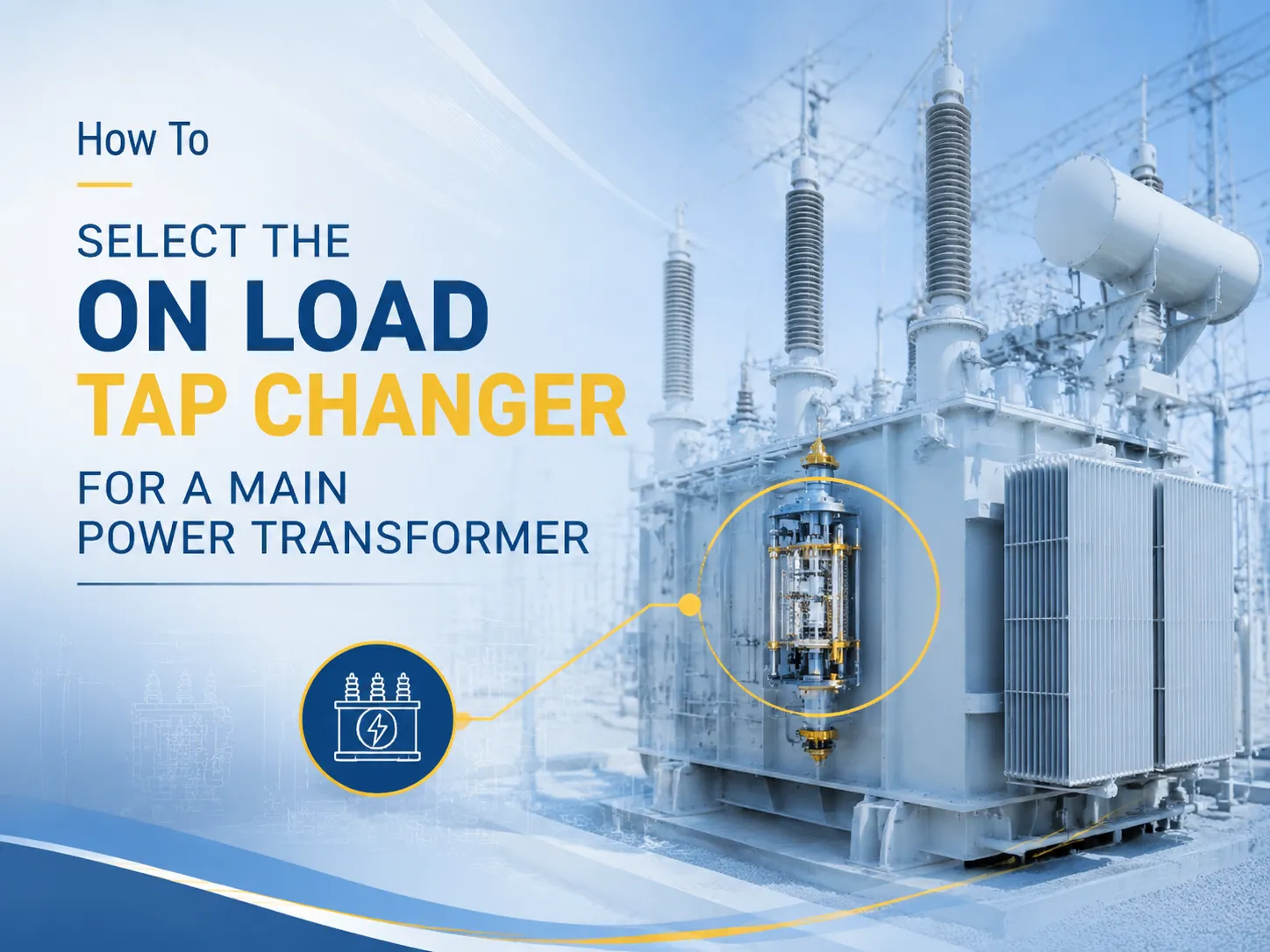
Was ist ein Lastwechsel-Schalter?
Der Lastwechsel-Schalter (OLTC) ist ein motorisch gesteuertes Gerät, das in Leistungstransformatoren zu finden ist und die Abgriffverbindungen der Regelspule ändert, während die Energie in Gebrauch ist. Dies geschieht durch Erhöhen oder Verringern der Abgriffe, wodurch das Übersetzungsverhältnis und die Ausgangsspannung verändert werden, was darauf hinweist, dass der OLTC eine entscheidende Rolle im kontinuierlichen Spannungsregelungsprozess unter sich ändernden Last- und Quellenbedingungen spielt.
Als eine Art von Gerät, das kontinuierlich Operationen durchführt, während der Strom fließt, ist der OLTC ein Präzisionsinstrument, was bedeutet, dass der Schaltvorgang unter bestimmten Bedingungen erfolgen muss, während der Schaltprozess tausende Male stattfinden muss, bevor der OLTC abnutzen kann.
Warum ein Haupttransformator einen benötigt.
Transformatoren werden zwischen dem Übertragungssystem und dem Verteilungssystem installiert. Beide Seiten des Transformators können im Laufe des Tages Lastschwankungen erfahren, da die Nachfrage schwanken kann, ebenso wie die Übertragungsspannung, die sich aufgrund der Netzkonfiguration ändert. Wenn der betreffende Transformator beispielsweise eine Leistung von 40 MVA hat, kann der Impedanzabfall allein zwischen 6-12% liegen. Daher können die Vorschriften bei voller Last oder ohne Last den Spannungsabfall des Transformators selbst um mehrere Prozent beeinflussen. Darüber hinaus besteht das Risiko, dass der 33 kV-Bus um 5-8% unter die normale Spannung fallen kann, was gemäß den lokalen Vorschriften nicht akzeptabel ist.
Um die erforderlichen Spannungsvariationen innerhalb eines akzeptablen Bereichs aufrechtzuerhalten, wird ein OLTC normalerweise mit dem automatischen Spannungsregler (AVR) kombiniert.
Wie ein OLTC ohne Unterbrechung schaltet
Der OLTC ist in zwei Phasen ausgelegt. Der Selektor findet den neuen Abgriffspunkt mechanisch mit den bereits über den aktiven Abgriff verbundenen Wicklungen. Daher wird der Betrieb des Selektors als bei null Stromwert betrachtet. Danach kommt die Zeit des Umleiterschalters, der den Strom folglich vom Hauptabgriff zum neuen Abgriff verschiebt. Die Übergangsimpedanz wird zwischen dem Selektor und dem Umleiterschalter platziert, sodass der durchfließende Strom niemals unterbrochen wird.
Das Design des Widerstands-Umleiters funktioniert so, dass der Strom durch einen oder zwei Übergangswiderstände fließt, die dazwischen platziert sind. Der Widerstandswert wird so ausgewählt, dass der Stromfluss während des Prozesses auf den Minimalwert begrenzt wird.
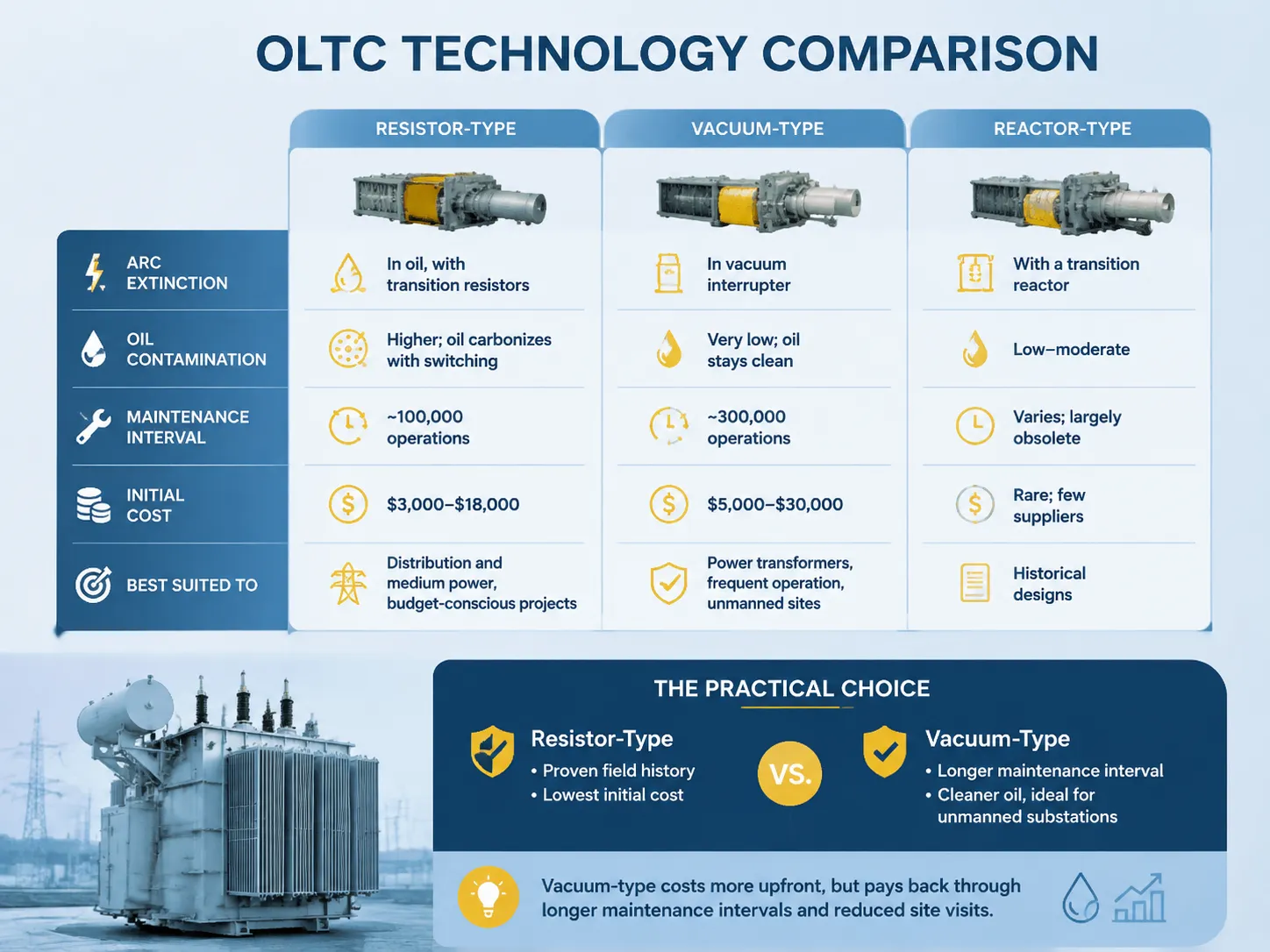
Widerstands- vs. Vakuum- vs. Reaktor-OLTC
| Charakteristik | Widerstands-Typ OLTC | Vakuum-Typ OLTC | Reaktor-Typ OLTC (veraltet) |
|---|---|---|---|
| Lichtbogenlöschung | In Öl, mit Übergangswiderständen | In Vakuumunterbrecher | Mit einem Übergangsreaktor |
| Ölverschmutzungsrate | Höher; Öl karbonisiert beim Schalten | Sehr niedrig; Öl bleibt sauber | Niedrig-mittel |
| Wartungsintervall | ~100.000 Operationen | ~300.000 Operationen | Variiert; weitgehend veraltet |
| Anschaffungskosten | $3,000-$18,000 | $5,000-$30,000 | Selten; wenige Anbieter |
| Am besten geeignet für | Verteilung und mittlere Leistung, budgetbewusste Projekte | Leistungstransformatoren, häufige Operationen, unbemannte Standorte | Historische Designs |
Bei neuen Haupttransformatoren kann man in der Regel zwischen Widerstands- oder Vakuumvarianten wählen. Die Widerstandsvariante wird seit langem verwendet und hat die niedrigsten Anschaffungskosten. Der Vakuumtyp hingegen kostet anfangs mehr aufgrund längerer Wartungsintervalle und weniger Anforderungen an Ölwechsel, was in unbemannten Umspannwerken, wo der Ölwechsel einen Standortbesuch und Ausfallzeiten erfordert, ein wichtiger Faktor sein kann.
Auswahl des Abgriffbereichs und der Schrittgröße
Der Abgriffbereich ist eine Berechnung der Spannungsregelung. Der Prozess besteht aus mehreren Schritten:
- Nehmen Sie die tatsächliche Spannungsfluktuation. Messen Sie die Spannung der Primärseite und die Spannung des Busses im Zustand voller Last; sie kann zwischen ±3-8% in einem tatsächlichen Netz zwischen Leicht- und Vollastbedingungen schwanken.
- Fügen Sie den Rückgang der Transformatorimpedanz hinzu. Bei voller Kapazität erreicht die Regelung von Transformatoren mit 10-40 MVA Leistung 4-8%, und die Abgriffe sollten sowohl die Änderung der Quelle als auch den internen Rückgang berücksichtigen.
- Bestimmen Sie die Größe des Schrittes. Üblicherweise werden 1.25% Schritte für große Transformatoren mit ordnungsgemäßer Regelung verwendet, während kleinere Transformatoren mit 2.5% Schritten arbeiten.
- Legen Sie den Bereich fest. Der ±8×1.25% Abgriffbereich ergibt ±10% in 16 Schritten, während der ±6×2.5% Abgriffbereich ±15% mit 12 Schritten erzeugt. Für die meisten Transformatoren im Bereich zwischen 10MVA und 60MVA wird der erste Bereich als Standard gewählt.
- Denken Sie an den AVR, der mit Hilfe eines Relais in einem Schritt mit Zeitverzögerung eine Busspannung bereitstellt, um ein Jagen zu vermeiden, und die Anzahl der Schritte sollte die genannten Anforderungen erfüllen.
Zusammenfassend lässt sich sagen, dass falsche Schätzungen zu Konsequenzen führen können: Wenn der Bereich zu eng ist, kann der Transformator die Spannung unter den schlechtesten Bedingungen nicht halten, und wenn er zu weit ist, bedeutet dies die Notwendigkeit weiterer Ausgaben für OLTC oder dessen Regelwicklung.
Verständnis der Strom- und Schritt-Spannungswerte
| Nennleistung | Bedeutung | Typische Werte für 10-60 MVA |
|---|---|---|
| Nenn-Durchgangsstrom | Maximaler Dauerstrom, den der OLTC führt | 300-1.250 A (nach Transformatorbewertung) |
| Nennstufenspannung | Spannung zwischen benachbarten Abgriffen | 500-3.000 V pro Schritt |
| Nennschaltleistung | Produkt aus Strom × Stufenspannung, die der Abzweiger verarbeiten kann | Bis zu ~1.000 kVA pro Schaltstufe |
| Betriebszyklen | Entwurfslebensdauer in Betrieb | 100,000-300,000+ |
| Normen | Entwurfs- und Typprüfungsbasis | IEC 60214-1/-2, IEEE C57.131 |
Der Durchgangsstrom muss den höchsten Dauerstrom des Transformators zuzüglich des Überlastfaktors abdecken, falls zutreffend, sodass bei einem 20%-Überlastvertrag die OLTC-Bewertung dies ebenfalls widerspiegeln muss. Mit anderen Worten, die Stufenspannung ist ebenso wichtig, da eine hohe Stufenspannung viel mehr Stress auf den Abzweiger bedeutet als hoher Strom mit niedriger Stufenspannung; dies wird vom Anbieter während des Tests der Schaltleistung überprüft.
Um Ihnen die Beziehung zu veranschaulichen, stellen wir Ihnen die folgende Größenreferenz in Bezug auf den Transformator zur Verfügung, den Sie spezifizieren.
| Transformatorbewertung | HV-Spannung | Max. Dauerstrom | Typische OLTC-Bewertung | OLTC-Preisspanne |
|---|---|---|---|---|
| 10 MVA | 66 kV | ~88 A | 100 A, Schritt 500-800 V | $4,000-$12,000 |
| 20 MVA | 110 kV | ~105 A | 125 A, Schritt 800-1.200 V | $6,000-$16,000 |
| 40 MVA | 132 kV | ~175 A | 200 A, Schritt 1.200-1.800 V | $8,000-$22,000 |
| 60 MVA | 220 kV | ~157 A | 200 A, Schritt 1.500-2.500 V | $12,000-$30,000 |
Nach Festlegung der Bewertungen ist es wichtig, dass die Spezifikation alle Anforderungen mit detaillierter Sprache umreißt. Mindestens muss die RFQ die folgenden Punkte klar angeben:
- Abgriffbereich und Schritte: müssen klar angegeben werden, z.B. ±8×1.25% (17 Schritte) an der HV-Wicklung.
- Der Nenn-Durchgangsstrom: Was ist der maximale Dauerstrom, einschließlich Überlastbetrieb.
- Stufenspannung: maximale Spannung zwischen den Abgriffen.
- Typ: entweder ein Widerstandstyp oder ein Vakuumtyp, Turm-Montage-Design (Kopftyp) oder eine im Tank befindliche Einheit.
- Motorantrieb: Spannung (110/220 DC oder AC), Drehmomentbeschränkungen, lokale oder Fernbedienung und AVR-Schnittstelle.
- Überwachung: Positionsanzeige, Betriebsstunden-Zähler, Ölstand und Drucküberwachung des OLTC-Raums.
- Normen und Typprüfungen: Typprüfungen gemäß IEC 60214-1, plus IEEE C57.131, wenn das Projekt in Nordamerika basiert.
- Ersatzteile und Dienstleistungen: Ersatzteile und Dienstleistungen, die von den Herstellern verfügbar sind.
Es gibt zwei der wichtigsten Spezifikationspunkte, die häufig ignoriert werden. Erstens, die Überlastbasis, die besagt, dass der OLTC für die Überlastkapazität des Transformators und nicht nur für die Nenn-Dauerleistung ausgelegt sein sollte. Zweitens, die AVR-Schnittstelle und das Kommunikationsprotokoll, das zeigt, ob der Abgriffwechsler Teil der Systeme der Automatisierung von Umspannwerken werden kann oder ob er auf einer isolierten manuellen Basis betrieben wird.
OLTC nach Transformatorgröße und -aufgabe
- Transformatoren mit geringerer Leistung (weniger als 5 MVA): Ölgetauchte oder ölzirkulierende Transformatoren (OLTC) nutzen somit keinen OLTC; das Abgreifen im Stromkreis erfolgt ergänzt durch Regelung an vorgelagerten Reglern.
- Transformatoren auf Umstationsebene (5 bis 60 MVA): Der Leistungsbereich für die Installation von OLTC; direkt verursachte systembasierte Regler werden zusammen mit standardmäßigen vorläufigen Auswirkungen auf den regulierten Bus verwendet.
- Schritt-auf-Generatortransformatoren; Die OELTC-Option ist selten; die Regelung erfolgt auf der Generator- oder Netzebene, abhängig von der Erzeugungskapazität der Generatoren.
- Transformatoren auf industrieller Ebene (10 bis 50 MVA): Die OLTC-Option ist auch auf dieser Ebene verfügbar; jedoch wird der Vakuumtyp von OLTC gewählt, wenn häufige Betriebsänderungen auftreten.
- Ofentransformatoren und Gleichrichtertransformatoren; es gibt eine hohe Frequenz von Abgriffoperationen, daher ist der Vakuumtyp von OLTC für den Betrieb gewünscht.
Marken- und Preisvergleich
| Marke | Herkunft | OLTC-Produkte | Ungefährer Preisbereich |
|---|---|---|---|
| MR Reinhausen | Deutschland | VACUTAP-Vakuum- und OILTAP-Widerstandsserie — der globale Referenz | $6,000-$35,000 |
| ABB | Schweiz/Schweden | Komplettpaket Transformator + OLTC | $5,000-$30,000 |
| Siemens | Deutschland | OLTC für große Leistungstransformatoren | $6,000-$32,000 |
| Hitachi Energie | Schweiz | Lastabgriffänderung bei Leistungstransformatoren | $7,000-$35,000 |
| Schneider Electric | Optimierungsmaßnahmen in der Praxis | Verteilungs-Klasse Lastabgreifer | $3,000-$15,000 |
| Jiangsu Subian Electric Power (integriert) | China | Transformatoren mit bewährten OLTCs, koordiniert nach IEC 60214 | $4.000-$15.000 (als Transformatoroption) |
da MR-Technologie oder lizenzierte Designs von fast allen führenden Transformatoren weltweit verwendet werden. Die VACUTAP-Serie von Vakuum-Lastabgreifern ist diejenige, die den Standard für wartungsfreien Betrieb gesetzt hat. ABB, Siemens und Hitachi Energy bieten ihre eigene oder Partner-OLTC-Technologie an. Der OLTC ist in der Regel ein benanntes Element im Transformatorvertrag, und die Wahl hängt von den Fähigkeiten des Transformatorenherstellers und der Wartungsphilosophie des Projekts ab. Jiangsu Subian Electric Power gehört zu den Herstellern, die getestete OLTCs in ihren Transformatoren installieren, einschließlich des Vakuumtyps für häufiges Schalten. Anstatt ein Produkt zu erhalten, das mit einem zusätzlichen OLTC ausgestattet ist, erhält der Käufer eine schlüsselfertige Montage, die Turm, Antrieb und AVR als ein komplettes System abdeckt. Aufgrund der effizienten Produktions- und Preispolitik von Subian liegt die Preisspanne von OLTC-Transformatoren etwa 40-60% unter ähnlichen Angeboten europäischer Hersteller. Unabhängig von der Marke, die Sie wählen, geben Sie jedoch immer den OLTC-Typ im Vertrag an und überprüfen Sie das Typprüfzertifikat.
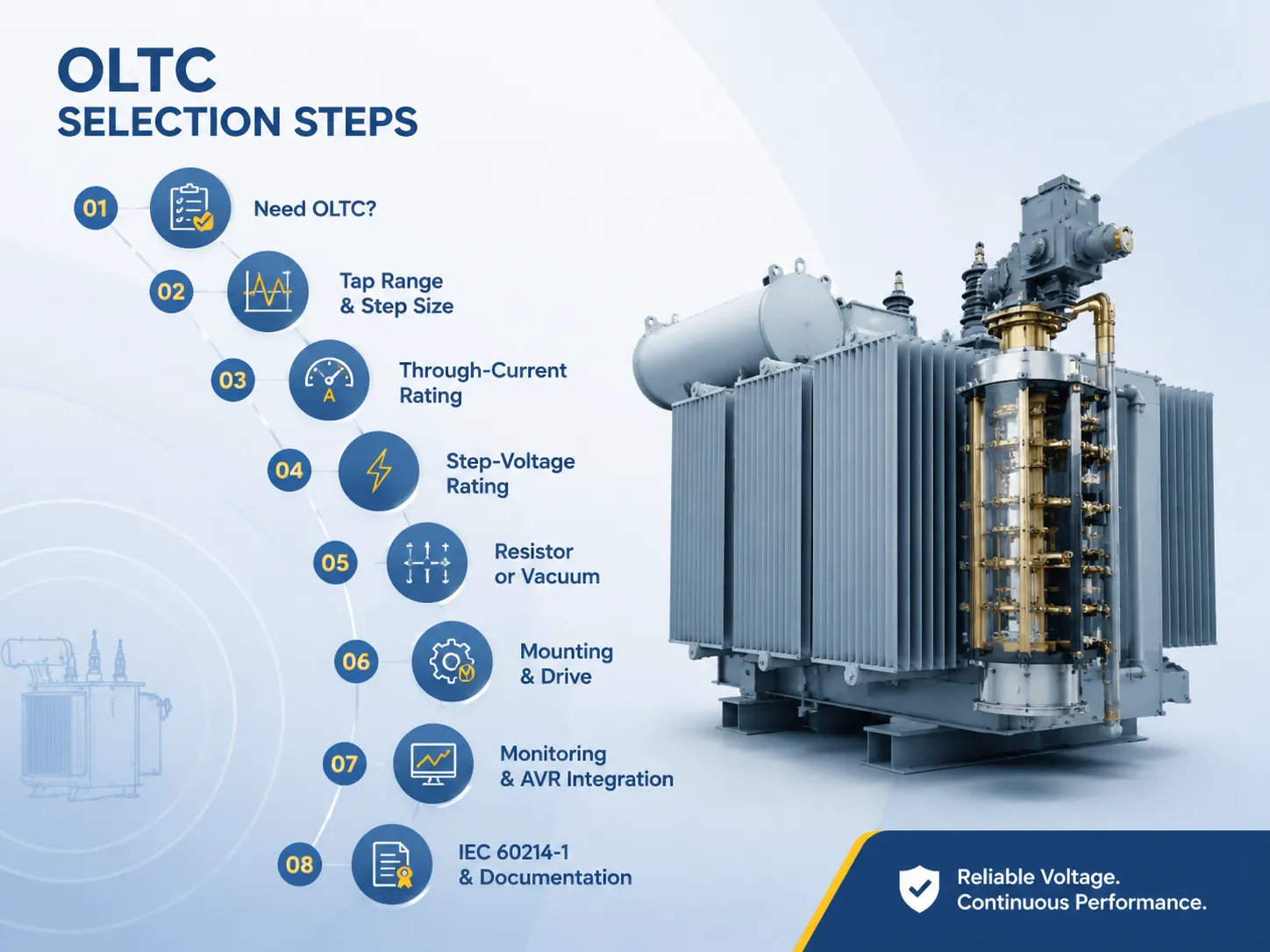
Schritt-für-Schritt-Auswahlverfahren
- Bewerten Sie, ob ein OLTC erforderlich ist. Wenn die Quelle und die Last stabil sind, benötigen Sie möglicherweise nur manuelle Abgriffe, aber im Falle eines Leistungstransformators ist eine automatische Regelung fast immer erforderlich.
- Bestimmen Sie die Abgriffgröße und den Bereich gemäß der internen Regelung des Transformators und den Spannungs schwankungen.
- Bestimmen Sie die Stromkapazität basierend auf dem maximalen Strom, der während des Dauerbetriebs mit Überlasten verfügbar ist.
- Überprüfen Sie die Schrittspannung mit der Spannung von Abgriff zu Abgriff der Regelwicklung.
- Entscheiden Sie, ob Widerstände oder Vakuum basierend auf dem Budget, dem Anwendungsbereich und der Schaltfrequenz verwendet werden sollen.
- Bestimmen Sie, ob eine Turm- oder Kopfmontage erforderlich ist, und entscheiden Sie über den Motorantrieb, wobei Sie sicherstellen, dass er die richtige Spannung und Steuerung hat.
- Listen Sie die Überwachungsanforderungen und die Anforderungen für die Integration des automatischen Spannungsreglers auf, einschließlich der Position, des Zählers, des Ölstands und der Kommunikationsprotokolle.
- Stellen Sie sicher, dass das Zertifikat der Typprüfung und der Prozessprüfung gemäß IEC 60214-1 verfügbar ist, und fügen Sie die Bezeichnung des OLTC im Vertrag hinzu.
Betrieb, Überwachung und Wartung
Der Bedarf an OLTC-Service wird hauptsächlich durch die Art des OLTC und wie oft er ein- und ausgeschaltet wird, beeinflusst. Empfehlungen umfassen:
- Verfolgen Sie, wie oft der OLTC jeden Monat betrieben wurde. Ein OLTC, der in Verbindung mit einem Leistungstransformator verwendet wird, kann 1.000-10.000 Schaltungen pro Jahr durchführen; daher sollten die Wartungsintervalle basierend auf der Betriebsanzahl und nicht auf der Anzahl der Jahre berechnet werden.
- Bei Widerstands-OLTCs sollte das Installationsöl des Abzweigers separat vom Öl im Haupttank betrachtet werden, da es während des Schaltvorgangs karbonisiert und viel schneller abbaut; filtern oder ersetzen Sie es gemäß dem vom Hersteller angegebenen Intervall (~100.000 Schaltungen).
- Bei Vakuum-OLTCs tritt während des Betriebs keine Kontamination auf; daher können die Intervalle viel länger sein (~300.000 Schaltungen); dennoch sollten der Mechanismus und der Antrieb bei jedem größeren Trip überprüft werden.
- Das Drehmoment des Motorantriebs, die Position des AVR-Relais-Schalters und die Position des Positionsanzeigers sollten jedes Jahr überprüft werden.
- Überwachen Sie die Temperaturen und Drücke des Abzweigöl; ein Temperaturanstieg weist auf einen Fehler in den Kontakten oder einen abnormalen Schaltvorgang hin.
- Die Protokollierung des Betriebscounters ist am kosteneffektivsten, da sie “Wartung alle fünf bis sieben Jahre durchführen” in “Wartung alle 100.000 Operationen durchführen” umwandelt, was einen erheblichen Unterschied für einen stark beanspruchten Transformator bedeutet.
Die Wartungsanforderungen verschiedener Designs sind drastisch unterschiedlich. Die beiden Haupttypen von OLTC sollten basierend auf Ihren Ausgaben verglichen werden.
| Wartungsartikel | Widerstands-Typ OLTC | Vakuum-Typ OLTC |
|---|---|---|
| Intervall für den Ölwechsel des Abzweigers | ~100.000 Operationen | ~300.000 Operationen |
| Öl-Kohlenisierungsrate | Mäßig bis hoch | Sehr niedrig |
| Intervall zur Kontaktinspektion | Bei jedem Ölwechsel | Alle 2.-3. Ölwechsel |
| Wartung des Motorantriebs | Gleich für beide (jährliche Überprüfung) | Gleich für beide |
| Geschätzte Wartungskosten über 20 Jahre | $8,000-$20,000 | $4,000-$10,000 |
Häufig gestellte Fragen
Wie viel kostet ein Lastabgriff?
Welchen Abgriffbereich sollte ich für meinen Haupttransformator angeben?
Was ist der Unterschied zwischen einem Widerstands- und einem Vakuum-Lastabgriff?
Wie oft benötigt ein OLTC Wartung?
Kann ich einen Lastwechselrichter an einen bestehenden Transformator nachrüsten?
Selten und selten wirtschaftlich. Die Regelwicklung, die Turm-Montage, die Tankabstände und die Kühlung müssen alle zum OLTC passen, und die meisten Festabgrifftransformatoren wurden nie dafür entworfen. Wenn Sie eine kontinuierliche Regelung an einem bestehenden Gerät benötigen, ziehen Sie stattdessen einen separaten spannungsregelnden Transformator oder einen Serien-Spannungsregler in Betracht. Andernfalls geben Sie den OLTC in der Entwurfsphase an.
Referenzen
- IEC 60214-1 — Lastwechselrichter, Leistungsanforderungen und Prüfmethoden — Der zentrale OLTC-Standard, der Typprüfungen und Bewertungen abdeckt.
- IEC 60214-2 — Abgriffwechsel, Anwendungsleitfaden — Auswahlhilfe für Bereiche, Stufen und Bewertungen.
- IEEE C57.131 — Anforderungen an Lastabgriffwechsel — Nordamerikanischer OLTC-Standard.
- MR Reinhausen — Abgriffwechsel-Portal — Die Dokumentation und Lebenszyklustdaten des führenden OLTC-Herstellers VACUTAP/OILTAP.
- IEC 60076-1 — Leistungstransformatoren, Allgemeine Anforderungen — Kontext auf Transformator-Ebene für die Integration und Prüfung von Lastschaltern.
- ABB Transformatoren — Referenz für die Integration von Transformator und Abgriffwechsel.
Fazit
Die Auswahl des Lastschalters für einen großen Transformator ist ein Prozess, der auf Fakten basiert. Die Spannungsschwankung und die Regelung des Transformators bestimmen den Bereich, während der Strom und die Schaltfähigkeit des Transformators die Ausgangsleistung bestimmen. Solange alles korrekt durchgeführt wird, wird der OLTC seine Funktionen über viele Jahre hinweg erfüllen.
- Berechnen Sie den Abgriffbereich unter Verwendung der aktuellen Spannungswerte und der internen Regelung.
- Bewerten Sie den OLTC gemäß der Überlastleistung, nicht nur nach der auf dem Typenschild angegebenen Bewertung.
- Wählen Sie den Vakuumtyp, wenn häufiges Schalten erforderlich ist und keine Person anwesend ist.
- Befolgen Sie die Leistungsaufzeichnungen, protokollieren Sie den Zähler und halten Sie das Zertifikat des Typentests, das dem Vertrag beigefügt ist.