


Un ingeniero del proyecto a cargo de una empresa de servicios públicos está formulando especificaciones para un transformador de potencia principal de capacidad de 40 MVA con un voltaje de 132/33 kV que puede regular el bus de distribución de 33 kV de toda la región. El proceso de diseño para el transformador casi se ha completado, pero en un punto se plantearon cuestiones en las reuniones celebradas: se refiere al cambiador de tomas bajo carga, sobre el cual surgieron muchas preguntas. Se prepararon las evaluaciones de varios fabricantes desde el punto de vista técnico, pero su costo puede diferir en 30%, los intervalos de mantenimiento difieren 3 veces, y las métricas de servicio a través de diferentes diseños no están disponibles en las hojas de datos. El ingeniero entiende que la utilización del cambiador de tomas bajo carga es crítica para el costo de operación del transformador durante un período de 30 años.
El objetivo de este artículo es proporcionar la información sobre la selección de los cambiadores de tomas bajo carga del transformador de potencia principal, que incluirá el rango de tomas, el tamaño del paso, las calificaciones de corriente y voltaje por paso, las diferencias entre los tipos de resistencia y vacío, su costo y las especificaciones que deben enviarse a los proveedores.
Respuesta: Un dispositivo de cambiador de tomas bajo carga se utiliza para ajustar la toma en el devanado de un transformador cuando está bajo carga con el fin de regular el voltaje sin interrupción del suministro. Para una unidad de 10 MVA – 60 MVA, los rangos de configuración posibles, respectivamente, son aproximadamente ± 8 × 1.25% o ± 6 × 2.5%. El dispositivo OLTC está clasificado para la misma corriente continua que la calificación máxima continua del transformador y tiene el voltaje por paso igual al voltaje del devanado.
¿Qué es un cambiador de tomas bajo carga?
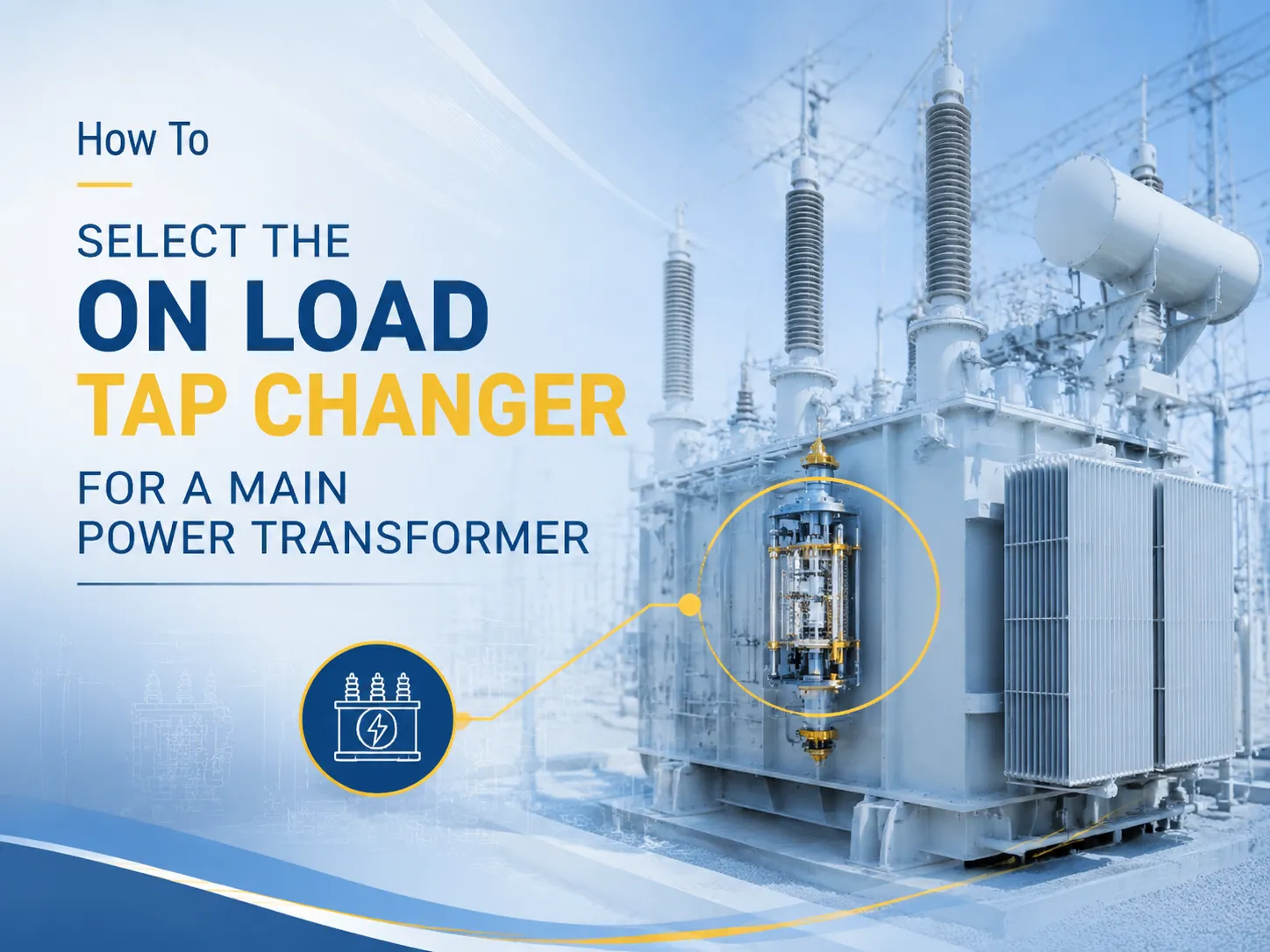
El cambiador de tomas bajo carga (OLTC) es un dispositivo controlado por motor que se encuentra en transformadores de potencia que altera las conexiones de toma de la bobina de ajuste mientras la energía sigue en uso. Esto se hace aumentando o disminuyendo las tomas, cambiando así la relación de transformación y la diferencia de potencial de salida, lo que indica que el OLTC juega un papel vital en el proceso de regulación continua del voltaje bajo condiciones cambiantes de carga y fuente.
Siendo el tipo de dispositivo que realiza continuamente cualquier operación mientras fluye la corriente, el OLTC es un instrumento de precisión, lo que significa que el conmutador debe hacerse bajo condiciones particulares, mientras que el proceso de conmutación debe tener lugar miles de veces antes de que el OLTC pueda desgastarse.
Por qué un transformador principal necesita uno.
Los transformadores se instalan entre el sistema de transmisión y el sistema de distribución. Ambos lados del transformador pueden experimentar fluctuaciones de carga a lo largo del día, ya que la demanda puede cambiar, así como la tensión de transmisión, que varía debido a la configuración de la red. Por ejemplo, cuando el transformador en cuestión tiene una capacidad de 40 MVA, la caída de impedancia puede ser de entre 6-12%. Por lo tanto, cuando se trata de carga completa o sin carga, las regulaciones pueden afectar la caída de tensión en varios porcentajes del propio transformador. Además, existe el riesgo de que el bus de 33 kV pueda caer 5-8% por debajo de la tensión normal, lo cual, según las regulaciones locales, no es aceptable.
Para mantener las variaciones de tensión requeridas dentro de un rango aceptable, un OLTC se combina generalmente con el regulador automático de tensión (AVR).
Cómo un OLTC cambia sin interrupción
El OLTC está diseñado en dos fases. El selector encuentra el nuevo punto de conexión mecánicamente con los devanados ya conectados a través del tap activo. Por lo tanto, aquí es donde se considera que la operación del selector ocurre con un valor de corriente cero. Después de eso, llega el momento del interruptor de derivación que, en consecuencia, mueve la corriente del tap principal al nuevo tap. La impedancia de transición se coloca entre el selector y el interruptor de derivación, de modo que la corriente que fluye nunca se interrumpe.
El diseño del resistor de derivación opera de tal manera que la corriente viaja a través de uno o dos resistores de transición que se colocan entre ellos. El valor de resistencia se selecciona de tal manera que el flujo de corriente se limita al valor mínimo durante el proceso.
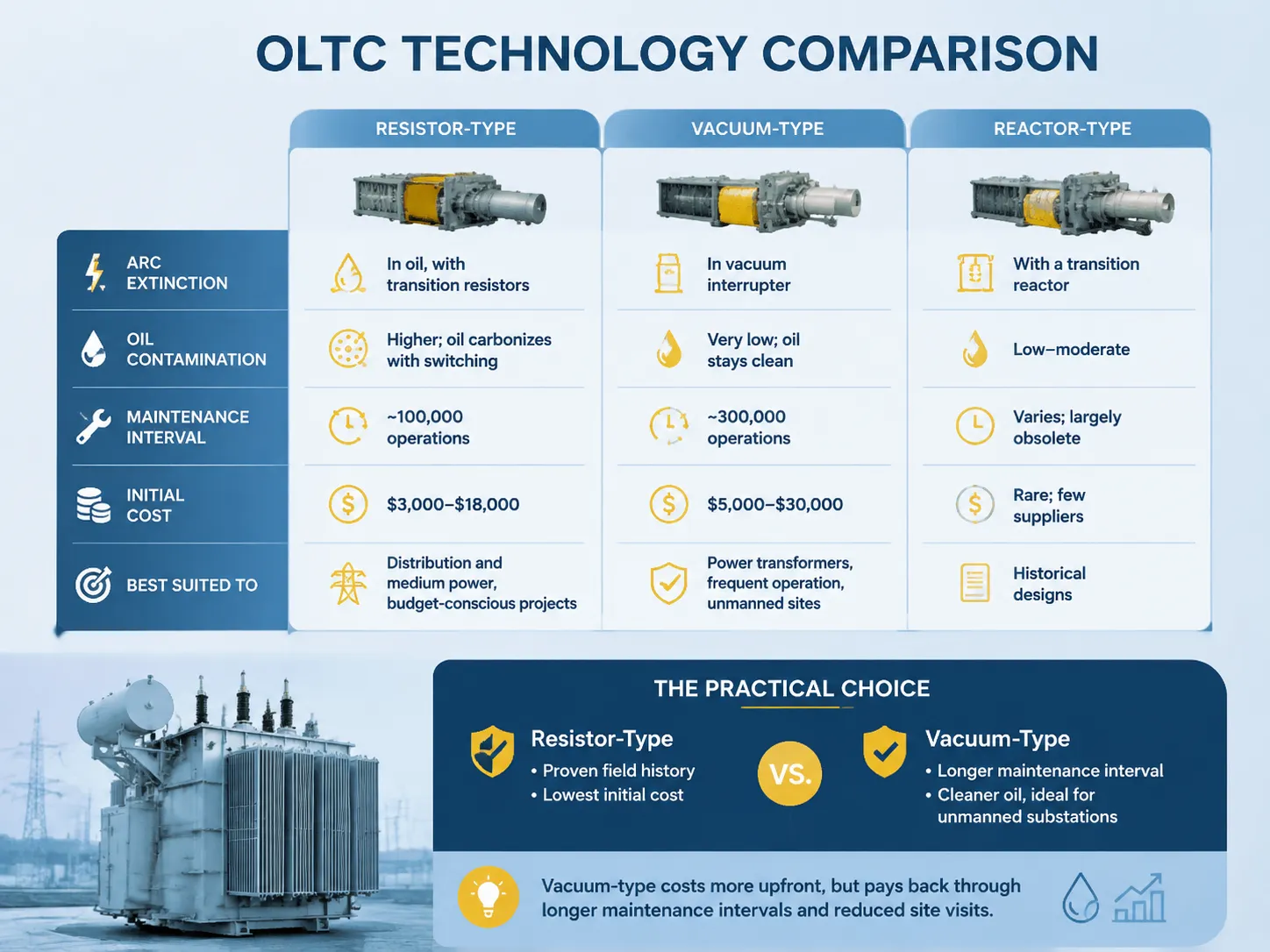
OLTC de tipo resistor vs. OLTC de tipo vacío vs. OLTC de tipo reactor
| Característica | OLTC de tipo resistor | OLTC de tipo vacío | OLTC de tipo reactor (heredado) |
|---|---|---|---|
| Extinción de arco | En aceite, con resistores de transición | En interruptor de vacío | Con un reactor de transición |
| Tasa de contaminación del aceite | Más alta; el aceite se carboniza con el conmutador | Muy baja; el aceite se mantiene limpio | Baja-moderada |
| Intervalo de mantenimiento | ~100,000 operaciones | ~300,000 operaciones | Varía; en gran medida obsoleto |
| Costo inicial | $3,000-$18,000 | $5,000-$30,000 | Raro; pocos proveedores |
| Mejor adecuado para | Proyectos de distribución y potencia media, con presupuesto limitado | Transformadores de potencia, operación frecuente, sitios no tripulados | Diseños históricos |
Cuando se trata de nuevos transformadores principales, generalmente se puede elegir entre variedades de resistor o de vacío. La variedad de resistor ha estado en uso durante mucho tiempo y tiene el costo inicial más bajo. Sin embargo, el tipo de vacío cuesta más al principio debido a los intervalos de mantenimiento más largos y a los menores requisitos de cambios de aceite, lo que puede ser una consideración importante en el caso de subestaciones no tripuladas donde el reemplazo de aceite requiere una visita al sitio y tiempo de inactividad.
Selección del rango de tap y tamaño del paso
El rango de tap es un cálculo del control de tensión. El proceso consiste en varios pasos:
- Toma la fluctuación de tensión real. Mide la tensión del lado primario y la tensión del bus bajo estado de carga completa; puede variar ±3-8% en una red real entre condiciones de carga ligera y carga completa.
- Agregue la caída en la impedancia del transformador. A plena capacidad, la regulación de transformadores con 10-40 MVA de potencia alcanza 4-8%, y los tomas deben tener en cuenta tanto el cambio de fuente como la caída interna.
- Determine el tamaño del paso. Por lo general, se utilizan pasos de 1.25% para transformadores grandes con regulación adecuada, mientras que los transformadores más pequeños trabajan con pasos de 2.5%.
- Establezca el rango. El rango de tomas de ±8×1.25% da ±10% en 16 pasos, mientras que el rango de tomas de ±6×2.5% genera ±15% utilizando 12 pasos. Para la mayoría de los transformadores dentro del rango entre 10MVA y 60MVA, se elige el primer rango como estándar.
- Piense en el AVR que proporciona un voltaje de bus con la ayuda de un relé en un paso con retardo de tiempo que permite evitar caza, y el número de pasos debe cumplir con los requisitos mencionados.
En conclusión, hacer estimaciones incorrectas puede llevar a consecuencias: si el rango es estrecho, el transformador no podrá mantener el voltaje en las peores condiciones, y si es demasiado amplio, significará la necesidad de gastos adicionales en OLTC o su devanado regulador.
Comprendiendo las Calificaciones de Corriente y Voltaje por Paso
| Clasificación | Significado | Valores Típicos para 10-60 MVA |
|---|---|---|
| Corriente nominal a través | Corriente continua máxima que soporta el OLTC | 300-1,250 A (según la clasificación del transformador) |
| Voltaje nominal por paso | Voltaje entre tomas adyacentes | 500-3,000 V por paso |
| Capacidad de conmutación nominal | Producto de corriente × voltaje por paso que el desviador puede manejar | Hasta ~1,000 kVA por paso de conmutación |
| Ciclos de operación | Vida útil de diseño en operaciones | 100,000-300,000+ |
| Normas | Base de diseño y prueba de tipo | IEC 60214-1/-2, IEEE C57.131 |
La corriente de paso debe cubrir la corriente continua más alta del transformador más el factor de sobrecarga, si corresponde, de tal manera que para un contrato de sobrecarga 20% la clasificación del OLTC también deberá reflejar esto. En otras palabras, el voltaje por paso es igual de importante ya que un alto voltaje por paso significa mucho más estrés en el desviador que una alta corriente con bajo voltaje por paso; esto es verificado por el proveedor durante la prueba de capacidad de conmutación.
Para ayudarle a visualizar la relación, le proporcionamos la siguiente referencia de dimensionamiento relacionada con el transformador que está especificando.
| Clasificación del transformador | Voltaje HV | Corriente continua máxima | Clasificación típica de OLTC | Rango de precios de OLTC |
|---|---|---|---|---|
| 10 MVA | 66 kV | ~88 A | 100 A, paso 500-800 V | $4,000-$12,000 |
| 20 MVA | 110 kV | ~105 A | 125 A, paso 800-1,200 V | $6,000-$16,000 |
| 40 MVA | 132 kV | ~175 A | 200 A, paso 1,200-1,800 V | $8,000-$22,000 |
| 60 MVA | 220 kV | ~157 A | 200 A, paso 1,500-2,500 V | $12,000-$30,000 |
Después de establecer las clasificaciones, es esencial que la especificación delinee todos los requisitos utilizando un lenguaje detallado. Al menos, la RFQ debe especificar los siguientes elementos de manera clara:
- Rango de tomas y pasos: debe especificarse claramente, por ejemplo, ±8×1.25% (17 pasos) en el devanado HV.
- La corriente de paso nominal: cuál es la corriente continua máxima, incluyendo la operación de sobrecarga.
- Voltaje por paso: voltaje máximo entre las tomas.
- Tipo: ya sea un tipo resistor o un tipo vacío, diseño de montaje en torreta (tipo cabeza) o una unidad en tanque.
- Accionamiento del motor: voltaje (110/220 DC o AC), limitaciones de par, operación local o remota, e interfaz AVR.
- Monitoreo: visualización de posición, contador de horas de trabajo, nivel de aceite y monitoreo de presión del espacio OLTC.
- Normas y pruebas de tipo: pruebas de tipo según IEC 60214-1, más IEEE C57.131 si el proyecto está basado en América del Norte.
- Repuestos y servicios: repuestos y servicios disponibles de los fabricantes.
Hay dos puntos de especificación más importantes que a menudo se ignoran. Primero, la base de sobrecarga, que establece que el OLTC debe estar clasificado para la capacidad de sobrecarga del transformador y no solo para la capacidad continua nominal. Segundo, la interfaz AVR y el protocolo de comunicación, que muestra si el cambiador de tomas puede formar parte de los sistemas de automatización de subestaciones o funcionará de manera aislada manualmente.
OLTC por tamaño y deber del transformador
- Transformadores de menor potencia (menos de 5 MVA): Transformador de inmersión en aceite o de circulación de aceite (OLTC) por lo tanto no utiliza OLTC; la toma en circuito se realiza complementada por regulación en reguladores aguas arriba.
- Transformadores a nivel de subestación (5 a 60 MVA): El rango de potencia para la instalación de OLTC; se utilizan reguladores basados en sistemas causales directos junto con impactos tentativos estándar en el bus regulado.
- Transformadores elevadores de generador; La opción OELTC es rara; la regulación se realiza a nivel de generador o de red dependiendo de la capacidad de generación de los generadores.
- Transformadores a nivel industrial (10 a 50 MVA): La opción OLTC también está disponible a este nivel; sin embargo, se elige el tipo de OLTC de vacío donde los cambios en la operación son frecuentes.
- Transformadores de horno y transformadores rectificadores; hay alta frecuencia de operación de toma, por lo que se desea el tipo de OLTC de vacío para la operación.
Comparación de marcas y precios
| Marca | Origen | Productos OLTC | Rango de precios aproximado |
|---|---|---|---|
| SR Reinhausen | Alemania | Serie de resistores VACUTAP de vacío y OILTAP — la referencia global | $6,000-$35,000 |
| ABB | Suiza/Suecia | Paquetes completos de transformadores + OLTC | $5,000-$30,000 |
| Siemens | Alemania | OLTC para transformadores de gran potencia | $6,000-$32,000 |
| Hitachi Energy | Suiza | Cambio de tomas en transformadores de potencia | $7,000-$35,000 |
| Schneider Electric | Francia | Cambiadores de tomas de clase de distribución | $3,000-$15,000 |
| Jiangsu Subian Electric Power (integrado) | China | Transformadores con OLTCs probados coordinados a IEC 60214 | $4,000-$15,000 (como opción de transformador) |
ya que la tecnología MR o diseños licenciados están siendo utilizados por casi todos los transformadores líderes en el mundo. La serie VACUTAP de cambiadores de tomas de vacío es la que estableció el estándar para un funcionamiento sin mantenimiento. ABB, Siemens y Hitachi Energy ofrecen su propia tecnología OLTC o en asociación. El OLTC suele ser un elemento nombrado en el contrato del transformador y la elección depende de las capacidades del fabricante del transformador y la filosofía de mantenimiento del proyecto. Jiangsu Subian Electric Power se encuentra entre los fabricantes que instalan OLTCs probados en sus transformadores, incluido el tipo de vacío para conmutaciones frecuentes. En lugar de obtener un producto que viene con un OLTC adicional adjunto, el comprador recibe un ensamblaje llave en mano que cubre el torreón, el accionamiento y el AVR como un sistema completo. Debido a la política de producción eficiente y de precios de Subian, el rango de precios de los transformadores OLTC es aproximadamente 40-60% más bajo en comparación con ofertas similares de fabricantes europeos. Sin embargo, independientemente de la marca que elija, siempre indique el tipo de OLTC en el contrato y verifique el certificado de prueba de tipo.
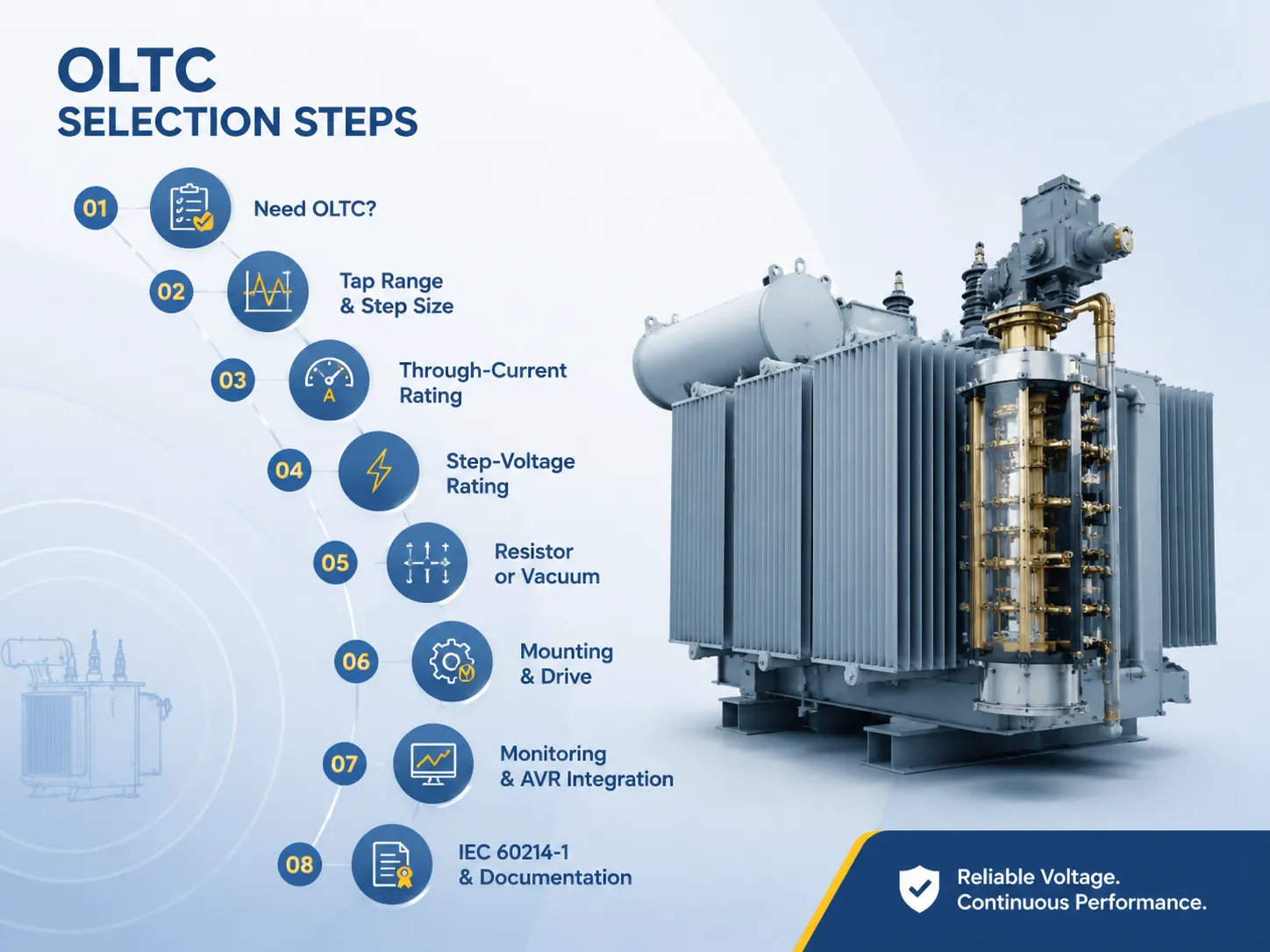
Procedimiento de selección paso a paso
- Evalúe si un OLTC es necesario. Si la fuente y la carga son estables, es posible que solo necesite tomas manuales, pero en el caso de un transformador de potencia, la regulación automática es casi siempre requerida.
- Determine el tamaño y el rango del paso de toma de acuerdo con la regulación interna del transformador y las fluctuaciones de voltaje.
- Determine la capacidad de corriente basada en la corriente máxima disponible durante la operación continua con sobrecargas.
- Verifique nuevamente el voltaje del paso con el voltaje de toma a toma del devanado regulador.
- Decida si usar resistores o vacío según el presupuesto, el dominio de aplicación y la frecuencia de conmutación.
- Identifique si se necesita montaje en torreón o en cabeza y decida sobre el accionamiento del motor, asegurándose de que soporte el voltaje correcto y los controles.
- Enumere los requisitos de monitoreo y los requisitos para la integración del regulador automático de voltaje, incluyendo la posición, contador, nivel de aceite y protocolos de comunicación.
- Asegúrese de que el certificado de la prueba de tipo y la prueba de proceso de acuerdo con IEC 60214-1 esté disponible, e incluya la designación del OLTC en el contrato.
Operación, Monitoreo y Mantenimiento
La necesidad de servicio del OLTC está mayormente influenciada por el tipo de OLTC y con qué frecuencia se enciende y apaga. Las recomendaciones incluyen:
- Realice un seguimiento de cuántas veces se ha operado el OLTC cada mes. Un OLTC utilizado en asociación con un transformador de potencia puede realizar de 1,000 a 10,000 conmutaciones al año; por lo tanto, los intervalos de mantenimiento deben calcularse en función del conteo de operaciones, en lugar de basarse en el número de años.
- En los OLTC de resistencias, el aceite de instalación del desviador debe considerarse por separado del aceite en el tanque principal, ya que se carboniza durante la operación de conmutación y se degrada mucho más rápido; filtre o reemplácelo según el intervalo especificado por el fabricante (~100,000 conmutaciones).
- En los OLTC de vacío, no ocurre contaminación durante la operación; por lo tanto, los intervalos pueden ser mucho más largos (~300,000 conmutaciones); aún así, el mecanismo y el accionamiento deben ser revisados en cada viaje importante.
- El par del accionamiento del motor, la posición del interruptor del relé AVR y la posición del indicador de posición deben verificarse cada año.
- Monitoree las temperaturas y presiones del aceite del desviador; un aumento en la temperatura indica un fallo en los contactos o un proceso de conmutación anormal.
- Registrar el contador de operaciones es lo más rentable, ya que cambia “realizar mantenimiento cada cinco a siete años” a “realizar mantenimiento cada 100,000 operaciones”, lo que significa una diferencia considerable para un transformador ocupado.
El mantenimiento requerido por diferentes diseños es drásticamente diferente. Los dos tipos principales de OLTC deben compararse en función de sus gastos.
| Elemento de mantenimiento | OLTC de tipo resistor | OLTC de tipo vacío |
|---|---|---|
| Intervalo de cambio de aceite del desviador | ~100,000 operaciones | ~300,000 operaciones |
| Tasa de carbonización del aceite | Moderada a alta | Muy bajo |
| Intervalo de inspección de contactos | En cada cambio de aceite | Cada 2º-3º cambio de aceite |
| Mantenimiento del accionamiento del motor | Igual para ambos (revisión anual) | Igual para ambos |
| Costo estimado de mantenimiento a 20 años | $8,000-$20,000 | $4,000-$10,000 |
Preguntas Frecuentes
¿Cuánto cuesta un cambiador de tomas bajo carga?
¿Qué rango de tomas debo especificar para mi transformador principal?
¿Cuál es la diferencia entre un cambiador de tomas de resistencia y uno de vacío?
¿Con qué frecuencia necesita mantenimiento un OLTC?
¿Puedo adaptar un cambiador de tomas bajo carga a un transformador existente?
Rara vez y rara vez de manera económica. El devanado regulador, el montaje en torreta, los espacios en el tanque y la refrigeración deben ser adecuados para el OLTC, y la mayoría de los transformadores de tomas fijas nunca fueron diseñados para uno. Si necesita regulación continua en una unidad existente, considere un transformador regulador de voltaje separado o un regulador de voltaje en serie en su lugar. De lo contrario, especifique el OLTC en la etapa de diseño.
Referencias
- IEC 60214-1 — Cambiadores de tomas, Requisitos de rendimiento y Métodos de prueba — El estándar central de OLTC que cubre pruebas de tipo y clasificaciones.
- IEC 60214-2 — Cambiadores de tomas, Guía de aplicación — Orientación para la selección de rangos, pasos y clasificaciones.
- IEEE C57.131 — Requisitos para Cambiadores de tomas de carga — Estándar de OLTC de América del Norte.
- MR Reinhausen — Portal de Cambiadores de tomas — La documentación y datos del ciclo de vida del fabricante líder de OLTC, VACUTAP/OILTAP.
- IEC 60076-1 — Transformadores de potencia, Requisitos generales — Contexto a nivel de transformador para la integración y prueba de cambiadores de tomas.
- Transformadores ABB — Referencia para la integración de transformadores y cambiadores de tomas.
Conclusión
Elegir el cambiador de tomas en carga para un transformador principal es un proceso basado en los hechos. La variación de voltaje y la regulación del transformador determinan el rango, mientras que la corriente del transformador y la capacidad de conmutación determinan la salida. Siempre que todo se haga correctamente, el OLTC funcionará durante muchos años.
- Calcule el rango de tomas utilizando los valores de voltaje reales y la regulación interna.
- Califique el OLTC de acuerdo con el rendimiento de sobrecarga, no solo con la clasificación en la placa.
- Opte por el tipo de vacío cuando se involucre conmutación frecuente y no haya personal.
- Siga los registros de rendimiento, registre el contador y mantenga el certificado de la prueba de tipo adjunto al contrato.