


OLTC represents the On-Load Tap Changer. While that may be enough info for one question, the abbreviation will not normally show up on its own. Instead, you will find it in transformer datasheet, tender specification or supplier quotation. Thus, instead of asking what it stands for, it is better to ask about the operation of this device, about its necessity and possible price.
Thus, let us see the whole issue in detail: interpretation of the term, what happens inside the tank, cases of OLTC application, how OLTC differs from tap changers used in the majority of standard distribution transformers, what numbers do they represent, and main producers of the devices as well.
An OLTC is a On Load Tap Changer, which is a mechanism that operates by changing a transformer tap position while it is still working. An OLTC is an important aspect of a transformer since it helps it maintain its voltage while the transformer is running. On the other hand, a common transformer uses OCTC, which is a type of tap changer where adjustments cannot be done unless a transformer is off. An OLTC can increase the transformer price by about 10-30%. The cost of the OLTC varies from $3,000-$30,000, depending on the voltage class and type, including distribution transformers that cost about $2,000-$8,000 and transmission transformers that cost about $15,000-$60,000. European company Maschinenfabrik Reinhausen (MR) is the leading manufacturer in this area, along with firms like Hitachi Energy, Siemens Energy, ABB, etc.
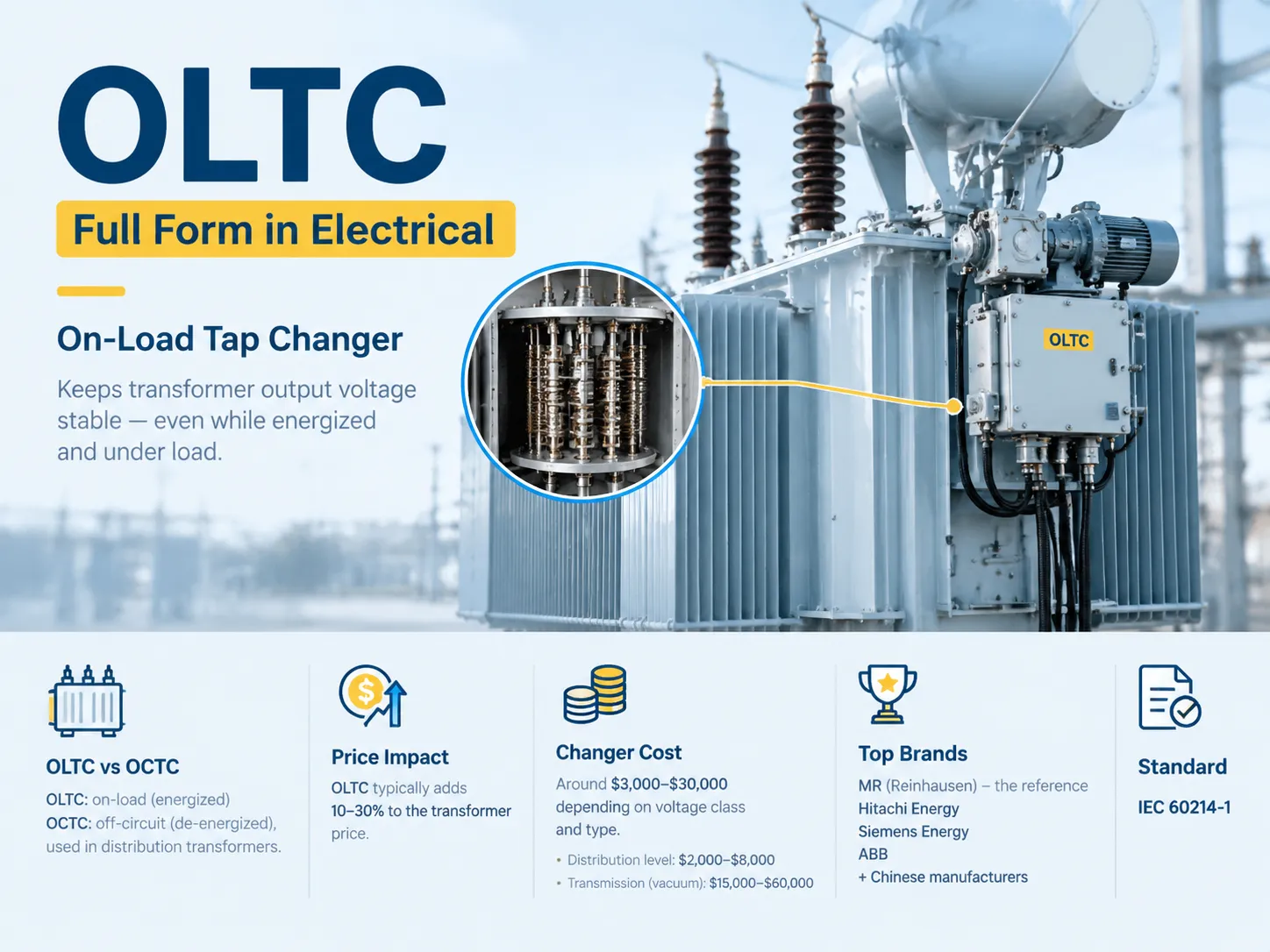
What OLTC Stands For, Word by Word
The three words of the description must be understood literally, which signifies that the full name is more than a simple trivia question.
- On-load means that the transformer does not turn off and continues supplying loads while tap changing happens. No outage, no switching out, no need to send a team to the site. This is the main purpose of the device and the reason it costs what it costs.
- Tap refers to the connection made on the high-voltage winding. Tap changing allows for changing the number of turns in the circuit, which will affect the turns ratio and, consequently, the output voltage. The idea is similar to the idea of fixed tap links on an ordinary distribution transformer, with the only difference being that an OLTC is designed to allow for rap changing during the current flow.
- Changer is the unit where all the mechanism parts are located: the motor-driving unit, vertical shaft, selector switch and diverters, along with the control cubicle to set the tap changing process. Modern designs often rely on using the diverter with vacuum interrupters instead of the oil-immersed contacts, which is responsible for recent price and maintenance improvements.
You will often come across the term “on-load tap-changing device” or “on-load tap-changing gear”, “OLTC transformer” used as a synonym for the transformer fitted with one. It means the same thing. In the old British and Commonwealth documents, it is often written as “on-load tap-changer”, and in North American where it sometimes is referred to as LTC (load tap changer).
What an OLTC Physically Does Inside a Transformer
The controller monitors the secondary voltage and when it goes out of a dead band — for example, if it strays by more than 1.25% from the required voltage — it kicks off the motor drive. The diverter switch operates, brief flow of current through some transition resistor or reactor takes place, and the tap selector moves to another tap. The diverter clings on to its new position.
The transition impedance reason is the entire engineering problem. One cannot just open the tap under load so the diverter creates a momentary controlled bridge with the help of the resistor or reactor that lets the current pass through.
The rest of the set-up is composed of the tap selector which is the make-before-break device that does not carry current itself; motor drive, gears; position indicator and limit switches, as well as an automatic control system, that connects all the other devices to the voltage relay, SCADA and remote commands.
The ordinary OLTC on the power transformer works with 8 or so +/– 1.25 %, thus it has 17 positional numbers and a degree of voltage adjustment of about +/- 10 %. However, there can also be made some other configurations such as 9 with +/- 1.67 % or 16 with +/- 0.625 %. The price depends on both the size of the step procedure as it impacts the leads used as well as the tap transformer view that must be connected to the switching element.
Where the OLTC Sits in the Transformer Family
We need to clarify the positioning of the device mentioned, as the term “OLTC transformer” is an ambiguous one.
The term OLTC does not refer to a kind of transformer but rather to a device that is attached to transformers and can be found in power transformers, large transformer substation transformers, rectifier transformers, and phase-shifting transformers. It will not be built into a small pole transformer or dry-type transformer simply because it would not be economically viable to install the OLTC on such transformers.
The general principle is that the bigger the transformer and the more the load varies, the more the OLTC is justified. A 40 MVA transformer connected to a substation where the load varies from 30% to 100% would be a proper use of an OLTC, but a 1,000 kVA transformer supplying power to a facility where the energy consumption is constant wouldn’t need the OLTC.
If you want the wider picture of how these units get classified — by function, by cooling, by application — that taxonomy is set out in this overview of how power transformers are classified and what each type does in the grid, and it’s a useful frame before you go shopping for a specific one.
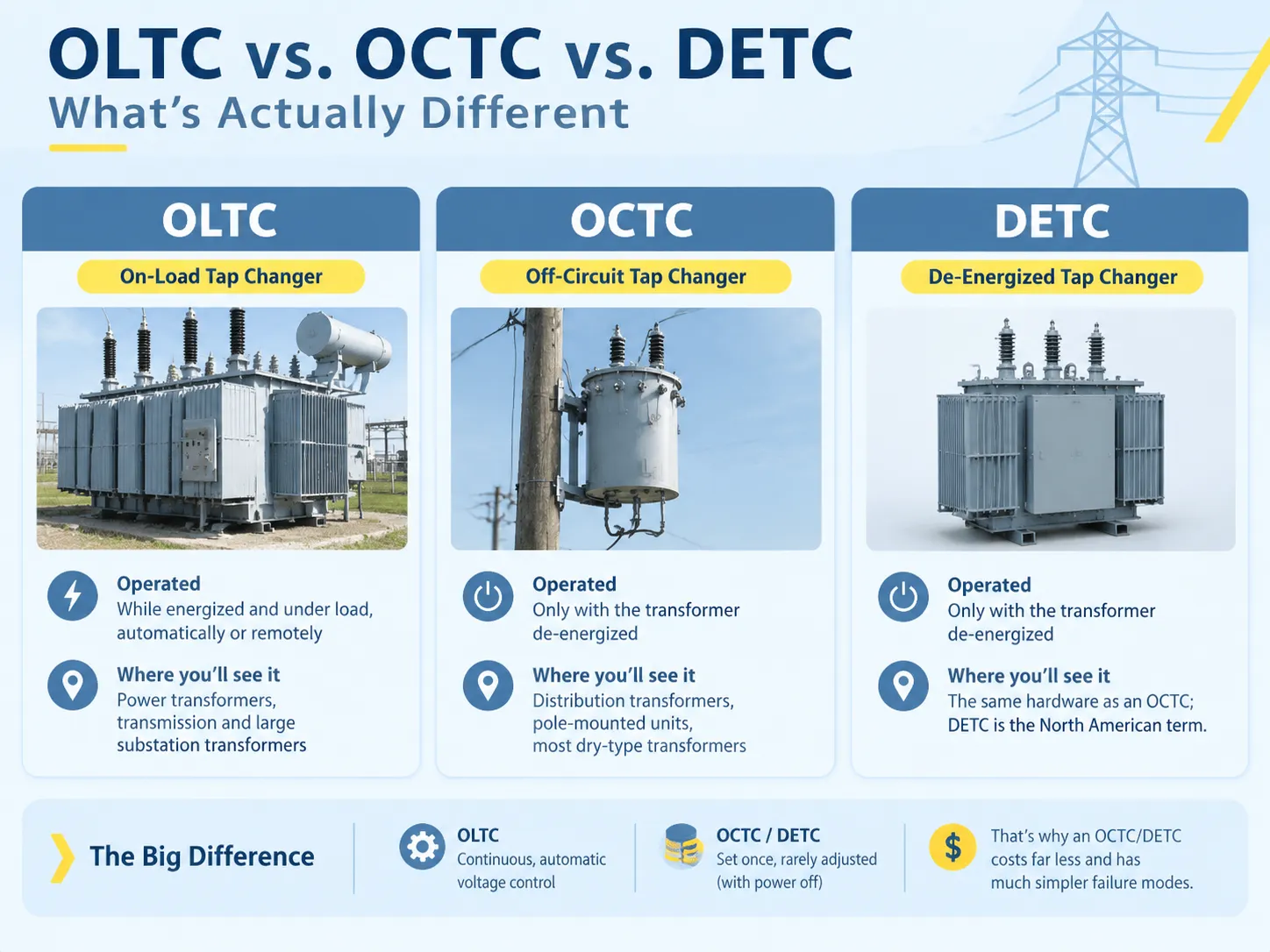
OLTC vs. OCTC vs. DETC: What’s Actually Different
This is where most confusion lives, and it’s worth a table.
| Устройство | Full form | Operated | Where you’ll see it |
|---|---|---|---|
| ОЛТЦ | On-Load Tap Changer | While energized and under load, automatically or remotely | Power transformers, transmission and large substation transformers |
| OCTC | Off-Circuit Tap Changer | Only with the transformer de-energized | Distribution transformers, pole-mounted units, most dry-type transformers |
| ДЕТК | De-Energized Tap Changer | Only with the transformer de-energized | The same hardware as an OCTC; DETC is the North American term |
OCTC and DETC are similar although the difference between these and OLTC is far from simple. The intuition behind an OCTC is that it consists of just switches that only alter their position when a system is first switched on or when there is a season change of voltage profile. The device consequently must be turned off and safely shut down beforehand.
In contrast, an OLTC performs this operation continuously. It reacts to changes in voltage in a matter of seconds. The control system can either be a fairly simple one that only consists of a voltage regulator with a time delay or it can be more complex, adaptive, taking into account power factor, circulating current of transformers connected in parallel or SCADA signals from the controlling system.
The practical aspect of this difference is the design aspect. Because OCTC is hardly changed and never under operational loading, there is no need in such characteristics as transition impedance, arc control or motor drive.
The Main Types of OLTC
Not all on-load tap changers are the same, so it’s important to be aware of the differences when selecting or replacing them.
- Resistor type. The diverter switch connects across a transition resistor for the switching process. Fast, compact, and the most popular design in Europe and Asia for both distribution and transmission.
- Reactance type. Uses an autotransformer as a preventive measure. It was dominant in the US market in the past but is slower and can handle high currents without losses caused by switching. Still frequently used in older and larger applications.
- Oil-insulated diverter. The diverter switch works in its own oil compartment. It is an old technology, reliable, but the oil needs to be replaced periodically after every operation because of degradation.
- Vacuum diverter. The sealed vacuum interrupters perform the current transfer process. It provides protection from current breaks because it is performed in no oil, thus providing longer operational periods but at a little higher price. It is widely used nowadays in the bulk prices.
- In-tank vs. separate compartment. In-tank technology shares the oil with the transformer, while separate compartment keeps diverter oil in isolation to prevent contamination. For heavily loaded transformers separate implementation should be chosen despite higher costs.
- Reversing vs. coarse/fine. The reversing mechanism has a smaller design and can provide a wide range of tap changing in one section; whereas coarse/fine implementation gives a wider range but requires more winding.
The choice of the right model should depend on its working frequency, required breaking current, and availability of maintenance access.There’s a longer treatment of the trade-offs in this transformer tap changer selection guide if you’re at the point of comparing specific configurations rather than just understanding the categories.
Where OLTC Transformers Are Used
Voltage control is required constantly.
- Transmission substations where high voltage (220 or 110 kV) is changed to low voltage in order to deliver electricity to an everchanging load.
- Long rural feeders where voltage drop is big and demand varies according to the season or irrigation regime.
- Transformation stations for renewable generation since output of solar and wind plants fluctuates much quicker than that of traditional load, so the voltage needs to be kept within narrow limits.
- Traction and railway transformers due to constant variation of the load during train movement.
- Electric arc and rectifier transformers since big current load fluctuations happen all the time and result in continuous need for adjustment of voltage.
- Phase shifting transformers where electric parameters are managed using transformers with changing tappings.
An example from manufacturing will clarify this issue much better. A unit like this SZ11 31,500 kVA 35/10.5 kV oil-immersed on-load voltage regulating transformer is built specifically for the case where a 35 kV incoming supply has to deliver a stable 10.5 kV to a distribution network whose load varies throughout the day. That’s an OLTC application in one component and one sentence.
What an OLTC Costs
The price varies widely among various manufacturers in terms of rating, voltage class, and current, but the general frame of costs remains stable enough to perform assessments.
| Артикул | Typical range (USD) | Примечания |
|---|---|---|
| OCTC / DETC (off-circuit) | $500–$3,000 | The baseline. No motor drive, no transition impedance |
| Distribution-level OLTC (≤33 kV) | $2,000–$8,000 | Oil-insulated diverter, typically 9 to 17 positions |
| Transmission-level OLTC (≥110 kV) | $15,000–$60,000 | Vacuum types sit at the upper end |
| Resistor or vacuum type, mid-range | $6,000–$35,000 | Driven mainly by current rating and step count |
| OLTC as a share of transformer price | +10–30% | Compared with +2–5% for an OCTC |
| OLTC increment on a 10 MVA transformer | $10,000–$25,000 | Depends heavily on whether vacuum or oil diverter |
The first point to discuss concerning the table is that the cost of the changer is not all included in the price of an OLTC transformer. Apart from the changer, an OLTC transformer has to be equipped with a tap winding, its leads, a motor with a control unit, and so on, so if we evaluate the gap in terms of price per kVA, then it is observed that the OLTC as compared to the OCTC transformer costs much more.
The lubricant or oil for the oil lantern should not be considered as an irrelevant item as it requires frequent checks of the oil and sometimes its replacement. Thus, with every 50,000 to 100,000 operations, it has to be replaced every three or five years (depending on the load). The vacuum type of transformers extends this interval, which is why they allow to achieve savings in the cost over its lifespan.
To give an example of the costs, OLTC transformers of capacity 20 MVA and voltage of 110 kV typically cost 430,000-700,000 EUR from major European manufacturers, below 450, 000 EUR from Schneider, and below 320,000 EUR from Chinese manufacturers.
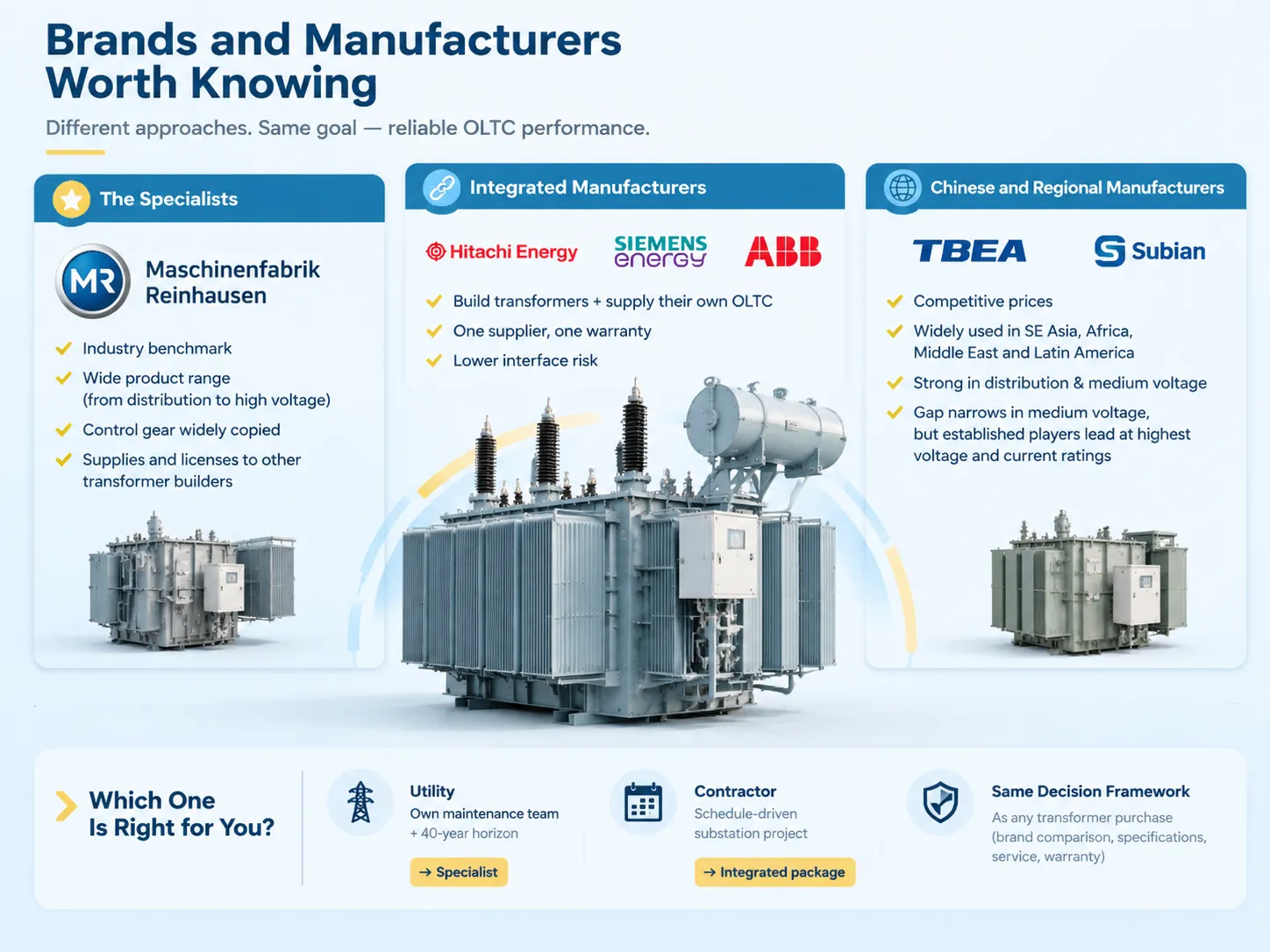
Brands and Manufacturers Worth Knowing
There are two very distinct categories of producers, and their customers generally must decide which one to go for.
Specialists. The Maschinenfabrik Reinhausen company is regarded as the market leader of the entire industry. If, in the call for tender, the specification reads “OLTC by MR or equal”, it signifies what exact product is intended. This manufacturer’s product portfolio includes everything from oil diverter products designed for the distribution voltag to vacuum devices suitable for the highest voltage classes, and their devices are widely imitated. Moreover, Reinhausen is engaged in licensing and supplying transformers to other manufacturers, which is why you can find tax changers of this manufacturer among transformers offered under various labels.
Integrated producers. Companies like Hitachi Energy, Siemens Energy and Alstom manufacture transformers and supply tap changing devices as one package. Hitachi Energy is particularly well known for this. This experience allows it to produce transformers along with tap-changing devices that comprise the product list offered. What is the key advantage of this approach? It is the single supplier who is responsible for the single warranty — a crucial benefit for the project with high uncertainty related to the interfaces.
Chinese and regional manufacturers. Due to their attractive price, TBEA, Subin and some other companies became successful in producing OLTC transformers. Due to their affordability these transformers can be applied in various projects implemented throughout Southeast Asia, Africa, Middle East and Latin America. The competition became fiercer with respect to medium voltage transformers, while the long-established specialists still retain the competitive edge in high voltage products and service network.
The primary consideration when making your decision should be the place where transformers will be delivered to and serviced. Companies that have well-developed infrastructures and capable personnel for maintenance usually opt for products manufactured by specialists. General contractors working at time-constrained projects usually prefer to purchase integrated products. Either way, the brand comparison exercise is the same one you’d run for any transformer purchase, and the frameworks in this buying guide for oil-immersed transformers with brand recommendations apply directly to OLTC-fitted units.
How to Specify One Without Regrets
If you’re developing a specification, the following parameters will determine whether you’ll get a practical device or merely an expensive ornament:
- Voltage regulation range and step size. Start with considering how much the supply voltage will fluctuate. A variation with a 10% accuracy range and a fluctuation of about 1.25% is what is needed in the majority of cases. Transmission and renewable connections may require higher accuracy or wider range.
- Number of operations per year. This number will determine whether to choose oil or vacuum, and whether to use tank installation or separate compartment. If a transformer is rated for 300,000 operations but is expected to run 20 cycles a day, it’ll mean regular servicing.
- Through-current through diverter. Voltage regulation is about breaking current load not only voltage. When it comes to this matter, oversizing is inexpensive compared to replacing contacts since it costs much less.
- Control philosophy. Will you have a stand-alone voltage regulation with a dead zone and time delay or coordinated control with parallel transformers and SCADA? The latter requires ensuring that control cubicles in both variants function properly and switching gears regulates current effectively.
- Parallel operation. In order to run two transformers in parallel, running both at the same tap position is necessary, and hence the need for either master-slave control or controlling circulating current in advance.
- Maintenance access. Having a separate tank might be costlier but make diverter service possible without draining the main tank. On a remote site, this might be the only deciding factor.
- Proof of compliance with the standards. You need to check documents in compliance with IEC 60214-1. Be not satisfied with copies of certificates and ask data on type test.
There is a longer walkthrough of these choices in this guide on how to select the on-load tap changer for a main power transformer, including how step size interacts with the tap winding and how the operating duty class should be matched to the project. If you’re specifying for the first time, start there rather than with the price list.
Часто задаваемые вопросы
What is OLTC and OCTC?
OLTC stands for On-Load Tap Changer, while OCTC stands for Off-Circuit Tap Changer. The difference between the two is that OLTC operates while the transformer is energized and in operation; it will use motorized drive, a selector switch, and a diverter switch that works under transition resistance, which ensures that the current is not broken. An OCTC can operate only when the transformer is turned off and safe; thus, it will work using the link that is made at commissioning. OLTC is installed in transformers that ensure the continuous control of voltage in the system; whereas OCTC is installed in distribution transformers since it is more cost-efficient.
What are the types of OLTC?
The first distinction is in terms of the method of switching from one state to another with use of transition resistors in the case of the resistor type, which is commonly used in Europe, Asia, and the hybrid type using an autotransformer. Furthermore, the division is based on the switching medium and thus to oil insulated switching systems with the switching contacts located in the oil and taking special care of it, while there is the vacuum type of systems in case of which the switching is made by using enclosed vacuum interruptions and no routine maintenance is necessary. Construction-wise, the systems are divided into either in-tank or separate-compartment units, and depending on the design there might be linear, reversing and coarse/fine taps.
What is the difference between RTCC and OLTC?
The OLTC is the actual switching apparatus and the RTCC represents the layer of controls that tells it what to do. The RTCC or Remote Tap Changer Control (also known as Remote Tap Changer Controller) is an electronic relay or controller that receives the secondary voltage, compares it with the desired value and dead-band, implements a time delay on the operation in order to ignore temporary voltage drops, and produces “raise” or “lower” commands for the motor assembly. Some RTCCs carry out the operation of coordination of transformers in parallel, line-drop compensation as well as SCADA communication. So RTCC is not an alternative to OLTC — it is the unit that provides automatic function of the OLTC. You can use OLTC without a sophisticated RTCC — a simple voltage relay will suffice, but it is impossible to have automatic operation without both devices.
What does OLTC mean?
On-Load Tap Changer is referred to as OLTC. In electrical engineering, the term “on-load” emphasizes that the equipment is functioning while the transformer is energizing and transmitting current. This deviates from the term “off-circuit” or “de-energized” since those terms indicate that the transformer has to be turned off first and be isolated from other components. The tap changer is the equipment used for selecting the point of connection of the winding. It changes the connection point in order to modify the number of turns, which also in turn enables voltage modification. Consequently, OLTC is translated into “a device that makes taps changes while the transformer is under load.” The equivalent acronym used in North America is LTC (load tap changer).
Can an OLTC be retrofitted to an existing transformer?
In a technical sense retrofitting is possible, but for a practical application it does not really make sense. Retrofitting can be described as an operation involving opening up the tank to replace the wire and insulate the leads, installing a driving motor and a separate compartment to actually rerun the control circuit. What is more, the costs involved in retrofitting may exceed a big part of the price of a transformer of the same rating and it also means giving up all the state of affairs concerning factory type tests. In situations when voltage control during operation is really needed but the transformer can only provide OCTC, some of the options include installing a separate regulator, using the booster transformer or changing the transformer with a new one at the end of its technical lifespan.
Ссылки
- IEC 60214-1 — Tap-changers, Part 1: Performance requirements and test methods — the governing standard for on-load and off-circuit tap changers
- Машиностроительный завод Рейнхаузен (MR) — manufacturer information and technical literature on on-load tap changers
- Hitachi Energy — Transformers — integrated transformer and tap changer solutions
- Siemens Energy — industry context on equipment design and environmental regulation
- Министерство энергетики США — grid equipment, transformer supply and reliability reporting
- National Electrical Manufacturers Association (NEMA) — electrical equipment standards and industry data
Заключение
OLTC denotes the On-Load Tap Changer. If the reader only recalls one sentence from this text, then that should be this one: it is the device that allows a transformer to self-correct its output voltage while current is still flowing; this is an outstanding feature compared to simple tap links of a standard distribution transformer.
The practical facts one needs to keep in mind while having a specification dialogue are as follows: expect to have ±8 up to ±16 steps with the step being between 0.625% and 1.67%; the price of the changer would range between $3,000 and $30,000 and would make the transformer cost by about 10%-30% more expensive; expect to see that while oil-insulated diverters would require servicing every few years, vacuum ones would serve for much longer; the standard you should be held to should be IEC 60214-1; and the name of MR Reinhausen will always be used as a benchmark.
The question of whether or not you need an OLTC boils down to one question. Is the voltage at the supply point fluctuating enough and often enough that you cannot regulate it by other means? In case the load profile is steady and the supply is stable, it is better to use an OCTC and spend money elsewhere.