


5人のエンジニアに、パワートランスと配電トランスの違いを尋ねると、5つの異なる答えが返ってきます。例えば、あるプロジェクトでは、2,500-kVAのパッドマウントが配電トランスと呼ばれる一方で、別のプロジェクトでは同じ機器が小型パワートランスのカテゴリーに属します。この記事では、基準における定義、これらの定義の実際の影響、および名板、冷却クラス、または問題の設置の写真に基づいて、特定のトランスがどのカテゴリーに該当するかを特定する方法を検討します。.
要するに:パワートランスは、送電レベルからサブ送電レベルに高容量の電流を伝送します。その標準電圧レベルは33 kV以上から始まり、500 kVAから数百MVAの電力レベルで運用され、最大容量で90-100%の負荷を通過します。一方、配電トランスは、中電圧から低電圧に変換し、35 kVAから500 kVAの範囲で、主電圧は11 kVから35 kV、トランスの二次電圧は約230-480 Vであり、その運用は50%から75%の負荷レベルに基づいています。なぜなら、負荷は一定ではないからです。Subian社は、配電クラスの油浸トランスと乾式トランスを製造しており、その製品ラインは主に配電クラスのトランスで構成されています。.
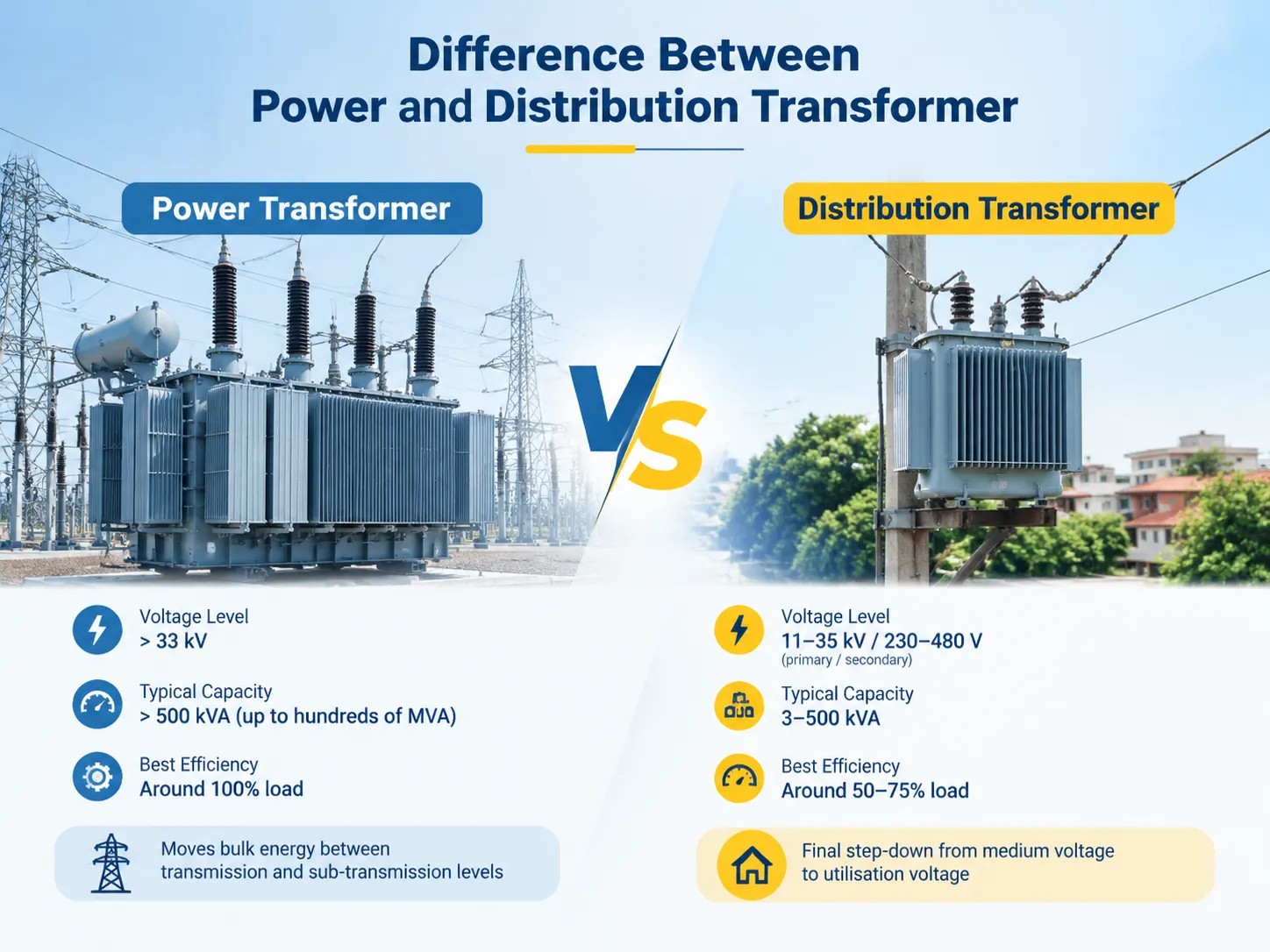
それらを区別する最も明確な方法:チェーン内の位置
名板のことは一旦忘れて、ユニットの位置に注目してください。発電ユニットは、発電施設で送電電圧レベルに上昇します。送電ユニットは、その電圧を全国に運びます。その後、サブ送電と主配電が段階的に電圧を下げます。最後の減少を担当するトランス、つまり建物や通りに電力を供給するトランスは、そのkVAに関係なく配電トランスです。.
最後の減少の前のすべて、発電機の昇圧ユニットから相互接続サブステーションまでがパワートランスです。消費者に直接リンクしていません。パワートランスがオンになっても、単一の人のために光が減少することはありませんが、地域全体にとっては減少します。このエンドユーザーとの接続に関するこの単一の事実が、デューティサイクルからユニットのサイズに与えられる重要性まで、ほぼすべての設計の偏差を説明します。.
電圧と容量:業界が境界を引く場所
IEEE 141は、従来の容量分割を説明しています。それによれば、配電タイプの容量は3 kVAから500 kVAの間にあり、パワータイプは500 kVAから始まるすべての容量をカバーします。同様に、液体浸漬トランスの一般的な要件を定めたIEEE C57.12.00標準も、トランスのタイプに対する同じ境界値を持っています。これは、受け入れられた標準が残ることを意味しますが、製造業者や現場で実際に作業を行う企業の間でわずかな偏差があります。.
| パラメータ | 電力トランス | 配電トランス |
|---|---|---|
| 主電圧 | 33 kVから765 kV | 11-35 kV(米国クラス15 / 25 / 35 kV) |
| 副電圧 | 送電ノードでの33 kVから220 kV | 230-480 V(480/277 V、208/120 V、400/230 V) |
| 定格容量 | 500 kVA以上;一般的には5-500 MVA | IEEE 141によると3-500 kVA;実際には最大2,500 kVA |
| 電圧クラス | HVおよびEHV | MV一次、LV二次 |
| どこに存在するか | 発電所、送電変電所、相互接続 | ポール、パッド、ボールト、屋内電気室 |
| 誰にサービスを提供するか | ネットワークとユーティリティ | エンドユーザー、建物、軽工業 |
この分野では、電圧のカテゴリーが最も信頼できる識別ツールと見なされています。利用される二次電圧が利用電圧の範囲に入る場合、私たちは配電変圧器を扱っています。逆に、両方の巻線が送電レベルで動作している場合、私たちは電力変圧器を扱っていますが、図面では非常に小さいサイズであることを示しているかもしれません。.
稼働サイクルと効率:実際にコストがかかる違い
人々は鉄損失と銅損失の重要性をほとんど過小評価しています。鉄(無負荷)損失は24時間365日継続的に発生し、銅(負荷)損失は瞬時の電流の二乗に依存します。電力変圧器はその名札定格に非常に近い状態で継続的に動作するため、設計者は最大負荷時に銅損失と鉄損失を等しくし、コアを減少させるためにフラックス密度を高くします。配電変圧器は継続的に動作しますが、ピーク時のみエネルギーを提供するため、設計者は鉄損失を最小限に抑えることに取り組み、最大負荷時には銅損失が優位になることを受け入れます。配電変圧器の効率は約50%-75%です。.
そのため、フルロードによって計算された通常の効率は配電装置には全く正しくありません。24時間の総エネルギー出力を変圧器の総エネルギー入力で割った全日効率がこの状況にはより良い選択肢です。300Wの鉄損失と1,200Wの銅損失を持つ100kVAの変圧器は、瞬時の効率が変動しても現実的な負荷サイクルにおいて98.7%の全日効率を示すことができます。.
そのため、電力とその正しいサイズ設定は、通常予想されるよりも配電側で非常に重要です。ユニットが過剰サイズの場合、鉄損失は決して動作しないユニットに作用します。変圧器が過小サイズの場合、銅損失はピーク時にペナルティをもたらします。負荷プロファイルは、ピーク需要だけでなく、kVAの選択を駆動すべきです。 適切な負荷計算 通常、接続負荷が示唆するよりも小さいユニットに落ち着きます。.
見える設計の違いと測定できる違い
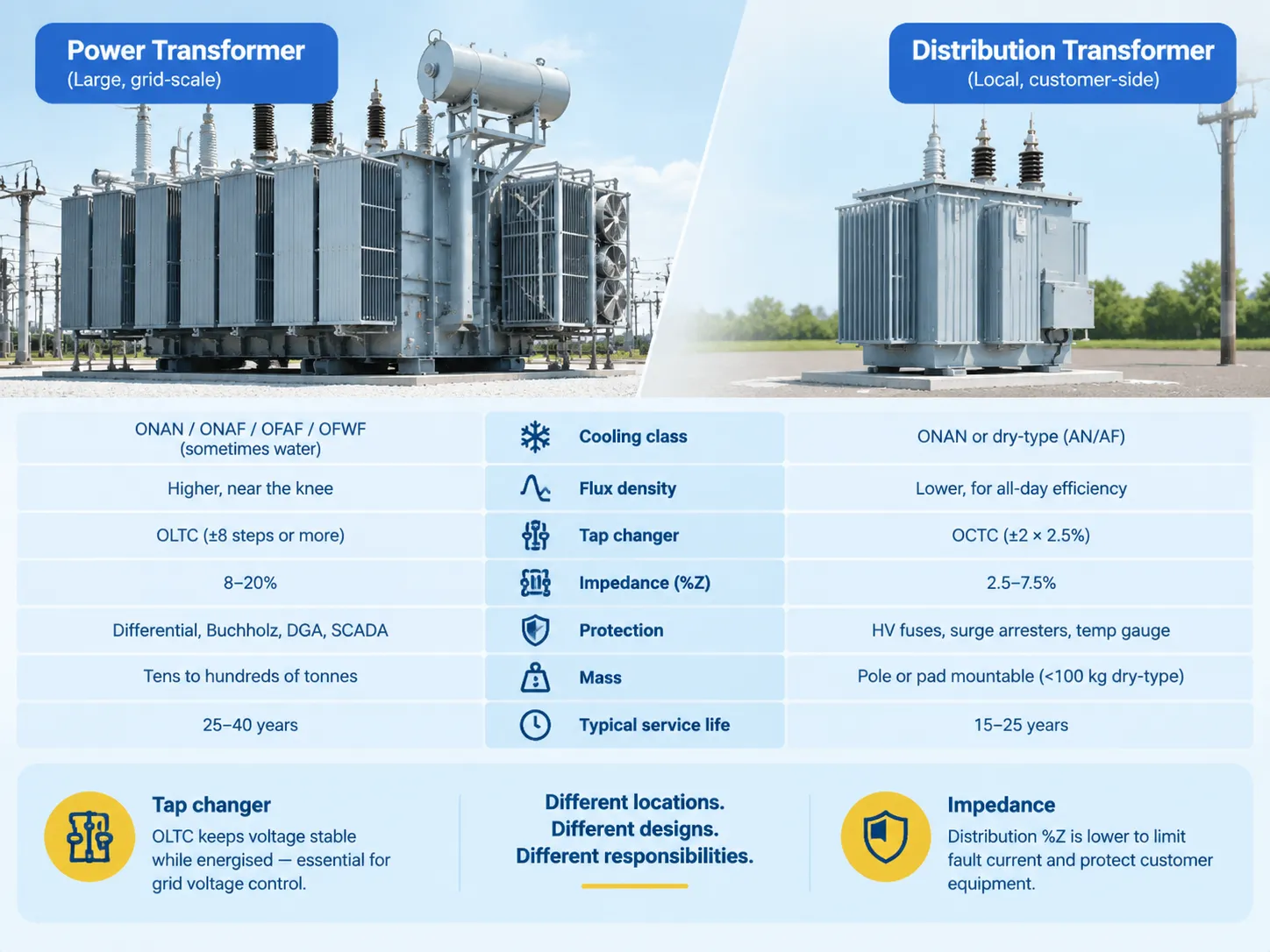
トランスに近づくと、多くの設計要素を見ることができます。パワートランスは、大型の油-filledコンテナで、コンザーバー、ラジエーター、ブリーザー、そして時には自然冷却(ONAN)から始まり、負荷や周囲の温度に応じてONA、OFA、またはOFWFなどの複数の冷却方法を備えています。どちらのファミリーに最終的に決まるかは、負荷によるのではなく、ユニットの位置によって決まることが多いです。 油浸型トランスと乾式トランス 完全に異なる防火およびメンテナンスの義務を負います。.
| 設計面 | 電力トランス | 配電トランス |
|---|---|---|
| 冷却クラス | ONAN / ONAF / OFAF / OFWF、時には水 | ONANまたは乾式(AN/AF) |
| フラックス密度 | B-H曲線の膝付近で高い | 一日中効率とトレードオフされる低い |
| タップチェンジャー | 負荷時タップチェンジャー(OLTC)一般的で、しばしば±8ステップ以上 | オフ回路タップチェンジャー(OCTC)、通常±2 × 2.5% |
| インピーダンス(%Z) | 故障調整とグリッド安定性のために選択され、しばしば8-20% | 故障電流を制限し、電圧降下を制御するために選択され、一般的に2.5-7.5% |
| 保護 | 差動保護、ブッフホルツリレー、DGA、SCADA統合 | HVヒューズ、サージアレスタ、温度計、時折リモートセンシング |
| 質量 | 永続的な基礎の上で数十トンから数百トン | ポールまたはパッドに取り付け可能で、時には乾式トランスで100 kg未満 |
| 典型的なサービス寿命 | 25-40年 | 15-25年 |
これらの行の最初はタップチェンジャーに関するもので、OLTCはトランスが通電中に電圧を制御できることを意味し、これはユニットが地域全体の電圧プロファイルを制御する必要がある場合に便利です。配電トランスの場合、設置時に設定され、その後は忘れられます。なぜなら、ピーク負荷時にタップを調整するために近隣を切り離したくないからです。次の行ではインピーダンスについて説明しています。その値は、顧客のサービス機器に到達する故障電流が制限されるように選ばれます。これが、500 kVAユニットの%Zが同サイズのパワートランスよりも通常低い理由でもあります。.
Types and sub-classes on each side
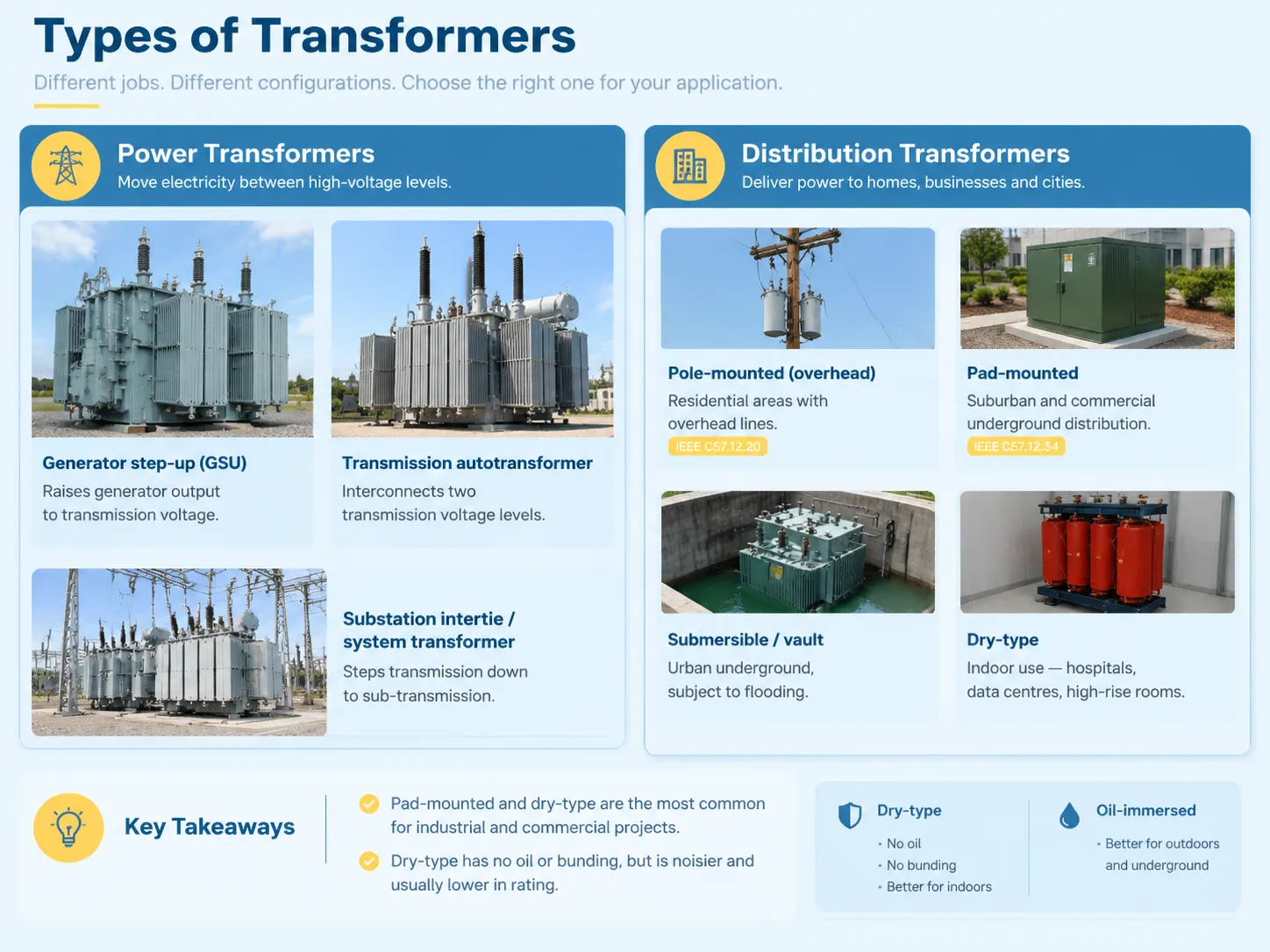
Neither category is monolithic, and the sub-classes tell you what the unit is for before you read a single rating. Pad-mounted and dry-type 配電トランス configurations account for the large majority of industrial and commercial enquiries, so those are the two rows worth knowing properly.
| クラス | Common types | 一般的な使用 |
|---|---|---|
| 電力 | 発電機ステップアップ(GSU) | Raises generator output to transmission voltage |
| Transmission autotransformer | Interconnects two transmission voltage levels | |
| Substation intertie / system transformer | Steps transmission down to sub-transmission | |
| 配電 | Pole-mounted (overhead) | Residential areas with overhead lines; IEEE C57.12.20 |
| パッドマウント | Suburban and commercial underground distribution; IEEE C57.12.34 | |
| Submersible / vault | Urban underground, subject to flooding | |
| 乾式 | Indoor use — hospitals, data centres, high-rise electrical rooms |
The dry-type row is also important. There is no oil to ignite firstly and no bunding needed, making dry-type distribution transformers the best candidate for indoor use where a liquid-filled transformer would have to comply with fire separation rules. The downside, however, is the noise level and the fact that dry-type transformers are mostly meant for lower ratings in the same footprint. Therefore, it is usually the building code and not the engineer that decides on putting a dry-type transformer over a liquid-filled one.
Standards and testing: what changes with the class
Classes have the same origins, though their contents differ from one another. IEEE C57.12.00 deals with the basic requirements for liquid transformers. IEEE C57.12.10 is intended for power transformers while IEEE C57.12.20 is meant for overhead transformers and IEEE C57.12.34 is meant for pad-mounted transformers. Internationally the role of these documents is undertaken by IEC 60076 and ANSI/IEEE standarts are being referred to in case of American utility involvement.
There are two regulatory actions that may be taken with respect to a distribution equipment that are very rarely addressed in case of power #transformer #specification. The first one is energy efficiency regulation; in the USA the DOE energy efficiency regulations apply to distribution equipment and the reason is that it is necessary to indicate tested no load and load losses with the relevant tolerances. That wording turns a transformer specification sheet into a contractual document rather than a brochure, and the guaranteed loss figures are what the factory test gets measured against.Another benefit is that the production of the distribution units is carried out in bulk so that they are subject to the same compliance for all usages as opposed to having to undergo different on-site verifications. This leads to the fact that it is much more important to obtain the certificate of tests than to get a marketing brochure.
Whatever type you are purchasing, you need to request the routine testing list according to the specifications: ratio and phase relationship parameters, short-circuit impedance (impedance measurement), no-load losing, load losing, and insulation resistance values. Ask for the actual routine testing certificate that corresponds with the serial number as opposed to a type testing report issued for the family of products.
Where the boundary genuinely blurs
Here are three points which make the 500 kVA line confusing for people involved in production assistance.
First, large distribution. Utilities do order 1,000, 1,500 or 2,500 kVA pad-mounted transformers in any distribution feeder. By IEEE 141 definition, these units are classified as power transformers, but their functional, installed capacities and design intentions should suggest that they belong to distribution transformers category. Generally speaking, one can say practice in the USA is more focused on functionality than classification.
Second, step-up transformers on generating facilities. For instance, a 1,500 kVA transformer that steps up voltage from 480V to 13.8 kV at a solar facility can be either power or distributions transformer. It all depends on specification made by a customer with regards to required operational features of a unit including cooling class, presence of tap changer, level of impedance, etc.
Third, vector groups and interconnection. Once you are paralleling transformers, vector group compatibility becomes the governing constraint regardless of class, so two units of similar rating from different classes can be electrically incompatible while two units from different decades sit happily in parallel. Get the vector group wrong and the circulating current will find it, so this is a configuration question, not a class question.
Which one do you actually need?
Start with the load’s requirements. If the secondary voltage corresponds with the one used by the equipment, you will need to use a distribution transformer, which means that the process of its selection will be a simple calculation based on the load profile, where through the kVA, one can evaluate the peak load, future growth of the load, and choose the cooling system and mounting solution.If at both sides of the transformer the voltage is the current voltage, then the transformer is considered a power transformer because the unit’s main purpose is connecting the systems rather than fulfilling its function as per the load. This means that the specification process will depend on fault level and impedance.
There are two major mistakes that are usually made while buying a transformer: the first is buying an undersized transformer that is unable to serve peak loads, and the second one is buying a unit on power transformer specifications, when actually it is possible to buy a distribution transformer, which will also cover the load.
The problem can be avoided by conducting a thorough study before making any purchasing decisions.
Subian produces a range of products in the segment of distribution equipment such as distribution transformers, instrument transformers, and neutral grounding systems. The company has no power transformers in stock and we will inform the clients about it in case of a project that needs one. In case when there is a necessity to create a load profile, we will fulfill this requirement together with the necessary test results.
よくある質問
What are the four main types of transformers?
There are four well-known categories of transformers based on their working principle. The classification more helpful to buyers segments transformers into power transformer, distribution transformer, instrument transformer (current and voltage) and dry-type transformer. In most cases industrial projects involve the use not of power transformers but of the last three transformer types.
What is the purpose of a distribution transformer?
This stage performs the last stage of reduction of voltage before electricity reaches the end user as it steps down medium voltage from the distributor to a utilization voltage like 480/277 V, 208/120 V or 400/230 V. Since it connects directly with the loads here, it is designed to be efficient at any point in the load curve that varies from a few percent to full rating every day.
What’s the difference between a transformer and a power supply?
A transformer alters alternating current (AC) voltage relying on electromagnetic induction only; it does not do anything else since transformers do not provide regulated output or rectified electricity, which only brings altered AC voltage. A power supply employs a transformer or a switching stage together with components responsible for the processes of rectification, filtering, and regulation; thus, it is capable of generating electricity of required quality to ensure that electronics can receive constant input signal.
What are the different types of distribution transformers?
Overhead units are designed to be mounted on poles, pad-mounted types to be used in underground distributions, vault or submersible types can be employed for said purposes, and dry types can be used indoors. Another aspect is that all of these categories have single-phase and three-phase types. The preferred type of mounting is often decided by the locality, the specifications and requirements for the unit, as well as the practices of the local utility.
Can a distribution transformer be used as a power transformer?
Not in a safe way while moving backwards. A distribution unit is not constructed for the voltages, short-circuit currents and continuous load application of transmission installations. A failure in design will lead to an emergency when one is used here as the impedances and protection settings of the other elements will be not valid.
Does a power transformer always have an OLTC?
Generally, however not always. On-load tap changing is prevalent as power transformers frequently regulate the voltage status of the entire network. Some intertie and generator step-up units use off-circuit tap changers or fixed ratios combined with additional regulation, making the OEM specifications the only firm reference source.
参考文献
- IEEE — C57.12.00 General Requirements for Liquid-Immersed Distribution, Power and Regulating Transformers
- IEEE — C57.12.20 Overhead-Type Distribution Transformers
- IEEE — C57.12.34 Pad-Mounted Compartmental-Type Distribution Transformers
- IEEE — IEEE 141 Recommended Practice for Electric Power Distribution for Industrial Plants
- IEC — IEC 60076 Power Transformers series
- US Department of Energy — Distribution transformer energy conservation standards
- UL Solutions — Transformer listing and certification reference
結論
The simplified interpretation indicates that a:Transmission transformer connects systems at transmission voltages and is tailored for continuous use at full capacity;Distribution transformer completes the final reduction of voltage before distribution and is designed for varied usage;While size provides a decent guide at a level of 500kVA, it is actually voltage category and duty cycles that prove to be the best references in practice.
In most cases, however, the real work of users takes place on the distribution side where the issues behind matching the transformer to load profile, cooling and mounting set-up as well as checking losses against the set efficiency requirements is performed. If you deal with a project of 1,000-2,500 kVA that oversteps the line between the two categories, make sure you get the specification written according to a function rather than type, and demand a routine testing certificate prior to releasing the equipment from the factory.