


In many electrical setups in places, such as hospitals, skyscrapers, data centers, and wind turbines, two names appear most of the time: the Schneider Trihal transformer and the Siemens GEAFOL transformer. For engineers who have chosen these units for their projects, they are familiar with them for their proven and fire-safe performance as flagship cast-resin dry-type transformer technologies in the industry. When it comes to international clients and energy companies, they always wonder what technology is more suitable for their projects from the point of view of voltage, environment, and cost rather than which brand is known better to the general public.
The purpose of this article is to compare the two brands, namely construction and the vacuum casting technology, voltage and power capabilities, measuring the partial discharge behavior, and the categorizing according to the IEC 60076-11 standard the fire and environmental safety level. Furthermore, this article explains what the buyers need to look for there rather than limiting their choice to the logos of the brands considered in the industry.
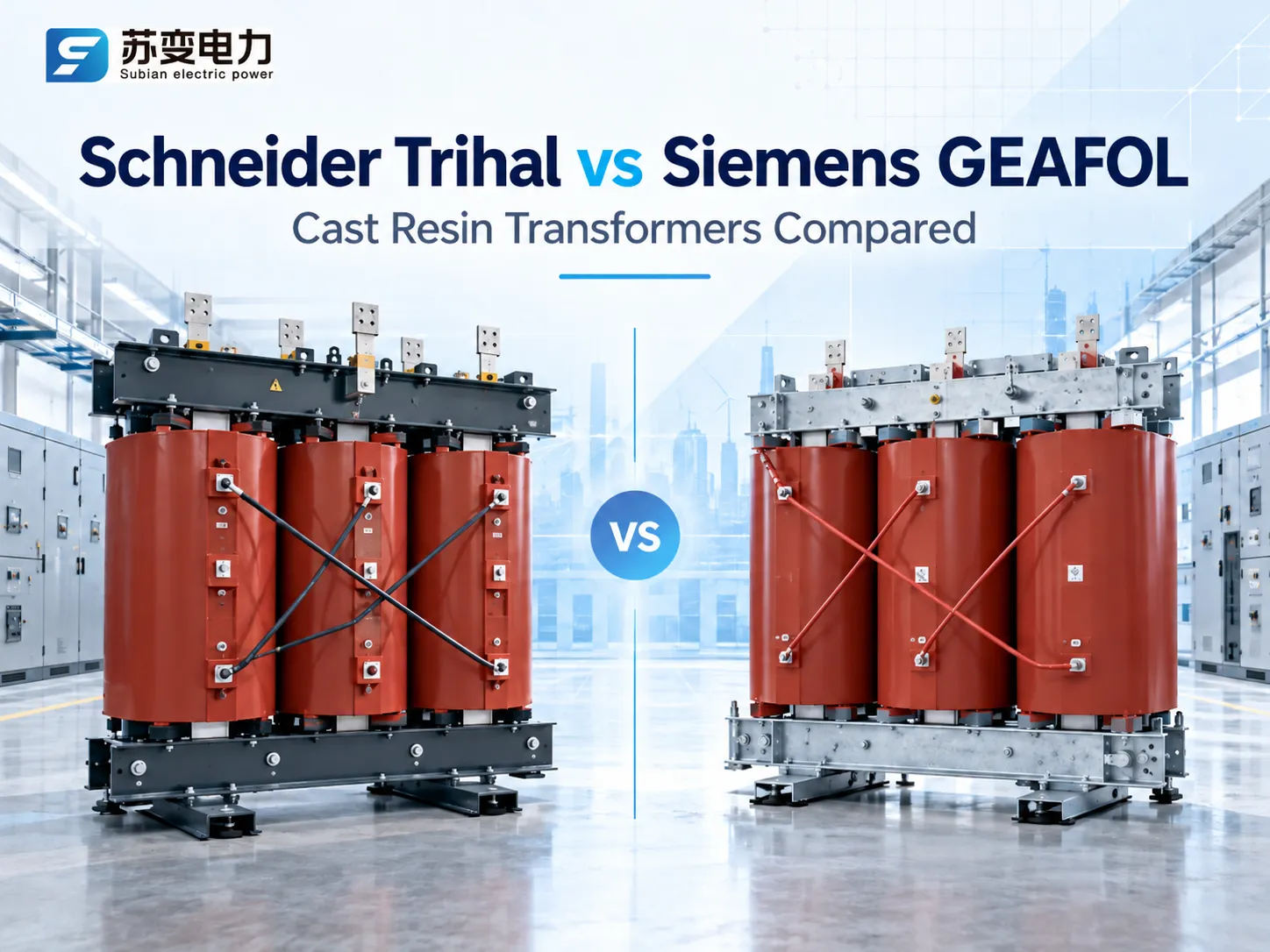
Cast Resin Transformers: What Makes Them Similar
Before comparing the two brands, it is better to focus on the aspects they have in common, which are shared to a large extent. In essence, cast resin transformer is considered a dry transformer, where the mediumSince no oil is present, installation of these transformers can take place indoors, near the load, or even in working zones.
The Process of Making Epoxy Resin Cast Windings
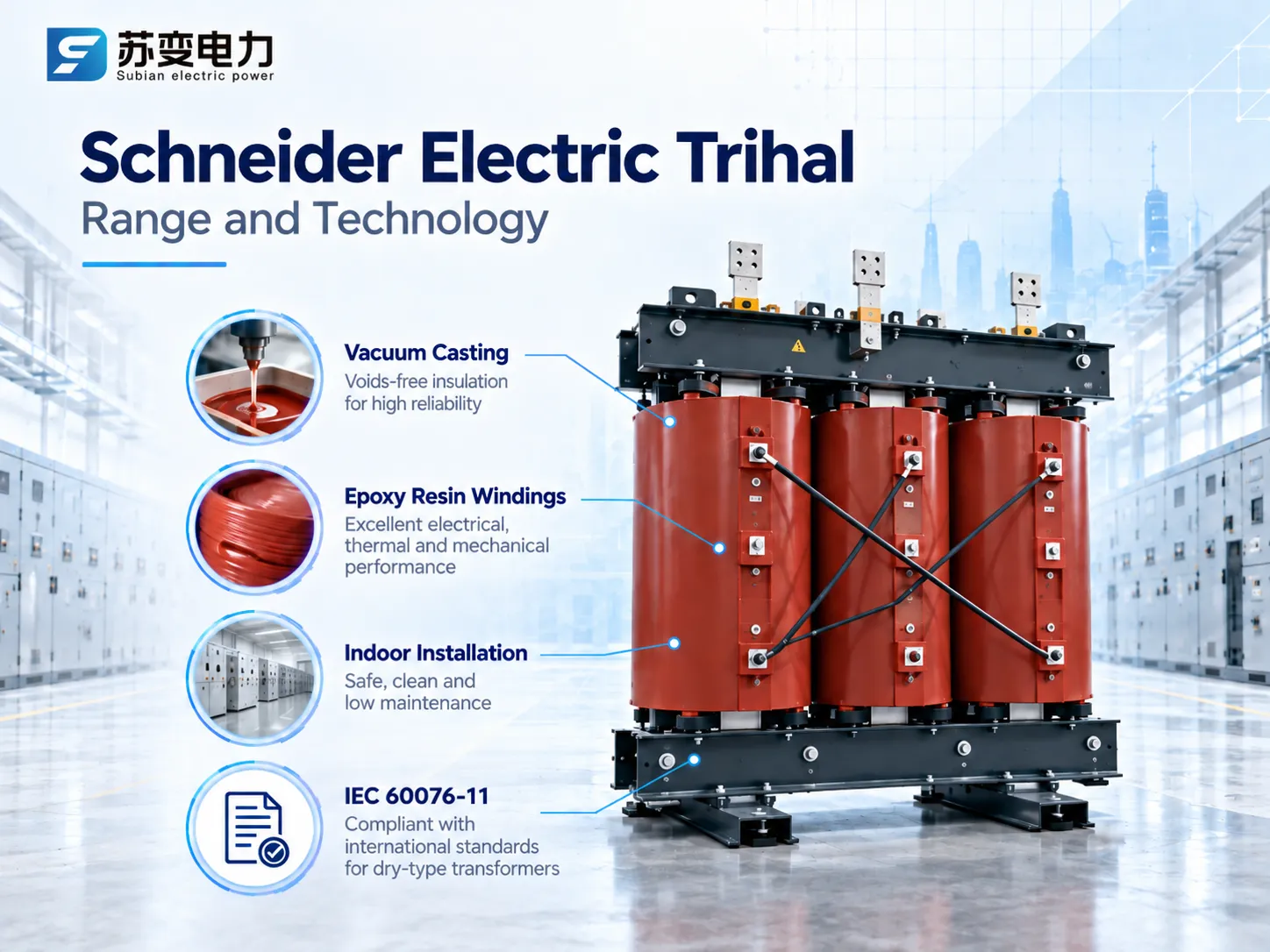
In a epoxy resin cast dry transformer, the high-voltage winding is produced, poured into the mold, and then filled with epoxy resin under vacuum conditions. The critical aspect of the operation is the fact that the presence of vacuum allows for air and moisture trapped in the resin to come out before the resin hardens. The hardened resin also performs physical protection of the winding and sealing against moisture and dust in various environmental conditions.
Reasons for Choosing Epoxy Resin Cast Over Oil-Filled Transformers
Although oil-filled transformers are the go-to option for outdoor and severe applications, epoxy resin cast transformers can be advantageous for installation in the buildings where safety of the equipment is crucial. Absence of the potential flammable medium means less fire load and the necessity of avoiding the oil pits and containment, as well as making compliance with the building construction rules easier. Their ability to work in a humid environment and resume operations without prior drying contribute to their attractiveness. This explains the reasons for Schneider and Siemens opting for epoxy resin in the design of their collection of dry transformers.
Schneider Electric Trihal — Range and Technology
Trihal transformers make wave of the dry-type range of Schneider Electric within its SeT Series.Trihal is a well-known and established product with global catalogues, an array of documented SKUs, and a significant installed base in Europe, which makes it a common reference in international specifications.
Trihal vacuum casting
Trihal is a dry-type transformer cast from three-phase resin and made by vacuum casting the medium-voltage windings in epoxy resin while impregnating the low-voltage windings in advance. Schneider mentions aluminum windings as a standard feature and puts a coating on the core and frame for additional protection against corrosion. Marketing the solution as fire-safe, Schneider gives this product a long service life and guarantees the absence of partial discharge at the usual acceptance test procedure.
Trihal characteristics, types, and typical applications
Trihal product specification gives the information regarding capacity from approximately 160 000 kVA to about 15 000 kVA, as well as the maximum voltage of 36 kV. According to Schneider, this product fulfills the requirements of F1 fire class and the environmental and climatic classes of IEC 60076-11 due to the silicone-free solution. The leading application areas for Trihal products are commercial real estate, hospitals, infrastructure, and manufacturing facilities where indoor Schneider dry-type transformers are needed. As the Trihal product line has been covered by a significant number of publications, it is common that the consultants indicate Trihal in their tender documents for requesting equivalent solutions from competitors.
Siemens GEAFOL — Range and Technology
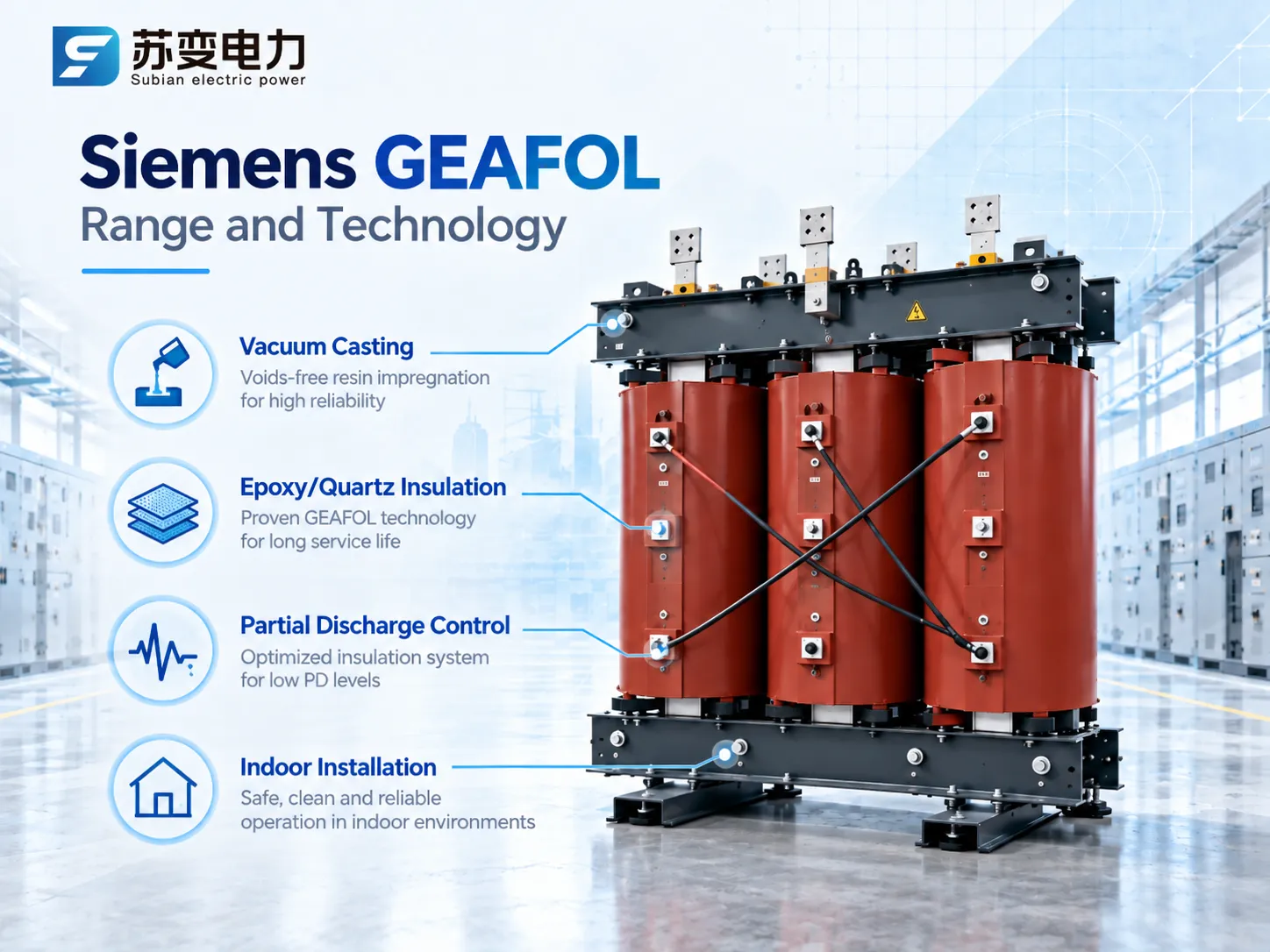
The GEAFOL cast resin transformer belongs to the range of Siemens Energy’s dry-type equipment and is considered to be one of the most widely referenced technologies in the industry also from the standpoint of its casting process, the partial discharge and the SF6-free insulation construction.GEAFOL encapsulation technology and insulation made of epoxy resin and quartz.
GEAFOL utilizes a combination of epoxy resin and quartz powder as insulation materials. The high voltage lines are plugged using a special vacuum furnace at high temperature. Siemens points out that the vacuum process helps avoid any gas inclusions and results in complete absence of partial discharge even at twice rated voltage. The company uses coils made of aluminum foil type. This is advantageous because the thermal expansion of aluminum is similar to that of cast resin making thermal strain minimal. As a result, GEAFOL is extremely durable and requires minimum maintenance due to its design.
GEAFOL applications, specifications and classes
The application of GEAFOL series of transformer actually goes beyond what many customers expect as the product can generate anywhere from about 50 to 50 MVA. In fact, GEAFOL series of transformers comply with IEC 60076-11 in a number of classes including E3 and F1 and C3. The best part about GEAFOL transformers is that they are the leaders in distribution power generation systems.
Schneider Trihal vs Siemens GEAFOL: Head-to-Head
There are many similarities between GEAFOL series of transformers and Trihal series of transformers made by Schneider. Both brands produce transformers that are vacuum encapsulated using epoxy resin and meet the highest standards of IEC 60076-11 safety classification.The impactful distinctions are observable at an envelope’s ends and in insulation specifications.
Voltage and power range
Trihal is rated for up to 36 kV and approximately up to 15 MVA, and it is enough for common medium-voltage distribution. GEAFOL indicates higher voltage (up to around 52 kV) and power (nearly 50 MVA), therefore ample margin for more powerful applications. For projects with common voltage of 11 kV, 22 kV, or 33 kV, both models could be applied, however, one might choose GEAFOL for other, supra-high voltages or high power requirements.
Insulation type and partial discharge
Both ranges are produced under vacuum conditions to avoid voids, thus making a good partial discharge performance. Siemens points that GEAFOL is tested for absence of partial discharge in voltage conditions of up to two rated voltages, whereas Schneider points low picocoulombs limitations of partial discharge for Trihal within regular and special tests. However, for the purchaser the most important takeaway should be that partial discharge is calculated for both models and evidence of that would be in test report, and not in manufacturer name.
Standards, fire and environmental classes
Both models satisfy IEC 60076-11 standard and satisfy fire category F1 level, which indicates the highest level of fire hazard caused by features of transformer itself.In essence, should the specifications require for F1 fire behavior and a particular class in E and C, both the Trihal and GEAFOL cast resin transformers are capable of satisfying these requirements.
So how do they differ?
Voltage and power limits: GEAFOL provides higher voltage and power while Trihal focuses on main medium voltage distribution.
Variety of applications: GEAFOL covers distribution, power, converter, and wind applications while Trihal focuses on distribution only.
Insulation details: GEAFOL utilizes epoxy and quartz insulation, foil coils, and claims about two times partial discharge test. Trihal uses cast HV along with pre-impregnated LV and aluminum conducts.
Ecosystem: each transformer has its own switchgear, monitoring, and documentation which affects the experience in case of single-vendor site.
Availability: lead time, market support, and cost differ for specific ratings depending on the region and the project and should be commented on if required.
Voltage Conventions: Why 11 kV, 22 kV, and 33 kV Matter
One of the features that complicate procurement is voltage conventions. Whereas the Chinese catalogue and projects refer to medium voltage systems as 10 kV, 20 kV, 35 kV systems, the majority of the world including the UK, the Middle East and Africa, and large parts of Asia refer to systems of 11 kV, 22 kV, and 33 kV.These are different labels and not just synonyms; these labels represent different system voltages. The cast resin dry type transformer must be built for a specific system. Trihal and GEAFOL ranges of transformers are customized specifically for the order by the manufacturer. However, it is the buyer who must give the right voltage value in the order.
The Nominal Voltage vs Highest Voltage for Equipment
There is another aspect. The nominal system voltage distinguished by a certain value, for example, 33 kV, is different from the highest voltage for the equipment Um, which in case of 33 kV is approximately equal to 36 kV. The protection level against impulses and electrical clearance are based on the Um voltage. This is the reason why Schneider and Siemens manufacturers define their lines according to the maximum equipment voltage, being either 36 kV or 52 kV, and not according to the nominal system voltage. The buyer should check if the nominal voltage value and the Um voltage corresponds to his network requirements while making a choice of Schneider Trihal transformer or Siemens GEAFOL transformer.
Efficiency and Ecodesign expectations
In addition to safety requirements, buyers require compliance with efficiency now. Within Europe, dry-type transformers are subjected to Ecodesign minimum-efficiency requirements. All brands have designs that correspond to the profit of requirements. For dry-type transformers the loss figures go along with real costs of operation (not only purchase). Therefore, comparing the values, it is important to base the calculations on loss figures, and not on purchase price.
How to Compare the Offers
The brand is important for the EPC contractor but good for the beginning only. Two units from different companies satisfying the same technical class of transformers are considered interchangeable for almost any project since they are installed according to the same specifications.
Match the specification, not the reputation
The proper comparison of any dry-type transformer becomes a minimal, easily verifiable list instead of a list of brands:
Nominal power (kVA or MVA), primary and secondary voltage, information about the use of 11 kV, 22 kV, 33 kV, or 10/20/35 kV.
Maximum voltage level for the equipment and the basic impulse level that is required by the network.
Vector group, short-circuit impedance, and tap-changing range.
Guaranteed no-load and load losses supported by the test report for the transformer.
IEC 60076-11 fire (F), environmental (E), and climate (C) classes that are required at the installation location.
Permitted level of partial discharge and testing of the temperature raise.
IP code of the transformer, the method of the cooling system active or passive, environmental temperature, and altitude.
With the understanding of these parameters, the decision turns into comparing engineering and commercial solutions and thus alternative suppliers get to compete. For a model-level view of how a Chinese cast resin series lines up against these international brands, see our companion guide, SCB13 vs International Cast Resin Transformers.
A Third Option: Factory-Direct Cast Resin Transformers from China
A number of instances in which a named Euro range is specified could sit better with a qualified Chinese manufacturer using the same IEC codes and selling at factory direct prices. One such manufacturer is Subian Electric. To be perfectly clear and fair, Subian Electric is not in any way affiliated, endorsed or authorized by Schneider Electric or Siemens, and the names Trihal and GEAFOL are owned by different companies and mentioned here only as a point of reference. Subian Electric does not claim that its products are the same as those of Euro manufacturers and asserts that any similarities should be established by comparing test reports of the specific units.
What Subian offers is a comparable technology class. Its 6–10 kV SCB series epoxy resin cast dry-type transformer and its 20–35 kV SCB series epoxy resin dry-type transformer are vacuum-cast cast resin transformer units built to IEC 60076-11 and Chinese GB standards, with low partial discharge, flame-retardant construction, and maintenance-free operation. For the lowest standby losses, its SCBH amorphous alloy dry-type transformer targets ultra-low no-load loss. For an international buyer, the practical path is to fix the specification first, then request test reports and documentation from each candidate, branded or factory-direct, and compare on evidence.
Frequently Asked Questions
Is the Schneider Trihal transformer better than the Siemens GEAFOL transformer?
Both devices cannot be described as superior to one another. Schneider Trihal transformer is designed for normal voltage distribution of mid-range voltage (up to 36kV), while Siemens GEAFOL transformer goes beyond those limits being capable of working with voltage interruptions of higher voltages up to 52kV and up to 50MVA. The choice of equipment for regular distribution projects can be made in favor of one or another device, while for applications that demand high-voltage or high-power solutions, it could be GEAFOL.
Are Trihal and GEAFOL the same technology?
Both share the same basic principle: the vacuum-cast epoxy resin dry-type transformer is within IEC 60076-11 standards at the F1 fire safety level. However, the specifics vary, as GEAFOL makes use of the epoxy/quartz casting tested to double its rated voltage for partial discharge purposes, while Trihal makes use of cast HV with pre-impregnated LV windings.
What voltage levels do these cast resin transformers cover?
Trihal has a publication range that goes to 36 kV which encloses 11 kV, 22 kV, and 33 kV networks as well as the 10/20/35 kV convention. GEAFOL continues up to approximately 52 kV. Therefore, always remember that nominal voltage mentioned in the system, as well as the highest voltage of the equipment, is different.
Can a Chinese SCB cast resin transformer replace a branded unit?
In theory, a cast resin dry type transformer made in accordance with IEC 60076-11 specifications and having proper loss values can fulfill the same function. Acceptance of this transformer as a substitute in a project will depend rather on the approved vendor, certifications required, and matching of specifications and test reports of both devices.
What documents should I request before buying any cast resin transformer?
Submit the routine-test reports which include no-load losses, load losses, temperature rise, dielectric withstand voltage, from partial discharge tests. You must also include IEC 60076-11 E, C, and F classes along with dimensional and connection diagrams and the relevant type-test documents. This is applicable to branded cast resin transformers and units directly manufactured from the factory.
Do these transformers support 11 kV, 22 kV, and 33 kV systems?
Affirmative. The Trihal cast resin transformer and the GEAFOL cast resin transformer will be made according to the requested voltage between 11 kV, 22 kV, and 33 kV and will be no different compared to the standard convention of the 10/20/35 kV. Please inform the nominal voltage and maximum voltage requirements in your query so that we can make sure that the insulation class and winding class are correct.
References
- IEC 60076-11 — Power transformers, Part 11: Dry-type transformers
- Wikipedia — Transformer types (cast resin dry-type)
- Electrical Engineering Portal — Dry-type transformers
Talk to Subian Electric
If your specifications for a project can be fulfilled by both a brand-name product and a factory model, it is advisable to compare them based on data instead of reputation. For an independent Chinese manufacturer of epoxy resin dry transformer and cast resin dry transformer, Subian Electric covers voltage ratings ranging from 6 kV to 35 kV in accordance with IEC 60076-11. In case you provide your requirements regarding voltage, capacity, losses, and IEC rating, the Subian engineers will present you with the options, as well as the necessary reports to ensure a fair comparison between a factory model and the brand-name products you are interested in.