


Um engenheiro está verificando o histórico de manutenção de um transformador elevador de 50 MVA que está em operação há 14 anos. O transformador ainda não enfrentou nenhuma falha maior, mas a última análise de óleo mostra aumento nos níveis de hidrogênio e algumas amostras de óleo do OLTC precisam ser coletadas. Os engenheiros fixaram o orçamento anual para a manutenção do transformador e o transformador está prestes a ser utilizado na próxima parada, que é de extrema importância para o processo. Na realidade, é claro que as tarefas devem ser priorizadas com base na eficiência de cada tarefa de acordo com o tempo em que a tarefa deve ser realizada e como cada tarefa deve ser analisada quanto à sua eficácia.
Este artigo destaca os aspectos mais importantes do processo de manutenção de transformadores de potência que estão ocultos em manuais extensos, a saber, quais tarefas realmente devem ser realizadas para garantir a confiabilidade do equipamento, o que os resultados da inspeção significam para a manutenção do transformador e quais tarefas podem ou não podem ser realizadas.
Resposta Rápida: A manutenção do transformador de potência pode proteger o equipamento por meio de: gerenciamento de óleo, testes elétricos, manutenção de acessórios e documentação. Os parâmetros centrais do gerenciamento incluem: a temperatura do óleo de 75 – 85°C enquanto trabalha sob a carga nominal, umidade do óleo abaixo de 20 – 30 ppm, tensão de ruptura acima de 30 – 40 kV e o TDCG inferior a 720 ppm de acordo com a IEEE C57.104. Os custos anuais de manutenção chegam a $1.500–$5.000 por local.
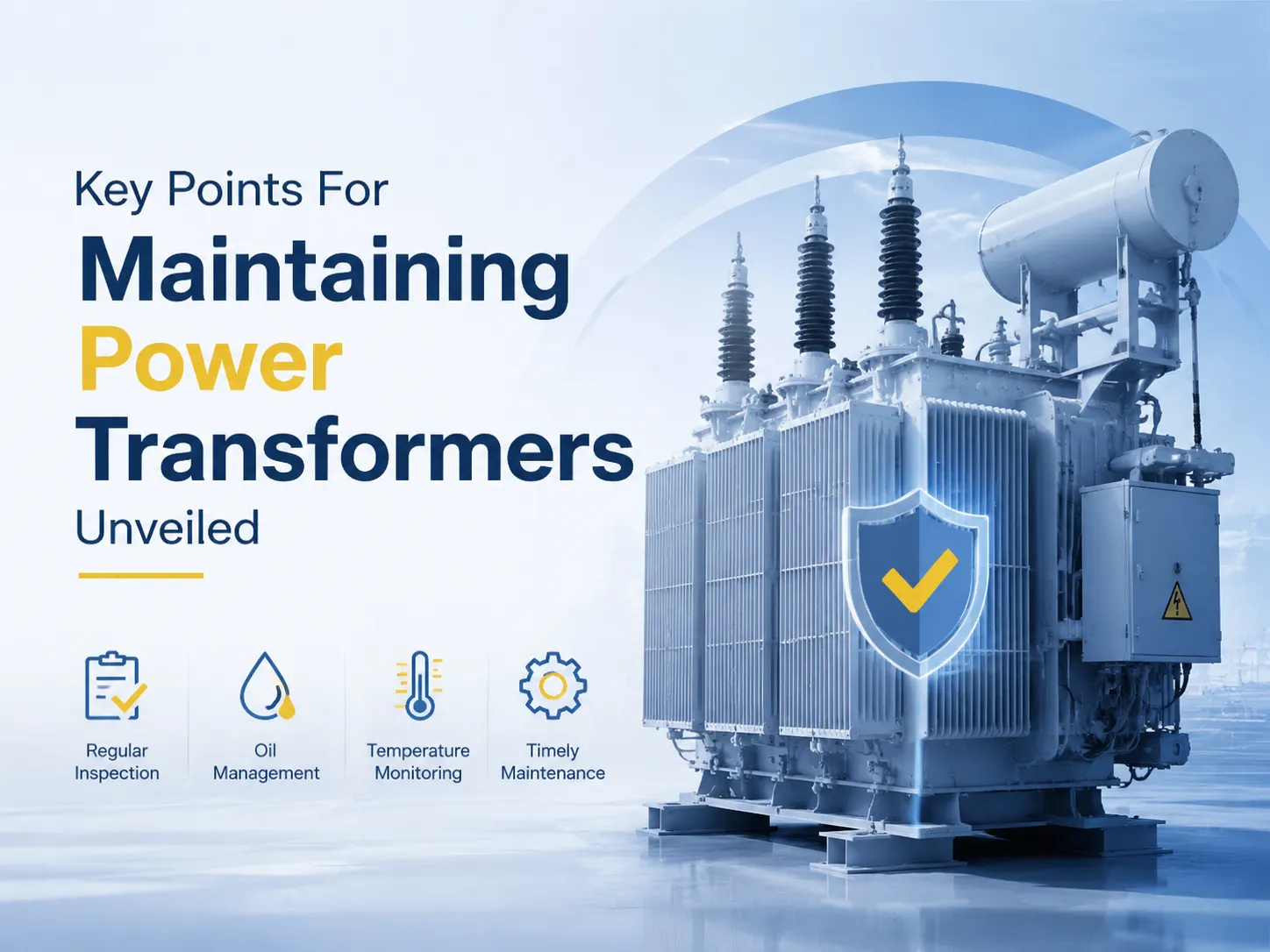
Por que a Manutenção de Transformadores de Potência é Inegociável
O transformador de potência é, ao mesmo tempo, o equipamento mais caro, de maior durabilidade e menos redundante encontrado em muitas estações de energia elétrica. Se um problema surgir com um transformador, a produção irá parar, a planta irá desligar e levará alguns meses para adquirir um substituto em caráter de emergência. De acordo com dados de confiabilidade fornecidos por grupos de trabalho da IEEE e CIGRÉ, quebras de isolamento, trocadores de tomadas e quebras de bucha são as principais fontes de falhas em transformadores; esses componentes podem ser identificados durante procedimentos de manutenção adequadamente designados que previnem a falha real de ocorrer.
A justificativa econômica é bastante simples. Por exemplo, um transformador de potência de 50MVA custa $250.000 e pode custar até $1,2 milhões; ao mesmo tempo, seu custo anual de manutenção é de $1.500 a $5.000, o que representa apenas uma pequena porcentagem do custo do equipamento. Além disso, paradas não planejadas são conhecidas por custar pelo menos $50.000 e podem chegar a $2 milhões, dependendo da carga perdida e sua duração. Assim, é seguro dizer que é prudente arcar com o custo da manutenção, pois é o mais econômico em termos da magnitude das possíveis perdas.
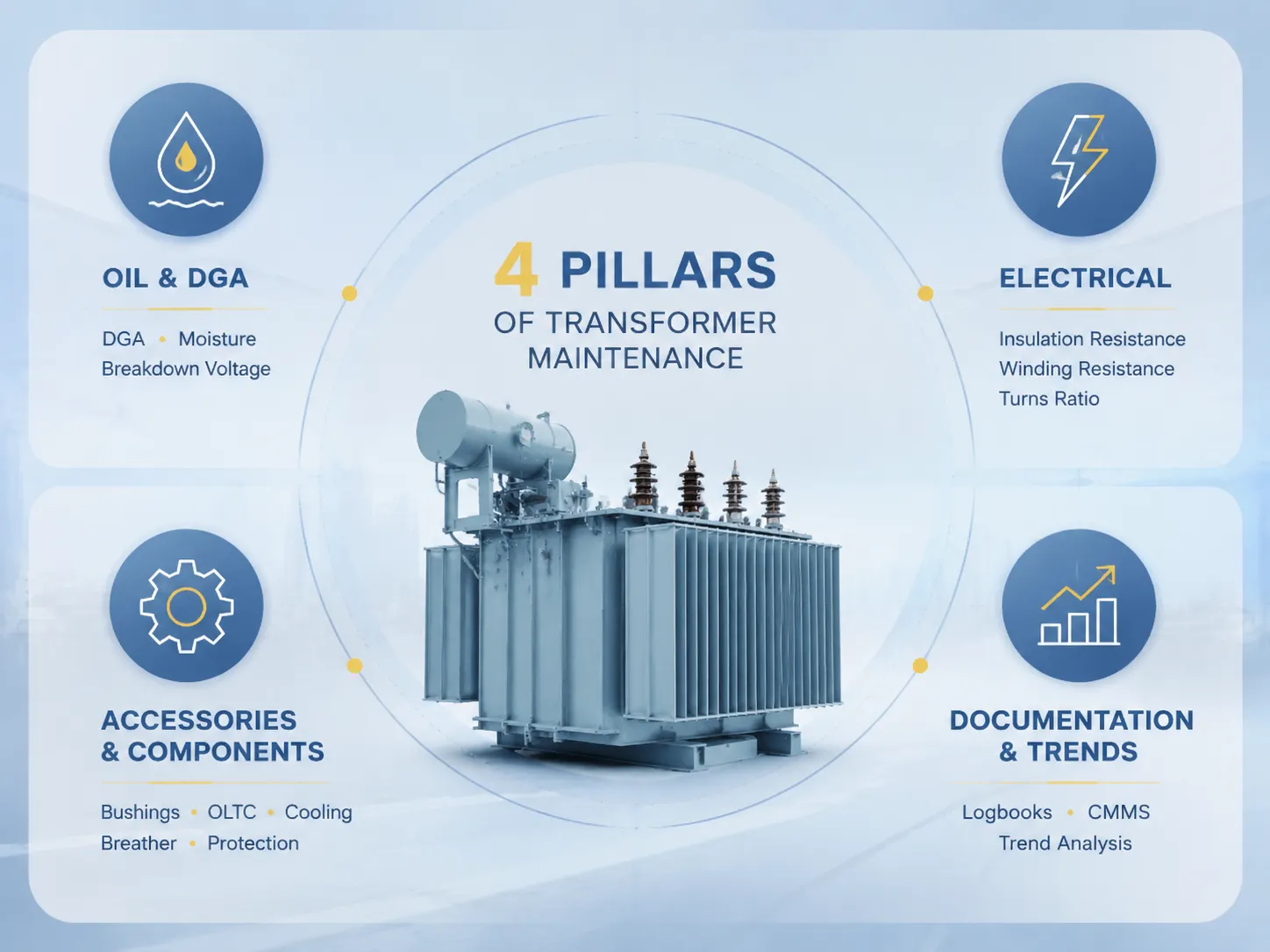
Os Quatro Pilares da Manutenção de Transformadores de Potência
No que diz respeito à manutenção de transformadores refrigerados a óleo, ela se enquadra em uma das quatro áreas, que garantem que nada fique sem atenção e nada seja feito em excesso.
| Pilar | O que Abrange | Teste Principal / Tarefa | Capturas |
|---|---|---|---|
| Gestão de óleo e DGA | Condição do óleo isolante e gases dissolvidos | DGA, umidade, tensão de ruptura, acidez | Falhas térmicas, arco elétrico, entrada de umidade, contaminação |
| Testes elétricos | Integridade do enrolamento e isolamento | Resistência de isolamento, relação, resistência do enrolamento, corrente de magnetização | Danos ao enrolamento, degradação do isolamento |
| Cuidado com acessórios e componentes | Buchas, respiradores, trocadores de tap, resfriamento, proteção | Inspeção visual, teste de óleo OLTC, verificação do respirador, teste do ventilador | Desgaste mecânico, umidade, falha de resfriamento |
| Documentação e tendências | Histórico, pontuação de condição, classificação de risco | Livros de registro, CMMS, análise de tendências | Falhas de desenvolvimento lento perdidas por leituras únicas |
Pilar 1: Gestão de Óleo e DGA
O óleo atua como isolante e refrigerante no transformador e como uma ferramenta de diagnóstico para identificar as falhas dentro do equipamento. A análise de gás dissolvido representa o teste mais abrangente que revela todas as informações necessárias. As falhas quebraram o isolamento de papel e óleo em gases específicos dissolvidos no óleo, como hidrogênio, metano, etano, etileno, acetileno, CO e CO2. A interpretação dos gases usando IEEE C57.104 e IEC 60599 indica o tipo e o nível da falha.
Valores importantes da gestão de óleo em transformadores de potência:
| Parâmetro | Normal | Aviso | Ação |
|---|---|---|---|
| Tensão de ruptura do óleo | > 40–60 kV | 30–40 kV | < 30 kV: filtrar ou substituir o óleo |
| Umidade do óleo | < 15–20 ppm | 20–30 ppm | > 30–40 ppm: secar e encontrar a fonte de entrada |
| Gás combustível total dissolvido | < 720 ppm | 720–1.920 ppm | > 1,920 ppm: investigar; > 4,630 ppm: retirar de serviço |
| Acidez | Baixa (número de neutralização < 0.1–0.15 mg KOH/g) | Tendência crescente | Alta: recondicionar o óleo |
| Conteúdo de furanos | Baixo | Aumento | Alto: envelhecimento do papel confirmado, plano de fim de vida |
A manutenção programada prática para transformadores de potência inclui um DGA anual e um semestral para unidades críticas ou após um evento de falha. Como o óleo do compartimento OLTC envelhece mais rápido, seu óleo é testado a cada 6-12 meses. Sempre colete a amostra da mesma válvula em uma carga definida e anote a temperatura do óleo.
Pilar 2: Testes Elétricos
Testes elétricos auxiliam os testes de óleo na inspeção das bobinas e isolamento diretamente:
- Resistência de isolamento (megger): é avaliada entre a bobina e o solo e entre as bobinas. A resistência de isolamento da bobina de alta tensão normal deve mostrar de 1000 a 5000 MΩ ou até mais; a comparação ao longo dos anos é de maior importância do que os números em absoluto. Se os números começarem a cair, há presença de umidade ou poluição.
- Resistência da bobina: é medida fase a fase e comparada; qualquer variação acima de 2–3 por cento indica uma falha em uma conexão ou volta.
- Relação de transformação: é um teste de relação de bobina que confirma os resultados com a placa de identificação; uma variação acima de 0,5-1 por cento indica curtos nas bobinas.
- Corrente de magnetização: um aumento nesta corrente pode indicar um curto ou dano no núcleo.
Esses testes normalmente custam entre $300 e $1.500 por unidade por inspeção e são realizados uma vez por ano ou após algum incidente sério, como curto-circuito ou descarga atmosférica. Quando combinados com DGA, podem ajudar a determinar o problema: DGA nos informa que há uma falha, enquanto os testes indicam a localização.
Pilar 3: Cuidado com Acessórios e Componentes
Acessórios são conhecidos por falhar mais do que o transformador principal e as falhas podem ser evitadas porque são previsíveis. A tabela a seguir mostra as tarefas necessárias que devem ser realizadas e os custos associados ao reparo:
| Acessório | Inspeção | Intervalo | Custo Típico |
|---|---|---|---|
| Buchas | Fissuras, rastreamento, vazamento de óleo; PD/tan-delta para unidades críticas | Visual diário; PD a cada 3–6 anos | $3.000–$30.000 por fase para substituição |
| Desumidificador | Cor do gel de sílica; regenerar quando rosa | Verificação diária | $50–$300 |
| OLTC | Amostra de óleo, motor de acionamento, contatos | Óleo 6–12 meses; revisão 3–6 anos | $5.000–$40.000 por revisão |
| Ventiladores / bombas de resfriamento | Operação, fluxo de ar, aletas do radiador | Teste mensal | $300–$5.000 por componente |
| Dispositivos de proteção | Circuitos de disparo do relé Buchholz e válvula de alívio | Durante interrupções programadas | $200–$1.000 |
- Isoladores: verifique se há danos, fissuras e vazamentos de óleo e assegure-se de que unidades danificadas sejam rapidamente substituídas. A falha do isolador pode destruir transformadores e os custos de substituição variam de $3.000 a $30.000. Testes de PD e tan-delta podem ser realizados a cada 3-6 anos para isoladores importantes.
- Desumidificador e conservador: o gel de sílica deve sempre ser azul; se estiver rosa, deve ser regenerado ou substituído. Quando um desumidificador está saturado, permite que o ar úmido penetre no óleo, o que causa degradação lenta do isolamento.
- Mudança de tomada: para unidades OLTC, o óleo OLTC deve ser amostrado regularmente; a operação de mudança de tomada deve ser verificada e a corrente do motor confirmada a cada 3-6 anos. Os custos de manutenção do OLTC variam de $5,000 a $40,000 para um ciclo de reparo, mas evitam falhas maiores.
- Sistema de resfriamento: ventiladores, bombas e termostatos devem ser testados; as aletas do radiador devem ser limpas e o fluxo de óleo monitorado para falhas.
- Dispositivos de proteção: relé Buchholz, dispositivos de proteção de pressão e circuitos de disparo devem ser testados durante reparos regulares.
Pilar 4: Documentação e Acompanhamento de Tendências
Dados relacionados à manutenção são incrivelmente valiosos, enquanto a documentação fornece suporte para outros componentes essenciais do sistema. Um conceito chave aqui é a prática de manter um histórico para cada unidade do sistema, contendo resultados de testes de comissionamento, desempenho e análise de DGA, testes elétricos, incidentes de sobrecarga, reparos e alarmes. Esse histórico permite três coisas: descobrir padrões (por exemplo, uma concentração de gás aumentou de 40 para 120 ppm em 24 meses), estabelecer as condições (ordenando as unidades por prioridades orçamentárias) e provar a existência de acordos de garantia e seguros.
A maioria dos procedimentos de manutenção hoje são automatizados por sistemas modernos de gerenciamento de ativos. O mínimo que deve ser feito é manter um livro de registro de todas as métricas úteis: todas as leituras, datas de eventos e ações da equipe de manutenção. Aqueles que mantêm os dados obtêm vantagens a partir disso, recebendo dinheiro para justificar seus orçamentos, ajudando autoridades reguladoras de auditoria e acelerando a investigação da causa raiz de qualquer problema.
O Cronograma de Manutenção: Tarefas e Frequências
O cronograma abaixo contém um ponto de referência útil para transformadores de potência. Ele pode ser alterado com base na urgência, idade e estado do transformador.
| Frequência | Tarefa | Custo Típico |
|---|---|---|
| Diário | Inspeção visual: nível de óleo, som, temperatura, buchas, vazamentos | $300–$1,500/ano de mão de obra |
| Trimestral | Resistência de isolamento, verificação visual/funcional do OLTC, teste do ventilador | $200–$800 |
| Semestral | DGA para unidades críticas, amostra de óleo do OLTC | $200–$500 por amostra |
| Anual | DGA completo, pacote de qualidade do óleo, resistência de enrolamento, relação, megger | $800–$2.500 |
| A cada 3–6 anos | Revisão do OLTC, PD/tan-delta do bushing, teste de proteção, inspeção minuciosa | $5.000–$40.000 |
| A cada 10–15 anos | Revisão maior, filtração/substituição de óleo, renovação de juntas | $10.000–$60.000 |
Como regra geral, um DGA deve ser realizado a qualquer momento e após qualquer incidente incomum. No caso de tal evento ocorrer, o DGA deve ser feito imediatamente.
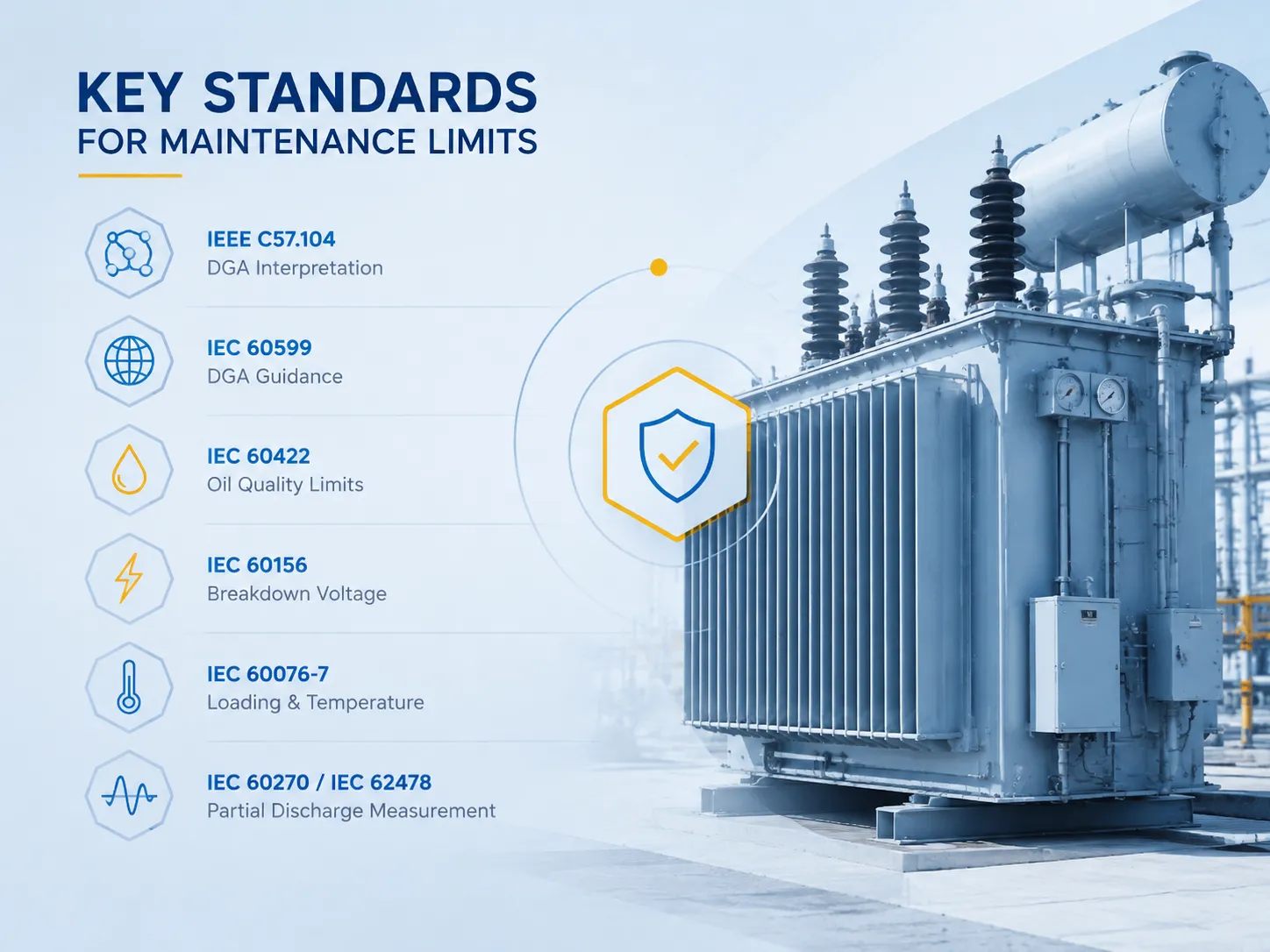
Principais Normas para Limites de Manutenção
As decisões sobre os trabalhos de manutenção devem ser baseadas nas normas em vigor e não em boatos. Abaixo está a lista das referências obrigatórias neste campo:
- IEEE C57.104 – a interpretação da descarga parcial e sua avaliação para diagnósticos à base de óleo.
- IEC 60599 – um guia internacional para análise de DGA de equipamentos antigos.
- IEC 60422 – controle e manutenção de óleos isolantes minerais com indicadores de qualidade.
- IEC 60156 – método de teste para falha dielétrica.
- IEC 60076-7 – recomendação sobre limites de carga e temperatura de transformadores.
- IEC 60270 / IEC 62478 – métodos de medição de descarga parcial em diagnósticos modernos.
Se a instrução do fabricante de um equipamento específico apresentar limites mais rigorosos ou específicos, eles devem ser seguidos.
Orçamentação de Manutenção: Custo vs. Risco de Falha
Os orçamentos de manutenção devem ser alocados de acordo com o risco e não com base em experiência ou hábitos. Alguns princípios são:
| Item | Valor Típico |
|---|---|
| Programa de manutenção anual (por transformador de potência) | $1.500–$5.000 |
| Amostra de DGA | $200–$500 |
| Pacote de qualidade do óleo | $150–$400 |
| Conjunto de monitoramento online (unidades críticas) | $25,000–$120,000 de capital |
| Substituição de transformador (20–60 MVA) | $250.000–$1,2 milhão |
| Custo de interrupção não planejada | $50,000–$2 milhões por evento |
| Vida útil esperada com manutenção adequada | 30–40 anos |
Tudo se resume a matemática: uma amostra de DGA de $400 por ano de um ativo $500,000 do qual você está obtendo 30+ anos de serviço é o investimento menos custoso que você faz. O mesmo raciocínio se aplica à extensão das inspeções para unidades em boas condições e ao aumento da frequência de inspeção para unidades de maior risco.
Ferramentas de Manutenção Modernas: Monitoramento e Análise
O monitoramento e a análise estão revolucionando a disciplina de manutenção. Com monitores de DGA online, sensores de descarga parcial e rastreadores de temperatura/carga em funcionamento, dados contínuos estão disponíveis para unidades críticas, graças a plataformas de análise que transformam os dados em alarmes sérios. A economia exige uma combinação de métodos: monitores online para as poucas unidades críticas que causariam uma falha catastrófica se uma ocorresse, e o habitual DGA laboratorial anual para a maior parte. O limite baseado em normas permanece inalterado, a única diferença é que os sistemas de monitoramento online capturam a falha que ocorre entre as amostras de leitura.
No entanto, a interpretação especializada continua sendo essencial. Os dados podem levar à fadiga de alarmes ou falhas não detectadas.
Perguntas Frequentes
Com que frequência um transformador de potência deve ser mantido?
Os princípios básicos por trás da manutenção de transformadores de potência incluem vigilância visual recorrente em dobro, verificações elétricas ocorrendo trimestralmente e DGA mais testes de qualidade do óleo anualmente. Testes semestrais de DGA podem ser realizados para os dispositivos mais críticos, enquanto o monitoramento online também é aplicável; o óleo do OLTC é testado quase uma vez por ano; reparos maiores ocorrem uma vez a cada cinco a dez anos. Em caso de anomalias, um teste imediato deve ser realizado primeiro.
Quais são os testes de manutenção mais importantes para um transformador de potência?
A análise de gás dissolvido é considerada o teste único mais útil, pois permite detectar problemas térmicos e elétricos antes da catástrofe. Geralmente é utilizada juntamente com testes de umidade e tensão de ruptura, resistência de enrolamento e testes de isolamento, o que totaliza cinco testes cobrindo a maioria dos indicadores de deterioração.
Quanto custa a manutenção de um transformador de potência por ano?
Custa cerca de 1.500-5.000 dólares por ano implementar o programa totalmente baseado em condição para transformadores de potência, incluindo vigilância diária, DGA realizada anualmente (custando 200-500 dólares), qualidade do óleo (150-400 dólares) e testes elétricos (300-1.500). O custo de reparos maiores também deve ser considerado – eles requerem 5.000-60.000 dólares uma vez a cada cinco ou dez anos.
Qual é a vida útil normal de um transformador de potência mantido?
Com uma gestão disciplinada do óleo, monitoramento adequado de DGA e testes elétricos regulares, transformadores de potência geralmente servem por 30-40 anos, alguns até alcançam 50. O envelhecimento do isolamento segue uma relação exponencial com a temperatura: a cada 6-8 K de temperatura estável acima do projeto, o envelhecimento do isolamento dobra, o que torna a disciplina de carga uma ferramenta de manutenção.
A manutenção preditiva pode prevenir todas as falhas de transformadores?
Não, a manutenção preditiva ajuda a detectar e prevenir falhas graduais (devido a isolamento, umidade, fraturas, contaminação do óleo) que causam derrotas contínuas. No entanto, explosões de buchas, descargas e curtos-circuitos externos não podem ser previstos.
Referências
- IEEE C57.104: Guia para a Interpretação de Gases Gerados em Transformadores Imersos em Óleo — A referência para limites de DGA e níveis de resposta de manutenção.
- IEC 60422: Orientação de Supervisão e Manutenção para Óleos Isolantes Minerais — Limites de qualidade do óleo e prática de manutenção para transformadores em serviço.
- IEC 60599: Guia para a Interpretação de DGA em Equipamentos Impregnados com Óleo Mineral — Estrutura internacional para interpretação de gás em equipamentos envelhecidos.
- IEC 60156: Líquidos Isolantes — Determinação da Tensão de Ruptura — Norma de teste para resistência dielétrica do óleo.
- IEC 60076-7: Guia de Carga para Transformadores de Potência Imersos em Óleo — Limites de temperatura e orientação de carga para unidades imersas em óleo.
- CIGRÉ — Brochuras técnicas sobre manutenção de transformadores, confiabilidade e avaliação de condição.
- Jiangsu Subian Electric Power — Fabricante de transformadores em conformidade com a IEC 60076, fornecendo documentação de manutenção e suporte técnico.
Conclusão
A manutenção de transformadores de potência deve se concentrar em um serviço de qualidade em vez de produção em massa no sentido tradicional da palavra. O processo de manutenção de equipamentos gira em torno de quatro pilares: gestão de óleo e DGA, inspeções elétricas, manutenção de suporte e documentação. A implementação do processo deve garantir o uso do ativo na máxima extensão, sendo a manutenção econômica.
- Realize testes de DGA uma vez por ano e após cada situação problemática.
- Realize DGA simultaneamente com testes de óleo e elétricos.
- Mantenha a disciplina de cuidado com acessórios: bucha isolante, desumidificador, OLTC e sistema de resfriamento.
- Documente e mantenha registros.