


Ao inspecionar as diferenças entre transformadores americanos e europeus, um comprador industrial descobrirá que não é apenas a localização da fabricação que conta, mas também os processos utilizados na especificação, teste e documentação relacionados a esse equipamento elétrico. Tome como exemplo o gerente de compras de uma planta no Texas que está utilizando um contratante EPC baseado na Europa. O equipamento oferecido possui códigos e especificações diferentes. A versão americana especifica IEEE C57.12.00, tipo de resfriamento OA/FA, 12.47 kV primário, enquanto a europeia oferece IEC 60076, tipo de resfriamento ONAN/ONAF, e 10 kV ou 20 kV. Ambos os modelos de transformadores devem ser capazes de funcionar corretamente, mas precisam de arranjos de engenharia para tornar isso possível. Este artigo apresenta as diferenças entre os dois tipos de transformadores para que comparações corretas possam ser feitas e compras apropriadas possam ser realizadas sem custos adicionais para retestes.
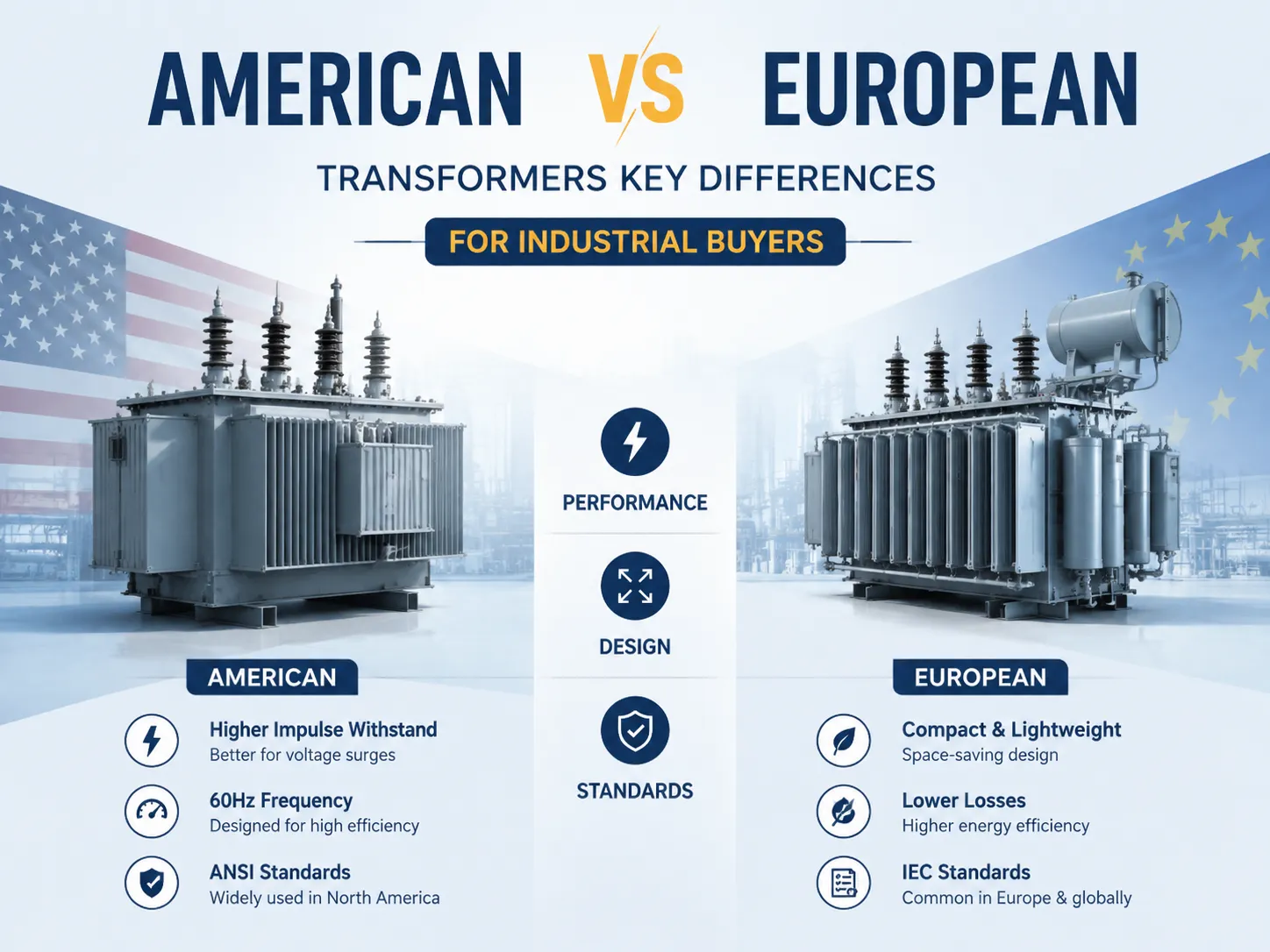
Resposta breve: Transformadores americanos e europeus diferem em especificação. O estilo americano de transformador segue os padrões ANSI/IEEE (IEEE C57.12.00, C57.12.20) e é projetado para redes que operam com uma frequência de 60 Hz, enquanto as tensões primárias podem incluir 12.47 kV, 13.8 kV ou 34.5 kV, com tensões secundárias de 120/240 V, 120/208 V ou 277/480 V. O estilo europeu de transformador segue o padrão IEC 60076 e opera a 50 Hz com tensões primárias de 6.6 kV, 10 kV, 11 kV, 20 kV ou 33 kV e tensão secundária de 230/400 V. O método de resfriamento do transformador, sua tolerância de impedância, marcação do grupo vetorial, método de mudança de tap e documentos para testes diferem entre os estilos.
Definições: O que as Duas Famílias São
Transformadores americanos operam de acordo com os padrões ANSI/IEEE. Esses transformadores funcionam perfeitamente em um sistema elétrico de 60 Hz. Os níveis de tensão primária utilizados por transformadores americanos seriam 7.2 kV, 12.47 kV, 13.8 kV, 24.9 kV e 34.5 kV. Além disso, as tensões fornecidas por esses transformadores para aplicações de usuários finais incluem 120 volts, 240 volts, 220 volts, 277 volts e 600 volts. As especificações de desempenho para os transformadores americanos são baseadas nos padrões de design IEEE C57, incluindo, mas não se limitando a, impedância e BIL.
Transformadores europeus, por outro lado, são fabricados de acordo com os padrões IEC 60076. Esses transformadores requerem uma rede de 50 Hz e vêm com vários níveis de tensão, alguns dos quais incluem 6.6 kV, 10 kV, 11 kV, 20 kV, 33 kV e 35 kV. Os sistemas de baixa tensão utilizados em tais transformadores são principalmente 230 volts, 400 volts e 415 volts. As especificações para o padrão IEC são reconhecidas na maioria das partes do mundo.
Embora haja diferenças nos padrões de design aplicáveis, os dois dispositivos funcionam com base nos mesmos princípios da física eletromagnética. Isso significa que, na medida em que o usuário final está preocupado, a aplicação de ambos os tipos de transformadores pode exigir uma abordagem diferente.
Normas Reguladoras: ANSI/IEEE vs. IEC 60076
- IEEE C57.12.00 refere-se a especificações gerais sobre transformadores, como transformadores de potência e distribuição nas práticas dos EUA em relação a vários parâmetros de transformadores, como classificação, BIL, aumento de temperatura e impedância.
- IEEE C57.12.20 e C57.12.90 referem-se a documentos de construção e teste que descrevem testes relacionados a distribuições, como isolamento, dielétrico, ruído e outros.
- NEMA TP-1 é um documento de referência de eficiência que é utilizado em cálculos de avaliação de perdas de utilidades nos EUA.
- IEC 60076-1 refere-se aos requisitos gerais de transformadores de potência e é um documento abrangente para a série IEC 60076.
- IEC 60076-2 (aumento de temperatura), -3 (níveis de isolamento), -5 (capacidade de resistência a curto-circuito), -10 (nível de ruído) são categorias IEC específicas que especificam as diferentes opções de teste.
O manual técnico europeu escreveria “transformador conforme IEC 60076-1, -2, -3 e -5, grupo vetorial Dyn11, tipo de resfriamento ONAN/ONAF, enquanto o manual técnico americano escreveria “transformador conforme IEEE C57.12.00, tipo de resfriamento OA, aumento de 65 graus centígrados, classe de 12.47 kV e 95 kV BIL.”
Classes de Frequência e Tensão Comparadas
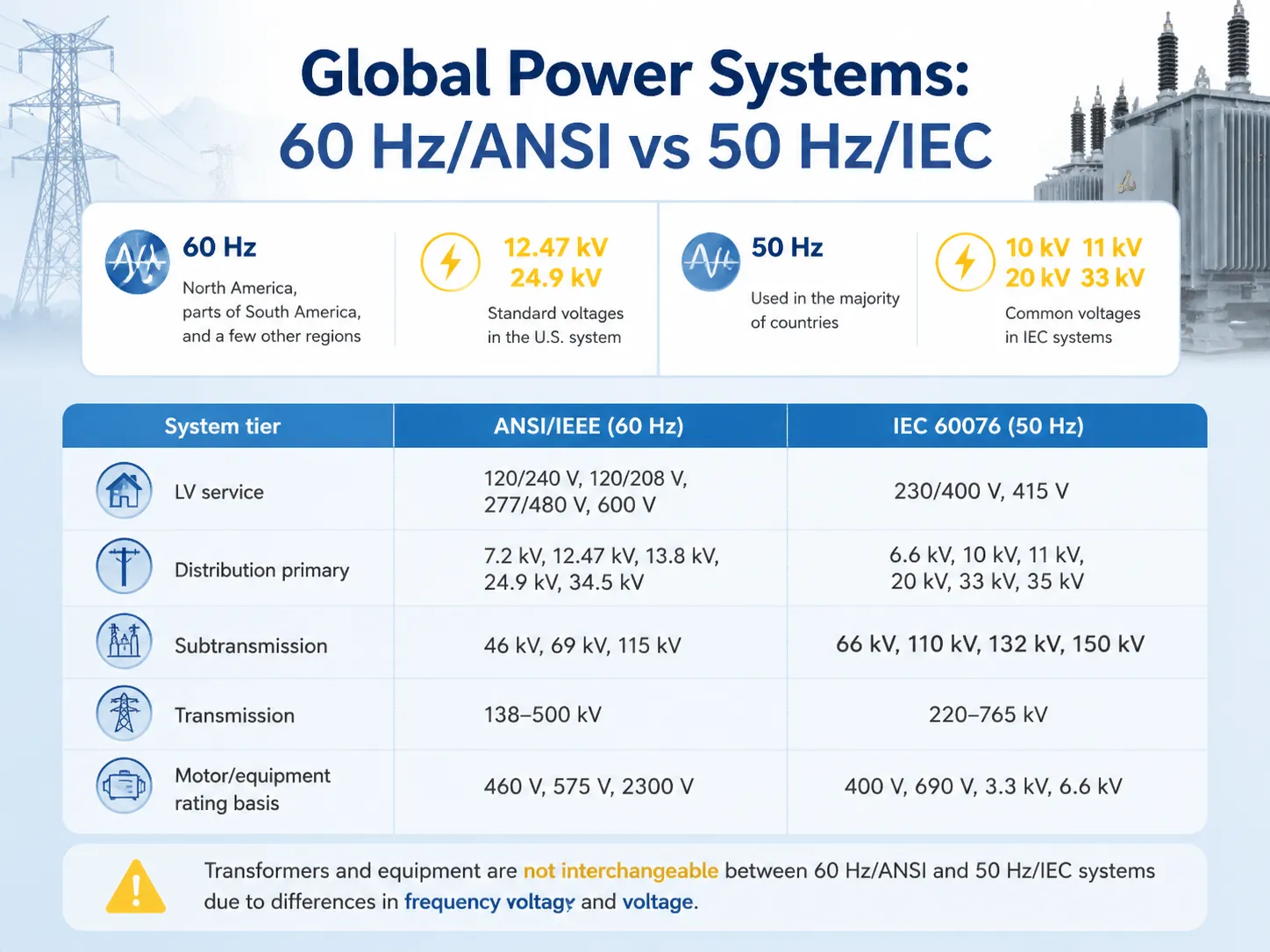
A frequência é o primeiro fator de divisão importante. A América do Norte, partes da América do Sul e algumas outras regiões usam 60 Hz, enquanto a maioria dos países tem uma frequência de 50 Hz. A fabricação de um transformador é projetada e construída considerando uma certa frequência. Um transformador operando em uma frequência para a qual não foi projetado pode levar a uma transformação que resultaria em uma densidade de fluxo muito maior, aproximando-se da saturação. Isso teria efeitos adversos consideráveis, incluindo superaquecimento, corrente de magnetização excessiva e envelhecimento do isolamento.
O segundo parâmetro que separa os dois sistemas é a tensão. A rede elétrica dos EUA utiliza tensões de 12.47 kV e 24.9 kV como tensões padrão, enquanto os sistemas IEC trabalham com 10 kV, 11 kV, 20 kV e 33 kV. O lado de baixa tensão também é diferente nos EUA (480 e 208 V) e nos sistemas IEC (400 e 415 V). Isso significa que todo o equipamento descrito é incompatível, pois difere em tensão.
| Nível do sistema | ANSI/IEEE (60 Hz) | IEC 60076 (50 Hz) |
|---|---|---|
| Serviço LV | 120/240 V, 120/208 V, 277/480 V, 600 V | 230/400 V, 415 V |
| Primário de distribuição | 2 kV, 12.47 kV, 13.8 kV, 24.9 kV, 34.5 kV | 6 kV, 10 kV, 11 kV, 20 kV, 33 kV, 35 kV |
| Subtransmissão | 46 kV, 69 kV, 115 kV | 66 kV, 110 kV, 132 kV, 150 kV |
| Transmissão | 138–500 kV | 220–765 kV |
| Base de classificação de motor/equipamento | 460 V, 575 V, 2300 V | 400 V, 690 V, 3.3 kV, 6.6 kV |
Notação de Resfriamento: OA/FA vs. ONAN/ONAF
A denotação de resfriamento é uma área importante de erro para iniciantes em RFQs. Nos EUA, OA (imersão em óleo e resfriamento natural), FA (resfriamento forçado com ventiladores), FOA (resfriamento forçado de óleo e ar) e combinações são termos comumente usados. A IEC utiliza o sistema de notação de quatro letras: O (óleo mineral), N ou F (resfriamento natural ou forçado), A ou W (ar ou água), N ou F (natural ou forçado). Portanto, ONAN é equivalente a OA e ONAF é o mesmo que FA. Antes de comparar custos, certifique-se de converter ambas as cotações para o mesmo sistema — um fornecedor usando ONAN ou ONAF em comparação com uma cotação dos EUA usando OA causará muita confusão entre aqueles que estão revisando as cotações, mesmo quando as máquinas têm características equivalentes.
| Significado | Notação ANSI/IEEE | Notação IEC |
|---|---|---|
| Imersão em óleo, resfriamento natural | OA | ONAN |
| Imersão em óleo, resfriamento por ventilador | FA | ONAF |
| Óleo forçado, ar forçado | FOA | OFAF |
| Óleo forçado, água forçada | FOW | OFWF |
| Tipo seco, ar natural | AA | UM |
Grupos Vetoriais e Deslocamento de Fase
Outro aspecto em que as duas famílias em sua classificação de transformadores diferem é a nomenclatura do grupo vetorial. A IEC utiliza o sistema de números de relógio, identificando o transformador como pertencente a um certo grupo vetorial que indica o tipo de conexão seguido por um número, que indica o deslocamento de fase das bobinas em múltiplos de 30 graus (por exemplo: Dyn11 significa que a bobina de baixa tensão lidera a bobina de alta tensão em 30 graus). O método mais comumente utilizado nos EUA é aquele introduzido pela ANSI; refere-se à designação angular e à ideia de um banco de conexão (por exemplo: delta-estrela com um atraso de fase de 30 graus). Como uma grande proporção (se não a maioria) dos transformadores instalados nos EUA opera em modo monofásico, a questão dos grupos vetoriais não é muito significativa. No entanto, o usuário deve certificar-se da conexão das bobinas e do ângulo de fase para equipamentos trifásicos, independentemente da notação em uso.
| Conexão de bobina | Notação IEC | Descrição ANSI/IEEE | Deslocamento de fase |
|---|---|---|---|
| Delta HV, estrela LV com neutro | Dyn11 | Delta-estrela, 30° de atraso (convenção dos EUA) | 330° (LV lidera) |
| Delta HV, estrela LV, alternado | Dyn5 | Delta-estrela, 150° | 150° |
| Estrela HV, delta LV | Yd11 | Estrela-delta, 30° | 330° |
| Estrela HV, estrela LV | Yyn0 | Estrela-estrela, 0° | 0° |
| Delta HV, delta LV | Dd0 | Delta-delta, 0° | 0° |
Testes, Placas de Identificação e Documentação
A filosofia de testes é diferente tanto no escopo dos testes quanto na apresentação dos resultados. A norma IEC 60076 estabelece testes de rotina (relação, grupo vetorial, resistência, impedância e perda de carga, perda em vazio e corrente, e testes dielétricos) e testes de tipo (aumento de temperatura, resistência a curto-circuito, nível de ruído), com tolerâncias claramente especificadas – por exemplo, ± 10% em impedância e tolerâncias especificadas para perdas. Quanto à prática dos EUA, ela segue códigos de teste estabelecidos pela IEEE C57.12.90 e utiliza fórmulas de avaliação de perdas da NEMA TP-1, onde a concessionária atribui o valor em dólar por watt de perdas em vazio e em carga e pede ao fabricante que otimize de acordo. Além disso, em países da IEC, os compradores esperam ver um relatório completo sobre testes de tipo incluído na proposta técnica, enquanto as concessionárias dos EUA exigem inspeção de terceiros ou testemunho de testes na fábrica. No entanto, a documentação não é um ornamento: serve como base para passar pela alfândega, aceitar mercadorias no local e obter seguro.
| Teste ou requisito | Prática ANSI/IEEE | Prática IEC 60076 |
|---|---|---|
| Escopo do teste de rotina | Conforme IEEE C57.12.90 | Conforme IEC 60076-1 |
| Tolerância de impedância | ±7.5% | ±10% padrão |
| Tolerância de perda em vazio | Conforme fórmula de avaliação de perdas | Especificado na IEC 60076-1 |
| Teste de aumento de temperatura | Teste de tipo, classe 65°C | Teste de tipo, IEC 60076-2 |
| Resistência a curto-circuito | IEEE C57.12.90 | IEC 60076-5 |
| Nível de som | Base IEEE C57.12.90 | IEC 60076-10 |
| Referência de eficiência | NEMA TP-1 | Valores de perda IEC 60076-1 |
Tabela de Comparação Lado a Lado
| Aspecto | Americano (ANSI/IEEE) | Europeu (IEC 60076) |
|---|---|---|
| Frequência nominal | 60 Hz | 50 Hz |
| Norma reguladora | Série IEEE C57.12, NEMA | Série IEC 60076 |
| Primários de distribuição comuns | 47 kV, 13.8 kV, 24.9 kV, 34.5 kV | 6 kV, 10 kV, 11 kV, 20 kV, 33 kV |
| Secundários de LV comuns | 120/240 V, 120/208 V, 277/480 V, 600 V | 230/400 V, 415 V, 6,3 kV, 10,5 kV |
| Notação de resfriamento | OA / FA / FOA | ONAN / ONAF / OFAF |
| Tolerância de impedância | ±7.5% | ±10% (mais rigoroso sob solicitação) |
| Notação do grupo vetorial | Convenções de ângulo ANSI | Dyn11, YNd11, etc. |
| Classe de aumento de temperatura | 65°C média de enrolamento | 60–65 K para classe A/F |
| Referência de eficiência típica | Avaliação de perda NEMA TP-1 | Valores de perda IEC 60076-1 |
Padrões de Aplicação Regional
De modo geral, transformadores americanos atendem às necessidades dos EUA, Canadá, México e algumas regiões da América Central e do Sul, bem como do Caribe e outros territórios com uma abordagem no estilo dos EUA. Transformadores europeus, por outro lado, atendem à Europa, Oriente Médio, África, a maior parte da Ásia e uma grande parte dos projetos de energia renovável globalmente, porque a IEC 60076 é o padrão principal para contratos EPC internacionais. No entanto, há exceções, uma vez que algumas empresas de energia na região do Golfo exigem unidades ANSI a 50 Hz de frequência, enquanto alguns países da América Latina misturam métodos IEC e ANSI. Portanto, antes de fazer sua oferta, certifique-se de fazer três perguntas: Qual é a frequência? Quais são as tensões? Qual é o padrão que o inspetor local irá implementar? As respostas fornecerão todas as informações necessárias.
Paisagem de Marca e Faixas de Preço
| Marca | Força da família padrão | Produto de distribuição típico | Faixa de preço indicativa (US$) |
|---|---|---|---|
| ABB | ANSI + IEC | Unidades de distribuição preenchidas com líquido e tipo seco | $12.000–$60.000 |
| Siemens | IEC forte, ANSI disponível | Transformadores de distribuição e industriais | $11.000–$55.000 |
| Schneider Electric | IEC forte | Unidades de tipo seco e resina moldada | $8.000–$45.000 |
| Hitachi Energy | ANSI + IEC | Transformadores de distribuição de grau utilitário | $13.000–$70.000 |
| Eaton | ANSI forte | Unidades de tipo seco, montadas em base para o mercado dos EUA | $7.000–$42.000 |
| Prolec GE | ANSI forte | Transformadores de distribuição utilitária dos EUA | $10.000–$55.000 |
| Jiangsu Subian Electric Power | IEC primário, ANSI sob solicitação | Unidades imersas em óleo, tipo seco, tipo caixa, especiais | $9.000–$40.000 |
Os preços variam para o transformador de distribuição com potência nominal de 1.000 a 2.500 kVA, onde se pode esperar variações dependendo da classificação, perdas, classe de tensão e equipamentos. Há vários fabricantes que fornecem produtos excelentes no contexto de transformadores, como ABB, Siemens, Schneider Electric, Hitachi Energy ou Eaton, que oferecem dispositivos excepcionalmente bons verificados por documentos de teste aceitos como referência da indústria. A Jiangsu Subian Electric Power Co. Ltd é uma empresa da China que fabrica transformadores imersos em óleo, tipo seco e tipo caixa de acordo com a IEC 60076 e também fornece projetos ANSI/IEEE para projetos de 60 Hz a preços acessíveis para clientes que exigem que todos os padrões de engenharia sejam atendidos. Os materiais utilizados na fabricação incluem aço silício orientado a grão e cobre para enrolamento, enquanto todos os tipos de testes são realizados na fábrica antes do envio dos transformadores. Mais detalhes estão disponíveis em site da Subian Electric.
Como Escolher a Família de Padrões Certos
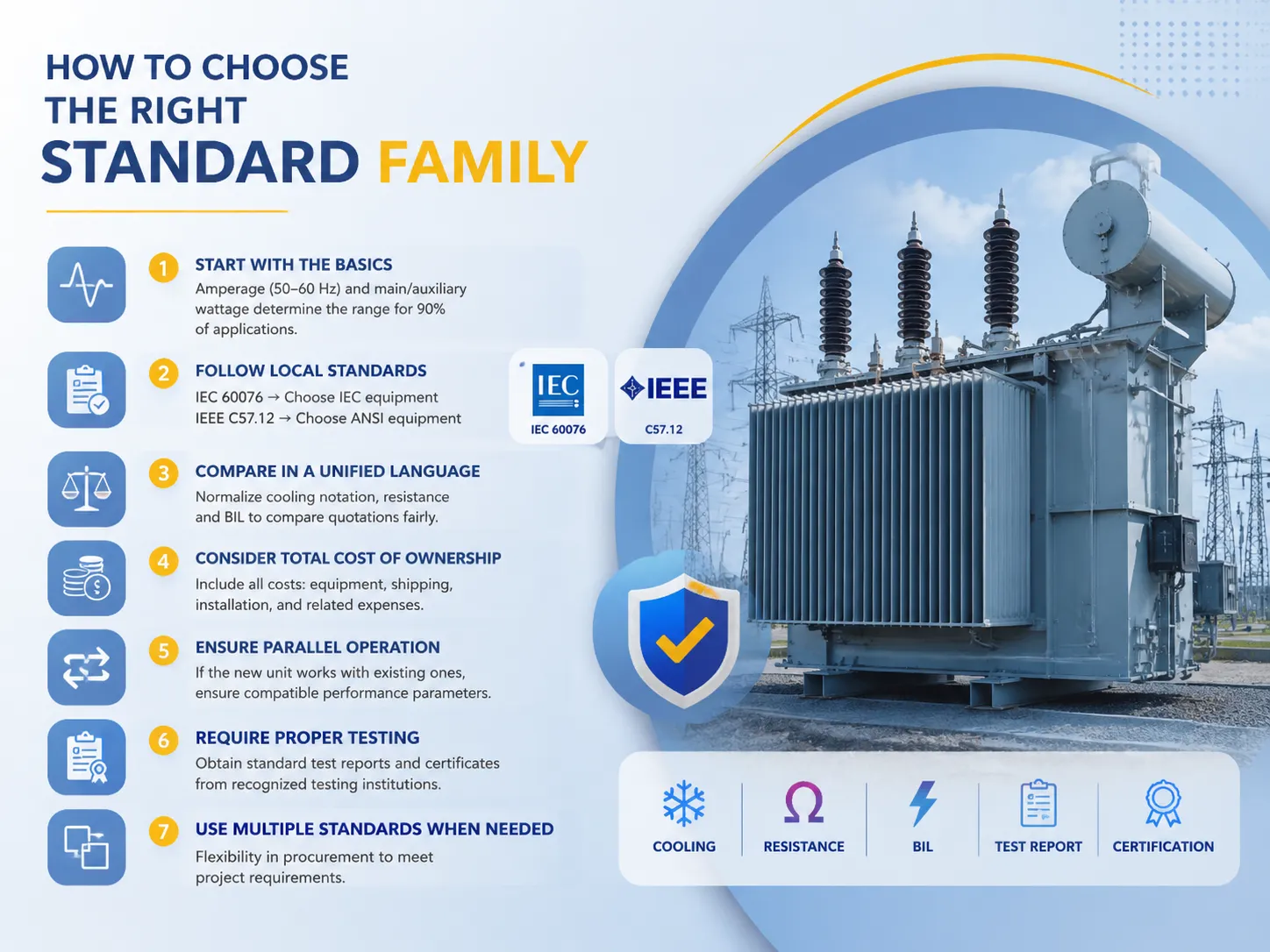
- Comece com a concepção da rede. A amperagem (50-60 Hz) e a potência principal/auxiliar neste local determinam a faixa para 90% de assuntos.
- Investigue os princípios locais. Se o fornecedor ou órgão de monitoramento seguir a norma IEC 60076, então adquira o equipamento IEC, no entanto, se eles dependerem da norma IEEE C57.12, busque os produtos ANSI. Não permita que opções baratas ditem suas decisões.
- Transforme os detalhes das especificações em termos de notação de resfriamento, resistência e BIL em uma linguagem unificada para comparar as cotações.
- Examine o custo total de compra e instalação que cobre todas as despesas: envio e transporte de equipamentos, fundos gastos na instalação.
- Certifique-se de que as condições de operação em paralelo sejam atendidas. Se for importante que uma nova unidade funcione junto com outra, tenha certeza de que os parâmetros de desempenho sejam compatíveis.
- Apresente os requisitos relacionados aos testes. Você deve receber um relatório de teste padrão e um certificado de teste realizado pela instituição reconhecida se seu projeto for especialmente significativo.
- Utilize várias normas para aquisição, se necessário.
Perguntas Frequentes
Um transformador de 50 Hz pode ser usado em uma rede de 60 Hz?
De modo geral, sim; no entanto, você deve verificar com o fabricante. A 60 Hz, a densidade de fluxo diminui em aproximadamente 17% em comparação com o ponto de projeto de 50 Hz, o que resulta em uma diminuição nas perdas em vazio e na corrente de magnetização. Há apenas uma pequena mudança no componente de perda de carga e na impedância; assim, a classificação exata da placa pode não ser atendida a 60 Hz. Para uma instalação permanente, prefira um dispositivo fabricado para a frequência real da rede, em vez de usar um que seja capaz de operar em frequências cruzadas.
Qual norma é mais comum para projetos de exportação internacional?
A IEC 60076 é a norma para a maioria dos projetos de exportação na Europa, África, Oriente Médio, Sudeste Asiático e América Latina, enquanto a ANSI/IEEE se aplica apenas à América do Norte e alguns territórios adjacentes. Se seu comprador for um contratante EPC, você pode esperar ver a IEC 60076-1, -2, -3 e -5 referenciadas na especificação.
Transformadores americanos e europeus são fisicamente intercambiáveis?
Com algumas mudanças. As configurações do bushing, a posição dos terminais, as aletas das unidades de resfriamento, as indicações na placa de identificação e as conexões do painel de baixa tensão diferem de uma maneira para outra. Na maioria dos casos, ao colocar o equipamento dos EUA em uma estação IEC, a unidade deve ser adaptada com barras coletoras e os circuitos de proteção devem ser reconfigurados adequadamente.
A Subian fabrica transformadores para ambos os padrões?
Certamente. A Jiangsu Subian Electric Power utiliza a IEC 60076 como seu padrão e realiza práticas ANSI/IEEE (IEEE C57.12.00, C57.12.20) para todos os seus projetos de 60 Hz, incluindo classes de tensão ANSI e tipo de resfriamento OA/FA. A planta realiza testes padrão de acordo com o código de teste apropriado e está em posição de oferecer exame testemunhado ou de terceiros de qualquer tipo.
Qual é a diferença de preço típica entre as versões ANSI e IEC da mesma classificação kVA?
Mesmo para classificações idênticas, a variação de preço está tipicamente na faixa de 5-15%, que pode ser influenciada mais pelo design dos tanques, tipo de bushings e escopo de testes do que pelo padrão em si. Um transformador com a classificação de 1.000 kVA12.47 kV pode, portanto, ter um preço na faixa de $12.000-28.000 com configuração ANSI e $11.000-26.000 com configuração IEC. Portanto, deve-se pedir a um fabricante de transformadores ANSI e IEC que forneça ambas as cotações e comparar as perdas e acessórios de acordo.
Referências
- IEEE C57.12.00 — Requisitos Gerais para Transformadores de Distribuição, Potência e Regulação Imersos em Líquido — a especificação americana fundamental para classificação e teste.
- IEC 60076-1 — Transformadores de Potência: Geral — o padrão guarda-chuva da série IEC 60076 utilizado mundialmente.
- IEC 60076-5 — Capacidade de Suportar Curto-Circuito — o padrão de verificação de curto-circuito IEC referenciado em RFQs de exportação.
- NEMA TP-1 — Guia para Determinação da Eficiência Energética para Transformadores de Distribuição — o benchmark de eficiência dos EUA para avaliação de perdas.
- IEEE C57.12.20 — Padrão para Transformadores de Distribuição Aéreos e Montados em Base — o padrão de construção para as unidades de distribuição americanas mais comuns.
- IEC 60076-10 — Determinação dos Níveis de Som — o padrão de teste IEC para ruído de transformadores, relevante para localização urbana e industrial.
Conclusão
Transformadores nos Estados Unidos e na Europa são fabricados de acordo com vários princípios, o que significa que haverá diferenças consideráveis entre eles, como frequência, tensão, sistema de resfriamento, grupos vetoriais e método de teste. A melhor maneira de finalmente fazer a compra correta é primeiro determinar os parâmetros da rede elétrica (por exemplo, frequência e tensões de entrada/saída, e padrão segundo o qual a unidade é produzida) e então converter as ofertas dos fabricantes em um formato, comparando os custos totais e as perdas das unidades em vez de apenas seus preços. site oficial para receber uma cotação compatível com a especificação na família de padrões que seu projeto realmente necessita.