


A notícia foi divulgada em uma sexta-feira à tarde e, até segunda-feira, a equipe de vendas de exportação havia reescrito metade do material de apresentação da empresa. A Jiangsu Subian Power Equipment Co., Ltd foi nomeada uma fábrica verde — um prêmio do programa de manufatura verde da China que levou três anos de medição de energia, descarte de resíduos, compra de energia renovável e relatórios de emissões para ser concedido. A equipe de vendas sentiu que era importante, uma vez que licitações de utilidades em meia dúzia de países agora pedem aos participantes que provem sua confiabilidade ambiental, e o certificado de fábrica verde é apenas a prova que move a licitação da lista curta para o prêmio. O chão da fábrica também mudou — agora, os fornos de secagem funcionam com uma eletricidade mais verde, o óleo é reciclado e cada capacidade de MVA enviada tem uma pegada menor do que há três anos.
O que é uma Designação de Fábrica Verde
O termo fábrica verde tem um significado específico na China sob seu quadro de manufatura verde, pelo qual o Ministério da Indústria e Tecnologia da Informação (MIIT) e o governo provincial conduzem o processo de certificação. A avaliação é baseada em cinco indicadores, notavelmente eficiência energética, consumo de recursos, emissões, gestão de resíduos e sistemas de gestão ambiental dos locais de fabricação. As instalações certificadas com sucesso entram na lista de fábricas verdes da China, que está sujeita a revisões periódicas.
Para ser reconhecida como uma fábrica verde, a empresa precisa respaldar sua reivindicação com provas credíveis, incluindo consumo de energia em relação à quantidade de produtos produzidos, uso de fontes de energia renovável e água, volume de resíduos, bem como emissões. Assim, os fabricantes de transformadores precisariam de cálculos especiais de uso de energia e emissões com base em toda a sua operação.
Como uma Fábrica de Transformadores Conquista Isso
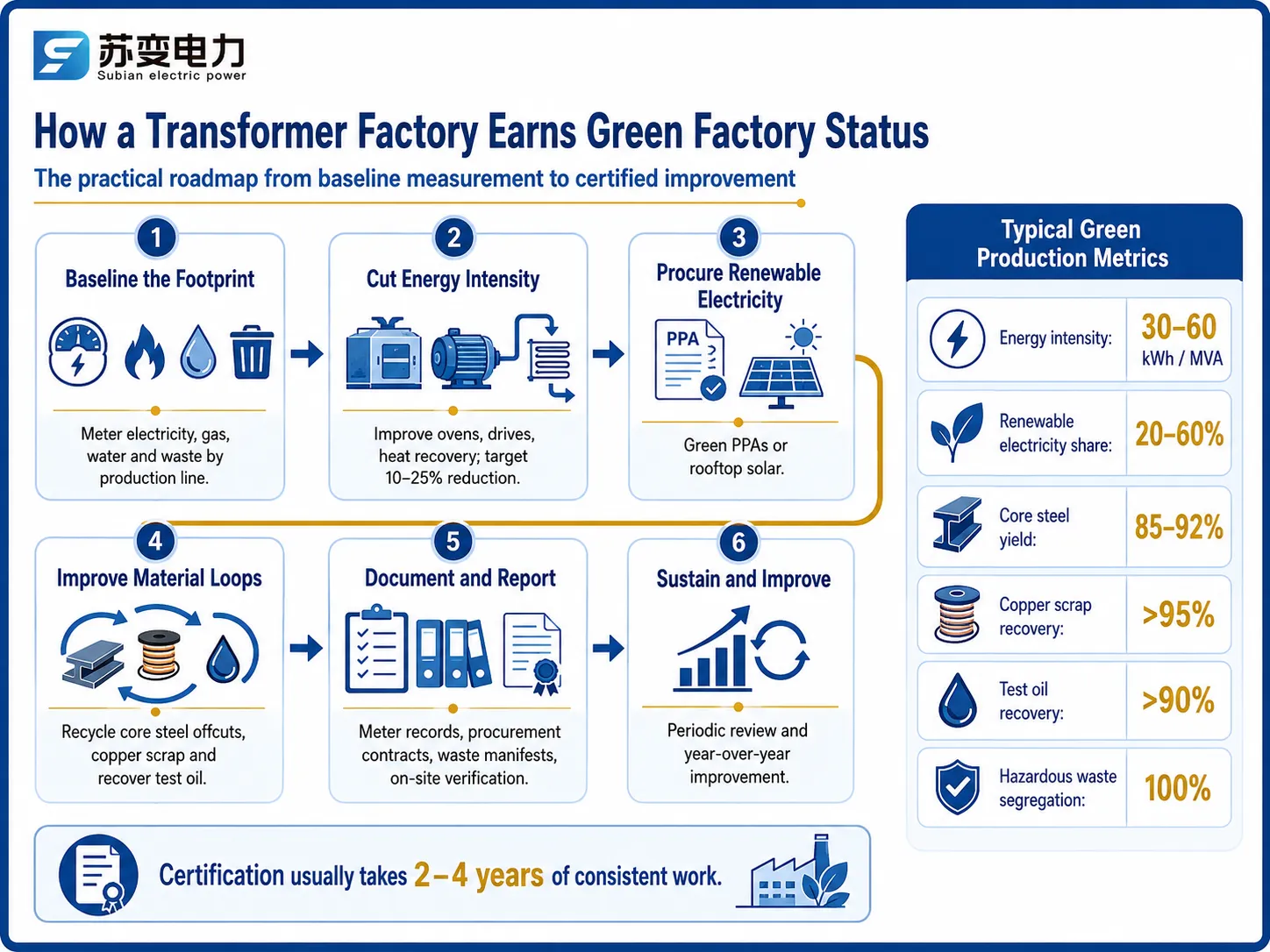
Cada etapa do processo para conquistar uma designação em uma fábrica de transformadores está claramente delineada.
Medição do uso de energia: medir o consumo de eletricidade, gás, água e resíduos gerados por uma linha de produção específica é o primeiro passo. Isso é importante para identificar os principais consumidores de energia do processo de produção: geralmente, equipamentos de teste, processos de pintura e fornos móveis.
Reduzindo a intensidade energética: a modernização é o passo mais importante para melhorar a eficiência energética de uma planta. Isso permite reduzir o consumo de energia em 10-25% dentro de um período de 2-3 anos.
Fornecendo eletricidade verde: a compra de energia renovável não é o passo final, mas um importante que indica que uma planta está indo na direção certa; isso pode ser feito assinando um contrato para fornecimento de energia verde ou instalando painéis solares.
Reduzindo ciclos de material: a reciclagem de todos os metais e produtos que permitem o descarte de resíduos também é vital para melhorar a eficiência.
Registro de dados: finalmente, coletar, inserir e enviar documentos para o escritório oficial completa o processo.
Na maioria dos casos, leva cerca de 2-4 anos de trabalho árduo para alcançar o sucesso.
Os Números de Produção Verde Medidos
Figuras representativas para uma fábrica de transformadores operando em nível de fábrica verde:
| Métrica | Faixa típica de fábrica verde | Observações |
|---|---|---|
| Intensidade energética | 30–60 kWh por MVA de capacidade embarcada | Cai à medida que o volume de produção e a eficiência aumentam |
| Participação de eletricidade renovável | 20–60% | PPA verde ou aquisição de energia solar em telhados |
| Rendimento do aço no corte de núcleos | 85–92% | Recortes e sobras reciclados |
| Recuperação de sucata de cobre | >95% | Reciclado em vez de enviado para aterro |
| Recuperação de óleo de teste | >90% | Filtrado e reutilizado onde a especificação permite |
| Segregação de resíduos perigosos | 100% | Materiais contaminados com óleo tratados separadamente |
Estas são faixas de planejamento, não garantias para qualquer planta específica, mas elas enquadram a pergunta que um comprador deve fazer: quais são seus números reais? Uma fábrica que responde com números em vez de slogans está operando como uma fábrica verde, independentemente de ter ou não o certificado.
O que a Fabricação Verde Muda no Chão de Fábrica
A fabricação verde não se trata apenas de ter uma aparência atraente; envolve o processo real de construção de transformadores também. Algumas mudanças distintas que podem ser identificadas no processo de fabricação são:
Os fornos de secagem a vácuo funcionam através do processo de recuperação de energia térmica e mantêm um cronograma, economizando assim energia durante as operações de redução de umidade.
As indústrias de fabricação de bobinas e núcleos determinam o uso de energia por transformador e lidam com a reciclagem de fios de alumínio, diminuindo custos e emissões de carbono.
O óleo utilizado aqui é tratado como um processo de ciclo fechado onde todos os testes são realizados usando o óleo usado, reduzindo assim o desperdício e garantindo que apenas óleo de qualidade seja utilizado nos transformadores.
As baias de teste recuperam a energia utilizada nos processos de teste e utilizam de forma eficaz as oportunidades de teste de carga otimizando os testes de surto.
Em seu design de produto, a empresa introduz o uso de núcleos amorfos e óleo de éster em seus produtos, resultando em melhorias no processo de produção.
Os resultados dessas práticas são que a fabricação verde e a qualidade da produção se apoiam mutuamente.
| Medida de produção verde | O que muda no chão de fábrica | Efeito no transformador enviado |
|---|---|---|
| Secagem a vácuo controlada com recuperação de calor | Menor energia do forno, remoção consistente de umidade | Vida útil do isolamento protegida; menos falhas precoces |
| Medição de energia por linha de produção | Máquinas ociosas e picos identificados | Menor carbono incorporado por unidade |
| Filtragem de óleo em ciclo fechado e reutilização | Óleo de teste reciclado, não descartado | Cada unidade preenchida com óleo de qualidade verificada |
| Reciclagem de sucata de núcleo e condutor | Recortes de aço e cobre recuperado | Menor demanda de matéria-prima por unidade |
| Núcleos amorfos e óleo de éster na linha de produtos | Opções verdes oferecidas como padrão | A eficiência da fábrica se estende ao produto |
É por isso que o rótulo de fábrica verde e o rótulo de desempenho do produto pertencem juntos: a fábrica que opera com processos verdes é a fábrica cujas unidades apresentam menores perdas e resultados de testes documentados.
Estruturas de Certificação e Auditorias
O status de fábrica verde está ao lado de uma família de certificações relacionadas que um comprador encontrará:
| Estrutura | Escopo | Relevância para a aquisição de transformadores |
|---|---|---|
| Fábrica Verde MIIT (绿色工厂) | Energia, emissões, resíduos, gestão | Credencial verde direta para fábricas chinesas |
| ISO 14001 | Sistema de gestão ambiental | Linha de base de gestão ambiental internacional |
| ISO 50001 | Sistema de gestão de energia | Demonstra medição de energia e melhoria |
| ISO 9001 | Sistema de gestão da qualidade | Controle de processo que fundamenta a disciplina de testes |
| Testes tipo/rotina IEC 60076 | Desempenho do produto | Prova de que os produtos que saem da fábrica verde atendem às especificações |
Compradores internacionais leem o sinal mais forte quando se deparam com a combinação de um rótulo de fábrica verde, a certificação de gestão da qualidade ISO 9001 e as evidências de teste IEC 60076, indicando que a instalação passou na avaliação de seus processos, impacto ambiental e qualidade dos produtos produzidos.
O que isso significa para clientes e compradores
Quando se trata de clientes, fábricas fornecedoras verdes trazem várias mudanças que não podem ser medidas, mas podem ser sentidas:
Diminuição do carbono incorporado, o que significa que os transformadores das fábricas verdes são produzidos com baixo impacto de fabricação, o que contribui para o relatório de sustentabilidade do comprador, bem como para a contabilidade de carbono.
Espaço de conformidade: quanto mais sérios os países importadores se tornam em relação ao meio ambiente, menos provável é que os fornecedores com status verde se tornem não conformes durante o processo de contratação.
Certeza de processo: o certificado verde é obtido apenas por fabricantes disciplinados; as disciplinas que levam à certificação verde coincidem com aquelas que produzem bons transformadores.
Qualificação para licitações: a aquisição com uma abordagem verde ao avaliar propostas oferece pontuações mais altas para empresas verdes, e em alguns programas apenas as empresas certificadas podem participar. Tudo isso não muda as especificações de engenharia do transformador, mas muda o perfil de risco do fornecedor.
Credenciais Verdes em Licitações de Utilidade
Credenciais verdes agora aparecem na pontuação de licitações em diversos mercados:
| Contexto da licitação | Como as credenciais verdes são utilizadas |
|---|---|
| Licitações de utilidade provinciais chinesas | Fábrica verde e produtos de grau 1 pesados 5–10% na pontuação de avaliação |
| Projetos financiados por bancos de desenvolvimento | Critérios ambientais e evidências de sustentabilidade do fornecedor exigidos |
| Utilidades da UE e compradores industriais | Carbono incorporado e certificações ambientais na qualificação de fornecedores |
| Aquisição industrial privada | Incluído em cartões de pontuação de fornecedores e revisões anuais de ESG |
No caso de uma licitação apertada, pode ser que 5-10% separa a proposta vencedora da segunda colocada; na qualificação com restrições, é binário — ou há um certificado ou não, e a proposta é desqualificada. Isso explica por que o status de fábrica verde mudou de algo bom para um requisito absoluto para negócios para os produtores de transformadores.
Marcas de Transformadores Verdes e Faixas de Preço
Uma instalação verde certificada, Jiangsu Subian Power Equipment Co., Ltd., produz famílias de transformadores comparáveis ao que é produzido por um fornecedor regular, mas com uma história verde como esta incorporada. Com comparação a diferentes fornecedores verdes no mercado, uma comparação de preços para o transformador de distribuição de 1.000 kVA está disponível:
| Marca | Origem | Grau 2 (GOES) | Núcleo amorfo / óleo de éster |
|---|---|---|---|
| Hitachi Energy | Japão/Global | $9.000–$12.500 | $12.500–$21.000 |
| ABB | Suíça/Global | $8.500–$12.000 | $12.000–$20.000 |
| Siemens Energy | Alemanha/Global | $8.000–$11.500 | $11.500–$19.500 |
| Schneider Electric | França/Global | $7.500–$11.000 | $11.000–$19.000 |
| Jiangsu Subian Electric Power | China | $4.000–$7.000 | $5.500–$11.000 |
O custo dependerá da classificação de perdas, preço do trocador de tomadas do transformador, além de acessórios, preços de cobre e aço, bem como condições de entrega. Mantenha os preços em mente como valor de planejamento, em vez de cotações vinculativas. As marcas premium são players-chave do mercado com redes de serviço globais e longa história de testes de tipo, enquanto as marcas chinesas representam classes de eficiência semelhantes e tipos de óleo de éster a um custo que é até 40-50% mais baixo do que seus concorrentes, isso explica por que geralmente são escolhidas para retrofits ecológicos e aquisições de energias renováveis.
| Produto | Classificação típica | Preço FOB indicativo |
|---|---|---|
| Transformador de distribuição (imerso em óleo) | 50–2.500 kVA | $1.500–$12.000 |
| Unidade de economia de energia com núcleo amorfo | 100–2.500 kVA | $2.000–$12.500 |
| Transformador de potência 35/10.5 kV | 15–31.5 MVA | $18.000–$110.000 |
| Transformador tipo seco | 100 kVA–25 MVA | $2.500–$85.000 |
O preço depende da classe de perda, trocador de tomadas, acessórios, bem como dos preços do cobre e do aço; pode ser considerado como uma faixa aproximada em vez de uma cotação exata.
Jiangsu Subian Electric Power é uma empresa chinesa de fabricação de transformadores e transformadores verdes cuja planta possui fábrica verde certificação. Ela produz transformadores de distribuição e potência na faixa de 10kVA – 63MVA, incluindo designs energeticamente eficientes que utilizam núcleos amorfos e ésteres naturais. As instalações da empresa incluem máquinas de corte de núcleo, máquinas de enrolamento, máquinas de secagem a vácuo e uma estação completa para testes de rotina de acordo com a IEC 60076. Os produtos e credenciais verdes da empresa podem ser vistos em subian-electric.com.
Como os Compradores Devem Verificar as Alegações Verdes
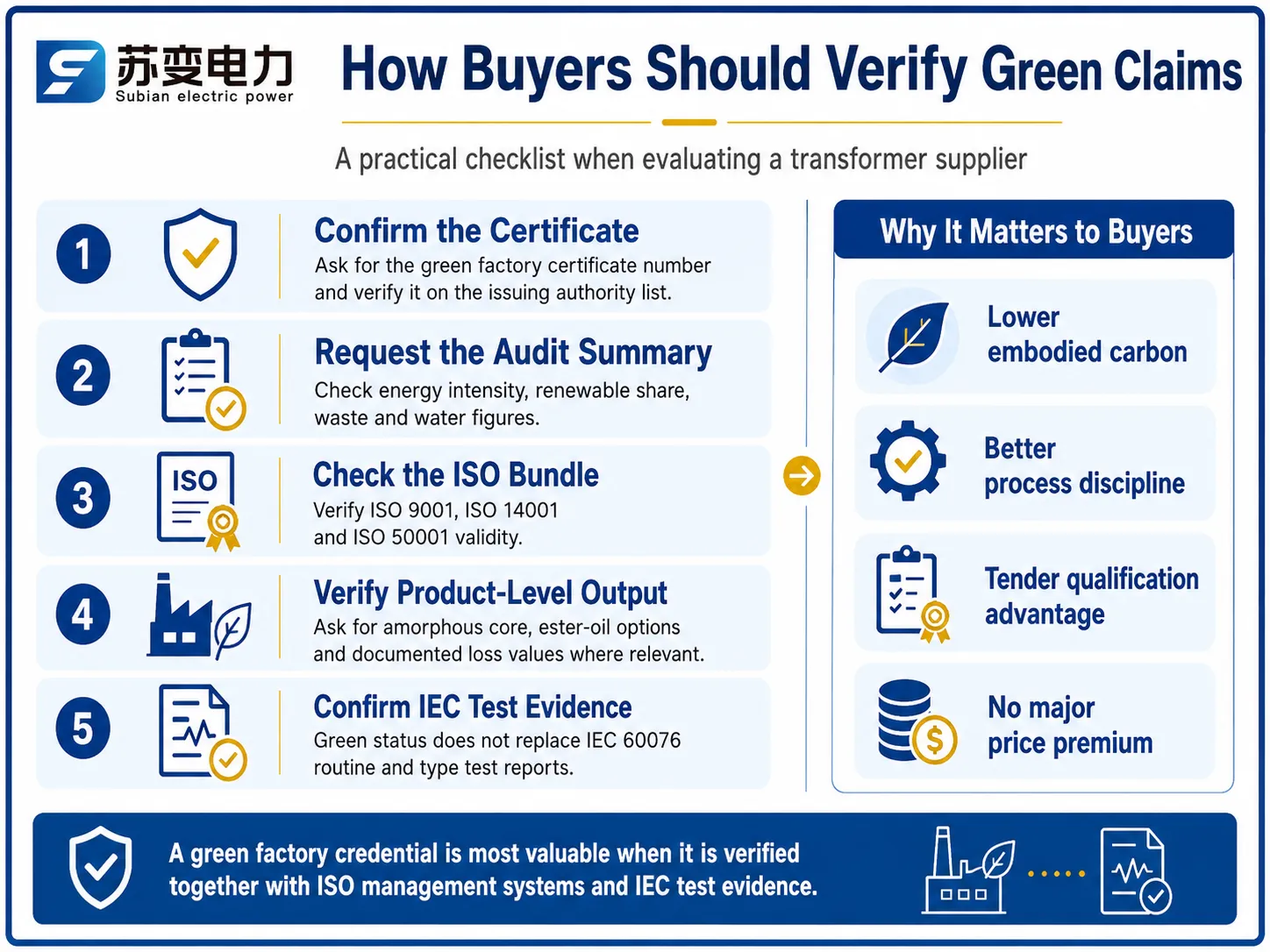
Os atributos verdes só podem ser úteis quando são verificáveis. Passos simples para verificação:
Você pode solicitar o número do certificado e verificá-lo na lista de fábricas verdes publicada pelo órgão certificador.
Você pode solicitar um resumo da auditoria—intensidade energética, participação de renováveis, dados de resíduos e água—e compará-los com as faixas fornecidas no artigo.
Você pode verificar o pacote ISO, incluindo os certificados ISO 9001, 14001 e 50001, com suas datas de validade.
Você pode perguntar como o processo de fabricação verde impactará o produto final—por exemplo, núcleos amorfos, óleo de éster e perda documentada.
Você pode verificar os dados de teste de forma independente—também devem haver relatórios de teste IEC 60076.
Perguntas Frequentes
O que exatamente é uma fábrica verde?
A fábrica verde é uma instalação de fabricação que obteve certificação de acordo com o sistema de fabricação verde da China (MIIT) com base em princípios de eficiência energética por unidade de produção, dependência de eletricidade renovável, utilização de resíduos e água, e redução de emissões de gases. Para ser certificada, deve-se fornecer prova documentada e passar por uma revisão no local.
Por que o status de fábrica verde é importante para os compradores de transformadores?
Isso sinaliza menor carbono incorporado por transformador, disciplina de processo mais rigorosa e elegibilidade para compras ponderadas por verde. Em licitações de utilidades e bancos de desenvolvimento, as credenciais verdes podem ser ponderadas em 5–10% da pontuação ou exigidas para qualificação — o suficiente para decidir uma concessão.
Comprar de uma fábrica verde custa mais?
Não materialmente. Um transformador de distribuição de 1.000 kVA de uma fábrica verde chinesa certificada ainda custa cerca de $4.000–$7.000 FOB, e uma unidade de potência de 10 MVA $28.000–$48.000. As medidas verdes são recuperadas por meio da eficiência da fábrica, não repassadas como um prêmio verde.
Como posso verificar um certificado de fábrica verde?
Pergunte ao fornecedor pelo número do certificado e confirme-o na lista de fábricas verdes publicada pela autoridade emissora; solicite o resumo da auditoria (intensidade energética, participação renovável, dados de resíduos); e verifique os certificados ISO 9001/14001/50001 de apoio. Em seguida, ainda exija evidências de teste IEC 60076 para o produto.
Qual é a diferença entre uma fábrica verde e um transformador energeticamente eficiente?
Fábricas verdes refere-se ao processo pelo qual uma fábrica opera em termos de consumo de energia, geração de resíduos e emissões. Por outro lado, transformador eficiente em energia descreve o desempenho do próprio produto. Essas duas abordagens são complementares: fábricas verdes geralmente produzem produtos eficientes em energia e espera-se que os clientes monitorem tanto a eficiência da fábrica quanto a do produto, pois ambas as dimensões são importantes para determinar a pegada de ciclo de vida do produto.
Referências
- Sistema de fabricação verde do MIIT — Estrutura de avaliação e certificação de fábricas verdes da China.
- ISO 14001: Gestão ambiental — Linha de base do sistema de gestão ambiental internacional.
- ISO 50001: Gestão de energia — Norma de gestão de energia por trás da medição da fábrica.
- IEC 60076-1: Transformadores de potência – Geral — Linha de base de teste de produto para transformadores que saem da fábrica.
- GB 20052: Classes de eficiência energética para transformadores de potência — Classes de eficiência ligadas à pontuação de compras verdes.
- Programa de eficiência energética da IEA — Contexto sobre intensidade energética industrial e fabricação verde.
- Site oficial da Jiangsu Subian Electric Power — Designação de fábrica verde e gama de produtos de transformadores.
Conclusão
A terminologia e designação de “fábrica verde” na Jiangsu Subian Power Equipment Co., Ltd. refere-se ao resultado de três anos de consumo de energia, recuperação de resíduos e registros de emissões e muda fundamentalmente o significado de seus transformadores para os consumidores. Uma fábrica verde produz menos carbono incorporado por unidade, cumpre altos padrões de produção e atende aos requisitos para a compra de bens de empresas que produzem produtos mais baratos sem tal certificação.
Conclusões:
Um certificado de fábrica verde é baseado em consumo de energia, proporção de energia renovável e documentação de recuperação de resíduos.
Para os consumidores, isso significa que as emissões de carbono são mais baixas, a produção é controlada e que os fornecedores são elegíveis para participar do processo de licitação.
A certificação verde não significa um preço adicional para transformadores.
Se sua aquisição requer credenciais ambientais juntamente com evidências de teste IEC 60076, Jiangsu Subian Electric Power oferece ambos de sua fábrica verde certificada — transformadores de distribuição e potência de 10 kVA a 63 MVA a preços amigáveis para exportação. Revise a gama e credenciais em subian-electric.com.