


Uma vila nas Filipinas que dependia de geradores a diesel para fornecer energia à comunidade nos últimos vinte anos, ativou o novo transformador classificado em 10/0,4 kV que possibilitou à comunidade experimentar eletricidade na clínica pela primeira vez. O transformador foi produzido em Jiangsu, China e transportado por mais de 3000 km pelo fabricante que pode ser encontrado em todas as subestações em todo o mundo, incluindo Ásia, África, Oriente Médio e América Latina. O valor de ter um fabricante que torna possível fornecer eletricidade a todos os países, sem dúvidas sobre se isso é realmente possível, pode ser comprovado pelo resultado do processo, assim que se leva a sério um dos fabricantes responsáveis.
O artigo descreve como os fabricantes de transformadores, em particular a Jiangsu Subian Electric Power, ajudam a mudar a situação da eletricidade na rede subdesenvolvida por meio da melhoria dos sistemas de fornecimento de energia de várias indústrias. Além disso, aprenderemos sobre o potencial do mercado global, o tipo de produtos exportados, os respectivos preços e o processo de compra de transformadores dos fabricantes na China.
De acordo com estimativas, o tamanho do mercado global de transformadores foi avaliado em aproximadamente $43 bilhões em 2024. A demanda por transformadores e outros equipamentos deve crescer a uma taxa de 6%–7% anualmente como resultado do aumento da produção de energia renovável, juntamente com o envelhecimento da infraestrutura elétrica existente e a eletrificação no mundo em desenvolvimento. A maior parte dos transformadores vendidos vem de empresas chinesas como a Jiangsu Subian Electric Power, que têm exportado transformadores com classificações entre 50 kVA e 220 kV para mais de 60 países. Os transformadores são acompanhados pelos certificados IEC 60076 e podem ser feitos sob medida no programa OEM/ODM.
Por que a Eletrificação Ainda Define o Desenvolvimento Global
A primeira coisa que se precisa saber sobre a produção de eletricidade é que ela serve como a base fundamental da vida, sem a qual bombas e sistemas de refrigeração não podem funcionar e sistemas de telecomunicações e educacionais não podem existir. A Agência Internacional de Energia relatou recentemente que em 2022 quase 780 milhões de pessoas viviam sem eletricidade, o que significa que, a menos que os investimentos na produção de eletricidade aumentem, cerca de 685 milhões de pessoas ainda estarão sem eletricidade em 2030.
Toda rede começará sua operação somente quando todos os transformadores necessários estiverem instalados para transformar a eletricidade de alta tensão em eletricidade doméstica. Em países em desenvolvimento, os problemas de fornecimento de eletricidade são muito complicados porque o equipamento antigo da década de 1970 e 1980 está sendo substituído por novas fontes de energia renovável, por exemplo, novas subestações, mas insuficientes. O número de compromissos alcançados é tão alto que os fabricantes não tiveram tempo para se ajustar a isso, resultando em os transformadores terem um atraso de cerca de um ano.
Mercado Global de Transformadores: Tamanho, Fatores e Previsão
De acordo com estimativas do setor, o mercado global de transformadores deve ser em torno de $43 bilhões em 2024 e tem uma taxa de crescimento anual de 6% a 7%. Os fatores que influenciam este mercado são mais estruturais do que cíclicos:
| Motor | Impacto | Números Exemplares |
|---|---|---|
| Construção de renováveis | Cada parque eólico/solar precisa de transformadores GSU + de coleta | 412 GW de eólica e solar adicionados globalmente apenas em 2023 |
| Envelhecimento da rede | Substituições de unidades de 30 a 50 anos | Idade média da frota dos EUA ~40 anos; muitas unidades além da vida útil projetada |
| Eletrificação | Novas conexões rurais e urbanas | ~685 milhões de pessoas ainda podem não ter energia até 2030 |
| Carregamento de veículos elétricos e centros de dados | Novos pontos de fornecimento MV/HV e subestações no local | Carga de centros de dados crescendo 15–25% por ano regionalmente |
| Repatriação industrial | Novas fábricas precisam de transformadores de potência | Fábricas de semicondutores, baterias e aço em todo o mundo |
A China controla a fabricação; produz quase 50 por cento dos transformadores de distribuição no mundo em volume e seus fabricantes estão cada vez mais atendendo projetos no exterior diretamente e não mais apenas por meio de distribuidores locais.
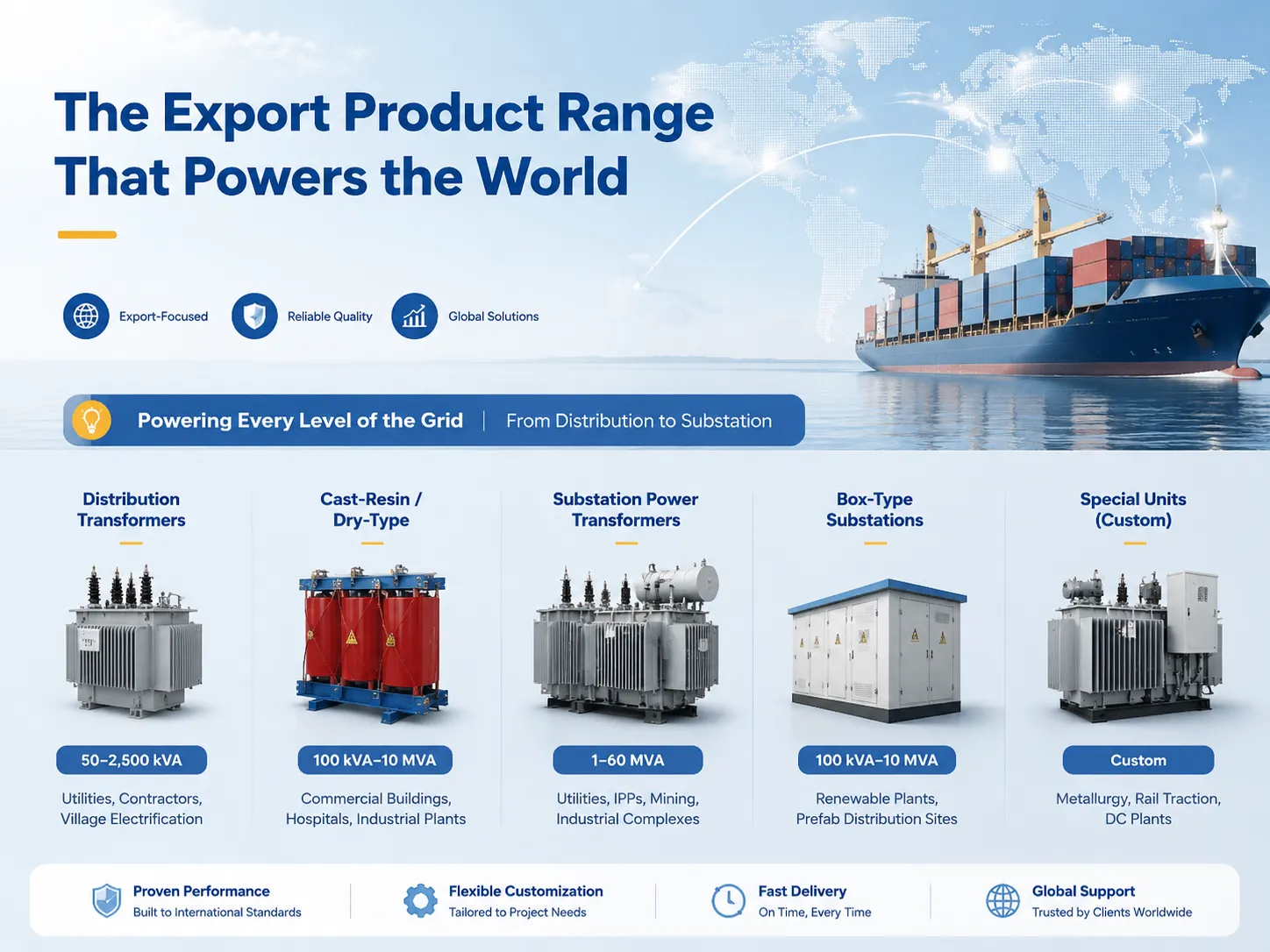
A Linha de Produtos de Exportação que Alimenta o Mundo
Um fabricante de transformadores como a Jiangsu Subian Electric Power, que foca em exportações, possui uma linha de produtos confiável que é paralela à própria rede:
| Família de Produtos | Faixa de Classificação | Compradores Típicos |
|---|---|---|
| Transformadores de distribuição (poste / base) | 50–2.500 kVA | Utilitários, empreiteiros, projetos de eletrificação rural |
| Resina fundida / tipo seco | 100 kVA–10 MVA | Torres comerciais, hospitais, plantas industriais |
| Transformadores de potência de subestação | 1–60 MVA | Utilitários, IPPs, mineração, complexos industriais |
| Subestações tipo caixa (compactas) | 100 kVA–10 MVA | Plantas renováveis, locais de distribuição pré-fabricados |
| Unidades especiais (retificador, forno, automático) | Personalizado | Metalurgia, tração ferroviária, plantas de CC |
A natureza dos pedidos é consistente em todos os lugares: transformadores de distribuição para a última milha, transformadores para subestações e subestações compactas projetadas para instalação fácil e rápida.
Como uma Fábrica de Transformadores Chinesa Atende Compradores Globais
O procedimento de aquisição de bens de uma fábrica difere muito do de obtenção do equipamento necessário de um revendedor local. O procedimento de pedido de um produto de um fabricante como a Subian consiste em várias etapas.
- Questionário técnico. Ele cobre requisitos de energia, relação de tensão, kVA/mVA, grupo vetorial, resfriamento, altitude, temperatura ambiente e código de rede local.
- Cotação com desenhos. O preço cotado inclui o design, fundação, volume de óleo, peso e arranjo dos terminais. Normalmente, leva de 3 a 7 dias úteis para receber uma cotação.
- Confirmação da amostra/teste de tipo. Um fabricante fornece documentação de teste de tipo ou organiza um teste diferente em caso de grande pedido. Fabricação e inspeção. Qualquer um desses testes pode ser verificado de acordo com os requisitos da IEC 60076, e a certificação de terceiros da indústria também é possível.
- Embalagem e transporte. O equipamento fabricado é rapidamente embalado utilizando caixas de transporte marítimo, e o transporte é realizado sob condições FOB, CIF ou outras.
- Serviço pós-venda. O fabricante fornece assistência operacional na comissionamento do equipamento, fornecimento de peças sobressalentes, bem como serviço de garantia e peças que podem durar entre 1 e 2 anos.
O prazo de entrega das fábricas chinesas é geralmente de cerca de 4 a 10 semanas para transformadores de distribuição e de cerca de 12 a 20 semanas para transformadores de potência, o que é muito mais curto do que o período de espera de 12 meses em alguns mercados europeus e dos EUA.
Qualidade & Certificação: IEC 60076, CE, ISO 9001 Explicado
Compradores internacionais têm preocupações legítimas sobre os padrões dos produtos. A solução satisfatória é que os testes e certificações sejam verificáveis e tornados contratuais.
| Certificação | Escopo | O que Abrange |
|---|---|---|
| Série IEC 60076 | Design, classificações, testes | Requisitos gerais, aumento de temperatura, dielétrico, resistência a curto-circuito |
| CE (LVD/EMC) | Acesso ao mercado da UE | Segurança da diretiva de baixa tensão + compatibilidade eletromagnética |
| ISO 9001 | Gestão da qualidade | Controle do processo de design, produção e inspeção |
| IEC 60076-11 | Transformadores do tipo seco | Unidades encapsuladas em resina, comportamento ao fogo, classe térmica |
| Inspeção de terceiros | Por contrato de compra | Testes testemunhais da SGS / BV / TÜV e inspeção pré-envio |
Fábricas chinesas respeitáveis aceitam inspeção de terceiros e são transparentes com os resultados dos testes. Se o fornecedor não permitir vigilância objetiva durante os testes, isso apenas coloca as alegações do fornecedor em dúvida.
Preços de Exportação Realistas por Classe de Classificação
O preço de exportação aconselhado pelas fábricas chinesas – como ponto de referência, foi comparado a muitos compradores globais. Estas são faixas esperadas; o preço do cobre, especificações prejudiciais e a marca do trocador de tap fazem com que eles variem.
| Classificação | Tipo | Preço FOB Indicativo |
|---|---|---|
| Tipo Seco (típico) | Distribuição, imerso em óleo | $1.500–$8.000 |
| 000 kVA | Distribuição, imerso em óleo | $18.000–$45.000 |
| 000 kVA | Tipo seco de resina fundida | $28.000–$70.000 |
| 5 MVA / 33 kV | Transformador de potência | $60.000–$160.000 |
| 20 MVA / 110 kV | Transformador de potência | $160.000–$300.000 |
Para calcular o custo desembarcado, não se esqueça de adicionar custos como frete, seguro, impostos de importação e impostos locais. É importante notar que os preços variam de acordo com a especificação, marca ou território; portanto, considere as informações fornecidas como meramente indicativas até que você receba uma cotação formal.
Demanda Regional: Onde Transformadores São Mais Necessários
- Sudeste Asiático – a instalação de nova urbanização e a mudança de centros de produção levam a uma demanda extensa por grandes remessas das instalações geradoras, variando de 20 kV a 66 kV de potência.
- Oriente Médio e África – a expansão das estruturas de rede, processos de dessalinização e a criação de centros de dados são de extrema importância, e devido às altas temperaturas, soluções de refrigeração específicas aparecem.
- América Latina – programas de modernização de utilidades e eletrificação de processos de mineração.
- Europa e América do Norte – o mercado tem os prazos de entrega mais longos devido à substituição de usinas antigas e novas conexões de formas renováveis de energia.
- Ásia Central e do Sul – o desenvolvimento de eletricidade rural e corredores industriais.
Cada região tenta obter seus pedidos da fonte mais barata de produtos certificados disponíveis, razão pela qual as exportações de manufatura chinesa estão crescendo constantemente.
O Papel dos Transformadores na Transição Energética
A chegada de fontes de energia renovável transformou a funcionalidade operacional dos transformadores. A geração de energia a partir de usinas eólicas e solares não é estável por natureza, ao contrário das usinas de energia baseadas em combustíveis fósseis que operam de maneira mais ou menos estável. Inversores são utilizados durante a geração de energia a partir dessas fontes renováveis e esses inversores causam o fluxo de harmônicos. Harmônicos afetam negativamente o desempenho do isolamento dos transformadores, exigindo assim designs especiais de acordo com o desempenho esperado. Como resultado da rápida demanda por energia, usinas de armazenamento de bateria são utilizadas, enquanto carregadores de veículos elétricos são instalados em muitos locais e cada um deles requer a instalação dos transformadores.
Como resultado, os fabricantes produzem transformadores com materiais mais resilientes (ou seja, nível de isolamento F/H).
Marcas Globais vs. Fabricantes Chineses
Marcas internacionais e fábricas chinesas não estão em desacordo uma com a outra — elas representam diferentes partes de uma única cadeia de valor e ambas são muito importantes para a eletrificação geral do mundo.
| Aspecto | Marcas Internacionais (ABB/Hitachi, Siemens, Schneider, GE) | Fábricas Chinesas (por exemplo, Subian) |
|---|---|---|
| Projetos de referência | EHV, HVDC, UHV de destaque | Distribuição + 110–220 kV de energia, renovável, mineração |
| Nível de preço | Premium (frequentemente +30–50%) | Direto da fábrica, competitivo |
| Prazo de entrega (2024–25) | 12–24 meses em mercados apertados | 4–20 semanas típico |
| Personalização | Engenharia de projetos | OEM/ODM, relações personalizadas e grupos vetoriais |
| Certificação | Conjuntos completos IEC/IEEE/UL | IEC 60076 + CE/ISO, inspeção de terceiros |
Para compradores em países em desenvolvimento ou em qualquer projeto em que a disciplina orçamentária seja importante, a Jiangsu Subian Electric Power está localizada em um ponto favorável: engenharia em conformidade com IEC 60076, transformadores a óleo e tipo seco de 50kVA a 220kV, flexibilidade OEM/ODM, certificação CE e ISO 9001 e preços diretos de fábrica.
A equipe da empresa oferece suporte a clientes internacionais com documentos em inglês, inspeção de terceiros e envio para qualquer porto.
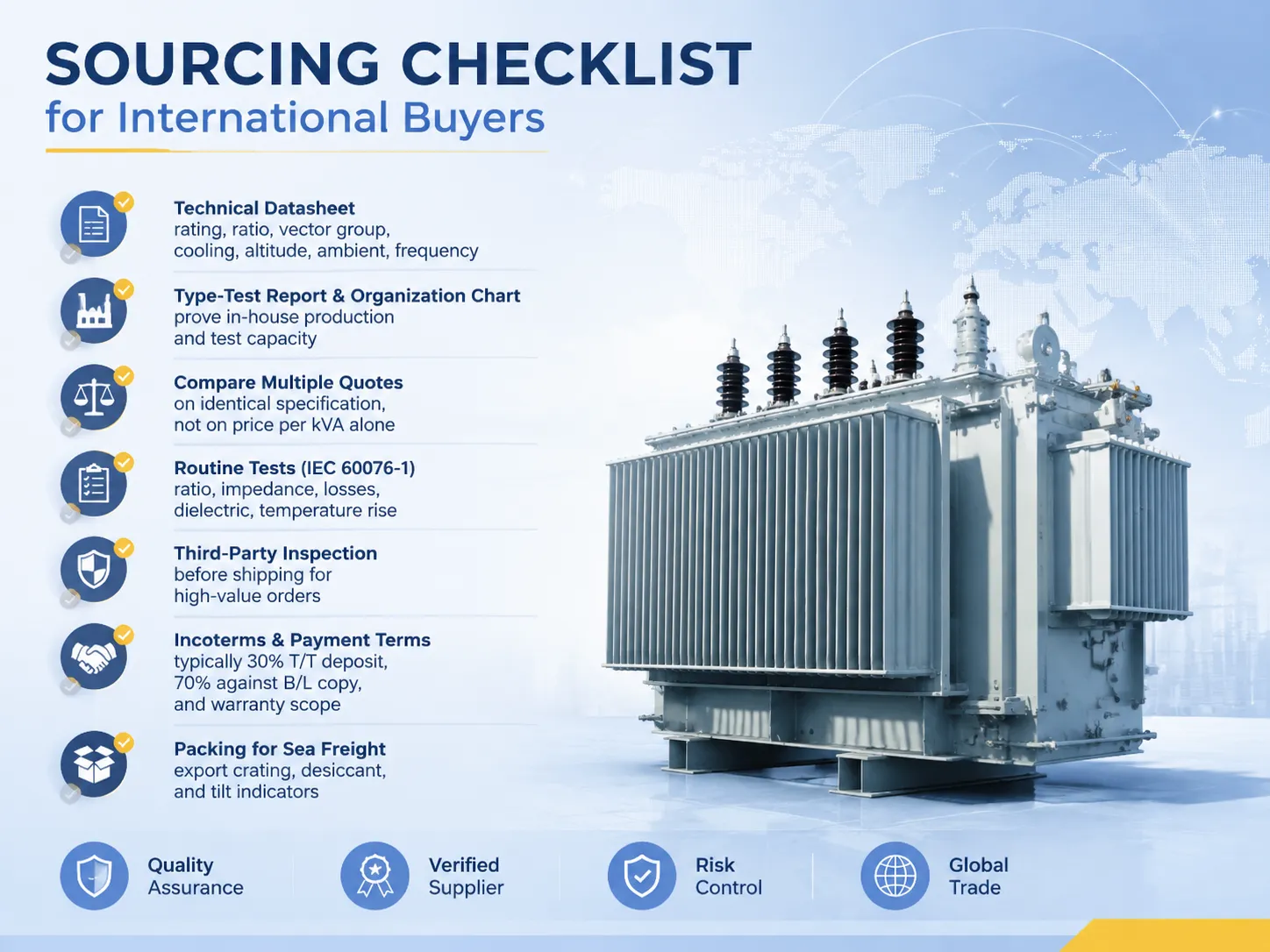
Lista de verificação de compras para compradores internacionais
- Solicite uma ficha técnica completa mostrando as classificações, relações, grupos vetoriais, resfriamentos, altitudes, ambientes e frequências.
- Obtenha os resultados dos testes de tipo da fábrica e um diagrama mostrando a capacidade de fabricar e testar as unidades.
- Compare não menos que duas ou três cotações onde a especificação seja semelhante, exceto pelo preço do kVA.
- Insista na realização dos testes padrão em conformidade com IEC 60076-1 (relação, impedância, perdas, dielétrico e aumento de temperatura nos modelos testados).
- Organize inspeções de terceiros antes de enviar pedidos de alto valor.
- Esclareça os termos detalhados, como Incoterm, arranjos de pagamento (geralmente, 30% de depósito ao fazer o pedido, 70% ao receber a fatura) e os tipos de garantia.
Perguntas Frequentes
Comprar transformadores de fabricantes chineses é seguro?
Certamente, se você comprar com base em padrões documentados, pode exigir relatórios de teste de tipo IEC 60076, certificação CE/ISO e inspeção independente de terceiros. Os preços FOB de fornecedores chineses para transformadores de distribuição de 1 MVA são tipicamente de 18.000-45.000 em comparação com 35.000-70.000 para marcas europeias semelhantes, o que mostra uma boa quantidade de economia. Fábricas respeitáveis publicam dados de teste que podem ser verificados antes do pagamento.
Qual é o prazo de entrega para pedidos de transformadores diretos da fábrica?
Normalmente, transformadores de tipo padrão de fábricas de produção chinesas são entregues em 4-10 semanas, e tipos de potência dentro do período de 12-20 semanas. Devido à escassez global de 2022 a 2024, certos fornecedores europeus forneceram prazos de 12 a 24 meses, levando assim um número de clientes a uma fábrica diretamente na China. Certifique-se de ter o prazo de entrega por escrito, antes de fazer qualquer pagamento antecipado.
Como posso obter uma cotação confiável de uma fábrica de transformadores?
Por favor, forneça uma ficha técnica completa incluindo as especificações como potência nominal, tensão primária, tensão secundária, grupo vetorial, impedância, classe de resfriamento, frequência, altura, temperatura e padrão. Você receberá uma proposta técnica completa juntamente com desenhos e um preço FOB firme de um fabricante sério em cerca de uma semana. Consultas incompletas levam a cotações imprecisas.
Quais certificações um transformador de exportação deve ter?
No mínimo, a IEC 60076-1 deve ser cumprida em relação aos relatórios de testes de rotina. A marcação CE é obrigatória na Europa. Para aumentar a credibilidade global, a gestão da qualidade ISO 9001 deve ser praticada; a IEC 60076-11 se aplica a unidades do tipo seco. Além das diretrizes mencionadas, os clientes de utilidades podem solicitar testes de tipo relacionados ao aumento de temperatura, impulso de raios e testes de resistência a curto-circuito, então procure por esses também.
A Subian suporta OEM/ODM ou especificações personalizadas?
Certamente. A Jiangsu Subian Electric Power pode produzir seus produtos de acordo com as especificações e pode fornecer diferentes tensões, grupos vetoriais, comutadores de derivação e abrigos pintados. A cooperação OEM/ODM é comum em projetos que recebem esboços criados pelo comprador antes de serem colocados em produção – amostras podem ser fornecidas para grandes lotes de produção.
Referências
- IEA: Acompanhando o Progresso da Energia Limpa 2024 — Estatísticas globais de eletrificação e acesso.
- IEC 60076-1: Transformadores de Potência — Geral — O padrão internacional que define classificações e testes de transformadores.
- Perspectiva Mundial de Energia da IEA 2023 — Projeções de acesso à energia e investimentos até 2050.
- Sociedade de Energia e Potência do IEEE — Orientação técnica sobre a aplicação de transformadores e confiabilidade da rede.
- ISO 9001:2015 Gestão da Qualidade — O padrão global de gestão da qualidade citado por fabricantes de transformadores.
- Transformadores Hitachi Energy — Referência da indústria para benchmarks de tecnologia de transformadores.
Conclusão
Conectar países com eletricidade é uma conquista tanto da cadeia de suprimentos quanto da tecnologia. Transformadores produzidos em Jiangsu agora fornecem eletricidade para vilarejos nas Filipinas, bem como para subestações no Golfo e centros de dados na América Latina, e o setor continua se expandindo em 6–7% por ano devido a mais fontes de energia renovável e eletrificação.
- A demanda por transformadores é impulsionada por renováveis, redes antigas e acesso à energia — todas tendências de longo prazo.
- A compra direta de fábricas chinesas permite que você obtenha transformadores em conformidade com os padrões IEC 60076 a preços 30%–50% mais baixos do que os oferecidos por marcas ocidentais.
- Certifique-se de comprar com segurança verificando os resultados dos testes de tipo, certificados e relatórios de inspeção de terceiros.
Se você está planejando um projeto que precisa de transformadores de distribuição ou potência de 50 kVA a 220 kV, converse com Jiangsu Subian Electric Power — um fabricante de transformadores chinês com experiência em exportação global, certificação IEC 60076 e preços diretos de fábrica que ajudam você a conectar seu canto do mundo à rede.