


Um planejador de utilidade está avaliando duas ofertas para um transformador de potência classificado em 20 MVA e em níveis de tensão de 66/11 kV. Ambos os fabricantes ofereceram a mesma capacidade de potência com perdas idênticas e aproximadamente o mesmo preço, mas a principal diferença reside em seus sistemas de óleo. Um fabricante projetou o transformador com base em um tanque conservador de óleo externo convencional com respirador de gel de sílica, enquanto o outro fabricante projetou um tanque de expansão corrugado sem conservador. O planejador entende que o tipo de sistema de óleo escolhido afeta não apenas o sistema de preservação de óleo em si, mas também impacta o cronograma de manutenção, o nível de risco de incêndio e o preço; tipicamente, o custo da unidade com conservador será 5-10% mais do que o preço de uma unidade selada, mas a primeira opção permite gerenciar o óleo de acordo com regulamentos simplificados durante muitos anos.
O guia fornece informações sobre para que serve um conservador, quais diferentes designs existem no mercado, como calcular seu tamanho e como escolher aqueles que melhor se adequarão ao sistema de preservação de óleo do transformador isolado a óleo.
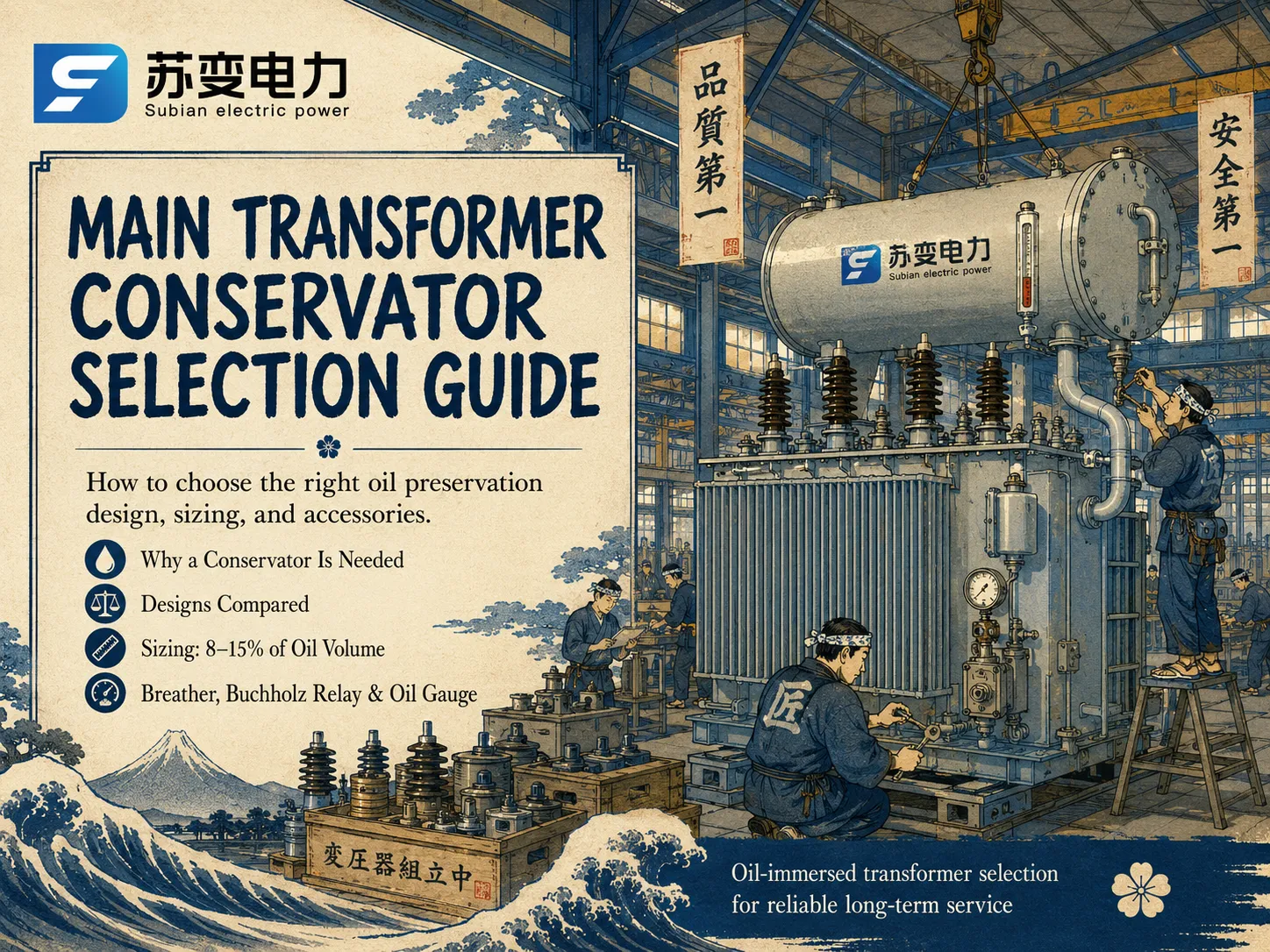
O que é um conservador de transformador?
Um conservador pode ser definido como um tanque auxiliar cilíndrico ou retangular colocado no topo do tanque principal do transformador, interligado com o tanque principal por meio de um tubo. Ele possui o volume de óleo em reserva para flutuar em nível de acordo com a variação de temperatura (carga). Quando o óleo se expande devido ao aquecimento, ele pode ser preenchido no conservador para que nenhuma pressão seja acumulada no tanque principal. O óleo flui entre o conservador e o tanque principal sem criar um vácuo adicional enquanto trabalha. O conservador permanece aberto ao ar atmosférico através de um respirador (ou é selado com uma membrana), que é uma razão importante pela qual deve ser posicionado no topo do tanque principal.
Na ausência de um conservador, um tanque totalmente selado significaria que a pressão interna aumenta à medida que o óleo se expande, e em caso de resfriamento, um vácuo aparece dentro, o que gera tensões na construção do tanque e conclusões.
Três características levam a esses resultados.
O óleo se expande dependendo da temperatura. O óleo mineral se expande aproximadamente 0,071% para cada grau Celsius de temperatura. Usando um tanque de 10.000 litros de capacidade submetido a uma variação de temperatura de 50°C, e levando em conta que o volume de óleo e a pressão aumentariam em 350 litros, fica claro que o tanque rígido selado pode ou romper ou empurrar o óleo para fora através do orifício de respiração.
O tanque principal deve estar sempre cheio. Se o óleo no tanque principal cair, sua bobina superior fica descoberta e permite que a umidade entre na isolação no espaço gasoso. Com a ajuda do conservador, o óleo preenche facilmente o tanque principal.
A pressão no espaço gasoso deve ser gerenciada. O design do conservador permite ter um pequeno espaço gasoso acima do óleo que é controlado pelo respirador. Se o design for sem o conservador, o espaço gasoso cresceria e encolheria com o aumento da carga, e como resultado, o ar seria movido para dentro e para fora do tanque.
Assim, torna-se possível fabricar o sistema de preservação de óleo “auto-ventilado”.
Comparação de Designs de Conservador
| Design | Como Funciona | Reserva Típica de Volume de Óleo | Custo Relativo |
|---|---|---|---|
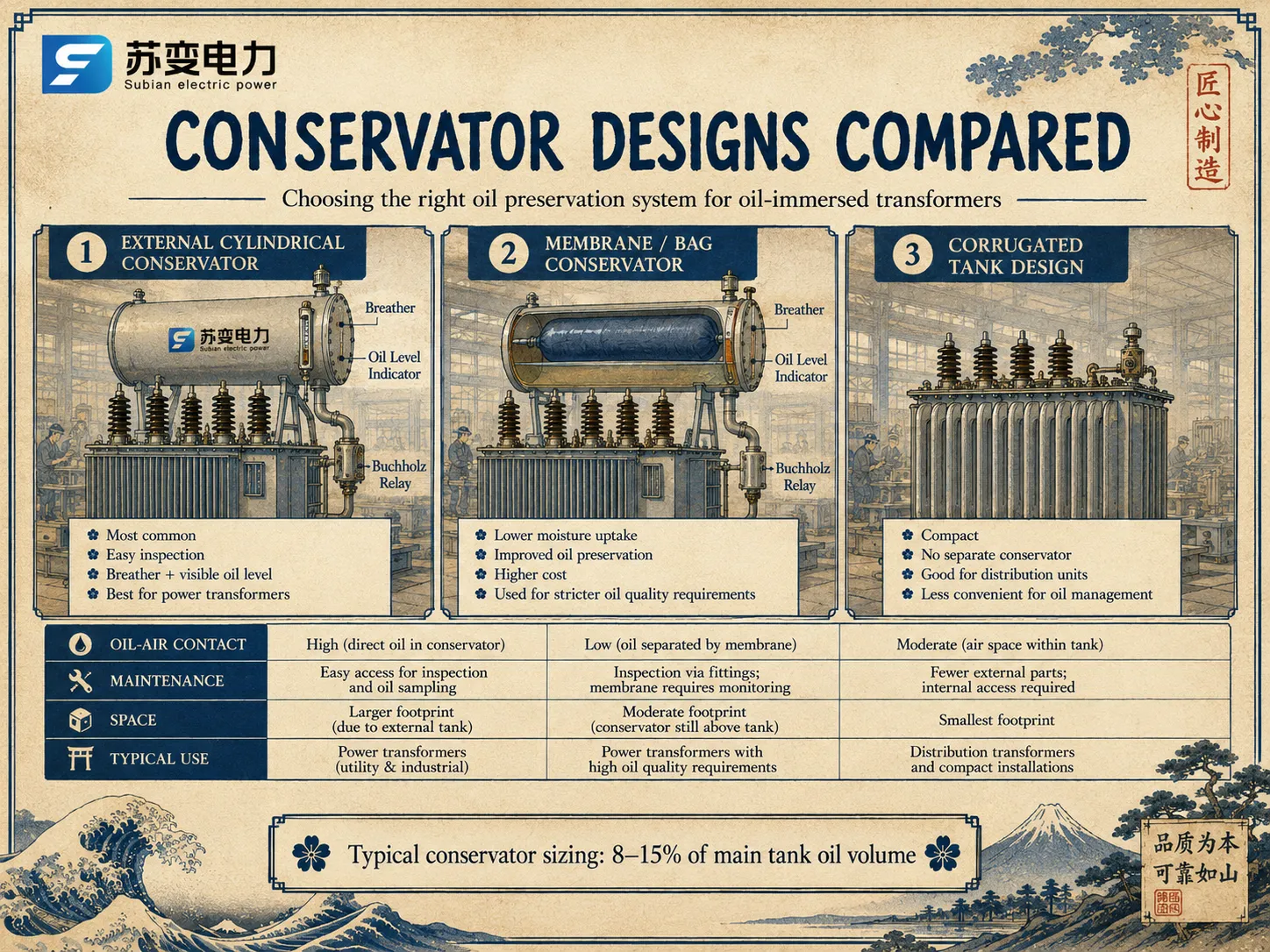
| Conservador cilíndrico externo | Tambor separado acima do tanque, respirador na parte superior, tubo de óleo abaixo | 8-15% do volume do tanque | Base de referência |
| Conservador de membrana / bolsa | Bolsa de borracha ou membrana separa o óleo do ar; espaço gasoso selado | 8-15% | +10-20% em relação ao conservador simples |
| Design de parede de tanque corrugada | Sem conservador separado; parede de tanque corrugada flexível absorve a expansão | Integrado | Semelhante ao conservador simples |
| Tanque selado / com gás | Tanque fixo com almofada de nitrogênio ou membrana; sem respirador | Nenhum (espaço gasoso) | +5-15% |
O conservador externo com um respirador continua sendo o design mais comum do mundo porque é simples, barato de construir e fácil de inspecionar. O conservador de membrana adiciona uma bolsa de borracha que separa completamente o óleo do ar externo, de modo que o óleo nunca entra em contato com oxigênio ou umidade da respiração — ao custo de uma bolsa que deve ser verificada quanto a danos. O design do tanque corrugado elimina o vaso separado e é popular em transformadores de distribuição onde espaço e simplicidade são mais importantes do que a conveniência de manutenção.
Dimensionando o Conservador Corretamente
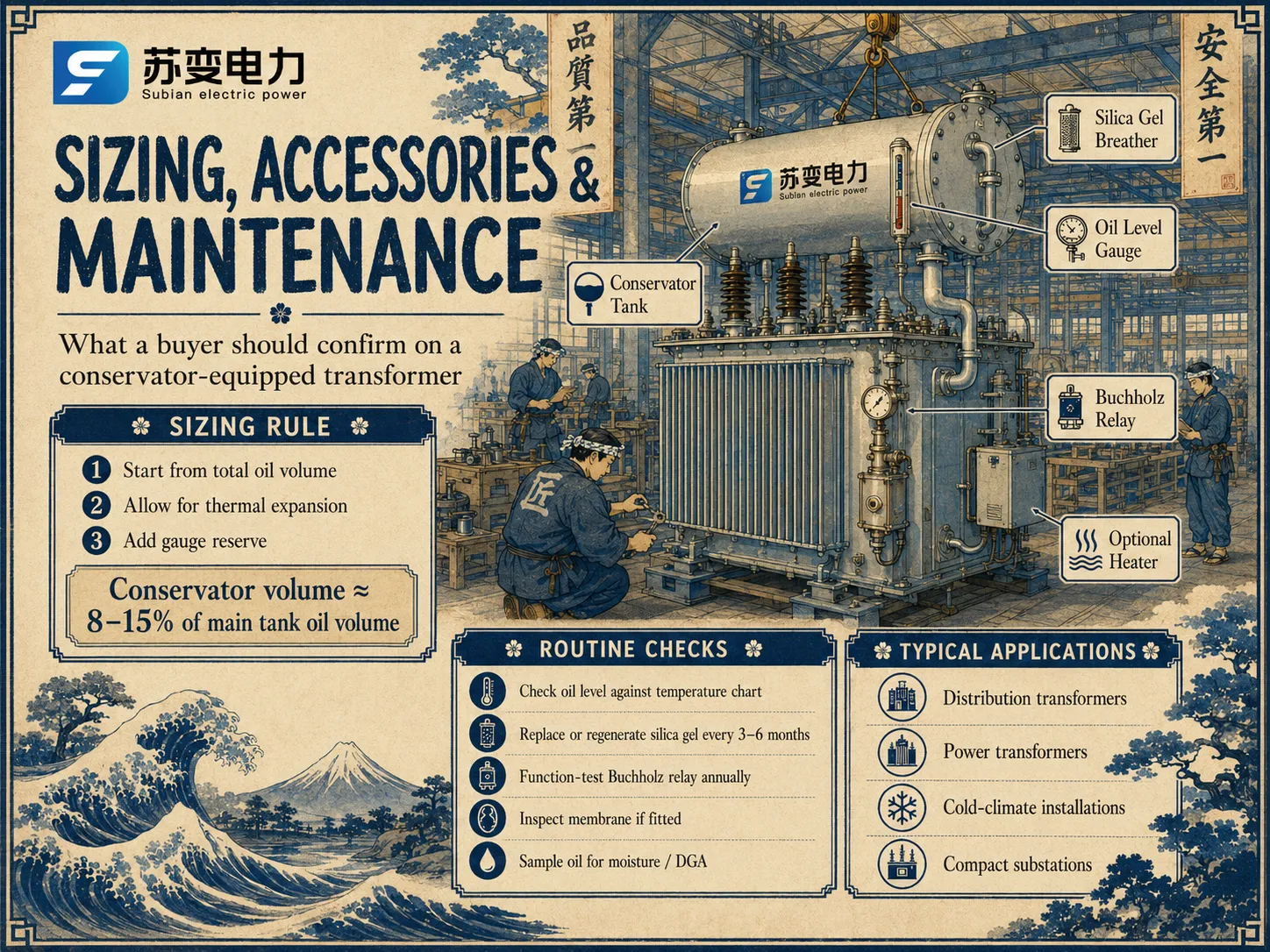
O conservador deve ter capacidade suficiente para contabilizar o volume de óleo que se expande entre a temperatura mínima durante a operação e a temperatura máxima permitida do óleo superior. Cada uma das etapas deve ser realizada: Determinar a faixa de temperatura. Em condições normais temperadas, o óleo se comporta de -10 graus em uma partida a frio até 90 graus enquanto está sob carga, o que corresponde à variação de temperatura de 100 K. Em caso de regiões quentes — use dados reais em vez disso. Calcule o volume de óleo a ser expandido, o que exigiria multiplicar o volume de óleo pelo coeficiente de expansão, grosso modo 0,0007 por K multiplicado pela variação de temperatura. Assim, por exemplo, o volume de óleo atinge 10.000 kg a 100K, o que seria igual a cerca de 700 litros. O espaço de reserva precisa ser contabilizado para o indicador de nível de óleo. O conservador deve indicar o nível de óleo o tempo todo, desde a marca máxima enquanto quente até a marca mínima enquanto frio, sugerindo assim 20 a 30% a mais de óleo do que o volume preciso de óleo, que é considerado cerca de 8 a 15% do volume geral de óleo do tanque. Calcular tudo errado custará um dinheiro significativo. Se o conservador for pequeno, o óleo vazará para fora através do respirador, levando a manchas de óleo no tanque e ar úmido sendo absorvido; enquanto se o conservador for superdimensionado, terá materiais e óleo em excesso. Para dimensionar rapidamente, começamos com o volume total de óleo no transformador, aqui estão valores de referência de engenharia para o conservador para uma variação de temperatura de 100 k:
| Classificação do Transformador | Volume Total Típico de Óleo | Volume de Trabalho do Conservador (10-12%) | Volume do Tanque do Conservador (com reserva de medidor) |
|---|---|---|---|
| Distribuição de 100 kVA | 300-400 L | 35-50 L | 60-80 L |
| Distribuição de 1 MVA | 500-2.000 L | 150-240 L | 250-350 L |
| Potência de 10 MVA | 000-12.000 L | 800-1.400 L | 200-2.000 L |
| Potência de 40 MVA | 000-35.000 L | 500-4.200 L | 500-6.000 L |
Acessórios e Proteção do Conservador
| Acessório | Propósito | Especificação Típica |
|---|---|---|
| Respirador de gel de sílica | Desumidificar o ar que entra no conservador | 1-15 kg de dessecante, indicador de mudança de cor |
| Medidor de nível de óleo (magnético) | Mostre o nível de óleo à primeira vista | Flutuador + ponteiro, mostrador marcado Min/Max |
| Relé Buchholz (gás) | Detectar gás e surto de óleo no tubo do conservador | DN50-DN100, dois interruptores de flutuação |
| Membrana / célula de ar | Separar o óleo da atmosfera em designs selados | Saco de borracha, substituível |
| Aquecedor de conservador (opcional) | Prevenir condensação em climas frios | Termostático, à prova de intempéries |
Em um transformador equipado com conservador, o relé Buchholz é montado no tubo entre o tanque principal e o conservador — sua localização correta e padrão. O respirador é instalado na parte superior do conservador, e o medidor de óleo na tampa final. Todos esses acessórios são testados como parte do teste de rotina do transformador em uma fábrica devidamente gerenciada.
Conservador vs. Tanque Corrugado vs. Designs Selados
| Característica | Conservador Externo | Tanque Corrugado | Selado / Com Gás |
|---|---|---|---|
| Contato óleo-ar | Controlado via respirador | Controlado via respirador | Nenhum (selado) |
| Acesso para manutenção | Excelente; fácil de inspecionar e reabastecer | Bom; nível via medidor | Limitado; amostragem de óleo apenas |
| Impacto no custo do transformador | +5 a +10% | +3 a +8% | +5 a +15% |
| Aplicação típica | A maioria dos transformadores de potência e distribuição | Distribuição, locais com espaço restrito | Onde a entrada de umidade deve ser minimizada |
| Risco de incêndio | Semelhante; o volume de óleo é o fator determinante | Semelhante | Exposição ao oxigênio ligeiramente menor |
Para transformadores acima de 5 MVA, o conservador externo é a escolha predominantemente comum porque facilita a gestão do óleo, a inspeção do nível e a manutenção do relé de gás. Tanques corrugados dominam a classe de distribuição de 100-2.500 kVA, onde preço e espaço são mais importantes do que a conveniência de manutenção. Designs selados aparecem onde o óleo nunca deve entrar em contato com o ar — mas complicam o reabastecimento e a inspeção, portanto, são a exceção em vez da regra.
Qual Design para Qual Transformador
- Transformadores de distribuição (50-2.500 kVA): conservador externo ou tanque corrugado, ambos com respirador; o conservador simplifica as verificações sazonais.
- Transformadores de potência (5-100 MVA): conservador externo com respirador, relé Buchholz, medidor de óleo magnético; conservador de membrana onde a baixa absorção de umidade é especificada.
- Transformadores de elevação de gerador e de rede: conservador de membrana ou selado para atender a rigorosas garantias de qualidade do óleo.
- Instalações em climas frios: conservador com aquecedor e dimensionamento adequado para a extremidade de baixa temperatura da faixa.
- Subestações compactas e pacotes de skid: tanque corrugado ou conservador de membrana para economizar altura e espaço.
Comparação de Marcas e Preços
| Marca | Origem | Oferta de Conservador | Faixa de Preço Aproximada (autônoma) |
|---|---|---|---|
| ABB | Suíça/Suécia | Completa gama de designs de conservador e selados | $1,200-$9,000 |
| Siemens | Alemanha | Transformadores de potência equipados com conservador | $1,500-$10,000 |
| Hitachi Energy | Suíça | Opções de conservador de membrana para grandes unidades | $1,500-$12,000 |
| Schneider Electric | França | Conservadores de transformadores de distribuição | $800-$5,000 |
| Fabricantes de acessórios especializados (Comem, etc.) | Itália / China | Tanques de conservador, sacos, medidores de nível | $500-$6,000 |
| Jiangsu Subian Electric Power | China | Designs de conservador e corrugados, conjunto completo de acessórios | $600-$6,000 |
Líderes europeus como ABB, Siemens, Hitachi Energy e Schneider Electric constroem designs de conservadores como parte de pacotes completos de transformadores, e fabricantes especializados de acessórios fornecem conservadores independentes e medidores de nível em todo o mundo. No próprio transformador, o conservador geralmente está incluído no preço base, então a comparação real é entre pacotes completos. Fabricantes como Jiangsu Subian Electric Power oferecemos tanto designs de conservador externo quanto de tanque corrugado, com o respirador, relé Buchholz e medidor de óleo incluídos e testados como um conjunto — toda a montagem aparece no certificado de teste de rotina. O preço da Subian para um transformador equipado com conservador é aproximadamente 40-60% abaixo das cotações de marcas europeias equivalentes, razão pela qual são uma escolha comum para concessionárias e OEMs na Ásia, África e América Latina. Ao comparar cotações, sempre confirme que o conservador, acessórios e seus testes estão detalhados em vez de ocultos no preço do tanque.
Dicas para Escolher o Conservador Apropriado
Primeiro de tudo, tome decisões sobre seus métodos de preservação de óleo. Você escolherá um conservador de respiração livre com um respirador, selado por membrana ou totalmente selado? Sua escolha determina o design do conservador.
O próximo passo é considerar o tamanho em relação à temperatura. Por favor, use as mínimas e máximas reais para seu local; a regra 8-15% assume uma faixa de 100 K, o que significa que um tanque maior é necessário em climas mais frios.
Agora verifique os acessórios. Seu conservador deve ter um respirador, um medidor de óleo e um relé Buchholz nas posições exigidas pelo esquema de proteção.
Outro passo é verificar o acesso à manutenção. Caso seu local não tenha pessoal, é preferível adquirir um conservador com um medidor de nível que possa ser lido à distância ou um design que não necessite verificar o nível de óleo.
Considere a área ocupada. Você deve usar um design corrugado para subestações containerizadas ou conservadores externos?
Você também precisa solicitar os registros sobre como os acessórios foram testados.
Operação e Manutenção
Os requisitos de manutenção de um conservador são simples, mas específicos:
A cada semana, verifique o medidor de nível de óleo do conservador em relação a um gráfico de nível corrigido pela temperatura padrão; qualquer desvio do gráfico de nível indica a ocorrência de um vazamento de óleo ou infiltração de umidade no óleo.
Substitua ou recarregue o gel de sílica localizado no respirador a cada 3-6 meses, ou assim que a cor do gel de sílica mudar indicando saturação.
Anualmente, realize um teste de funcionamento no relé Buchholz colocado no tubo do conservador para confirmar que este componente funciona corretamente.
Cada vez que houver uma interrupção, inspecione a membrana que pode estar instalada dentro do conservador em busca de buracos ou endurecimento e confirme a presença de um espaço suficiente entre o saco e a parede do conservador.
No ponto de amostra do conservador, amostre o óleo para verificar a presença de água e gases dissolvidos, pois o óleo no conservador é considerado o indicador de todo o sistema de lubrificação.
Ignorar o medidor do conservador é uma das principais causas da falha de resfriamento do equipamento na prática; o vazamento constante de óleo reduz o nível de óleo, e como o relé reage à geração de gás, o operador descobre que o tanque não foi preenchido há meses. Apesar do fato de que o conservador custa apenas 100 dólares, ele poderia ter indicado a questão do baixo nível de óleo há muito tempo.
Perguntas Frequentes
Quanto custa um conservador de transformador?
Como um componente autônomo, um tanque de conservador custa $800-$8.000 dependendo do volume e material, além de $50-$1.200 para o respirador, medidor de óleo e relé. Em um transformador completo, o design do conservador adiciona aproximadamente 5-10% ao preço total em comparação com um tanque selado. Para uma unidade de distribuição de 1 MVA, o pacote do conservador geralmente adiciona $500-$2.000 à cotação.
Que tamanho de conservador eu preciso?
Dimensione-o para absorver a expansão total do óleo entre as temperaturas mínimas e máximas de óleo do seu local. A regra de engenharia é 8-15% do volume de óleo do tanque principal, com 10-12% sendo o padrão comum para uma variação de 100 K. Climas frios precisam da extremidade maior; locais tropicais com faixas de temperatura restritas podem usar a extremidade menor.
Qual é a diferença entre um conservador e um tanque de expansão de óleo?
Eles são a mesma coisa em palavras diferentes. O conservador (também chamado de conservador de óleo, tanque de expansão ou tanque de preservação de óleo) é o pequeno recipiente montado acima do tanque principal que acomoda a expansão térmica do óleo e mantém o tanque cheio. O termo “conservador” é o padrão na engenharia de transformadores, enquanto “tanque de expansão” é o termo de engenharia mais geral.
Um transformador pode funcionar sem um conservador?
Sim — designs de tanque corrugado, membrana e totalmente selados operam sem um conservador externo separado. Mas todo transformador imerso em óleo precisa de alguma forma de preservação de óleo. O tanque corrugado usa a parede flexível, o tanque selado usa um colchão de nitrogênio ou membrana, e apenas o conservador fornece um nível de óleo visível e fácil acesso para manutenção. Para transformadores acima de 5 MVA, um conservador é fortemente preferido na prática.
Por que o medidor de nível de óleo do meu conservador está caindo?
Verifique-o em relação ao gráfico de nível corrigido pela temperatura primeiro — uma queda durante uma noite fria é normal. Se o nível cair abaixo do valor chartado para a temperatura atual, há um vazamento de óleo (verifique soldas, juntas e a válvula de amostra) ou a entrada de umidade consumindo o espaço de óleo. Trate uma queda genuína de nível como uma prioridade: um nível baixo de conservador pode eventualmente expor o topo do enrolamento e acionar um desligamento de Buchholz.
Referências
- IEC 60076-1 — Transformadores de Potência, Requisitos Gerais — O padrão mestre que cobre sistemas de preservação de óleo, conservadores e acessórios.
- IEEE C57.12.00 — Requisitos Gerais para Transformadores Imersos em Líquido — Requisitos norte-americanos para equipamentos de preservação de óleo.
- IEEE C57.106 — Guia para Aceitação e Manutenção de Óleo Mineral Isolante — Limites de umidade e qualidade do óleo que o conservador protege.
- Hitachi Energy — Produtos de Transformadores — Referência para opções de design de conservador e transformador selado.
- Transformadores ABB — Referência da indústria para documentação de sistemas de preservação de óleo.
- Revista Transformers — Artigos práticos sobre manutenção de conservadores e design de sistemas de óleo.
Conclusão
O conservador atua como o núcleo calmo do sistema de preservação de óleo do transformador. Ele absorve a expansão térmica, fornece proteção ao tanque cheio de óleo, serve como suporte para o respirador, bem como para o relé de gás, e facilita o monitoramento pela equipe de manutenção ao ter um sistema de óleo visível e mensurável. Dependendo de se o design do conservador que você prefere se baseia em forma sólida por questões de compactação, ou se você deseja usar um conservador externo por questões de utilidade, ou se você precisa da solução de membrana por questões de pureza do óleo, ele ainda deve ser escolhido sabiamente em vez de herdado de uma especificação de engenharia padrão.
Certifique-se de dimensionar o conservador de acordo com as temperaturas reais em seu local (8-15% do volume do tanque).
Certifique-se de usar o medidor de óleo, o respirador e o relé Buchholz como um conjunto.
Verifique o medidor de nível em relação ao gráfico de temperatura semanalmente.
Liste o conservador e os acessórios em cada cotação.
Para transformadores imersos em óleo equipados com conservador construídos de acordo com a IEC 60076-1 com testes completos de acessórios, entre em contato Jiangsu Subian Electric Power decidem www.subian-electric.com e solicite uma cotação detalhada com seus dados de kVA, tensão e temperatura do local.