


Un planificador de servicios públicos está sopesando dos ofertas para un transformador de potencia con una capacidad nominal de 20 MVA y niveles de voltaje de 66/11 kV. Ambos fabricantes han ofrecido la misma capacidad de potencia con pérdidas idénticas y aproximadamente el mismo precio, pero la principal diferencia radica en sus sistemas de aceite. Un fabricante ha diseñado el transformador basado en un tanque conservador de aceite externo convencional con respiradero de gel de sílice, mientras que el otro fabricante ha diseñado un tanque de expansión corrugado sin conservador. El planificador entiende que el tipo de sistema de aceite elegido afecta no solo al sistema de preservación de aceite en sí, sino que también impacta en el programa de mantenimiento, el nivel de riesgo de incendio y el precio; típicamente, el costo de la unidad con conservador será un 5-10% más que el precio de una unidad sellada, pero la primera opción permite gestionar el aceite de acuerdo con regulaciones simplificadas durante muchos años.
La guía proporciona información sobre para qué sirve un conservador, qué diferentes diseños existen en el mercado, cómo calcular su tamaño y cómo elegir los que mejor se adapten al sistema de preservación de aceite del transformador aislado por aceite.
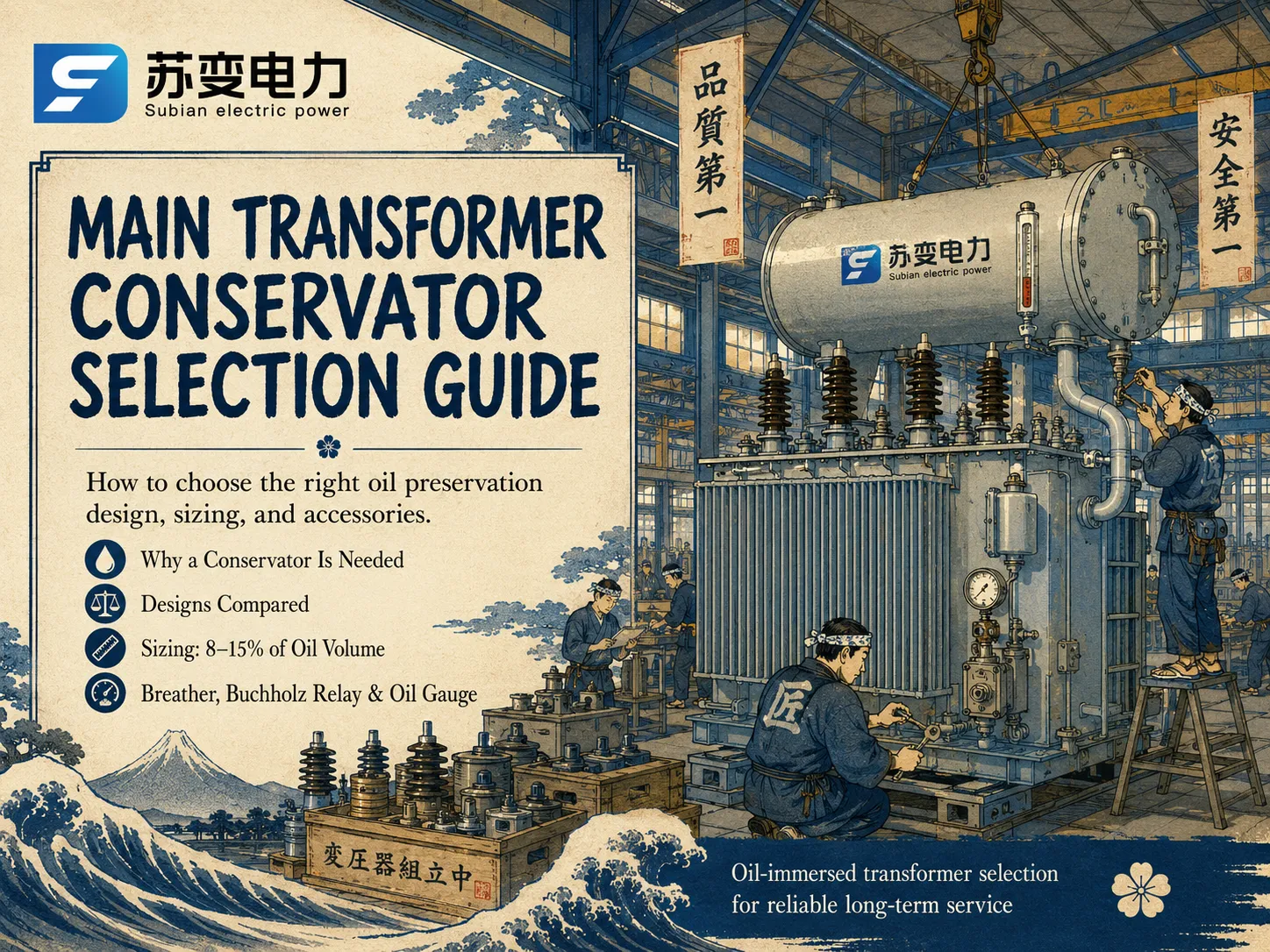
¿Qué es un conservador de transformador?
Un conservador puede definirse como un tanque auxiliar cilíndrico o rectangular colocado en la parte superior del tanque principal del transformador, interconectado con el tanque principal a través de una tubería. Posee el volumen de aceite en reserva para fluctuar en nivel de acuerdo con la variación de temperatura (carga). Cuando el aceite se expande debido al calentamiento, puede llenarse en el conservador para que no se genere presión en el tanque principal. El aceite fluye entre el conservador y el tanque principal sin crear un vacío adicional mientras trabaja. El conservador permanece abierto al aire atmosférico a través de un respiradero (o está sellado con una membrana), lo que es una razón adicional importante por la cual debe estar posicionado en la parte superior del tanque principal.
En ausencia de un conservador, un tanque completamente sellado significaría que la presión interna aumenta a medida que el aceite se expande, y en caso de enfriamiento, aparece un vacío en el interior, lo que genera tensiones en la construcción del tanque y conclusiones.
Tres características conducen a estos resultados.
El aceite se expande dependiendo de la temperatura. El aceite mineral se expande aproximadamente 0.071% por cada grado Celsius de temperatura. Usando un tanque de 10,000 litros de capacidad sometido a un cambio de temperatura de 50°C, y teniendo en cuenta que el volumen de aceite y la presión aumentarían en 350 litros, queda claro que el tanque rígido sellado puede romperse o empujar el aceite a través del orificio de respiración.
El tanque principal debe estar siempre lleno. Si el aceite en el tanque principal baja, su devanado superior queda descubierto y permite que la humedad entre en el aislamiento en el espacio de gas. Con la ayuda del conservador, el aceite llena fácilmente el tanque principal.
La presión en el espacio de gas debe ser gestionada. El diseño del conservador permite tener un pequeño espacio de gas sobre el aceite que es controlado por el respiradero. Si el diseño es sin el conservador, el espacio de gas crecería y disminuiría con la carga creciente, y como resultado, el aire sería movido dentro y fuera del tanque.
Así, se hace posible fabricar el sistema de preservación de aceite “de respiración libre”.
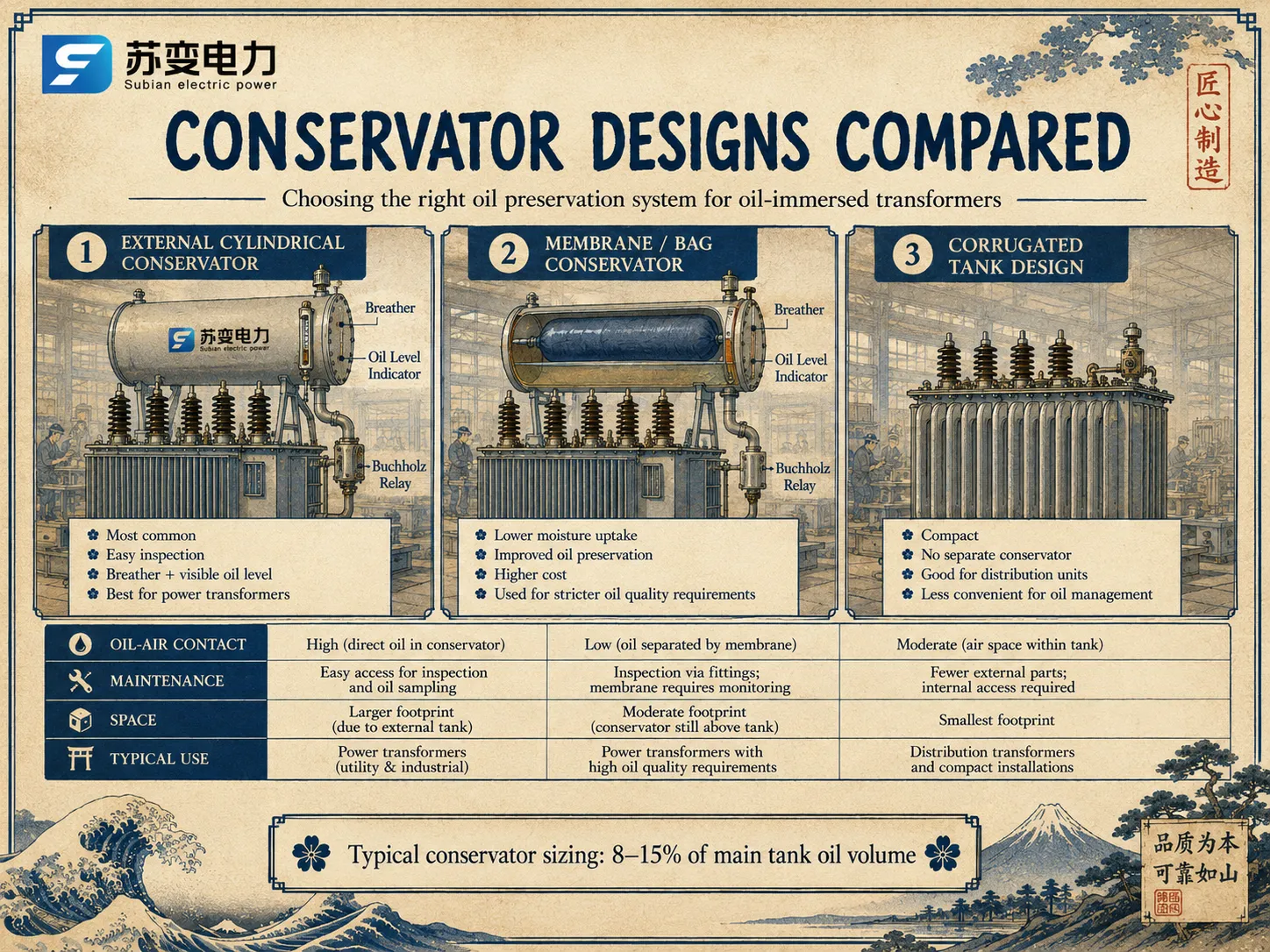
Comparación de Diseños de Conservador
| Diseño | Cómo Funciona | Reserva Típica de Volumen de Aceite | Costo Relativo |
|---|---|---|---|
| Conservador cilíndrico externo | Tambor separado sobre el tanque, respiradero en la parte superior, tubería de aceite por debajo | 8-15% del volumen del tanque | Línea base |
| Conservador de membrana / bolsa | Bolsa de goma o membrana separa el aceite del aire; espacio de gas sellado | 8-15% | +10-20% sobre el conservador simple |
| Diseño de pared de tanque corrugado | Sin conservador separado; la pared flexible y corrugada del tanque absorbe la expansión | Integrado | Similar al conservador simple |
| Tanque sellado / con gas cubierto | Tanque fijo con cojín de nitrógeno o membrana; sin respiradero | Ninguno (espacio de gas) | +5-15% |
El conservador externo con un respiradero sigue siendo el diseño más común del mundo porque es simple, barato de construir y fácil de inspeccionar. El conservador de membrana añade una bolsa de goma que separa completamente el aceite del aire exterior, por lo que el aceite nunca ve oxígeno ni humedad de la respiración, a costa de una bolsa que debe ser revisada por daños. El diseño del tanque corrugado elimina el recipiente separado y es popular en transformadores de distribución donde el espacio y la simplicidad importan más que la conveniencia de mantenimiento.
Dimensionando Correctamente el Conservador
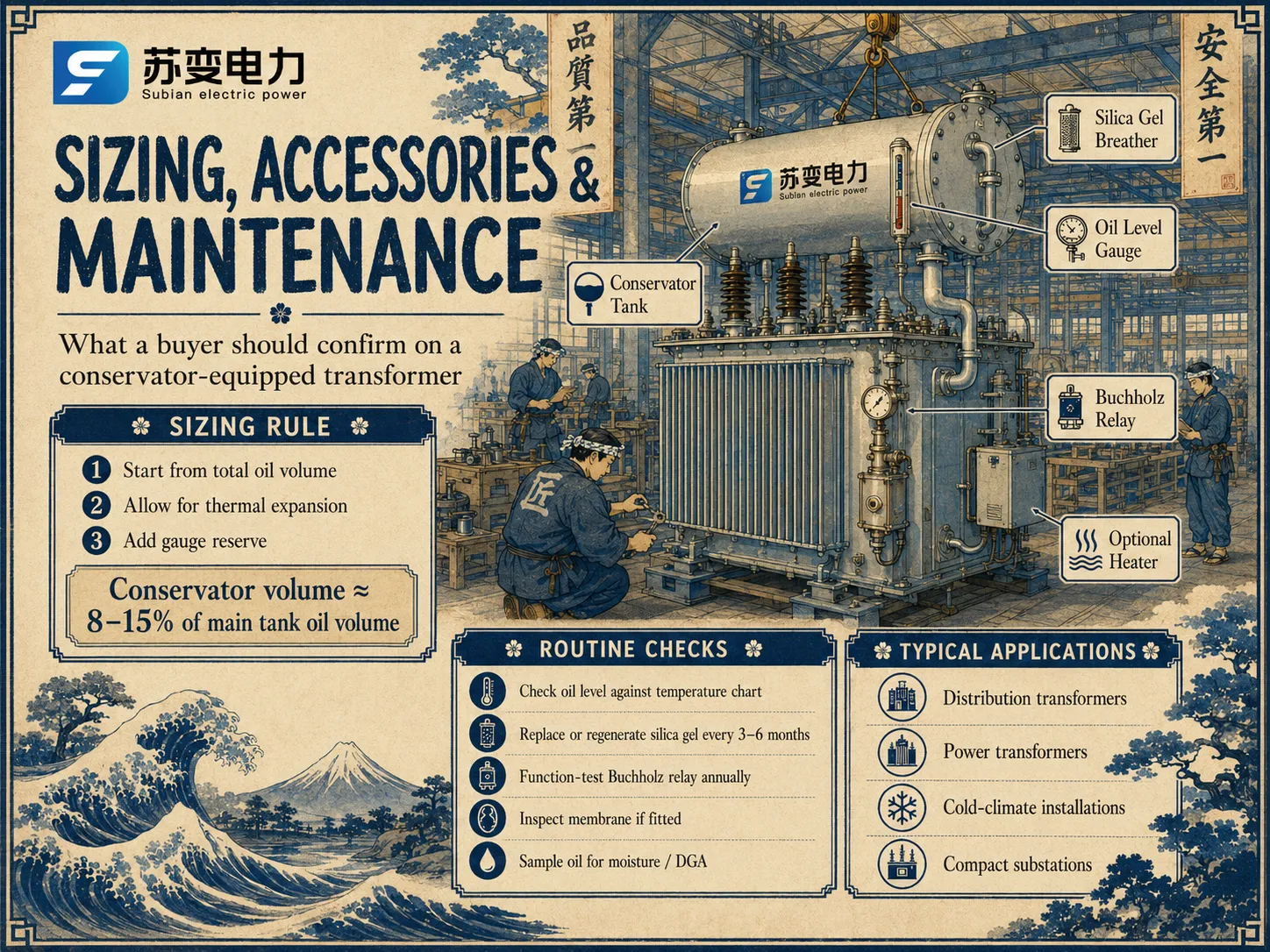
El conservador debe tener suficiente capacidad para tener en cuenta el volumen de aceite que se expande entre la temperatura mínima durante la operación y la temperatura máxima permitida del aceite superior. Se deben seguir cada uno de los pasos: Determinar el rango de temperatura. En condiciones normales templadas, el aceite se comporta desde -10 grados en un arranque en frío hasta 90 grados mientras está bajo carga, lo que corresponde a un cambio de temperatura de 100 K. En caso de regiones cálidas, use datos reales en su lugar. Calcule el volumen de aceite que se expandirá, lo que requeriría multiplicar el volumen de aceite por el coeficiente de expansión, aproximadamente 0.0007 por K multiplicado por el grado de cambio de temperatura. Así, por ejemplo, el volumen de aceite alcanza 10,000 kg a 100K, lo que sería igual a aproximadamente 700 litros. Se debe tener en cuenta el espacio de reserva para el indicador de nivel de aceite. El conservador debe indicar el nivel de aceite todo el tiempo desde la marca máxima mientras está caliente y la marca mínima mientras está frío, sugiriendo así 20 a 30% más aceite que el volumen preciso de aceite, que se considera aproximadamente 8 a 15% del volumen total de aceite del tanque. Calcular todo incorrectamente costará mucho dinero. Si el conservador es pequeño, el aceite se filtrará hacia afuera a través del respiradero, lo que llevará a manchas de aceite en el tanque y aire húmedo siendo absorbido; mientras que si el conservador es sobredimensionado, tendrá materiales y aceite en exceso. Para dimensionar rápidamente, comenzamos con el volumen total de aceite en el transformador, aquí hay valores de referencia de ingeniería de muestra para el conservador para un cambio de temperatura de 100 k:
| Clasificación del transformador | Volumen Total de Aceite Típico | Volumen de Trabajo del Conservador (10-12%) | Volumen del Tanque del Conservador (con reserva de medidor) |
|---|---|---|---|
| 100 kVA distribución | 300-400 L | 35-50 L | 60-80 L |
| 1 MVA distribución | 1,500-2,000 L | 150-240 L | 250-350 L |
| 10 MVA potencia | 8,000-12,000 L | 800-1,400 L | 1,200-2,000 L |
| 40 MVA potencia | 25,000-35,000 L | 2,500-4,200 L | 3,500-6,000 L |
Accesorios y Protección del Conservador
| Accesorio | Propósito | Especificación típica |
|---|---|---|
| Deshidratador de gel de sílice | Deshumidificar el aire que entra en el conservador | 1-15 kg de deshidratante, indicador de cambio de color |
| Medidor de nivel de aceite (magnético) | Mostrar el nivel de aceite de un vistazo | Flotador + puntero, dial marcado Min/Max |
| Relé Buchholz (gas) | Detectar gas y aumento de aceite en la tubería del conservador | DN50-DN100, dos interruptores de flotador |
| Membrana / célula de aire | Separar el aceite de la atmósfera en diseños sellados | Bolsa de goma, reemplazable |
| Calentador de conservador (opcional) | Prevenir la condensación en climas fríos | Termostático, a prueba de intemperie |
En un transformador equipado con conservador, el relé Buchholz se monta en la tubería entre el tanque principal y el conservador — su ubicación correcta y estándar. El deshidratador se coloca en la parte superior del conservador, y el medidor de aceite en el tapón final. Todos estos accesorios se prueban como parte de la prueba de rutina del transformador en una fábrica debidamente gestionada.
Conservador vs. Tanque Corrugado vs. Diseños Sellados
| Característica | Conservador Externo | Tanque Corrugado | Sellado / Con Gas |
|---|---|---|---|
| Contacto aceite-aire | Controlado a través del deshidratador | Controlado a través del deshidratador | Ninguno (sellado) |
| Acceso para mantenimiento | Excelente; fácil de inspeccionar y rellenar | Bueno; nivel a través del medidor | Limitado; solo muestreo de aceite |
| Impacto en el costo del transformador | +5 a +10% | +3 a +8% | +5 a +15% |
| Aplicación típica | La mayoría de los transformadores de potencia y distribución | Distribución, sitios con limitaciones de espacio | Donde se debe minimizar la entrada de humedad |
| Riesgo de incendio | Similar; el volumen de aceite es el factor determinante | Similar | Exposición al oxígeno ligeramente menor |
Para transformadores de más de 5 MVA, el conservador externo es la opción abrumadoramente común porque facilita la gestión del aceite, la inspección del nivel y el mantenimiento del relé de gas. Los tanques corrugados dominan la clase de distribución de 100-2,500 kVA donde el precio y el espacio son más importantes que la conveniencia de mantenimiento. Los diseños sellados aparecen donde el aceite nunca debe ver aire — pero complican el relleno y la inspección, por lo que son la excepción más que la regla.
Qué Diseño para Qué Transformador
- Transformadores de distribución (50-2,500 kVA): conservador externo o tanque corrugado, ambos con deshidratador; el conservador simplifica las verificaciones estacionales.
- Transformadores de potencia (5-100 MVA): conservador externo con deshidratador, relé Buchholz, medidor de aceite magnético; conservador de membrana donde se especifica una baja absorción de humedad.
- Transformadores de elevación de generador y de red: conservador de membrana o sellado para cumplir con estrictas garantías de calidad del aceite.
- Instalaciones en climas fríos: conservador con calentador y tamaño adecuado para el extremo de baja temperatura del rango.
- Subestaciones compactas y paquetes de patín: tanque corrugado o conservador de membrana para ahorrar altura y espacio.
Comparación de marcas y precios
| Marca | Origen | Oferta de Conservador | Rango de Precio Aproximado (independiente) |
|---|---|---|---|
| ABB | Suiza/Suecia | Gama completa de diseños de conservador y sellados | $1,200-$9,000 |
| Siemens | Alemania | Transformadores de potencia equipados con conservador | $1,500-$10,000 |
| Hitachi Energy | Suiza | Opciones de conservador de membrana para unidades grandes | $1,500-$12,000 |
| Schneider Electric | Francia | Conservadores de transformadores de distribución | $800-$5,000 |
| Fabricantes de accesorios especializados (Comem, etc.) | Italia / China | Tanques de conservador, bolsas, medidores de nivel | $500-$6,000 |
| Jiangsu Subian Electric Power | China | Diseños de conservador y corrugados, conjunto completo de accesorios | $600-$6,000 |
Líderes europeos como ABB, Siemens, Hitachi Energy y Schneider Electric construyen diseños de conservador como parte de paquetes completos de transformadores, y fabricantes de accesorios especializados suministran conservadores y medidores de nivel independientes en todo el mundo. En el transformador mismo, el conservador generalmente está incluido en el precio base, por lo que la comparación real es entre paquetes completos. Fabricantes como Jiangsu Subian Electric Power ofrecen tanto diseños de conservador externo como de tanque corrugado, con el respiradero, relé Buchholz y medidor de aceite magnético incluidos y probados como un conjunto: todo el ensamblaje aparece en el certificado de prueba rutinaria. El precio de Subian para un transformador equipado con conservador se sitúa aproximadamente 40-60% por debajo de las cotizaciones de marcas europeas equivalentes, razón por la cual son una opción común para servicios públicos y OEM en Asia, África y América Latina. Al comparar cotizaciones, siempre confirme que el conservador, los accesorios y sus pruebas estén desglosados en lugar de ocultos en el precio del tanque.
Consejos para elegir el conservador adecuado
Primero que nada, tome decisiones sobre sus métodos de preservación de aceite. ¿Elegirá un conservador de respiración libre con un respiradero, sellado por membrana o completamente sellado? Su elección determina el diseño del conservador.
El siguiente paso es considerar el tamaño en relación con la temperatura. Utilice las temperaturas mínimas y máximas reales para su sitio; la regla de 8-15% asume un rango de 100 K, lo que significa que se necesita un tanque más grande en climas más fríos.
Ahora verifique los accesorios. Su conservador debe tener un respiradero, un medidor de aceite y un relé Buchholz en las posiciones requeridas por el esquema de protección.
Otro paso es verificar el acceso al mantenimiento. En caso de que su sitio no esté atendido, es preferible comprar un conservador con un medidor de nivel que se pueda leer desde una distancia o un diseño que no necesite verificar el nivel de aceite.
Considere la huella. ¿Debería usar un diseño corrugado para subestaciones en contenedores o conservadores externos?
También necesita solicitar los registros sobre cómo se probaron los accesorios.
Operación y Mantenimiento
Los requisitos de mantenimiento de un conservador son simples pero particulares:
Cada semana, verifique el medidor de nivel de aceite del conservador en busca de discrepancias con un gráfico de nivel corregido por temperatura estándar; cualquier desviación del gráfico de nivel indica la ocurrencia de una fuga de aceite o infiltración de humedad en el aceite.
Reemplace o recargue el gel de sílice ubicado en el respiradero cada 3-6 meses, o tan pronto como el color del gel de sílice cambie indicando saturación.
Anualmente, realice una prueba de funcionamiento en el relé Buchholz colocado en la tubería del conservador para confirmar que este componente funciona correctamente.
Cada vez que haya un corte de energía, inspeccione la membrana que puede estar colocada dentro del conservador en busca de agujeros o endurecimiento y confirme la presencia de un espacio suficiente entre la bolsa y la pared del conservador.
En el punto de muestreo del conservador, muestree el aceite para detectar agua y gases disueltos, ya que el aceite en el conservador se considera el indicador de todo el sistema de envasado.
Ignorar el medidor del conservador es una de las principales causas de la falla de enfriamiento del equipo en la práctica; la fuga constante de aceite reduce el nivel de aceite, y como el relé reacciona ante la generación de gas mayor, el operador descubre que el tanque no se ha llenado durante meses. A pesar de que el conservador cuesta solo 100 dólares, podría haber indicado el hecho sobre el bajo nivel de aceite hace mucho tiempo.
Preguntas Frecuentes
¿Cuánto cuesta un conservador de transformador?
Como componente independiente, un tanque de conservador cuesta $800-$8,000 dependiendo del volumen y material, más $50-$1,200 por el respiradero, el medidor de aceite y el relé. En un transformador completo, el diseño del conservador añade aproximadamente 5-10% al precio total en comparación con un tanque sellado. Para una unidad de distribución de 1 MVA, el paquete del conservador típicamente añade $500-$2,000 a la cotización.
¿Qué tamaño de conservador necesito?
Dimensione para absorber la expansión total del aceite entre las temperaturas mínimas y máximas de aceite de su sitio. La regla de ingeniería es de 8-15% del volumen de aceite del tanque principal, siendo 10-12% el valor predeterminado común para un cambio de 100 K. Los climas fríos necesitan el extremo más grande; los sitios tropicales con bandas de temperatura ajustadas pueden usar el extremo más pequeño.
¿Cuál es la diferencia entre un conservador y un tanque de expansión de aceite?
Son lo mismo en diferentes palabras. El conservador (también llamado conservador de aceite, tanque de expansión o tanque de preservación de aceite) es el pequeño recipiente montado sobre el tanque principal que acomoda la expansión térmica del aceite y mantiene el tanque lleno. El término “conservador” es el estándar en la ingeniería de transformadores, mientras que “tanque de expansión” es el término de ingeniería más general.
¿Puede un transformador funcionar sin un conservador?
Sí, los diseños de tanque corrugado, membrana y completamente sellados operan sin un conservador externo separado. Pero cada transformador sumergido en aceite necesita alguna forma de preservación del aceite. El tanque corrugado utiliza la pared flexible, el tanque sellado utiliza un cojín de nitrógeno o membrana, y solo el conservador le proporciona un nivel de aceite visible y fácil acceso para el mantenimiento. Para transformadores de más de 5 MVA, un conservador es fuertemente preferido en la práctica.
¿Por qué está bajando el medidor de nivel de aceite de mi conservador?
Verifíquelo primero contra la tabla de niveles corregidos por temperatura: una caída durante una noche fría es normal. Si el nivel se desvía por debajo del valor indicado para la temperatura actual, hay una fuga de aceite (verifique soldaduras, juntas y la válvula de muestreo) o la entrada de humedad que consume el espacio de aceite. Trate una caída genuina del nivel como un hallazgo prioritario: un nivel bajo del conservador puede eventualmente exponer la parte superior del devanado y activar un disparo de Buchholz.
Referencias
- IEC 60076-1 — Transformadores de potencia, Requisitos generales — El estándar maestro que cubre sistemas de preservación de aceite, conservadores y accesorios.
- IEEE C57.12.00 — Requisitos generales para transformadores sumergidos en líquido — Requisitos norteamericanos para equipos de preservación de aceite.
- IEEE C57.106 — Guía para la Aceptación y Mantenimiento de Aceite Mineral Aislante — Límites de humedad y calidad del aceite que protege el conservador.
- Hitachi Energy — Productos de Transformadores — Referencia para opciones de diseño de conservadores y transformadores sellados.
- Transformadores ABB — Referencia de la industria para la documentación del sistema de preservación de aceite.
- Revista Transformers — Artículos prácticos sobre el mantenimiento del conservador y el diseño del sistema de aceite.
Conclusión
El conservador actúa como el núcleo tranquilo del sistema de preservación de aceite del transformador. Absorbe la expansión por calor, proporciona protección al tanque lleno de aceite, sirve como soporte para el respirador así como para el relé de gas, y facilita el monitoreo por parte del personal de mantenimiento al tener un sistema de aceite visible y medible. Dependiendo de si el diseño del conservador que prefieres se basa en una forma sólida por el bien de la compacidad, o si deseas utilizar un conservador externo por el bien de la utilidad, o si necesitas la solución de membrana por el bien de la pureza del aceite, aún debe ser elegido sabiamente en lugar de heredado de una especificación de ingeniería de plantilla.
Asegúrate de dimensionar el conservador de acuerdo con las temperaturas reales en tu sitio (8-15% del volumen del tanque).
Asegúrate de usar el medidor de aceite, el respirador y el relé de Buchholz como un conjunto.
Verifica el medidor de nivel contra la tabla de temperatura semanalmente.
Enumera el conservador y los accesorios en cada cotización.
Para transformadores sumergidos en aceite equipados con conservador construidos según IEC 60076-1 con pruebas completas de accesorios, contacta Jiangsu Subian Electric Power en www.subian-electric.com y solicita una cotización detallada con tus datos de kVA, voltaje y temperatura del sitio.