


Se você estiver em um shopping ou centro de dados, a poucos pés da fiação, você passará por dois tipos principais de transformadores — o equipamento montado em base que atende ao edifício e os transformadores do tipo seco que convertem 11 kV para 400 kV — e nem perceberá. Tudo que funciona com eletricidade deve seu funcionamento a um transformador, fazendo com que ele desempenhe uma de suas funções mais importantes — a de transformar tensões.
Neste artigo, explicaremos o funcionamento dos transformadores de forma simples e clara, enquanto fornecemos números adequados em relação a processos como transformação de tensão, isolamento, adaptação de impedância e regulação, demonstrando assim que o conhecimento sobre transformadores pode nos ajudar a manter as necessidades elétricas de várias indústrias.
O que é um transformador e o que ele realmente faz?
Transformadores são dispositivos estáticos com um certo número de bobinas (frequentemente referidas como enrolamentos) alojadas em torno de um núcleo magnético compartilhado. Essencialmente, o principal objetivo de um transformador é transferir a energia da corrente alternada (CA) de um circuito para outro, enquanto muda o nível de tensão e amperagem e mantém a frequência a mesma. Portanto, os transformadores são dispositivos elétricos muito confiáveis, pois não possuem componentes móveis durante a operação.
O nome do transformador vem de sua operação, que é transformar tensão. Em geral, transformadores do tipo elevador permitem aumentar a tensão para fins de fornecimento eficiente de eletricidade a longas distâncias e transformadores do tipo redutor ajudam a reduzir a tensão. No entanto, mudar a tensão é apenas uma pequena parte do que os transformadores podem fazer – eles também atuam como isoladores de circuito, dispositivos de adaptação de impedância, bloqueadores de CC, métodos de controle de fornecimento e muitos outros.
Como os transformadores funcionam: Indução em um diagrama vale mais que mil palavras
O princípio de funcionamento por trás disso é a lei de indução de Faraday. Uma corrente no enrolamento primário gera um campo magnético variável que passa pelo núcleo de aço laminado. O campo magnético variável induz uma corrente na bobina secundária. A razão da tensão secundária para a tensão primária é de acordo com a razão de enrolamentos:
V1 / V2 = N1 / N2, e idealmente V1 × I1 = V2 × I2.
Como a corrente está fluindo apenas pelo circuito primário (existe uma conexão através da indução, mas o circuito secundário não está eletrificado diretamente), um transformador mantém ambos os circuitos isolados. Na prática, um transformador de distribuição com classificação de 100 kVA em 11/0,4 kV estaria transportando aproximadamente 9 A no primário em plena carga, enquanto a carga no secundário seria em torno de 144 A.
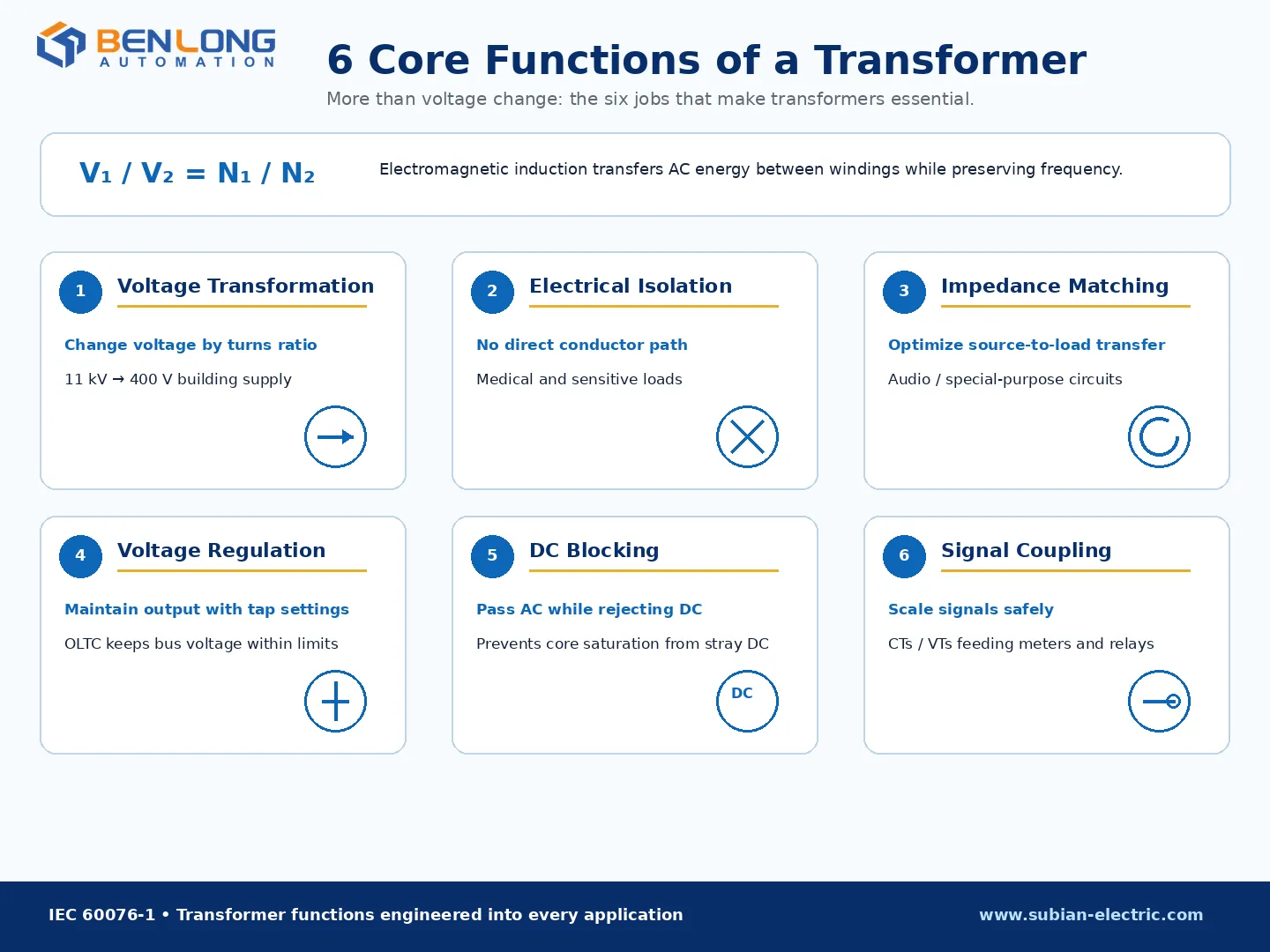
As seis funções de um transformador
| Função | O que faz | Exemplo do mundo real |
|---|---|---|
| Transformação de tensão | Muda o nível de tensão via razão de enrolamentos | 11 kV → 400 V para um fornecimento de edifício |
| Isolamento elétrico | Separa circuitos; sem caminho condutor direto | Isolando uma sala de imagem médica de falhas na rede elétrica |
| Adaptação de impedância | Otimiza a transferência de potência entre fonte e carga | Correspondência da saída do amplificador a um alto-falante (transformadores de áudio) |
| Regulação de tensão | Mantém a saída dentro dos limites através de comutadores de derivação | OLTC mantendo um barramento de 20 kV em ±2% |
| Bloqueio de CC | Passa CA, bloqueia CC | Prevenindo CC indesejada de saturar núcleos de distribuição |
| Acoplamento de sinal | Transfere sinais enquanto isola níveis | Transformadores de instrumento alimentando relés de proteção |
A maioria das pessoas só pensa na primeira linha, mas isolamento, regulação e bloqueio de CC são exatamente o que mantém equipamentos sensíveis funcionando durante distúrbios na rede.
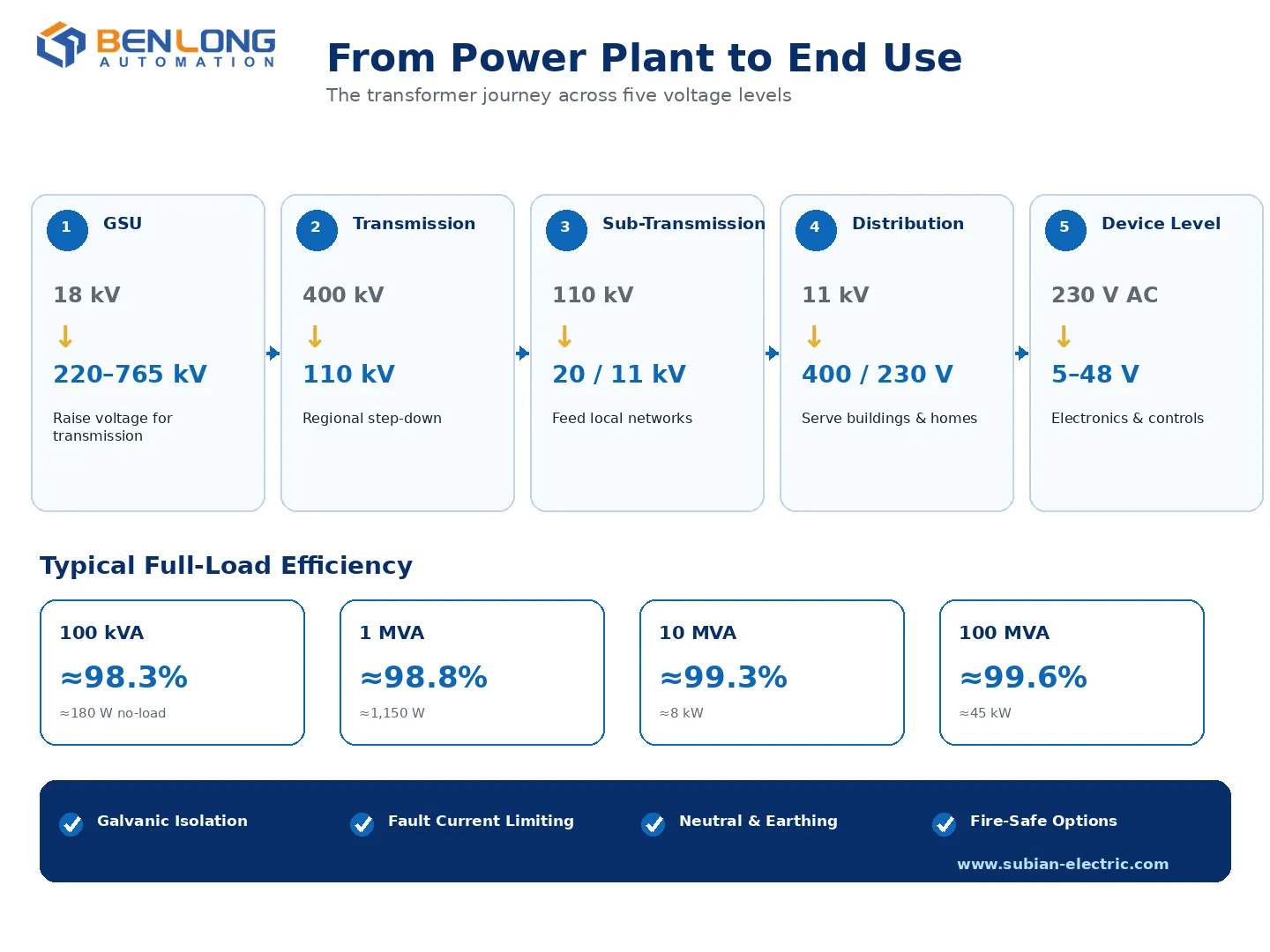
A Jornada do Transformador: Da Usina até Sua Casa
O processo de iluminação em suas casas é composto por uma multiplicidade de transformadores. Vamos considerar aqueles que podemos encontrar em uma cadeia de transformadores usados para esse propósito:
Transformador GSU – a tensão de saída do gerador de 18 kV é elevada para o nível de 220–765 kV.
Transformador de redução de transmissão – reduz a tensão de 400 kV para o nível de 110 kV nas subestações regionais.
Transformador de subtransmissão – reduz a entrada de 110 kV para 20/11 kV.
Transformador de distribuição – reduz a tensão de 11 kV que chega ao transformador de poste ou montado em base fora da sua casa para 400/230 V.
Transformadores em nível de dispositivo – carregadores e outras fontes de energia reduzem a tensão ainda mais para 5–48 V de potência necessária para o funcionamento de diferentes aparelhos elétricos.
Dessa forma, podemos entender facilmente que entre a usina e o carregador de celular temos 4-6 transformadores no meio.
Tipos de Transformadores e Suas Funções
| Tipo | Faixa de Tensão | Foco na Função | Uso Típico |
|---|---|---|---|
| Transformador de potência | 33–765 kV | Transferência em massa, regulação | Subestações, usinas |
| Transformador de distribuição | 4–35 kV | Etapa final de redução, eficiência | Montagens de poste/base, edifícios |
| Tipo seco / resina fundida | Até 35 kV | Segurança contra incêndio, uso interno | Edifícios altos, hospitais, marinha |
| Transformador de isolamento | Qualquer | Separação galvânica, ruído | Médico, laboratórios, centros de dados |
| Autotransformador | Rede HV | Acoplamento econômico | Interconexões 220/110 kV |
| Transformador de instrumento | Qualquer | Medição e proteção em escala | Relés, medidores, monitoramento |
Observe a sobreposição: um “transformador de potência” e um “transformador de distribuição” desempenham a mesma função fundamental, mas são projetados para ciclos de trabalho diferentes — um para carga alta contínua, outro para carga parcial variável. Essa única diferença impulsiona a maioria das decisões de especificação.
Eficiência, Perdas e Contas de Energia
A eficiência do transformador é alta, mas não é gratuita. As perdas se dividem em perdas de vazio (ferro), que ocorrem 24 horas por dia sempre que a unidade está energizada, e perdas de carga (cobre), que crescem com o quadrado da corrente. Valores típicos:
| Classificação | Perda em Vazio | Perda de Carga | Eficiência @ Carga Total |
|---|---|---|---|
| Tipo Seco (típico) | ≈180 W | ≈1.500 W | ≈98,3% |
| 1 MVA | ≈1.150 W | ≈10.500 W | ≈98,8% |
| 10 MVA | ≈8 kW | ≈55 kW | ≈99,3% |
| 100 MVA | ≈45 kW | ≈320 kW | ≈99,6% |
Como os transformadores operam continuamente, os custos causados pelas perdas são importantes. O transformador de distribuição com uma capacidade de 1 MVA, tendo perdas de aproximadamente 1,5%, pode desperdiçar cerca de 10–15 MWh de energia elétrica durante o ano, o que pode custar vários milhares de dólares por ano a preços usuais de eletricidade comercial. Os operadores devem ter em mente que, caso haja milhares de unidades na frota, os padrões de eficiência (por exemplo, o GB 20052 da China e o Regulamento 548/2014 da UE) terão uma importância econômica para o país.
Funções de Segurança: Isolamento, Aterramento e Proteção
Os transformadores são usados para tarefas críticas de segurança que incluem:
Isolamento Galvânico: Não há conexão condutiva entre os enrolamentos primário e secundário, de modo que qualquer falha ocorrendo no lado da carga não pode retornar ao circuito de alimentação.
Limitação de Falhas: A impedância de um transformador (tipicamente entre 5 e 10%) limita a corrente de curto-circuito que previne danos aos dispositivos de manobra e proteção nas seções subsequentes do circuito elétrico.
Aterramento Neutro: O tipo e a configuração do enrolamento do transformador definem o esquema de aterramento neutro que fornece informações sobre a tensão de toque e a forma como o transformador é protegido.
Segurança Contra Incêndio: Transformadores do tipo seco e preenchidos com éster são considerados mais seguros do que equipamentos preenchidos com óleo, pois as normas NFPA 70 e IEC 60076-11 promovem suas aplicações internas devido ao seu menor risco de incêndio em edifícios.
Separação Confiável de Tensões: Buchas isoladas a óleo e outros designs de isolamento dos transformadores interrompem qualquer acesso às zonas de tensão perigosas.
Esta lista fornece informações sobre os motivos pelos quais as regulamentações classificaram a instalação de transformadores como uma atividade de engenharia que requer conhecimento de aspectos como requisitos de distância, contenção de óleo, etc.
Especificações e Tabela de Classificações do Transformador
| Parâmetro | Valor Típico (1 MVA, 11/0,4 kV) |
|---|---|
| Potência nominal | 000 kVA |
| Relação de tensão | 000 / 400 V |
| Grupo vetorial | Dyn11 |
| Tensão de impedância | 6% |
| Resfriamento | ONAN |
| Nível de isolamento | 75 kV BIL primário |
| Perda em vazio | ≈1.150 W |
| Perda de carga | ≈10.500 W |
| Padrão | IEC 60076-1 |
Esses dez números definem todo o contrato funcional do dispositivo. Quando os compradores comparam transformadores, eles estão comparando esses números — e as garantias por trás deles.
Aplicações em Edifícios, Indústria e Infraestrutura
- Entidades comerciais — alimentações de 11 quilovolts transformadas para 400 e 230 volts.
Instalações de saúde — transformadores de isolamento usados para proteger dispositivos médicos sensíveis.
Centros de dados — sistema de média tensão e unidades de distribuição e de transformação de fontes de alimentação ininterruptas instaladas.
Locais de fabricação — transformadores são usados para reduzir a tensão de 33 quilovolts para 11 quilovolts.
Energia renovável eólica e solar — subestações são usadas reversamente para transformar a saída de renováveis de baixa tensão para tensão de rede.
Trabalho operacional ferroviário — transformadores de subestação transmitindo energia em 25 kV de tensão.
Preços Realistas & Principais Marcas
Os transformadores são precificados por classificação, especificação e marca. Faixas de nível de planejamento (FOB, imersos em óleo, perdas padrão):
| Marca / Tipo | 1 MVA | 20 MVA / 110 kV |
|---|---|---|
| Hitachi Energy / Siemens | $35.000–$70.000 | $430.000–$700.000 |
| Schneider Electric | $30.000–$55.000 | $280.000–$450.000 |
| TBEA (China) | $18.000–$35.000 | $180.000–$320.000 |
| Jiangsu Subian Electric Power (China) | $16.000–$30.000 | $160.000–$300.000 |
Os preços variam com a especificação, nível de perda e região. Para projetos que precisam do conjunto completo de funções — transformação, isolamento, regulação e segurança — sem o prêmio de marca europeia, Jiangsu Subian Electric Power fabrica transformadores de distribuição e potência de 50 kVA a 220 kV, imersos em óleo e tipo seco, com relatórios de teste de tipo IEC 60076, personalização OEM/ODM e preços diretos de fábrica tipicamente 30%–50% abaixo dos equivalentes ocidentais. Seus engenheiros especificam o grupo vetorial, as tomadas e a interface de proteção para corresponder exatamente à sua instalação.
Perguntas Frequentes
Qual é a principal função de um transformador em uma casa?
Um transformador de poste elétrico ou montado em pad reduz a tensão de distribuição de cerca de 11 kV para 400 / 230 V. Além dessa redução, o transformador fornece isolamento (que mantém quaisquer falhas do lado da fonte longe do circuito da casa) e escalonamento de corrente (que permite que o dispositivo forneça aproximadamente 144 A em 400 V com uma classificação de 100 kVA em vez de aproximadamente 9 A em 11 kV). Após o transformador discreto, o carregador reduz a tensão ainda mais para 5-48 V DC.
Por que um transformador não tem partes móveis?
Porque sua função é eletromagnética, não mecânica: a corrente alternada no primário cria um fluxo magnético variável no núcleo, que induz tensão no secundário. Não há nada para rotacionar ou reciprocidade, razão pela qual os transformadores costumam durar de 30 a 40 anos com manutenção limitada a testes de óleo, substituição de juntas e serviços de trocadores de tomadas.
Quão eficientes são os transformadores em operação real?
Transformadores de distribuição operam em torno de 98%–99% e grandes transformadores de potência em 99.0%–99.7% em plena carga. A eficiência atinge o pico em carga parcial (tipicamente 40%–75% da classificação), razão pela qual os engenheiros dimensionam os transformadores para que a carga normal fique nessa faixa. As perdas são contínuas, portanto, garantias de eficiência e perda dominam o custo operacional a longo prazo.
Qual é a diferença entre um transformador elevador e um transformador redutor?
Física funcionalmente idêntica, direção oposta: um transformador elevador tem mais espiras no secundário (V2 > V1) e é usado em usinas para aumentar a tensão para transmissão; um transformador redutor tem mais espiras no primário (V2 < V1) e alimenta a distribuição e os usuários finais. O mesmo transformador físico pode até ser usado em ambos os papéis, dependendo de qual enrolamento é o lado de fornecimento.
Quanto custa um transformador para um prédio ou fábrica?
Uma unidade de 100 kVA custa cerca de $1.500–$8.000, uma unidade de 1 MVA $18.000–$45.000 (óleo) ou $28.000–$70.000 (tipo seco), e um transformador de potência de 20 MVA / 110 kV $160.000–$700.000 dependendo da marca e especificação. Sempre solicite cotações em especificações idênticas e considere os custos de instalação, proteção e testes, que podem adicionar 20%–40% ao preço do equipamento.
Referências
- IEC 60076-1: Transformadores de Potência — Geral — A norma internacional para classificações, tolerâncias e testes.
- IEC 60076-11: Transformadores Secos — Requisitos específicos para transformadores tipo seco e de resina fundida.
- IEEE C57.12.00: Requisitos Gerais para Transformadores Imersos em Líquido — Norma acompanhante norte-americana.
- NFPA 70: Código Elétrico Nacional — Requisitos de instalação e segurança para transformadores em edifícios.
- US EPA: Eficiência do Transformador — Por que a eficiência do transformador é importante para a política energética e climática.
- Transformadores Siemens Energy — Referência de benchmark para engenharia de transformadores modernos.
Conclusão
A função dos transformadores é a espinha dorsal silenciosa da vida moderna: transformação de tensão, isolamento, correspondência de impedância, regulação, bloqueio de CC e acoplamento de sinal, tudo entregue sem partes móveis e eficiências acima de 98%. Desde o GSU em uma usina até a unidade montada no solo fora do seu edifício, cada estágio da cadeia elétrica depende deste dispositivo.
- Transformadores mudam a tensão pela relação de espiras enquanto isolam circuitos e limitam falhas.
- Eficiência de 98%–99,7% ainda custa dinheiro em escala — garantias de perda importam.
- Funções de segurança (isolamento, aterramento, impedância) são projetadas, não opcionais.
- Orce $1,5k–$8k para 100 kVA, $18k–$45k para 1 MVA, $160k–$700k para a classe de 20 MVA.
Se você está especificando um transformador para um edifício, fábrica ou projeto de utilidade, Jiangsu Subian Electric Power fornece transformadores de distribuição e potência de 50 kVA a 220 kV com certificação IEC 60076 e suporte de engenharia para cada etapa do seu projeto.