

If you are at a shopping mall or data center, a few feet away from the cabling, you will pass by two major types of transformers — the pad mounted equipment servicing the building and the dry type transformers converting 11 kV to 400 kV — and won’t even realize. Everything that runs on electricity owes its work to a transformer, causing it to perform one of its most important functions — that of transforming voltages.
In this article, we will explain the operation of transformers simply and clearly, while providing adequate numbers with respect to such processes as voltage transformation, isolation, impedance matching, and regulation, thus demonstrating that the knowledge about transformers can help us in maintaining the electrical needs of various industries.

What Is a Transformer & What Does It Actually Do?
Transformers are static devices with a certain number of coils (often referred to as windings) housed around a shared magnetic core. Essentially, the main aim of a transformer is to transfer the energy of the alternating current (AC) from one circuit to another while changing the voltage and amperage level and keeping the frequency the same. Hence, transformers are very reliable electrical devices as they do not have any moving components while operating.
The name of the transformer comes from its operation, which is transforming voltage. In general, transformers of the step-up type permit to increase the voltage for the purposes of efficient long-distance electricity supply and transformers of the step-down type help to reduce the voltage. However, changing the voltage is only a small part of what transformers can do – they also act as circuit isolators, impedance matching devices, DC blockers, methods of supply control, and many others.
How Transformers Work: Induction in One Diagram’s Worth of Words
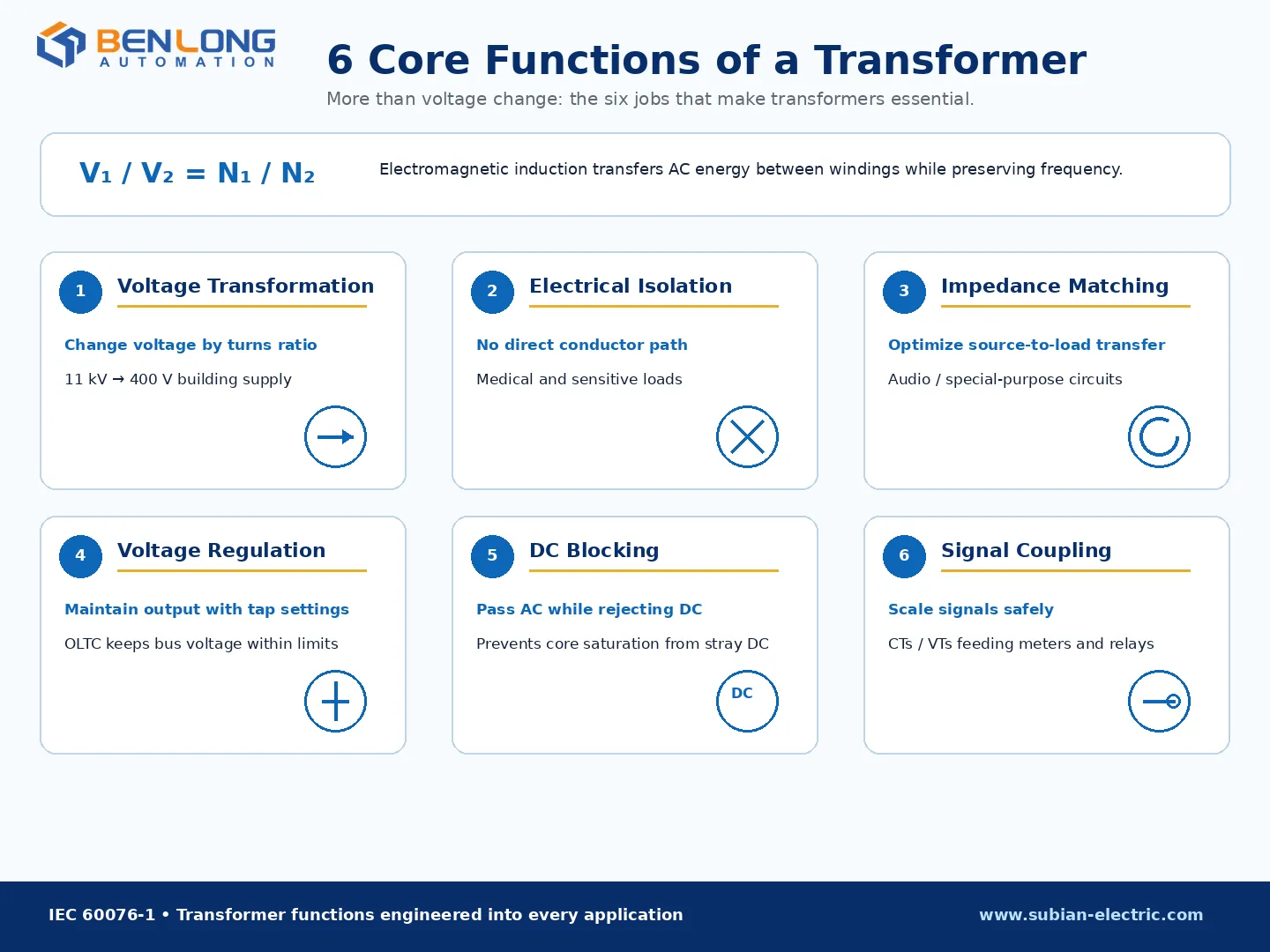
The working principle behind it is Faraday’s law of induction. A current in the primary winding generates a changing magnetic field that passes through the laminated steel core. The changing magnetic field induces a current in the secondary coil. The ratio of secondary voltage to the primary voltage is as per the turns ratio:
V1 / V2 = N1 / N2, and ideally V1 × I1 = V2 × I2.
Since current is only flowing through the primary circuit (a connection exists through induction, but the secondary circuit is not directly electrified), a transformer keeps both circuits isolated. In practice, a distribution transformer of 100 kVA rating at 11/0.4 kV would be carrying approximately 9 A in the primary at full load, while the load at the secondary would be around 144 A.
The Six Functions of a Transformer
| Function | What It Does | Real-World Example |
|---|---|---|
| Voltage transformation | Changes voltage level via turns ratio | 11 kV → 400 V for a building feed |
| Electrical isolation | Separates circuits; no direct conductor path | Isolating a medical imaging suite from mains faults |
| Impedance matching | Optimizes power transfer between source and load | Matching amplifier output to a speaker (audio transformers) |
| Voltage regulation | Holds output within limits via tap changers | OLTC holding a 20 kV bus at ±2% |
| DC blocking | Passes AC, blocks DC | Preventing stray DC from saturating distribution cores |
| Signal coupling | Transfers signals while isolating levels | Instrument transformers feeding protection relays |
Most people only ever think about the first row, but isolation, regulation, and DC blocking are exactly what keep sensitive equipment alive during grid disturbances.
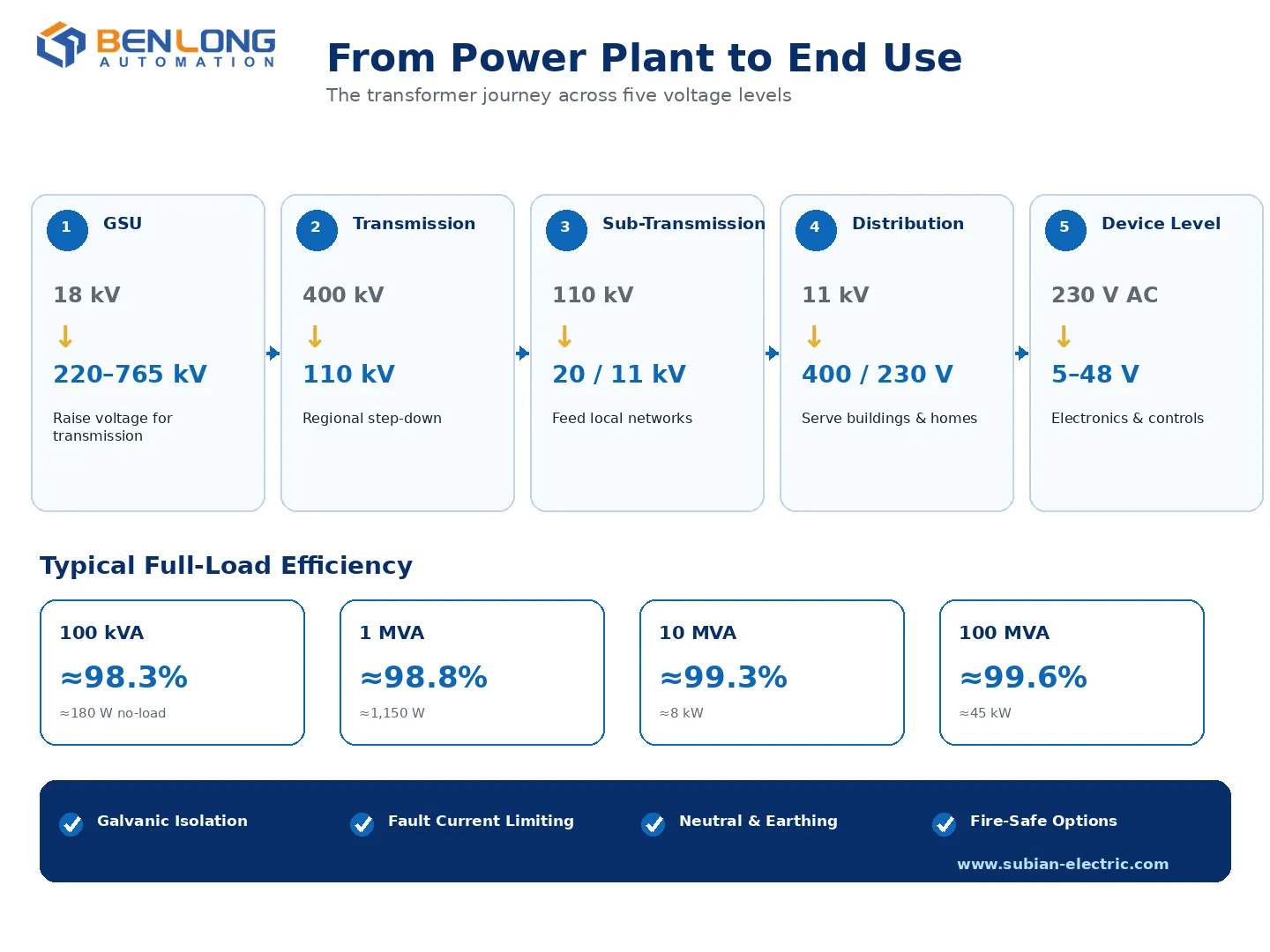
The Transformer Journey: From Power Plant to Your Home
The process of lighting in your houses is comprised of a multitude of transformers. Let’s consider the ones we can find in a chain of transformers used for this purpose:
GSU transformer – the generator output voltage of 18 kV is raised to the 220–765 kV level.
Transmission step-down transformer – steps down the voltage of 400 kV to the level of 110 kV on the regional substations.
Sub-transmission transformer – reduces the 110 kV input to 20/11 kV.
Distribution transformer – reduces the voltage of 11 kV that reaches the pole or pad-mount transformer outside your house to 400/230 V.
Device-level transformers – chargers and other power sources reduce the voltage further down to 5–48 V of power required for the functioning of different electric appliances.
This way, we can easily understand that between the plant and the cell phone charger we have 4-6 transformers in between.
Transformer Types & Their Functions
| タイプ | Voltage Range | Function Focus | 一般的な使用 |
|---|---|---|---|
| Power transformer | 33–765 kV | Bulk transfer, regulation | Substations, plants |
| Distribution transformer | 2.4–35 kV | Final step-down, efficiency | Pole/pad mounts, buildings |
| Dry-type / cast resin | Up to 35 kV | Fire safety, indoor duty | High-rises, hospitals, marine |
| Isolation transformer | Any | Galvanic separation, noise | Medical, labs, data centers |
| Auto-transformer | HV grid | Economical coupling | 220/110 kV interconnections |
| Instrument transformer | Any | Measurement & protection scaling | Relays, meters, monitoring |
Note the overlap: a “power transformer” and a “distribution transformer” perform the same fundamental function but are engineered for different duty cycles — one for continuous high load, one for variable partial load. That single difference drives most of the specification decisions.
Efficiency, Losses & Energy Bills
Transformer efficiency is high but not free. Losses split into no-load (iron) losses, which run 24 hours a day whenever the unit is energized, and load (copper) losses, which grow with the square of current. Typical values:
| 定格 | No-Load Loss | Load Loss | Efficiency @ Full Load |
|---|---|---|---|
| 100 kVA | ≈180 W | ≈1,500 W | ≈98.3% |
| 1 MVA | ≈1,150 W | ≈10,500 W | ≈98.8% |
| 10 MVA | ≈8 kW | ≈55 kW | ≈99.3% |
| 100 MVA | ≈45 kW | ≈320 kW | ≈99.6% |
Since transformers operate continuously, the costs caused by losses are important. The distribution transformer with a 1 MVA capacity having losses of approximately 1.5% can waste around 10–15 MWh of electrical energy during the year, which can cost several thousands of dollars per year at usual prices for commercial electricity. Operators should keep in mind that in case there are thousands of units in the fleet, the standards of efficiency (e.g., China’s GB 20052 and the EU’s Regulation 548/2014) will have an economic significance for the country.
Safety Functions: Isolation, Earthing & Protection
Transformers are used for safety-critical tasks that include:
Galvanic Isolation: There is no conductive connection between the primary and secondary windings so that any fault occurring at the load side cannot return back into the supply circuit.
Fault Limitation: Impedance of a transformer (typically between 5 and 10%) limits short circuit current that prevents damage to switchgear and protection devices in subsequent sections of the electric circuit.
Neutral Earthing: The type and configuration of the transformer winding defines the neutral earthing scheme that provides information regarding the touch voltage and the way the transformer is protected.
Fire Safety: Dry type and ester filled transformers are considered safer than oil-filled equipment as NFPA 70 and IEC 60076-11 standards promote their indoor applications because of their lower fire hazard in buildings.
Reliable Separation of Voltages: Oil insulated bushings and other insulation designs of the transformers interrupt any access to the hazardous voltage zones.
This list provides information regarding reasons why regulations classified the installation of transformers as an engineering activity that requires knowledge of such aspects as distance requirements, oil containment, etc.
Transformer Specifications & Ratings Table
| パラメータ | Typical Value (1 MVA, 11/0.4 kV) |
|---|---|
| Rated power | 1,000 kVA |
| Voltage ratio | 11,000 / 400 V |
| Vector group | Dyn11 |
| Impedance voltage | 6% |
| 冷却 | ONAN |
| Insulation level | 75 kV BIL primary |
| 無負荷損失 | ≈1,150 W |
| 負荷損失 | ≈10,500 W |
| 標準 | IEC 60076-1 |
These ten numbers define the entire functional contract of the device. When buyers compare transformers, they are comparing these numbers — and the guarantees behind them.
Applications Across Buildings, Industry & Infrastructure
- Commercial entities — 11 kilovolt feeds transformed to 400 and 230 volts.
Healthcare facilities — isolation transformers used to protect sensitive medical devices.
Data centers — medium-voltage system and uninterruptible power supplies distribution and step-down units installed.
Manufacturing sites — transformers are used to step down voltage from 33 kilovolts to 11 kilovolts.
Wind and solar renewable energy — substations are reversely used to transform renewables output from low to grid voltage.
Railway operational work — substation transformers transmitting energy in 25 kV voltage.
Realistic Prices & Top Brands
Transformers are priced by rating, specification, and brand. Planning-level ranges (FOB, oil-immersed, standard losses):
| Brand / Type | 1 MVA | 20 MVA / 110 kV |
|---|---|---|
| Hitachi Energy / Siemens | $35,000–$70,000 | $430,000–$700,000 |
| シュナイダーエレクトリック | $30,000–$55,000 | $280,000–$450,000 |
| TBEA (China) | $18,000–$35,000 | $180,000–$320,000 |
| Jiangsu Subian Electric Power (China) | $16,000–$30,000 | $160,000–$300,000 |
Prices vary with specification, loss level, and region. For projects that need the full function set — transformation, isolation, regulation, and safety — without a European brand premium, Jiangsu Subian Electric Power manufactures distribution and power transformers from 50 kVA to 220 kV class, oil-immersed and dry-type, with IEC 60076 type-test reports, OEM/ODM customization, and factory-direct pricing typically 30%–50% below Western equivalents. Their engineers specify the vector group, taps, and protection interface to match your installation exactly.

よくある質問
What is the main function of a transformer in a home?
An electric pole or pad-mounted transformer reduces the distribution voltage from around 11 kV to 400 / 230 V. In addition to this reduction, the transformer provides isolation (which keeps any faults from the supply side away from the home circuit), and current scaling (which allows the device to supply approximately 144 A over 400 V at a rating of 100 kVA instead of approximately 9 A at 11 kV). After the discrete transformer, the charger reduces the voltage yet again to 5-48 V DC.
Why does a transformer have no moving parts?
Because its function is electromagnetic, not mechanical: alternating current in the primary creates a changing magnetic flux in the core, which induces voltage in the secondary. There is nothing to rotate or reciprocate, which is why transformers routinely last 30–40 years with maintenance limited to oil testing, gasket replacement, and tap changer servicing.
How efficient are transformers in real operation?
Distribution transformers run at about 98%–99% and large power transformers at 99.0%–99.7% at full load. Efficiency peaks at partial load (typically 40%–75% of rating), which is why engineers size transformers so normal load sits in that band. Losses are continuous, so efficiency and loss guarantees dominate long-term operating cost.
What is the difference between a step-up and a step-down transformer?
Functionally identical physics, opposite direction: a step-up transformer has more turns on the secondary (V2 > V1) and is used at power plants to raise voltage for transmission; a step-down has more turns on the primary (V2 < V1) and feeds distribution and end users. The same physical transformer can even be used in both roles depending on which winding is the supply side.
How much does a transformer cost for a building or factory?
A 100 kVA unit costs about $1,500–$8,000, a 1 MVA unit $18,000–$45,000 (oil) or $28,000–$70,000 (dry-type), and a 20 MVA / 110 kV power transformer $160,000–$700,000 depending on brand and specification. Always request quotes on identical specifications, and factor in installation, protection, and testing costs, which can add 20%–40% to the equipment price.
References
- IEC 60076-1: Power Transformers — General — The international standard for ratings, tolerances, and tests.
- IEC 60076-11: Dry-Type Transformers — Requirements specific to dry-type and cast-resin transformers.
- IEEE C57.12.00: General Requirements for Liquid-Immersed Transformers — North American companion standard.
- NFPA 70: National Electrical Code — Installation and safety requirements for transformers in buildings.
- US EPA: Transformer Efficiency — Why transformer efficiency matters for energy and climate policy.
- Siemens Energy Transformers — Benchmark reference for modern transformer engineering.
Conclusion
The function of transformers is the quiet backbone of modern life: voltage transformation, isolation, impedance matching, regulation, DC blocking, and signal coupling, all delivered with no moving parts and efficiencies above 98%. From the GSU at a power plant to the pad-mount unit outside your building, every stage of the electrical chain depends on this device.
- Transformers change voltage by turns ratio while isolating circuits and limiting faults.
- Efficiency of 98%–99.7% still costs money at scale — loss guarantees matter.
- Safety functions (isolation, earthing, impedance) are engineered, not optional.
- Budget $1.5k–$8k for 100 kVA, $18k–$45k for 1 MVA, $160k–$700k for 20 MVA class.
If you are specifying a transformer for a building, factory, or utility project, Jiangsu Subian Electric Power supplies distribution and power transformers from 50 kVA to 220 kV class with IEC 60076 certification and engineering support for every step of your project.