


The authors question their own claims. Their views on dry transformers cannot be justified. As these types of transformers contain no liquid, the transformer consists of windings and core supported by ambient air. The insulating materials used in the case of dry transformers are solid, meaning epoxy, resin impregnated materials or vacuum pressure impregnated windings. There is a presence of liquids in the oil immersed transformers and therefore the design requirements for dry transformers cannot apply to oil-immersed types of transformers. As a result, the main statement of the paper is that the process used in the article is not suitable for the type of equipment where it is applied.
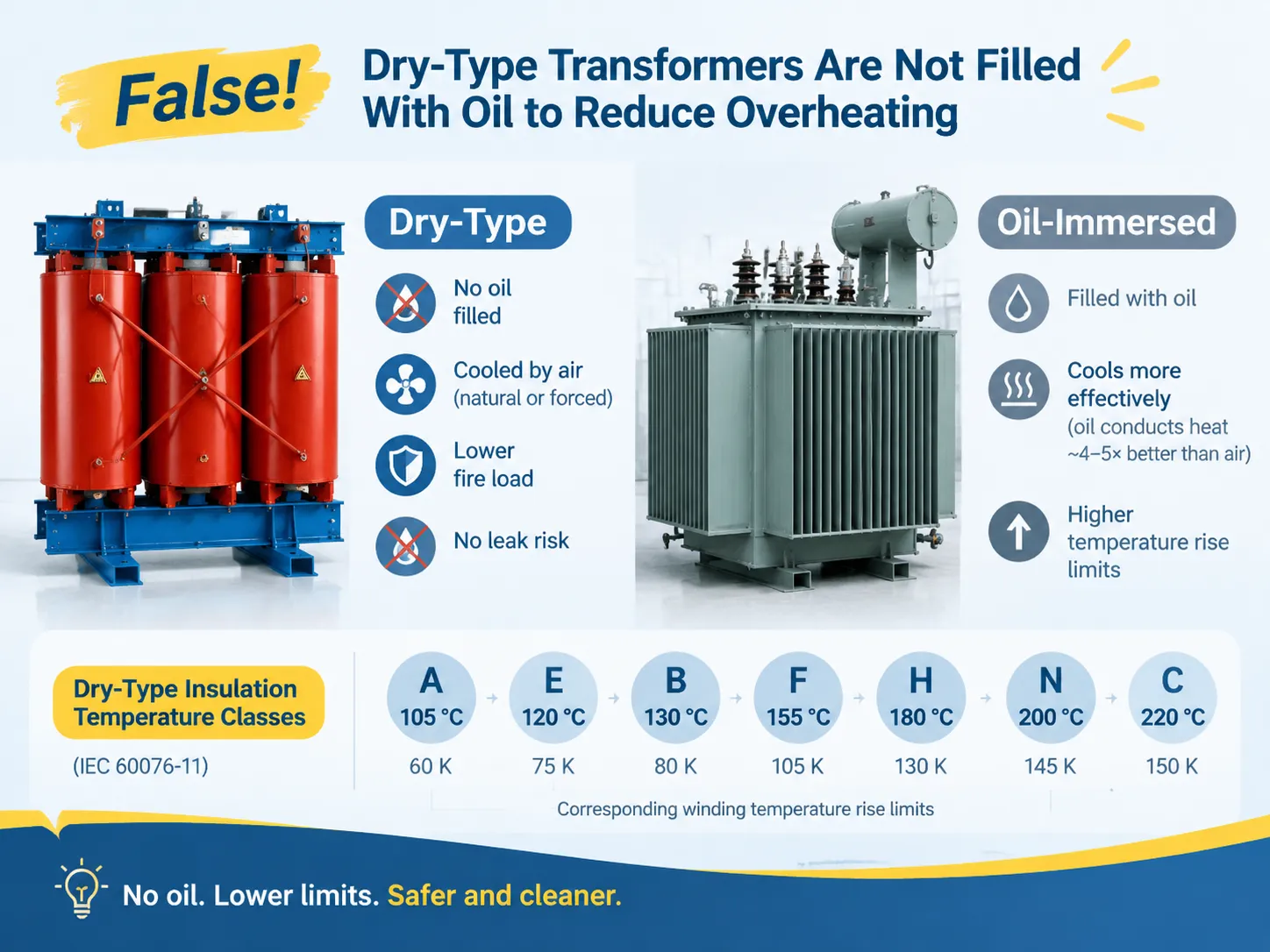
In conclusion, the outcome is unfavorable. Therefore, with the inclusion of an oil-based cooling system, a dry type transformer is turned into a liquid filled one. The cooling is conducted by air, either natural (i.e. atmospheric) or mechanical (i.e. forced). According to the IEC 60076-11, there are different types of thermal insulation (Class A (105 °C), Class E (120 °C), Class B (130 °C), Class F (155 °C), Class H (180 °C), Class N (200 °C), and Class C (220 °C)) with their limits depending on the environmental characteristics of the class.
The Claim, and Why It Is Wrong
The word “dry” has nothing to do with marketing phrasing but concerns transformers with cooling and insulating elements not being liquid. IEC has issued IEC 60076 -11 related to dry transformers and stating the units capable of working at power of 2500 kVA and voltage of 36 kV. The term “dry” used here implies nothing liquid.
The confusion in this matter arises because both types of transformers can be observed to be the same in terms of their appearance, location in substations and share the same manufacturers. Both types of transformers are capable of converting the electric energy from one form to another through the core made of metal and the copper coils. What distinguishes the two is the fact that the power transformers utilize oil, whereas the dry transformer uses just air as insulating and cooling means.
The two families are usually compared on exactly the criteria this myth gets backwards, and where dry-type and oil-immersed transformers genuinely differ comes down to cooling medium, fire load, footprint, maintenance regime and where the unit is allowed to be installed — not to which one has oil in it.
What Actually Cools a Dry-Type Transformer
Air is mainly responsible for rendering dry types inferior in terms of maximum temperature increase when compared to oil-filled counterpart units with identical capacity ratings.
- Thermal performance. The thermal conductivity of air is estimated to be approximately 0.026 W/m·K. On the other hand, the thermal conductivity of transformer oil is about 0.12 W/m·K, meaning that oil has four or five times greater thermal performance than air. This single figure sheds light on the differences between the species groups.
- Cooling methods. Air natural (AN) performs cooling through convection only, while air forced (AF) requires the installation of fans producing increased short-term cooling performance. Yet another alternative, which is a hybrid type, is known as ANAF and which means air natural cooling on normal load and performing cooling through the use of fans on full load. Note that the installation of fan sets makes such type noisier and increases maintenance, which must be highlighted when someone states that he is aiming at AF only because of its supposed advantages.
- Clearance and air circulation. Most manufacturers recommend ensuring at least 300 mm clearance from walls for air natural cooling or reducing minimum clearance to about 150 mm when using air forced cooling. The above figure must be considered when planning installation of equipment, as manufacturing recommendations formulate clear limitations.
- Cleanliness is crucial for cooling effectiveness as the presence of dust on winding and in cooling passages can lead to effectiveness losses reaching 15-30%. That is why dry-type periodic maintenance programs account for regular cleaning while oil-filled counterparts do not provide either recommendations or requirements.
- Altitude and environmental parameters have adverse effects on cooling functioning.
The cooling method also becomes the naming convention on the datasheet, and wet-type units use the same letters differently — the cooling technology comparison across transformer types, including oil-forced variants, is set out in this overview of transformer cooling methods, which is a useful reference when a specification quotes ONAN, ONAF or OFAF and you need to know what the letters commit the supplier to.
Insulation Classes and Temperature Rise Limits
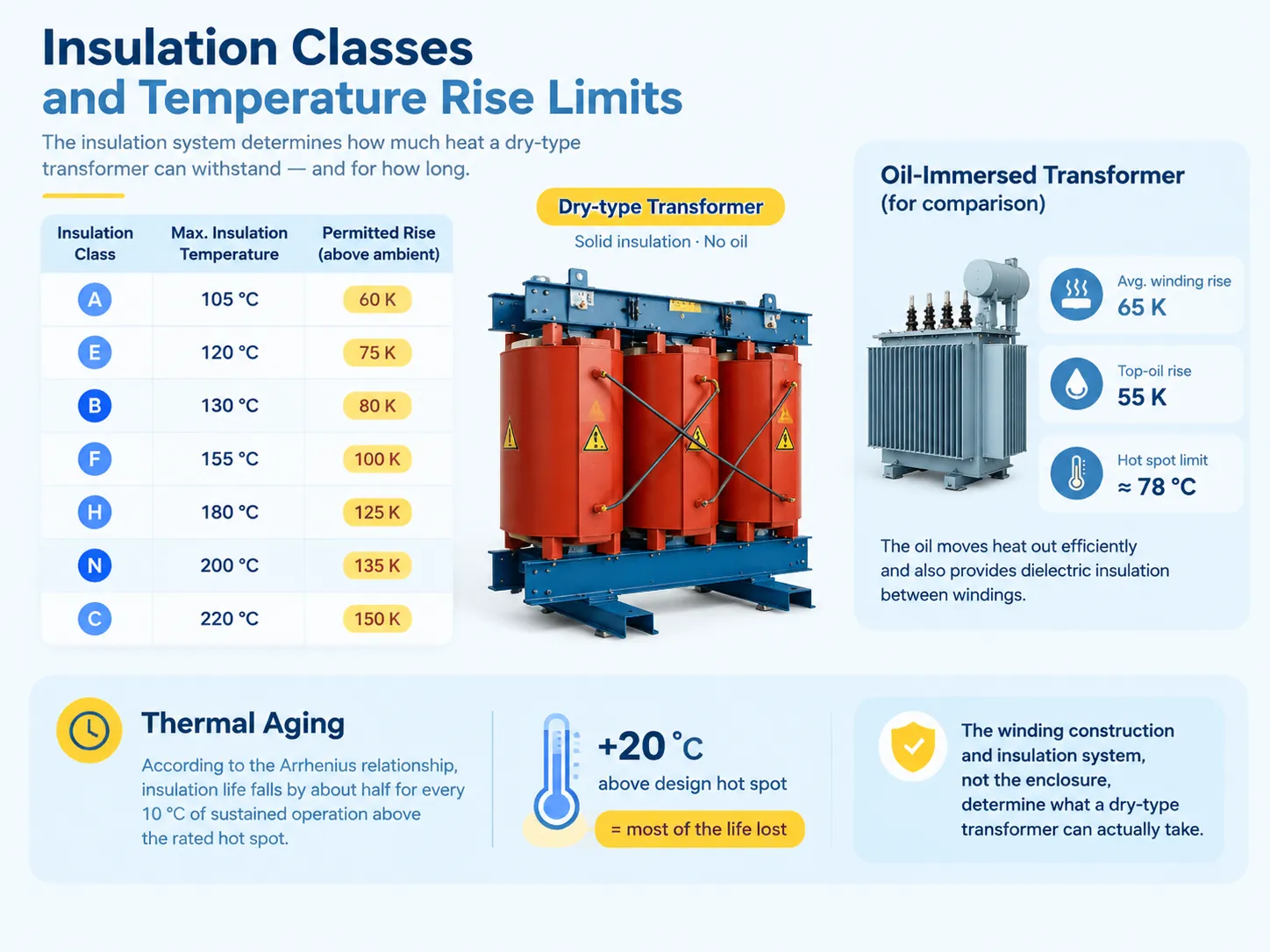
This is where the rating of a dry-type transformer becomes relevant, so precision is crucial. There is no oil that would help the heat dissipate, so the solid insulation system must withstand the temperatures it is designed to endure; IEC 60076-11 outlines both the insulation class and the maximum permitted temperature increase relating to ambient temperature.
- Class A (105 °C) — 60 K winding temperature increase. Older equipment.
- Class E (120 °C) — 75 K. This is not too common today.
- Class B (130 °C) — 80 K. Often used in general applications.
- Class F (155 °C) — 100 K. This is what is typically used for distribution applications.
- Class H (180 °C) — 125 K. Used in more demanding operating conditions with higher loads.
- Class N (200 °C) — 135 K. This class is used in special applications.
- Class C (220 °C) — 150 K. Widely used in North America in dry-type VPI installations; at the 150 K temperature, the hot spot temperature at rated load exceeds 210 °C.
In comparison, an oil-immersed transformer complying with IEC 60076-2 and ANSI standards at a maximum temperature increase of 65 K and an average rise in the top oil believed to not be more than 55 K maintains a hot spot temperature of 78 °C above the ambient level. The oil is not there to cool the transformer, but rather to achieve high enough efficiency in the heat removal process and provide dielectric insulation between the leading turns and subsequent windings.
This is important for business in the context of thermal aging. The Arrhenius equation states that the insulation life is halved every 10 °C rise in temperature maintained. Hence, a dry-type transformer exceeding the hot spot by 20 °C would lose not only a fraction of its service life, but the majority of it, with its malfunction manifesting itself in the insulation failure far after the failure, rather than giving any indications beforehand.That is also why the winding construction and insulation system, not the enclosure, decide what a dry-type transformer can actually take, and the component-level detail behind that is explored in what sits inside a dry-type transformer and why each part matters.
Three Constructions, Three Different Products
With “dry-type” not being a standalone distinction but more of an umbrella concept, we can see that the three main varieties behave different enough not to be used interchangeably.
- Casting resin. In basic terms, we encapsulate the windings in resin under vacuum, forming a solid body of insulation, having good mechanical properties, and a great resistance to water, dust, and chemical aggression. Partial discharge becomes a big deal here since the failure typically begins in solids because of voids, and that’s the reason why the organization IEC 60076-11 makes partial discharge testing mandatory. This is typical for indoor distribution network.
- Resin-encapsulated and VPI method. In this technique, instead of making a winding using the casting method we first impregante it with resin in high-pressure vacuum chamber, obtaining robust insulation system of class H or class C with a good tolerance of overloads. This method became quite common in the USA, especially in retrofitting work.
- Open or ventilated type. Here the winding is just enclosed in covering while relying on airflow and usually higher insulation class in general. This method is usually not that expensive and the protection levels reach IP20 or IP23.
The rating of enclosure does not depend on the preferences of the owners, but on what kind of environment unit is used in: for example, rating IP00 would be used in case of open windings being placed in specially designated room, IP20 would be in case of being installed inside closed room.A representative product in this space is the SCB-series cast resin dry-type distribution transformer for 6–10 kV systems, where the epoxy-encapsulated winding, the specified insulation class and the low-loss core are the parameters that decide suitability rather than the kVA figure alone.
Where Dry Types Get Used, and Why the Myth Persists
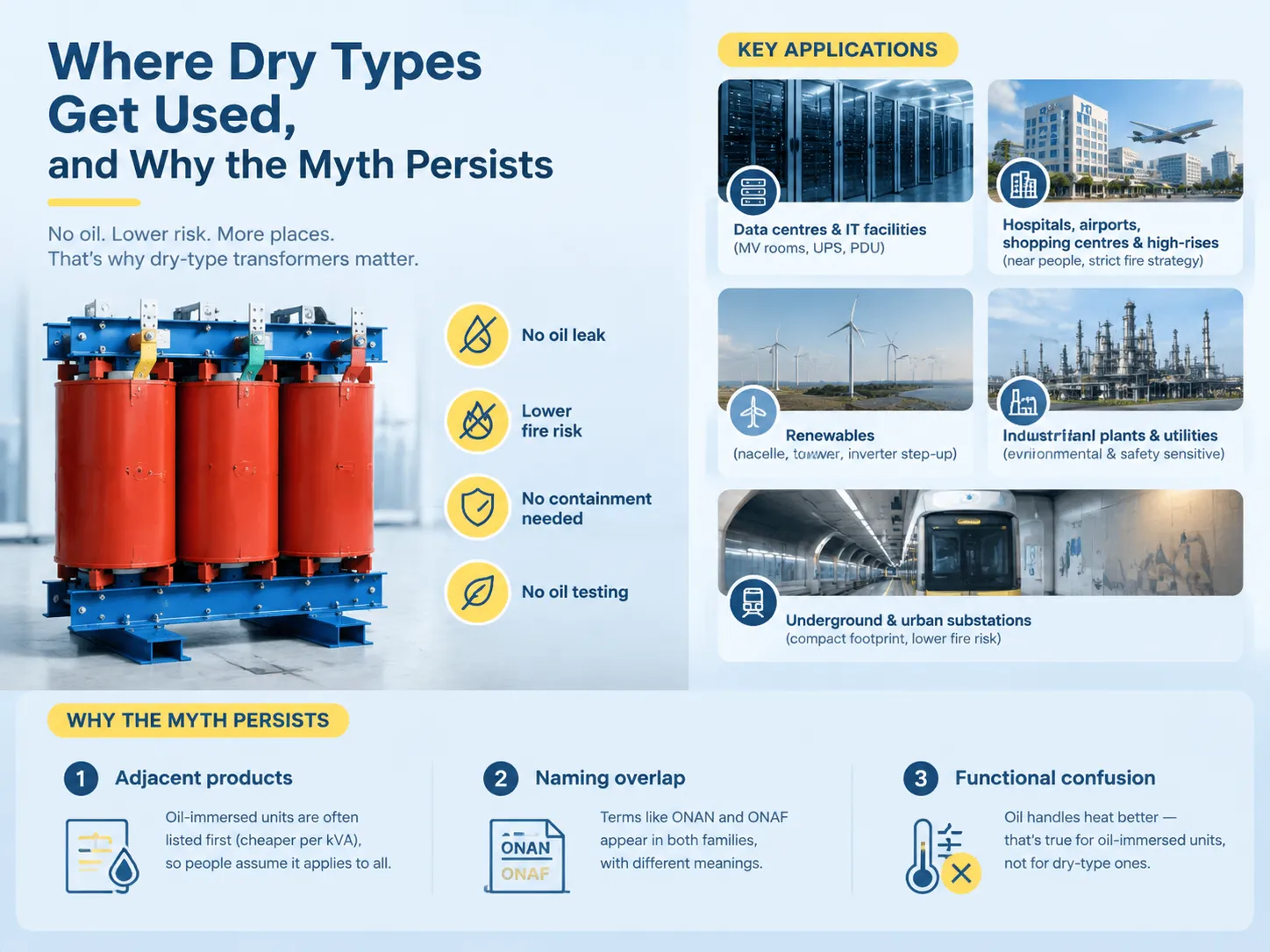
The reason dry-type transformers are used is safety. The absence of liquid implies there will be no oil leaks, no bunded containment, no oil containment pit, no fire load of hundred litres of liquid on fire inside the building, and no requirement for periodic oil testing. This is what makes it possible to use them indoors, close to the working areas, in tunnels, on offshore platforms, as well as inside data centres.
The application examples include:
- Data centres and IT facilities including medium voltage rooms, UPS isolators, and PDU step-downs places where there is no chance of recovering from oil leak incident.
- Hospitals, airports, shopping malls, high-rise buildings, etc. where due to restrictions on fire strategy there is no possibility for use of oil-filled transformers near people.
- Renewable energy industry where the nacelle, tower, or inverter step-up applications could be justified due to expensive maintenance access and limited enclosure volume.
- Industrial plants and utilities where consequences from oil leaking could be seen as dangerous and where safety measures would be needed.
- Urban and underground substations where footprint and fire risk are an essential matter and dry-type transformer can be used where oil-type one would need a specifically equipped fire-protective room with fire rating.
Real projects in this space are usually specified on the same logic, and a delivered installation gives a better sense of it than a datasheet does — for instance, the dry-type transformers supplied for a dual power supply project in Pakistan show the pattern: dual supplies, indoor installation, no oil containment, and a protection scheme built around the transformer rather than around the risk of the transformer itself.
The myth stems from three sources.
- Synonym products. Almost all manufacturers market both types, and oil-cooled products often take the first place in the catalogue as they prove to be less expensive in utilization. Thus, the person hoping through the catalogue would see the term oil in it and assume all the products featured along with it are oil-cooled ones.
- True term confusion. Words like ONAN and ONAF describe cooling types, and the same letters are present in dry-type transformers with a different meaning. For instance, “AN” means air natural in the case of dry-type transformers.
- The confusion is functional and not cosmetic. Oil-cooled transformers do indeed perform better in terms of overheating prevention, which makes the phrase “oil prevents overheating” true if applied to the other family of transformers. The mistake here is the fact that this statement is attributed to the wrong type of transformer.
What to Check Before You Buy
Five factors contribute significantly and all should be found on the datasheet rather than discussed in detail during sales talks.
- Insulation classification and temperature increase. Class F with 100 K and Class H with 125 K results are two different products while possessing the same kVA. Ensure the existence of both the class and the temperature increase level, and ensure the ambient temperature conditions.
- Cooling conditions and presence of fans. AN, AF or ANAF are included, as well as the noise level for a device located close to the occupied area.
- Enclosure IP classification and its effect on the continuous rating at the site facilities.
- Losses and efficiency rating. No-load losses and load losses form the operating cost during the entire time of its operation. They are additionally subject to regulations in certain countries, as for instance, GB/T 10228-2023 provides for the definitions of efficiency classes in China, while the ErP Tier 2 regulations control product quality in the European market.
- Certification requirements. IEC 60076-11 is an internationally accepted standard and UL 1562 is a standard for dry-type general-purpose and power transformers used in North America.
One important word about price: dry-type transformers are usually more expensive than oil transformers of the same type and the reason for it. It is not attributed to better performance of these units but their price is because they do not use oil. Generally, they are much cheaper for the entire installation period and more expensive at the initial stage.
Frequently Asked Questions
Are dry-type transformers filled with oil?
No. There are no liquid mediums in dry type transformers for purposes of cooling or insulation. Instead dry type transformers rely on air for cooling either through natural cooling as in AN type transformers or artificial as in AF type transformers. They also employ solid insulation materials such as cast epoxy resin insulation or resin-impregnated windings. The IEC 60076-11 standard deals with dry-type transformers, which is valid for transformers of power rating 2500 kVA and voltage rating 36 kV.
Why do dry-type transformers have lower temperature rise limits than oil-immersed ones?
Air is known to be a much poorer conductor of heat as compared to oil. With thermal conductivity being 0.026 W/m·K for air versus around 0.12 W/m·K for insulating oil, dry transformer is not able to get rid of excess heat from the coils quickly. In order for the insulation to remain good enough during the whole 30-year period of usage, it is necessary for the temperature of the coils not to rise too steeply—60 K in case of class A insulation and 150 K of class C insulation, which are specified in IEC 60076-11. With the oil transformer, it was observed that the temperature of the coils increased to 65 K while the temperature of the oil rose by 55 K.
How does a dry-type transformer cool itself without oil?
Power transfer occurs through three forms. Transmission from the coil to the solid insulation can take place through conduction, the casing to the ambient air through convection, and through radiation from the casing. Natural convection (AN) is sufficient for almost all applications where there’s sufficient space for this process to take place at about 300 mm from any wall or 150 mm when forced cooling is used. To meet the increased capacity requirements while keeping the same basic unit size, fans are either installed (AF) or installed on the condition of their operation only when it is necessary (ANAF). In terms of care, dust covering of the coils and the channels for cooling would decrease the efficiency of systems by 15-30%.
Which is better, a dry-type or an oil-immersed transformer?
Neither transformer type is generally preferred; instead, they are made for different applications. If fire safety, installation indoors, proximity to people, ecological safety, and difficult maintenance prevent its use (like being employed in data centers, hospitals, tall buildings, tunnels, off-shore and city substations), the dry-type transformer should be used. The oil-filled transformer must be selected if the low cost per kVA, high-temperature operation, outdoor installation in bunded area, or ease of oil maintenance are needed, which is usually required for large outdoor distribution and transmission employment. The types of transformers are not mutually exclusive; in fact, it is usual for one site to employ oil transformers at the incoming substations and dry-type transformers at its distribution stations.
References
- International Electrotechnical Commission — IEC 60076-11, dry-type power transformers
- UL Standards & Engagement — UL 1562, Transformers, Distribution, Dry-Type
- NFPA 70, National Electrical Code — Article 450, transformers and transformer vaults
- Schneider Electric — dry-type transformer application and selection documentation
- Siemens — transformer technology and cooling method reference material
Conclusion
Dry-type transformers have different construction principles than traditional transformers because they operate without oil as insulation. Despite the fact that dry-type transformers lose some thermal resistance and do not use any combustion fluids as insulating materials, these transformers can be installed at the locations like data centers, hospitals, tunnels, and basements with no need of spill management, fire fighting services, or oil monitoring. The problem with understanding the dry-type transformer is due to the similar principle of operation for both oil-filled and dry-type transformers and the existence of the same vocabulary with both of them. The instructions related to this type of transformer provide the sufficient information about the insulation system, temperature rise, and various methods of cooling.