


If you’re researching Siemens switchgear, you’re probably comparing your options for your own project, one which cannot afford unexpected outages. Switchgear is found in every substation, factory, data center, and the majority of commercial buildings, where it provides reliable protection from faults, overloads, and short circuits. The brand has an expert position in industry for a reason, but you must have a comprehensive understanding of the products first. Before you make a purchasing decision, inspecting this guide will help you get an overview of the switchgear product categories, determining which option works best for your particular project.
Functionality of Switchgear and Importance of Siemens Brand
Switchgear is a collective term used to describe circuit breakers, isolators, fuses, busbars, and control devices that disconnect and protect electrical circuits from improper usage. Whenever there is an accident, switchgear is able to interrupt the flow of current quickly enough to avoid fires, damage, and injuries. Moreover, in case of maintenance works, switchgear will allow engineers to isolate a section of the system safely. Overall, switchgear is the reason why customers are able to make proper choices in the aforementioned situations.
Due to the protection of equipment and life that switchgear provides, companies placing orders always care a lot about reliability and safety of switchgear certified products. That is the reason why Siemens enjoys such a good reputation worldwide.
Why Siemens Switchgear Is a Global Benchmark
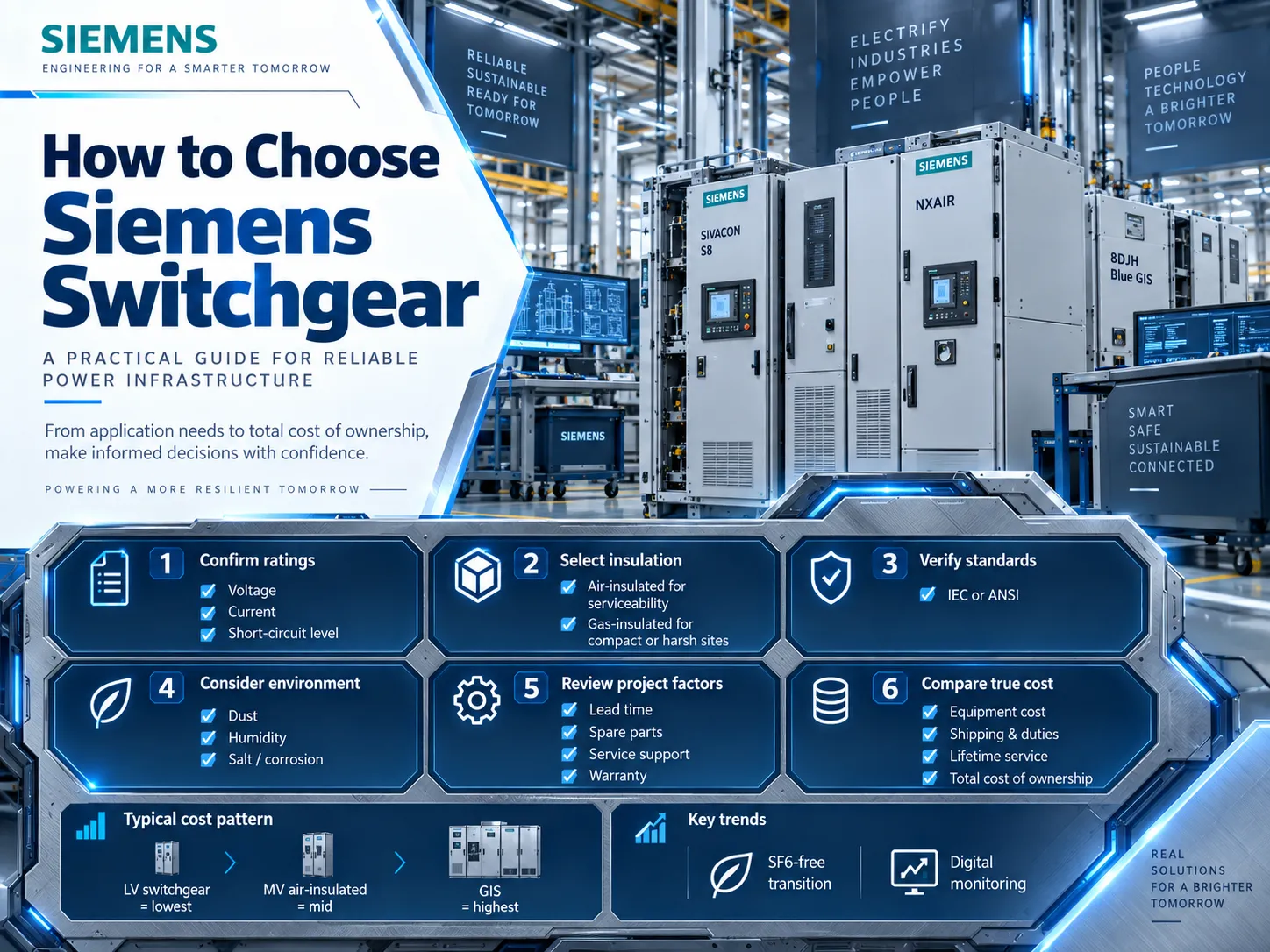
Siemens positions itself as a full-spectrum supplier, covering everything from small distribution boards to gas-insulated substations rated for the highest voltages. Several things set Siemens switchgear apart in the eyes of specifiers.
Firstly, the variety in portfolio ensures that a single vendor can satisfy all the needs for all electrical rooms by providing everything from low voltage distribution all the way to medium voltage primary switchgear. Secondly, Siemens is known to heavily invest in type testing and international certification of its products, which is one of the aspects that consultants love about its product datasheets. Thirdly, Siemens has been very active in the sustainability space by trying to reduce its dependency on the SF6 gas used for insulating its products. Lastly, the company is also known for incorporating digital monitoring and diagnostics in its designs.
None of this makes Siemens the only sensible option, but it explains why Siemens medium voltage switchgear and its low-voltage cousins appear on so many approved-vendor lists worldwide.
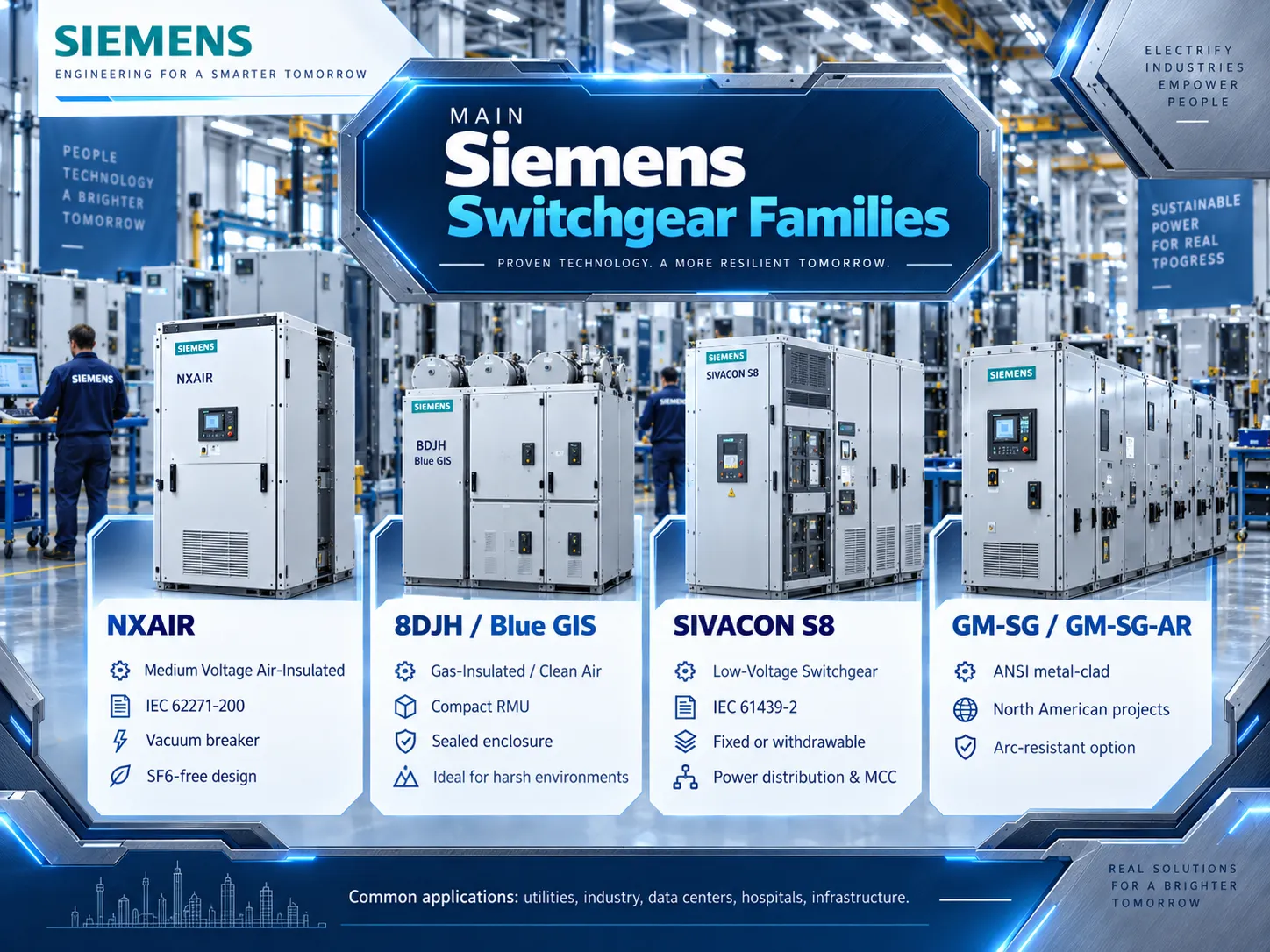
The Main Siemens Switchgear Product Families
One reason buyers get confused is that Siemens uses a lot of product names. Below is a simplified map of the families you are most likely to encounter, grouped by voltage level and insulation type.
Siemens Medium-Voltage Air-Insulated Switchgear (NXAIR)
NXAIR is Siemens’ flagship air-insulated switchgear for medium-voltage applications. Instead of using insulating gas, it relies on natural air, which eliminates greenhouse-gas concerns and simplifies end-of-life recycling. NXAIR is built around vacuum circuit breakers, includes interlocking and pressure-relief features for arc-fault protection, and is type-tested to the IEC 62271-200 standard that governs metal-enclosed medium-voltage assemblies. It is a common choice for utility substations, industrial plants, and infrastructure projects where operators want a proven, serviceable design. Siemens has also added low-power instrument transformers and modern protection relays to make the platform ready for digital substations.
Siemens Gas-Insulated Switchgear (8DJH and Blue GIS)
When floor space is tight or the environment is harsh, gas-insulated switchgear becomes attractive because it packs the same switching capability into a much smaller, sealed enclosure. The 8DJH family is Siemens’ widely deployed secondary distribution gas-insulated switchgear, typically used for compact substations and ring main units that feed local distribution networks. A ring main unit, for those newer to the terminology, is a compact assembly that connects a customer or a distribution loop to the medium-voltage grid.
Historically, this class of equipment used SF6 gas, which is an extremely potent greenhouse gas. Siemens has responded with its “blue” range of SF6-free switchgear, including an 8DJH model that uses only the natural constituents of ambient air, marketed as Clean Air. The hermetically sealed, welded vessel keeps the live parts insensitive to humidity, dust, and salt, which is why Siemens gas-insulated switchgear performs well in coastal, tropical, and heavily polluted locations. For larger primary substations, the higher-voltage 8DN GIS range extends the same sealed-enclosure philosophy to transmission-level voltages.
Siemens Low-Voltage Switchgear (SIVACON S8)
On the low-voltage side, SIVACON S8 is the name buyers encounter most often. It is a modular Siemens low voltage switchgear system for power distribution and motor control in industrial plants, commercial buildings, data centers, hospitals, and utilities. SIVACON S8 is design-verified to IEC 61439-2, offers fixed and withdrawable mounting options, and can be configured with high current ratings and strong short-circuit withstand capability. Siemens supports it with arc-fault testing, seismic-qualified versions, and integration into energy-management and monitoring platforms. Around SIVACON S8 sit the SENTRON range of protective devices and circuit breakers and the ALPHA distribution boards, which together let one vendor supply the whole low-voltage chain.
ANSI Options for North American Projects
As Siemens provides metal-enclosed designs like GM-SG as well as arc-resistant models such as GM-SG-AR for projects defined according to the ANSI standards in North America instead of IEC standards, they serve equivalent purposes in terms of protection but differ in construction and testing parameters. The differences play a crucial role because, for instance, IEC and ANSI equipment cannot be interchangeable according to specifications despite carrying out the same purpose.
The Use of Siemens Switchgear
Siemens switchgear equipment is versatile in various applications where electricity is used. Utilities utilize the equipment in getting electricity from primary and secondary substations smoothly. Heavy industries – like steel manufacturing plants, mining companies, and chemical/petrochemical businesses – use the machines since failure to carry out a single trip could lead to losses in production.
Switchgear is also utilized in facilities that are of little importance to the economy but critical for many, including data centers and their reliance on resilient low-voltage switchgear and medium voltage distribution systems. Ever-increasing energy needs due to AI – powered computing technologies add to the demand for switchgear, while hospitals require machines that ensure power supply to operating rooms and support systems. Switchgear equipment is widely used in other structures and infrastructures in aviation services, water purification plants, solar farms, wind projects, and others. Any project that requires connection to the grid, without failure in electricity distribution, makes use of switchgear technology.
Comparison of Global Brands with OEM Factories
Once the buyer learns about Siemens switchgear and its application, their next challenge is to find one conveniently. Premium European brands are renowned for their reliability but their high prices and long delivery times even in prosperous economic times make them less attractive. Moreover, significant shipping and import duties, as well as years of maintenance charge add to the financial burden of purchasing switchgear equipment.
Thus, more and more contractors, EPC-economists, and distributors opt for buying Siemens switchgear from other manufacturers whose products are of equal quality and comply with IEC standards but cost less and take shorter time to deliver products to the customers. The best of such manufacturing plants are OEM factories using the technology of in-house production, which allows them to customize each product according to the client’s request.
Subian Power: An OEM Switchgear Factory Introduction
Jiangsu Subian Power Equipment Co., Ltd. (Subian Electric Power) is a Chinese OEM/ODM switchgear manufacturer based in the Xuzhou High-Tech Industrial Development Zone in Jiangsu Province. Established in 2019 and recognized as a high-tech enterprise, the company designs and produces 110 kV and below power transformers, prefabricated and combined substations, photovoltaic and wind-power step-up substations, and complete sets of high and low voltage switchgear. Its equipment is deployed in main power grids, commercial and residential real estate, hydropower, thermal, solar and wind generation, airports, tunnels, petrochemical sites, and general industry.
It is important to understand what is meant by “OEM factory” in this situation. Subian Power is not a company that is authorized, affiliated with, or a supplier to Siemens; it is a manufacturer that produces switchgear products and offers OEM and ODM services. Therefore, customers and distributors can request products according to their own requirements and specifications. The difference in the case of both direct factory buyers and users of premium brands is clear: it is the same equipment providing the same level of electrical safety but the differences lie in the place of the equipment manufacturing process.
Since Subian has its own production and engineering facilities, it can provide three significant benefits for end users. First, it can design switchgear panels according to the specifications of the project. Secondly, pricing will be more affordable because of the lack of distribution network. Thirdly, customers will receive their order as quickly as possible.
Subian’s High and Low Voltage Switchgear Range
Subian’s high and low voltage switchgear catalog covers the same core technologies that specifiers expect from a global brand, spanning air-insulated, gas-insulated, and solid-insulated designs across both medium- and low-voltage classes.
Medium-Voltage Switchgear
On the medium-voltage side, the KYN28A-12, which is a type of metal clad switchgear that is rated for use with 12 kV systems, is a withdrawable indoor equipment. In this switchgear, a draw-out circuit-breaker truck and a comprehensive application of mechanical interlocks are utilized so that operating errors such as the racking in or racking out of a circuit breaker while under a load are ruled out, and the switchgear itself is manufactured according to the Chinese national standards. It is directly analogous to the air-insulated metal-clad switchgear utilized in substations across pipelines and industries globally.
For distribution loops and compact substations, Subian provides two options of ring main units. HXGN15-12 is a fixed-type device perforated by air and solid insulation while XGN15-12 is the inflatable version that employs SF6 load-break switches for a compact structure. In this way, clients are allowed to choose between SF6-free solution and a conventional gas-insulated one depending on the existing regulations and environmental philosophies. In addition, Subian also delivers the range of vacuum circuit breakers such as indoor VS1 and outdoor ZW32 types that are installed in the above-mentioned equipment.
Low-Voltage Switchgear
For low voltage distribution and motor management, Subian offers the GCS and MNS systems, both of which consist of modular switchgear lines suitable for use in some sorts of industrial companies, data processing centers, and infrastructure projects. Meanwhile, the GGD AC distribution cabinet completes the line-up as a reliable and fixed solution for simple power distribution tasks. Much like the medium-voltage range, these can be produced on an OEM and ODM basis so that a reseller or contractor is able to choose the desired ratings and configurations as well as implement their own labels.
Every product line is supported by full documentation, and Subian can supply switchgear as part of a complete substation package alongside its dry-type and oil-immersed transformers and prefabricated substations. You can review the current line-up on the high and low voltage switchgear page.
Siemens Switchgear vs. an OEM Factory: How to Decide
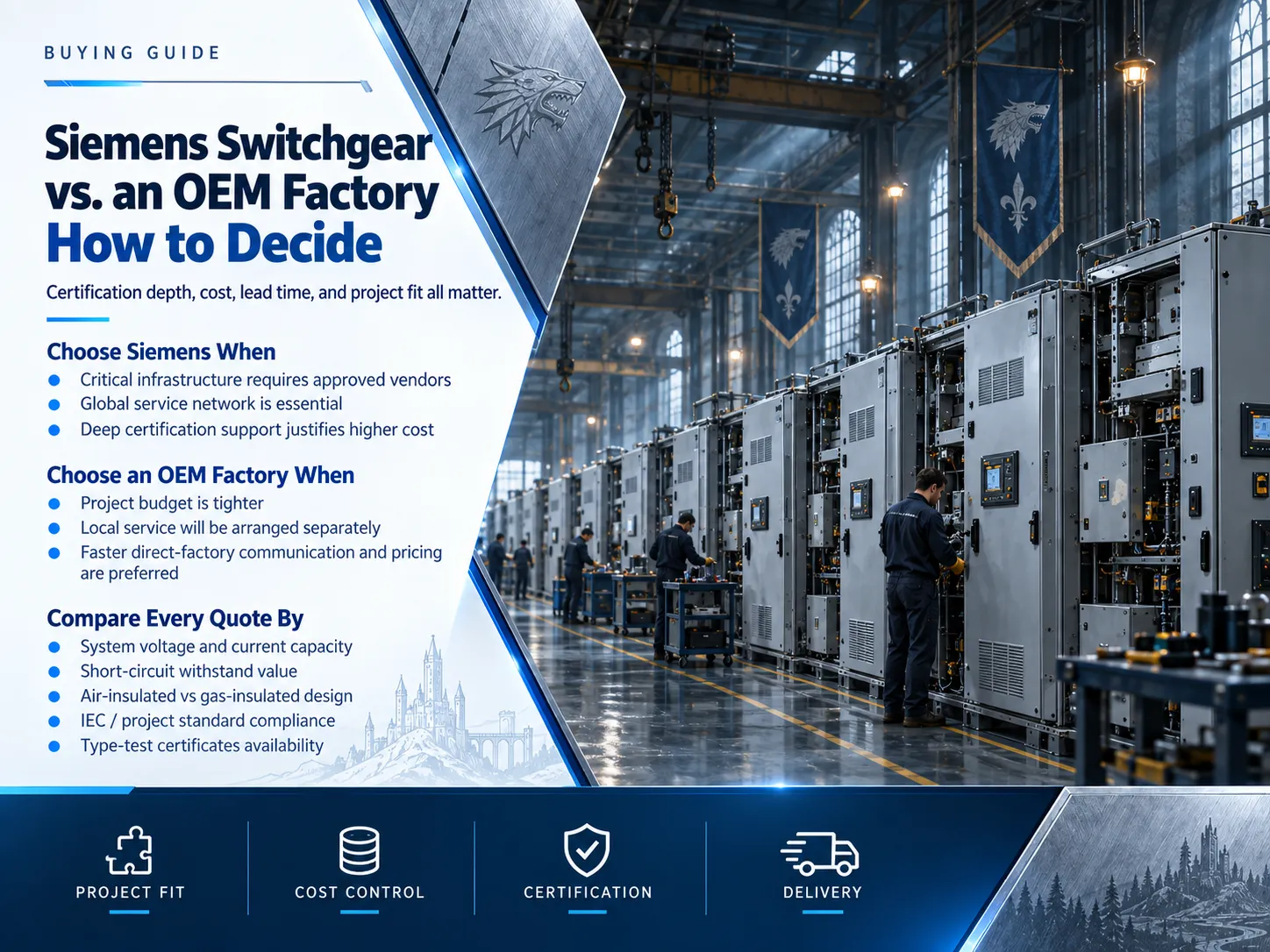
A disciplined approach, one can be safe whatever the result is. In the case of critical infrastructures with strict approved vendors, the depth of certification of Siemens switchgear and their global service network may justify their price. On the other hand, direct factory purchasing may provide acceptable results at a lower cost in cases of projects with lower budgets, or projects that will arrange local servicing separately regardless of the manufacturer.
Regardless of the conclusions, it is important to check each quote against the same criteria and verify first the system voltage or the current capacity and the short circuit withstand value, as these moments are the same for all vendors. Next, the insulation type must correspond to the construction site type: air insulation if the place allows, gas insulation when in a tight space in a dirty or humid environment. Then it must be verified which standard has been chosen for the project and whether the certificate for type tests is available from any vendor, regardless of whether it is a well-known brand or a switchgear factory.
Frequently Asked Questions
Is Subian Power affiliated with Siemens?
No. Subian Power is an independent Chinese OEM/ODM switchgear manufacturer and is not affiliated with, authorized by, or a supplier to Siemens. It manufactures its own switchgear and transformer lines and is presented here as a factory-direct alternative for buyers who are comparing options.
Can an OEM factory match Siemens switchgear on standards?
A capable factory builds to the same international benchmarks. When evaluating any Siemens switchgear alternatives, ask for type-test certificates against the relevant IEC standard, confirm the voltage, current, and short-circuit ratings, and verify the insulation medium. A reputable OEM will provide the same documentation package a premium brand would.
What switchgear does Subian manufacture?
Subian produces medium-voltage metal-clad switchgear (KYN28A-12), air- and gas-insulated ring main units (HXGN15-12 and XGN15-12), and low-voltage draw-out and distribution systems (GCS, MNS, and GGD), along with the vacuum circuit breakers used inside them. The full range is on the high and low voltage switchgear page.
Why choose an OEM factory over a premium brand?
The main reasons buyers cite are cost, customization, and lead time. Ordering directly from an OEM switchgear factory removes several layers of distribution margin, allows each panel to be tailored to the project, and often shortens delivery compared with imported premium equipment, without giving up compliance when the documentation checks out.
Work With Subian as Your OEM Switchgear Factory
Understanding Siemens switchgear is really about understanding your own project, its voltage and current needs, the standard it follows, the environment it will operate in, and the budget and schedule you have to meet. Siemens sets a high benchmark, and for some buyers that benchmark is exactly what they need. For many others, a factory-direct route delivers the same compliance and performance while protecting both budget and timeline.
As an OEM and ODM manufacturer of high and low voltage switchgear, transformers, and complete substation packages, Subian Power can review your single-line diagram, match the ratings and certifications your project requires, and provide a competitive quotation with clear lead times. Explore the full high and low voltage switchgear range, or contact the Subian Power engineering team today to discuss a tailored, cost-effective switchgear and substation solution for your next project.