


If you access any transformer data sheet that describes three-phase transformers, you will come across either Dyn11 or Ynd11. Some other transformer data sheets might use different designations, but they all refer to the vector group of transformers. This means that a delta connection (Δ) is employed for one side of the transformer while a wye connection (Y) is utilized for the other side. The delta-wye connection serves as the most popular transformer connection worldwide because it enables the transformer to perform two primary functions, which include increasing or decreasing voltage and creating a grounded neutral for the wye side.
Brief explanation: A delta-wye transformer is constructed in such a way that there are three primary windings connected in delta (without neutral) and three secondary connections (or windings) connected in wye (with a take off point on the wye) enabling both ways to transform voltage whilst providing grounded neutral in wye side. This type of connection is typically used for distribution purposes since it allows both voltage change and stable neutral (on wye) for single-phase types of loads as well as enforces blockage of triplen harmonics and zero-sequence currents from one side to another.
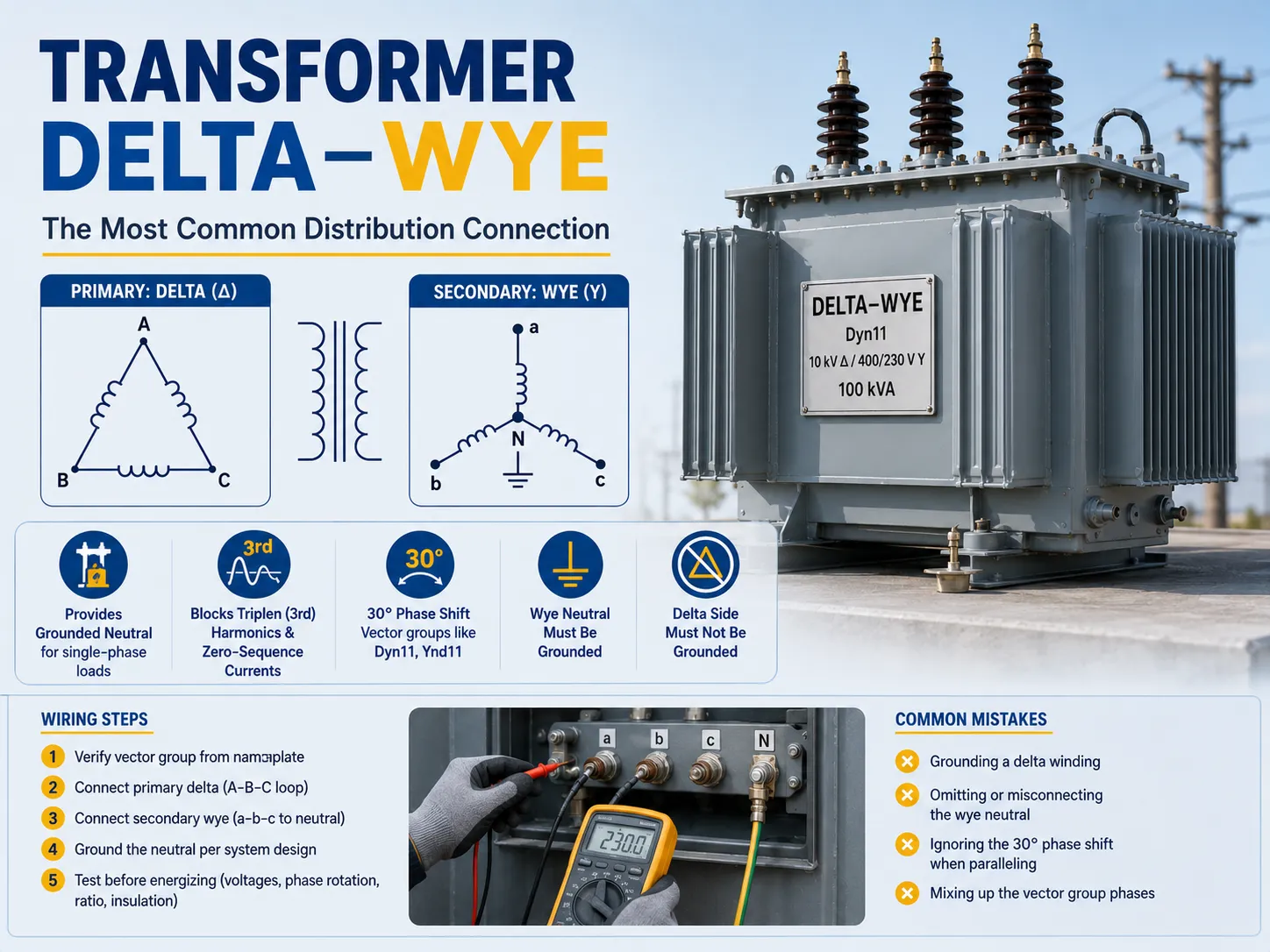
What Is a Delta-Wye Transformer?
A three-phase transformer consists of three primary and three secondary windings, and in each case, this arrangement allows for two different kinds of configurations. The first option is delta (Δ) connections, where the windings end up connecting together in a triangle shape (thus, it is electricall closed), completely avoiding the concept of a neutral point, and connecting the line terminals to the apexes of the triangle. The second option is the so-called wye (Y) connection type, where the common point (neutral) where the windings join connects to the terminals. In other words, the connection must come either via the delta configuration on the primary (often defined in terms of voltage) or via the delta-wye transformer configuration; that is Dyn.
The other possibility entails a wye primary with a delta secondary connection in situations such as generating stations where high voltage is generated or even industrial standard applications. The definition of the vector group is key knowledge; that means it outlines the types of wye windings in relation to the delta connections, which leads to the phase displacement between them thus one transformer type can be used across multiple systems.Our transformer vector groups guide explains the code system in full.
When Do You Need the Delta-Wye Connection?
You need a delta-wye connection in cases where three conditions are met: the transformation of three-phase power, the requirement of a neutral on one side, and the necessity of solving problems due to wye-wye connections. Common cases include:
- Medium Primary voltage distribution step-down to a four-wire low voltage system (400/230V-wye in Europe/Asia/Australia or 120/208V-wye in North America), which provides the neutral to supply single-phase loads.
- Industrial 480V to 120/208V (480V delta or wye shop supply feeding a delta-wye transformer unit that supplies 120/208V wye for convenience outlets, controls, and lighting).
- Generation (Ynd) where the wye generator’s stator is raised to a delta-connected high voltage supply, making use of the grounded neutral to regulate ground fault hazards.
- Harmonic isolation is made possible through using the delta winding to trap triplen harmonics within the system and preventing them from circulating back to the source.
If your application requires having a grounded neutral on one side — which most do, since that’s how you get the neutral for single-phase applications — delta-wye is typically the appropriate solution. If both sides need to be ungrounded or you need no neutral, a delta-delta may suffice — our delta-delta vs delta-wye comparison covers the alternatives.
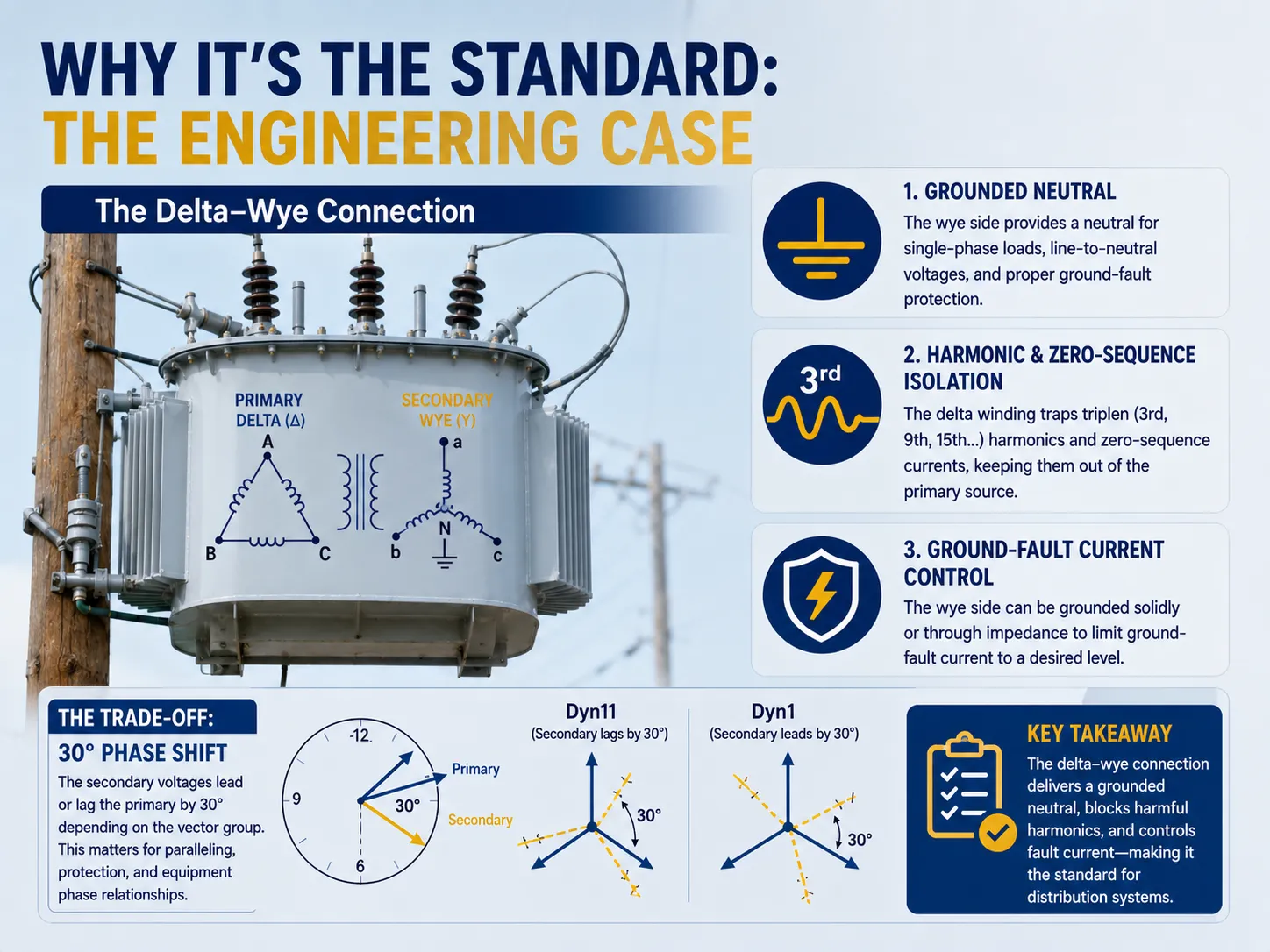
Why It’s the Standard: The Engineering Case
Three reasons justify the use of the wye-delta transformer connection:
- A grounded wye neutral is essential in a transformer that is either a two-phase lighting load, line-ground voltage overload, or provide sufficient ground-fault protection; the grounded neutral of the wye side offers that, whereas the delta-delta transformer is unable to do that due to lack of grounded neutral for the wye side.
- Isolation of harmonic and zero-sequence currents: the delta-wye transformer provides means for eliminating triplen harmonic and zero-sequence combinations through providing a circulating current path in the delta winding, thereby avoiding possible triplen harmonics heating effects that result from other configurations when a grounded wye transformer without a delta winding is employed.
- The wye side can be grounded in either an effective manner or through impedance, ensuring limit ground-fault current by protecting both the transformer and the entire system
The price one must pay for the advantages listed above is a phase shift of 30 degrees between the primary and secondary terminals, which varies depending on whether the vector group of the transformer calls for clockwise/ccw operation – i.e. Dyn11 or Dyn1. It has a considerable significance in paralleling operations, in protection relay adjustments, in conjunction with loads requiring set phase relationship to one another; hence the importance of the vector group mentioned in the nameplate and verified upon commissioning of the transformer.
Tools and Safety Before You Start
When it comes to delta-wye transformer wiring, working with high energy equipment means that you will need to follow stringent guidelines.
- Turn off the power to the transformer along with all circuits connected to it and lock it out until such time you can prove that it is safe to work from every terminal using a voltage meter.
- Personal protective equipment (PPE): you will need to wear arc-rated clothes, insulated gloves rated for the voltage you are dealing with, and face protection as the terminals of the transformer can cause very high voltage arcs.
- Tools: insulated screwdrivers and wrenches, a torque wrench for the terminal hardware, a phase rotation meter, a voltmeter (many categories available, so be careful), an insulation resistance tester, and a transformer turns ratio (TTR) tester if you have one available.
- Nameplate and drawings: you must have a nameplate indicating vector groups, tap settings, and connection diagrams from the manufacturer. Do not wire from memory or guesses.
- Qualified personnel only: this is an electrician’s job only; the following steps are for guidance only, and should you choose a non-licensed person to perform this work, you are subjecting yourself to great liability for any results.
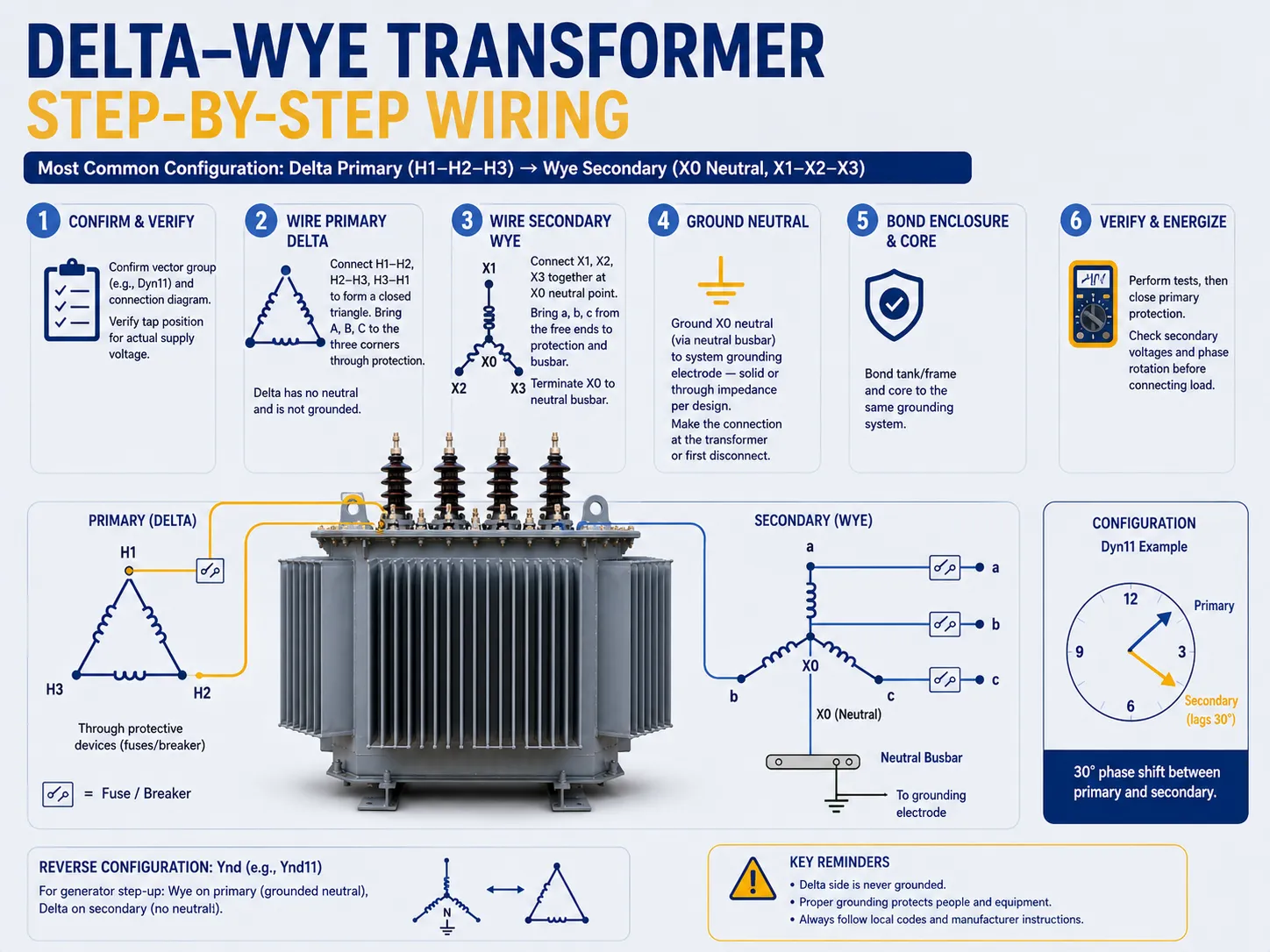
Step-by-Step Wiring
In the most representative situation of delta primary (H1-H2-H3), wye secondary (X0 neutral, X1-X2-X3):
- Check the vector group and connection circuit from the data sheet and plate of equipment (such as Dyn11) and also verify the tap position on the primary winding for the real voltage supply.
- Connect the primary delta: connect the ends of winding wires to create the closed delta such as H1 finish to H2 start, H2 finish to H3 start, H3 finish to H1 start, and connect three phase leads (A, B, C) to the three corners of the delta through protection equipment (fuses/breaker). The delta system does not have neutral and is not a grounded system.
- Connect the secondary in wye: connect all winding wires of X1, X2 and X3 at the neutral point X0, then take three leads (a, b, and c) from the open end for protection and busbar. Connect the X0 neutral ground to the neutral busbar.
- Ground the neutral according to the system design: connect X0 (through neutral busbar) to the system grounding electrode. The ground wire must be sized according to the code (and our transformer grounding basics article provides guidance on this); the connection is to be made at the transformer or the first disconnect and not to the load.
- Bonding of the enclosure and core: the bonding of tank/frame and core should be done on the same ground system.
- Energize and verify: perform the tests given below, close the primary protective devices and measure secondary voltage and phase rotation before the load connection.
Now, in the case of the reverse (Ynd, generator step-up) configuration, the roles will be reversed, where the wye will act as a primary neutral, which has to be grounded according to generator design, and the delta system remains under secondary configuration only.Our three-phase transformer range covers the standard configurations available off the shelf, with the vector-group details for utility step-down units in the distribution section of the catalog.
Testing and Verification
Before energization, perform the following tests. Once you have energized the unit for the first time, perform the tests again:
- Insulation Resistance: Take reading of primary-neutral, secondary-neutral and primary-secondary insulation resistances. Ensure that the records are matched with the minimum values prescribed by the manufacturer. If low value is encountered, action must be taken immediately to investigate into the matter before energizing the unit.
- Continuity & Polarity Test: Make sure that each winding is alive and no open corner exists, and at the same time wye neutral point is connected between all windings.
- Turns Ratio Test (TTR): Match the turns ratio with that stated on the nameplate of the transformer.
- Energization Test: Measure line-line and line-neutral voltages across the transformer on both sides of the transformer. On the wye side, the voltage should come out to be √3 times the voltage measured on the line neutral of the transformer. Also check if the neutral point is grounded; and also phase rotation for the transformers.
- Neutral Current Check: If a neutral current is being carried by the neutral, then it means there is an unbalanced load on the transformer. A properly designed wye transformer behaves correctly.
A structured acceptance test set — insulation, ratio, polarity, and energized checks — is part of any proper commissioning; our transformer testing guide lists the full suite and the pass criteria for each.
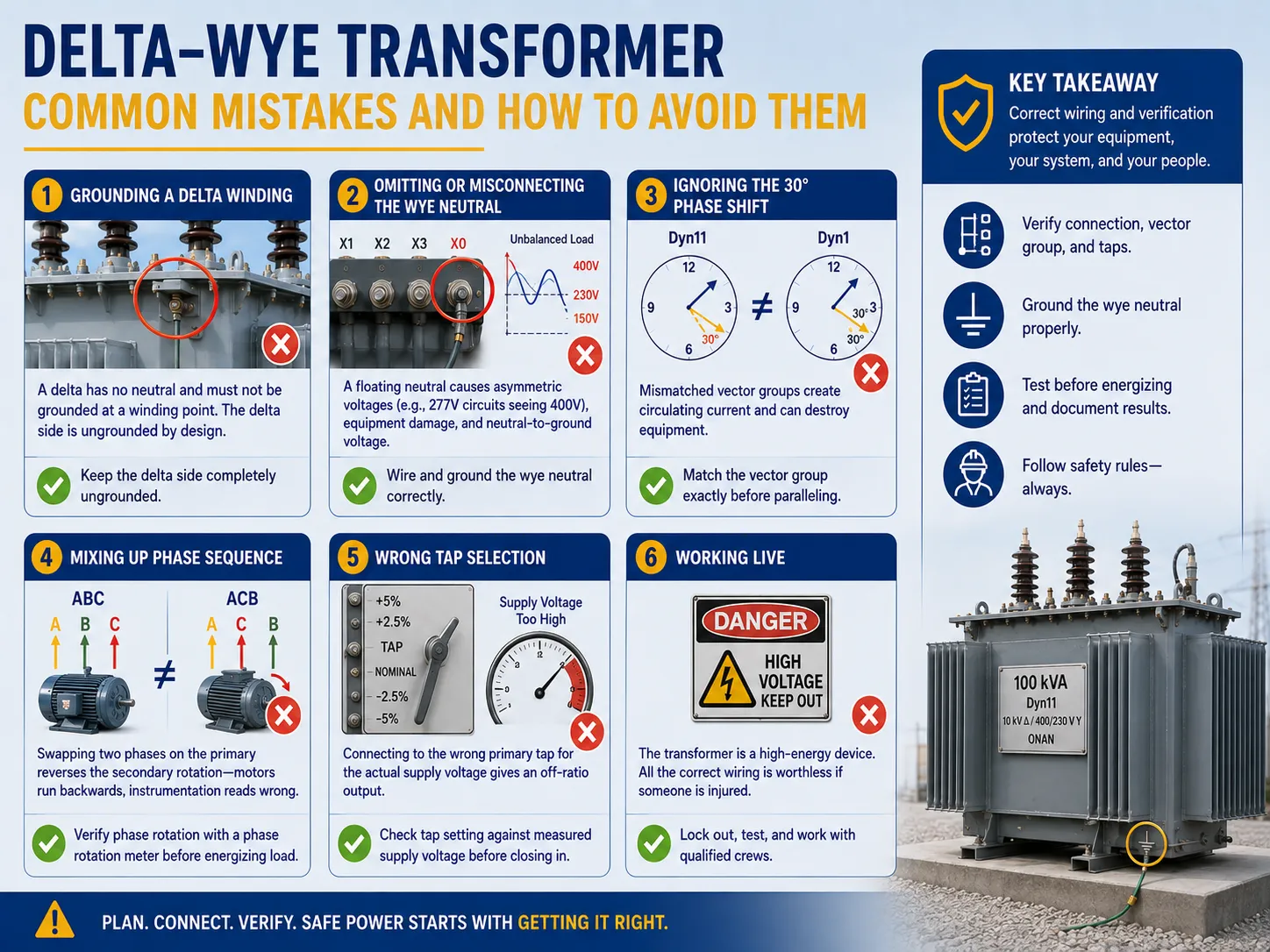
Common Mistakes and How to Avoid Them
- Grounding the Delta: A delta winding has no neutral point, and therefore should not be grounded at any winding point. Indeed, grounding one of the phases, or any tap connection on the winding results in an unintentional and potentially dangerous grounded system. The delta side is designed to be ungrounded.
- Neglecting the Wye’s Neutral or Misconnecting it: Most floating neutral conditions will result in unpredictable and abnormal voltages. This allows some of the equipment to become damaged and allows voltage levels on the neutral to ground to develop.
- Neglecting the 30 Degree Phase Shift: If two transformers are connected in parallel with different vector groups, severe circulating currents can occur and damage the transformers. Verify that the vector groups are compatible.
- Reversing Phase Sequence: If two of the phases on the primary are reversed, the secondary phase rotation will be reversed as well and all of the equipment connected to the transformer will operate in a wrong manner. Always check the phase rotation.
- Selecting the Wrong Tap: Connecting the wrong tap on the primary side of the transformer will also result in an erroneous output. Always make sure you have selected the correct primary tap setting before turning on the transformer.
- Working Live: Since the transformer is a high-energy device, it will not matter if the system is wired correctly if someone gets hurt while doing it. Always remember to lock-out, tag-out, and work with qualified personnel.
Frequently Asked Questions
What does a Delta Wye transformer do?
A Delta-Wye transformer transfers three-phase voltage from a delta configuration (with no neutral) to a wye configuration (wye configuration provides a neutral that is grounded and stable), which serves the purpose of converting voltages of either kind to the other as well as maintain a stable neutral for single-phase loads. It is used for electricity distribution purposes, whereby, for example, is used for voltage conversion from a delta of 10kV to 400 or 230 V wye. As mentioned earlier that Delta-Wye transformers serve to isolate triplen harmonics or zero-sequence current.
How do you tell if 480 is delta or wye?
Determine the voltage. In the case of 480V Delta system, there is no neutral system in the same way whereby the line-to-line voltage equals to 480V. On the other hand, 480 V Wye system uses a neutral and as such the voltage is determined by dividing 480 with the square root of three giving 277V from each phase to the neutral. You can check for the presence of neutral conductor and measure the voltage between the line and the neutral voltage; if the value determined is 277V, the system is Wye, and if the neutral is nonexistent, then the Delta system is in use.
Is 240V Wye or Delta?
In North America, 240V three-phase systems normally use Delta configuration unless the Wye system is being used for commercial applications. It comprises either the Delta format of 240V or center-tap Delta of input voltage of 240/120 V. However, the existence of Delta is dependent upon the nameplate. If there is any neutral present, then it is Wye.
How do you wire a delta wye transformer?
To wire a Delta-Wye transformer, use 3-phase wires connected to the transformers used to ensure that all points connected with each transformer have a neutral present.
References
- IEEE C57 — Transformer standards (vector groups, testing, application)
- NFPA 70 — National Electrical Code (transformer installation, grounding)
- OSHA 1910.269 — Electric power generation, transmission, and distribution safety
- IEC 60076 — Power transformers (vector groups, ratings)
- ANSI — Transformer standards and application guides
Conclusion
The delta-wye transformer serves as the common mode of electrical connection because it provides the solution to the two issues every distribution network faces. It switches voltage and creates a grounded neutral while the delta absorbs the harmonics and zero-sequence current before damage to the source can occur. There are six steps to making this connection correctly: determine the vector group, create a delta loop that isn’t grounded, connect the neutral of the wye, ground that neutral, check with insulation, ratios, and rotation testing, and lastly do not forget about the 30° phase shift for paralleling. If you perform all six steps, the Dyn11 on the nameplate will become a transformer that can supply service to a building, facility, or community for years taking advantage of its simple and reliable delta-wye connectivity.