


Ein Schaltschrankbauer erhält einen Transformator mit einer Leistung von 15 kVA. Der Transformator arbeitet bei 480 Volt und hat einen einphasigen Anschluss, wird jedoch nach der Installation und der Platzierung vor einem programmierbaren Logikcontroller und vier Servoantrieben für sechs lange Monate zu einem nutzlosen Gerät. Nach einem halben Jahr führt jemand eine Analyse mit einem Zangenmessgerät durch und stellt fest, dass 11 Ampere dreifache harmonische Ströme am Neutralleiter vorhanden sind.
Der Fehler lag nicht am Transformator, da er für allgemeine Anwendungen ausgewählt wurde. Dies ist somit das Problem, das am häufigsten im Bereich der industriellen Automatisierung auftritt.
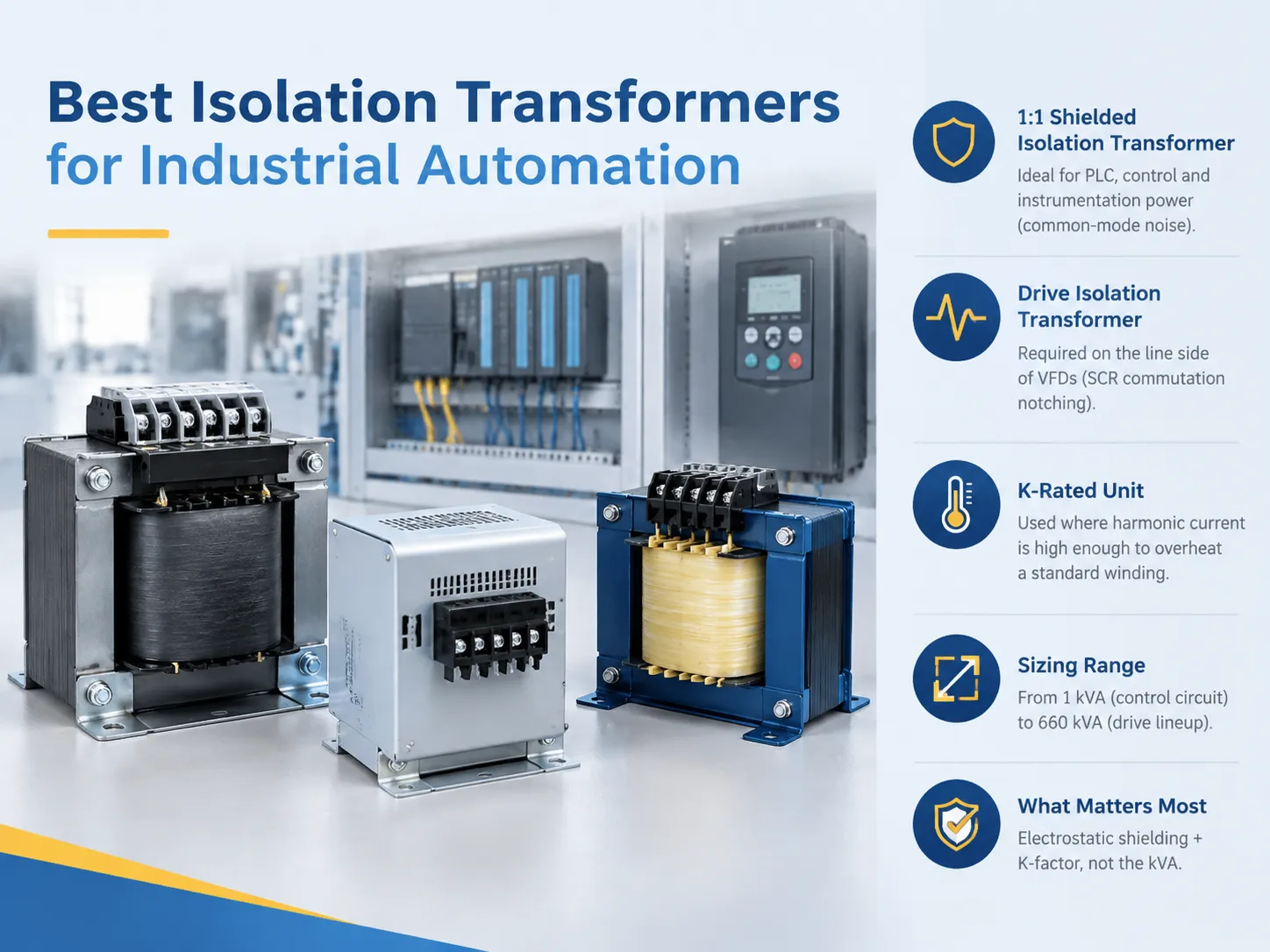
Der richtige Isolationstransformator für die industrielle Automatisierung hängt von der Last und nicht von der Spannung ab. SPS, Steuerungs- und Instrumentierungsstrom benötigen einen 1:1 abgeschirmten Isolationstransformator (von Hammond Power Solutions, SolaHD, Acme und Rex Power Magnetics), während ein Antriebsisolierungstransformator auf der Leitungsseite von VFDs verwendet werden muss, aufgrund der Kerbwirkung, die durch den SCR-Kommutierungsprozess verursacht wird. Ein K-bewerteter Isolationstransformator ist notwendig, wenn harmonische Ströme stark genug sind, um eine Überhitzung der regulären Wicklungen zu verursachen. Die Leistung reicht von 1 kVA für Steuerkreise bis zu 660 kVA für Antriebe; die wichtigsten Spezifikationen sind elektrostatische Abschirmung und K-Bewertungsfaktoren, nicht die kVA-Bewertung.
Was ein Isolationstransformator tatsächlich tut
Jeder Transformator bietet galvanische Isolation. Mit zwei Wicklungen, die einen magnetischen Kern teilen und ohne metallischen Pfad zwischen Primär- und Sekundärseite, sind Absenkungsverteilungstransformatoren bereits isolierende Geräte, von denen Käufer glauben, dass sie sie erwerben.
Isolationstransformatoren werden so bezeichnet, weil sie eine elektrostatische Abschirmung haben, die aus Kupfer- oder Aluminiumfolie besteht und zwischen den Wicklungen angebracht ist. Wäre diese Abschirmung nicht vorhanden, würde die zwischen den Wicklungen verfügbare Kapazität sehr hochfrequente Störungen über die Barriere hinweg übertragen. Die im Strom vorhandenen Gleichtakttransienten würden in derselben Form auf der Sekundärseite erscheinen, wie sie auf die Primärseite kamen.
Die Abschirmung verhindert dies, indem sie die Energie zur sicheren Entsorgung in die Erde ableitet. Sie bietet keine Filterung von differentiellen Störungen, reguliert die Spannung nicht und wird den Blitzstoß nicht beseitigen. Man könnte deutlich sehen, dass es drei verschiedene Geräte gibt, aber der Markt bezeichnet sie alle als ein Produkt.
Eine genaue Beschreibung eines solchen abgeschirmten Isolationstransformators wäre: ein Transformator, der die Spannung und Leistung dessen, was er durchlässt, nicht verändert, während er Gleichtaktgeräusche über einer Frequenz von etwa 1 kHz filtert.
Die vier Aufgaben, die verwechselt werden
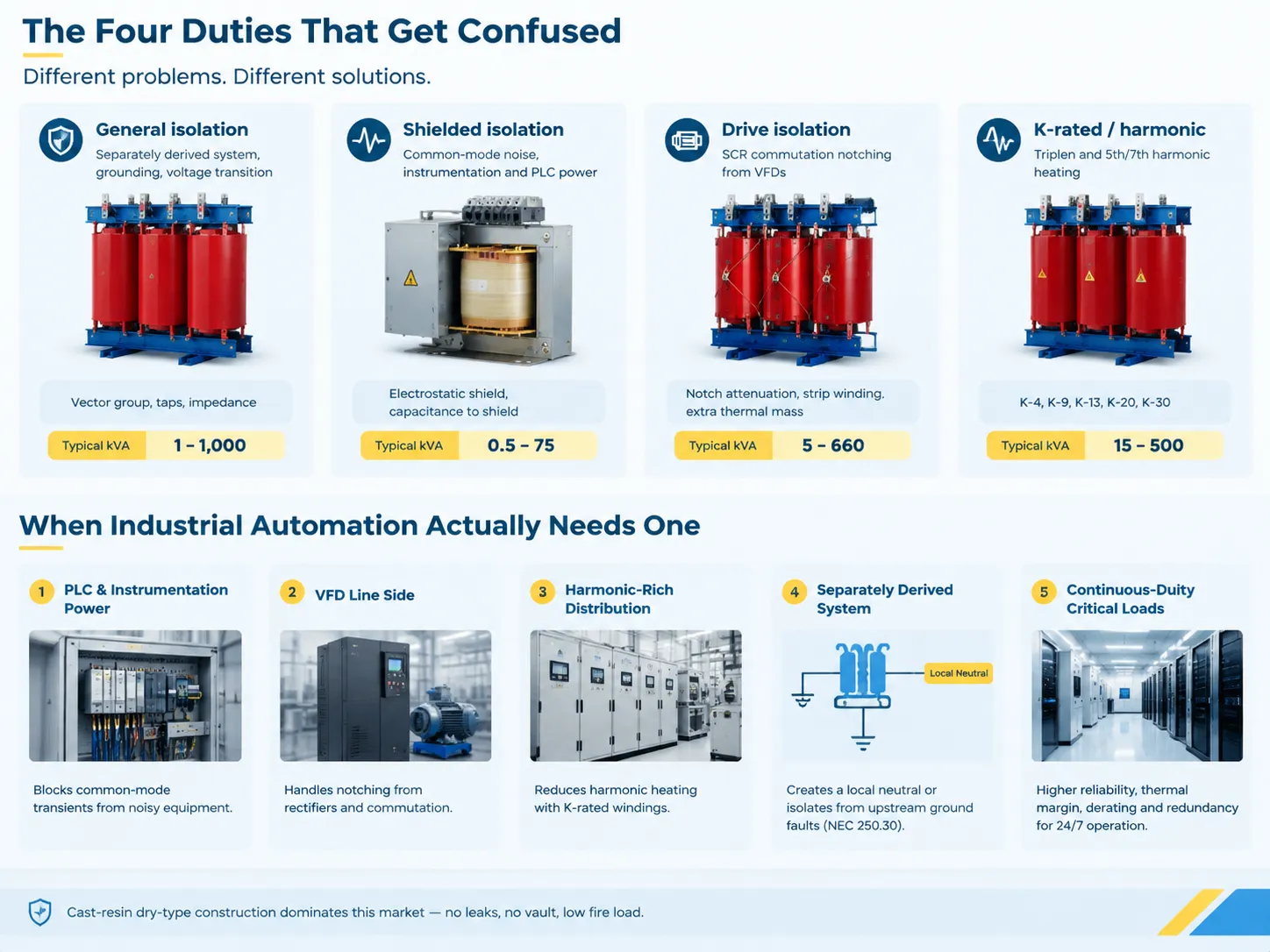
| Betrieb | Teil, das es löst | Schlüssel-Spezifikation | Typische kVA |
|---|---|---|---|
| Allgemeine Isolation | Separat abgeleitetes System, Erdung, Spannungsübergang | Vektorguppe, Abzapfungen, Impedanz | 1–1,000 |
| Abgeschirmte Isolation | Gleichtaktgeräusche, Instrumentierungs- und SPS-Strom | Elektrostatische Abschirmung, Kapazität zur Abschirmung | 0.5–75 |
| Antriebsisolierung | SCR-Kommutierungs-Kerbung von VFDs | Kerbabschwächung, Streifenwicklung, zusätzliche thermische Masse | 5–660 |
| K-rated / harmonisch | Triplen- und 5. / 7. harmonische Erwärmung | K-4, K-9, K-13, K-20, K-30 | 15–500 |
Von den vier angegebenen Methoden sind zwei praktisch jedes Mal gleichwertig. Ein isolierter Transformator muss ebenfalls K-rated sein, da seine Aufgabe darin besteht, das Notching als System zu eliminieren, und ein VFD-System erzeugt sowohl ursprüngliches Notching als auch harmonische Ströme. Der Kauf eines K-rated Transformators anstelle eines, der DIT (fortschrittliche Technologie für Isolationstransformatoren) hat, gibt Ihnen thermische Last ohne Notching-Korrektur. Im Gegensatz dazu macht der Erwerb eines DIT ohne Berücksichtigung des K-Faktors die Lösung mit dem Eintauchtransformator verfügbar, aber die Wicklung wird bei übermäßigen Temperaturen betrieben.
Gießharz- und Trockenbauweisen setzen sich in diesem speziellen Fall aus einem einfachen Grund durch: Es gibt keine Leckagen, keine Gewölbe, und die Verbrennungslast ist so gering, dass von den Versicherern keine Probleme aufgeworfen werden. Die Konstruktionsunterschiede zwischen Gießharzdesigns und den Alternativen sind in diesem Vergleich von SCB13-Einheiten gegen internationale Gießharztransformatoren, was wichtig ist, wenn ein Projekt importierte Antriebe mit inländischen Verteilungseinrichtungen mischt.
Wenn industrielle Automatisierung tatsächlich einen benötigt
Es gibt fünf Situationen, die Ausgaben erfordern. In allen anderen Fällen wird die Angelegenheit nicht diskutiert.
- Strom- und PLC-Instrumentierung in einer Anlage mit viel Lärm. Der 480V-120V-Isolationstransformator steht vor der Steuerstromversorgung, die in der Lage ist, alle gemeinsamen Modusstörungen, die durch Schweißmaschinen, Kontaktoren und andere Antriebe verursacht werden, zu eliminieren. Dies ist in der Praxis der Fall und funktioniert, es sei denn, der Filter hat einen guten Erdungsanschluss und die sekundären Drähte sind kurz.
- Die Linienseite des VFD. Der Betrieb eines sechsphasigen Motors führt dazu, dass zwei der Phasen bei jeder Kommutation kurzgeschlossen werden, was zur Bildung der genotteten Spannungen führt, die den vorgelagerten Transformator mechanisch und thermisch belasten. Die Anwendung des Transformators wurde so durchgeführt, dass die Verwendung von Streifenleitern die Reduzierung von Wirbelstromverlusten und die gute Heizreserve ermöglicht.
- Verteilung harmonischer Ströme. Wenn der Transformator die Gruppen von Antrieben, UPS-Gleichrichtern und LED-Treibern speist, erwärmen die resultierenden harmonischen Ströme die Wicklung viel höher als erwartet, bezogen auf die kVA-Bewertung des Transformators. Im Gegensatz zum K-rated Transformator kann die klassische Technologie bis zu einem gewissen Grad ohne Überdimensionierung arbeiten.
- Beginnen Sie, sich auf das abgeleitete System zu beziehen. Falls die Anlage einen lokalen Neutralpunkt oder eine andere Erdung benötigt oder den Erdschlussweg unterbrechen möchte, sollte der Transformator verwendet werden, um dieses Ziel gemäß NEC 250.30 zu erreichen.
- Kritische Geräte mit kontinuierlichem Betrieb versorgen. Die Stromversorgung rund um Datenräume, Reinräume und andere Geräte ist von größter Bedeutung für jedes Unternehmen. Wie das in der Praxis aussieht, einschließlich der Abwertung und Redundanzentscheidungen, wird in diesem Blick auf hochzuverlässige Trockenbau-Transformatoren für Rechenzentren behandelt., und die Überlegungen übertragen sich direkt auf eine Prozesslinie, die 8.000 Stunden im Jahr läuft.
Dimensionierung: Die Arithmetik, die die meisten Angebote falsch machen
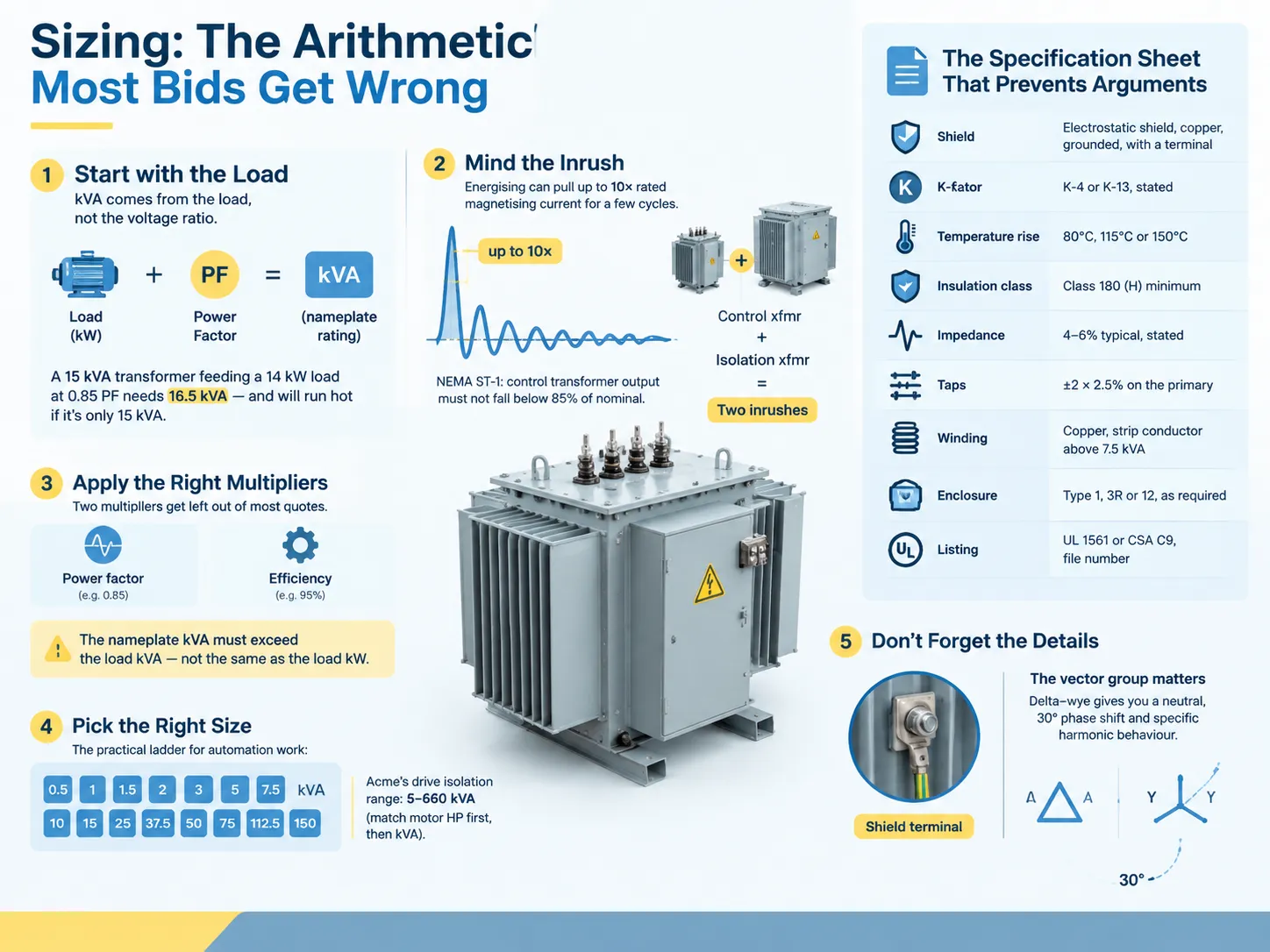
Die Last bestimmt kVA, nicht das Verhältnis der Spannung. Bestimmen Sie zunächst die gesamte angeschlossene Last, berechnen Sie alle Diversitäten, die gerechtfertigt werden können, und wählen Sie die nächstgrößere Standardgröße. In einem 1:1 Transformator überträgt der Transformator nicht die gleiche kVA, da die Spannungsverhältnisse gleich sind. Er überträgt einfach die berechnete kVA und hält das Stromniveau an beiden Primär- und Sekundäranschlüssen gleich, da die Spannung ebenfalls gleich sein wird.
Es fehlen zwei Korrekturfaktoren in den meisten Angeboten.
Effizienz. Wenn beispielsweise ein 15 kVA Transformator an eine 14 kW Last mit einem Leistungsfaktor von 0,85 angeschlossen ist, könnte er mit 16,5 kVA bewertet sein und mit Überhitzung betrieben werden. Der kVA-Wert auf dem Typenschild sollte höher sein als der kVA-Wert der Last, der sich vom kW-Wert der Last unterscheiden kann.
Einschaltstrom. Wenn der Transformator unter Spannung gesetzt wird, verbraucht er Magnetisierungsstrom, der bis zu 10-mal höher als der Nennwert für mehrere Zyklen sein kann. Daher sollte gemäß dem NEMA ST-1 Standard die Ausgangsspannung des Steuertransformators während des Einschaltvorgangs nicht weniger als 85% des Nennwerts betragen. Aus diesem Grund sind Steuertransformatoren so ausgelegt, dass sie unter dem Flussniveau von Verteilungstransformatoren arbeiten. Wenn ein Steuertransformator von einem Isoliertransformator gespeist wird, würde es erneut einen Einschaltstrom geben, und der vorgelagerte Leistungsschalter wird dies erkennen.
Die Standardtabelle für Automatisierungsanwendungen hat Werte von 0,5, 1, 1,5, 2, 3, 5, 7,5, 10, 15, 25, 37,5, 50, 75, 112,5, 150 kVA. Acme produziert eine Palette von 5 kVA bis 660 kVA, da in den meisten Fällen der DIT-Prozess die Übereinstimmung zwischen der verfügbaren Nennleistung und den installierten Motoren herstellt, sodass die Auswahltabellen entsprechend HP und kVA angeordnet sind.
Das Datenblatt, das Streitigkeiten verhindert
| Einzelposten | Schreiben Sie dies | Warum es wichtig ist |
|---|---|---|
| Shield | Electrostatic shield, copper, grounded, brought to a terminal | Without a terminal you cannot verify the bond |
| K-Faktor | K-4 or K-13, stated | Unstated means K-1 by default |
| Temperaturanstieg | 80°C, 115°C or 150°C | 150°C is smaller and shorter-lived |
| Isolierklasse | Class 180 (H) minimum | Margin against harmonic heating |
| Impedanz | 4–6% typical, stated | Sets downstream fault current |
| Taps | ±2 × 2.5% on the primary | Corrects a supply running high or low |
| Wickeln | Copper, strip conductor above 7.5 kVA | Lower eddy loss, better short-circuit strength |
| Gehäuse | Type 1, 3R or 12, as the location requires | Washdown and outdoor areas are not Type 1 |
| Listing | UL 1561 or CSA C9, file number | Inspectors ask, and so do insurers |
Most commonly, the shield terminal is disregarded. Even though a shield that has been bonded to the core as well as the core which has merged into the enclosure can carry current, it is impossible to measure the terminal before taking it apart which is often not done by many when assembling the machinery.
The vector group also deserves thorough investigation. For instance, a delta-wye transformer used to produce a separately derived system will give you neutral, 30-degree phase shift, and define the way harmonic behaviour works based on the mechanics of the circuit. This explanation of the delta–wye transformer and how it works covers the part that matters at commissioning rather than in theory.
Brands and Product Families Worth Shortlisting
In North America, four names stand out clearly. However, one is actually an established specialist rather than a catalog brand.
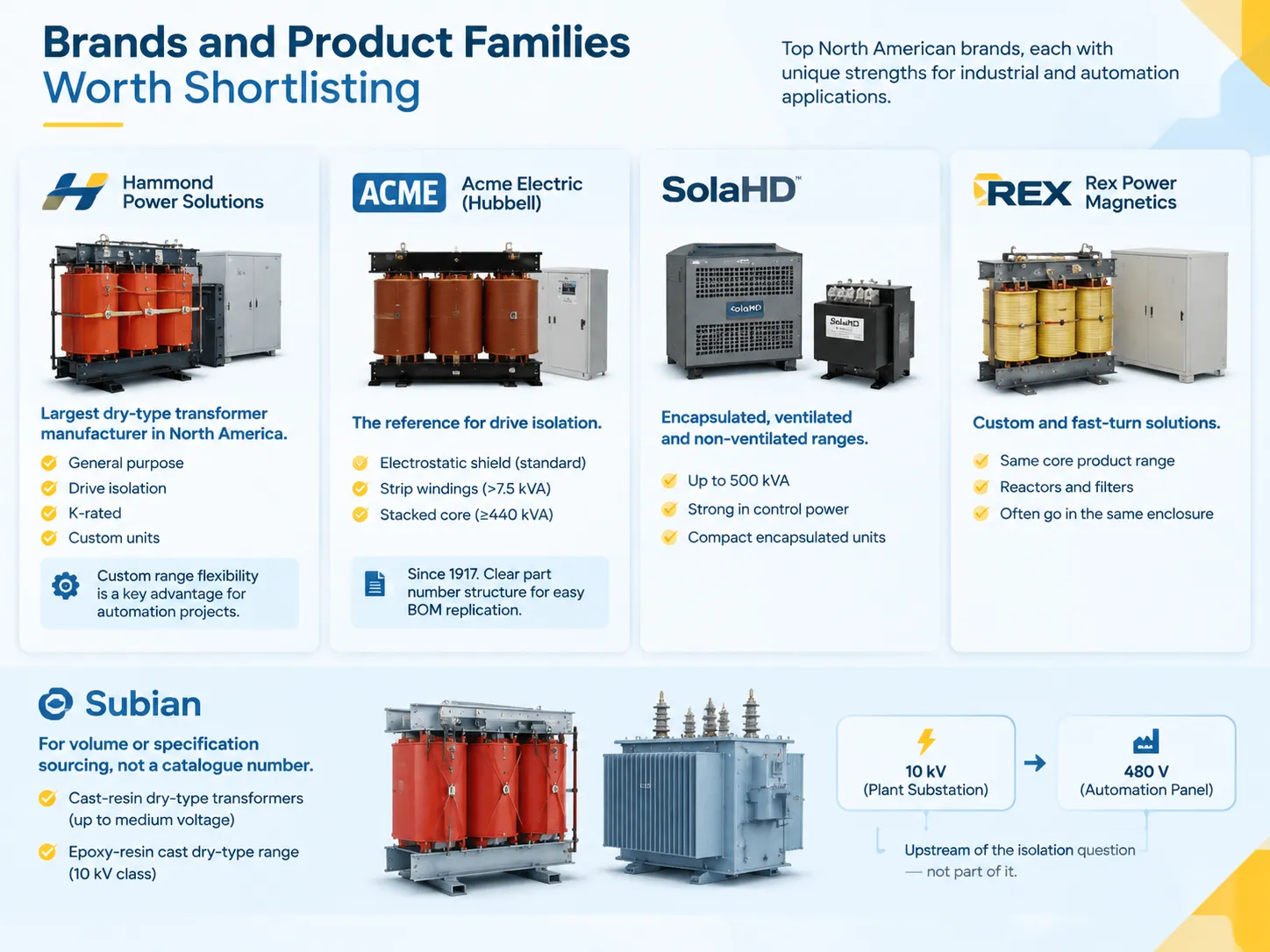
- Hammond Power Solutions, which happens to be the biggest dry-type transformer producer in North America, is known for typical transformers such as general-purpose transformers, drive isolation transformers, K-rates transformers, and customized transformers. The company’s main advantage in automation is the ability to provide a comprehensive range of customized transformers, which is necessary when a manufacturer requires 575 V input and 480 V output in a special enclosure.
- Acme Electric (Hubbell) is the main brand in terms of drive isolation. The electrostatic shield is a standard quality of the DIT series and is not an option. All transformers of above 7.5 kVA contain strip windings, whereas the ones of 440 kVA and more do use a stacked core. The company has been working on the production of such transformers since the year of 1917.
- SolaHD is a competitor of the same type of transformer. However, their product is encased and ventilated, with the non-ventilated one included in this group of products. However, in terms of control power units, their encapsulated equipment is much more powerful.
- Rex Power Magnetics has entered the same market, however, the company is known for its customized solutions and quick delivery, as well as reactors and filters that are commonly included in the same enclosure.
For buyers sourcing at volume or to a specification instead of a catalogue number, the manufacturer side looks different. Subian builds cast-resin dry-type transformers up to medium voltage, and the epoxy-resin cast dry-type range covers the 10 kV class that feeds a plant substation before anything reaches a 480 V automation panel. That is upstream of the isolation question, not part of it, and knowing where the boundary sits stops the wrong enquiry going to the wrong supplier.
Installation Details That Decide Whether It Works
If a shielded isolation transformer is mounted incorrectly, it becomes ineffective because of the unshielded version’s characteristics, and the issues involved are always the same.
Long secondary leads. Noise is induced into each meter-long section of the conductor making it possible to make use of the transformer shield only for what takes place inside the transformer. Place the transformer close enough to the load, make the secondary lines as short as possible, and do not keep them parallel to the power cables for 10 meters.
Ground loops through the shield. On the one hand, the shield needs to be grounded in one area, which means that one should not do it at both ends, otherwise, a loop antenna is created around noise. The shield must be connected to the panel not through painted metal but through a conductive lead.
Then the usual electrical checks. Overcurrent protection on both primary and secondary, bonding jumper on the secondary if the transformer creates a separately derived system and the full commissioning set including the insulation resistance check, turns ratio check, polarity check, and load test before handing it over to the customer. The sequence and acceptance values are set out in this guide to testing a transformer before energisation, and skipping the ratio check is how a reversed winding reaches a live PLC.
Mistakes That Show Up in Commissioning
- Ordering a 1:1 device when a step-down transformer is required. A 480 to 120 volt control supply is meant to perform step-down operations with the benefit of isolation; it is certainly not a 1:1 transformer. Customers ordering a 1:1 transformer along with a separate 120 V power supply would end up paying more and taking up more panel space for achieving the exact same goal.
- Assuming that the shield takes care of earth loops. It does remove common mode noise, but does not tackle the issue of the difference between two ground references.
- Disregarding sounds. A transformer installed outside the control room wall, creating 55 dB noise, becomes a ground for complaints. Core construction and isolation in mounting are given a lot of attention, but placing the unit in the corridor is no way to design it.
- Ignoring the heat. A transformer with 15 kVA power rating and 97% efficiency generates about 460 W in the enclosure. Enclosing it in the sealed cabinet based only on drive losses will cause the equipment to run 15°C above expected temperatures.
FAQ
Do I need a 1:1 isolation transformer or a shielded step-down?
When the load voltage is different, a stepdown unit with a shield is needed instead of a 1:1 unit. If the load voltage is already the same as the supply voltage and the problem is common mode noise, the 1:1 shielded unit is the right choice. The term 1:1 represents the ratio of the unit and not its noise characteristics and the shield works for noise suppression.
Does an isolation transformer protect against power surges?
In a way, yes. The inductance lessens sharp voltage spikes, and the shield prevents noise interference but does not provide surge protection and, therefore, has no UL 1449 classification; surge protection devices are found at the point of entrance to the service, as well as in the panel of the building.
K-rated or oversized: which is better for harmonic loads?
The cleaner answer is K-rated. A K-13 unit fulfills the necessity to transport the harmonic current while maintaining the temperature rise below the rated limit. When a K-rated unit is unavailable in the required size as well as lead time, the solution is oversizing by a factor of 1.5 to 2 times without any effect on the performance but with an impact on the panel space for the gear.
Can I bond the neutral on the secondary?
When it comes to transformers that are separately derived systems, NEC 250.30 provides guidance; there must be a system bonding jumper connecting the secondary neutral to the equipment grounding conductor, either at the transformer or at the first disconnecting means, but not at both locations. In cases when the transformer is not a separately derived system, the neutral will not be bonded at the transformer. Failing to understand this can lead to the creation of a parallel ground path and an un-clearing ground fault.
Referenzen
- Hammond Power Solutions — Dry-Type Transformer Catalogue
- Hubbell — Acme Electric Drive Isolation Transformers
- SolaHD (Emerson) — Power Quality and Control Transformers
- Rex Power Magnetics — Dry-Type Transformers and Reactors
- NFPA 70 — National Electrical Code, Articles 250 and 450
Fazit
The best isolation transformer for an automation panel is not necessarily the most costly. Rather, it is the one that has characteristics matching the load: shielded from noise, drive-rated for notching, K-rated for harmonics, and sized from kVA, rather than voltage ratios.
Just four lines of specification will determine whether a certain unit does anything useful at all. First is a shield with a terminal to measure. Second is that the K factor is stated. Third is that the temperature rise is stated. Finally is the proximity of the mounting site to the load so that any potential for malfunction through design failure is minimized.