


In Nigeria wurde ein Beschaffungsingenieur, der für ein Versorgungsunternehmen arbeitet, über eine neue Richtlinie der chinesischen Regierung informiert, die Tausende von veralteten Verteilungstransformatoren vom Markt nimmt. Das Versorgungsunternehmen des Ingenieurs betreibt noch mehrere Einheiten des S7, die in den 1980er Jahren produziert wurden, während das Unternehmen die Verwendung von generalüberholten Transformatoren aus dem Ausland in Betracht zieht und wissen möchte, ob die auf dem Markt sichtbaren S7-Marken einen Kauf wert sind oder potenziell problematisch sein könnten.
In diesem Artikel werde ich erläutern, wie China S7 und ältere Verteilungstransformatoren ausgemustert hat, warum eine solche Richtlinie eingeführt wurde, was die Nachrichten für Kunden bedeuten würden, die neue und gebrauchte Transformatoren kaufen, und schließlich, wie man Verlustwerte, Effizienzklassen und Preissignale in der Branche jetzt versteht.
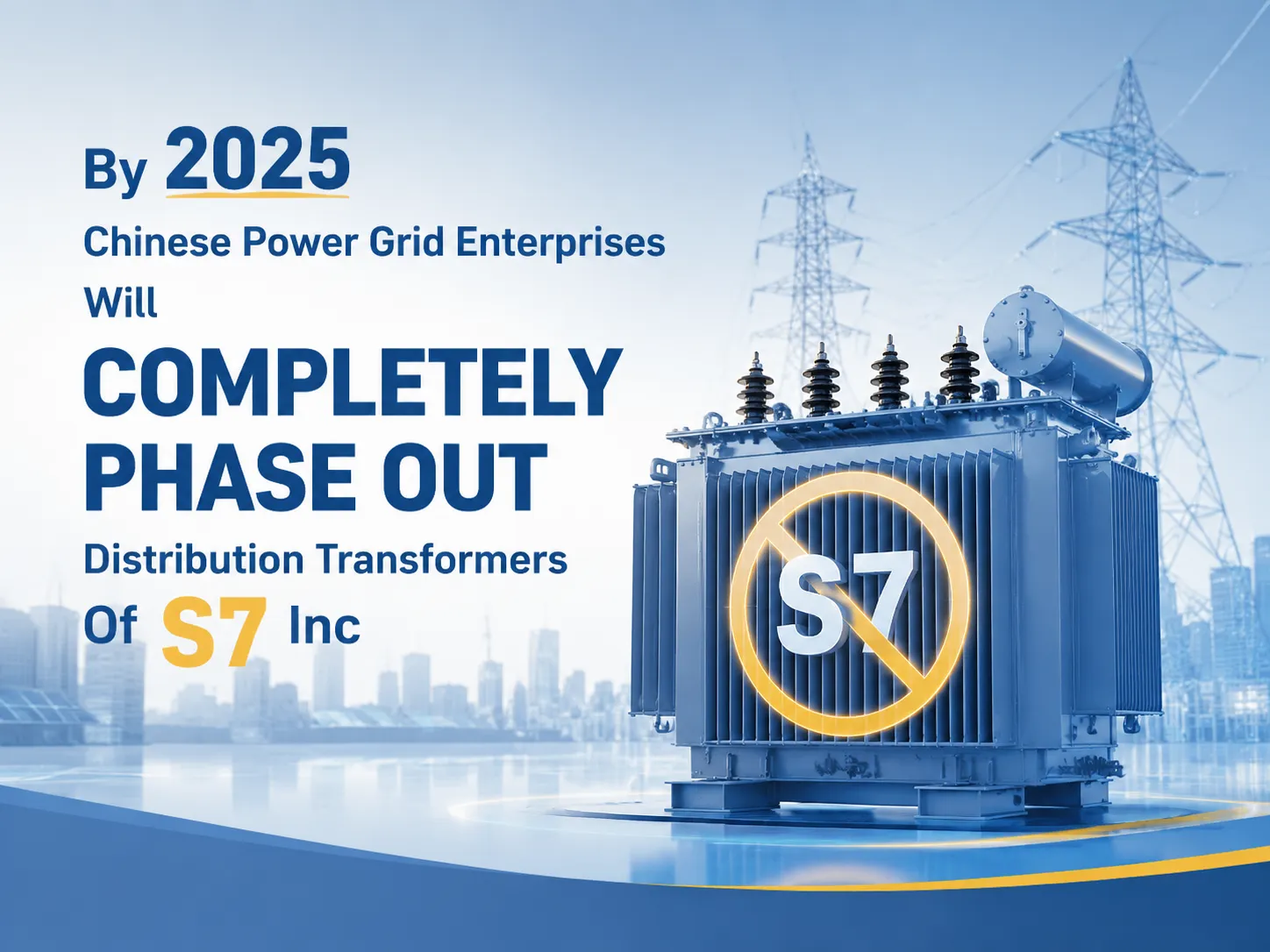
China hat seine Richtlinie zur energieeffizienten Transformatoren durch die Einführung des “Transformator-Energieeffizienz-Verbesserungsplans (2015–2020)” und eines neuen Bewertungsstandards (GB 20052) formalisiert, der vorschrieb, dass S7-Klasse-Transformatoren – die nach dem alten S7-Design gebaut wurden und von Design aus hohe Leerlaufverluste haben – ausgemustert werden, da sie 1–2% der Energie verschwenden, die sie während ihrer gesamten Nutzungsdauer leiten. Der Plan sah vor, dass die chinesischen Versorgungsunternehmen bestehende S7/S8-Klasse-Transformatoren (und später auch S9-Klasse-Transformatoren) durch moderne energieeffiziente Modelle S11, S13 oder S15 ersetzen, die die Leerlaufverluste um 30–60% reduzieren würden.
Der Hintergrund: Warum China S7-Transformatoren ausgemustert hat
Mit dem schnellsten Wachstum unter allen Stromnetzen in der Geschichte hatte China eine erhebliche Anzahl von Verteilungstransformatoren, die in den 1980er und 1990er Jahren nach dem S7-Modell entworfen wurden. Obwohl sie damals kostengünstig waren, wies die S7-Technologie im Vergleich zu modernen Standards ein relativ hohes Maß an Leerlauf (Eisen-) Verlusten auf. Da Verteilungstransformatoren fast ständig während des gesamten Betriebsjahres von 8.760 Stunden laufen, treten die Eisenverluste kontinuierlich auf, unabhängig von der vom Transformator bereitgestellten Leistung.
Forschungen, die in China durchgeführt wurden, besagten, dass die S7-Serie eine erhebliche Menge an Elektrizität im Land verbrauchte. Laut den Berechnungen der Nationalen Entwicklungs- und Reformkommission (NDRC) und des Ministeriums für Industrie könnte der Austausch aller Transformatoren gegen neue Modelle dem Land ermöglichen, jährlich etwa 25-40 TWh Energie zu sparen, was der jährlichen Stromproduktion vieler großer Kraftwerke entspricht. Somit wird der gesamte Prozess nicht nur zu einer wirtschaftlichen, sondern auch zu einer Maßnahme zur Energiesicherheit.
Im Jahr 2015 löste die Einführung des “Transformationsverbesserungsplans” den massenhaften Rückzugsprozess aus, bei dem Organisationen verpflichtet wurden, ältere Transformatorenmodelle, einschließlich der S9-Typen, in Bereichen mit hohen Transformatorenergieverlusten auszusondern. Infolgedessen wurden bis zu Beginn der 2020er Jahre nahezu alle S7-Einheiten aus dem Stromsystem des Landes zurückgezogen, wobei nur wenige Einheiten im Einsatz blieben.
Der Zeitplan und die Abdeckung der Richtlinien
Der Ausstieg war kein einmaliger nächtlicher Erlass; es war eine Abfolge von eskalierenden Vorgaben. Die wichtigsten Meilensteine:
| Jahr | Richtlinie / Meilenstein | Umfang |
|---|---|---|
| 1998 | S9 als Ersatz für S7 eingeführt | Neue Installationen wechseln zum S9-Design |
| 2010 | Effizienzklassen GB 20052-2013 entworfen | Definiert Energieeffizienzstufen 1–3 |
| 2015 | Transformator-Effizienzverbesserungsplan (2015–2020) | Netzunternehmen müssen S7/S8 ausmustern; S9 später angestrebt |
| 2017–2019 | NDRC-Benachrichtigungen und provinziellen Vorgaben | Fristen für den Rückzug von S7 durchgesetzt; Subventionen für S13/amorphe |
| 2020 | Planperiode endet; S7 effektiv aus den Netzflotten eliminiert | Anteil amorpher Kerne bei Neuinvestitionen steigt stark an |
| 2021–2025 | Überarbeitung GB 20052-2020 verschärft Effizienzklassen | Minimale Effizienz erhöht; S9/S11 werden zunehmend ausgemustert |
Die Botschaft, die von den Käufern empfangen wird, kann nicht missverstanden werden: Jede neue Effizienzanforderung dient als neue Mindestanforderung. Die beste Technologie von 1985 wird bis 2020 als veraltet erklärt, wie es anderswo der Fall ist; der einzige Unterschied sind die Daten, an denen verschiedene Länder ihre Vorschriften umsetzen – in Europa war es die Eurcode-Richtlinie und in den USA gibt es länderspezifische und kalifornische Vorgaben sowie viele andere.
Was “S7” tatsächlich auf einem Typenschild bedeutet
Der Name “S7” stammt von der ursprünglichen Serie von Transformatoren in China. Der erste Buchstabe “S” steht für dreiphasig (san xiang), während die Zahl die Generation des Designs angibt: S5, S7, S9, S11, S13 und S15 (amorph). Jede Generation ist darauf ausgelegt, die Verluste zu reduzieren. Von Anfang der 1980er bis zur Mitte der 1990er Jahre war die S7-Serie der primäre Transformatorentyp, der im Verteilungsnetz in China verwendet wurde.
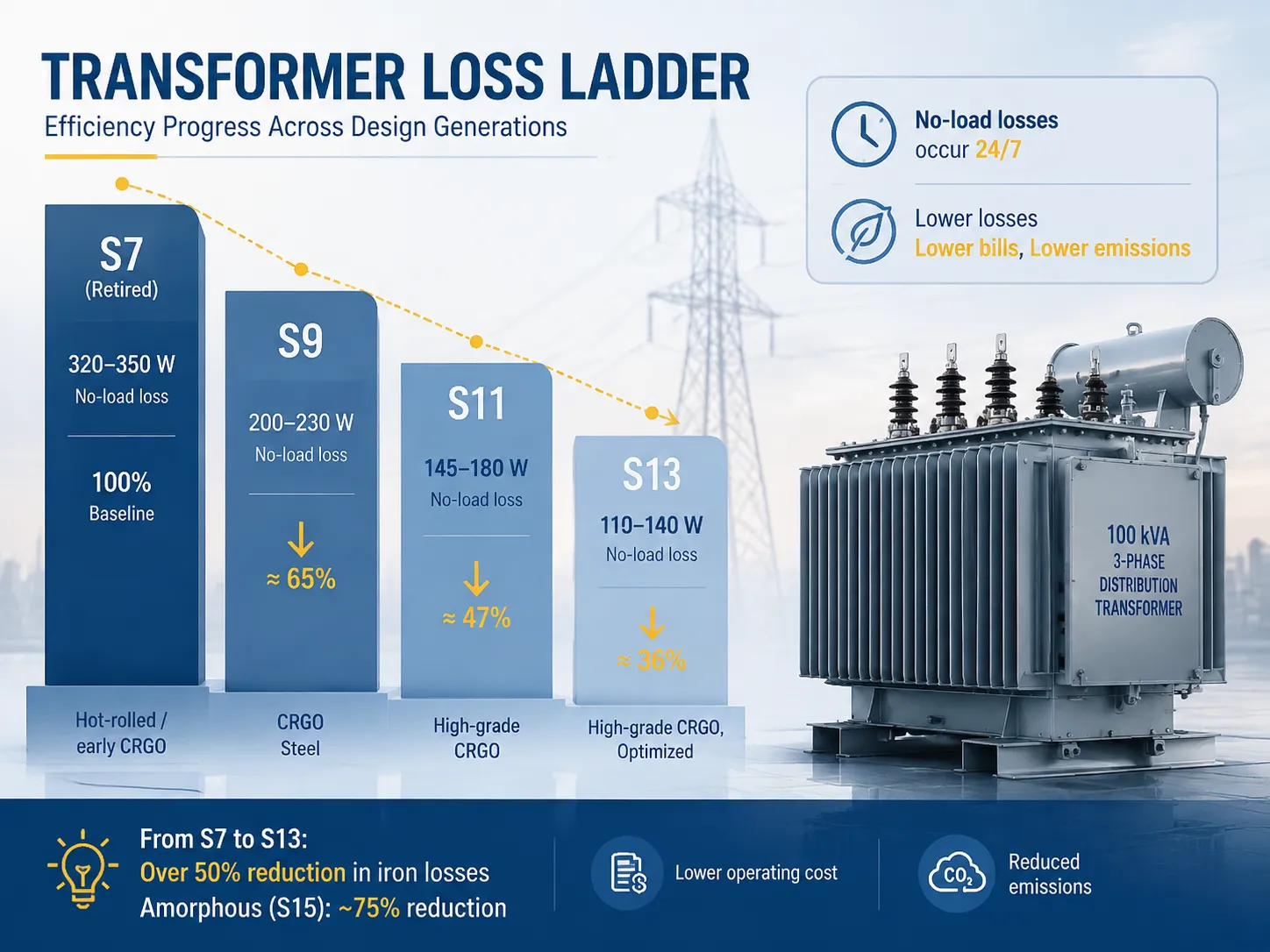
Die Verschwendung der S7 wird durch den Kernstahl verursacht. Er besteht aus warmgewalztem oder früh kaltgewalztem, kornorientiertem Siliziumstahl mit einem hohen spezifischen Verlustwert. Darüber hinaus optimierte das Design die Kerngeometrie nicht so, wie es die späteren Designs tun – und als Ergebnis hat ein typischer S7-Transformator mit einer Kapazität von 100 kBA eine Leerlaufverluste von etwa 320-350 W, während die Verluste für den S9 fast halbiert sind und für den S11 etwa 145-180 W betragen.
Es sollte beachtet werden, dass der Begriff “S7” kein offizieller IEC- oder IEEE-Begriff ist. Daher wird der Begriff außerhalb Chinas selten verwendet. Die Leerlaufverluste der alten Transformatorentwürfe weltweit sind jedoch die gleichen wie die der S7-Transformatoren, die in den USA, Japan und Europa zu finden sind.
Verlustniveaus: S7 vs S9 vs S11 vs S13
Das zentrale technische Thema bezieht sich auf das Konzept der Verlustleiter. Die angezeigte Tabelle soll die Nulllast- und Lastverluste des 100 kVA dreiphasigen Verteilungstransformators in Bezug auf die Entwurfsgenerationen anhand von Beispieldaten aus der Literatur vergleichen.
| Entwurfsgeneration | Kernart | Leerlaufverlust (100 kVA) | Lastverlust @75°C | Relativer Eisenverlust |
|---|---|---|---|---|
| S7 (außer Betrieb) | Warmgewalzt / frühes CRGO | 320–350 W | ≈ 1.750–1.950 W | 100% (Basislinie) |
| S9 | CRGO-Stahl | 200–230 W | ≈ 1.500–1.650 W | ≈ 65% |
| S11 | Hochwertiges CRGO | 145–180 W | ≈ 1.400–1.550 W | ≈ 47% |
| S13 | Hochwertiges CRGO, optimiert | 110–140 W | ≈ 1.350–1.500 W | ≈ 36% |
| S15 (amorph) | Amorphes Metallband | 70–90 W | ≈ 1.300–1.500 W | ≈ 24% |
Wie oben erwähnt, beseitigt das Upgrade von S7 auf S11 oder S13 über die Hälfte der Eisenverluste, und der Wechsel zu einem amorphen Kern reduziert die Verluste um etwa 75%. Da Leerlaufverluste den ganzen Tag über kontinuierlich auftreten, spiegeln sich die Unterschiede sofort in den Stromrechnungen und Emissionen wider.
GB 20052 Effizienzklassen erklärt
Chinas Effizienzklassifizierung ist in GB 20052 zu finden, “Mindestzulässige Werte der Energieeffizienz und Energieeffizienzklassen von Leistungstransformatoren.” In diesem Standard gibt es drei mögliche Klassen:
- Klasse 3 ist die minimale Energieeffizienz; sie ist fast gleich dem Niveau der alten S9/S11.
- Klasse 2 ist das Energiesparniveau; es ist ungefähr gleich den Verlusten von S13.
- Klasse 1 ist das maximale Effizienzniveau; in der Tat hat es fast vergleichbare Leistungen wie die Verwendung des amorphen Kerns (S15).
Im Jahr 2020 wurde GB 20052-2020 so geändert, dass der Verkauf von Transformatoren unter Klasse 3 in China verboten wurde. Es wird auch gefordert, dass alle neuen Transformatoren, die für das Netz gekauft werden, der Klasse 2 oder höher entsprechen. Der Standard begrenzt den Leerlaufverlust für einen 100 kVA Transformator auf 170 W für Klasse 3, 150 W für Klasse 2 und 120 W für Klasse 1 im Vergleich zu den 320-350 W von S7.
| Effizienzklasse | 100 kVA Leerlaufverlustgrenze | Grob vergleichbares Design | Status in China |
|---|---|---|---|
| Klasse 3 (minimal) | ≈ 170 W | S11-Klasse CRGO | Mindestzulässig für den Verkauf |
| Klasse 2 (energiesparend) | ≈ 150 W | S13-Klasse CRGO | Erforderlich für netzfinanzierte Käufe |
| Klasse 1 (höchste) | ≈ 120 W | Amorpher Kern (S15-Klasse) | Bevorzugt unter Effizienzsubventionen |
| S7 Referenz (außer Betrieb) | 320–350 W | Warmgewalzt / frühes CRGO | Aus dem Netzbetrieb genommen |
Weltweit ist ein ähnliches Konzept in Form der EU-Ecodesign-Verordnung 548/2014 (in der Fassung von 2019/1783) oder den 2016 Standards, die von den US-Behörden festgelegt wurden, sichtbar. Um den Vergleich der Transformatorpreise weltweit zu erleichtern, sollten Käufer die entstandenen Verluste in dieselbe Einheit umrechnen, um genaue Schätzungen zu erhalten, was besonders wichtig ist, da ein Gerät mit niedrigen Anschaffungskosten, aber hohen Verlusten über 20 Jahre hinweg kaum jemals günstig genug ist.
Die Betriebskostenmathematik eines alten Transformators
Die Wirtschaftlichkeit ist im Fall von S7 nicht günstig. Nehmen wir einen 100kVA Transformator, der eine bescheidene durchschnittliche Last von 40% hat, 8760 Stunden arbeitet und die Energiekosten $0,10 pro kWh betragen.
| Kostenposition | S7 Einheit | S11 Ersatz | Jährlicher Unterschied |
|---|---|---|---|
| Leerlaufenergie (jährlich) | ≈ 3.066 kWh | ≈ 1.445 kWh | −1.621 kWh |
| Load energy (annual, 40% LF) | ≈ 2,805 kWh | ≈ 2,349 kWh | −456 kWh |
| Total energy cost / year | ≈ $587 | ≈ $379 | −$208 / year |
| Over 15 remaining years | — | — | ≈ $3,120 saved |
The discrepancy for one piece of equipment amounts to a few hundred dollars per year, which is not significant. However, if a company has around 10,000 outdated pieces of equipment, it ends up costing them more than $2 million per year in unnecessary costs associated with the electricity bill. This is why the Chinese power system abandoned the whole fleet of S7 units and why power regulators are tightening their policies constantly.
The second financial aspect is the problem of reliability. S7 units are from 30 to 40 years old now. The processes of wear and tear of insulation materials, oil, and gaskets cause the deterioration of units and reduce the remaining lifespan of the system. One mid-life distribution transformer will cost around $1000 to $3000 to repair and from $2000 to $6000 to replace.
What This Means for the Secondary Market
This is the trap for customers. The Chinese phase-out has resulted in the removal of S7/S8/S9 devices from the grid – all of which, in many cases, have appeared on the market under labels of “reconditioned” or “overhauled.” On initial inspection, the price seems attractive: a 100 kVA S7 could be priced from $400 to $900 compared to $1,400 to $2400 for a new S11-equivalent from China. However, one has to account for the costs below.
- Operational Problems: A used device can cause you an extra loss from $150 to $250 per annum compared to a new energy-efficient device.
- Useable Lifespan: A transformer 30 years old is estimated to last 5-15 years instead of 25-30.
- Obscure Condition: “Reconditioned” could mean anything from proper refurbishment to just repainting with new gaskets. In the absence of test findings and load history, the risk is unmeasurable.
- Nonstandard Status: S7 devices do not comply with current efficiency regulations, which can lead to a ban of reincorporation in regulated markets or fines.
Wise purchasers view reconditioned S7/S8 units as an emergency solution only and require that oil tests (dielectric, moisture, acidity), winding resistance, ratio, and megger tests be conducted prior to purchase, and set aside the funds for replacement within the following five years.
Replacement Options, Brands, and Prices
If you are intending to buy new transformers instead of S7 transformers, the question is which energy-efficient design you want to buy. Below is the table with indicative costs of a replacement 100 kVA three-phase transformer from different suppliers, quoted on a FOB basis.
| Brand / source | Design | 100 kVA price (FOB) | Leerlaufverlust | Anmerkungen |
|---|---|---|---|---|
| ABB | S11-class / custom | $4,200–$6,500 | ≈ 150–180 W | Premium brand, global service |
| Siemens | S11-class / custom | $4,000–$6,800 | ≈ 150–180 W | Strong utility track record |
| Schneider Electric | S11-class / custom | $3,800–$6,200 | ≈ 150–180 W | Integrated LV ecosystem |
| Hitachi Energie | S11-class / custom | $4,500–$7,000 | ≈ 150–180 W | Utility-grade reputation |
| Eaton | S11-class / custom | $3,500–$5,800 | ≈ 150–180 W | Americas distribution strength |
| TBEA / China XD | S13 / amorphous available | $1,700–$3,000 | ≈ 110–170 W | State-backed, volume manufacturing |
| Jiangsu Subian Electric Power | S11 / S13 / amorphous | $1,500–$2,600 | ≈ 110–180 W | Export-focused, IEC 60076 tested |
In projects where certification, local presence, and financing recognition are valued more than initial cost, international brands like ABB, Siemens, Schneider Electric, and Hitachi Energy would be the given option since their products equal or exceed the GR 20052 grade 2-3 standards and provide proper backing for this.
In the case of replacement programs where thousands of products will run, Jiangsu Subian Electrical Power would be a cost-effective solution. The company produces S11, S13, and amorphous-core transformers from 5 kVA to 2,500 kVA tested in accordance with IEC 60076 and GR 20052, and also applies conformity certificates to every transformer and optionally third-party review. Buying a brand-new energy-saving transformer at the factory price will usually cost less over its life cycle than buying a discounted S7 transformer that will incur losses for 10 years.
Action Points for Buyers Outside China
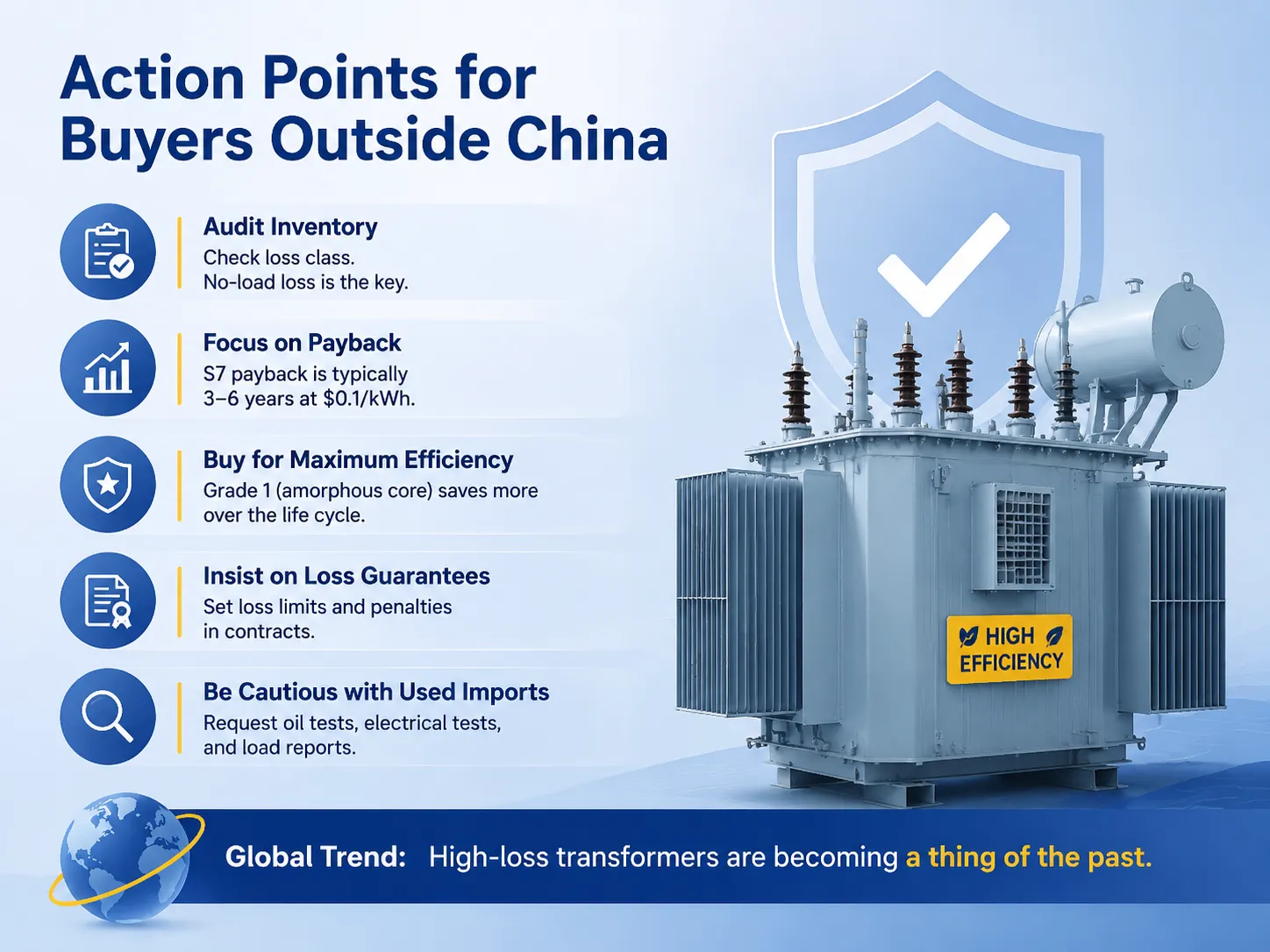
The Chinese decommissioning brings important lessons for any operator not using low-loss transformers:
- Audit your inventory according to loss class. The nameplate no-load loss is the best single indicator of replacement necessity.
- Look at the payback and not the price. Replacement payback for S7 transformer at $0.1/kWh is usually three to six years; payback period is smaller at higher electricity tariffs.
- Buy according to the maximum allowable efficiency standard. If amorphous core transformer (Grade 1) is only 15-25% more expensive than the S11 transformer, the savings during the life cycle warrant the investment.
- Insist on loss guarantees in contracts. By introducing no-load and load losses limits and penalties in the contracts you can protect your budget.
- Be very caution while buying imported used transformers. Ask for oil test results, electrical tests, and load reports.
Also remember that all major markets share the same trend – high-loss transformers are becoming a thing of the past.
Häufig gestellte Fragen
What is the difference between S7 and S9 transformers?
The S7 and S9 are two generations of distribution transformers that have been made in China. The S9 was developed around 1998. Although the materials used to build the S9 transformers include cold-rolled grain-oriented silicon steel and optimized geometry of the core, they still consume 30-40% less energy compared to the S7 transformers. Thus, a 100kVA transformer loses 200-230W of electricity instead of 320-350W consumed by the S7 transformer. In dollar terms, this translates into $60-$100 savings on electricity bills.
Can I still buy S7 transformers in China?
The introduction of S7 and other below-Grade-3 models is virtually prohibited under GB 20052-2020 in China, which has led the grid utilities to dispose of their fleets. S7 devices are still available on the secondary markets as used or “refurbished” devices at low prices. Unless you get an offer that is compelling enough as a temporary solution, the new S11/S13 machine priced between $1,500 and $2,600 (100 kVA, FOB China) is a better option.
Are S11 and S13 transformers worth the extra cost?
Generally speaking, yes. An S13 transformer will cost about 5-15% more than a similar S11 transformer and will reduce no-load losses by an additional 20-25%. Based on the assumption of 10 cents/kWh and 8760 hours of operation per year, there is a loss reduction of about 50-90 dollars a year for a 100 kVA transformer which gives a payback of 3-7 years and continues to save money for over 20 years. The higher the rates and utilization factors, the shorter the payback term.
What does GB 20052 mean for imported transformers?
GB 20052 defines the standards regarding the efficiency of transformers sold in and used within the borders of China. All transformers imported into China must comply with the minimum requirement of Grade 3, while the cases of grid-funded projects need compliance with Grade 2 or above. Apart from that, GB 20052 is still of use for foreign buyers as a reference point in terms of loss ratings of transformers produced in China.
How do I calculate the payback of replacing an old transformer?
Multiply the difference in no-load losses (kW) by 8,760 hours, add the difference in load losses multiplied by the square of the average load factor (example: 0.4² = 0.16 at 40% load) multiplied by 8,760 hours, and multiply the total by your tariff to compare the result with the replacement cost. Example: 0.13 kW lower no-load losses multiplied by 8,760 hours gives 1,139 kWh per year saving at $0.10 per kWh which corresponds to $114 per year saving — for replacing the appliance costing about $2,000 payback period due to losses accounts for 17 years of operation without maintenance and other benefits related to new appliances.
Referenzen
- National Development and Reform Commission (NDRC) — Issued China’s Transformer Energy Efficiency Improvement Plan (2015–2020).
- IEC — Publisher of IEC 60076, the international transformer testing standard used for replacement units.
- International Energy Agency (IEA) — Analysis of distribution transformer losses and efficiency policy worldwide.
- U.S. Ministerium für Energie — Distribution transformer efficiency standards and market impact assessments.
- European Commission — Ecodesign regulation 548/2014 and 2019/1783 for transformers.
- Energy Star — Reference for energy-efficiency benchmarking and savings calculators.
- Jiangsu Subian Electric Power — Manufacturer of S11, S13, and amorphous-core distribution transformers.
Fazit
The fact that China decided to ban S7 and older transformer technologies has been based on pure numbers because a continuously operating transformer with high no-load losses incurs unnecessary costs and wasted energy all its life. As a result of this initiative, tens of millions of devices were decommissioned. Also, the efficiency rating employed in this approach (GB20052) is consistent with the EU Ecodesign requirements and the US DOE standards.
- Regard any S7 standard or inefficient transformer as an effective liability. Annual loss costs incurred by their operation do exist and remain constant.
- Usually, payback period for a unit replacement is between 3 and 6 years at average tariffs but can be shorter when the electricity cost is high.
- Choose only the most modern effective equipment available in the market and insert ceilings for losses in the contract. Be it ABB or Siemens or Schneider or Jiangsu Subian Electric
- Power, you will still have the benefit of using new highly efficient equipment instead of a discounted legacy device in its normal operating mode.