


In Lagos hat ein Elektroinstallateur eine Bestellung von zwölf Trockentransformatoren mit einer Kapazität von 1000 kVA pro Einheit zu einem sehr attraktiven Preis aufgegeben. Während der Inbetriebnahme stellte sich jedoch heraus, dass die Einheiten mit einer Impedanzabweichung von 5 Prozent, dem Fehlen eines Teilentladungszertifikats und einem Typenschild, das nicht mit dem Werksprüfbericht übereinstimmte, versendet wurden. Infolgedessen wurde das gesamte Projekt um drei Monate verzögert, und der Kunde verlor das Vertrauen in die Lieferkette. Es ist die Geschichte, die sich in jedem Markt wiederholt, in dem Kunden den Preis pro kVA als das Hauptkriterium für die Wahl des Lieferanten bewerten.
Dieser Einkaufsführer hilft Ihnen zu verstehen, wie Sie den Prozess des Kaufs von Trockentransformatoren angehen können. So werden Sie durch jede Phase des Prozesses geleitet, beginnend mit der Bestimmung Ihrer Spannung, Last, Umgebung und fortfahrend mit dem Lesen von Angeboten, der Überprüfung der Einhaltung des IEC 60076-11-Leitfadens, der Durchführung von Inspektionen und der Berechnung der Gesamtkosten des Eigentums.
Der Trockentransformator ist ein luftgekühlter Transformator mit einer Kapazität von 25 kVA bis 12.500 kVA. Er ist mit gegossenem Epoxidharz oder Klasse-H-Lack isoliert und nicht mit Öl, und wird grundsätzlich gemäß IEC 60076-11 (und IEEE C57.12.01 / NEMA TP-1 in Nordamerika) verwendet. Der Kernkauprozess umfasst: die Festlegung der Spannung und Kurzschlussfähigkeit des Systems, die Bestimmung von Verlusten und Effizienzklasse, die Wahl zwischen gegossenem Harz und VPI, die Überprüfung des K-Faktors im Falle von nichtlinearen Lasten, das Einholen der Prüfzeugnisse und das Hinzufügen von 10-15% zu den Kosten des Transformators für Versand, Zoll und Inbetriebnahme.
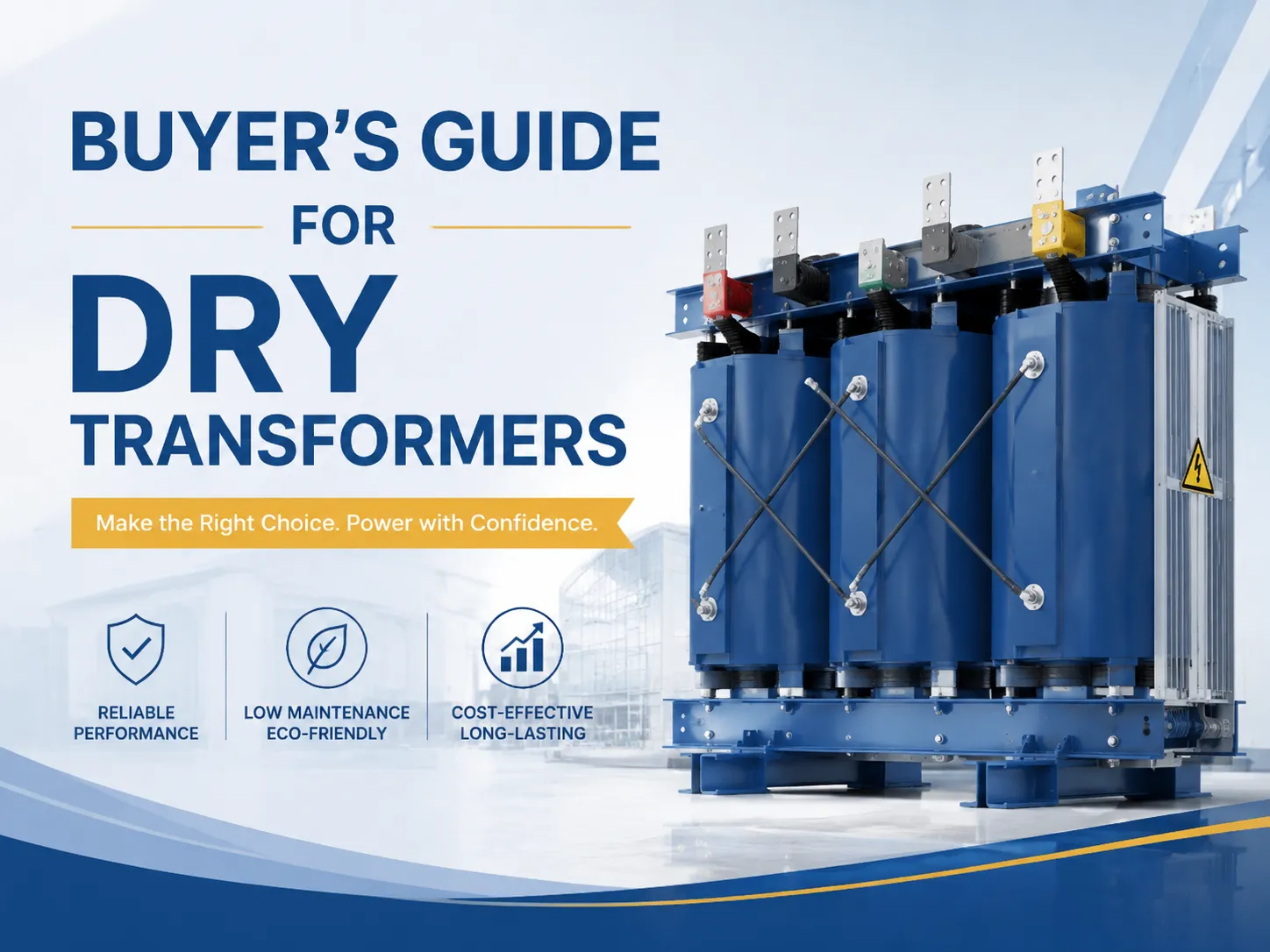
Was ist ein Trockentransformator?
Ein Trockentransformator ist ein Transformator, der Elektrizität mittels magnetischer Induktion und ohne flüssige Isolierung überträgt. Stattdessen sind die Leiter mit milden Materialien wie Epoxidharz oder Klasse H-Lack isoliert, während der Kern aus einer Reihe von Siliziumstahlblechen besteht. Diese Art von Transformator wird an Orten eingesetzt, an denen Öl nicht verwendet werden kann, einschließlich Gebäude, Tunnel, Schiffe und Türme.
Die maximalen Spannungspegel, die gemäß den IEC-Vorschriften zulässig sind, können 36 kV erreichen, und die häufigste Leistung von Transformatoren liegt zwischen 50 kVA und 12.500 kVA. Verluste, Impedanz und Temperaturanstieg sind Werte, die basierend auf den im Routineprüfbericht enthaltenen Daten bestätigt werden müssen, der vom Hersteller mit jeder Lieferung bereitgestellt werden sollte.
Wie es funktioniert
Die Magnetisierung des laminierten Stahlkerns erfolgt durch den Fluss von Wechselstrom. Dadurch entsteht ein Magnetfeld, das einen Strom in der Sekundärwicklung durch elektromagnetische Induktion induziert, wie es das Gesetz von Faraday vorschreibt. Bei Transformatoren sind die Spannungs- und Primär- zu Sekundärwicklungsverhältnisse gleichwertig: Daher wird ein Transformator mit 100 Primärwicklungen und 10 Sekundärwicklungen die Spannung um den Faktor zehn reduzieren und gleichzeitig den Strom um denselben Faktor erhöhen.
Wärme begrenzt den Betrieb von Transformatoren; Kupferverluste steigen mit dem Quadrat der Last; Kernverluste bleiben während des Betriebs konstant. In dieser Hinsicht sind trockene Isolationssysteme auf Temperaturklassen F (155°C) und H (180°C) beschränkt, mit einem Temperaturanstieg von 100 K und 125 K über einem Umgebungsniveau von 40°C. Wenn diese Grenzen überschritten werden, kann die Isolierung nach wenigen Betriebsstunden dauerhaft beschädigt werden.
Typen und Konstruktion
| Konstruktion | Isolationssystem | Nennbereich | Hauptmerkmale |
|---|---|---|---|
| Gießharz (eingekapselt) | Epoxidharz, vakuumgegossen | 100–12.500 kVA | Feuchtigkeitsbeständig, selbstlöschend, niedrige PD, leise |
| VPI (vakuumdruckimprägniert) | Klasse H Lack | 25–3.000 kVA | Geringere Kosten, gute Leistung in sauberer Innenluft |
| Offen belüfteter Trocken-Typ (OVDT) | Aramidpapier + Lack | 500–3.000 kVA | Versorgungsstil offene Wicklungen, hohe thermische Beständigkeit |
| Amorpher Metallkern | Gießharz oder VPI | 50–2.500 kVA | 70–80% geringere Leerlaufverluste, höhere Erstkosten |
Für die meisten gewerblichen Kunden liegt die Wahl normalerweise zwischen Gießharz und VPI. Gießharz ist teurer, etwa 15% bis 30% teurer als VPI, aber es kommt besser mit Feuchtigkeit, Teilentladungsstress und wiederholter Energisierung zurecht. Daher bevorzugen Rechenzentren und Prozessindustrien Gießharz.
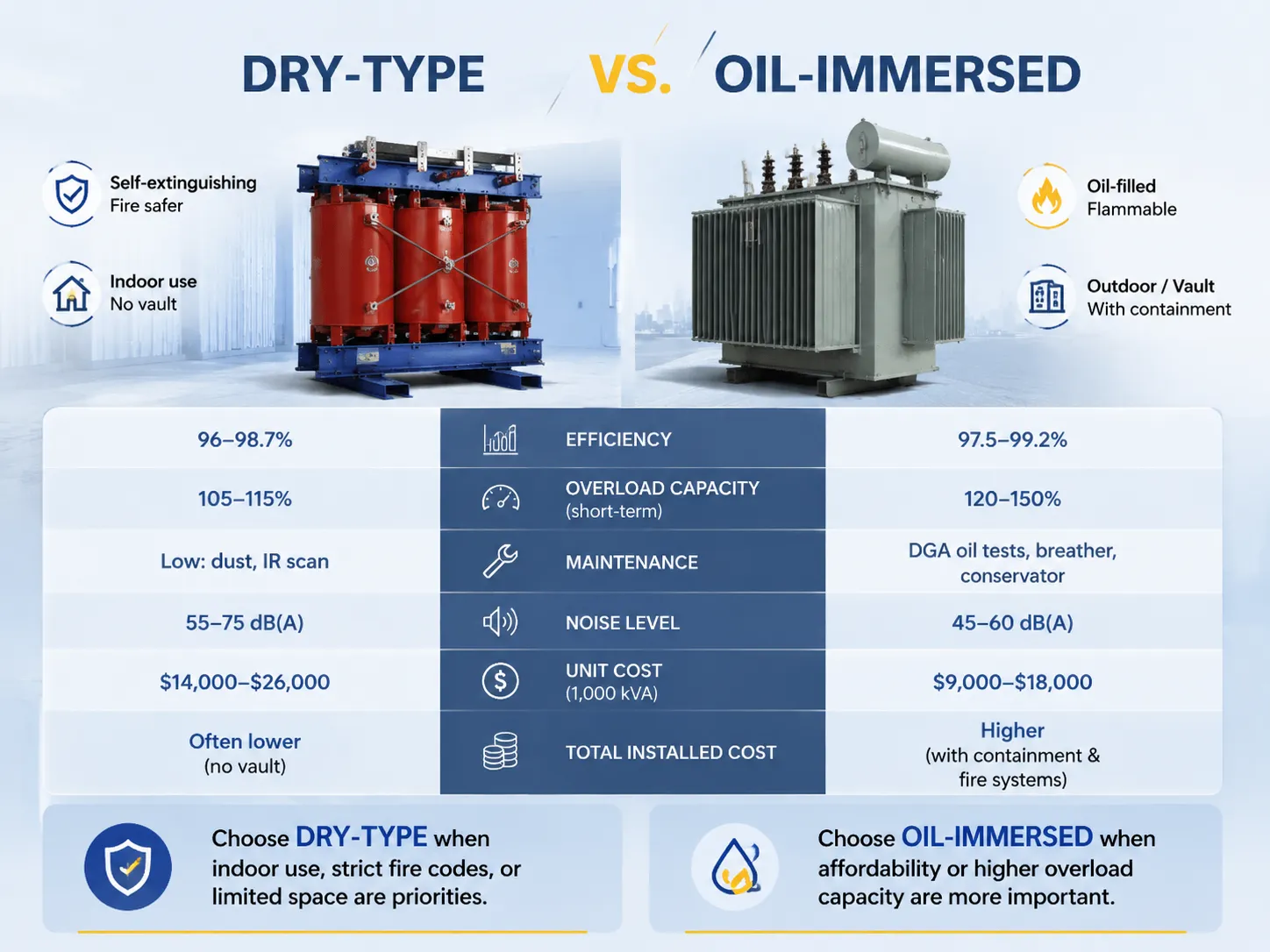
Trocken-Typ vs. Öl-untergetaucht
| Kriterium | Trockentyp | Ölgetaucht |
|---|---|---|
| Sicherheit / Feuer | Selbstlöschende Materialien | Entzündliches Öl, Eindämmung erforderlich |
| Installation | Innen, kein Tresor | Außen oder Tresor mit Auffangwanne/Grube |
| Effizienz | 96–98.7% typisch | 5–99.2% typisch |
| Überlast | 105–115% kurzfristig | 120–150% kurzfristig |
| Wartung | Niedrig: Staub, IR-Scan | DGA-Öltests, Entlüfter, Konservator |
| Geräusch | 55–75 dB(A) | 45–60 dB(A) |
| Stückkosten, 1.000 kVA | $14.000–$26.000 | $9.000–$18.000 |
| Gesamte Installationskosten | Oft niedriger (kein Tresor) | Höher, sobald Eindämmungs- und Brandschutzsysteme zählen |
Wählen Sie Trocken-Typ Einheiten, wenn der Innenbereich erforderlich ist oder wenn die Einhaltung strenger Brandschutzvorschriften oder ein eingeschränkter Platz wichtiger ist. Wählen Sie ölgefüllte Einheiten, wenn die Erschwinglichkeit oder ein höherer Überlastspielraum relevanter ist als die Idee, drinnen zu installieren.
Spezifikationen, die Sie überprüfen müssen
| Parameter | Was Sie anfordern sollten | Typischer Wert |
|---|---|---|
| Nennleistung | Kontinuierliche kVA bei angegebenem Umfeld | 100–2.500 kVA (Verteilung) |
| Primär-/Sekundärspannung | Beide, mit Abgriffbereich | 11 kV / 0,4 kV; 33 kV / 11 kV, ±2×2.5% |
| Impedanz (uk) | Kurzschluss-Spannung bei Nennstrom | 4–8%, Toleranz ±7.5% |
| Verluste | Leerlauf- und Lastverlust bei 120°C | Siehe Effizienztabelle unten |
| Temperaturanstieg | Wicklungsanstiegsklasse | 100 K (F) oder 125 K (H) |
| Isolationsniveau | Blitzimpuls (LI) und Netzfrequenz (AC) | z.B. 75/28 kV für 11 kV System |
| Geräuschpegel | Schallpegel bei 1 m | 55–75 dB(A) |
| Kühlmethode | AN, AF oder ANAF | AN-Norm; AF erhöht die Kapazität um 15–20% |
| Normen | Geregelt Norm und Prüfzeugnis | IEC 60076-1/-11, IEEE C57.12.01 |
Effizienzklassen und Verlustwerte
| Nennleistung (kVA) | Leerlaufverlust (W) | Lastverlust @120°C (W) | Effizienz @100% |
|---|---|---|---|
| 250 | 500–700 | 2,600–3,800 | 98.1–98.6% |
| 630 | 1,000–1,400 | 6,000–8,500 | 98.2–98.8% |
| 1,000 | 1,500–2,100 | 8,900–12,500 | 98.3–98.9% |
| 1,600 | 2,100–3,000 | 13,000–18,000 | 98.5–99.0% |
| 2,500 | 3,000–4,200 | 19,000–26,000 | 98.7–99.1% |
Hochleistungstransformatoren (häufig aus amorphem Metallkern oder einer besseren Qualität von Siliziumstahl) haben geringere Leerlaufverluste, was etwa 30-60% im Vergleich zu herkömmlichen Designs spart. Wenn die Maschine das ganze Jahr über mit leichten Lasten betrieben wird, würden die Einsparungen die zusätzlichen Kosten von 10-25% der ursprünglichen Investition über einen Zeitraum von drei bis sechs Jahren decken. Die Berechnungen der Amortisation der Investition müssen unter der Annahme der Verlustkosten von $3.000 bis $6.000 für jedes kW des Verlusts durchgeführt werden.
Anwendungen in verschiedenen Branchen
- Bürogebäude und Wolkenkratzer: elektrische Räume im Keller mit Verteilungsansatz von 11/0,4 kV, ohne Verwendung von Öl.
- Rechenzentren: Trockentransformatoren mit einer Nennleistung von 750–3.000 kVA, verwendet für die Einspeisungen von 480/277 V und 208/120 V Schaltanlagen.
- Erneuerbare Quellen: Transformatoren für Windkraftanlagen mit einer Nennleistung von 1 bis 5 MVA im Turm und Solaranlagen, die eine Hilfsversorgung bereitstellen.
- Schienenverkehr: Traktionshilfstransformatoren, die unter Vibrationen und Feuchtigkeit in Tunneln arbeiten können.
- Marinebereich: Gießharzkleintransformatoren, die ihre Arbeit unter salzigen Sprühnebel und Kondensation aufrechterhalten.
- Industriesektor: Isolations- und Absenktransformatoren für Motorsteuerungen und Antriebe.
Top-Marken und Preisspannen
| Marke | Land | 000 kVA Preis | 500 kVA Preis | Stärke |
|---|---|---|---|---|
| ABB | Schweiz | $22.000–$36.000 | $40.000–$62.000 | Globales Netzwerk, digitale Überwachung |
| Siemens | Deutschland | $21.000–$35.000 | $38,000–$58,000 | GEAFOL cast-resin reference |
| Schneider Electric | Optimierungsmaßnahmen in der Praxis | $22,000–$37,000 | $39,000–$60,000 | Eco-design portfolio |
| Hitachi Energie | Schweiz/Japan | $23,000–$38,000 | $41,000–$65,000 | High-power cast resin |
| Eaton | Irland/USA | $15,000–$26,000 | $28,000–$45,000 | UL/NEMA line, fast stock in Americas |
| CG Power | Indien | $16.000–$28.000 | $29,000–$47,000 | Value pricing, EMEA reach |
| Jiangsu Subian Electric Power | China | $12,000–$22,000 | $22.000–$38.000 | Direct factory, OEM/ODM, IEC 60076 tested |
Well-known brands such as ABB, Siemens, Schneider Electric, and Hitachi Energy charge high prices for local connections, technical assistance, and many years of proving technology. However, construction is obsolete as grain-oriented steel cores, resinification, and ordinary IEC testing remain the same everywhere. For example, manufacturers like Jiangsu Subian Electric Power supply transformers that comply with IEC 60076 standards at a price that is 30% to 50% less than official European prices while shipping their products to over 60 locations. One cannot choose anything other than two manufacturers and two local suppliers to compare costs, including delivery and inspection fees.
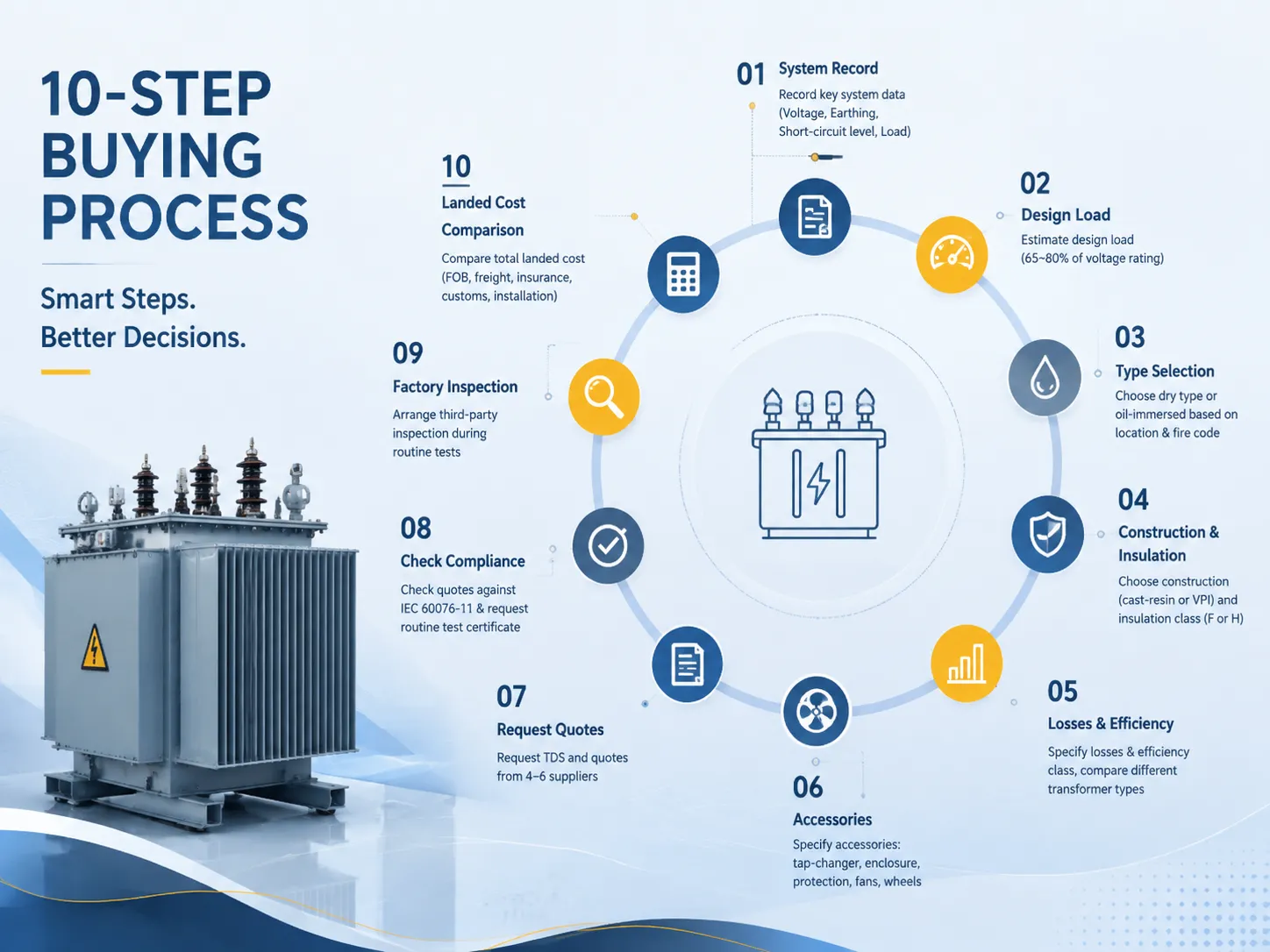
The 10-Step Buying Process
- It is necessary to record all aspects of the system being used in terms of specification: nominal voltage, earthing arrangement, short-circuit level and load in kVA and load profile.
- Use a calculating method to estimate design load of 65~80% of the voltage rating, thus achieving maximum efficiency.
- Choose dry type or oil-immersed transformer based on location, fire code and installation cost.
- Choose construction method (cast-resin or VPI) and insulation class (F or H).
- Specify losses and efficiency class. Tally losses with efficiency of different type of transformers.
- Determine the type of accessories, such as tap-changer, enclosure, thermistor/PTC protection, fans and wheels.
- Order a technical data sheet and quotes from four to six suppliers.
- Check quotes against IEC 60076-11 and ask for routine test certificate for the reference unit.
- If possible, arrange third-party inspection at the factory during the routine tests (it will cost 1-3% of the unit price).
- By using landed cost comparison formula (which includes not only FOB price, but also freight charges, insurance, customs and, of course, installation expenditure) for comparing contacts.
Reading Quotations and Avoiding Traps
- Losses classified as either guaranteed or measured: only guaranteed losses that can be tested will be accepted – a 10% variance results in loss valuation in the range of $1,500–$4,000 for every machine unit.
- Impedance tolerance: standard is ±7.5% according to IEC 60076-1; and a higher tolerance can result in the breakdown of protection coordination.
- Ambient base: it must be ensured that the design ambient is specified (typically is 40°C); if quotation is done at 30°C, that isn’t of direct comparability.
- Enclosure and cooling: confirm if IP23, fans, and the presence of sensors are taken into account in pricing or stated separately, which is quite frequent and increases pricing by 8-15%.
- Incoterms: ascertain whether prices are expressed as EXW, FOB, or CIF; quotations being expressed as EXW can be misleading since they appear to be really cheap but afterward turn out to be double the price as freight and insurance must be considered.
- Documentation: make sure that various types test certificates, routine test report, drawings, and warranty for one year with stated conditions will be provided.
Factory Inspection and Testing
- Observe regular examinations following IEC 60076-1/60076-11: turns ratio, resistance, no-load and load losses, IR assessment, elevated voltage examination, and partial discharge (for cast resin).
- Compare the nameplate data to the order details: power rating, voltage, impedance, losses, criteria, date of any manufacturing.
- Photographical observations of the condition of the cast resin coils, tracing any cracks, bubbles, or discoloration from previous curing processes.
- Check the hardness of the core clamps as well as that the ground lugs are available.
- Take pictures of the serial numbers, test arrangement, as well as the packaging.
Delivery, Installation and Maintenance
- Lifting should only be done with rated lifting lugs and not by using slings on bushings, coils and fan shields.
- Store indoors, and if the storage period is longer than 6 months an IR test should be performed and an energization should be done for 4-6 hours under no load condition beforehand.
- Place on a flat base which is at least 600-700 mm in height at the front with 200-300 mm clearance at the back for air flows.
- Measure IR before the energizing operation; if less than 100 MΩ at 500 V is measured, dry it out.
- Carry out infrared scanning for the first time in 30 days after commissioning and then quarterly; tighten the loose connections with more than 20 K temperature difference.
- Perform cleaning of the radiator ducts and fins once a year using a small degree of vacuum cleaning.
Häufig gestellte Fragen
How much does a dry-type transformer cost per kVA?
The cost of cast-resin transformers ranges from approximately $14 to $26 per kVA for units with power ratings ranging from 630 to 2000 kVA, and price ranges for VPI transformers vary from $9 to $18 per kVA when factory-bound. A typical cast-resin transformer with a power rating of 1000 kVA will cost between $14,000 and $26,000, excluding taxes ranging from 10 to 15% for shipping, customs clearance charges, and installation expenses. Prices vary according to brand, specifications, and geographical differences.
What is the difference between cast-resin and VPI dry-type transformers?
Winding and epoxy materials can be found in cast-resin transformers. This unique type of transformer offers an extremely high degree of protection against moisture without compromising performance in operations since it provides low partial discharge of less than 10 pC. It is definitely recommended for installations in humid or fire-prone areas.
Can a dry-type transformer be installed outdoors?
Yes, as long as the unit has proper enclosures (normally IP54 or IP55 weatherproof), it can have heating strips to control condensation and a sun roof. Units rated for indoor use, like IP23, installed outdoors will deteriorate insulation and cause insulation tracking failure. Dry-type outdoor-rated units cost about 10 to 20 percent more than indoor units of similar design.
How long do dry-type transformers last?
When used under the appropriate temperature conditions and maintained clean, cast-resin type transformers usually last more than 25–30 years in service life. Insulation life decreases by about two times for every increase in temperature exceeding standard values by 8–10°C. Hence, to preserve your equipment, it is recommended to keep the temperature of the windings within the limits given in the specification.
Why are dry-type transformers more expensive than oil-filled ones?
The price of materials required for dry type transformers is higher due to epoxy resin and class H insulation in place of bulk transformer oil, and dry types need more substantial conductors as air cooling is less efficient than oil cooling. At the same time, once making adjustments to the vault, oil containment, and extending fire-suppression systems, the overall cost of the dry system tends to be lower even in indoor locations.
Referenzen
- IEC 60076-11: Power Transformers – Dry-Type Transformers — core standard for ratings, losses, temperature rise and testing of dry-type units.
- IEC 60076-1: General Requirements — covers rated values, tolerances, and general test procedures for power transformers.
- IEEE C57.12.01: Dry-Type Distribution and Power Transformers — North American requirements and test methods.
- NEMA TP-1: Guide for Determining Energy Efficiency of Distribution Transformers — the efficiency benchmark used across North American tenders.
- U.S. DOE Distribution Transformer Efficiency — explains minimum efficiency regulations and loss evaluation.
- NFPA 70 (NEC) — installation and clearance requirements for transformer locations.
- Jiangsu Subian Electric Power — IEC 60076-compliant dry-type transformer manufacturer offering cast-resin and VPI lines with OEM support.
Fazit
A successful purchase of a dry-type transformer depends on the type of specification you provide, the completeness of your quotations, and the quality of factory inspection. Dry-type transformers are proven technology; you differentiate a favorable purchase from an expensive purchase based on verifications of losses, impedance, temperature rise class, and conformity to standards instead of relying on a technical specification sheet.
- Articulate the IEC 60076-11 conformity, losses level, and test submissions in writing.
- Do a comparison of the total cost of ownership with landed price, and include a loss estimation of $3,000-$6,000 per kW.
- Also, be ready to pay an additional 10-15% on top of the price for logistics.
Irrespective of whether you are buying from market leaders like ABB and Siemens, or directly from Jiangsu Subian Electric Power, the contract should specify the standards used, the necessary tests, and warranty provisions.