


Em Lagos, um empreiteiro elétrico fez um pedido de doze transformadores secos de capacidade 1000 kVA por unidade a um preço muito atraente. No entanto, durante a fase de comissionamento, foi revelado que as unidades foram enviadas com desvio de impedância de 5 por cento, ausência de certificado de descarga parcial e placa de identificação que não correspondia ao relatório de teste da fábrica. Como resultado, todo o projeto foi atrasado por três meses, e o cliente perdeu a confiança na cadeia de fornecedores. É a história que se repete em todos os mercados onde os clientes julgam o preço por kVA como o principal critério para escolher o fornecedor.
Este guia do comprador ajudará você a entender como proceder com o processo de compra de transformadores secos. Assim, você será orientado em cada etapa do processo, começando pela determinação da sua tensão, carga, ambiente e continuando com a leitura de cotações, verificação de conformidade com o guia IEC 60076-11, realização de inspeção e cálculo do custo total de propriedade.
O transformador seco é um transformador resfriado a ar com capacidade variando de 25 kVA a 12.500 kVA. Ele é isolado com resina epóxi fundida ou verniz classe-H, e não com óleo, e é utilizado em princípio de acordo com a IEC 60076-11 (e IEEE C57.12.01 / NEMA TP-1 na América do Norte). O processo de compra principal inclui: estabelecer a tensão e a curto-circuito do sistema, determinar perdas e classe de eficiência, escolher entre resina fundida e VPI, verificar o fator K em caso de cargas não lineares, obter os certificados de teste e adicionar 10-15% ao custo do transformador para envio, alfândega e comissionamento.
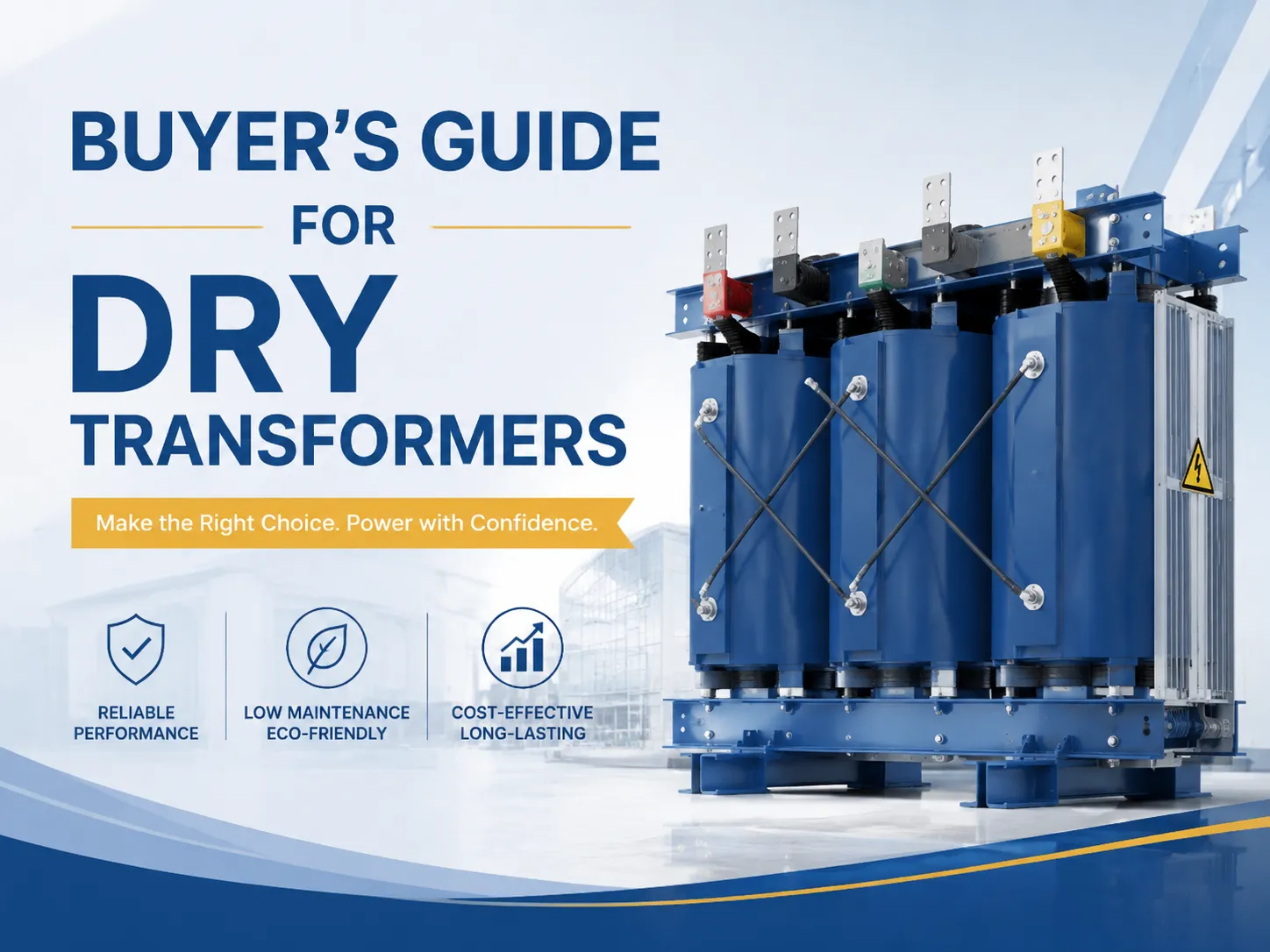
O que é um Transformador Seco?
Um transformador seco é aquele que transmite eletricidade usando indução magnética e sem isolamento líquido. Em vez disso, os condutores são isolados usando materiais leves como resina epóxi ou verniz Classe H, enquanto o núcleo é composto por uma série de laminações de aço silício. Este tipo de transformador é utilizado em qualquer lugar onde o óleo não pode ser usado, incluindo edifícios, túneis, navios e torres.
Os níveis máximos de tensão permitidos sob as regulamentações da IEC podem atingir 36 kV e a potência mais comum dos transformadores varia de 50 kVA a 12.500 kVA. Perdas, impedância e aumento de temperatura são valores que devem ser confirmados com base nos dados incluídos no relatório de teste de rotina, que deve ser fornecido pelo fabricante com cada entrega.
Como Funciona
A magnetização do núcleo de aço laminado ocorre devido ao fluxo de corrente alternada. Assim, um campo magnético é criado que induz uma corrente no enrolamento secundário através da indução eletromagnética, conforme prescrito pela lei de Faraday. Nos transformadores, as relações de tensão e de enrolamentos primário para secundário são equivalentes: portanto, um transformador com 100 enrolamentos primários e 10 enrolamentos secundários reduzirá a tensão por um fator de dez, ao mesmo tempo em que aumentará a corrente pelo mesmo fator.
O calor limita a operação dos transformadores; as perdas de cobre aumentam com o quadrado da carga; as perdas no núcleo permanecem constantes durante a operação. Nesse aspecto, os sistemas de isolamento do tipo seco são limitados às classes de temperatura F (155°C) e H (180°C), com aumento de temperatura igual a 100 K e 125 K acima de um nível ambiente de 40°C. Se esses limites forem excedidos, o isolamento pode ser danificado permanentemente após algumas horas de operação.
Tipos e Construção
| Construção | Sistema de Isolamento | Faixa de Classificação | Características Principais |
|---|---|---|---|
| Resina fundida (encapsulada) | Resina epóxi, fundida a vácuo | 100–12.500 kVA | Resistente à umidade, autoextinguível, baixa PD, silencioso |
| VPI (impregnado a pressão de vácuo) | Verniz Classe H | 25–3.000 kVA | Custo mais baixo, bom desempenho em ar limpo interno |
| Tipo seco ventilado aberto (OVDT) | Papel de aramida + verniz | 500–3.000 kVA | Bobinas abertas estilo utilitário, alta resistência térmica |
| Núcleo de metal amorfo | Resina fundida ou VPI | 50–2.500 kVA | 70–80% menores perdas em vazio, maior custo inicial |
Para a maioria dos clientes comerciais, a escolha geralmente é entre resina fundida e VPI. A resina fundida é mais cara, cerca de 15% a 30% mais cara que o VPI, mas lida melhor com umidade, estresse de descarga parcial e energização repetida. Como resultado, os centros de dados e as indústrias de processo preferem a resina fundida.
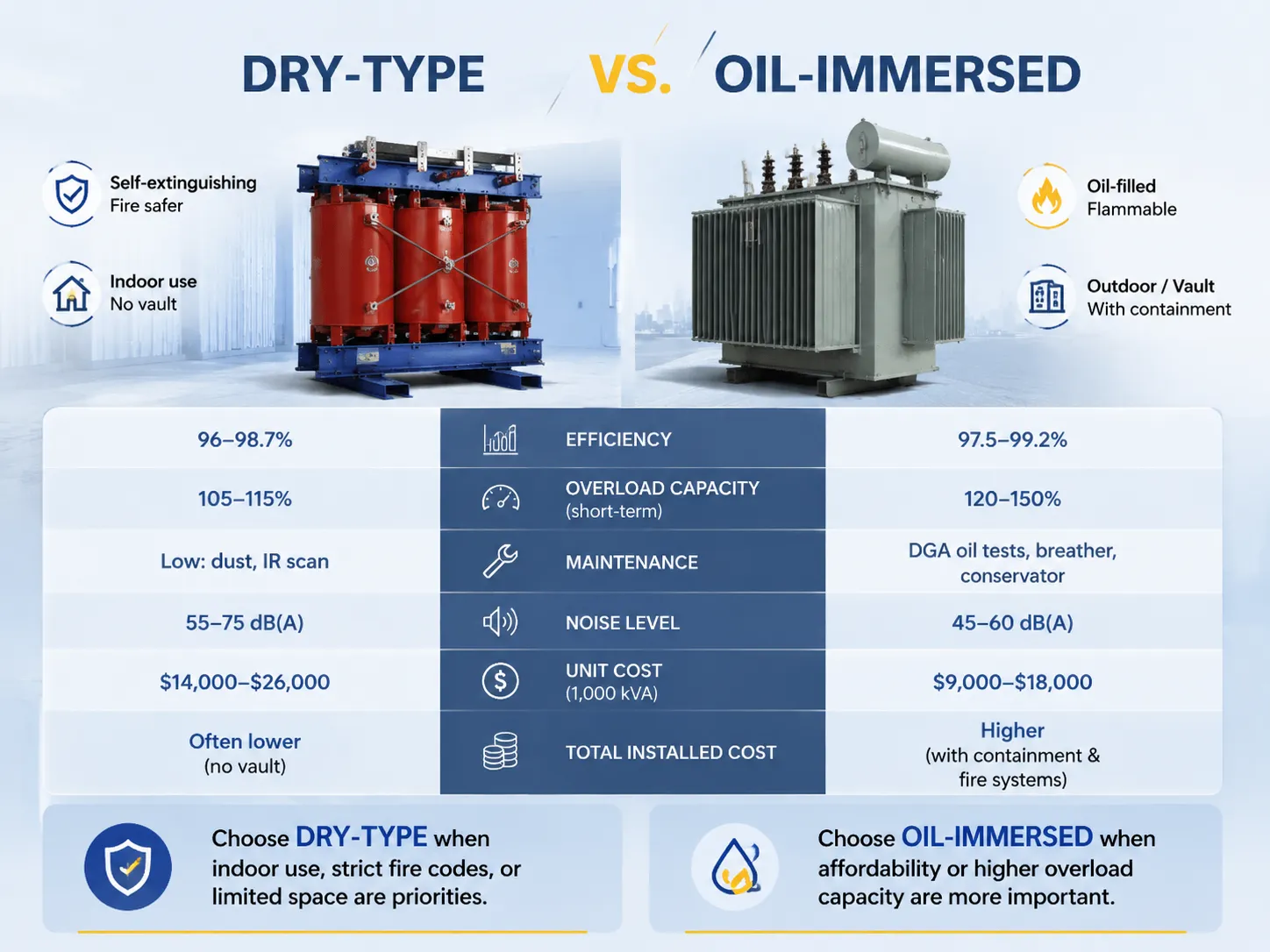
Tipo Seco vs. Imerso em Óleo
| Critério | Seco | Óleo Imerso |
|---|---|---|
| Segurança / incêndio | Materiais autoextinguíveis | Óleo inflamável, contenção necessária |
| Instalação | Interno, sem cofre | Externo ou cofre com contenção/fossa |
| Eficiência | 96–98.7% típico | 5–99.2% típico |
| Sobrecarga | 105–115% a curto prazo | 120–150% a curto prazo |
| Manutenção | Baixo: poeira, varredura IR | Testes de óleo DGA, respirador, conservador |
| Ruído | 55–75 dB(A) | 45–60 dB(A) |
| Custo unitário, 1,000 kVA | $14.000–$26.000 | $9.000–$18.000 |
| Custo total instalado | Muitas vezes mais baixo (sem cofre) | Maior uma vez que sistemas de contenção e incêndio são contabilizados |
Selecione unidades do tipo seco quando o uso interno for necessário ou quando a conformidade com códigos de incêndio rigorosos ou ter um espaço de piso restrito for mais significativo. Selecione unidades preenchidas com óleo quando a acessibilidade ou ter uma maior margem de sobrecarga for mais relevante do que a ideia de instalação interna.
Especificações que você deve verificar
| Parâmetro | O que perguntar | Valor Típico |
|---|---|---|
| Potência nominal | kVA contínuo na temperatura ambiente declarada | 100–2.500 kVA (distribuição) |
| Tensão primária/secundária | Ambos, com faixa de derivação | 11 kV / 0,4 kV; 33 kV / 11 kV, ±2×2.5% |
| Impedância (uk) | Tensão de curto-circuito na corrente nominal | 4–8%, tolerância ±7.5% |
| Perdas | Perda em vazio e perda em carga a 120°C | Veja a tabela de eficiência abaixo |
| Aumento de temperatura | Classe de aumento de enrolamento | 100 K (F) ou 125 K (H) |
| Nível de isolamento | Impulso de relâmpago (LI) e frequência de potência (AC) | por exemplo, 75/28 kV para sistema de 11 kV |
| Nível de ruído | Pressão sonora a 1 m | 55–75 dB(A) |
| Método de resfriamento | AN, AF ou ANAF | Padrão AN; AF adiciona capacidade de 15–20% |
| Normas | Padrão regulamentado e certificado de teste | IEC 60076-1/-11, IEEE C57.12.01 |
Classes de eficiência e valores de perda
| Classificação (kVA) | Perda em vazio (W) | Perda em carga @120°C (W) | Eficiência @100% |
|---|---|---|---|
| 250 | 500–700 | 2,600–3,800 | 98.1–98.6% |
| 630 | 1,000–1,400 | 6,000–8,500 | 98.2–98.8% |
| 1,000 | 1,500–2,100 | 8,900–12,500 | 98.3–98.9% |
| 1,600 | 2,100–3,000 | 13,000–18,000 | 98.5–99.0% |
| 2,500 | 3,000–4,200 | 19,000–26,000 | 98.7–99.1% |
Transformadores de alta eficiência (geralmente feitos de núcleo de metal amorfo ou um melhor grau de aço silício) têm perdas em vazio mais baixas, economizando cerca de 30-60% em comparação com os designs convencionais. Se a máquina estiver energizada o dia todo durante o ano e alimentada por cargas leves, o custo das economias cobriria os custos adicionais de 10-25% do investimento original ao longo de um período de três a seis anos. Os cálculos do retorno do investimento devem ser feitos assumindo os custos de perda de $3.000 a $6.000 para cada kW de perda.
Aplicações em diversos setores
- Edifícios de escritórios e arranha-céus: salas elétricas de subsolo com abordagem de distribuição de 11/0,4 kV, sem uso de óleo.
- Centros de dados: transformadores do tipo seco com classificação de 750–3.000 kVA, usados para as alimentações de painéis de 480/277 V e 208/120 V.
- Fontes renováveis: transformadores de turbinas eólicas com classificação de 1 a 5 MVA dentro da torre e usinas solares que fornecem suprimento auxiliar.
- Transporte ferroviário: transformadores auxiliares de tração que podem operar sob vibrações e umidade dentro de túneis.
- Área marinha: transformadores pequenos de resina fundida que mantêm seu funcionamento sob sprays salgados e condensação.
- Setor industrial: transformadores de isolamento e redução para fins de controle e acionamento de motores.
Principais Marcas e Faixas de Preço
| Marca | País | Preço de 1.000 kVA | Preço de 2.500 kVA | Força |
|---|---|---|---|---|
| ABB | Suíça | $22.000–$36.000 | $40.000–$62.000 | Rede global, monitoramento digital |
| Siemens | Alemanha | $21.000–$35.000 | $38.000–$58.000 | Referência de resina fundida GEAFOL |
| Schneider Electric | França | $22.000–$37.000 | $39.000–$60.000 | Portfólio de eco-design |
| Hitachi Energy | Suíça/Japão | $23.000–$38.000 | $41.000–$65.000 | Resina fundida de alta potência |
| Eaton | Irlanda/EUA | $15.000–$26.000 | $28.000–$45.000 | Linha UL/NEMA, estoque rápido nas Américas |
| CG Power | Índia | $16.000–$28.000 | $29.000–$47.000 | Preços competitivos, alcance EMEA |
| Jiangsu Subian Electric Power | China | $12.000–$22.000 | $22.000–$38.000 | Fábrica direta, OEM/ODM, testado conforme IEC 60076 |
Marcas conhecidas como ABB, Siemens, Schneider Electric e Hitachi Energy cobram preços altos por conexões locais, assistência técnica e muitos anos de comprovação de tecnologia. No entanto, a construção está obsoleta, pois núcleos de aço orientados por grão, resinificação e testes IEC comuns permanecem os mesmos em todos os lugares. Por exemplo, fabricantes como Jiangsu Subian Electric Power fornecem transformadores que atendem aos padrões IEC 60076 a um preço que é de 30% a 50% menor do que os preços oficiais europeus, enquanto enviam seus produtos para mais de 60 locais. Não se pode escolher nada além de dois fabricantes e dois fornecedores locais para comparar custos, incluindo taxas de entrega e inspeção.
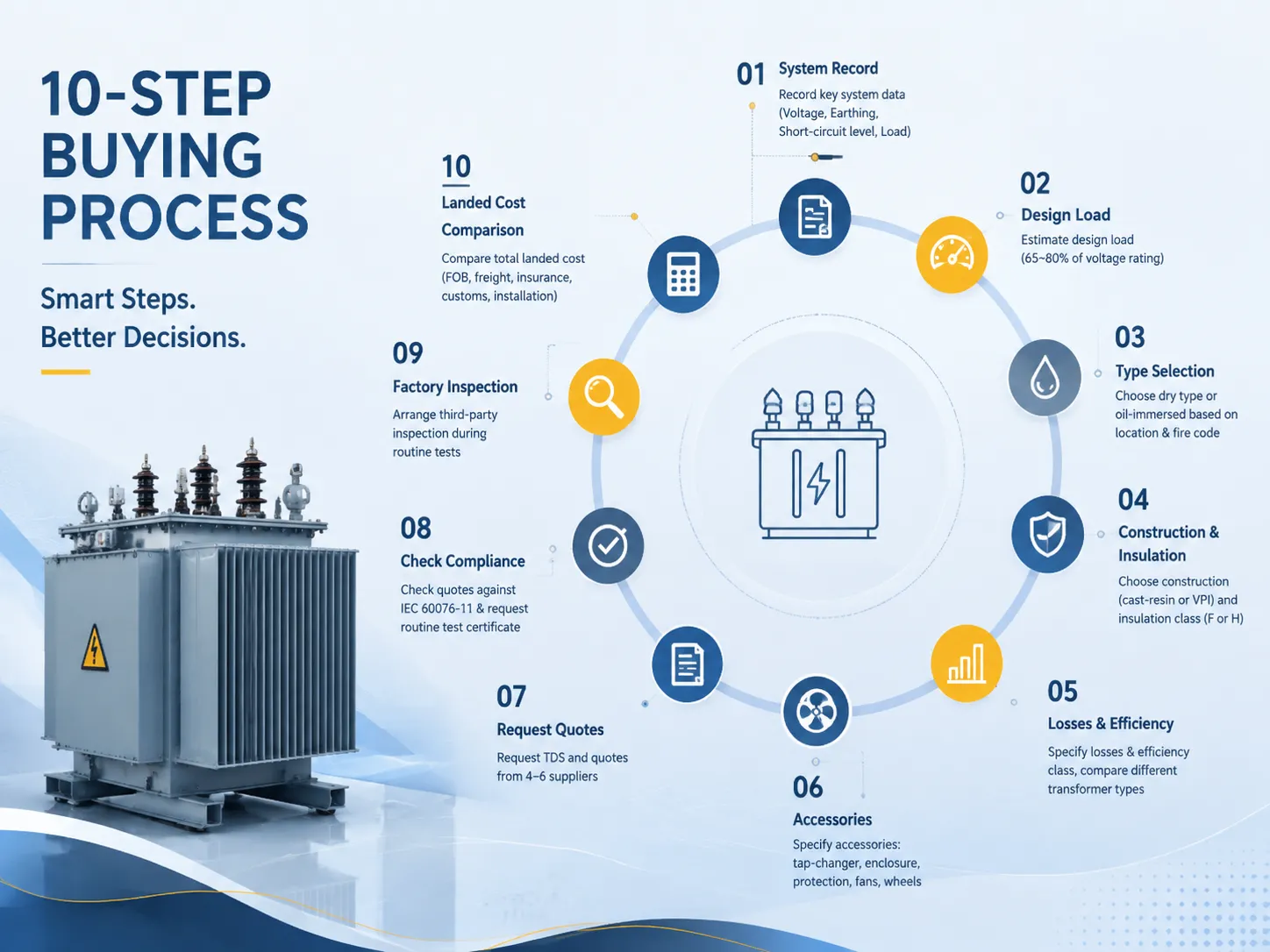
O Processo de Compra em 10 Etapas
- É necessário registrar todos os aspectos do sistema em uso em termos de especificação: tensão nominal, arranjo de aterramento, nível de curto-circuito e carga em kVA e perfil de carga.
- Use um método de cálculo para estimar a carga de projeto de 65~80% da classificação de tensão, alcançando assim a máxima eficiência.
- Escolha transformador do tipo seco ou imerso em óleo com base na localização, código de incêndio e custo de instalação.
- Escolha o método de construção (resina fundida ou VPI) e classe de isolamento (F ou H).
- Especifique perdas e classe de eficiência. Compare perdas com a eficiência de diferentes tipos de transformadores.
- Determine o tipo de acessórios, como chave de derivação, invólucro, proteção termistor/PTC, ventiladores e rodas.
- Solicite uma ficha técnica e cotações de quatro a seis fornecedores.
- Verifique as cotações em relação à IEC 60076-11 e peça o certificado de teste de rotina para a unidade de referência.
- Se possível, organize uma inspeção de terceiros na fábrica durante os testes de rotina (isso custará 1-3% do preço da unidade).
- Usando a fórmula de comparação de custo desembarcado (que inclui não apenas o preço FOB, mas também as taxas de frete, seguro, alfândega e, claro, despesas de instalação) para comparar contatos.
Lendo Cotações e Evitando Armadilhas
- Perdas classificadas como garantidas ou medidas: apenas perdas garantidas que podem ser testadas serão aceitas – uma variação de 10% resulta em avaliação de perda na faixa de $1,500–$4,000 para cada unidade de máquina.
- Tolerância de impedância: o padrão é ±7.5% de acordo com a IEC 60076-1; e uma tolerância maior pode resultar na quebra da coordenação de proteção.
- Base ambiental: deve-se garantir que o ambiente de projeto esteja especificado (normalmente é 40°C); se a cotação for feita a 30°C, isso não é de comparabilidade direta.
- Invólucro e resfriamento: confirme se IP23, ventiladores e a presença de sensores estão incluídos no preço ou declarados separadamente, o que é bastante frequente e aumenta o preço em 8-15%.
- Incoterms: verifique se os preços estão expressos como EXW, FOB ou CIF; cotações expressas como EXW podem ser enganosas, pois parecem realmente baratas, mas depois se revelam o dobro do preço, pois frete e seguro devem ser considerados.
- Documentação: certifique-se de que vários tipos de certificados de teste, relatório de teste de rotina, desenhos e garantia por um ano com condições especificadas serão fornecidos.
Inspeção e Teste de Fábrica
- Observe exames regulares seguindo IEC 60076-1/60076-11: relação de transformação, resistência, perdas em vazio e sob carga, avaliação de IR, exame de alta tensão e descarga parcial (para resina fundida).
- Compare os dados da placa de identificação com os detalhes do pedido: potência nominal, tensão, impedância, perdas, critérios, data de qualquer fabricação.
- Observações fotográficas da condição das bobinas de resina fundida, rastreando quaisquer rachaduras, bolhas ou descoloração de processos de cura anteriores.
- Verifique a dureza dos grampos do núcleo, bem como se os terminais de aterramento estão disponíveis.
- Tire fotos dos números de série, arranjo de teste, bem como da embalagem.
Entrega, Instalação e Manutenção
- O levantamento deve ser feito apenas com ganchos de elevação classificados e não usando cintas em buchas, bobinas e proteções de ventilador.
- Armazene em ambientes internos, e se o período de armazenamento for superior a 6 meses, um teste de IR deve ser realizado e uma energização deve ser feita por 4-6 horas sob condição de não carga previamente.
- Coloque sobre uma base plana que tenha pelo menos 600-700 mm de altura na frente com 200-300 mm de folga na parte de trás para fluxos de ar.
- Meça o IR antes da operação de energização; se menos de 100 MΩ a 500 V for medido, seque-o.
- Realize a varredura infravermelha pela primeira vez em 30 dias após a comissionamento e depois trimestralmente; aperte as conexões soltas com mais de 20 K de diferença de temperatura.
- Realize a limpeza dos dutos e aletas do radiador uma vez por ano usando um pequeno grau de limpeza a vácuo.
Perguntas Frequentes
Quanto custa um transformador de tipo seco por kVA?
O custo dos transformadores de resina fundida varia de aproximadamente $14 a $26 por kVA para unidades com potências variando de 630 a 2000 kVA, e as faixas de preço para transformadores VPI variam de $9 a $18 por kVA quando vinculados à fábrica. Um transformador típico de resina fundida com uma potência nominal de 1000 kVA custará entre $14.000 e $26.000, excluindo impostos que variam de 10 a 15% para frete, taxas de desembaraço aduaneiro e despesas de instalação. Os preços variam de acordo com a marca, especificações e diferenças geográficas.
Qual é a diferença entre transformadores de resina fundida e transformadores de tipo seco VPI?
Materiais de enrolamento e epóxi podem ser encontrados em transformadores de resina fundida. Este tipo único de transformador oferece um grau extremamente alto de proteção contra umidade sem comprometer o desempenho nas operações, uma vez que proporciona baixa descarga parcial de menos de 10 pC. É definitivamente recomendado para instalações em áreas úmidas ou propensas a incêndios.
Um transformador de tipo seco pode ser instalado ao ar livre?
Sim, desde que a unidade tenha invólucros adequados (normalmente IP54 ou IP55 à prova de intempéries), pode ter tiras de aquecimento para controlar a condensação e um telhado solar. Unidades classificadas para uso interno, como IP23, instaladas ao ar livre deteriorarão o isolamento e causarão falha de rastreamento do isolamento. Unidades secas classificadas para uso externo custam cerca de 10 a 20 por cento a mais do que unidades internas de design semelhante.
Quanto tempo duram os transformadores secos?
Quando usados sob as condições de temperatura apropriadas e mantidos limpos, os transformadores do tipo resina fundida geralmente duram mais de 25 a 30 anos em vida útil. A vida útil do isolamento diminui cerca de duas vezes para cada aumento de temperatura que excede os valores padrão em 8 a 10°C. Portanto, para preservar seu equipamento, é recomendado manter a temperatura das bobinas dentro dos limites dados na especificação.
Por que os transformadores secos são mais caros do que os preenchidos com óleo?
O preço dos materiais necessários para transformadores do tipo seco é mais alto devido à resina epóxi e ao isolamento classe H em vez de óleo de transformador a granel, e os tipos secos precisam de condutores mais substanciais, pois a refrigeração a ar é menos eficiente do que a refrigeração a óleo. Ao mesmo tempo, ao fazer ajustes no cofre, contenção de óleo e extensão dos sistemas de supressão de incêndio, o custo total do sistema seco tende a ser menor, mesmo em locais internos.
Referências
- IEC 60076-11: Transformadores de Potência – Transformadores Secos — norma básica para classificações, perdas, aumento de temperatura e testes de unidades secas.
- IEC 60076-1: Requisitos Gerais — abrange valores nominais, tolerâncias e procedimentos gerais de teste para transformadores de potência.
- IEEE C57.12.01: Transformadores de Distribuição e Potência Secos — Requisitos e métodos de teste da América do Norte.
- NEMA TP-1: Guia para Determinar a Eficiência Energética de Transformadores de Distribuição — o benchmark de eficiência utilizado em licitações na América do Norte.
- Eficiência de Transformadores de Distribuição do U.S. DOE — explica as regulamentações de eficiência mínima e avaliação de perdas.
- NFPA 70 (NEC) — requisitos de instalação e espaço livre para locais de transformadores.
- Jiangsu Subian Electric Power — fabricante de transformadores do tipo seco em conformidade com IEC 60076, oferecendo linhas de resina fundida e VPI com suporte OEM.
Conclusão
Uma compra bem-sucedida de um transformador do tipo seco depende do tipo de especificação que você fornece, da completude de suas cotações e da qualidade da inspeção de fábrica. Transformadores do tipo seco são tecnologia comprovada; você diferencia uma compra favorável de uma compra cara com base em verificações de perdas, impedância, classe de aumento de temperatura e conformidade com normas, em vez de depender de uma ficha técnica.
- Articule a conformidade com IEC 60076-11, nível de perdas e submissões de teste por escrito.
- Faça uma comparação do custo total de propriedade com o preço desembarcado e inclua uma estimativa de perda de $3,000-$6,000 por kW.
- Além disso, esteja preparado para pagar um adicional de 10-15% sobre o preço para logística.
Independentemente de você estar comprando de líderes de mercado como ABB e Siemens, ou diretamente da Jiangsu Subian Electric Power, o contrato deve especificar as normas utilizadas, os testes necessários e as disposições de garantia.