


Vor einem kürzlich gelieferten 500 kVA Verteilungstransformator an Ihrem Umspannwerk stehen Sie vor einem Übergabeprotokoll, das zwanzig Details auflistet, mit denen Sie kaum vertraut sind. Doch selbst wenn Sie sich in Bezug auf die Hauptteile des Transformators ratlos fühlen, bedeutet die Tatsache, dass der Transformator mit einer 12-monatigen Garantie geliefert wird, nichts, da Sie nicht feststellen können, ob der Kern von einem zugelassenen Werk produziert wurde oder ob die Durchführungen den Anforderungen der IEC 60137 Norm entsprechen. Die Wissenslücke zeigt sich oft in Form von heißen Ölwerten, fehlerhaften Lastschaltern oder erfolglosen Dielektriktests.
Dieser Artikel beschreibt die Hauptkomponenten eines Transformators für potenzielle Käufer – vom Kern über den Konservator bis hin zu Kühlkörpern und verschiedenen Arten von Zubehör. Sie werden den Zweck jedes Teils sowie die geltenden Normen entdecken, auf die Sie achten sollten, zusammen mit den geschätzten Preisen für 2024.
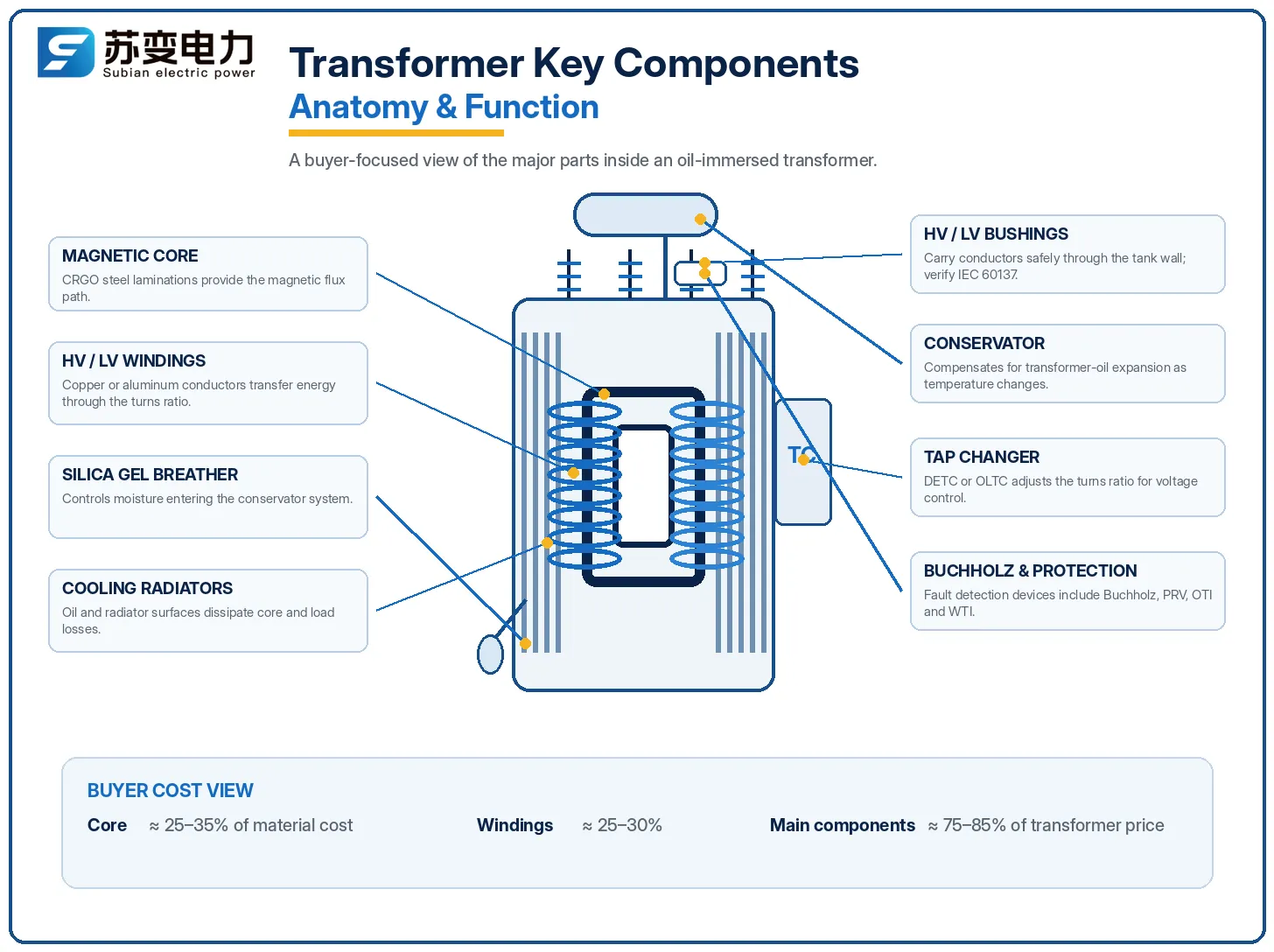
Was sind die Hauptkomponenten eines Transformators?
Durch elektromagnetische Induktion bietet der Kern des Transformators ein Mittel zur Übertragung von Elektrizität zwischen Schaltungen, mit nur drei wesentlichen Teilen: der Kern bietet den optimalen Weg für den Fluss, die Wicklungen leiten Elektrizität und das Isolationssystem sorgt dafür, dass die beiden Schaltungen getrennt bleiben.
Für ölgetauchte Transformatoren umfassen die wesentlichen Komponenten:
– Kern – besteht aus gestapelten oder gewickelten Lamellen aus elektrischen Stahl, die kornorientiert (CRGO-Typ) sind, mit einer Dicke von 0,23 bis 0,35 mm und einem Siliziumgehalt von etwa 3%.
– Wicklung – besteht aus Kupfer- oder Aluminiumdraht, der in konzentrischen oder gestapelten Schichten angeordnet werden kann, die Wicklung ist mit Papier, Emaille oder Nomex für die trockenen Typen isoliert.
– Abgriff – kann entweder in Form von abgekoppelten Lastschaltern, auch bekannt als toter Abgriffschalter (DETC), oder als unter Last arbeitende Abgriffschalter (OLTC) vorliegen.
– Durchführungen – entweder aus Porzellan oder Epoxid-/Kriechmaterialien, die verwendet werden, um Strom durch die Abdeckung des Transformators zu führen, bewertet gemäß IEC 60317.
– Tank – ein Gehäuse, das mit einem Ausdehnungsgefäß für die Stabilität des Öls je nach Temperaturänderung ausgestattet ist.
– Kühlsystem – umfasst Merkmale wie gewellte Lamellen, Konvektionskühler und Ölpumpe zur Zirkulation des Öls.
– Schutzvorrichtungen – umfasst Buchholz-Relais, Druckentlastungsgeräte und Öltemperaturanzeigen (OTI).
Die Definition kann Käufern helfen, da jede dieser Komponenten ihre eigenen relevanten Normen hat und unterschiedliche Fehler auftreten können.
Wie Transformator-Komponenten zusammenarbeiten.
Wenn eine Wechselspannung an die Primärwicklung angelegt wird, magnetisiert sie den Kern und induziert eine Spannung in der Sekundärwicklung, die proportional zum Übersetzungsverhältnis ist. Der Kern konzentriert den magnetischen Fluss, sodass die Kopplung zwischen den Wicklungen nahezu perfekt ist, und der Abgriffwechsler passt das Übersetzungsverhältnis an, um Abweichungen der Netzspannung auszugleichen. In der Zwischenzeit entfernt das Kühlsystem die durch I²R-Verluste in den Wicklungen und Kernverluste durch Hysterese und Wirbelströme erzeugte Wärme.
Ein typischer 1.000 kVA ölgetauchter Transformator, der bei voller Last läuft, erzeugt etwa 8-12 kW Gesamtschäden, die grob 60/40 zwischen Lastverlusten und Leerlaufverlusten aufgeteilt sind. Die Kühler und die natürliche Ölkonvektion bewältigen die ONAN-Kühlung bis etwa 2.500 kVA; darüber hinaus erhöhen Ventilatoren (ONAF) die Kapazität um 30-35%, und die erzwungene Ölzirkulation (OFAF) wird bei großen Leistungstransformatoren eingesetzt. Das Buchholz-Relais sitzt in der Leitung zwischen dem Tank und dem Konservator und schaltet bei Gasansammlungen über 250-300 cm³ oder Ölströmungen über 1 m/s ab, um interne Fehler zu erfassen, bevor sie katastrophal werden.
Dieses Verständnis der Wechselwirkungen hilft Ihnen, einen Prüfbericht zu lesen. Wenn der Leerlaufverlust die IEC 60076-1 Toleranz von +15% überschreitet, während das Übersetzungsverhältnis korrekt ist, ist der Kernstahl verdächtig. Wenn die Impedanzspannung außerhalb des ±7.5% Toleranzbereichs liegt, wurden die Wicklungsgeometrie oder Isolationsabstände geändert, was auch die mechanische Festigkeit unter Kurzschlussbedingungen beeinflusst.
Kernkomponenten nach Funktion
| Bauteil | Funktion | Typisches Material / Typ | Relevanter Standard |
|---|---|---|---|
| Kern | Bietet magnetischen Flussweg | CRGO Siliziumstahl, 0,23-0,35 mm Laminate | IEC 60076-1, IEEE C57.12.00 |
| Wicklungen | Überträgt Energie über das Übersetzungsverhältnis | Elektrolytisches Kupfer oder Aluminium, papier/CTP isoliert | IEC 60076-1 |
| Abgriffschalter | Passt das Übersetzungsverhältnis zur Spannungsregelung an | Abgeschaltet (DETC) oder unter Last (OLTC) | IEC 60214-1 |
| Durchführungen | Führt Leiter durch die Tankwand | Porzellan, Verbundwerkstoff, RIP; bis zu 1.050 kV Klasse | IEC 60137 |
| Isolationssystem | Elektrische Isolation + Kühlmittel | Mineralöl, Esterflüssigkeit, Pressspan, Papier | IEC 60296 |
| Kühlradiatoren | Dissipiert Kern- + Lastverluste | Lamellenradiatoren, Ventilatoren, Ölpumpen | IEC 60076-2 |
| Konservator & Entlüfter | Kompensiert die Ölerweiterung; entfernt Feuchtigkeit | Gummimembran, Silikagel | IEC 60076-1 |
| Schutzvorrichtungen | Erkennt Fehler, schützt das Asset | Buchholz-Relais, PRV, OTI/WTI | IEC 60076-22-1 |
Hauptkomponenten vs. Zubehör
Die Unterscheidung zwischen “Schlüsselkomponenten” und “Zusatzteilen” beeinflusst Ihren Ansatz zur Preisverhandlung erheblich. Wenn es einen Fehler in einer Schlüsselkomponente gibt, führt dies normalerweise zu einer vollständigen Neuwicklung oder dem Austausch des Kerns, im Gegensatz zu einem Ausfall eines Zusatzteils, der normalerweise einen einfachen Austausch des Teils erfordert. In diesem Zusammenhang hängt Ihr Ersatzteilbestand und Ihre Gesamtkosten stark von der Unterscheidung zwischen diesen beiden Gruppen ab.
| Aspekt | Hauptkomponenten | Zubehör |
|---|---|---|
| Beispiele | Kern, Wicklungen, Tank, Durchführungen, Abgriffwechsler | Thermometer, Entlüfter, Ventile, Räder, Typenschild |
| Anteil am Transformatorpreis | 75-85% | 15-25% |
| Folgen eines Ausfalls | Unit out of service for weeks | Replaced on site in hours |
| Typical lifecycle | 25-40 years | 5-15 years (relays, gaskets) |
| Factory test focus | Full routine tests per IEC 60076-1 | Visual, functional, calibration |
A prevalent error involves requesting a “fully fitted” quote while neglecting to declare any accessories, and then learning that attachments cost extra. Include in your technical specification the name of every accessory for price comparisons.
Component Specifications to Check
When you receive a transformer datasheet, these are the component-level numbers that deserve your attention before you compare prices:
| Parameter | What to Verify | Typical Value (1,000 kVA, 11/0.4 kV) |
|---|---|---|
| Leerlaufverlust | Core steel grade and joint quality | 1,100-1,600 W |
| Lastverlust | Winding material and conductor sizing | 10,000-13,000 W |
| Impedanzspannung | Short-circuit withstand design | 5.0-6.0% |
| Abgriffbereich | OLTC steps and voltage band | ±5% in 2.5% steps, or 15-17 steps for OLTC |
| Isolationsniveau | LI/AC withstand for the system class | 75/28 kV for 12 kV class |
| Oil quality | Breakdown voltage before filling | ≥50 kV per IEC 60296 for new oil |
| Temperaturanstieg | Cooling design margin | 65 K top oil, 78 K hot spot (IEC) |
It is advisable for you to request a certification of core steel (such as Baosteels 23ZH90 or 27ZH100, Nippon Steel or ThyssenKrupp) and a copper conductor certificate confirming that its conductivity is 99.9%, since these two documents reveal the most popular tricks to cut costs in the industry. The most common schemes include the use of recycled copper and the downgrading of the lamination thickness to 0.35 mm, which makes it possible to increase no-load losses by 10-15%.
Applications Across Voltage Levels
Despite having similar elements, the components they use and their configuration differ from one application to another. For example, distribution transformers require high overload capacity and low maintenance; hence, they use ONAN cooling, off-circuit tap changers, and standard CRGO cores. Meanwhile, in case of power transformers, due to high costs of failures, the power transformers require OLTC voltage regulation, forced cooling, and conservators with Buchholz protection.
Renewable projects have their own issues to deal with. For instance, wind and solar farms use special step-up transformers that need to support fluctuating loads and switching. Additionally, energy storage makes the transformers work in a bidirectional way which gives stress on the tap changers and bushings.
Top Brands & Price Ranges for Components
When it comes to distribution transformers, it is uncommon to purchase components individually, rather you tend to buy the ready to use unit. However, when purchasing spare parts or specifications, knowing the pricing bands can help with bargaining. Below listed prices stand for the indicative price ranges for the year 2024 and are adjusted depending on the specification, brand, and region.
| Artikel | Brands / Suppliers | Preisspanne | Anmerkungen |
|---|---|---|---|
| CRGO core steel | Baosteel, Nippon Steel, ThyssenKrupp | $1,500-$3,200 / ton | Grade 23ZH90 higher cost |
| Copper winding wire | Luvata, Liljedahl, local mills | $8,500-$10,500 / ton | Tracks LME copper |
| Off-circuit tap changer | ABB, Reinhausen, Shanghai Huaming | $200-$1,500 / unit | Low voltage rating cheaper |
| Lastabgriffwechsel (OLTC) | Reinhausen, ABB, Hitachi Energy | $3,000-$15,000 / unit | Vacuum type at the high end |
| HV bushings | ABB, HSP, Trench, local ceramic makers | $150-$3,000 / unit | Depends on voltage and creepage |
| Buchholz-Relais | MR, Comem, JD, local brands | $80-$400 / unit | Gas and surge trip thresholds |
| Complete 100 kVA transformer | Jiangsu Subian Electric Power, TBEA, local OEMs | $2,500-$5,000 FOB | Oil-immersed, standard CRGO |
| Complete 1,000 kVA transformer | Jiangsu Subian Electric Power, TBEA, local OEMs | $15,000-$30,000 FOB | Depends on loss guarantee |
Companies like ABB, Siemens, and Schneider take the lead among manufacturers of OLTCs, bushings, and relays, and they are known for their reliability and quality. In the case of large distribution transformers, the companies that serve this market in North America and Europe are Hitachi Energy and Prolec GE. When customers face the choice between high-quality products of OEMs and price, they increasingly tend to buy from Jiangsu Subian Electric Power, which produces oil-immersed and dry-type distribution transformers that meet the requirements of IEC 60076 and export its products to customers in Asia, Africa, the Middle East, and South America. What is crucial is to base the buying decision on tests and not on prices.
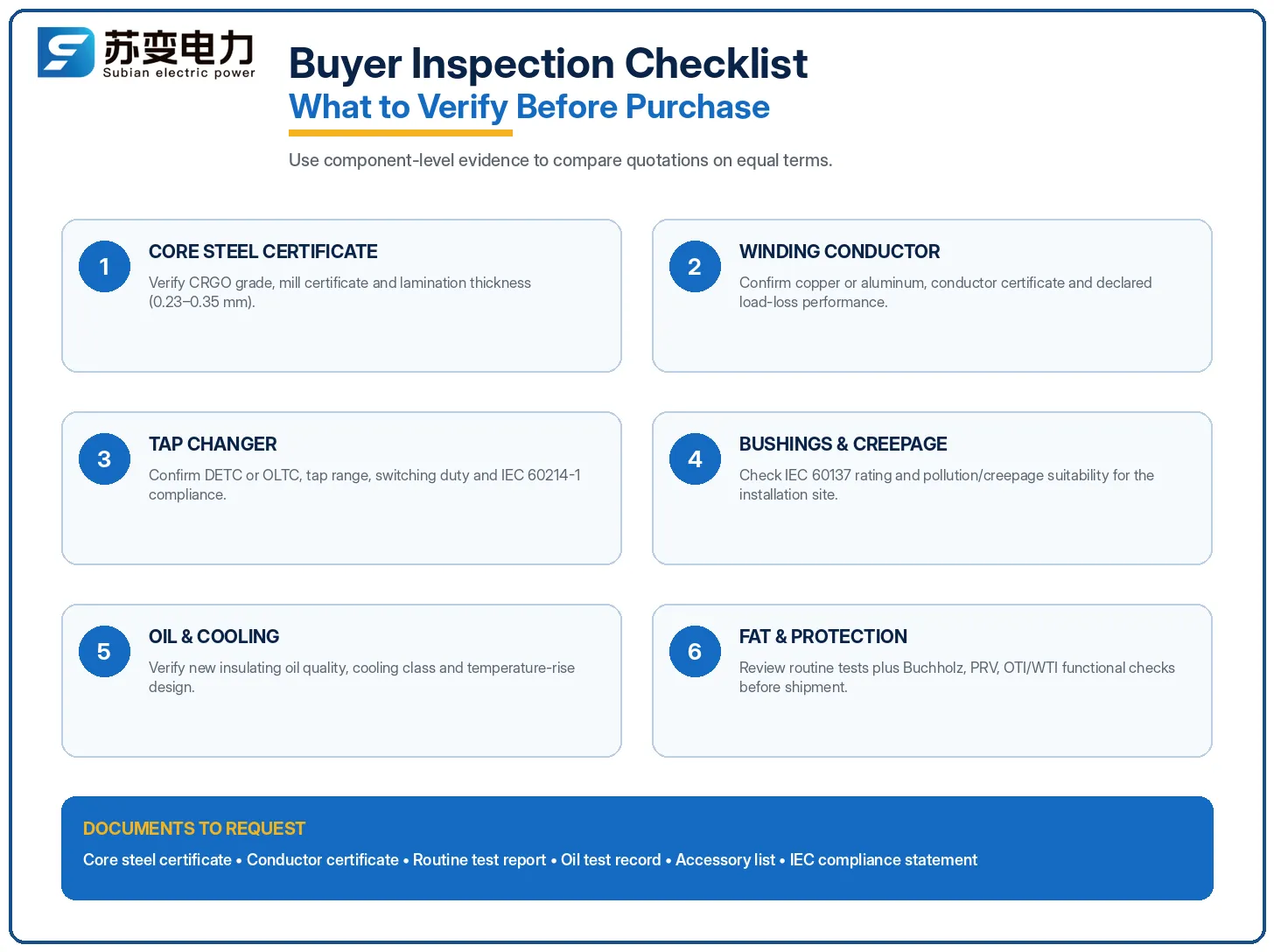
How to Choose Components as a Buyer
Follow this checklist when you evaluate a transformer quotation so the components match your real operating conditions:
- Define the loss budget first. Losses are capitalized over 20-30 years; a 1 kW difference at $0.10/kWh costs roughly $8,760 a year. Set the allowable no-load and load losses before asking for prices.
- Confirm the core steel grade. Ask for the mill certificate. 0.23-0.27 mm high-grade CRGO lowers no-load loss but adds 5-10% to cost; it pays back where the transformer runs lightly loaded.
- Choose winding material deliberately. Copper windings cost more but resist overloads better and are standard for critical loads; aluminum is acceptable for lightly loaded rural distribution where initial cost dominates.
- Match the tap changer to the grid. If your supply voltage fluctuates more than ±5%, invest in an OLTC. For stable grids, an off-circuit tap changer at ±2.5% and ±5% is enough.
- Specify bushings for your environment. Coastal and industrial sites need creepage-extended bushings (specific creepage ≥ 25 mm/kV for high pollution class per IEC 60815).
- Check the cooling class against the load profile. ONAN is fine for most distribution duty; ask for ONAF capability if you expect peak overloads.
- Ask for the spare parts list. A sensible package includes one set of gaskets, a spare breather, and spare temperature indicators so you are not waiting weeks for a failure.
Factory Inspection & Maintenance
Prior to dispatch, it is advisable to make it a point to be part of the factory acceptance test or FAT at least once if not conduct a review of the same. The standard tests according to the standards of IEC 60076-1 entails measurement of winding resistance, turns ratio, load loss, no-load loss, various dielectric tests, and a temperature-rise test on a sample unit. If the MVA (Megavolt Ampere) is above 3.15 MVA you must insist on obtaining the short-circuit withstand test which ensures that the winding systems can withstand such a fault.
Once the device is in use the parts that require attention do not change. Make sure to check the silica gel breather every month and change it once 60-70% of the crystals are colored. You are also required to sample the oil every year for breakdown voltage, acidity, as well as dissolved gas analysis (DGA). The oil is considered to be alright if it has a minimum breakdown voltage of 50 kV and no increase in the hydrogen or acetylene levels. You should also check the surface of bushing for tracking every time there is an outage and use the off circuit tap changers once a year as corrosion occurs if the contacts are left static.
| Maintenance Task | Häufigkeit | Component Covered |
|---|---|---|
| Breather check / gel replacement | Monatlich | Conservator, breather |
| Oil sampling and DGA | Jährlich | Isolationssystem |
| Thermal scan of terminals | Every 6 months | Bushings, cable boxes |
| Tap changer exercise | Jährlich | DETC / OLTC |
| Relay function test | Every 2 years | Buchholz, PRV, OTI/WTI |
| Dissolved gas trending review | Jährlich | Core and winding health |
Häufig gestellte Fragen
Which transformer component fails most often?
Reports about utility failures frequently identify bushings and tap changers as the components with the highest failure rates. Together, they comprise approximately 20% to 30% of all transformer forced outages. This is also the reason that creepage-extended bushings and the yearly operation of savers are beneficial in polluted environments.
What is the difference between a DETC and an OLTC?
DETC can only be turned on when the transformer is out of service and usually comes with its three or five positions providing an output of ± 2.5% and ±5% respectively. OLTC is designed to operate while under load with numerous switches, up to 17 or 27 positions and costs in the range of $3,000-$15,000 depending on the power rating. If automatic voltage regulation is required or if the voltage deviation exceeds ±5%, OLTC should be applied; otherwise, use of a DETC is more appropriate.
Why is the core the most expensive single component?
The CRGO core steel represents about 25-35% of transformer material cost because the quantity is large and the steel itself is expensive. A 1,000 kVA unit uses roughly 1.2-1.8 tons of core steel, which at $1,500-$3,200 per ton adds up fast. The grade choice matters: moving from 0.35 mm to 0.23 mm laminations cuts no-load loss by 10-15% but raises steel cost by 5-10%.
How much do replacement bushings cost?
A 12 kV class bushing for a distribution transformer typically costs $150-$500, while 33 kV class bushings run $500-$1,500 and 110 kV class units reach $2,000-$3,000 or more. The price depends on insulation type (porcelain vs. composite), creepage length for pollution class, and whether it includes a current transformer for protection metering.
Can I buy a transformer without an OLTC and save money?
It is true that an OLTC adds about 8-15% to the total cost of the transformer. You could save the cost of the OLTC if the incoming voltage is stable constantly as well as the load requirements. The OLTC is also beneficial for renewable or commercial loads since there are fluctuations in the voltage levels.
Referenzen
- IEC 60076-1: Power transformers – General – The core international standard covering ratings, test methods, and tolerances for power and distribution transformers.
- IEC 60214-1: Tap-changers – Performance and test requirements for on-load and off-circuit tap changers.
- IEC 60137: Insulated bushings for alternating voltages above 1,000 V – Dimensional, dielectric, and pollution requirements for bushings.
- IEC 60296: Fluids for electrotechnical applications – Unused mineral insulating oils – Oil quality parameters including breakdown voltage and acidity limits.
- IEEE Std C57.12.00 – General requirements for liquid-immersed distribution, power, and regulating transformers used in North American markets.
- NEMA standards for transformers – North American energy-efficiency and construction standards, including NEMA TP-1 for distribution transformers.
- Jiangsu Subian Electric Power – IEC 60076-certified transformer manufacturer offering oil-immersed and dry-type distribution and power transformers.
Fazit
When it comes to transformers, it is crucial to know about components when spending money. The key components of the transformer, namely, core, winding, tap changer, bushings and cooling system, enables its efficiency and reliability, and the cost of these components makes up 80 to 90% of the price. A buyer’s loss budget should be determined first, and then he should check the steel core and copper certificates, ensure that the components meet the requirements of the specific grid and environment, and only then he should ask for test reports and make the payment.
In case whether you are looking to buy distribution transformers or power transformers, Jiangsu Subian Electric Power manufactures transformers that conform to the standards of IEC 60076 and offers detailed information on the components and test reports. All you need to do is to submit your loss budget and the relevant information about the operating conditions.