


Se tenant devant un transformateur de distribution de 500 kVA récemment livré sur votre site de sous-station, vous êtes confronté à une feuille de remise d'usine énumérant vingt détails que vous connaissez à peine. Cependant, même si vous vous sentez perdu par rapport aux principales parties du transformateur, le fait que le transformateur soit accompagné d'une garantie de 12 mois ne signifie rien, car vous êtes incapable de déterminer si le noyau a été produit par un fabricant approuvé ou si les isolateurs sont conformes aux exigences de la norme IEC 60137. Le manque de connaissances se manifeste souvent sous la forme de lectures d'huile chaude, de changeurs de prises défectueux ou de tests diélectriques infructueux.
Cet article décrit les principales composants d'un transformateur pour les acheteurs potentiels – du noyau au conservateur et des radiateurs de refroidissement à divers types d'accessoires. Vous découvrirez l'objectif de chaque partie ainsi que les normes applicables, les défauts auxquels vous devez prêter attention, ainsi que les prix estimés pour 2024.
Quels sont les principaux composants d'un transformateur ?
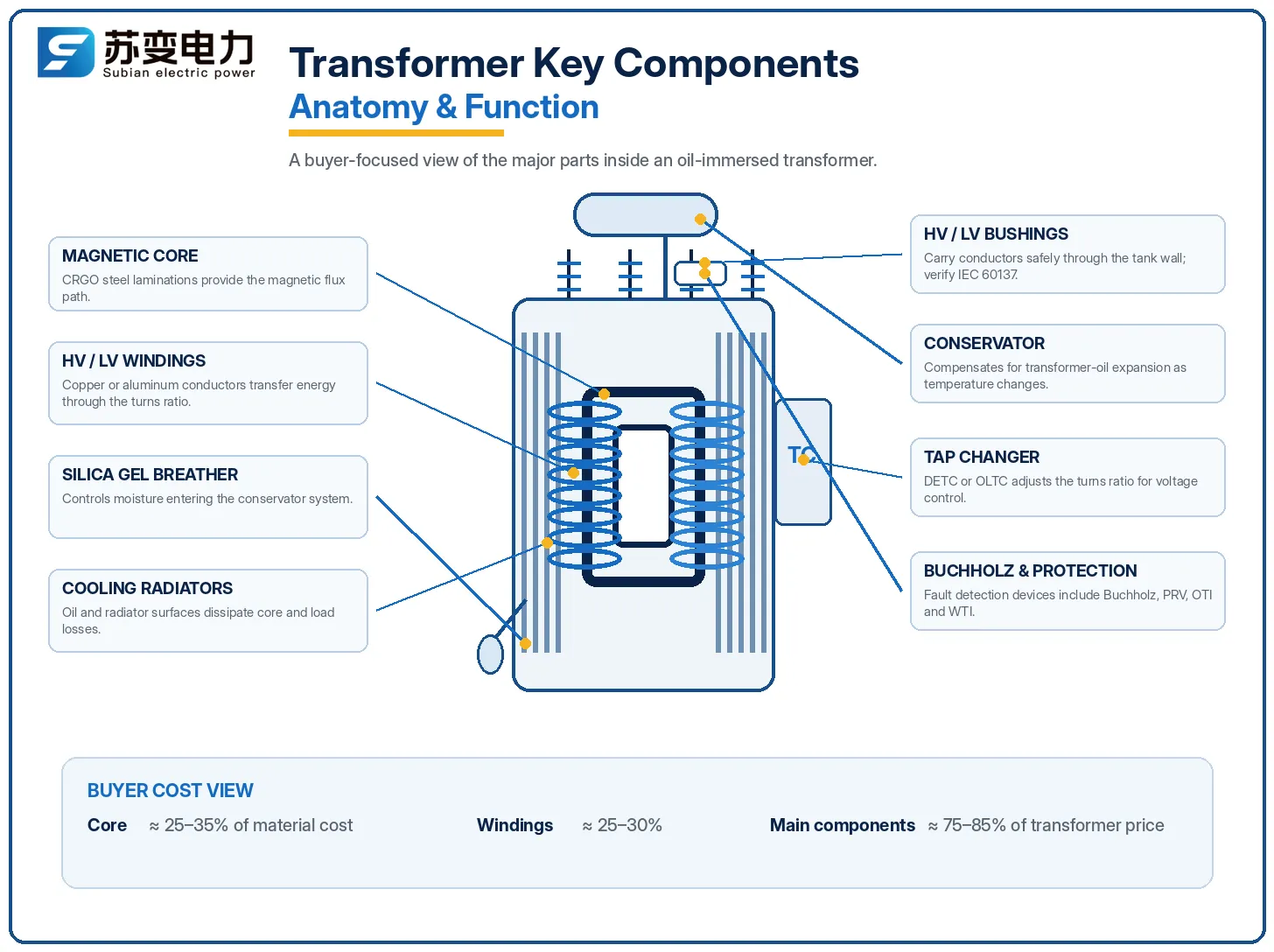
Utilisant l'induction électromagnétique, le noyau du transformateur fournit un moyen de transmettre l'électricité entre les circuits, avec seulement trois parties essentielles : le noyau fournit le chemin optimal pour le flux, les enroulements conduisent l'électricité, et le système d'isolation garantit que les deux circuits sont maintenus séparés.
Pour les transformateurs immergés dans l'huile, les composants essentiels comprennent :
– Noyau – constitué de laminations empilées ou enroulées d'acier électrique orienté (type CRGO), dont l'épaisseur varie entre 0,23 et 0,35 mm, avec une teneur en silicium d'environ 3%.
– Enroulement – constitué de fil de cuivre ou d'aluminium pouvant être disposé en couches concentriques ou empilées, l'enroulement est isolé à l'aide de papier, d'émail ou de Nomex pour les types secs.
– Prise – peut être sous la forme de changeurs de prises hors circuit, également connus sous le nom de changeur de prises à vide (DETC), ou de changeurs de prises sous charge (OLTC).
– Isolateur – soit en porcelaine, soit en matériaux de type époxy/creepage utilisés pour faire passer le courant à travers le couvercle du transformateur, classés selon la norme IEC 60317.
– Réservoir – une enceinte équipée d'un vase d'expansion pour la stabilité de l'huile en fonction des variations de température.
– Système de refroidissement – comprend des caractéristiques telles que des ailettes ondulées, des refroidisseurs à convection et une pompe à huile pour faire circuler l'huile.
– Dispositifs de protection – inclut le relais Buchholz, le dispositif de décharge de pression et l'indicateur de température de l'huile (OTI).
La définition peut être utile aux acheteurs, car chacun de ces composants a ses propres normes pertinentes et peut connaître différentes pannes.
Comment les composants du transformateur fonctionnent ensemble.
Lorsque une tension alternative est appliquée à l'enroulement primaire, elle magnétise le noyau et induit une tension dans l'enroulement secondaire proportionnelle au rapport de transformation. Le noyau concentre le flux magnétique, de sorte que le couplage entre les enroulements est presque parfait, et le changeur de prises ajuste le rapport de transformation pour compenser la dérive de tension du réseau. Pendant ce temps, le système de refroidissement élimine la chaleur générée par les pertes I²R dans les enroulements et les pertes dans le noyau dues à l'hystérésis et aux courants de Foucault.
Un transformateur typique de 1 000 kVA immergé dans l'huile fonctionnant à pleine charge produit environ 8-12 kW de pertes totales, réparties à peu près 60/40 entre les pertes de charge et les pertes à vide. Les radiateurs et la convection naturelle de l'huile gèrent le refroidissement ONAN jusqu'à environ 2 500 kVA ; au-delà, des ventilateurs (ONAF) augmentent la capacité de 30-35%, et la circulation forcée de l'huile (OFAF) est utilisée sur les grands transformateurs de puissance. Le relais Buchholz se trouve dans le tuyau entre le réservoir et le conservateur et se déclenche en cas d'accumulation de gaz au-dessus de 250-300 cm³ ou de montée d'huile au-dessus de 1 m/s, détectant les défauts internes avant qu'ils ne deviennent catastrophiques.
Comprendre cette interaction vous aide à lire un rapport de test. Si la perte à vide dépasse la tolérance IEC 60076-1 de +15% alors que le rapport de transformation est correct, l'acier du noyau est suspect. Si la tension d'impédance est en dehors de la bande de tolérance de ±7.5%, la géométrie des enroulements ou les distances d'isolation ont été modifiées, ce qui déplace également la résistance mécanique sous conditions de court-circuit.
Composants du noyau par fonction
| Composant | Fonction | Matériau / Type typique | Norme pertinente |
|---|---|---|---|
| Noyau | Fournit un chemin pour le flux magnétique | Acier au silicium CRGO, laminations de 0,23-0,35 mm | IEC 60076-1, IEEE C57.12.00 |
| Enroulements | Transfère l'énergie via le rapport de transformation | Cuivre ou aluminium électrolytique, isolé en papier/CTP | IEC 60076-1 |
| Changeur de prises | Ajuste le rapport de transformation pour le contrôle de la tension | Hors circuit (DETC) ou sous charge (OLTC) | IEC 60214-1 |
| Bagues | Transporte les conducteurs à travers la paroi du réservoir | Porcelaine, composite, RIP ; jusqu'à la classe 1 050 kV | IEC 60137 |
| Système d'isolation | Isolation électrique + milieu de refroidissement | Huile minérale, fluide ester, carton pressé, papier | IEC 60296 |
| Radiateurs de refroidissement | Dissipe les pertes dans le noyau + les pertes de charge | Radiateurs de type ailettes, ventilateurs, pompes à huile | IEC 60076-2 |
| Conservateur & respirateur | Compense l'expansion de l'huile ; élimine l'humidité | Diaphragme en caoutchouc, gel de silice | IEC 60076-1 |
| Dispositifs de protection | Détecte les défauts, protège l'actif | Relais Buchholz, PRV, OTI/WTI | IEC 60076-22-1 |
Composants principaux vs. accessoires
Reconnaître la différence entre les “ composants clés ” et les “ ajouts ” affecte considérablement votre approche de la négociation des prix. Chaque fois qu'il y a un défaut dans un composant clé, cela entraîne généralement un ré-enroulement complet ou un remplacement de son noyau, contrairement à une défaillance d'un ajout qui nécessite normalement un simple remplacement de la pièce. Dans ce contexte, votre stock de pièces de rechange et votre coût total de possession dépendent grandement de la distinction entre ces deux groupes.
| Aspect | Composants principaux | Accessoires |
|---|---|---|
| Exemples | Noyau, enroulements, réservoir, bushing, changeur de prises | Thermomètres, respirateur, vannes, roues, plaque signalétique |
| Part du prix du transformateur | 75-85% | 15-25% |
| Conséquence de la défaillance | Unité hors service pendant des semaines | Remplacé sur site en quelques heures |
| Cycle de vie typique | 25-40 ans | 5-15 ans (relais, joints) |
| Concentration sur les tests en usine | Tests de routine complets selon IEC 60076-1 | Visuel, fonctionnel, étalonnage |
Une erreur fréquente consiste à demander un devis “entièrement équipé” tout en négligeant de déclarer des accessoires, puis d'apprendre que les accessoires coûtent en supplément. Incluez dans votre spécification technique le nom de chaque accessoire pour les comparaisons de prix.
Spécifications des composants à vérifier
Lorsque vous recevez une fiche technique de transformateur, voici les numéros au niveau des composants qui méritent votre attention avant de comparer les prix :
| Paramètre | Ce qu'il faut vérifier | Valeur typique (1 000 kVA, 11/0,4 kV) |
|---|---|---|
| Pertes à vide | Qualité de l'acier du noyau et qualité des joints | 1 100-1 600 W |
| Pertes en charge | Matériau d'enroulement et dimensionnement des conducteurs | 10 000-13 000 W |
| Tension d'impédance | Conception de résistance au court-circuit | 5.0-6.0% |
| Plage de prises | Étapes OLTC et bande de tension | ±5% en 2.5% étapes, ou 15-17 étapes pour OLTC |
| Niveau d'isolation | Résistance LI/AC pour la classe de système | 75/28 kV pour la classe 12 kV |
| Qualité de l'huile | Tension de claquage avant remplissage | ≥50 kV selon IEC 60296 pour nouvelle huile |
| Élévation de température | Marge de conception de refroidissement | 65 K huile supérieure, 78 K point chaud (IEC) |
Il est conseillé de demander un certificat d'acier du noyau (tel que Baosteels 23ZH90 ou 27ZH100, Nippon Steel ou ThyssenKrupp) et un certificat de conducteur en cuivre confirmant que sa conductivité est de 99,9%, car ces deux documents révèlent les astuces les plus populaires pour réduire les coûts dans l'industrie. Les schémas les plus courants incluent l'utilisation de cuivre recyclé et la réduction de l'épaisseur de laminage à 0,35 mm, ce qui permet d'augmenter les pertes à vide de 10-15%.
Applications à travers les niveaux de tension
Bien qu'ayant des éléments similaires, les composants qu'ils utilisent et leur configuration diffèrent d'une application à l'autre. Par exemple, les transformateurs de distribution nécessitent une grande capacité de surcharge et peu d'entretien ; par conséquent, ils utilisent un refroidissement ONAN, des changeurs de prises hors circuit et des noyaux CRGO standard. En revanche, en cas de transformateurs de puissance, en raison des coûts élevés des pannes, les transformateurs de puissance nécessitent une régulation de tension OLTC, un refroidissement forcé et des conservateurs avec protection Buchholz.
Les projets renouvelables ont leurs propres problèmes à gérer. Par exemple, les parcs éoliens et solaires utilisent des transformateurs élévateurs spéciaux qui doivent supporter des charges fluctuantes et des commutations. De plus, le stockage d'énergie fait fonctionner les transformateurs de manière bidirectionnelle, ce qui met à l'épreuve les changeurs de prises et les bushing.
Meilleures marques et gammes de prix pour les composants
En ce qui concerne les transformateurs de distribution, il est rare d'acheter des composants individuellement, vous avez plutôt tendance à acheter l'unité prête à l'emploi. Cependant, lors de l'achat de pièces de rechange ou de spécifications, connaître les fourchettes de prix peut aider à la négociation. Les prix indiqués ci-dessous représentent les fourchettes de prix indicatives pour l'année 2024 et sont ajustés en fonction de la spécification, de la marque et de la région.
| Article | Marques / Fournisseurs | Plage de prix | Remarques |
|---|---|---|---|
| Acier du noyau CRGO | Baosteel, Nippon Steel, ThyssenKrupp | $1 500-$3 200 / tonne | Grade 23ZH90 coût plus élevé |
| Fil de cuivre pour enroulement | Luvata, Liljedahl, usines locales | $8 500-$10 500 / tonne | Suivi du cuivre LME |
| Changeur de prises hors circuit | ABB, Reinhausen, Shanghai Huaming | $200-$1,500 / unité | Tension basse moins chère |
| Changeur de prise sous charge (OLTC) | Reinhausen, ABB, Hitachi Energy | $3,000-$15,000 / unité | Type à vide à l'extrémité supérieure |
| Bagues HV | ABB, HSP, Trench, fabricants de céramique locaux | $150-$3,000 / unité | Dépend de la tension et de l'isolement |
| Relais Buchholz | MR, Comem, JD, marques locales | $80-$400 / unité | Seuils de déclenchement de gaz et de surtension |
| Transformateur complet de 100 kVA | Jiangsu Subian Electric Power, TBEA, OEM locaux | $2,500-$5,000 FOB | Imprégné d'huile, CRGO standard |
| Transformateur complet de 1,000 kVA | Jiangsu Subian Electric Power, TBEA, OEM locaux | $15,000-$30,000 FOB | Dépend de la garantie de perte |
Des entreprises comme ABB, Siemens et Schneider sont en tête parmi les fabricants de OLTC, de bushing et de relais, et elles sont connues pour leur fiabilité et leur qualité. Dans le cas des grands transformateurs de distribution, les entreprises qui desservent ce marché en Amérique du Nord et en Europe sont Hitachi Energy et Prolec GE. Lorsque les clients doivent choisir entre des produits de haute qualité d'OEM et le prix, ils ont de plus en plus tendance à acheter auprès de Jiangsu Subian Electric Power, qui produit des transformateurs de distribution imprégnés d'huile et de type sec répondant aux exigences de la norme IEC 60076 et exporte ses produits vers des clients en Asie, en Afrique, au Moyen-Orient et en Amérique du Sud. Ce qui est crucial, c'est de baser la décision d'achat sur des tests et non sur des prix.
Comment choisir des composants en tant qu'acheteur
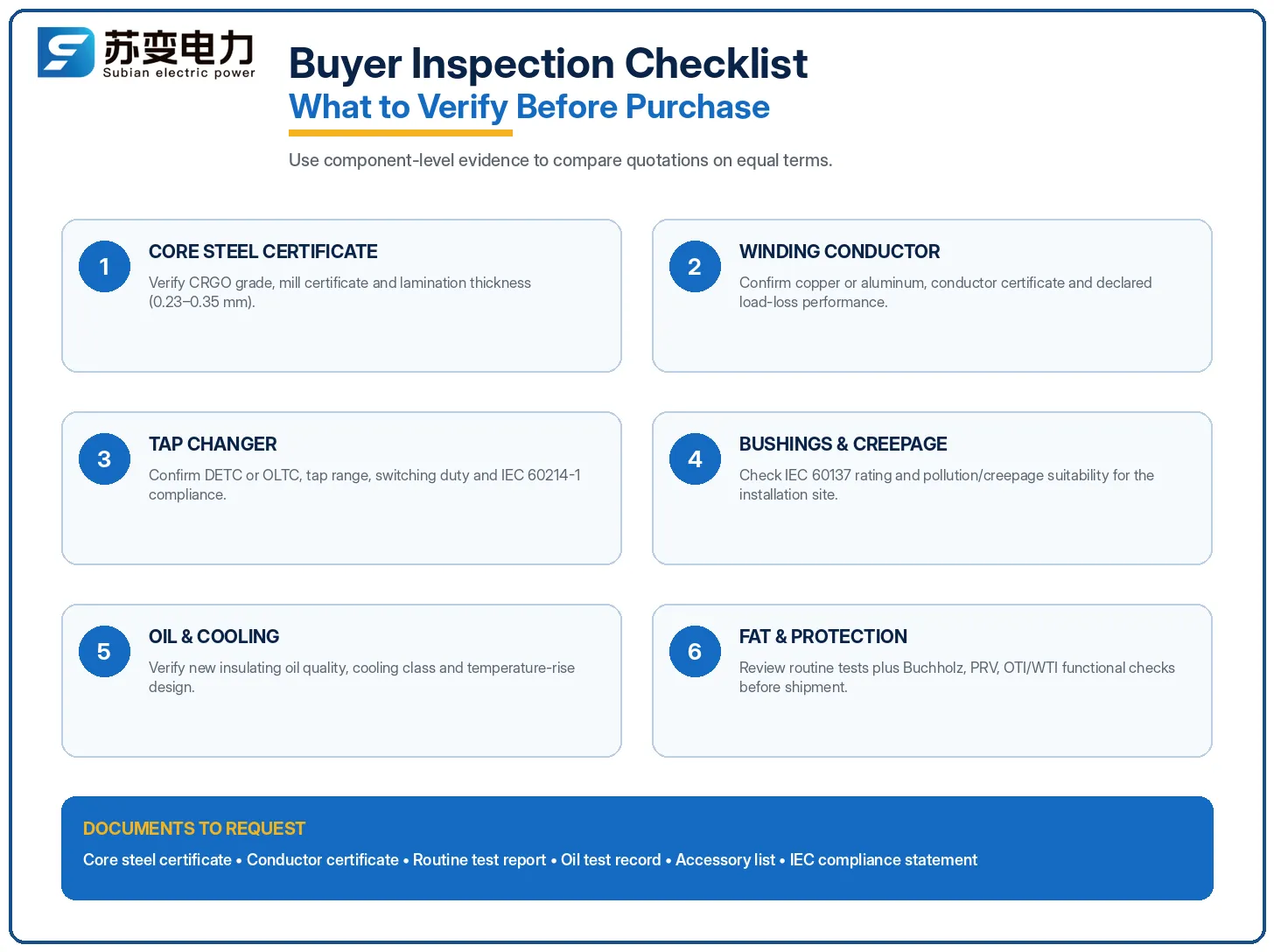
Suivez cette liste de contrôle lorsque vous évaluez un devis de transformateur afin que les composants correspondent à vos conditions d'exploitation réelles :
- Définissez d'abord le budget de perte. Les pertes sont capitalisées sur 20-30 ans ; une différence de 1 kW à $0.10/kWh coûte environ $8,760 par an. Fixez les pertes à vide et à charge acceptables avant de demander des prix.
- Confirmez la qualité de l'acier du noyau. Demandez le certificat de l'usine. Un CRGO de haute qualité de 0,23-0,27 mm réduit la perte à vide mais ajoute 5-10% au coût ; cela se rembourse lorsque le transformateur fonctionne légèrement chargé.
- Choisissez le matériau d'enroulement délibérément. Les enroulements en cuivre coûtent plus cher mais résistent mieux aux surcharges et sont standards pour les charges critiques ; l'aluminium est acceptable pour la distribution rurale légèrement chargée où le coût initial domine.
- Associez le changeur de prises au réseau. Si votre tension d'alimentation fluctue de plus de ±5%, investissez dans un OLTC. Pour les réseaux stables, un changeur de prises hors circuit à ±2.5% et ±5% suffit.
- Spécifiez les bushings pour votre environnement. Les sites côtiers et industriels nécessitent des bushings à éclatement étendu (éclatement spécifique ≥ 25 mm/kV pour la classe de pollution élevée selon la norme IEC 60815).
- Vérifiez la classe de refroidissement par rapport au profil de charge. ONAN est suffisant pour la plupart des tâches de distribution ; demandez la capacité ONAF si vous attendez des surcharges de pointe.
- Demandez la liste des pièces de rechange. Un package sensé comprend un ensemble de joints, un respirateur de rechange et des indicateurs de température de rechange afin que vous n'attendiez pas des semaines en cas de panne.
Inspection et maintenance en usine
Avant l'expédition, il est conseillé de participer au test d'acceptation en usine ou FAT au moins une fois, sinon de procéder à un examen de celui-ci. Les tests standard selon les normes IEC 60076-1 comprennent la mesure de la résistance des enroulements, du rapport de transformation, des pertes en charge, des pertes à vide, divers tests diélectriques et un test d'élévation de température sur une unité échantillon. Si le MVA (Mégavolt Ampère) est supérieur à 3,15 MVA, vous devez insister pour obtenir le test de résistance au court-circuit qui garantit que les systèmes d'enroulement peuvent supporter une telle défaillance.
Une fois l'appareil en service, les pièces nécessitant une attention ne changent pas. Assurez-vous de vérifier le déshydratant en gel de silice chaque mois et de le remplacer une fois que 60-70% des cristaux sont colorés. Vous devez également prélever un échantillon d'huile chaque année pour la tension de claquage, l'acidité, ainsi que l'analyse des gaz dissous (DGA). L'huile est considérée comme acceptable si elle a une tension de claquage minimale de 50 kV et aucune augmentation des niveaux d'hydrogène ou d'acétylène. Vous devez également vérifier la surface des bushing pour des traces chaque fois qu'il y a une coupure de courant et utiliser les changeurs de prises hors circuit une fois par an, car la corrosion se produit si les contacts restent statiques.
| Tâche de maintenance | Fréquence | Composant couvert |
|---|---|---|
| Vérification du déshydratant / remplacement du gel | Mensuel | Conservateur, déshydratant |
| Échantillonnage d'huile et DGA | Annuellement | Système d'isolation |
| Scan thermique des bornes | Tous les 6 mois | Bushings, boîtes de câbles |
| Exercice du changeur de prises | Annuellement | DETC / OLTC |
| Test de fonction de relais | Tous les 2 ans | Buchholz, PRV, OTI/WTI |
| Revue des tendances des gaz dissous | Annuellement | Santé du noyau et des enroulements |
Questions Fréquemment Posées
Quel composant du transformateur tombe le plus souvent en panne ?
Les rapports sur les pannes des services publics identifient fréquemment les bushings et les changeurs de prises comme les composants ayant les taux de défaillance les plus élevés. Ensemble, ils représentent environ 20% à 30% de toutes les pannes forcées de transformateurs. C'est également la raison pour laquelle les bushings à creepage étendu et l'opération annuelle des économiseurs sont bénéfiques dans des environnements pollués.
Quelle est la différence entre un DETC et un OLTC ?
Le DETC ne peut être activé que lorsque le transformateur est hors service et est généralement équipé de trois ou cinq positions fournissant une sortie de ± 2.5% et ±5% respectivement. L'OLTC est conçu pour fonctionner sous charge avec de nombreux commutateurs, jusqu'à 17 ou 27 positions et coûte entre $3,000 et $15,000 selon la puissance nominale. Si une régulation automatique de la tension est requise ou si la déviation de la tension dépasse ±5%, l'OLTC doit être appliqué ; sinon, l'utilisation d'un DETC est plus appropriée.
Pourquoi le noyau est-il le composant unique le plus coûteux ?
L'acier CRGO du noyau représente environ 25-35% du coût des matériaux du transformateur car la quantité est importante et l'acier lui-même est coûteux. Une unité de 1 000 kVA utilise environ 1,2 à 1,8 tonne d'acier de noyau, ce qui, à $1,500-$3,200 par tonne, s'accumule rapidement. Le choix de la qualité est important : passer de laminations de 0,35 mm à 0,23 mm réduit les pertes à vide de 10-15% mais augmente le coût de l'acier de 5-10%.
Combien coûtent les bushings de remplacement ?
Un bushing de classe 12 kV pour un transformateur de distribution coûte généralement entre $150 et $500, tandis que les bushings de classe 33 kV varient de $500 à $1,500 et les unités de classe 110 kV atteignent $2,000 à $3,000 ou plus. Le prix dépend du type d'isolation (porcelaine vs. composite), de la longueur de creepage pour la classe de pollution, et s'il inclut un transformateur de courant pour la mesure de protection.
Puis-je acheter un transformateur sans un OLTC et économiser de l'argent ?
Il est vrai qu'un OLTC ajoute environ 8-15% au coût total du transformateur. Vous pourriez économiser le coût de l'OLTC si la tension d'entrée est constamment stable ainsi que les exigences de charge. L'OLTC est également bénéfique pour les charges renouvelables ou commerciales, car il y a des fluctuations dans les niveaux de tension.
Références
- IEC 60076-1 : Transformateurs de puissance – Général – La norme internationale de base couvrant les classifications, les méthodes d'essai et les tolérances pour les transformateurs de puissance et de distribution.
- IEC 60214-1 : Changeurs de prises – Exigences de performance et d'essai pour les changeurs de prises sous charge et hors circuit.
- IEC 60137 : Bushings isolés pour des tensions alternatives supérieures à 1,000 V – Exigences dimensionnelles, diélectriques et de pollution pour les bushings.
- IEC 60296 : Fluides pour applications électrotechniques – Huiles minérales isolantes non utilisées – Paramètres de qualité de l'huile, y compris la tension de claquage et les limites d'acidité.
- IEEE Norme C57.12.00 – Exigences générales pour les transformateurs de distribution, de puissance et de régulation immergés dans un liquide utilisés sur les marchés nord-américains.
- Normes NEMA pour les transformateurs – Normes nord-américaines d'efficacité énergétique et de construction, y compris NEMA TP-1 pour les transformateurs de distribution.
- Jiangsu Subian Electric Power – Fabricant de transformateurs certifié IEC 60076 offrant des transformateurs de distribution et de puissance immergés dans l'huile et de type sec.
Conclusion
Lorsqu'il s'agit de transformateurs, il est crucial de connaître les composants lors de la dépense d'argent. Les composants clés du transformateur, à savoir le noyau, l'enroulement, le changeur de prises, les bushing et le système de refroidissement, garantissent son efficacité et sa fiabilité, et le coût de ces composants représente 80 à 90 % du prix. Le budget de perte d'un acheteur doit d'abord être déterminé, puis il doit vérifier les certificats de noyau en acier et de cuivre, s'assurer que les composants répondent aux exigences du réseau et de l'environnement spécifiques, et seulement ensuite demander des rapports d'essai et effectuer le paiement.
Que vous cherchiez à acheter des transformateurs de distribution ou des transformateurs de puissance, Jiangsu Subian Electric Power fabrique des transformateurs conformes aux normes IEC 60076 et offre des informations détaillées sur les composants et les rapports d'essai. Tout ce que vous avez à faire est de soumettre votre budget de perte et les informations pertinentes sur les conditions d'exploitation.