


Haben Sie jemals ein Transformatorenschild gesehen, das Dyn11 zeigte, und sich gefragt, was die Buchstaben und die Zahl bedeuten? Wenn ja, schauen Sie auf den Delta-Wye-Transformator, der die beliebteste dreiphasige Verbindung in Verteilungssystemen weltweit ist. Wenn der Ingenieur mit der Inbetriebnahme eines neuen Verteilungsunterwerks oder einer Industrieanlage beauftragt wird, wird er diesen Transformator in fast jedem Layout-Design antreffen. Dieser Artikel wird die Definition eines Delta-Wye-Transformators, präsentieren, sowie das Wesen der Verbindung in Bezug auf Spannungen und Phasenverschiebung, ihre Vorteile gegenüber anderen Verbindungsarten und wie man die Transformatoren für Ihre Projekte richtig auswählt.
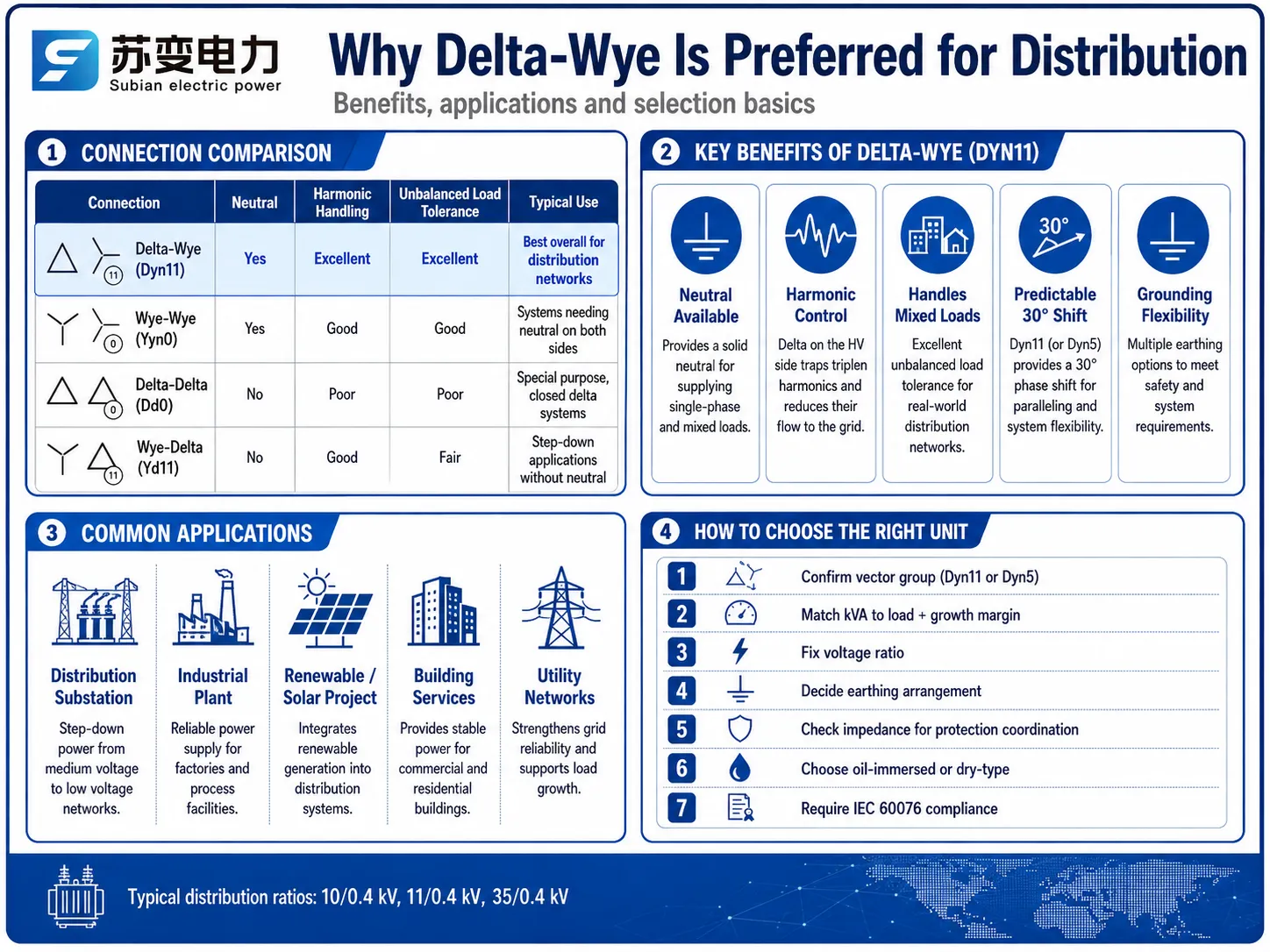
Was ist ein Delta-Stern-Transformator?
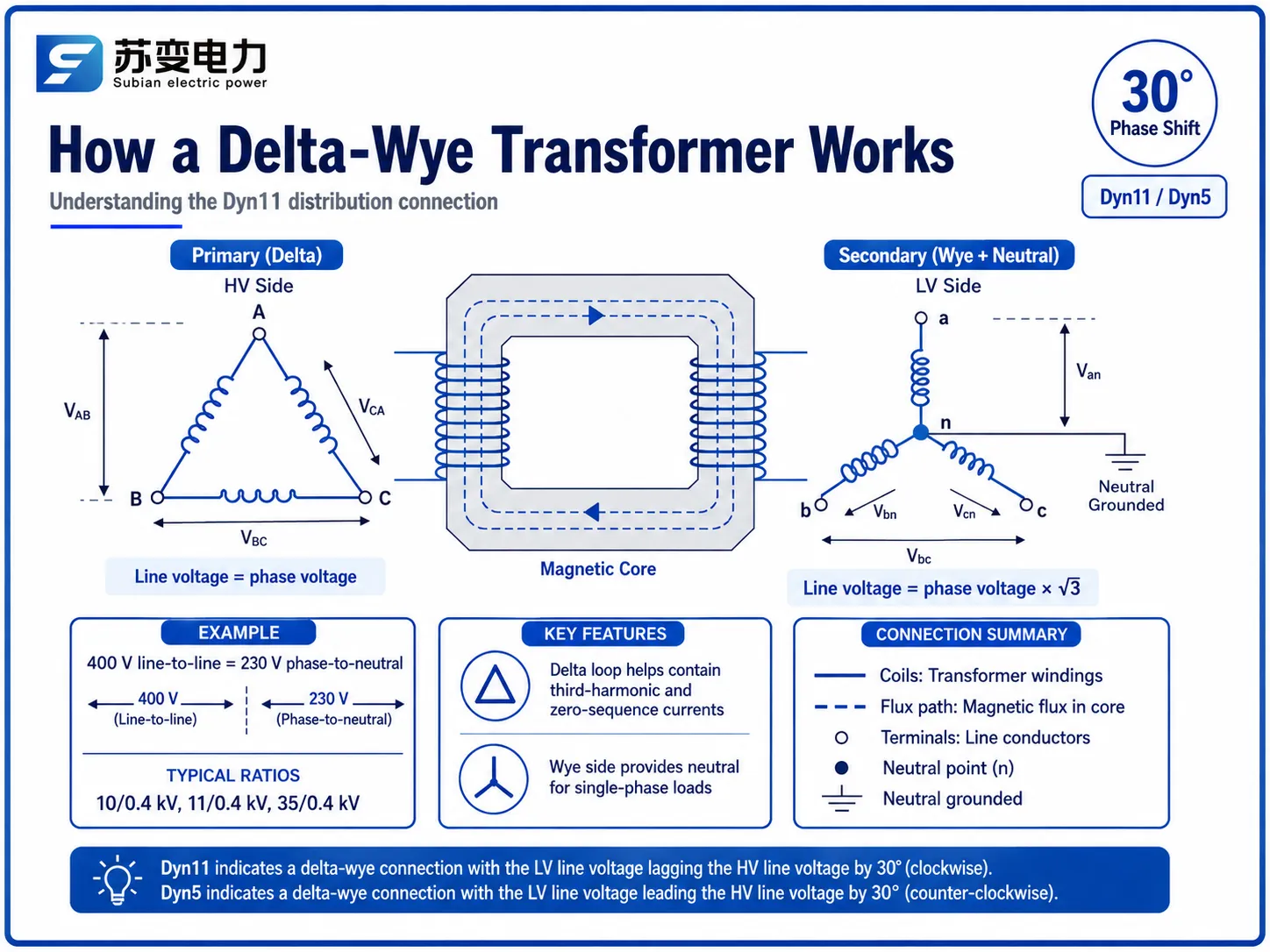
In Bezug auf die Topologie fällt ein Delta-Wye-Transformators unter die Kategorie eines dreiphasigen Transformators, dessen Hochspannungsseite (HV) Wicklungen in Delta und Niederspannungsseite (LV) Wicklungen in Wye konfiguriert sind. Die Delta-Konfiguration umfasst das Verbinden jeder Wicklung Ende-zu-Ende, wodurch eine geschlossene dreieckige Schleife entsteht, während in der Wye-Konfiguration ein Ende jeder der LV-Wicklungen an einem gemeinsamen Neutralpunkt angeschlossen ist. Der Wye-Neutralpunkt wird normalerweise zu einem vierten Anschluss geführt, was die Bezeichnung Dyn bedeutet, die darauf hinweist, dass die HV-Seite eine Delta-Konfiguration hat und die LV-Seite Wye, während n für neutral steht. Die Kombination der beiden Konfigurationen ergibt einen Delta-Wye-Transformator, der die Vorteile beider Konfigurationen bietet. Zum Beispiel dient die Delta-Verbindung der Primärseite, indem sie ein Mittel bietet, durch das ungeerdete sekundäre Ströme zusammen mit drittharmonischen Flüssen behandelt werden können. Auf der anderen Seite hilft die Wye-Verbindung, die Neutralpunkte für einphasige Lasten zu stabilisieren und die Erdung des Systems bereitzustellen.
Wie die Delta-Wye-Verbindung funktioniert
Es ist am besten, mit der Analyse der Wye-Seite zu beginnen, da sie die Spannung angibt, die von der Ausrüstung gesehen wird. Da jede Phasenwicklung vom Leitungsanschluss zum Neutralpunkt in der Wye-Verbindung verläuft, wird die Phasenspannung (Wicklungsspannung) als √3 (1,732) pro der Leitungs-zu-Leitungs-Spannung angegeben. Ein 0,4 kV dreiphasiges System hat eine Phasenspannung von unter 0,4/1,732 = 0,23 kV (oder 230 V). Dies ist genau der Grund, warum die IEC-Niederspannungsversorgung 230/400 V angibt. Der Neutralleiter führt überschüssigen Strom während unausgeglichener einphasiger Lasten.
Die Delta-Seite hat drei Wicklungen, die in einem Ring verbunden sind, und hier ist die Leitungs-zu-Leitungs-Spannung die der Phasen- (Wicklungs-) Spannung aufgrund der Abwesenheit von irgendeinem teilenden √3 oder Neutral. Der Ring bildet eine geschlossene Schleife, die es ermöglicht, dass Nullfolge- und drittharmonische Ströme im Delta-Design zirkulieren. Der Vorteil einer Delta-Verbindung besteht darin, dass sie keine drittharmonische Verzerrung zulässt, die das Versorgungsniveau beeinflusst. Außerdem erfolgt die Spannungsumwandlung in der Einheit gemäß einem Übersetzungsverhältnis, was sie von der Wye-Verbindung unterscheidet, während eine Delta-Anordnung immer eine konstante Phasenverschiebung einführt, d.h. 30°.
| System | Leitungs-zu-Leitungs-Spannung | Phasenspannung (Wye) | Beziehung |
|---|---|---|---|
| IEC-Niederspannungsdienst | 400 V | 230 V | 400 / 1.732 |
| IEC-Niederspannung, UK | 415 V | 240 V | 415 / 1.732 |
| US-Niederspannungsdienst | 208 V | 120 V | 208 / 1.732 |
| US-Industrie | 480 V | 277 V | 480 / 1.732 |
| Delta-Seite (kein Neutralleiter) | Entspricht der Phasenspannung | — | Keine 1,732 Teilung |
Vektorgruppen: Dyn11, Dyn5 und was sie bedeuten
Der Code der Vektorgruppennotation gibt einen Hinweis auf die Phasenbeziehung und die Art der Verbindung. D bedeutet, dass die Hochspannungswicklung delta-verbunden ist; y bedeutet, dass die Niederspannungswicklung stern-verbunden ist; n zeigt an, dass der Niederspannungsneutralleiteranschluss herausgeführt wurde. Die Zahl in der Vektorgruppennotation gibt den Phasendifferenz der Niederspannung im Vergleich zur Hochspannung in Vielfachen von 30° an, wie bei einer Uhr. Wenn eine Vektorgruppe Dyn11 ist, ist die Leitungs- spannung des Niederspannungssystems der Hochspannung um 11*30° = 330° (oder um 30° hinterher); in Dyn5 führt sie um 150°. Die verwendeten Zahlen, entweder 11 oder 5, sind sehr bedeutend, wenn Transformatoren parallel betrieben werden oder wenn eine Phasenbeziehung für den Modus des Transformatorenschutzes erforderlich ist. Manchmal ist die Verbindung von zwei delta-stern-Transformatoren parallel nur möglich, wenn ihre Vektorgruppen und Phasensequenzen übereinstimmen. Es ist wichtig, die Gruppe in der Bestellspezifikation sowie im Prüfbericht zu überprüfen und zu bestätigen, da beispielsweise ein Dyn11 nicht mit einem Dyn5-Transformatorensystem parallel betrieben werden kann.
| Uhrzeit | Phasenverschiebung | Häufige Verwendung |
|---|---|---|
| 0 | 0° | Stern-Stern- und Delta-Delta-Bänke |
| 1 | 30° (Niederspannung verzögert) | Delta-Stern, einige nordamerikanische Bänke |
| 5 | 150° | Delta-Stern, spezielle Erdungsschemata |
| 6 | 180° | Umgekehrtes Stern-Stern, Zick-Zack-Varianten |
| 11 | 330° (Niederspannung führt 30°) | Delta-Stern-Verteilungsstandard |
Hauptmerkmale und Vorteile
| Merkmal | Vorteil |
|---|---|
| Stern-Seiten-Neutralleiter | Versorgt einphasige Lasten und bietet einen Erdungsbezug |
| Delta-Hauptschleife | Zirkuliert Nullfolge- und Dritt-Harmonische Ströme, schützt die Versorgung |
| 30° Phasenverschiebung | Standardisierte, vorhersehbare Phasenbeziehung für den Parallelbetrieb |
| Toleranz gegenüber unausgeglichenen Lasten | Gemischte einphasige und dreiphasige Lasten verursachen weniger Spannungsungleichgewicht |
| Erdungsflexibilität | Der Neutralleiter kann fest geerdet oder über eine Erdungsimpedanz verbunden werden |
Delta-Wye vs. Andere Verbindungen
| Verbindung | Neutral verfügbar | Behandlung der dritten Harmonischen | Toleranz gegenüber unausgeglichenen Lasten | Häufige Verwendung |
|---|---|---|---|---|
| Delta-Wye (Dyn11) | Ja (Niederspannung) | Gut — Delta-Schleife zirkuliert es | Gut | Verteilung, industrielle Versorgung |
| Wye-Wye (Yyn0) | Ja (beide Seiten) | Schlecht ohne tertiäre Wicklung | Schlecht | Selten allein in Dreiphasen verwendet |
| Delta-Delta (Dd0) | Nein | Gut | Schlecht — kein Niederspannungsneutral | Industrielle Lasten, keine Erdung erforderlich |
| Wye-Delta (Yd11) | Nein (Niederspannungsdelta) | Gut | Gut | Hochspannungserzeugung |
Delta-Wye ist die einzige weit verbreitete Verbindung, die Ihnen einen geerdeten Neutralleiter auf der Lastseite und eine Harmonische Minderung auf der Versorgungsseite bietet. Wye-Wye, ohne die dritte Wicklung, wird eine gewisse Neutralverschiebung und dritte harmonische Verzerrung bei unausgeglichenen Lasten aufweisen. Delta-Delta hat überhaupt keinen Neutralleiter. Falls die Last eine 230/400 V Vierdrahtversorgung benötigt, wird Delta-Wye fast immer Ihre bevorzugte Verbindung sein.
Häufige Anwendungen
- Umspannwerke, die 35 kV oder 10 kV auf 0,4 kV für die Versorgung von Vierdrahtsystemen im gewerblichen Bereich und in der Industrie reduzieren. Fertigungsunternehmen, die dreiphasigen elektrischen Strom (für Motoren und Kompressoren) und den Neutralleiter für Beleuchtungs- und Steuergeräte benötigen. Projekte im Bereich erneuerbare Energien, bei denen der Neutralreferenz und die Harmonischen am Ausgang des Wechselrichters durch den Transformator auf der Sammelschiene enthalten sind. Bau von Anlagen, die eine geerdete Versorgung gemäß den Sicherheitsstandards erfordern. Versorgungsnetze, die manchmal durch den eigenen Erdungstransformator eine Delta-Wye-Einheit erstellen.
Typische Spezifikationen
| Nennleistung (kVA) | Übersetzungsverhältnis | Vektorguppe | Impedanz | Richtpreis (US$) |
|---|---|---|---|---|
| 100 | 10/0,4 kV | Dyn11 | 4% | $3.000–$6.000 |
| 315 | 10/0,4 kV | Dyn11 | 4% | $5.500–$10.000 |
| 630 | 10/0,4 kV | Dyn11 | 4.5–6% | $9.000–$16.000 |
| 1,000 | 35/0,4 kV | Dyn11 | 6% | $14.000–$25.000 |
| 2,500 | 35/0,4 kV | Dyn11 | 6–8% | $28.000–$45.000 |
Die Preise sind indikativ FOB für ölgetauchte Einheiten mit Standardverlustniveaus; Trockenbauharzversionen liegen etwa 20–40% höher bei derselben Nennleistung. Bestätigen Sie die Impedanz gegen Ihr Schutzschema, da es den Fehlerstrom und die Diskriminierung bestimmt.
So wählen Sie die richtige Einheit aus
- Bestätigen Sie die Vektorkonfiguration. Dyn11 für die meisten Verteilungsaufgaben; Dyn5, wo das Netz eine andere Phasenbeziehung erfordert. Geben Sie dies in der Bestellung an.
- Passen Sie die kVA an die Last an. Dimensionieren Sie nach der angeschlossenen Last, der größten Anlauflast und einer Wachstumsreserve von 10–20%.
- Fixieren Sie das Spannungsverhältnis. 35/0,4 kV, 10/0,4 kV oder 11/0,4 kV, abhängig von Ihrem Primärnetz und der Niederspannungstafelspannung.
- Entscheiden Sie über die Erdungsanordnung. Feste Neutralerdung ist am einfachsten; verwenden Sie einen Neutralerdungswiderstand (NER), wo Fehlerstromgrenzen erforderlich sind.
- Überprüfen Sie die Impedanz zur Schutzkoordination. Eine 4–6% Impedanz ist typisch; höhere Werte begrenzen den Fehlerstrom, erhöhen jedoch die Spannungsregelung.
- Wählen Sie Isolierung und Kühlung für den Standort. Ölgetaucht im Freien, Trockenbauharz drinnen; ONAN-Standard, ONAF für hohe Lastfaktoren.
- Erfordern Sie die Einhaltung von IEC 60076. Bestätigen Sie die Isolationsniveaus, Temperaturanstieg und Kurzschlussfestigkeit und fordern Sie den Prüfbericht an.
Top-Marken und Preisspannen
| Marke | Land | Produktfokus | Indikative Preisspanne (US$) |
|---|---|---|---|
| ABB | Schweiz/Schweden | Verteilungs- und industrielle Delta-Wye-Einheiten | $4.000–$60.000 |
| Siemens | Deutschland | IEC-Verteilungstransformatoren | $3.500–$55.000 |
| Schneider Electric | Optimierungsmaßnahmen in der Praxis | Trockenbau- und Gießharzeinheiten | $3.000–$45.000 |
| Hitachi Energie | Schweiz | Versorgungsgrad-Verteilungstransformatoren | $4.500–$70.000 |
| Eaton | USA | Nordamerikanische Verteilungseinheiten | $2.500–$42.000 |
| Jiangsu Subian Electric Power | China | Öl-untergetauchte und trockene, maßgeschneiderte Vektorgruppen | $3.000–$45.000 |
Die genannten Preise sind nicht fest und können je nach Hersteller, Qualität der Produkte sowie Schäden und verwendeter Ausrüstung variieren. Bekannte Unternehmen, die Delta/Wye-Transformatoren herstellen, sind ABB, Schneider Electric, Siemens, Hitachi Energy und Eaton. Die Dokumentation dieser Unternehmen dient als hervorragender Referenzpunkt für Spezifikationen. Interessierte, die Delta/Wye-Transformatoren gemäß IEC 60076-Standards zu besseren Preisen herstellen lassen möchten, können Wick-Transformatoren von Jiangsu Subian Electric Power Co., Ltd. kaufen. Dieses Unternehmen stellt Öl (湿型) und trocken (干型) Typ Delta-Wye-Transformatoren in allen Kapazitäten her, beginnend von kleinen Verteilungseinheiten bis hin zu mehreren MVA und mit verschiedenen Vektorgruppen, einschließlich Dyn11 und Dyn5. Jiangsu Subian Electric Power Co., Ltd. verwendet hochwertigem orientierten Stahl und Kupfer für ihre Transformatoren und kann vollständige Testdokumentationen sowie notwendige Unterstützung für ihre Exporte bereitstellen. Überprüfen Sie das Produktsortiment auf der Subian Electric-Website verfügbar.
Häufig gestellte Fragen
Warum ist die Delta-Wye-Verbindung in der Verteilung so verbreitet?
Der Vorteil dieser Verbindung besteht darin, dass sie alles auf einmal bereitstellt: Erdung des Neutralleiters bei Niederspannung für einphasige Lasten und Erdung; die Möglichkeit, eine Delta-Schleife auf der Hochspannungsseite zu bilden, die Dritt-Harmonische und Nullfolgenströme einfängt, sowie einen angemessenen Widerstand gegen unausgeglichene Lasten. Keine andere Verbindung hat diese drei Merkmale, und das ist der Grund, warum Dyn11 für Verteilungstransformatoren im Spannungsbereich von 10 kV bis 0,4 kV gewählt wurde.
Was bedeutet Dyn11 auf einem Transformatorenschild?
D zeigt, dass die Hochspannungswicklung in einer Delta-Verbindung ist, y lässt uns wissen, dass die Niederspannungswicklung in einer Wye (oder Stern) Verbindung ist, und n zeigt an, dass der Niederspannungsneutralleiter herausgeführt ist. Die 11 gibt die Uhrzeit an: das bedeutet, dass die LV-Leitungs-Spannung der HV-Leitungs-Spannung um 330 Grad voraus ist (dies entspricht einem Rückstand der LV-Leitungs-Spannung um 30 Grad), was uns die Eigenschaft der Delta-Wye-Verbindung gibt – eine Phasenverschiebung von 30 Grad.
Warum gibt es eine 30° Phasenverschiebung in einem Delta-Wye-Transformator?
Die Transformation ist das Ergebnis der Änderungen in den Verbindungen der Wicklungen auf den beiden Seiten. Bei der Wye-Verbindung ist der Leitungs-Spannungs-Phasor die Differenz zwischen zwei Phasen-Spannungen, die um 120 Grad getrennt sind, während bei der Delta-Verbindung es gleich der Spannung einer Phase ist. Durch den Vergleich der beiden Leitungs-Spannungen kann man feststellen, dass der Winkel zwischen den Phasoren 30 Grad beträgt, was der Grund ist, warum der Delta-Wye-Transformator als 11 oder 5 (30 oder 150 Grad) bezeichnet wird.
Kann ein Delta-Wye-Transformator unausgeglichene Lasten bewältigen?
Ganz gut. Wenn Delta-Verbindungen in einer Primärwicklung vorhanden sind, fließt der Ungleichstrom in der Sekundärwicklung durch das Delta-Netzwerk und wird unterdrückt. Dies macht diese Art von Verbindung vorteilhaft, wenn eine Kombination aus einphasigen und dreiphasigen Versorgungen genutzt wird. In Situationen mit hoher Ungleichheit ist es entscheidend, dass das System ordnungsgemäß bewertet ist und der Neutralstrom berücksichtigt wird.
Stellt Subian Delta-Wye-Transformatoren für den Export her?
In der Tat! Jiangsu Subian Electric Power kann Delta-Wye-Transformatoren gemäß IEC 60076 mit der benötigten Vektorgroup, Kapazität und Spannungsverhältnis liefern und bietet auch regelmäßige Prüfberichte sowie optionale Prüfungen durch Dritte für internationale Aufträge an. Die Fabrik ist in der Lage, entweder ölgetauchte oder trockene Bauweise für typische Verteilungsklassen zu liefern.
Referenzen
- IEC 60076-1 — Leistungstransformatoren: Allgemeines — der maßgebliche Standard für Bewertung und Prüfung, einschließlich der Bezeichnung der Vektorgroup.
- IEC 60076-3 — Isolationsniveaus und dielektrische Tests — definiert die Isolationsanforderungen für Delta-Wye-Transformatoren der Verteilungsklasse.
- IEC 60076-5 — Fähigkeit zur Kurzschlussfestigkeit — der Kurzschlussprüfungsstandard für die Wicklungen.
- NEMA TP-1 — Energieeffizienz für Verteilungstransformatoren — Effizienzbenchmark, die in der Verlustbewertung verwendet wird.
- Hitachi Energy — Transformatorprodukte — Referenzdokumentation für Transformatoren der Versorgungsqualität.
- Eaton — Transformatorentechnische Informationen — praktische Verbindungs- und Anwendungshinweise von einem großen Hersteller.
Fazit
Es kombiniert eine geerdete Wye-Sekundärseite, die für einphasige Lasten mit einer Erdverbindung geeignet ist, mit einer Primärdelta-Wicklung, die in der Lage ist, harmonische Unterdrückung durchzuführen und unbalancierte Ströme zu absorbieren, während gleichzeitig eine Phasenverschiebung von 30 Grad ermöglicht wird. Um den Erfolg der Verwendung solcher Transformatoren sicherzustellen, sollte die richtige Kombination der folgenden fünf Elemente erreicht werden: die Spezifikation der Vektorgroup (typischerweise Dyn11), die Bestimmung der Transformator-kVA basierend auf Laststudien, die Identifizierung des Spannungsverhältnisses, das zum Netzwerk passt, die Auswahl des Erdungsmodus sowie die Übereinstimmung aller Spezifikationen mit den Anforderungen des IEC 60076 Standards und die Verfügbarkeit von Prüfunterlagen. Bestätigen Sie Ihre Vektorgroup und Lastdaten mit dem Team über die offizielle Website um ein angebotsgemäßes Angebot zu erhalten.