


Have you ever come across a transformer nameplate that showed Dyn11 and pondered over what the letters and number signified? If yes, you are staring at the delta-wye transformer, which happens to be the most popular three-phase connection in distribution systems around the globe. When the engineer is tasked with commissioning a new distribution substation or industrial plant, he will encounter this transformer on almost each of the layout designs. This article will present the definition of a delta-wye transformer, and the essence of the connection in terms of voltages and phase shift, its advantages over the other types of connections, and how to properly select the transformers for your projects.
What Is a Delta-Wye Transformer?
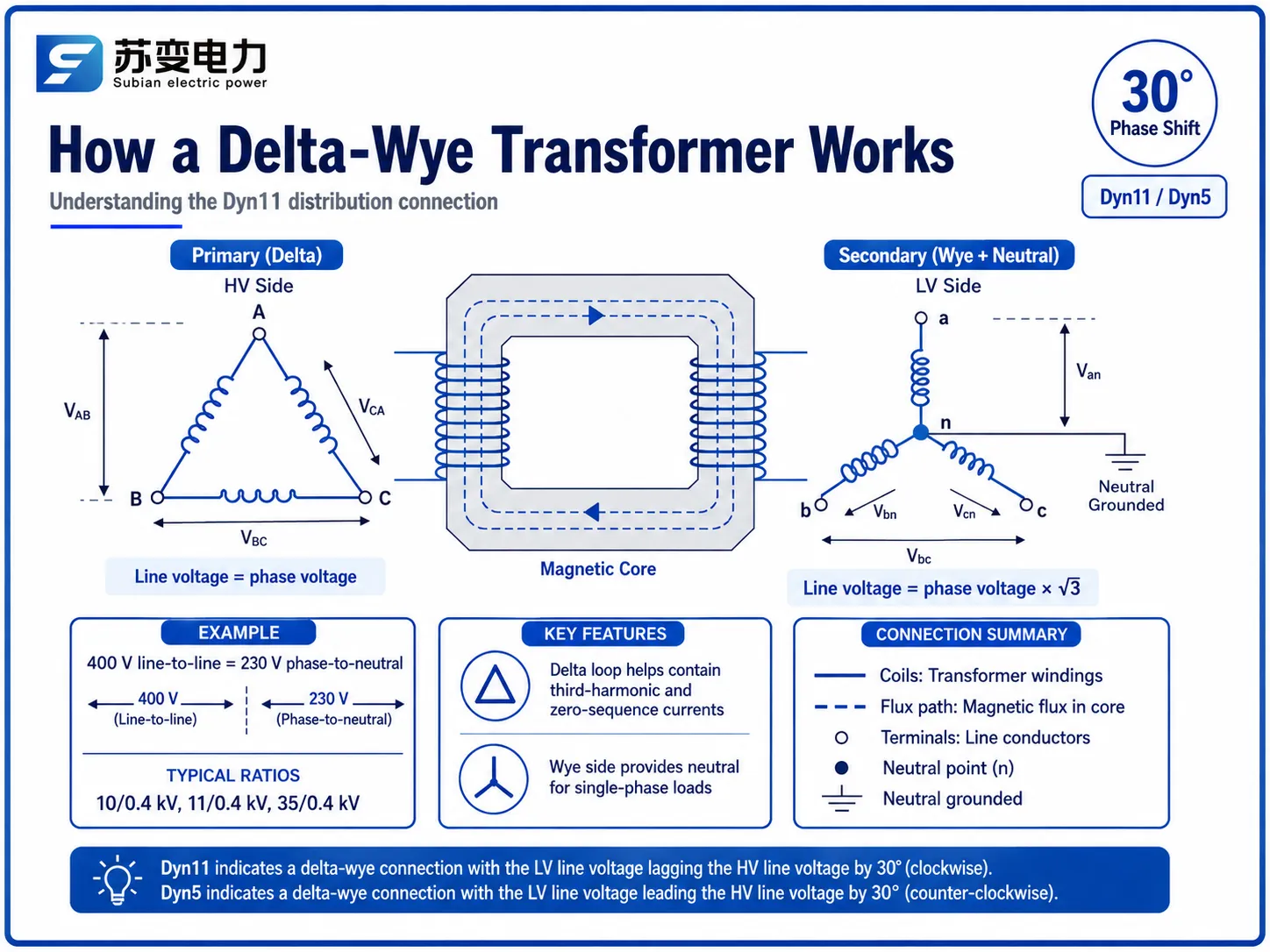
In terms of topology, a delta-wye transformer falls under the category of a three-phase transformer with its High Voltage (HV) side windings configured in delta and Low Voltage (LV) side windings configured in wye. The delta configuration involves connecting each winding end-to-end thereby creating a closed triangular loop whilst in the wye configuration; one end of each of the LV windings is connected at a common neutral point. The wye neutral is usually taken to a fourth terminal which is what the naming Dyn stands for, indicating that the HV side has delta configuration, and the LV side wye while n refers to neutral. The combination of the two configurations results in a delta-wye transformer that provides the advantages offered by the two configurations. For example; the delta connection serves the primary side by offering a means through which ungrounded secondary currents can be handled together with third harmonic flux containing. On the other hand, the wye connection helps stabilize neutral points for single-phase loads and provide grounding of the system.
How the Delta-Wye Connection Works
It’s best to start with analysis of the wye side since it gives the voltage seen by the equipment. As each phase winding runs from the line terminal to neutral juncture in the wye connection, the phase voltage (winding voltage) is given as √3 (1.732) per the line-to-line voltage. A 0.4 kV three-phase system has phase voltage under 0.4/1.732 = 0.23 kV (or 230 V). This is exactly the reason behind IEC low-voltage supply giving 230/400 V. The neutral wire carries excess current during unbalanced single-phase loads.
The delta side has three windings connected in a ring, and here, the line-to-line voltage is that of the phase (winding) voltage due to absence of any dividing √3 or neutral. The ring forms a closed loop that allows zero-sequence and third-harmonic current to circulate in delta design. The advantage of having a delta connection is that it does not allow third-harmonic distortion to affect supply level. Also, the voltage transformation in the unit takes place according to a turns ratio, which is what makes it different from wye connection, while a delta arrangement always introduces a constant phase shift, i.e. 30°.
| System | Line-to-line voltage | Phase voltage (wye) | Relationship |
|---|---|---|---|
| IEC LV service | 400 V | 230 V | 400 / 1.732 |
| IEC LV, UK | 415 V | 240 V | 415 / 1.732 |
| US LV service | 208 V | 120 V | 208 / 1.732 |
| US industrial | 480 V | 277 V | 480 / 1.732 |
| Delta side (no neutral) | Equal to phase voltage | — | No 1.732 division |
Vector Groups: Dyn11, Dyn5, and What They Mean
The code of vector group notation provides an indication of phase relation and the way connection is made. D denotes that the high voltage winding is delta-connected; y means that the low voltage winding is wye-connected; n signifies that the low voltage neutral line terminal has been brought out. The number in vector group notation indicates the phase difference of the low voltage with respect to the high voltage in terms of multiples of 30° as in a clock. If a vector group is Dyn11, in it the line voltage of low voltage system is ahead of that of high voltage system by 11*30° = 330° (or behind by 30°); in Dyn5, it leads by 150°. The numbers being used, either 11 or 5, is very significant when transformers operate parallel or when phase relation is required for mode of transformer protection. Sometimes connection of two delta-wye transformers in parallel will be possible only in case their vector groups and phase sequences will match. It is important to check and confirm the group in the ordering specification as well as in testing report since, for example, a Dyn11 will not parallel with Dyn5 transformer system.
| Clock number | Phase displacement | Common use |
|---|---|---|
| 0 | 0° | Wye-wye and delta-delta banks |
| 1 | 30° (LV lags) | Delta-wye, some North American banks |
| 5 | 150° | Delta-wye, special earthing schemes |
| 6 | 180° | Wye-wye reversed, zig-zag variants |
| 11 | 330° (LV leads 30°) | Delta-wye distribution standard |
Key Features and Benefits
| Feature | Benefit |
|---|---|
| Wye-side neutral | Supplies single-phase loads and provides a grounding reference |
| Delta primary loop | Circulates zero-sequence and third-harmonic currents, protecting the supply |
| 30° phase displacement | Standard, predictable phase relationship for parallel operation |
| Unbalanced-load tolerance | Mixed single-phase and three-phase loads cause less voltage imbalance |
| Grounding flexibility | Neutral can be solidly earthed or connected through an earthing impedance |
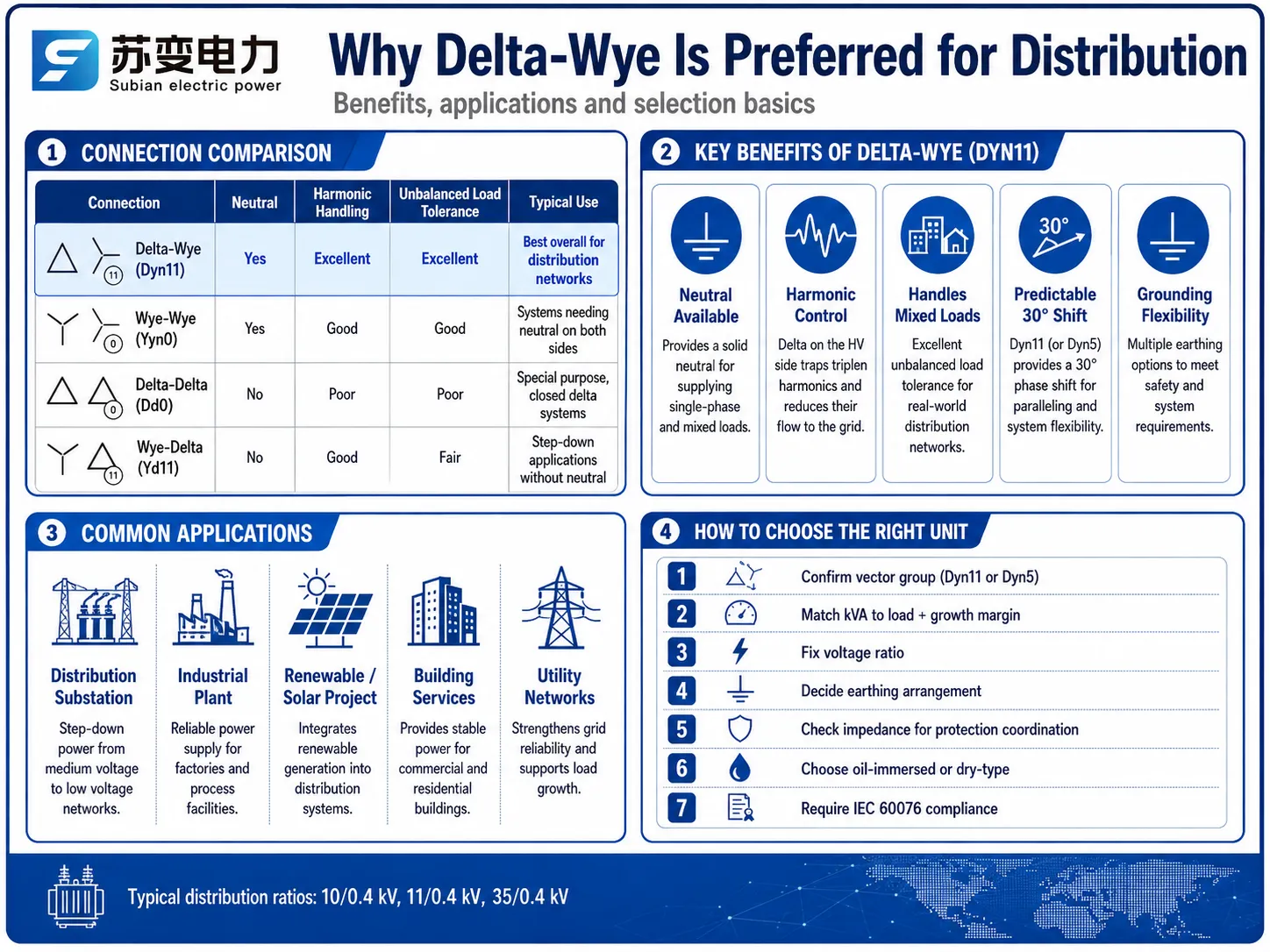
Delta-Wye vs. Other Connections
| Connection | Neutral available | Third-harmonic handling | Unbalanced-load tolerance | Common use |
|---|---|---|---|---|
| Delta-wye (Dyn11) | Yes (LV) | Good — delta loop circulates it | Good | Distribution, industrial supply |
| Wye-wye (Yyn0) | Yes (both sides) | Poor without tertiary winding | Poor | Rarely used alone in three-phase |
| Delta-delta (Dd0) | No | Good | Poor — no LV neutral | Industrial loads, no grounding need |
| Wye-delta (Yd11) | No (LV delta) | Good | Good | Step-up in generation |
Delta wye is the only widely adopted connection which gives you a grounded neutral on the load side and harmonic mitigation on the supply side. Wye wye, without the third winding, will have some neutral displacement and third harmonic distortion for unbalanced loads. Delta delta does not have any neutral at all. So, in case the load needs 230/400 V four-wire supply, delta wye is going to be your connection of choice almost invariably.
Common Applications
- Substations that decrease 35 kV or 10 kV to 0.4 kV for the supply of four-wire systems in the commercial field and industry. Manufacturing companies needing three-phase electric power (for motors and compressors) and the neutral for lighting and controlling devices. Renewable energy projects where the neutral reference and harmonics are contained at the inverter cluster output by means of the transformer on the collector side. Construction of plant operations that require grounded supply in accordance with safety standards. Utility systems that create a delta-wye unit sometimes by means of the own grounding transformer.
Typical Specifications
| Rating (kVA) | Voltage ratio | Vector group | Impedance | Indicative price (US$) |
|---|---|---|---|---|
| 100 | 10/0.4 kV | Dyn11 | 4% | $3,000–$6,000 |
| 315 | 10/0.4 kV | Dyn11 | 4% | $5,500–$10,000 |
| 630 | 10/0.4 kV | Dyn11 | 4.5–6% | $9,000–$16,000 |
| 1,000 | 35/0.4 kV | Dyn11 | 6% | $14,000–$25,000 |
| 2,500 | 35/0.4 kV | Dyn11 | 6–8% | $28,000–$45,000 |
Prices are indicative FOB for oil-immersed units with standard loss levels; dry-type cast resin versions run about 20–40% higher at the same rating. Confirm impedance against your protection scheme, because it governs fault current and discrimination.
How to Choose the Right Unit
- Confirm the vector group. Dyn11 for most distribution duties; Dyn5 where the network requires a different phase relationship. State it on the order.
- Match the kVA to the load. Size from the connected load, the largest starting load, and 10–20% growth margin.
- Fix the voltage ratio. 35/0.4 kV, 10/0.4 kV, or 11/0.4 kV depending on your primary network and LV panel voltage.
- Decide the earthing arrangement. Solid neutral earthing is simplest; use a neutral earthing resistor (NER) where fault-current limits are required.
- Check the impedance for protection coordination. A 4–6% impedance is typical; higher values limit fault current but raise voltage regulation.
- Choose insulation and cooling for the site. Oil-immersed outdoors, dry-type cast resin indoors; ONAN standard, ONAF for high load factors.
- Require IEC 60076 compliance. Confirm insulation levels, temperature rise, and short-circuit withstand, and request the routine test report.
Top Brands and Price Ranges
| Brand | Country | Product focus | Indicative price range (US$) |
|---|---|---|---|
| ABB | Switzerland/Sweden | Distribution and industrial delta-wye units | $4,000–$60,000 |
| Siemens | Germany | IEC distribution transformers | $3,500–$55,000 |
| Schneider Electric | France | Dry-type and cast resin units | $3,000–$45,000 |
| Hitachi Energy | Switzerland | Utility-grade distribution transformers | $4,500–$70,000 |
| Eaton | USA | North American distribution units | $2,500–$42,000 |
| Jiangsu Subian Electric Power | China | Oil-immersed and dry-type, custom vector groups | $3,000–$45,000 |
The mentioned prices are not fixed and can vary among manufacturers based on the quality of the products as well as damage and equipment used. Well-known companies that make delta/wye transformers include ABB, Schneider Electric, Siemens, Hitachi Energy and Eaton. The documentation of these companies serves as an excellent point of reference for specifications. Those who are interested in getting delta/wye transformers manufactured according to IEC 60076 standards at better prices can buy wick transformers from Jiangsu Subian Electric Power Co., Ltd. This company manufactures oil (湿型) and dry (干型) type delta-wye transformers in all capacities starting from small distribution units up to several MVA and with various vector groups including Dyn11 and Dyn5. Jiangsu Subian Electric Power Co., Ltd. uses high-quality oriented steel and copper for their transformers and can provide full testing documentation and necessary support for their exports.Review the product range on the Subian Electric website.
Frequently Asked Questions
Why is the delta-wye connection so common in distribution?
The benefit that comes from this connection is the ability to provide everything at once: neutral grounding on low-voltage for single-phase loads and earthing; the ability to make a delta loop on high-voltage side that traps third-harmonic and zero-sequence currents, and a reasonable degree of resistance to unbalanced loads. No other connection has those three features, and that is the reason why Dyn11 has been chosen for distribution transformers in the voltage range from 10 kV down to 0.4 kV.
What does Dyn11 mean on a transformer nameplate?
D shows that the high-voltage winding is in a delta connection, y lets us know that the low-voltage winding is in a wye (or star) connection, and n indicates that the low-voltage neutral is out. The 11 indicates clock hour: this means that LV line voltage leads HV line voltage by 330 degrees (this is equivalent to lagging LV line voltage by 30 degrees), which gives us the characteristic of the delta-wye connection—30-degree phase shift.
Why is there a 30° phase shift in a delta-wye transformer?
The transformation is a result of the changes in the connections of the windings on the two sides. For the wye connection, the line voltage phasor is the difference between two phase voltages which are separated by 120 degrees, while for the delta connection, it is equal to the voltage of one phase. By comparing the two line voltages, one can find out that the angle between the phasors is 30 degrees, which is the reason why delta-wye transformer is referred to as 11 or 5 (30 or 150 degrees).
Can a delta-wye transformer handle unbalanced loads?
Quite well. When delta type connections are present in a primary winding, unbalance current in the secondary winding will flow through the delta network and be suppressed. This makes this type of connection favorable when utilizing a combination of single phase and three phase supplies. In situations of high imbalance it is essential that the system is properly rated and the neutral current accounted for.
Does Subian manufacture delta-wye transformers for export?
Indeed! Jiangsu Subian Electric Power can supply delta-wye transformers according to IEC 60076 with the vector group, capacity, and voltage ratio you need, and also provides routine testing reports and optional third-party inspections for international jobs. The factory is capable of supplying either oil-immersed or dry type construction for typical distribution classes.
References
- IEC 60076-1 — Power Transformers: General — the governing standard for rating and testing, including vector-group designation.
- IEC 60076-3 — Insulation Levels and Dielectric Tests — defines insulation requirements for distribution-class delta-wye transformers.
- IEC 60076-5 — Ability to Withstand Short Circuit — the short-circuit verification standard for the windings.
- NEMA TP-1 — Energy Efficiency for Distribution Transformers — efficiency benchmark used in loss evaluation.
- Hitachi Energy — Transformer Products — reference documentation for utility-grade distribution transformers.
- Eaton — Transformer Engineering Information — practical connection and application guidance from a major manufacturer.
Conclusion
it combines a grounded wye secondary suitable for single-phase loads with an earth connection with a primary delta winding capable of performing harmonic suppression and absorbing unbalanced currents, at the same time allowing for a 30-degree phase shift. To ensure the success of using such transformers, the right combination of the following five elements should be achieved: the specification of the vector group (typically Dyn11), the determination of the transformer kVA based on load studies, the identification of voltage ratio matching the network, the selection of earthing mode, as well as the conformance of all specifications to the requirements of the IEC 60076 standard and the availability of testing documentation.Confirm your vector group and load data with the team through the official website to receive a specification-matched quotation.