


¿Alguna vez te has encontrado con una placa de identificación de un transformador que mostraba Dyn11 y te has preguntado qué significan las letras y el número? Si es así, estás mirando el transformador delta-estrella, que resulta ser la conexión trifásica más popular en los sistemas de distribución alrededor del mundo. Cuando se le encarga al ingeniero la puesta en marcha de una nueva subestación de distribución o planta industrial, se encontrará con este transformador en casi cada uno de los diseños de distribución. Este artículo presentará la definición de un transformador delta-estrella, y la esencia de la conexión en términos de voltajes y desplazamiento de fase, sus ventajas sobre los otros tipos de conexiones, y cómo seleccionar adecuadamente los transformadores para tus proyectos.
¿Qué es un transformador delta-estrella?
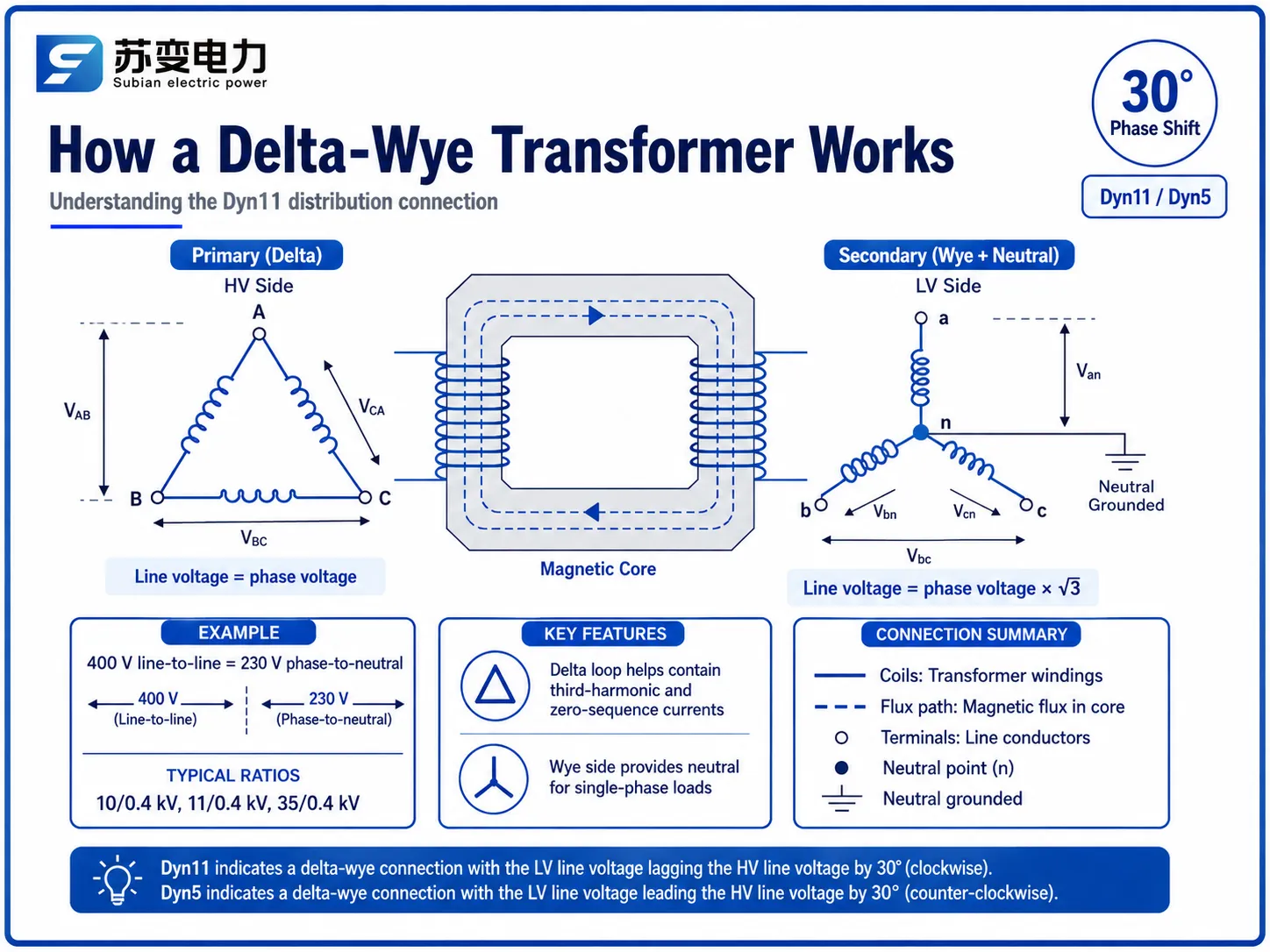
En términos de topología, un transformador delta-estrella cae bajo la categoría de un transformador trifásico con sus devanados de alta tensión (HV) configurados en delta y los devanados de baja tensión (LV) configurados en estrella. La configuración delta implica conectar cada devanado de extremo a extremo creando así un lazo triangular cerrado, mientras que en la configuración estrella; un extremo de cada uno de los devanados LV se conecta en un punto neutro común. El neutro de la estrella generalmente se lleva a un cuarto terminal, que es lo que significa el nombre Dyn, indicando que el lado HV tiene configuración delta, y el lado LV estrella, mientras que n se refiere a neutro. La combinación de las dos configuraciones resulta en un transformador delta-estrella que proporciona las ventajas ofrecidas por las dos configuraciones. Por ejemplo; la conexión delta sirve al lado primario al ofrecer un medio a través del cual se pueden manejar corrientes secundarias no aterrizadas junto con el flujo de tercer armónico. Por otro lado, la conexión estrella ayuda a estabilizar los puntos neutros para cargas monofásicas y proporciona la puesta a tierra del sistema.
Cómo funciona la conexión Delta-Estrella
Es mejor comenzar con el análisis del lado estrella ya que proporciona el voltaje visto por el equipo. A medida que cada devanado de fase corre desde el terminal de línea hasta la unión neutra en la conexión estrella, el voltaje de fase (voltaje de devanado) se da como √3 (1.732) por el voltaje línea a línea. Un sistema trifásico de 0.4 kV tiene un voltaje de fase de 0.4/1.732 = 0.23 kV (o 230 V). Esta es exactamente la razón detrás del suministro de baja tensión IEC que da 230/400 V. El cable neutro lleva corriente excesiva durante cargas monofásicas desbalanceadas.
El lado delta tiene tres devanados conectados en un anillo, y aquí, el voltaje línea a línea es el del voltaje de fase (devanado) debido a la ausencia de cualquier división √3 o neutro. El anillo forma un lazo cerrado que permite que la corriente de secuencia cero y el tercer armónico circulen en el diseño delta. La ventaja de tener una conexión delta es que no permite que la distorsión de tercer armónico afecte el nivel de suministro. Además, la transformación de voltaje en la unidad ocurre de acuerdo con una relación de vueltas, que es lo que la hace diferente de la conexión estrella, mientras que un arreglo delta siempre introduce un desplazamiento de fase constante, es decir, 30°.
| Sistema | Voltaje línea a línea | Voltaje de fase (estrella) | Relación |
|---|---|---|---|
| Servicio de baja tensión IEC | 400 V | 230 V | 400 / 1.732 |
| Baja tensión IEC, Reino Unido | 415 V | 240 V | 415 / 1.732 |
| Servicio de baja tensión EE. UU. | 208 V | 120 V | 208 / 1.732 |
| Industrial EE. UU. | 480 V | 277 V | 480 / 1.732 |
| Lado delta (sin neutro) | Igual a la tensión de fase | — | Sin división de 1.732 |
Grupos vectoriales: Dyn11, Dyn5, y lo que significan
El código de notación del grupo vectorial proporciona una indicación de la relación de fase y la forma en que se realiza la conexión. D denota que el devanado de alta tensión está conectado en delta; y significa que el devanado de baja tensión está conectado en estrella; n significa que el terminal de línea neutra de baja tensión ha sido llevado hacia afuera. El número en la notación del grupo vectorial indica la diferencia de fase de la baja tensión con respecto a la alta tensión en términos de múltiplos de 30° como en un reloj. Si un grupo vectorial es Dyn11, en él la tensión de línea del sistema de baja tensión está adelantada respecto a la del sistema de alta tensión en 11*30° = 330° (o retrasada en 30°); en Dyn5, está adelantada en 150°. Los números utilizados, ya sea 11 o 5, son muy significativos cuando los transformadores operan en paralelo o cuando se requiere relación de fase para el modo de protección del transformador. A veces, la conexión de dos transformadores delta-estrella en paralelo solo será posible si sus grupos vectoriales y secuencias de fase coinciden. Es importante verificar y confirmar el grupo en la especificación de pedido así como en el informe de pruebas, ya que, por ejemplo, un Dyn11 no se podrá conectar en paralelo con un sistema de transformador Dyn5.
| Número de reloj | Desplazamiento de fase | Uso común |
|---|---|---|
| 0 | 0° | Bancos estrella-estrella y delta-delta |
| 1 | 30° (la baja tensión se retrasa) | Delta-estrella, algunos bancos norteamericanos |
| 5 | 150° | Delta-estrella, esquemas de puesta a tierra especiales |
| 6 | 180° | Estrella-estrella invertida, variantes zig-zag |
| 11 | 330° (la baja tensión adelanta 30°) | Estándar de distribución delta-estrella |
Características y beneficios clave
| Característica | Beneficio |
|---|---|
| Neutro del lado estrella | Suministra cargas monofásicas y proporciona una referencia de puesta a tierra |
| Bucle primario delta | Circula corrientes de secuencia cero y de tercer armónico, protegiendo el suministro |
| Desplazamiento de fase de 30° | Relación de fase estándar y predecible para operación en paralelo |
| Tolerancia a carga desbalanceada | Cargas monofásicas y trifásicas mixtas causan menos desbalance de tensión |
| Flexibilidad de puesta a tierra | El neutro puede estar sólidamente aterrizado o conectado a través de una impedancia de puesta a tierra |
Delta-Y vs. Otras Conexiones
| Conexión | Neutro disponible | Manejo de tercer armónico | Tolerancia a carga desbalanceada | Uso común |
|---|---|---|---|---|
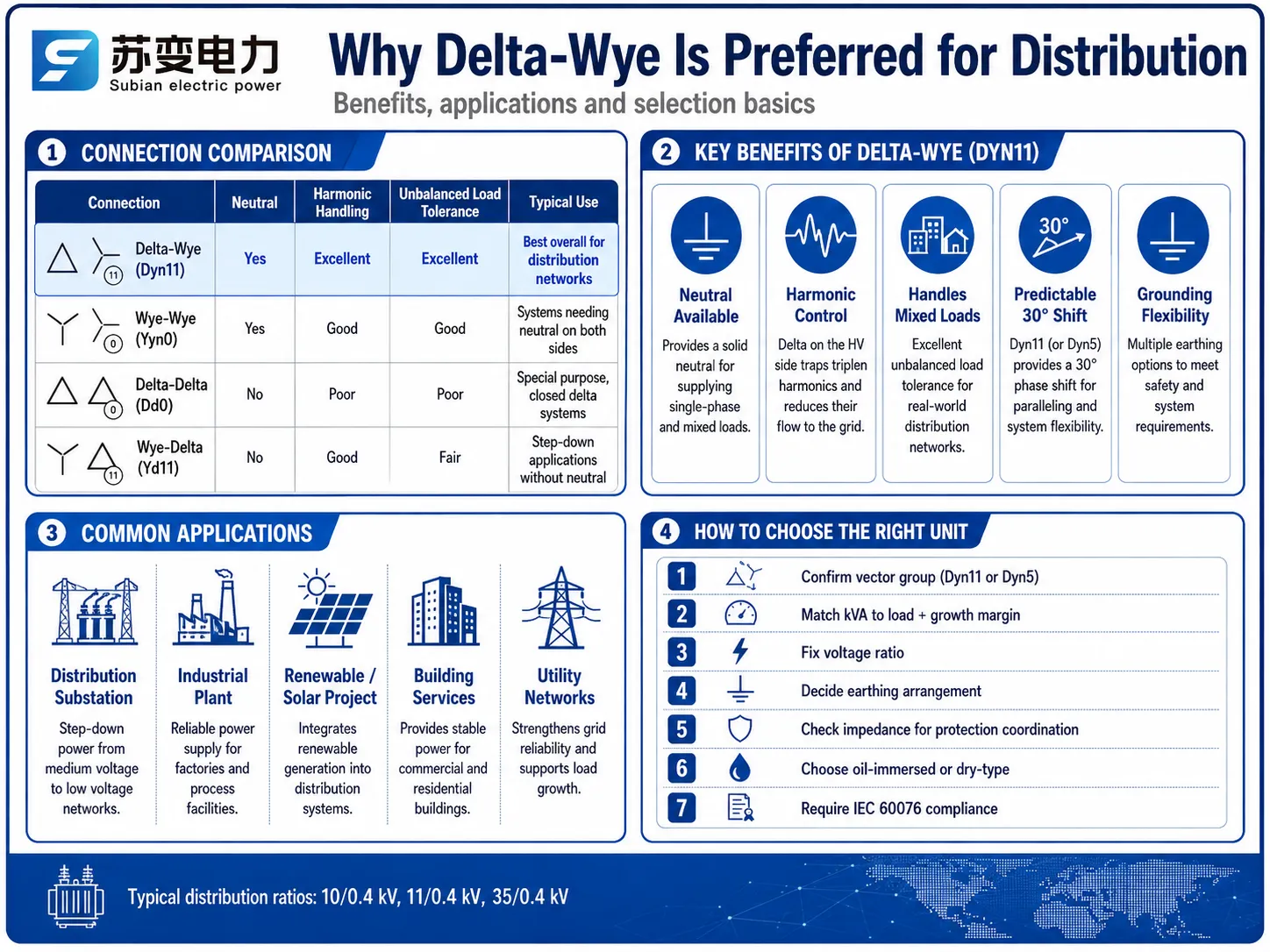
| Delta-estrella (Dyn11) | Sí (LV) | Bueno — el lazo delta lo circula | Buena | Distribución, suministro industrial |
| Estrella-estrella (Yyn0) | Sí (ambos lados) | Pobre sin devanado terciario | Pobre | Rara vez se usa solo en trifásico |
| Delta-delta (Dd0) | No | Buena | Pobre — sin neutro LV | Cargas industriales, sin necesidad de puesta a tierra |
| Estrella-delta (Yd11) | No (delta LV) | Buena | Buena | Elevación en generación |
Delta wye es la única conexión ampliamente adoptada que te proporciona un neutro aterrizado en el lado de carga y mitigación de armónicos en el lado de suministro. Wye wye, sin el tercer devanado, tendrá algún desplazamiento de neutro y distorsión de tercer armónico para cargas desbalanceadas. Delta delta no tiene ningún neutro en absoluto. Por lo tanto, en caso de que la carga necesite un suministro de 230/400 V de cuatro hilos, delta wye será tu conexión de elección casi invariablemente.
Aplicaciones Comunes
- Subestaciones que disminuyen 35 kV o 10 kV a 0.4 kV para el suministro de sistemas de cuatro hilos en el campo comercial e industrial. Empresas manufactureras que necesitan energía eléctrica trifásica (para motores y compresores) y el neutro para iluminación y dispositivos de control. Proyectos de energía renovable donde la referencia de neutro y los armónicos se contienen en la salida del grupo de inversores mediante el transformador en el lado del colector. Construcción de operaciones de planta que requieren suministro aterrizado de acuerdo con las normas de seguridad. Sistemas de utilidad que crean una unidad delta-wye a veces mediante el propio transformador de puesta a tierra.
Especificaciones típicas
| Clasificación (kVA) | Relación de voltaje | Grupo vectorial | Impedancia | Precio indicativo (US$) |
|---|---|---|---|---|
| 100 | 10/0.4 kV | Dyn11 | 4% | $3,000–$6,000 |
| 315 | 10/0.4 kV | Dyn11 | 4% | $5,500–$10,000 |
| 630 | 10/0.4 kV | Dyn11 | 4.5–6% | $9,000–$16,000 |
| 1,000 | 35/0.4 kV | Dyn11 | 6% | $14,000–$25,000 |
| 2,500 | 35/0.4 kV | Dyn11 | 6–8% | $28,000–$45,000 |
Los precios son indicativos FOB para unidades sumergidas en aceite con niveles de pérdida estándar; las versiones de tipo seco de resina fundida cuestan alrededor de 20–40% más en la misma clasificación. Confirma la impedancia contra tu esquema de protección, porque gobierna la corriente de falla y la discriminación.
Cómo Elegir la Unidad Correcta
- Confirma el grupo vectorial. Dyn11 para la mayoría de los deberes de distribución; Dyn5 donde la red requiere una relación de fase diferente. Indícalo en el pedido.
- Ajusta el kVA a la carga. Dimensiona según la carga conectada, la carga de arranque más grande y un margen de crecimiento de 10–20%.
- Fija la relación de voltaje. 35/0.4 kV, 10/0.4 kV, o 11/0.4 kV dependiendo de tu red primaria y el voltaje del panel LV.
- Decide el arreglo de puesta a tierra. La puesta a tierra de neutro sólido es la más simple; usa un resistor de puesta a tierra de neutro (NER) donde se requieran límites de corriente de falla.
- Verifica la impedancia para la coordinación de protección. Una impedancia de 4–6% es típica; valores más altos limitan la corriente de falla pero aumentan la regulación de voltaje.
- Elige aislamiento y refrigeración para el sitio. Sumergido en aceite al aire libre, tipo seco de resina fundida en interiores; estándar ONAN, ONAF para factores de carga altos.
- Requiere cumplimiento con IEC 60076. Confirma niveles de aislamiento, aumento de temperatura y resistencia a cortocircuitos, y solicita el informe de prueba de rutina.
Principales marcas y rangos de precios
| Marca | País | Enfoque del producto | Rango de precios indicativo (US$) |
|---|---|---|---|
| ABB | Suiza/Suecia | Unidades delta-wye de distribución e industriales | $4,000–$60,000 |
| Siemens | Alemania | Transformadores de distribución IEC | $3,500–$55,000 |
| Schneider Electric | Francia | Unidades de tipo seco y de resina fundida | $3,000–$45,000 |
| Hitachi Energy | Suiza | Transformadores de distribución de grado utilitario | $4,500–$70,000 |
| Eaton | EE. UU. | Unidades de distribución de América del Norte | $2,500–$42,000 |
| Jiangsu Subian Electric Power | China | Grupos vectoriales personalizados de tipo inmerso en aceite y tipo seco | $3,000–$45,000 |
Los precios mencionados no son fijos y pueden variar entre fabricantes según la calidad de los productos, así como por daños y equipos utilizados. Empresas reconocidas que fabrican transformadores delta/wye incluyen ABB, Schneider Electric, Siemens, Hitachi Energy y Eaton. La documentación de estas empresas sirve como un excelente punto de referencia para las especificaciones. Aquellos interesados en obtener transformadores delta/wye fabricados de acuerdo con las normas IEC 60076 a mejores precios pueden comprar transformadores wick de Jiangsu Subian Electric Power Co., Ltd. Esta empresa fabrica transformadores delta-wye de tipo aceite (湿型) y seco (干型) en todas las capacidades, desde pequeñas unidades de distribución hasta varios MVA y con varios grupos vectoriales, incluyendo Dyn11 y Dyn5. Jiangsu Subian Electric Power Co., Ltd. utiliza acero orientado y cobre de alta calidad para sus transformadores y puede proporcionar documentación completa de pruebas y el soporte necesario para sus exportaciones. Revise la gama de productos en el sitio web de Subian Electric.
Preguntas Frecuentes
¿Por qué es tan común la conexión delta-wye en la distribución?
El beneficio que proviene de esta conexión es la capacidad de proporcionar todo a la vez: puesta a tierra del neutro en baja tensión para cargas monofásicas y conexión a tierra; la capacidad de hacer un lazo delta en el lado de alta tensión que atrapa corrientes de tercer armónico y de secuencia cero, y un grado razonable de resistencia a cargas desbalanceadas. Ninguna otra conexión tiene esas tres características, y esa es la razón por la cual se ha elegido Dyn11 para transformadores de distribución en el rango de voltaje de 10 kV hasta 0.4 kV.
¿Qué significa Dyn11 en una placa de identificación de transformador?
D indica que el devanado de alta tensión está en una conexión delta, y nos informa que el devanado de baja tensión está en una conexión wye (o estrella), y n indica que el neutro de baja tensión está fuera. El 11 indica la hora del reloj: esto significa que la tensión de línea LV adelanta a la tensión de línea HV en 330 grados (esto es equivalente a retrasar la tensión de línea LV en 30 grados), lo que nos da la característica de la conexión delta-wye: un desplazamiento de fase de 30 grados.
¿Por qué hay un desplazamiento de fase de 30° en un transformador delta-estrella?
La transformación es el resultado de los cambios en las conexiones de los devanados en los dos lados. Para la conexión estrella, el fasor de voltaje de línea es la diferencia entre dos voltajes de fase que están separados por 120 grados, mientras que para la conexión delta, es igual al voltaje de una fase. Al comparar los dos voltajes de línea, se puede descubrir que el ángulo entre los fasores es de 30 grados, que es la razón por la cual el transformador delta-estrella se refiere como 11 o 5 (30 o 150 grados).
¿Puede un transformador delta-estrella manejar cargas desbalanceadas?
Bastante bien. Cuando hay conexiones tipo delta en un devanado primario, la corriente desbalanceada en el devanado secundario fluirá a través de la red delta y será suprimida. Esto hace que este tipo de conexión sea favorable al utilizar una combinación de suministros monofásicos y trifásicos. En situaciones de alto desbalance, es esencial que el sistema esté correctamente dimensionado y que se tenga en cuenta la corriente neutra.
¿Subian fabrica transformadores delta-estrella para exportación?
¡De hecho! Jiangsu Subian Electric Power puede suministrar transformadores delta-estrella de acuerdo con IEC 60076 con el grupo vectorial, capacidad y relación de voltaje que necesite, y también proporciona informes de pruebas rutinarias e inspecciones de terceros opcionales para trabajos internacionales. La fábrica es capaz de suministrar construcciones sumergidas en aceite o tipo seco para clases de distribución típicas.
Referencias
- IEC 60076-1 — Transformadores de Potencia: General — el estándar regulador para clasificación y pruebas, incluyendo la designación del grupo vectorial.
- IEC 60076-3 — Niveles de Aislamiento y Pruebas Dielectrónicas — define los requisitos de aislamiento para transformadores delta-estrella de clase de distribución.
- IEC 60076-5 — Capacidad para Resistir Cortocircuitos — el estándar de verificación de cortocircuito para los devanados.
- NEMA TP-1 — Eficiencia Energética para Transformadores de Distribución — referencia de eficiencia utilizada en la evaluación de pérdidas.
- Hitachi Energy — Productos de Transformadores — documentación de referencia para transformadores de distribución de grado utilitario.
- Eaton — Información de Ingeniería de Transformadores — guía práctica de conexión y aplicación de un fabricante importante.
Conclusión
combina un secundario estrella a tierra adecuado para cargas monofásicas con una conexión a tierra con un devanado primario delta capaz de realizar supresión armónica y absorber corrientes desbalanceadas, al mismo tiempo que permite un desplazamiento de fase de 30 grados. Para asegurar el éxito del uso de tales transformadores, se debe lograr la combinación correcta de los siguientes cinco elementos: la especificación del grupo vectorial (típicamente Dyn11), la determinación del kVA del transformador basado en estudios de carga, la identificación de la relación de voltaje que coincida con la red, la selección del modo de conexión a tierra, así como la conformidad de todas las especificaciones con los requisitos de la norma IEC 60076 y la disponibilidad de documentación de pruebas. Confirme su grupo vectorial y datos de carga con el equipo a través de la página web oficial para recibir una cotización ajustada a la especificación.