


Es ist Dienstagmorgen um 6:50 Uhr, als der Schichtelektriker in einem mittelgroßen Werk erkennt, dass ein 2.000 kVA Transformator viel lauter summt als gewöhnlich. Das Buchholz-Relaisfenster hat eine kleine Gasblase, und der Ölmessstab am Konservator zeigt einen niedrigeren Wert als im letzten Monat. Jeder kennt das Sprichwort, dass Probleme mit Transformatoren sich nicht von selbst verringern, auch wenn niemand es noch als Notfall bezeichnen möchte. Einige der besten täglichen Wartungspraktiken für Transformatoren und Methoden zur Fehlersuche bei häufigen Problemen kommen zum Einsatz.
Dieser Artikel bietet Ihnen praktische Informationen zur täglichen und regelmäßigen Wartung von flüssigkeitsgefüllten Transformatoren sowie Schritt-für-Schritt-Empfehlungen zur Fehlersuche bei den häufigsten Fehlfunktionen, einschließlich plötzlicher Geräusche, Ölleckagen, hoher Öltemperatur, Buchholz-Relaisbetrieb, schlechter Isolierung usw. Sie finden Checklisten, Alarm- und Normalwerte, realistische Schätzungen und Untersuchungsschritte im Artikel.
Einfach ausgedrückt bedeutet dies, dass die tägliche Wartung von Transformatoren ein unkomplizierter Prozess ist. Um gewartet zu werden, erfordert es die Überprüfung der Ölfarbe und des Niveaus, das Augenmerk auf ungewöhnliche Geräusche, die Überprüfung der Temperatur, die Überprüfung der Durchführungen und des Buchholz-Relais sowie das Notieren von Alarmen. Häufige Probleme mit Transformatoren und Lösungen umfassen die Überprüfung der Öltemperatur, des Buchholz-Gasalarms, der Ölleckagen und des niedrigen Isolationswiderstands.
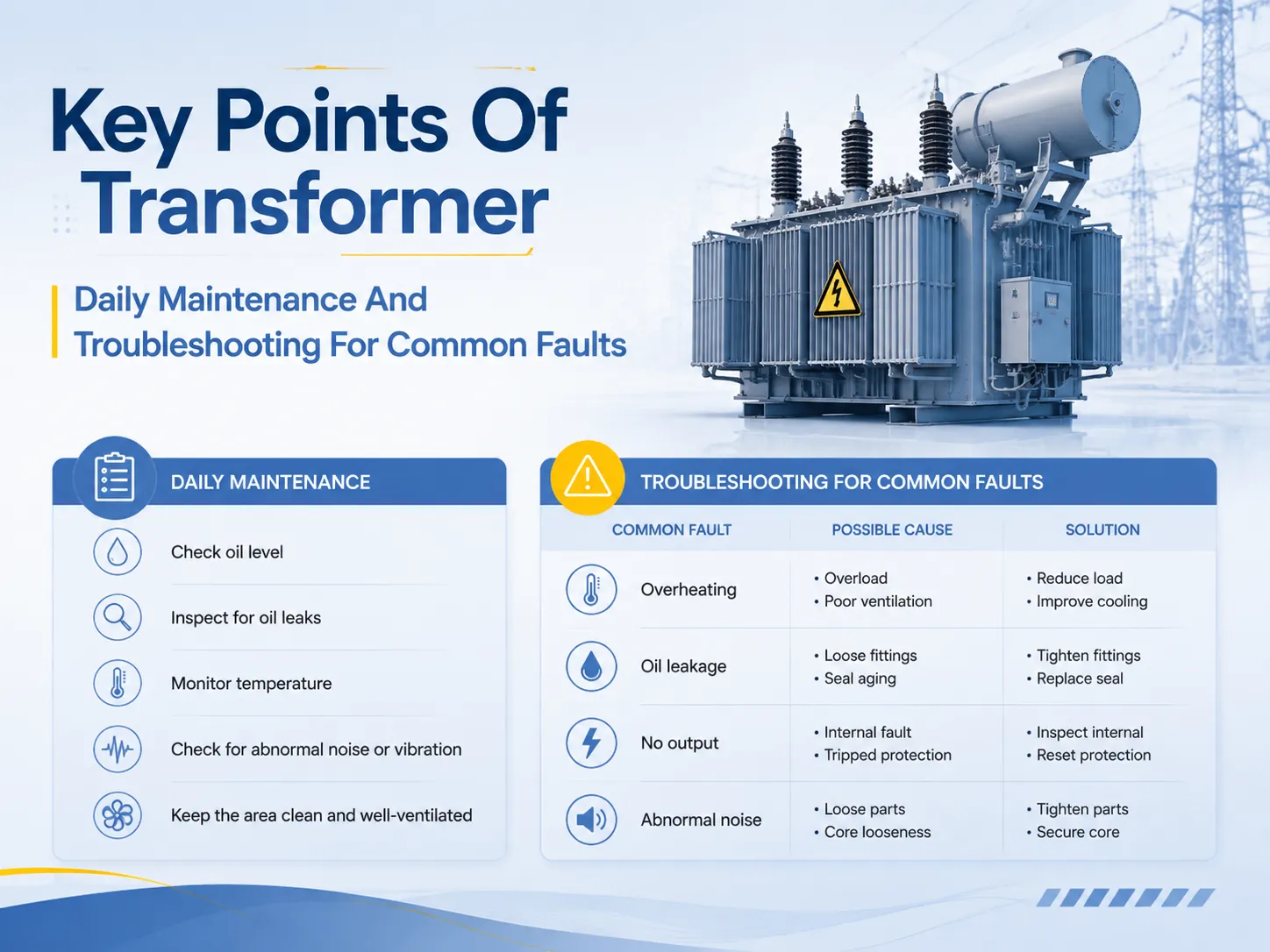
Warum tägliche Wartung wichtig ist
Transformatoren können auf zwei Arten ausfallen: abrupt aufgrund von Ereignissen wie einem Blitzschlag, explodierenden Durchführungen oder Kurzschlüssen; oder langsam aufgrund der Verschlechterung der Isolierung, dem Eindringen von Feuchtigkeit durch die Transformatoren und der mechanischen Funktion des Transformators. Die langsamen Ausfälle sind etwas, mit dem die präventive Wartung umgehen kann, da sie Wochen oder Monate vor dem Ausfall frühe Anzeichen geben: zum Beispiel ein niedrigerer Ölstand im Transformatorbehälter, eine Veränderung des Geräuschs des Transformators, ein Anstieg der Temperatur des Behälters und unbedeutende Ölleckagen.
Forschungen von IEEE und CIGRÉ-Arbeitsgruppen zeigen, dass die Daten zu Transformatorausfällen die Schlussfolgerung unterstützen, dass Isolationssysteme und Abgriffe die größte Anzahl der gesamten Transformatorausfalldaten ausmachen, die 30–50 Prozent der gesamten Anzahl der Ausfälle der Transformatoren ausmachen. Ein fünfminütiger Rundgang jeden Tag kann helfen, die Ursachen von Isolations-FIA-Ausfällen zu identifizieren, während eine jährliche Ölprobe, die $300 kostet, bestätigen kann, was im Inneren des Transformatorbehälters passiert. Das gegenteilige Szenario impliziert, dass die Fehlfunktion entdeckt wird, wenn das Schutzgerät aktiviert wird, was bedeutet, dass Notfallreparaturen durchgeführt werden müssen, zusammen mit Überstunden und den Kosten für die Durchführung dieser Aufgaben, die in der Regel die Wartungskosten um das 5- bis 20-fache übersteigen.
Die tägliche Inspektionscheckliste
Eine typische tägliche Inspektion eines ölgefüllten Transformators dauert etwa 5–10 Minuten. Befolgen Sie die untenstehenden Punkte und stellen Sie sicher, dass Sie ordnungsgemäße Aufzeichnungen führen:
- Ölstand: Überprüfen Sie einen manuellen Ölstandsanzeiger. Ein plötzlicher Rückgang weist auf entweichendes Öl und mögliche Mängel hin.
- Ölzustand und Aroma: Das Sichtglas sollte sauberes und klares Öl anzeigen; trübes Öl weist auf Feuchtigkeit oder Kohlenstoffisierung hin.
- Geräusche: Der Transformator sollte nur ein sanftes Summen erzeugen; jedes Summen deutet auf lockere Teile, Kernprobleme oder Entladeaktivitäten hin. Jede Abweichung vom normalen Geräusch sollte Verdacht erregen.
- Temperaturen: Notieren Sie den Wert der Oberöltemperatur und vergleichen Sie ihn mit dem Lastzustand. In einem voll belasteten Verteilungstransformator sollte die Temperatur bei normalem Wetter nahe 60–75 °C liegen; alle Werte über 85-90 °C sollten alarmierend sein.
- Durchführungen: Achten Sie auf Risse oder Spuren.
- Entlüfter: Silikagel sollte noch blau sein (was auf einen Mangel an Feuchtigkeit hinweist); es sollte pink oder rötlich sein.
- Buchholz-Relais: Bestätigen Sie, dass sich kein Gas im Fenster angesammelt hat.
- Alles andere: Achten Sie auf das Vorhandensein von Öl unter dem Transformator, ungewöhnliche Vibrationen, lockere Schrauben usw.
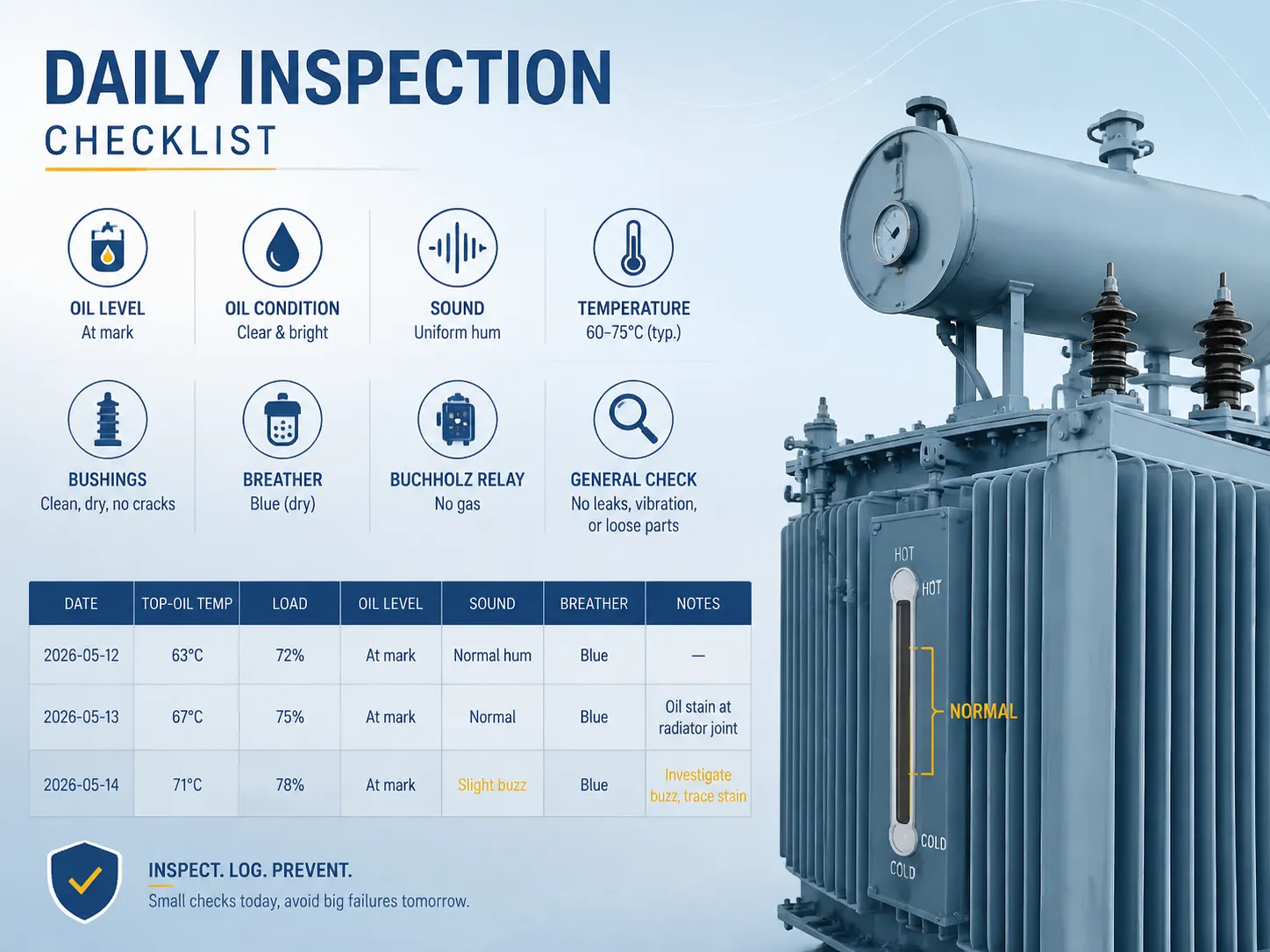
Jede ungewöhnliche Aktivität wird aufgezeichnet und ernst genommen, während das tägliche Protokoll auch nützliche Trenddaten liefert, die für zukünftige Diagnosen verwendet werden können. Ein standardisiertes einfaches Protokollbuch, das bei jeder Gelegenheit ausgefüllt wird, ermöglicht einen schnellen Überblick über Trends:
| Datum | Oberöltemp | Last | Ölstand | Geräusch | Entlüfter | Anmerkungen |
|---|---|---|---|---|---|---|
| 2026-05-12 | 63°C | 72% | Bei Markierung | Normales Summen | Blau | — |
| 2026-05-13 | 67°C | 75% | Bei Markierung | Normal | Blau | Ölverschmutzung an der Radiatorverbindung |
| 2026-05-14 | 71°C | 78% | Bei Markierung | Leichtes Summen | Blau | Summen untersuchen, Fleck nachverfolgen |
Wöchentliche und monatliche Routineaufgaben
Tägliche Inspektionen zeigen sofortige Anzeichen von Problemen, während wöchentliche und monatliche Inspektionen helfen, längere Verschlechterungen zu erkennen:
| Häufigkeit | Aufgabe | Typischer Standard / Wert |
|---|---|---|
| Wöchentlich | Sichtprüfung aller Zubehörteile, Betrieb der Kühlventilatoren, Überprüfung auf Ölundichtigkeiten | Keine Lecks, Ventilatoren laufen nach Thermostat |
| Monatlich | Ölstand bei Temperatur überprüfen, Erdungsverbindungen inspizieren, Isolatoroberflächen reinigen | Erdungswiderstand < 1 Ω, wo getestet |
| Vierteljährlich | Isolationswiderstand (Megger)-Test an Wicklungen, Betrieb des Abgriffsprüfers überprüfen | IR-Werte im Trend, nicht absolut; 1.000–5.000 MΩ typisch bei gesunden HV-Wicklungen |
| Halbjährlich | Ölprobenentnahme auf Feuchtigkeit und dielektrische Festigkeit, OLTC-Ölprobe | Durchschlagspannung > 30–40 kV gemäß IEC 60156; Feuchtigkeit < 20–30 ppm |
| Jährlich | Vollständige DGA, Furananalyse, Ölqualitätsprüfung, Schutzrelaisprüfung | Gasniveaus gemäß IEEE C57.104 Zustand 1 |
| Alle 3–5 Jahre | Gründliche Inspektion, Konservator- und Entlüfterüberholung, OLTC-Kontaktinspektion | Hersteller- und IEC 60422-Richtlinien |
Wie “Normal” aussieht: Referenzwerte
Die Diagnose beginnt mit dem Verständnis, was normale Werte sind. Die folgende Tabelle stellt die praktischen Verteilungsbereiche für die sogenannten ölgetauchten Verteilungstransformatoren dar:
| Parameter | Normalbereich | Untersuchen, wenn | Alarm-/Aktionsniveau |
|---|---|---|---|
| Oberöltemperatur (belastet) | 50–75°C | > 80–85°C | > 90–95°C: Last reduzieren, Kühlung überprüfen |
| Schätzung des Hot-Spot der Wicklung | < 98°C gemäß Lastleitfaden | Trend steigend | > 110–120°C: ernsthafte Alterung |
| Durchschlagspannung des Öls | > 40–60 kV | 30–40 kV | < 30 kV: Filtration/Ersetzung erforderlich |
| Ölfeuchtigkeit | < 15–20 ppm | 20–30 ppm | > 30–40 ppm: Öl austrocknen und untersuchen |
| Isolationswiderstand (Megger, HV-Wicklung) | > 1.000 MΩ | Fallender Trend zwischen den Tests | < 100–500 MΩ: austrocknen und erneut testen |
| Farbe des Silikagel-Entlüfters | Blau (trocken) | Teilweise rosa | Vollständig rosa/rot: regenerieren oder ersetzen |
| TDCG (gesamt brennbare Gase) | < 720 ppm | 720–1.920 ppm | > 1.920 ppm: detaillierte Untersuchung gemäß IEEE C57.104 |
Seien Sie sich bewusst, dass die Trends wichtiger sind als Einzelmessungen: Eine Öltemperatur von 78°C ist alarmierender, wenn sie um 5°C pro Woche steigt, als wenn sie stabil bei konstanter Last bleibt.
Fehlersuche bei den häufigsten Fehlern
Wenn Anzeichen für eine Fehlfunktion vorliegen, führen Sie eine ordnungsgemäße Untersuchung durch, anstatt Annahmen zu treffen. Bei der Fehlersuche an Transformatoren kann es hilfreich sein, die folgende Tabelle mit häufigen Problemen und möglichen Ursachen sowie den ersten Tests, die Sie durchführen sollten, zu konsultieren:
| Symptom | Wahrscheinlichste Ursachen | Erste Überprüfungen | Nächster Schritt, wenn nicht gelöst |
|---|---|---|---|
| Ungewöhnliches Geräusch / Summenänderung | Lockere Kernklemmen, lockere Montageschrauben, OLTC-Antriebs-Vibration, Teilentladung, Last-Harmoniken | Schrauben festziehen, Geräusch mit Lastniveau vergleichen, auf Knacken hören | PD-Messung, Kernerdstromtest |
| Ölstand sinkt | Leck an Dichtungen/Buchsen, Entlüfterfehler, Temperaturabfall | Alle Verbindungen inspizieren, Temperaturkorrelation überprüfen | Leck finden und beheben; Öl auf Feuchtigkeit testen |
| Hohe Öltemperatur | Überlast, Kühlventilatoren laufen nicht, blockierte Kühler, niedriger Ölstand, hohe Umgebungstemperatur | Last im Vergleich zur Nennleistung überprüfen, Ventilatorbetrieb, Kühlerluftstrom | Lastleitfaden überprüfen, Kühler reinigen, DGA |
| Buchholzgas-Alarm | Geringe Gasemissionen durch normale Alterung, Überhitzung oder einen internen Fehler | Gasprobe entnehmen, Menge und Geruch notieren | DGA von Gas und Öl; vergleichen mit IEEE C57.104 |
| Buchholz-Auslösung (plötzlich) | Schwerwiegender interner Fehler, Lichtbogen, Kurzschluss | Nicht wieder unter Spannung setzen; isolieren und inspizieren | Vollständige interne Inspektion, DGA, Wicklungstests |
| Niedriger Isolationswiderstand | Feuchtigkeit im Öl, nasse Wicklung, Staub und Verunreinigung | Megger-Test, Ölfeuchtigkeitstest | Trocknungsprozess, Ölfiltration, Nachtest |
| Überhitzung an Verbindungen | Lockere Anschlüsse, korrodierte Kabelschuhe, unterdimensionierte Leiter | Thermografie von Anschlüssen und Sammelschienen | Nach Drehmomentvorgabe anziehen, Kabelschuhe ersetzen |
Buchholz-Relaisbetrieb: Was es Ihnen sagt
Das Buchholz-Relais ist im Rohr positioniert, das den Transformatorbehälter mit dem Konservator verbindet, und ist Teil eines internen Fehlererkennungssystems. Das Relais verfügt über zwei Schwimmer: Der obere Schwimmer sendet ein Alarmsignal bei Gasansammlung und der untere Schwimmer betätigt den Leistungsschalter, wenn Öl plötzlich zum Konservator strömt und ein erheblicher Fehler auftritt. Wenn das Buchholz-Gerät Alarm schlägt:
- Es ist notwendig, die Menge des freigesetzten Gases zu notieren und ob das Relais nur ein Warnsignal gegeben hat oder den elektrischen Stromkreis abgeschaltet hat.
- Es ist wichtig, eine Gasprobe vom Buchholz-Ventil zu entnehmen und die Menge des Gases sowie dessen Geruch zu notieren. Ein unangenehmer Geruch kann ein Indikator für Lichtbogenbildung sein.
- Es ist unerlässlich, das gesammelte Gas zu analysieren: Abnorm hohe Mengen an Wasserstoff und Acetylen weisen auf Lichtbogenbildung und schwerwiegende Fehler hin, während eine vorherrschende Luftzusammensetzung auf Probleme mit dem Luftfilter hinweisen kann.
- Es ist notwendig, gleichzeitig die DGA-Ölprobe zu entnehmen und die Gaskonzentrationen mit den im Standard IEEE C57.104 beschriebenen Bedingungen zu vergleichen.
- Es ist notwendig, eine Entscheidung zu treffen: Wenn die Gaszusammensetzung auf Überhitzung oder Lichtbogenphänomene hinweist – schließen Sie die Einheit nicht wieder an, bis eine interne Inspektion und mögliche Reparaturarbeiten durchgeführt wurden. Wenn die Gasansammlung statistisch nicht signifikant ist und keine fehlerhafte Funktion anzeigt, kann die Einheit ohne Probleme weiterarbeiten, jedoch sollten laufende Inspektionen durchgeführt werden, um sicherzustellen, dass keine Fehler vorliegen.
Ereignisse der Gasansammlung sollten dokumentiert und dem Ingenieur gemeldet werden, um eine weitere Verfolgung der Gasbildung zu ermöglichen.
Ölundichtigkeiten: Ursachen und Handhabung
Das sichtbarste Wartungsproblem in Bezug auf Ölundichtigkeiten sind Öl leaks, die aus drei Gründen wichtig sind: Senkung des Ölstands (was die Effektivität der Kühl- und Isolationssysteme beeinträchtigt), Eindringen von Feuchtigkeit und Luft durch die Lecks und Verursachung von Umwelt- und Sicherheitsproblemen. Ölundichtigkeiten treten am wahrscheinlichsten an den Dichtungen an der Verbindung zwischen dem Tank und dem Deckel, an den Buchsenbasen, an den Flanschen der Konservatorrohre, an den Anschlüssen zum Kühlradiator und am Ablassventil auf.
Bei der Suche nach einem Ölleck ist es am besten, einige Inspektionen mit einem sauberen Tuch durchzuführen oder, im Falle eines sehr kleinen Lecks, die Verbindungen nachts mit einer Taschenlampe zu überprüfen (es wären sichtbare Ölflecken vorhanden). Es wird empfohlen, die Schrauben an der Flansch gemäß den Anweisungen des Herstellers anzuziehen, und wenn das nicht hilft, die Dichtungen durch neue Materialien zu ersetzen. Nach jeder Reparatur muss das Öl über den Konservator aus demselben Batch nachgefüllt werden, und nach einer Woche muss eine Probe auf Feuchtigkeit überprüft werden. Selbst kleine Öllecks können zu großen Problemen führen, da die Einheit, die 5-10 Liter pro Monat verliert, beginnen wird, feuchte Luft durch den Entlüfter aufzunehmen.
Überhitzung und Kühlfehler
Ständige Überhitzung ist der schnellste Weg, die Lebensdauer eines Transformators zu verringern, da das Altern der Isolierung praktisch mit jedem Anstieg der Temperatur um 6-8 Grad K verdoppelt wird. Im Falle einer hohen Öltemperatur sind die folgenden Schritte zu unternehmen:
- Überprüfen Sie, ob die Last mit dem Typenschild und dem Lastenheft (IEC 60076-7) übereinstimmt. Wenn die Last die Typenschildangabe überschreitet und keine Kühlung durch Ventilatoren erfolgt, führt dies zu Überhitzung.
- Überprüfen Sie den Zustand des Ventilators und der Pumpe. In einem ONAF-Transformator arbeiten die Ventilatoren automatisch durch das Thermostat; der Ausfall des Ventilators oder Probleme mit der Luftzirkulation im Kühler können zu einem Temperaturanstieg von 10-20 Grad führen.
- Überprüfen Sie den Kühler, um sicherzustellen, dass die Lamellen sauber sind; verwenden Sie Luft oder Wasser, aber verwenden Sie keinen Hochdruckreiniger, da dies den Kühler beschädigen könnte.
- Überprüfen Sie den Ölstand und die Zirkulation. Ein niedriger Ölstand kann aufgrund schlechter Kühlung und heißer Punkte in der Nähe der Wicklung zu Überhitzung führen.
- Finden Sie heraus, ob es interne Ursachen für das Problem gibt.
Elektrische Fehler: Isolationswiderstand und Erdung
Der Test des Isolationswiderstands (Megger) wird für eine typische Bewertung von Feuchtigkeit und Verunreinigung verwendet. Jede Wicklung wird sowohl gegen Erde als auch gegeneinander mit einer Spannung von 500–5.000 V getestet, abhängig vom Transformator. Die Temperatur während des Tests sollte ebenfalls registriert werden. Der kritische Punkt ist nicht die absolute Messung des Isolationswiderstands, sondern seine Veränderung über die Zeit, sodass im Vergleich zu den Ergebnissen des Vorjahres mehr Wert auf die Entwicklungen der Werte als auf die Endzahlen gelegt werden sollte. Wenn ein niedriger Isolationswiderstand festgestellt wird, folgt der Test des Öls auf Feuchtigkeit und die dielektrische Festigkeit. Wenn das Öl als verunreinigt befunden wird, ist die nächste Maßnahme das Filtern und/oder Wechseln des Öls, gefolgt von einem erneuten Test. In den schlimmsten Fällen kann es erforderlich sein, den Transformator auszutrocknen, wobei die bereitgestellten Empfehlungen zum kontrollierten Prozess des Trocknungsverfahrens durch die Hersteller zu befolgen sind.
Erdung ist ein unabhängiges und sehr wichtiges tägliches Verfahren. Der Tank sollte mit allen nicht stromführenden metallischen Teilen geerdet werden; der Erdungswiderstand beträgt in der Regel 1–5 Ω, abhängig vom System. Wenn die Erdung fehlschlägt, bleibt der Tank im Falle eines internen Fehlers des Transformators unter Spannung. Eine visuelle Inspektion der verwendeten polymeren Riemen zur Erdung muss regelmäßig durchgeführt werden, um ihre Korrosion, Lockerheit und den allgemeinen Zustand zu überprüfen.
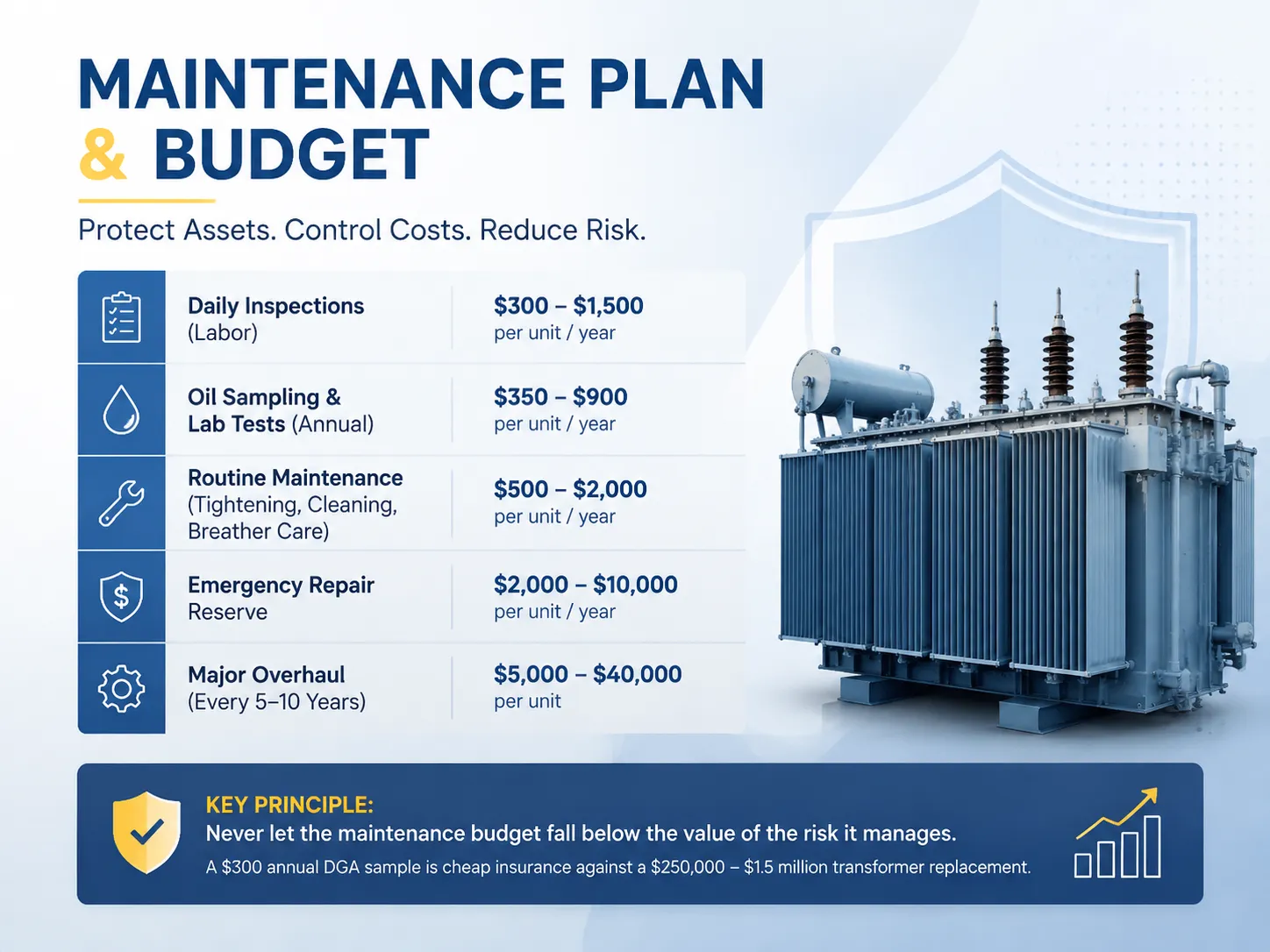
Erstellung eines Wartungsplans und Budgets
Entwickeln Sie schriftliche Wartungspläne aus Ihren Checklisten, indem Sie Rollen und Budgets relevanten Mitarbeitern zuweisen.
| Kostenposition | Typische jährliche Kosten (pro Einheit) | Anmerkungen |
|---|---|---|
| Tägliche Inspektionen (Arbeitsaufwand) | $300–$1.500 | 10 Minuten/Tag Technikerzeit |
| Ölmusterentnahme und Labortests (jährlich) | $200–$500 pro DGA-Probe | Plus $150–$400 für das Ölqualitäts-Paket |
| Routinewartung (Festziehen, Reinigen, Pflege des Atmungsventils) | $500–$2.000 | Verbrauchsmaterialien und Arbeitsaufwand |
| Notfallreparaturreserve | $2,000–$10,000 pro Einheit budgetiert | Dichtungssets, Öl, Dichtungen, Lüfter |
| Hauptüberholung (alle 5–10 Jahre) | $5.000–$40.000 | OLTC-Inspektion, Ölfiltration, Dichtungen |
Das Hauptprinzip der Wartungsbudgetierung ist, dass das Wartungsbudget niemals niedriger sein sollte als die Kosten der potenziellen Risiken. Eine jährliche DGA-Probe für $300 ist eine gute Investition im Vergleich zu einem potenziellen Verlust der Transformatorenkosten zwischen $250.000 und $1.500.000.
Häufig gestellte Fragen
Wie oft sollte Transformatorenöl entnommen werden?
Bei funktionierenden Transformatoren ist es üblich, einmal pro Jahr eine Probe zu entnehmen. Im Falle von Verteiltransformatoren sollte die Ölprobenahme alle ein bis drei Jahre erfolgen, abhängig von der Wichtigkeit des Transformators. Bei jeder Alarmierung durch das Buchholzrelais, jeder Überlastsituation, jeder Art von Fehlfunktion oder wenn eine erhebliche Gasproduktion vorliegt, sollte so schnell wie möglich (innerhalb weniger Wochen) eine Probe entnommen werden. Im Durchschnitt liegen die Kosten für eine DGA-Probe zwischen $200 und $500 zusammen mit einem Bericht des Labors.
Was ist die normale Betriebstemperatur eines Transformators?
Die Temperatur an der Oberseite des Öls in einem aktiven Öltransformator muss bei gemäßigten Klimabedingungen zwischen 60°C und 75°C liegen. Wenn die Temperatur 85°C übersteigt, ist es notwendig, die Situation zu überprüfen. Wenn die Hot-Spot-Temperatur über 98°C liegt, findet der Prozess der Isolationsalterung statt.
Was bedeutet ein Alarm des Buchholzrelais?
Die Gasansammlung im Konservatorrohr ist der Auslöser für den Alarm des Buchholzrelais. Das Gas könnte entweder Luft sein, die während des Fehlers des Atmungsventils produziert wird, oder Gase, die während Überhitzungen und Lichtbogenbildung im Inneren des Tanks entstehen. Folglich muss das Gas probiert werden, und eine DGA muss durchgeführt werden, um eine Schlussfolgerung zu ziehen.
Wie gehe ich mit einem Transformator mit niedrigem Isolationswiderstand um?
Zuerst müssen Sie das Öl, die Sättigung und die dielektrische Festigkeit des Öls überprüfen. Es ist sehr wahrscheinlich, dass das Öl feucht ist. Das Öl muss gefiltert oder ersetzt werden, wenn die Sättigung mehr als 20-30 ppm beträgt. Falls die Wicklung des Transformators feucht ist, sollte ein kontrollierter Trocknungsprozess gemäß den Anweisungen des Herstellers durchgeführt werden.
Was soll ich tun, wenn ein Transformator am Buchholzrelais auslöst?
Stellen Sie vor dem Einschalten des Transformators sicher, dass die Transformatoreneinheit isoliert ist und nehmen Sie Gas- und Ölproben für die DGA. Nachdem das Buchholzrelais ausgelöst wurde, ist es wichtig, das Relais und den Konservator zu überprüfen.
Referenzen
- IEEE C57.104: Leitfaden zur Interpretation von Gasen, die in ölgetauchten Transformatoren erzeugt werden — Die Referenz für die DGA-Interpretation und Alarmstufen während der Fehlersuche.
- IEC 60422: Aufsicht und Wartungsleitfaden für mineralische Isolieröle — Definiert die Qualitätsgrenzen für Öl und Wartungspraktiken.
- IEC 60076-7: Lastleitfaden für ölgefüllte Transformatoren — Die Referenz für Temperaturgrenzen und zyklische/Notfallbelastungen.
- IEC 60156: Isolierflüssigkeiten — Bestimmung der Durchschlagspannung — Prüfstandard für die dielektrische Festigkeit von Öl, die in der routinemäßigen Wartung verwendet wird.
- IEC 60599: Leitfaden zur Interpretation von DGA in mineralölimprägnierten Geräten — Internationaler Rahmen für die Gasinterpretation.
- CIGRÉ — Veröffentlicht technische Broschüren zur Transformatorwartung, Fehlestatistiken und Zustandsbewertung.
- Jiangsu Subian Electric Power — IEC 60076-konformer Transformatorenhersteller, der Wartungsdokumentation und technischen Support bereitstellt.
Fazit
Die tägliche Wartung von Transformatoren ist sehr einfach, kostengünstig und eines der besten wertorientierten Vorhaben innerhalb eines elektrischen Anlagenprogramms. Ein kurzer vorläufiger Rundgang, der fünf Minuten dauert, eine monatliche Routineinspektion und eine jährliche Probe der DGA-Untersuchung helfen leicht, kritische Mängel zu finden, die zu unkontrollierbaren Ereignissen führen, und sie stattdessen in geplante Wartung umzuwandeln. Im Allgemeinen muss, wann immer eine Abnormalität auftritt, der Algorithmus zur Fehlersuche für eine effiziente Problemausschluss eingeleitet werden: Zuerst die offensichtlichen Variablen überprüfen, dann die Ölproben entnehmen und schließlich diese gemäß den Standards interpretieren und Maßnahmen ergreifen, anstatt zu warten, bis der Schutz sich selbst aktiviert.
- Implementieren Sie die tägliche Checkliste und protokollieren Sie die Messwerte.
- Nehmen Sie mindestens einmal im Jahr Ölproben für DGA und nach dem Buchholz-Ereignis.
- Untersuchen Sie die Änderungen von Temperatur, Geräusch und Niveau, anstatt sie zu akzeptieren.
- Energisieren Sie niemals nach einem Buchholz-Ereignis ohne Überprüfungen.
- Berücksichtigen Sie einen Preis von $200–$500 für eine DGA-Probe im Vergleich zu über $250.000 für den Austausch der elektrischen Maschine.