


Es martes por la mañana a las 6:50 AM cuando el electricista de turno en una planta de tamaño mediano se da cuenta de que un transformador de 2,000 kVA está zumbando mucho más fuerte de lo habitual. La ventana del relé Buchholz tiene un pequeño bolsillo de gas, y el medidor de aceite en el conservador marca un nivel más bajo que el mes pasado. Todos conocen el dicho de que los problemas con los transformadores no se hacen más pequeños por sí solos, incluso si nadie quiere llamarlo una emergencia todavía. Algunas de las mejores prácticas de mantenimiento diario de transformadores y métodos para solucionar problemas comunes entran en juego.
Este artículo le proporcionará información práctica sobre el mantenimiento diario y regular de equipos de transformadores sumergidos en líquido y recomendaciones paso a paso sobre cómo solucionar las principales fallas, incluyendo ruidos repentinos, fugas de aceite, alta temperatura del aceite, funcionamiento del relé Buchholz, mala aislamiento, etc. Encontrará listas de verificación, valores de alarma y normales, estimaciones realistas y pasos de investigación en el artículo.
En términos simples, esto significa que el mantenimiento diario de transformadores es un proceso directo. Para ser mantenido, requiere verificar el color y el nivel del aceite, prestar atención a cualquier sonido inusual, verificar la temperatura, revisar las conexiones de los bujes y el relé Buchholz, y anotar cualquier alarma. Los problemas comunes de los transformadores y sus soluciones incluyen verificar la temperatura del aceite, la alarma de gas Buchholz, las fugas de aceite y la baja resistencia de aislamiento.
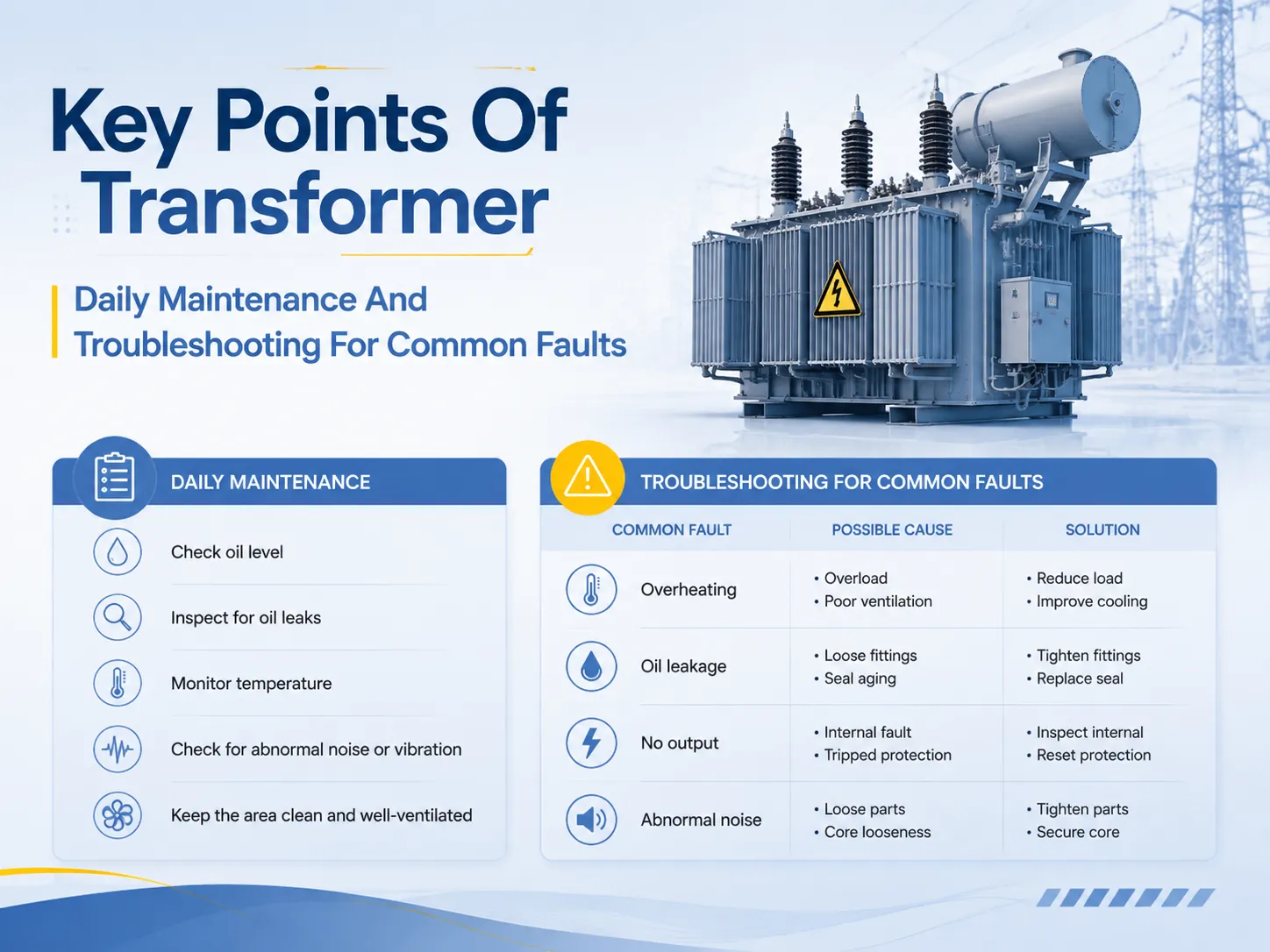
Por qué el Mantenimiento Diario es Importante
Los transformadores pueden fallar de dos maneras: abruptamente debido a ocurrencias como un rayo, explosiones de bujes o cortocircuitos; o lentamente debido a la degradación del aislamiento, la entrada de humedad a través de los transformadores y la función mecánica del transformador. Las fallas lentas son algo con lo que el mantenimiento preventivo puede lidiar, ya que dan señales tempranas semanas o meses antes de que ocurra la falla: por ejemplo, un nivel más bajo de aceite en el tanque del transformador, algún cambio en el sonido del transformador, un aumento en la temperatura del tanque y fugas de aceite insignificantes.
La investigación realizada por los grupos de trabajo de IEEE y CIGRÉ muestra que los datos de fallas de transformadores respaldan la conclusión de que el sistema de aislamiento y los cambiadores de tomas constituyen el mayor número de datos de fallas totales de transformadores, representando entre el 30 y el 50 por ciento del total de interrupciones de los transformadores. Un recorrido de cinco minutos cada día puede ayudar a identificar las causas de las fallas de aislamiento FIA, mientras que una muestra de aceite anual que cuesta $300 puede confirmar lo que está sucediendo dentro del tanque del transformador. El escenario opuesto implica descubrir la falla cuando se activa el dispositivo de protección, lo que significa que se necesitan realizar trabajos de reparación de emergencia junto con trabajos extraordinarios y costos heredados necesarios para llevar a cabo estas tareas, que generalmente superan los costos de mantenimiento entre 5 y 20 veces.
La Lista de Verificación de Inspección Diaria
Una inspección diaria típica de un transformador lleno de aceite toma alrededor de 5 a 10 minutos. Siga los puntos a continuación mientras asegura un registro adecuado:
- Nivel de Aceite: verifique algún indicador manual del nivel de aceite. Una disminución repentina denota aceite escapado y posibles defectos.
- Condición y Aroma del Aceite: el vidrio de visualización debe indicar aceite limpio y claro; el aceite turbio significa humedad o carbonización, respectivamente.
- Ruido: el transformador debe producir solo un zumbido suave; cualquier ruido de zumbido indica partes sueltas, problemas en el núcleo o actividad de descarga. Cualquier alteración del sonido regular debe levantar sospechas.
- Temperaturas: anote el nivel de temperatura del aceite superior y compárelo con la condición de carga. En un transformador de distribución completamente activo, la temperatura debe estar cerca de 60 a 75 °C en clima normal; cualquier lectura por encima de 85-90 °C debe ser alarmante.
- Aisladores: busque agrietamientos o rastros.
- Deshidratador: el gel de sílice debe seguir siendo azul (indicando falta de humedad); debe ser rosa o rojizo.
- Relé Buchholz: confirme que no hay acumulación de gas en la ventana.
- Cualquier otra cosa: considere la presencia de aceite debajo del transformador, vibraciones inusuales, pernos sueltos, etc.
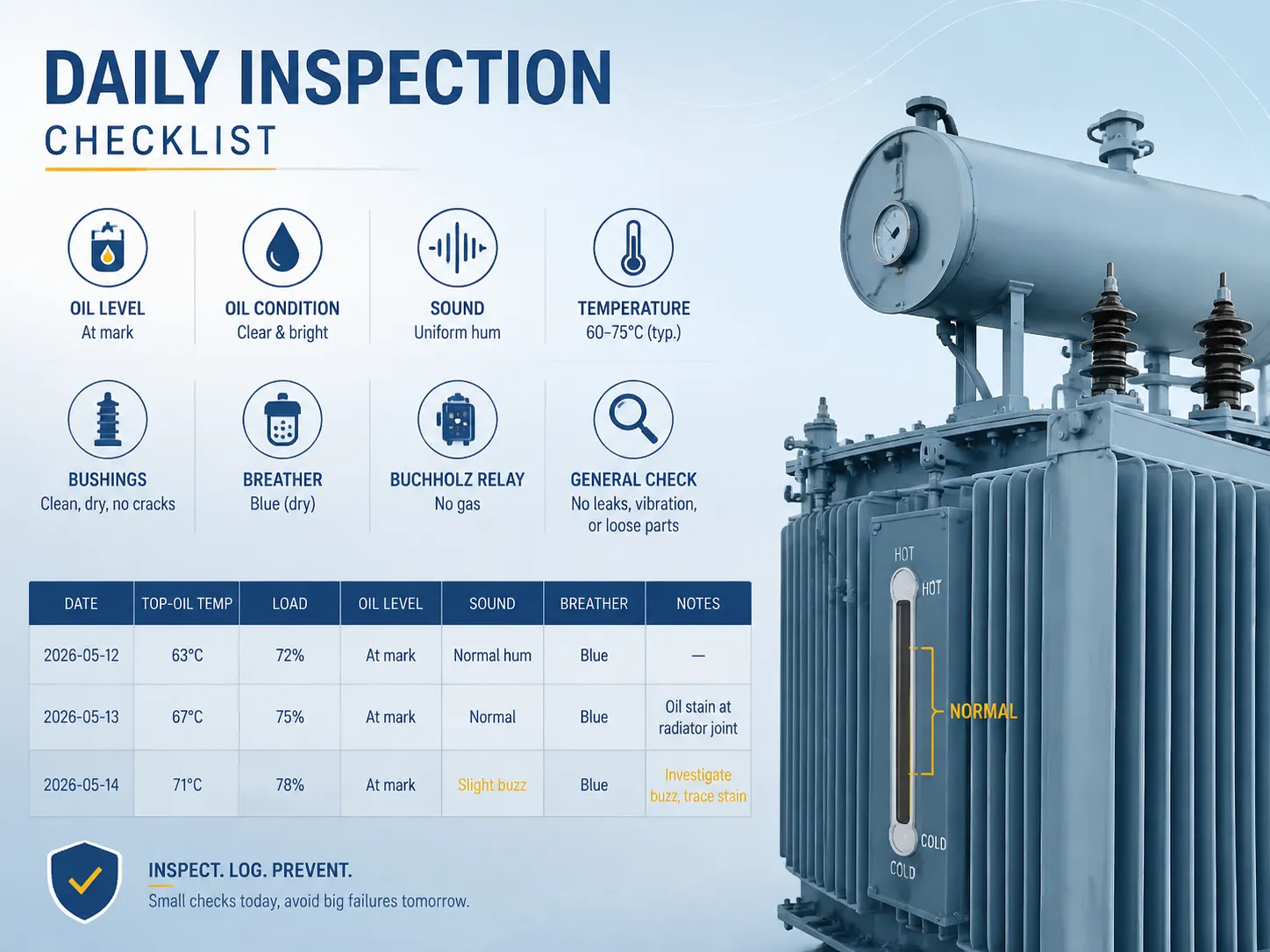
Cualquier actividad inusual se registra y se toma en serio, mientras que el registro diario también proporciona datos de tendencias útiles que pueden ser utilizados para diagnósticos futuros. Un libro de registro simple estandarizado llenado en cada ocasión permite una rápida visualización de tendencias:
| Fecha | Temp. Aceite Superior | Carga | Nivel de Aceite | Sonido | Deshidratador | Notas |
|---|---|---|---|---|---|---|
| 2026-05-12 | 63°C | 72% | En marca | Zumbido normal | Azul | — |
| 2026-05-13 | 67°C | 75% | En marca | Normal | Azul | Mancha de aceite en la unión del radiador |
| 2026-05-14 | 71°C | 78% | En marca | Zumbido leve | Azul | Investigar zumbido, rastrear mancha |
Tareas de Rutina Semanal y Mensual
Las inspecciones diarias revelan signos inmediatos de problemas, mientras que las inspecciones semanales y mensuales ayudan a detectar un deterioro más prolongado:
| Frecuencia | Tarea | Estándar / Valor Típico |
|---|---|---|
| Semanal | Inspección visual de todos los accesorios, operación de ventiladores de enfriamiento, verificación de fugas de aceite | Sin fugas, ventiladores funcionan con termostato |
| Mensual | Verificar nivel de aceite a temperatura, inspeccionar conexiones a tierra, limpiar superficies de aisladores | Resistencia a tierra < 1 Ω donde se prueba |
| Trimestral | Prueba de resistencia de aislamiento (megger) en devanados, verificar operación del cambiador de tomas | Los valores de IR son tendencias, no absolutos; 1,000–5,000 MΩ típico en devanados de HV saludables |
| Semestral | Muestreo de aceite para humedad y resistencia dieléctrica, muestra de aceite de OLTC | Voltaje de ruptura > 30–40 kV según IEC 60156; humedad < 20–30 ppm |
| Anual | DGA completo, análisis de furanos, prueba de calidad del aceite, prueba de relé de protección | Niveles de gas según IEEE C57.104 condición 1 |
| Cada 3–5 años | Inspección exhaustiva, revisión de conservador y respirador, inspección de contactos de OLTC | Fabricante y guía IEC 60422 |
Cómo se ve “Normal”: Valores de referencia
El diagnóstico comienza con entender cuáles son los valores normales. La tabla a continuación representa los rangos de distribución práctica para los llamados transformadores de distribución sumergidos en aceite:
| Parámetro | Rango Normal | Investigar Cuándo | Nivel de Alarma / Acción |
|---|---|---|---|
| Temperatura del aceite superior (cargado) | 50–75°C | > 80–85°C | > 90–95°C: reducir carga, verificar refrigeración |
| Estimación de punto caliente del devanado | < 98°C según guía de carga | Tendencia en aumento | > 110–120°C: envejecimiento serio |
| Voltaje de ruptura del aceite | > 40–60 kV | 30–40 kV | < 30 kV: filtración/reemplazo necesario |
| Humedad del aceite | < 15–20 ppm | 20–30 ppm | > 30–40 ppm: secar el aceite e investigar |
| Resistencia de aislamiento (megger, devanado HV) | > 1,000 MΩ | Tendencia a la baja entre pruebas | < 100–500 MΩ: secar y volver a probar |
| Color del respirador de gel de sílice | Azul (seco) | Parcialmente rosa | Totalmente rosa/rojo: regenerar o reemplazar |
| TDCG (gas combustible total) | < 720 ppm | 720–1,920 ppm | > 1,920 ppm: investigación detallada según IEEE C57.104 |
Tenga en cuenta que las tendencias son más importantes que las mediciones individuales: una temperatura de aceite de 78°C es más alarmante si aumenta 5°C por semana que si se mantiene estable con una carga constante.
Solucionando los Problemas Más Comunes
Si hay indicios de mal funcionamiento, realice una investigación ordenada en lugar de hacer suposiciones. Al solucionar problemas de transformadores, puede ser útil consultar la siguiente tabla de problemas comunes y posibles causas, así como las primeras pruebas que debe realizar:
| Síntoma | Causas Más Probables | Primeras Comprobaciones | Siguiente Paso Si No Se Resuelve |
|---|---|---|---|
| Cambio en ruido inusual / zumbido | Núcleo suelto, pernos de montaje sueltos, vibración del accionamiento de OLTC, descarga parcial, armónicos de carga | Apriete los pernos, compare el ruido con el nivel de carga, escuche crujidos | Medición de PD, prueba de corriente de tierra del núcleo |
| Nivel de aceite en caída | Fuga en juntas/bujes, falla del respirador, caída de temperatura | Inspeccionar todas las juntas, verificar correlación de temperatura | Encontrar y reparar la fuga; probar el aceite para humedad |
| Temperatura del aceite alta | Sobrecarga, ventiladores de refrigeración no funcionando, radiadores bloqueados, bajo nivel de aceite, alta temperatura ambiente | Verificar carga vs calificación, operación del ventilador, flujo de aire del radiador | Revisar guía de carga, limpiar enfriadores, DGA |
| Alarma de gas de Buchholz | Gas menor por envejecimiento normal, sobrecalentamiento o un fallo interno | Recoger muestra de gas, anotar cantidad y olor | DGA de gas y aceite; comparar con IEEE C57.104 |
| Disparo de Buchholz (súbito) | Falla interna mayor, arco, cortocircuito | NO volver a energizar; aislar e inspeccionar | Inspección interna completa, DGA, pruebas de devanados |
| Baja resistencia de aislamiento | Humedad en el aceite, devanado húmedo, polvo y contaminación | Prueba de Megger, prueba de humedad en el aceite | Proceso de secado, filtración de aceite, nueva prueba |
| Sobrecalentamiento en las conexiones | Terminales sueltos, lengüetas corroídas, conductores subdimensionados | Termografía de terminales y barras colectoras | Reapretar a especificación, reemplazar lengüetas |
Operación del Relé de Buchholz: Lo que te dice
El relé de Buchholz está situado en el tubo que conecta el tanque del transformador con el conservador, siendo parte de un sistema de detección de fallas internas. El relé cuenta con dos flotadores: el flotador superior envía una señal de alarma al acumular gas y el flotador inferior opera el interruptor automático cuando el aceite se mueve repentinamente hacia el conservador y ocurre una falla significativa. Cuando el dispositivo de Buchholz emite una alarma:
- Es necesario anotar la cantidad de gas liberado y si el relé solo dio una señal de alerta o funcionó para desconectar el circuito eléctrico.
- Es importante recoger una muestra de gas del válvula de Buchholz y anotar la cantidad de gas y su olor. Un olor desagradable puede ser un indicador de arco.
- Es esencial analizar el gas recogido: cantidades anormalmente altas de hidrógeno y acetileno revelan la ocurrencia de arcos y fallas graves, mientras que una composición de aire predominante puede mostrar problemas con el respiradero de aire.
- Es necesario tomar la muestra de aceite DGA al mismo tiempo y comparar las concentraciones de gas con las condiciones descritas en la norma IEEE C57.104.
- Es necesario tomar una decisión: si la composición del gas indica fenómenos de sobrecalentamiento o arco – no reconectar la unidad hasta la inspección interna y posibles trabajos de reparación. Si la acumulación de gas no es estadísticamente significativa y no indica un funcionamiento defectuoso, la unidad puede seguir funcionando sin problemas, pero se deben realizar inspecciones continuas para asegurar la ausencia de fallas.
El evento de acumulación de gas debe ser documentado y reportado al ingeniero para permitir un seguimiento adicional de la formación de gas.
Fugas de aceite: Causas y Manejo
El problema de mantenimiento más visible con respecto a las fugas de aceite son las fugas de aceite que son importantes por tres razones: disminución del nivel de aceite (lo que afecta la efectividad de los sistemas de enfriamiento y aislamiento), permitiendo la entrada de humedad y aire a través de las fugas, y causando problemas ambientales y de seguridad. Las fugas de aceite son más propensas a ocurrir en las juntas entre el tanque y la tapa, en las bases de los bujes, en las bridas de los tubos de los conservadores, en las conexiones al radiador de enfriamiento y en la válvula de drenaje.
Al intentar encontrar una fuga de aceite, es mejor realizar algunas inspecciones con un paño limpio o, en el caso de una fuga muy pequeña, revisar las juntas por la noche con una linterna (habría trazas de aceite visibles). Se recomienda apretar los tornillos en la brida de acuerdo con las instrucciones del fabricante y si no ayuda, reemplazar las juntas con nuevos materiales. Después de cualquier reparación, el aceite debe ser llenado a través del conservador de la misma partida y después de una semana se debe verificar una muestra en busca de humedad. Incluso pequeñas fugas de aceite pueden llevar a grandes problemas, ya que la unidad que pierde 5-10 litros al mes comenzará a absorber aire húmedo a través del respiradero.
Sobrecalentamiento y Fallos de Enfriamiento
El sobrecalentamiento continuo es la forma más rápida de disminuir la vida útil de un transformador debido al hecho de que el envejecimiento del aislamiento se duplica prácticamente con cada aumento de 6-8 grados K en temperatura. En el caso de que la temperatura del aceite sea alta, tome los siguientes pasos:
- Verifique si la carga corresponde a la placa de identificación y al folleto de carga (IEC 60076-7). Si la carga excede la cifra de la placa de identificación y no hay enfriamiento por parte de los ventiladores, esto llevará al sobrecalentamiento.
- Verifique el estado del ventilador y la bomba. En un transformador ONAF, los ventiladores funcionan automáticamente por el termostato; la falla del ventilador o problemas con la circulación de aire en el radiador pueden llevar a un aumento de temperatura de 10-20 grados.
- Inspeccione el radiador para asegurarse de que las aletas estén limpias; use aire o agua, pero no use una lavadora de alta presión ya que podría dañar el radiador.
- Verifique el nivel de aceite y la circulación. Un bajo nivel de aceite puede llevar al sobrecalentamiento debido a un enfriamiento deficiente y puntos calientes cerca del devanado.
- Averigüe si hay causas internas del problema.
Fallos Eléctricos: Resistencia de Aislamiento y Puesta a Tierra
La prueba de resistencia de aislamiento (megger) se utiliza para una evaluación típica de humedad y contaminación. Cada devanado se prueba tanto a tierra como entre sí utilizando un voltaje de 500–5,000 V dependiendo del transformador. La temperatura durante la prueba también debe ser registrada. El punto crítico no es la medición absoluta de la resistencia de aislamiento, sino su cambio a lo largo del tiempo, por lo que para comparar con los resultados del año anterior, se debe dar más importancia a los desarrollos en los valores que a los números finales. En caso de que se detecte baja resistencia de aislamiento, se sigue con la prueba del aceite para humedad y resistencia dieléctrica. Si se encuentra que el aceite está contaminado, el filtrado y/o el cambio del mismo es el siguiente paso, seguido de una nueva prueba. En las peores situaciones, puede ser necesario secar el transformador, siguiendo las recomendaciones proporcionadas sobre el proceso controlado del procedimiento de secado por parte de los fabricantes.
La puesta a tierra es un procedimiento diario independiente y muy importante. El tanque debe estar conectado a tierra con todas las partes metálicas no energizadas; la resistencia de puesta a tierra es generalmente de 1–5 Ω dependiendo del sistema. Si la puesta a tierra falla, el tanque permanece energizado en caso de cualquier falla interna del transformador. Se debe realizar una inspección visual regularmente en las correas poliméricas utilizadas para la puesta a tierra para verificar su corrosión, aflojamiento y estado general.
Elaboración de un Plan de Mantenimiento y Presupuesto
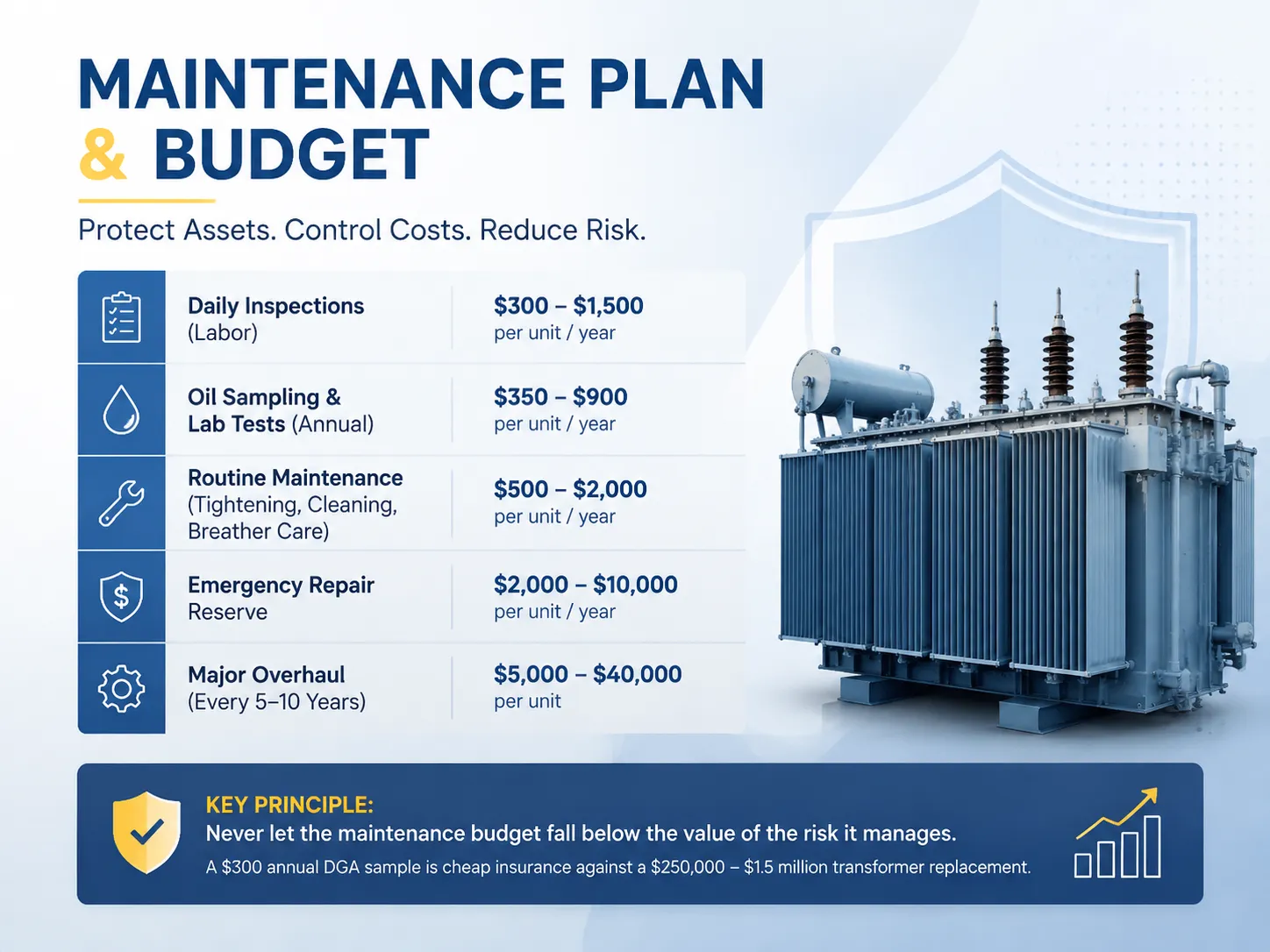
Desarrollar planes de mantenimiento por escrito a partir de sus listas de verificación, asignando roles y presupuestos a los empleados relevantes.
| Artículo de Costo | Costo Anual Típico (por unidad) | Notas |
|---|---|---|
| Inspecciones diarias (mano de obra) | $300–$1,500 | 10 minutos/día de tiempo del técnico |
| Muestreo de aceite y pruebas de laboratorio (anuales) | $200–$500 por muestra de DGA | Más $150–$400 por paquete de calidad de aceite |
| Mantenimiento rutinario (apretado, limpieza, cuidado del respirador) | $500–$2,000 | Consumibles y mano de obra |
| Reserva para reparaciones de emergencia | $2,000–$10,000 por unidad presupuestada | Kits de juntas, aceite, sellos, ventiladores |
| Revisión mayor (cada 5–10 años) | $5,000–$40,000 | Inspección de OLTC, filtración de aceite, juntas |
El principio principal del presupuesto de mantenimiento es que el presupuesto de mantenimiento nunca debe ser inferior al costo de los riesgos potenciales. Una muestra anual de DGA para $300 es una buena inversión en comparación con una pérdida potencial en los costos del transformador entre $250,000 y $1,500,000.
Preguntas Frecuentes
¿Con qué frecuencia se debe muestrear el aceite del transformador?
Para transformadores en funcionamiento, tomar una muestra una vez al año es una práctica normal. En el caso de transformadores de distribución, la toma de muestras de aceite debe realizarse una vez cada uno a tres años dependiendo del nivel de importancia del transformador. Para cada alarma activada por el relé Buchholz, cualquier situación de sobrecarga, cualquier tipo de mal funcionamiento, o si hay una producción considerable de gas, se debe tomar una muestra lo antes posible (en unas pocas semanas). En promedio, los costos por una muestra de DGA son de $200 hasta $500 junto con un informe del laboratorio.
¿Cuál es la temperatura de operación normal de un transformador?
La temperatura en la parte superior del aceite en un transformador de aceite activo debe estar entre 60°C y 75°C en condiciones climáticas templadas. Si la temperatura supera los 85°C durante un largo período, es necesario verificar la situación. Si la temperatura del punto caliente es superior a 98°C, se está produciendo el proceso de envejecimiento del aislamiento.
¿Qué significa una alarma del relé Buchholz?
La acumulación de gas en el tubo del conservador es lo que activa la alarma del relé Buchholz. El gas podría ser aire producido durante la falla del respirador o gases producidos durante sobrecalentamientos y arcos dentro del tanque. En consecuencia, el gas debe ser muestreado, y se debe realizar un DGA para llegar a una conclusión.
¿Cómo manejo un transformador con baja resistencia de aislamiento?
Primero, debes verificar el aceite, la saturación y la resistencia dieléctrica del aceite. Es muy probable que el aceite esté húmedo. El aceite debe ser filtrado o reemplazado en caso de que la saturación sea superior a 20-30 ppm. En el caso de que el devanado del transformador esté húmedo, se debe realizar un procedimiento de secado controlado de acuerdo con las instrucciones proporcionadas por el fabricante.
¿Qué debo hacer cuando un transformador se dispara en el relé Buchholz?
Antes de encender el transformador, asegúrate de aislar la unidad del transformador y tomar muestras de gas y aceite para el DGA. Después de que se haya disparado el relé Buchholz, es esencial verificar el relé y el conservador.
Referencias
- IEEE C57.104: Guía para la Interpretación de Gases Generados en Transformadores Sumergidos en Aceite — La referencia para la interpretación de DGA y niveles de alarma durante la resolución de problemas.
- IEC 60422: Supervisión y Guía de Mantenimiento para Aceites Aislantes Minerales — Define los límites de calidad del aceite y la práctica de mantenimiento.
- IEC 60076-7: Guía de Carga para Transformadores de Potencia Sumergidos en Aceite — La referencia para los límites de temperatura y carga cíclica/emergente.
- IEC 60156: Líquidos Aislantes — Determinación de la Tensión de Ruptura — Norma de prueba para la resistencia dieléctrica del aceite utilizada en el mantenimiento rutinario.
- IEC 60599: Guía para la Interpretación de DGA en Equipos Impregnados con Aceite Mineral — Marco internacional para la interpretación de gases.
- CIGRÉ — Publica folletos técnicos sobre el mantenimiento de transformadores, estadísticas de fallas y evaluación de condiciones.
- Jiangsu Subian Electric Power — Fabricante de transformadores conforme a IEC 60076 que proporciona documentación de mantenimiento y soporte técnico.
Conclusión
El mantenimiento diario de los transformadores es muy fácil, económico y una de las mejores iniciativas orientadas al valor dentro de cualquier programa de activos eléctricos. Un breve recorrido preliminar que toma cinco minutos, una inspección rutinaria mensual y una muestra anual de investigación de DGA ayudarán fácilmente a encontrar defectos críticos que conducen a eventos incontrolables y convertirlos en mantenimiento planificado. Generalmente, cada vez que surge una anormalidad, se debe iniciar el algoritmo de solución de problemas para una exclusión eficiente de problemas: primero, verifique las variables obvias, luego recoja las muestras de aceite y, finalmente, interprételas de acuerdo con las normas y tome medidas en lugar de esperar a que la protección se active por sí misma.
- Implemente la lista de verificación diaria y registre las lecturas.
- Tome muestras de aceite para DGA al menos una vez al año y después del evento de Buchholz.
- Investigue los cambios de temperatura, ruido y nivel en lugar de aceptarlos.
- Nunca vuelva a energizar después de que ocurra Buchholz sin verificaciones.
- Considere un precio de $200–$500 por una muestra de DGA en comparación con más de $250,000 por reemplazar la máquina eléctrica.