

見積もりをリクエスト
ニュース

トランスの日常メンテナンスと一般的な故障のトラブルシューティングの重要ポイント

It’s Tuesday morning at 6:50 AM when the shift electrician at a medium-sized plant realizes that a 2,000 kVA transformer is buzzing much louder than it usually does. The Buchholz relay window has a tiny gas pocket, and the oil gauge on the conservator reads lower than last month. Everyone knows the saying that trouble with transformers doesn’t get smaller by itself, even if nobody wants to call it an emergency just yet. Some of the best transformer daily maintenance practices and methods of troubleshooting common problems come into play.

This article will provide you with practical information about daily and regular equipment maintenance of liquid immersed transformers and step-by-step recommendations on how to troubleshoot the main malfunctions, including sudden noise, oil leakage, high oil temperature, Buchholz relay work, poor insulation, etc. You will find checklists, alarm and normal values, realistic estimates, and investigating steps in the article.

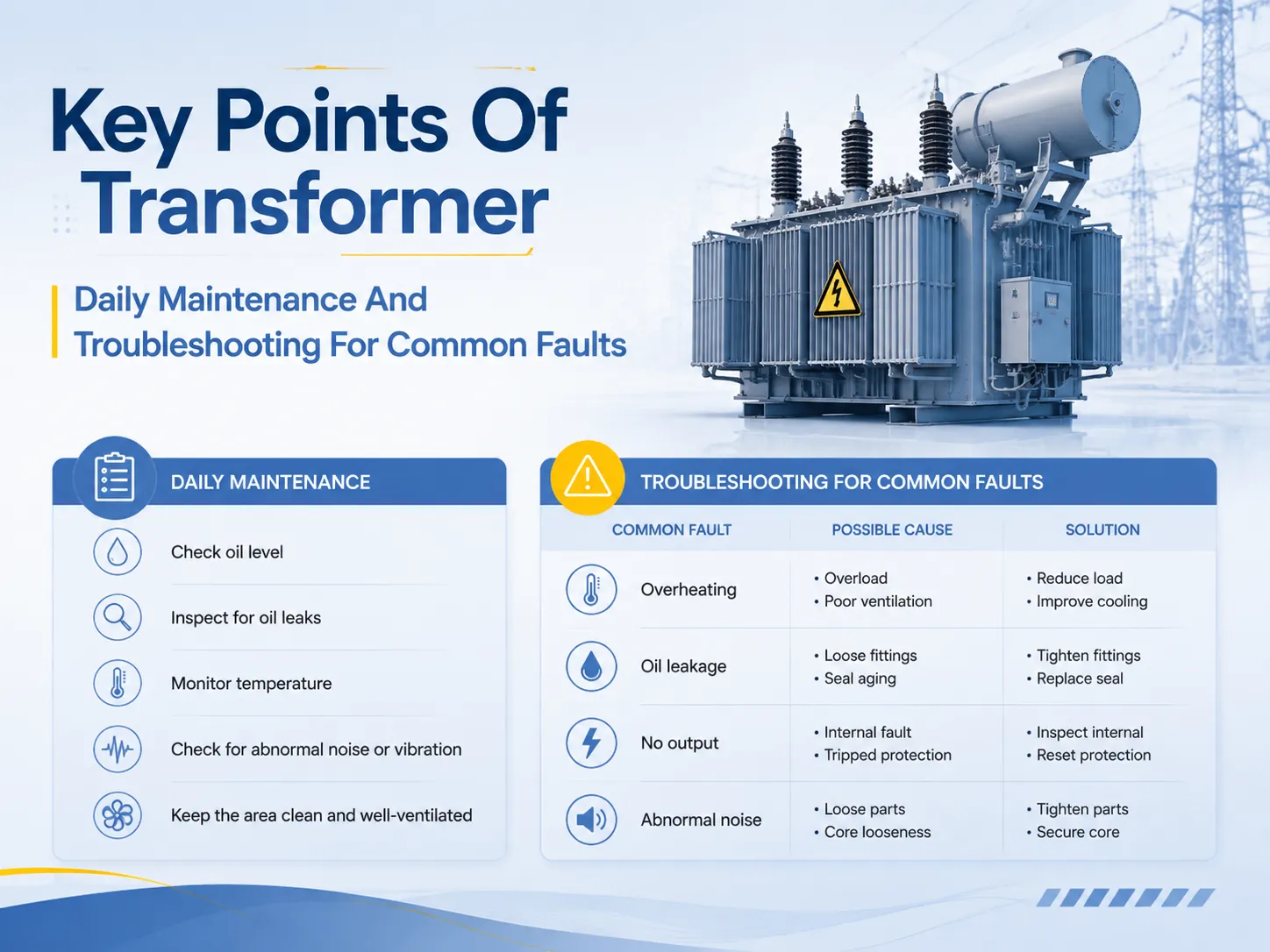
In simple terms, this means that daily transformer maintenance is a straightforward process. In order to be maintained, it requires checking the oil color and level, paying attention to any unusual sounds, checking the temperature, checking the bushing connections and the Buchholz relay, noting any alarms. Common transformer problems and solutions include checking the temperature of the oil, the Buchholz gas alarm, the oil leaks, and the low insulation resistance.

Key Points Of Transformer Daily Maintenance And Troubleshooting For Common Faults


Why Daily Maintenance Matters

Transformers may break down in two ways: abruptly due to occurrences such as a lightning strike, bushings exploding, or short circuiting; or slowly due to the degradation of insulation, ingress of moisture through the transformers, and the mechanical function of the transformer. The slow breakdowns are something that preventive maintenance can deal with as they give early signs weeks or months before the failure takes place: for example, a lower level of oil in the transformer tank, some change in the sound of the transformer, some increase in the temperature of the tank, and insignificant oil leakage.

Research made by IEEE and CIGRÉ working groups shows that transformer failure data supports the conclusion that insulation system and tap changers constitute the largest number of the total transformer failure data, accounting for 30–50 percent of the total number of breaks of the transformers. A five-minute walk-by every day can help identify the causes of insulation FIA failures, whereas an annual oil sample that costs $300 can confirm what is happening inside the transformer tank. The opposite scenario implies discovering the malfunction when the protection device is activated which means emergency repair works need to be conducted along with overtime works and legacy costs needed to conduct these tasks which generally exceed the maintenance costs 5–20 times.

The Daily Inspection Checklist

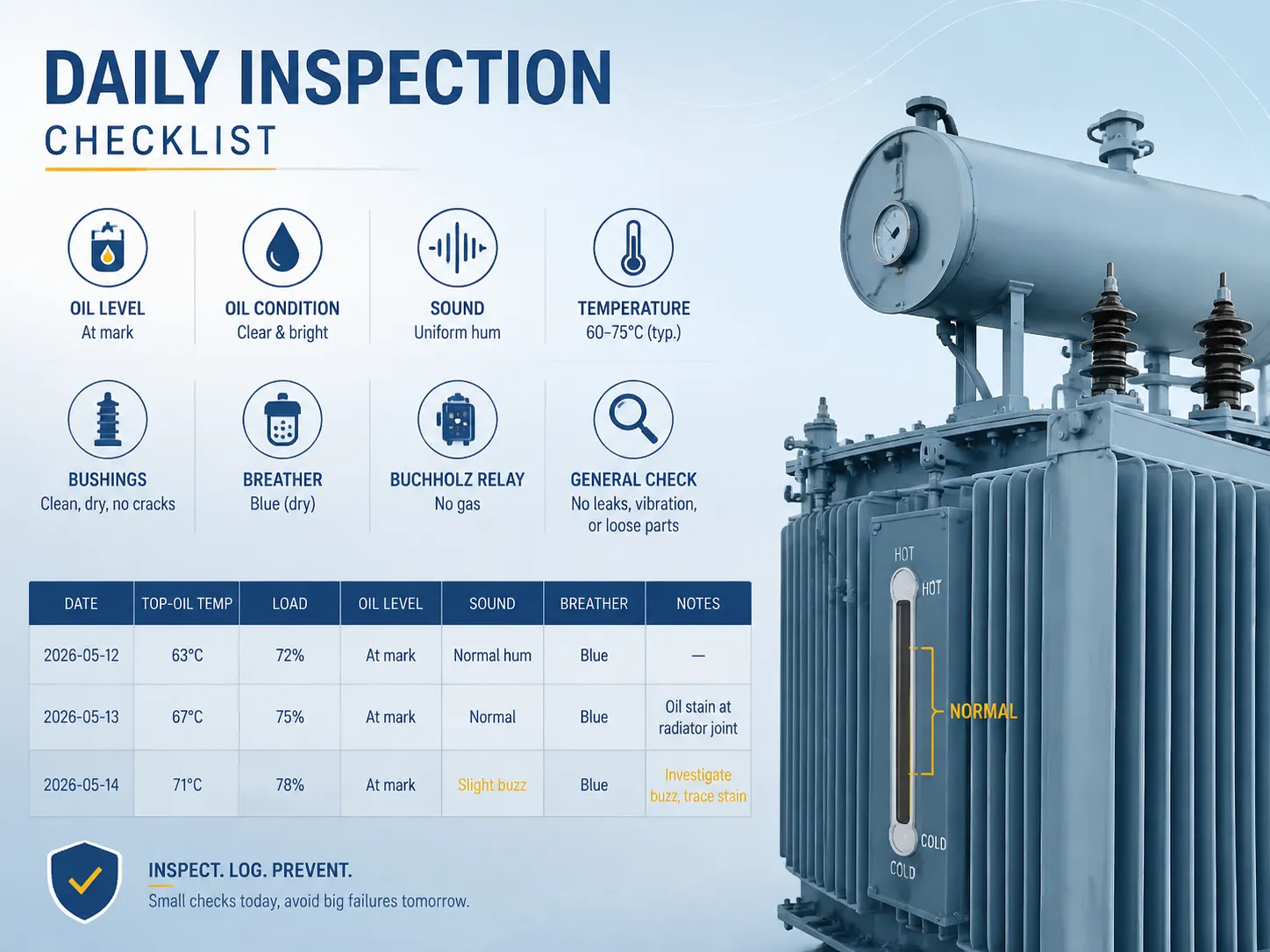
A typical daily inspection of an oil-filled transformer takes around 5–10 minutes. Follow the points below while ensuring proper recording:

  • Oil Level: check some manual oil level indicator. A sudden decrease denotes escaped oil and possible defects.
  • Oil Condition and Aroma: the sight glass should indicate clean and clear oil; cloudy oil signifies moisture or carbonization, respectively.
  • Noise: the transformer should produce only a smooth hum; any buzzing noise indicates loosening parts, core issues, or discharge activity. Any alteration from regular sound should raise suspicions.
  • Temperatures: write down the level of top-oil temperature and compare it to the loaded condition. In a fully live distribution transformer, temperature should be close to 60–75 °C in normal weather; any readings above 85-90 °C should be alarming.
  • Bushings: look for cracking or tracking.
  • Breather: silica gel should still be blue (indicating lack of moisture); it should be pink or reddish.
  • Buchholz Relay: confirm that there is no gas accumulation in the window.
  • Anything else: consider the presence of any oil under the transformer, unusual vibrations, loose bolts, etc.

The Daily Inspection Checklist

Any unusual activity gets recorded and taken seriously, while the daily record also provides useful trend data that can be used for future diagnoses. A standardized simple logbook filled in on each occasion enables the quick view of trends:

Date Top-Oil Temp Load Oil Level Sound Breather 注記
2026-05-12 63°C 72% At mark Normal hum Blue
2026-05-13 67°C 75% At mark Normal Blue Oil stain at radiator joint
2026-05-14 71°C 78% At mark Slight buzz Blue Investigate buzz, trace stain

Weekly and Monthly Routine Tasks

Daily inspections reveal immediate signs of issues, while weekly and monthly inspections help work out longer deterioration:

Frequency Task Typical Standard / Value
Weekly Visual inspection of all accessories, cooling fans operation, oil leak check No leaks, fans run on thermostat
Monthly Check oil level at temperature, inspect grounding connections, clean insulator surfaces Grounding resistance < 1 Ω where tested
Quarterly Insulation resistance (megger) test on windings, verify tap changer operation IR values trend, not absolute; 1,000–5,000 MΩ typical on healthy HV windings
Semi-annual Oil sampling for moisture and dielectric strength, OLTC oil sample Breakdown voltage > 30–40 kV per IEC 60156; moisture < 20–30 ppm
Annual Full DGA, furan analysis, oil quality test, protection relay test Gas levels per IEEE C57.104 condition 1
Every 3–5 years Thorough inspection, conservator and breather overhaul, OLTC contact inspection Manufacturer and IEC 60422 guidance

What “Normal” Looks Like: Reference Values

Diagnosing starts with understanding what normal values are. The table below represents the practical distribution ranges for the so called oil-immersed distribution transformers:

Parameter Normal Range Investigate When Alarm / Action Level
Top-oil temperature (loaded) 50–75°C > 80–85°C > 90–95°C: reduce load, check cooling
Winding hot-spot estimate < 98°C per loading guide Trend rising > 110–120°C: serious aging
Oil breakdown voltage > 40–60 kV 30–40 kV < 30 kV: filtration/replacement needed
Oil moisture < 15–20 ppm 20–30 ppm > 30–40 ppm: dry out oil and investigate
Insulation resistance (megger, HV winding) > 1,000 MΩ Dropping trend between tests < 100–500 MΩ: dry-out and retest
Silica gel breather color Blue (dry) Partly pink Fully pink/red: regenerate or replace
TDCG (total combustible gas) < 720 ppm 720–1,920 ppm > 1,920 ppm: detailed investigation per IEEE C57.104

Be mindful that the trends are more important than single measurements: 78°C oil temperature is more alarming if it rises 5°C a week than if it is stable with a constant load.

Troubleshooting the Most Common Faults

If there are indications of malfunction, conduct an orderly investigation instead of making assumptions. When troubleshooting transformers, it may help to consult the following table of common problems and possible causes, as well as the first tests that you should perform:

Symptom Most Likely Causes First Checks Next Step If Not Resolved
Unusual noise / humming change Loose core clamping, loose mounting bolts, OLTC drive vibration, partial discharge, load harmonics Tighten bolts, compare noise to load level, listen for crackling PD measurement, core ground current test
Oil level falling Leak at gaskets/bushings, breather fault, temperature drop Inspect all joints, check temperature correlation Find and fix leak; test oil for moisture
Oil temperature high Overload, cooling fans not running, blocked radiators, low oil level, high ambient Check load vs rating, fan operation, radiator airflow Review loading guide, clean coolers, DGA
Buchholz gas alarm Minor gas from normal aging, overheating, or an internal fault Collect gas sample, note quantity and odor DGA of gas and oil; compare with IEEE C57.104
Buchholz trip (sudden) Major internal fault, arcing, short circuit Do NOT re-energize; isolate and inspect Full internal inspection, DGA, winding tests
Low insulation resistance Moisture in oil, wet winding, dust and contamination Megger test, oil moisture test Dry-out process, oil filtration, retest
Overheating at connections Loose terminals, corroded lugs, undersized conductors Thermography of terminals and busbars Re-torque to spec, replace lugs

Buchholz Relay Operation: What It Tells You

The Buchholz relay is positioned in the pipe connecting the transformer tank to the conservator, being part of an internal fault detection system. The relay features two floats: the upper float sends an alarming signal upon gas accumulation and the lower float operates the circuit-breaker when oil suddenly moves to the conservator and a significant fault occurs.When the Buchholz device alarms:

  • It is necessary to note the quantity of gas released and whether the relay just gave an alert signal or worked to shut down the electrical circuit.
  • It is important to gather a gas sample from the Buchholz valve and note the amount of gas and its odor. An unpleasant smell can be an indicator of arcing.
  • It is essential to analyze the gathered gas: abnormally high quantities of hydrogen and acetylene reveal the occurrence of arcing and serious faults, while a predominant air composition may show problems with the air breather.
  • It is necessary to take the DGA oil sample at the same time and compare gas concentrations with the conditions described in IEEE C57.104 standard.
  • It is necessary to make a decision: if the gas composition indicates overheat or arcing phenomena – do not reconnect the unit until internal inspection and possible repair works. If gas accumulation is not statistically important and does not indicate flawed operation, the unit may keep on working without any problems, but ongoing inspections should be done to be sure about the absence of faults.

Gas accumulation event should be documented and reported to the engineer to allow further tracking of gas formation.

Oil Leakage: Causes and Handling

The most visible maintenance problem with regard to the oil leakage is oil leaks that are important for three reasons: lowering oil level (which affects the effectiveness of cooling and insulation systems), letting moisture and air in through the leaks, and causing environmental and safety problems. Oil leaks are most likely to occur at the gaskets at the connection between the tank and the cover, at the bushing bases, at the flanges of conservators’ pipes, at the connections to the cooling radiator, and at the drain valve.

When trying to find an oil leak, it is best to make some inspections with a clean cloth or, in the case of a very small leak, check the joints at night with a flashlight (there would be visible oil traces). It is recommended to tighten the bolts on the flange according to the manufacturer’s instructions and if it does not help, to replace the gaskets with the new materials. After any repair, the oil must be filled through the conservator from the same batch and after one week a sample must be checked for moisture. Even small oil leaks can lead to big problems as the unit leaking 5-10 liters a month will begin taking in moist air through the breather.

Overheating and Cooling Faults

Continuous overheating is the quickest way to decrease the lifespan of a transformer owing to the fact that the aging of the insulation is practically doubled with every rise of 6-8 degrees K in temperature. In the case when the oil temperature is high, take the following steps:

  • Check if the load corresponds to the nameplate and the loading pamphlet (IEC 60076-7). If the load exceeds the nameplate figure and there is no cooling from fans, it will lead to overheating.
  • Check the state of fan and pump. In an ONAF transformer, fans work automatically by the thermostat; the failure of the fan or problems with circulation of air in the radiator may lead to a temperature increase of 10-20 deg.
  • Inspect the radiator to make sure that the vanes are clean; use air or water but do not use a high-pressure washer as it might lead to damaging the radiator.
  • Check the oil level and circulation. Low level of oil may lead to overheating because of poor cooling and hot points near the winding.
  • Find out whether there are internal causes of the problem.

Electrical Faults: Insulation Resistance and Grounding

Testing of insulation resistance (megger) is used for a typical evaluation of moisture and contamination. Each winding is tested both to ground and each other using a voltage of 500–5,000 V depending on the transformer. The temperature during the test should also be registered. The critical point is not the absolute measurement of insulation resistance, but its change over time, so to compare with the previous year results, more importance should be put to the developments in values rather than the final numbers. In case low insulation resistance is detected, testing of oil for moisture and dielectric strength follows. If the oil is found to be contaminated, filtering and/or changing of it is the next step, followed by retesting. In the worst situations, drying out the transformer may be required, following provided recommendations on the controlled process of the drying procedure by manufacturers.

Grounding is an independent and very important daily procedure. The tank should be grounded with all non-current-carrying metallic parts; the resistance of grounding is generally 1–5 Ω depending on the system. If grounding fails, the tank remains energized in case of any internal failure of the transformer. Visual inspection must be performed regularly on the polymeric straps used for grounding to make a check on their corrosion, looseness and overall condition.

Building a Maintenance Plan and Budget

Building a Maintenance Plan and Budget

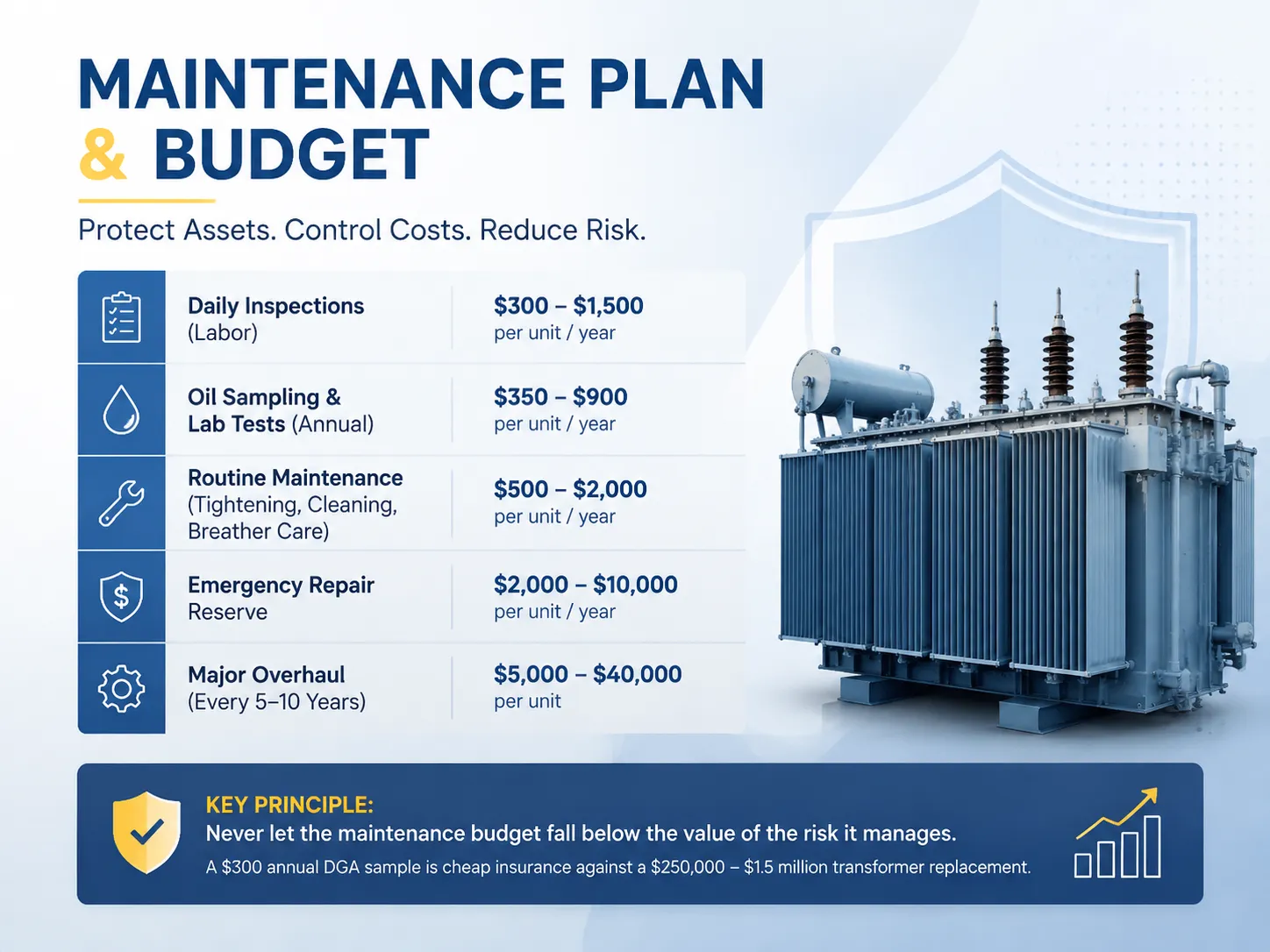
Develop written maintenance plans from your checklists, assigning roles and budgets to relevant employees.

Cost Item Typical Annual Cost (per unit) 注記
Daily inspections (labor) $300–$1,500 10 minutes/day of technician time
Oil sampling and lab tests (annual) $200–$500 per DGA sample Plus $150–$400 for oil quality package
Routine maintenance (tightening, cleaning, breather care) $500–$2,000 Consumables and labor
Emergency repair reserve $2,000–$10,000 per unit budgeted Gasket kits, oil, seals, fans
Major overhaul (every 5–10 years) $5,000–$40,000 OLTC inspection, oil filtration, gaskets

The main principle of maintenance budgeting is that the maintenance budget should never be lower than the cost of the potential risks. An annual DGA sample for $300 is a good investment compared with a potential loss in transformer costs between $250,000 and $1,500,000.

Frequently Asked Questions

How often should transformer oil be sampled?

For functioning transformers, taking a sample once per year is normal practice. In the case of distribution transformers, oil sampling should be performed once every one to three years depending on the level of importance of the transformer. For each alarm activated by the Buchholz relay, any overloading situation, any type of malfunction, or if there is a considerable gas production, a sample should be taken as soon as possible (in a few weeks). On average, the costs for one sample of the DGA are from $200 up to $500 together with a report from the laboratory.

What is the normal operating temperature of a transformer?

The temperature at the top of the oil in an active oil transformer has to be from 60°C up to 75°C in temperate climate conditions. If the temperature exceeds 85°C for a long time, it is necessary to check the situation. If the hot-spot temperature is over 98°C, the process of insulation aging is taking place.

What does a Buchholz relay alarm mean?

The gas accumulation in the conservator pipe is what triggers the Buchholz relay to alarm. The gas could be either air produced during the fault of the breather or gases produced during overheats and arcing inside the tank. Consequently, the gas needs to be sampled, and a DGA must be performed to make the conclusion.

How do I handle a transformer with low insulation resistance?

First of all, you have to check the oil, saturation, and dielectric strength of the oil. It is most likely that the oil is wet. The oil must be filtered or replaced in case saturation is more than 20-30 ppm.In the case when the winding of the transformer is wet, a procedure of controlled drying should be performed according to the instructions given by the manufacturer.

What should I do when a transformer trips on the Buchholz relay?

Before switching on the transformer, make sure to isolate the transformer unit and take gas and oil samples for the DGA. After the Buchholz relay has been tripped, it is essential to check the relay and the conservator.

References

Conclusion

The daily upkeep of transformers is very easy, inexpensive, and one of the best value-oriented undertakings within any electrical asset program. A brief preliminary walk-through that takes five minutes, a monthly routine inspection, and an annual sample of DGA investigation will easily help one find critical defects leading to the unmanageable events and turn them into planned maintenance instead. Generally, whenever an abnormality arises, the algorithm of troubleshooting must be initiated for efficient problem exclusion: first, check the obvious variables, then collect the oil samples, and finally, interpret them according to standards and take action except having to wait until the protection activates itself.

  • Implement the daily checklist and record the readings.
  • Take oil samples for DGA at least once a year, and after the Buchholz event.
  • Investigate the changes of temperature, noise and level instead of accepting them.
  • Never reenergize after Buchholz happens without checks.
  • Consider a price of $200–$500 for one DGA sample compared to over $250,000 of replacing the electrical machine.