


Denken Sie daran, als Sie Ihr Mobiltelefon aufgeladen, die Waschmaschine eingeschaltet oder ein MRT-Gerät in einer medizinischen Einrichtung gesehen haben. All diese Aktionen wurden durch Transformatoren ermöglicht, während viele Menschen nie einen Transformator gesehen haben. Ein Kraftwerk, das Hunderte von Kilometern entfernt liegt, wandelt elektrische Energie einmal oder zweimal um; daher, wenn diese von einem Elektrizitätswerk erzeugte Energie 20 kV beträgt, erhält das nahegelegene Gerät sie in 230 V. Es muss etwas geben, das solche Übergänge ermöglicht, und das erwähnte “Etwas” existiert etwa ein Dutzend Mal zwischen dem Generator und dem Gerät. Der Transformator ist derjenige, der diese Aufgabe sehr gut bewältigt, da er eine weit verbreitete Maschine in der Elektroingenieurbranche ist.
Dieser detaillierte Leitfaden zielt darauf ab, Antworten auf die allererste Frage für die Studienanfänger zu geben, die in die Elektrotechnik eintreten: Wofür ist ein Transformator ausgelegt?? Hier finden Sie Informationen darüber, was ein Transformator ist und wie er funktioniert, zusammen mit seinen Haupttypen mit Beispielen und Abbildungen, die zu jeder Kategorie gehören. Egal, ob Sie Student, Elektriker oder Einkaufsleiter sind, dieser Artikel wird Ihnen helfen, die Grundlagen von Transformatoren zu verstehen.
Was ist ein Transformator?
Ein Transformator ist ein elektrisches Gerät, das aus zwei oder mehr Wicklungen besteht, die magnetisch gekoppelte Funktionen zur Spannungsumwandlung von Wechselstrom ausführen. Es ist völlig frei von beweglichen Teilen – es überträgt Energie über das Magnetfeld, nicht über einen Leiter, und kann daher jahrzehntelang mit wenig Wartung betrieben werden. Transformatoren decken Spannungen von den kleinsten Instrumententransformatoren, die nur in wenigen VA bewertet sind, bis zur Leistung von Megavolt-Ampere ab, die von EHV-Transformatoren mit 1.500 MVA genutzt wird.
Transformatoren arbeiten nur mit Wechselstrom, was es dem AC ermöglichte, den ‘Krieg der Ströme’ am Ende des 19. Jahrhunderts zu gewinnen. AC kann auf Hunderte von Kilovolt für Übertragungszwecke erhöht und wieder für den Verbrauch gesenkt werden – dies konnte mit DC-Systemen nicht erreicht werden.
Die 4 Hauptaufgaben eines Transformators
| Aufgabe | Was es tut | Beispiel |
|---|---|---|
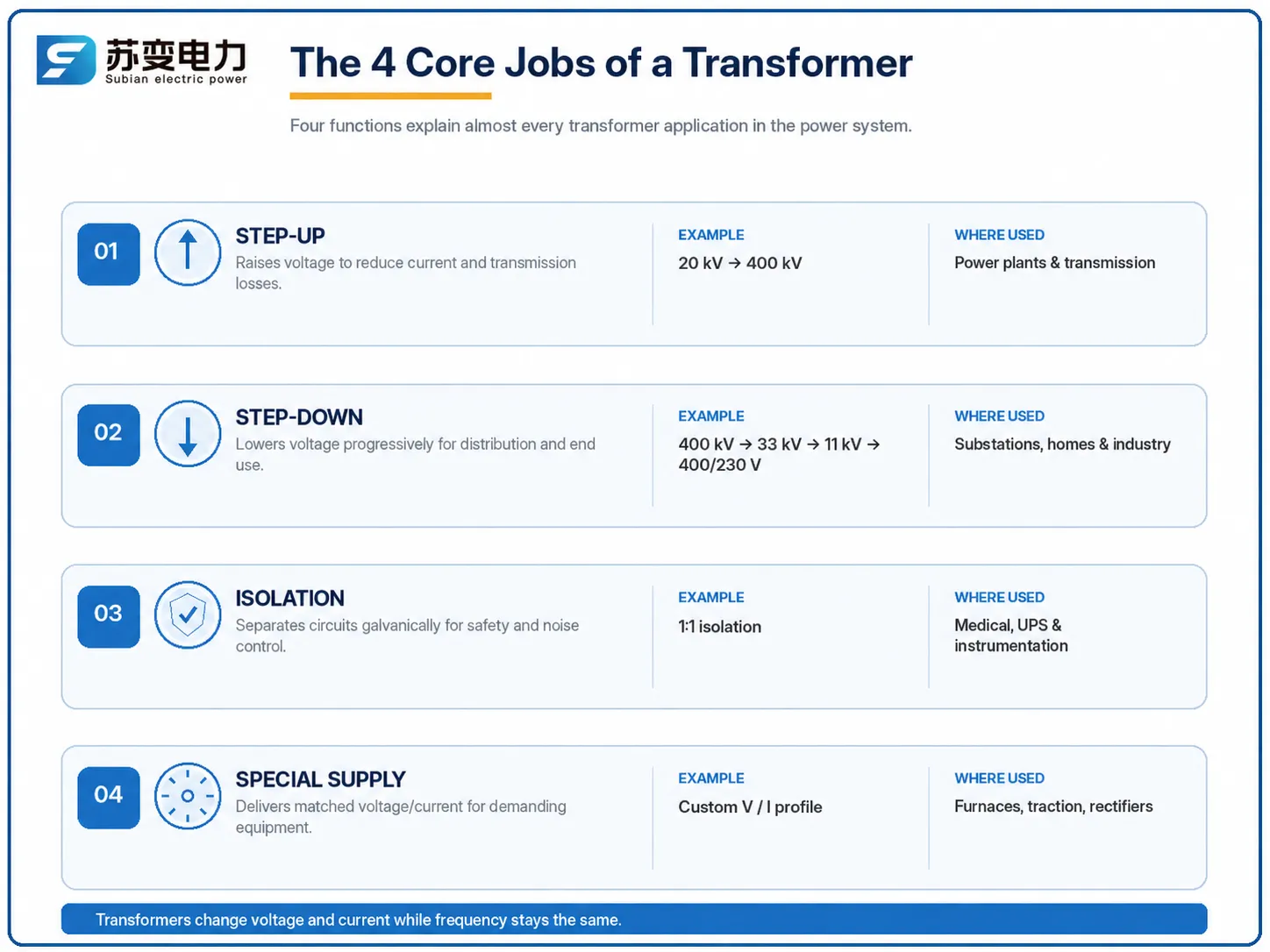
| Hochspannung | Erhöht die Spannung für die Übertragung über lange Strecken und reduziert Leitungsverluste | 20 kV → 400 kV in einem Kraftwerk |
| Niederspannung | Senkt die Spannung für die Verteilung und den Endverbrauch | 400 kV → 33 kV → 11 kV → 400/230 V |
| Isolation | Trennt Schaltungen galvanisch zur Sicherheit und Geräuschkontrolle | Medizinische Geräte, Instrumentierung, USV |
| Spezialversorgung | Bietet angepasste Spannung/Strom für spezifische Lasten | Ofentransformatoren, Gleichrichtertransformatoren, K-Faktor-Einheiten |
Hoch- und Niederspannung arbeiten in quantitativen Begriffen. In den meisten Szenarien durchläuft elektrische Energie in Stromleitungen mehrere Spannungsänderungen: einmal im Generator, einmal auf jeder Ebene der Unterübertragung, einmal im Verteilungstransformator in der Nähe des Hauses und in einigen Fällen innerhalb des Gebäudes.
Wie ein Transformator funktioniert
Das Arbeitsprinzip des Geräts basiert auf elektromagnetischer Induktion, d.h. Faradays Gesetz. Wenn Wechselstrom durch die Primärwicklung fließt, erzeugt er einen wechselnden magnetischen Fluss im Kern, der aus laminiertem Stahl besteht. Der von der Primärwicklung erzeugte magnetische Fluss wird mit der Sekundärwicklung verbunden, was eine Spannung in der Sekundärwicklung induziert, die proportional zur Anzahl der Windungen darin ist. Die Formel ist einfach: ist Vprimär / Vsekundär = Nprimär / Nsekundär, während die Leistung in gleich der Leistung aus abzüglich der Verluste ist, was bedeutet, dass der Strom umgekehrt proportional zum Spannungsverhältnis variiert.
Die Effizienz ist in der Tat sehr hoch. Verteilungstransformatoren arbeiten mit Effizienzraten von 97–99,1 %, während große Leistungstransformatoren Effizienzraten von 99,5–99,7 % erreichen. Danach werden die Verluste in Wärme umgewandelt, einschließlich der Kernverluste (Leerlaufverluste), die auftreten, während das Gerät in Betrieb ist, und Kupferverluste (Lastverluste), die proportional zum Quadrat des Stroms sind.
Schlüsselkomponenten erklärt
| Bauteil | Material | Funktion |
|---|---|---|
| Kern | Kornorientierter Siliziumstahl oder amorphes Metall | Leitet den magnetischen Fluss zwischen den Wicklungen; Qualität bestimmt die Leerlaufverluste |
| Wicklungen | Kupfer oder Aluminium, papier/aramid isoliert | Trägt Strom und erzeugt/induziert Spannung; Verhältnis bestimmt die Transformation |
| Isolierung & Kühlmedium | Transformatoröl, Epoxidharz oder Klasse-H-Lack | Elektrisch isoliert und entfernt Wärme von dem aktiven Teil |
| Abgriffschalter | Kupferkontakte, manuell oder OLTC | Passt das Windungsverhältnis an, um die Ausgangsspannung unter Systemvariationen zu halten |
| Tank / Gehäuse | Stahl, mit Konservator, Entlüfter, Durchführungen | Schützt den aktiven Teil, hält Öl, bietet Anschlüsse und Kühlfläche |
Arten von Transformatoren
| Typ | Kühlung / Isolierung | Nennbereich | Wo verwendet |
|---|---|---|---|
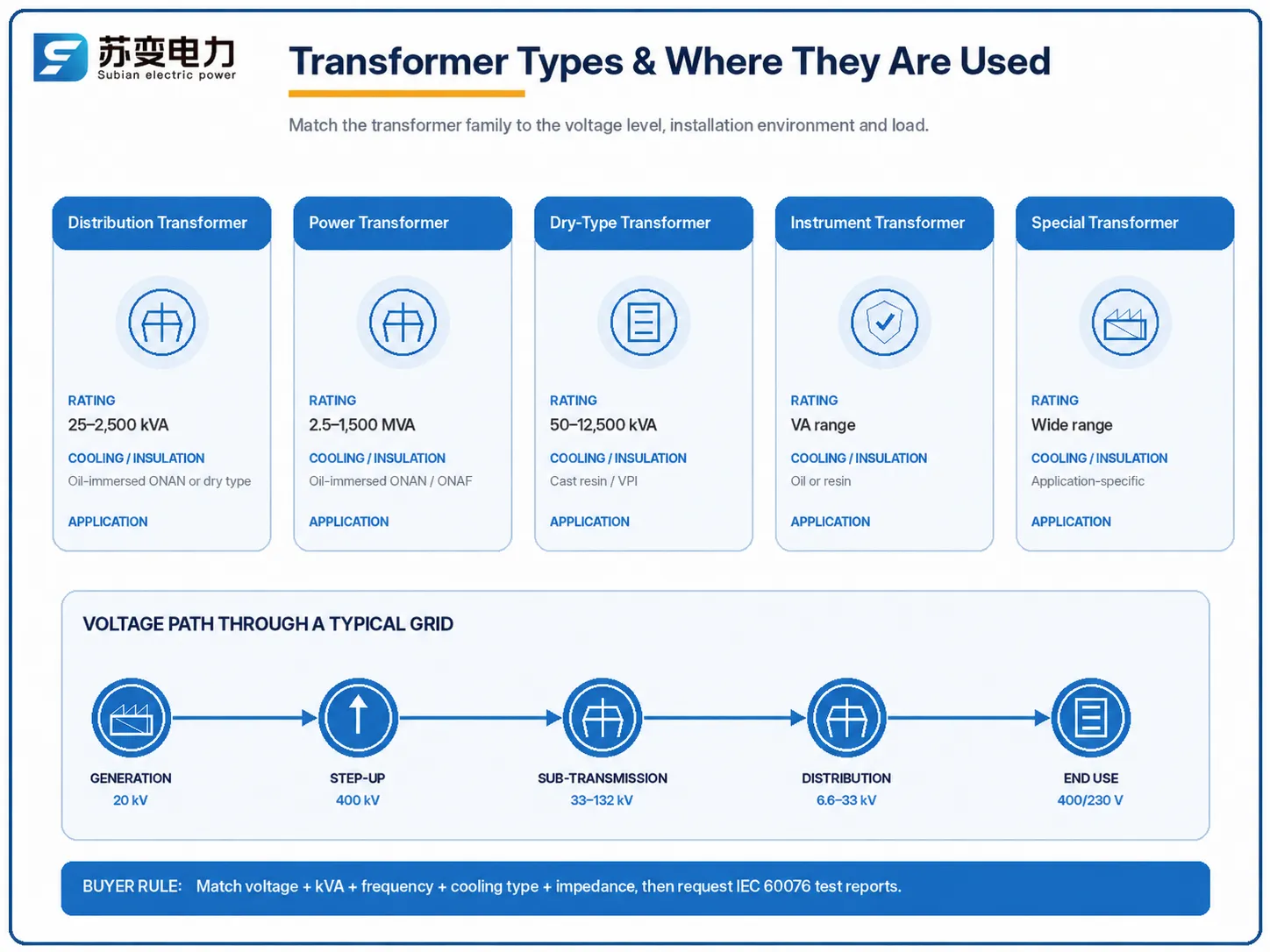
| Verteilungstransformator | Ölgetaucht ONAN oder Trockenbau | 25–2.500 kVA | Masten, Fundamente, Umspannwerke, die Haushalte und Unternehmen versorgen |
| Leistungstransformator | Ölgetaucht ONAN/ONAF | 2,5–1.500 MVA | Netz-Umspannwerke, Generator-Hochspannung |
| Trockentyp-Transformator | Gießharz / VPI | 50–12.500 kVA | Innenräume, Rechenzentren, Marine, Hochhäuser |
| Instrumententransformator (CT/VT) | Öl oder Harz | VA-Bereich | Messung und Schutz |
| Spezialtransformatoren | Nach Bedarf | Weit | Öfen, Traktion, Solar, Wind, Gleichrichter |
Spannungsniveaus und deren Verwendung
| Spannungsniveau | Klasse | Rolle des Transformators |
|---|---|---|
| 110–800 kV | Extra/Ultra Hochspannung | Großübertragung zwischen Regionen |
| 33–132 kV | Hochspannung / Unterübertragung | Regionale Versorgung zu Umspannwerken |
| 6,6–33 kV | Mittelspannung | Verteilungsleitungen, industrielle Versorgungen |
| 380/415 V, 208/120 V | Niederspannung | Verteilungsschaltanlagen für Endverbraucher |
| <50 V | Extra Niederspannung | Steuerung, Signalgebung, Sicherheitsisolierung |
Anwendungen in der Praxis nach Sektor
- In der Stromerzeugung heben Step-Up-Transformatoren in thermischen, hydroelektrischen, nuklearen, Wind- und Solaranlagen die Generatorspannung auf ein Niveau, das für Übertrager geeignet ist.
In der Übertragung und Verteilung besteht das gesamte Netzsystem von 400 kV bis 11 kV und 0,4 kV aus Transformatoren.
In der Industrie wandeln die Umspannwerke die Spannung von 11 kV–33 kV in 400 V um, die für Motoren und elektrische Antriebe sowie in Öfen verwendet werden.
In gewerblichen Räumlichkeiten liefern die isolierten Transformatoren im Elektroraum Strom von 400/230 V für die Verteilung und Beleuchtung auf den Etagen.
Im Falle des Schienenverkehrs regulieren die Transformatoren entweder auf Lokomotiven oder an den festen Punkten der Eisenbahnen die Spannung aus dem Netz entweder auf 25 kV oder 15 kV oder verhindern, dass sie 750 V (DC-System) überschreitet.
Im Falle von erneuerbaren Energiequellen hat jede Windturbine und jede Solarwechselrichterstation ihren eigenen Transformator, der zur Stromversorgung der Netze verwendet wird.
In Haushalten, entweder auf Masten oder pad-montiert, wandelt der Transformator bereits die Mittelspannung in die 230 V um, die von Blockadaptern verwendet werden.
Warum Elektrizität ohne sie nicht funktionieren würde
Die Hochspannungsübertragung ermöglicht es, Verluste, die aufgrund des Widerstands durch den Quadratwert des Stromwerts, genannt I²R-Leistungsverlust, auftreten, zu reduzieren. Wenn man die Spannung verdoppelt, würde der Strom um das 4-fache sinken, und der Verlust in der Leitung würde um 75% sinken. Das Fehlen von Step-Up-Transformatoren würde den Verlust von 10-20% der erzeugten elektrischen Energie im Transit aufgrund von Wärmeabstrahlung bedeuten. Ihre Anwesenheit führt zu Verlusten von nur 2-5%. Transformatoren helfen, Elektrizität zu isolieren und die Sicherheit ihrer Betriebsabläufe zu verbessern, indem sie Spannungen zwischen verschiedenen Systemen umwandeln. Diese Maschine ist unter anderen Maschinen, die gebaut wurden, sehr oft exquisit zu finden.
Marken und typische Preise
| Marke | Land | 100 kVA Verteilung | 630 kVA Verteilung | Anmerkungen |
|---|---|---|---|---|
| Hitachi Energie | Schweiz/Japan | $2,800–$5,000 | $9.000–$15.000 | Netzqualität, weites globales Netzwerk |
| Siemens | Deutschland | $2,700–$4,800 | $8.500–$14.500 | Stark in Europa und der Industrie |
| ABB | Schweiz | $2,700–$4,800 | $8.500–$14.000 | Breites Vertriebsportfolio |
| Schneider Electric | Optimierungsmaßnahmen in der Praxis | $2,600–$4,600 | $8.000–$13.500 | Öko-Design-Verteilungslinie |
| Eaton | Irland/USA | $2,200–$4,000 | $7,000–$12,000 | Starke Präsenz in Nordamerika |
| Jiangsu Subian Electric Power | China | $1,300–$3,200 | $4.800–$9.500 | IEC 60076 getestet, Direktfabrik, OEM/ODM |
Internationale Marken wie Hitachi Energy, Siemens und ABB führen in den Bereichen Service und technische Dokumente, mit entsprechenden Kosten. Das Design für die Standardverteilungsklasse ist ein altes und hochgradig standardisiertes, wobei fast alle renommierten chinesischen Hersteller die gleichen IEC 60076 und IEEE C57.12 Normen einhalten. Jiangsu Subian Electric Power gehört zu den chinesischen Transformatorenherstellern, die an der Produktion einer breiten Palette von Verteilungs- und Leistungstransformatoren bis zu 110kV beteiligt sind. Das Unternehmen bietet verschiedene Prüfberichte, die Möglichkeit einer Drittanbieterinspektion und Unterstützung für OEM-Unternehmen zu Preisen direkt ab Werk, die im Allgemeinen 25-40% niedriger sind als die europäischen Preise.
Wie man den richtigen auswählt
- Bestimmen Sie die Systemspannung und Frequenz (z.B. 11/0,4 kV, 50 Hz) und die Erdungsanordnung.
- Berechnen Sie Ihre Spitzenlast in kVA; dimensionieren Sie das Gerät auf 65–80% der Nennleistung für die beste Effizienz.
- Wählen Sie den Kühltyp: ölgetaucht für im Freien, Trockenbau für Innenräume oder feuerempfindliche Standorte.
- Wählen Sie die Verlust- und Effizienzklasse basierend auf dem 24/7-Betrieb und den lokalen Vorschriften (z. B. DOE 10 CFR 431, NEMA TP-1).
- Geben Sie die Impedanz an (typischerweise 4–6% für die Verteilung), um die Schutzeinstellungen abzugleichen.
- Entscheiden Sie sich für Zubehör: Abzapfwechsler, Gehäuse-IP-Bewertung, Überwachungs- und Schutzgeräte.
- Fordern Sie Angebote mit Routineprüfzertifikaten von mindestens drei Lieferanten an und vergleichen Sie die Gesamtkosten.
Häufig gestellte Fragen
Was ist die einfachste Erklärung dafür, was ein Transformator tut?
Ein Transformator ändert die Spannung von Wechselstrom. Er erhöht die Spannung für eine effiziente Übertragung über lange Strecken und senkt sie wieder für eine sichere Nutzung in Haushalten, Büros und Fabriken, indem er zwei magnetisch gekoppelte Spulen durch einen Stahlkern verwendet. Er hat keine beweglichen Teile und benötigt keine eigene Energiequelle.
Warum ist Wechselstrom erforderlich, damit Transformatoren funktionieren?
Transformatoren sind auf einen sich ändernden magnetischen Fluss angewiesen, um Spannung in der sekundären Wicklung zu induzieren, und nur ein Wechselstrom erzeugt diesen sich ändernden Fluss. Gleichstrom erzeugt einen konstanten Fluss, der nichts induziert – genau aus diesem Grund gewann Wechselstrom den historischen Wettbewerb gegen Gleichstrom für die Netzübertragung.
Was ist die typische Effizienz eines Transformators?
Verteilungstransformatoren arbeiten mit einer Effizienz von 97–99%; größere Leistungstransformatoren erreichen 99,5–99,7%. Selbst kleine Verbesserungen sind wichtig, da Verteilungstransformatoren kontinuierlich unter Spannung stehen, sodass Effizienzstandards wie NEMA TP-1 und U.S. DOE 10 CFR 431 Mindestverlustniveaus für in Nordamerika verkaufte Einheiten vorschreiben.
Wie viel kostet ein einfacher Transformator?
Ein 25–50 kVA einphasiger Freileitungstransformator kostet $600–$1,500; eine 100 kVA dreiphasige Einheit kostet $1,500–$4,000; ein 630 kVA Verteilungstransformator $6,000–$12,000; und ein 10 MVA Leistungstransformator $80,000–$160,000. Fügen Sie 10–20% für Fracht, Installation und Zubehör hinzu. Die Preise variieren je nach Marke, Verlusten und Region.
Wie lange hält ein Transformator?
Ölgetauchte Verteilungstransformatoren halten typischerweise 25–35 Jahre und große Leistungstransformatoren 40–50 Jahre bei ordnungsgemäßer Wartung. Die Lebensdauer der Isolierung wird durch die Temperatur bestimmt: Ein dauerhafter Betrieb 8–10°C über dem bewerteten Hotspot halbiert die verbleibende Lebensdauer, sodass die Lastdisziplin der stärkste Hebel für die Langlebigkeit ist.
Referenzen
- Encyclopaedia Britannica: Transformator — zugängliche Erklärung der Physik der elektromagnetischen Induktion und des Transformatorbetriebs.
- IEC 60076-1: Leistungstransformatoren – Allgemeine Anforderungen — der globale Standard, der Bewertungen, Toleranzen und Tests definiert.
- U.S. DOE: Effizienz von Verteilungstransformatoren — erklärt, warum Effizienz wichtig ist und die geltenden Mindestanforderungen.
- NEMA TP-1 — der Branchenbenchmark für die Effizienz von Verteilungstransformatoren in Nordamerika.
- IEEE C57.12.00 — nordamerikanischer Standard für flüssigkeitsgetauchte Transformatoren.
- IEA Weltenergieausblick — Kontext zur Nachfrage nach Netzwerkinfrastruktur und zur Bereitstellung von Transformatoren.
- Jiangsu Subian Electric Power — Transformatorenhersteller, der IEC 60076-konforme Einheiten von der Verteilung bis zur 110 kV-Klasse liefert.
Fazit
Transformatoren sind entscheidend für jedes elektrische Netz. Sie erhöhen das Spannungsniveau, senken es, messen es, isolieren spezifische Schaltungen und versorgen jedes System mit den erforderlichen elektrischen Lasten – alles ohne bewegliche Teile und über viele Jahre.
Um Transformatoren zu verstehen, müssen wir die vier Schlüssel Funktionen von Transformatoren, die Wissenschaft hinter dem elektromagnetischen Prinzip und ihre Typen erkunden.
Transformatoren nutzen elektromagnetische Induktion, um Spannungsniveaus zu ändern. Die Effektivität kann bis zu 97-99,7% betragen.
Alle elektrischen Wege umfassen 4 bis 6 Transformatorstufen.
Erreichen Sie die optimale Leistung bei der Auswahl des Transformators und stellen Sie sicher, dass Sie um den IEC 60076-Testbericht bitten.
Wenn Sie also Ihren Lieferanten auswählen, vergleichen Sie die Gesamtkosten des Eigentums sowohl globaler Unternehmen, z.B. Hitachi, Siemens, als auch lokaler Anbieter, z.B. Jiangsu Subian Electric Power.