


Consider when you charged your mobile, turned the washing machine on, or saw an MRI machine being used in a medical facility. All these actions were enabled by transformers, while the fact is that many people never even saw a transformer. A power plant located hundreds of kilometers away converts electric power into energy once or twice; therefore, if this power generated by an electric plant is 20 kV, the near-connected device gets it in 230 V. There should be something that provides such transitions, and the mentioned “something” exists just about a dozen times between the generator and the device. The transformer is the one that manages this task very well as it is a widely utilized machine in the electrical engineering industry.
This detailed guide aims to provide answers to the very first question for the freshmen who enter electrical engineering: what is a transformer designed for? Here, you will find information about what a transformer is and how it works along with its main types with examples and figures belonging to each category. Whether you are a student, an electrician or a purchasing manager, this article will help you understand the basics of transformers.
What Is a Transformer?
A transformer is an electrical device comprising two or more windings which perform magnetically coupled functions for the purpose of voltage transformation of alternating current. It is completely free from any moving part – it transfers power via the magnetic field, not conductor, and therefore can operate for decades with little maintenance. Transformers accommodate in voltage from the tiniest of instrument transformers rated in only a few VA up to the power of megavolt-ampere utilized by EHV transformers rated in 1,500 MVA.
Transformers only work with alternating current, which is what allowed the AC to win the ‘war of currents’ in the end of the 19th century. AC can be raised to hundreds of kilovolts for transmission purposes and lowered again for consumption – this could not be done with DC systems.
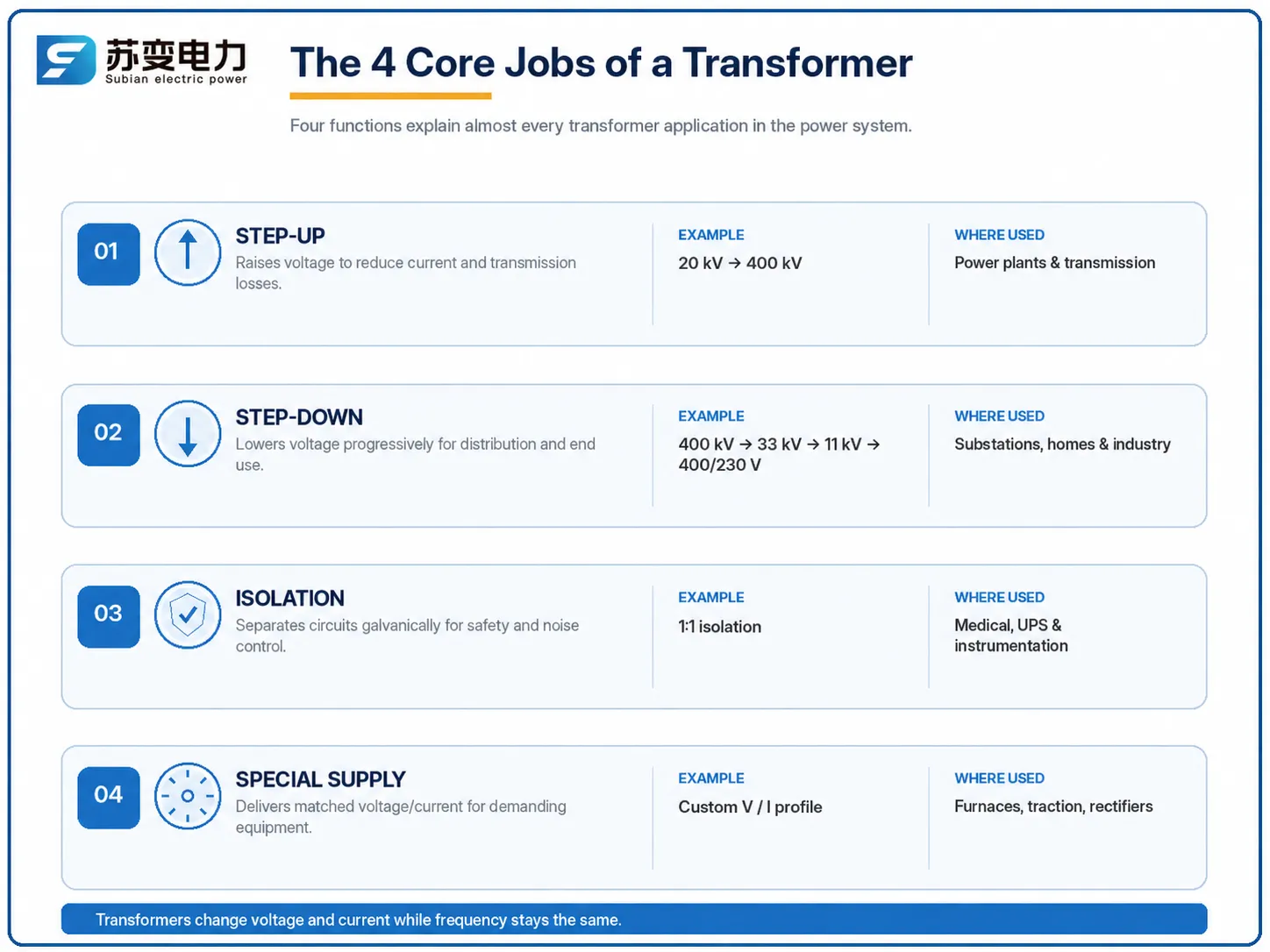
The 4 Core Jobs of a Transformer
| Job | What It Does | Example |
|---|---|---|
| Step-up | Raises voltage for long-distance transmission, cutting line losses | 20 kV → 400 kV at a power plant |
| Step-down | Lowers voltage for distribution and end use | 400 kV → 33 kV → 11 kV → 400/230 V |
| Isolation | Separates circuits galvanically for safety and noise control | Medical equipment, instrumentation, UPS |
| Special supply | Provides matched voltage/current for specific loads | Furnace transformers, rectifier transformers, K-factor units |
Step-up and step-down perform in quantity terms. In most scenarios, in power lines, electrical energy undergoes changing its voltage multiple times: once in the generator, once in every level of sub-transmission, once at the distribution transformer near the home, and in some cases inside the building.
How a Transformer Works
The working principle of the device is based on electromagnetic induction, i.e. Faraday’s law. When alternating current goes through the primary winding, it produces alternating magnetic flux in the core that is made of laminated steel. The magnetic flux created by the primary winding gets linked to the secondary winding, which induces voltage in the secondary winding that is proportional to the number of turns in it. The formula is simple: is Vprimary / Vsecondary = Nprimary / Nsecondary, while power in is equal to power out less losses, meaning that current varies inversely to voltage ratio.
Efficiency is very high in fact. Distribution transformers operate at efficiency rates of 97–99%, while large power transformers achieve efficiency rates of 99.5–99.7%. After that, the losses are converted to heat, including core (no-load) losses, which happen while the device is in operation and copper (load) losses that are proportional to the square of current.
Key Components Explained
| Component | Material | Function |
|---|---|---|
| Core | Grain-oriented silicon steel or amorphous metal | Conducts magnetic flux between windings; quality determines no-load loss |
| Windings | Copper or aluminum, paper/aramid insulated | Carry current and create/induce voltage; ratio sets transformation |
| Insulation & cooling medium | Transformer oil, epoxy resin, or class-H varnish | Electrically isolates and removes heat from the active part |
| Tap changer | Copper contacts, manual or OLTC | Adjusts turns ratio to hold output voltage under system variations |
| Tank / enclosure | Steel, with conservator, breather, bushings | Protects the active part, holds oil, provides terminals and cooling surface |
Types of Transformers
| Type | Cooling / Insulation | Rating Range | Where Used |
|---|---|---|---|
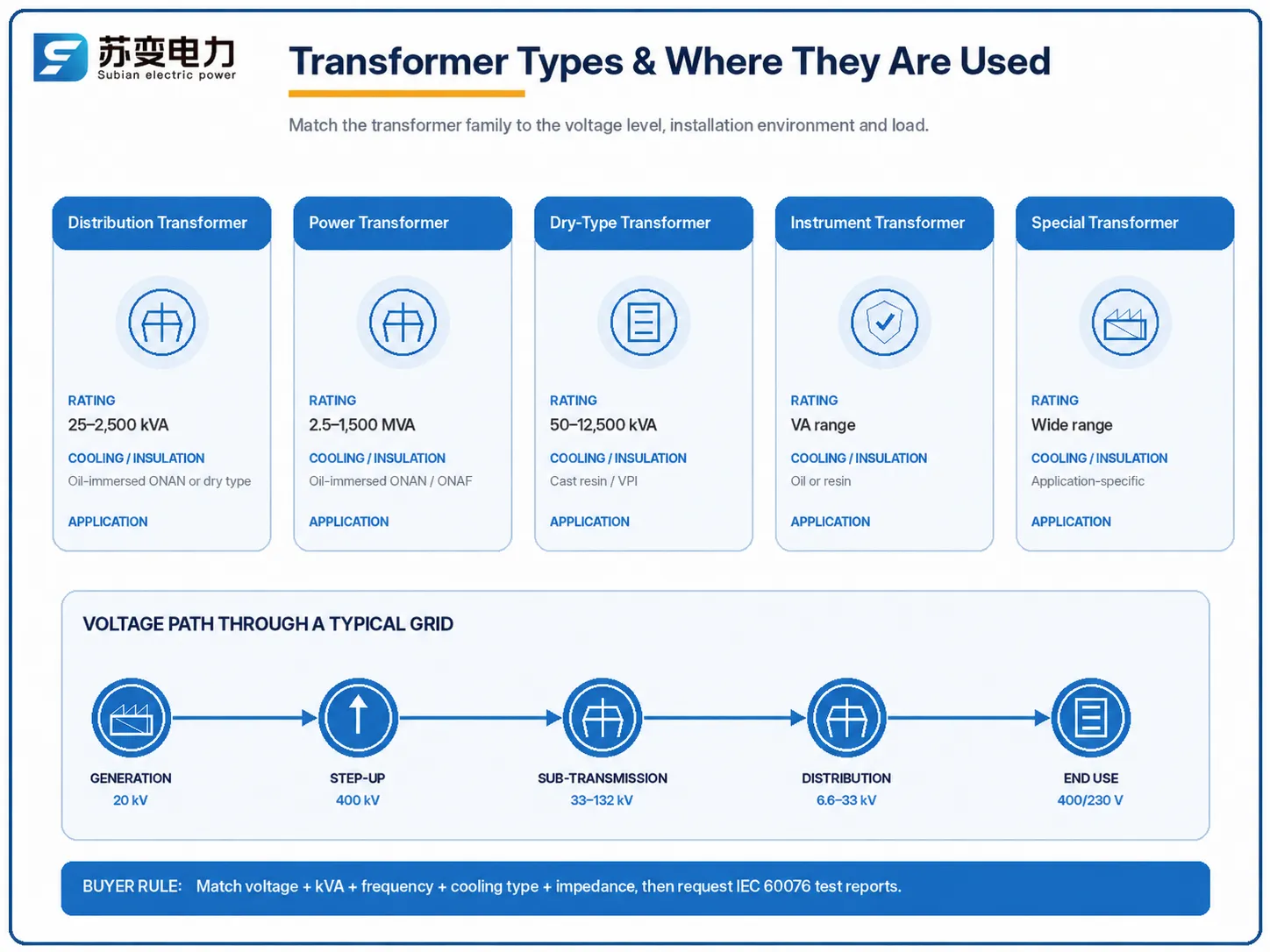
| Distribution transformer | Oil-immersed ONAN, or dry type | 25–2,500 kVA | Poles, pads, substations feeding homes and businesses |
| Power transformer | Oil-immersed ONAN/ONAF | 2.5–1,500 MVA | Grid substations, generator step-up |
| Dry-type transformer | Cast resin / VPI | 50–12,500 kVA | Indoor, data centers, marine, high-rise |
| Instrument transformer (CT/VT) | Oil or resin | VA range | Metering and protection |
| Special transformers | As required | Wide | Furnaces, traction, solar, wind, rectifiers |
Voltage Levels and Where They Are Used
| Voltage Level | Class | Transformer Role |
|---|---|---|
| 110–800 kV | Extra/Ultra high voltage | Bulk transmission between regions |
| 33–132 kV | High voltage / sub-transmission | Regional supply to substations |
| 6.6–33 kV | Medium voltage | Distribution feeders, industrial supplies |
| 380/415 V, 208/120 V | Low voltage | End-user distribution boards |
| <50 V | Extra low voltage | Control, signaling, safety isolation |
Real-World Applications by Sector
- In power generation, step-up transformers in the thermal, hydroelectric, nuclear, wind, and solar plants elevate generator voltage to a level fit for transmitters.
In transmission and distribution, the whole grid system from 400kV down to 11 kV and 0.4kV consists of transformers.
In the industry, the power substations convert the voltage of 11 kV–33kV into that of just 400 V usable for engines and electric drives and also in furnaces.
In commercial premises, the insulated transformers present in the electric room provide electricity of 400/230 V for distribution and lighting on the floors.
In case of rail transport, the transformers either on locomotives or at the stationary points of the railroads regulate voltage from the grid either down to 25 kV or 15 kV or prevent it from going above 750 V (DC system).
In the case of renewable energy sources, each wind turbines and solar inverter station has its own transformer used to power the networks.
In households, either on pole or pad-mounted, the transformer already converts the medium voltage to the 230 V usable by block adaptors.
Why Electricity Wouldn’t Work Without Them
The high voltage transmission allows one to reduce losses occurring due to the resistance by the square of the current value called I²R power loss. If one doubled the voltage, the current would be decreased by 4 times, and the loss in the line would be decreased by 75%. The absence of step-up transformers would imply the loss of 10-20% of generated electric power in transit because of heat emissions. Their presence leads to the losses of only 2-5%. Transformers help to isolate electricity and improve the safety of their operations converting voltages between different systems. This machine is very often found exquisite among other machines built.
Brands and Typical Prices
| Brand | Country | 100 kVA Distribution | 630 kVA Distribution | Notes |
|---|---|---|---|---|
| Hitachi Energy | Switzerland/Japan | $2,800–$5,000 | $9,000–$15,000 | Grid-grade quality, wide global network |
| Siemens | Germany | $2,700–$4,800 | $8,500–$14,500 | Strong in Europe and industry |
| ABB | Switzerland | $2,700–$4,800 | $8,500–$14,000 | Broad distribution portfolio |
| Schneider Electric | France | $2,600–$4,600 | $8,000–$13,500 | Eco-design distribution line |
| Eaton | Ireland/US | $2,200–$4,000 | $7,000–$12,000 | Strong North American presence |
| Jiangsu Subian Electric Power | China | $1,300–$3,200 | $4,800–$9,500 | IEC 60076 tested, direct factory, OEM/ODM |
International brands such as Hitachi Energy, Siemens and ABB take the lead in the areas of service and engineering documents, with corresponding cost. However, the design for standard distribution class is an old one and highly standardized, with almost all reputable Chinese manufacturers following the same IEC 60076 and IEEE C57.12 norms. Jiangsu Subian Electric Power is among the Chinese transformer manufacturers that are involved in production of a wide range of distribution and power transformers up to 110kV. The company provides various test reports, the option of third-party inspection and support for OEM companies at direct-from-the-factory prices that are generally 25-40% lower than European prices.
How to Choose the Right One
- Identify the system voltage and frequency (e.g. 11/0.4 kV, 50 Hz) and the earthing arrangement.
- Calculate your peak load in kVA; size the unit at 65–80% of nameplate for best efficiency.
- Choose the cooling type: oil-immersed for outdoor, dry type for indoor or fire-sensitive sites.
- Select loss and efficiency class based on 24/7 running and local regulations (e.g. DOE 10 CFR 431, NEMA TP-1).
- Specify impedance (typically 4–6% for distribution) to match protection settings.
- Decide accessories: tap changer, enclosure IP rating, monitoring and protection devices.
- Request quotations with routine test certificates from at least three suppliers and compare landed cost.
Frequently Asked Questions
What is the simplest explanation of what a transformer does?
A transformer changes the voltage of alternating current. It raises voltage for efficient transmission over long distances and lowers it again for safe use in homes, offices and factories, using two coils magnetically coupled through a steel core. It has no moving parts and needs no energy source of its own.
Why is AC required for transformers to work?
Transformers rely on a changing magnetic flux to induce voltage in the secondary winding, and only an alternating current produces that changing flux. Direct current produces a steady flux that induces nothing—this is exactly why AC won the historic competition against DC for grid transmission.
What is the typical efficiency of a transformer?
Distribution transformers operate at 97–99% efficiency; larger power transformers reach 99.5–99.7%. Even small improvements matter because distribution transformers run energized continuously, so efficiency standards such as NEMA TP-1 and U.S. DOE 10 CFR 431 mandate minimum loss levels for units sold in North America.
How much does a basic transformer cost?
A 25–50 kVA single-phase pole transformer costs $600–$1,500; a 100 kVA three-phase unit runs $1,500–$4,000; a 630 kVA distribution transformer $6,000–$12,000; and a 10 MVA power transformer $80,000–$160,000. Add 10–20% for freight, installation and accessories. Prices vary by brand, losses and region.
How long does a transformer last?
Oil-immersed distribution transformers typically last 25–35 years and large power transformers 40–50 years with proper maintenance. Insulation life is governed by temperature: sustained operation 8–10°C above the rated hotspot halves the remaining life, so loading discipline is the strongest lever on longevity.
References
- Encyclopaedia Britannica: Transformer — accessible explanation of the physics of electromagnetic induction and transformer operation.
- IEC 60076-1: Power Transformers – General Requirements — the global standard defining ratings, tolerances and testing.
- U.S. DOE: Distribution Transformer Efficiency — explains why efficiency matters and the regulatory minimums in force.
- NEMA TP-1 — the industry benchmark for distribution transformer efficiency in North America.
- IEEE C57.12.00 — North American standard for liquid-immersed transformers.
- IEA World Energy Outlook — context on grid infrastructure demand and transformer deployment.
- Jiangsu Subian Electric Power — transformer manufacturer supplying IEC 60076-compliant units from distribution to 110 kV class.
Conclusion
Transformers are critical in any electrical grid. They raise the voltage level, lower it, meter it, isolate specific circuits, and supply each system with required electrical loads—all without any moving parts and for many years.
To understand transformers, we need to explore the four key functions of transformers, the science behind the electromagnetic principle, and their types.
Transformers use electromagnetic induction to alter voltage levels. The effectiveness can be as high as 97-99.7%.
All electrical paths include 4 to 6 transformer stages.
Achieve the optimal output when choosing the transformer and make sure you ask to provide the IEC 60076 test report.
Thus, when you come to choose your supplier, compare the total cost of ownership of both global companies, e.g., Hitachi, Siemens, or local suppliers, e.g., Jiangsu Subian Electric Power.