


Considere cuando cargó su móvil, encendió la lavadora o vio una máquina de MRI siendo utilizada en una instalación médica. Todas estas acciones fueron habilitadas por transformadores, mientras que el hecho es que muchas personas nunca han visto un transformador. Una planta de energía ubicada a cientos de kilómetros de distancia convierte la energía eléctrica en energía una o dos veces; por lo tanto, si esta energía generada por una planta eléctrica es de 20 kV, el dispositivo conectado más cercano la recibe en 230 V. Debe haber algo que proporcione tales transiciones, y el mencionado “algo” existe aproximadamente una docena de veces entre el generador y el dispositivo. El transformador es el que gestiona esta tarea muy bien, ya que es una máquina ampliamente utilizada en la industria de la ingeniería eléctrica.
Esta guía detallada tiene como objetivo proporcionar respuestas a la primera pregunta para los estudiantes de primer año que ingresan a la ingeniería eléctrica: ¿para qué está diseñado un transformador?Aquí encontrará información sobre qué es un transformador y cómo funciona, junto con sus principales tipos con ejemplos y figuras pertenecientes a cada categoría. Ya sea que sea un estudiante, un electricista o un gerente de compras, este artículo le ayudará a entender los conceptos básicos de los transformadores.
¿Qué es un transformador?
Un transformador es un dispositivo eléctrico que comprende dos o más devanados que realizan funciones acopladas magnéticamente con el propósito de la transformación de voltaje de corriente alterna. Está completamente libre de cualquier parte móvil: transfiere energía a través del campo magnético, no del conductor, y por lo tanto puede operar durante décadas con poco mantenimiento. Los transformadores acomodan voltajes desde los más pequeños de transformadores de instrumentos clasificados en solo unos pocos VA hasta la potencia de megavolt-amperios utilizada por transformadores EHV clasificados en 1,500 MVA.
Los transformadores solo funcionan con corriente alterna, que es lo que permitió que la CA ganara la ‘guerra de las corrientes’ a finales del siglo XIX. La CA puede elevarse a cientos de kilovoltios para fines de transmisión y bajarse nuevamente para el consumo; esto no se podía hacer con sistemas de CC.
Los 4 trabajos principales de un transformador
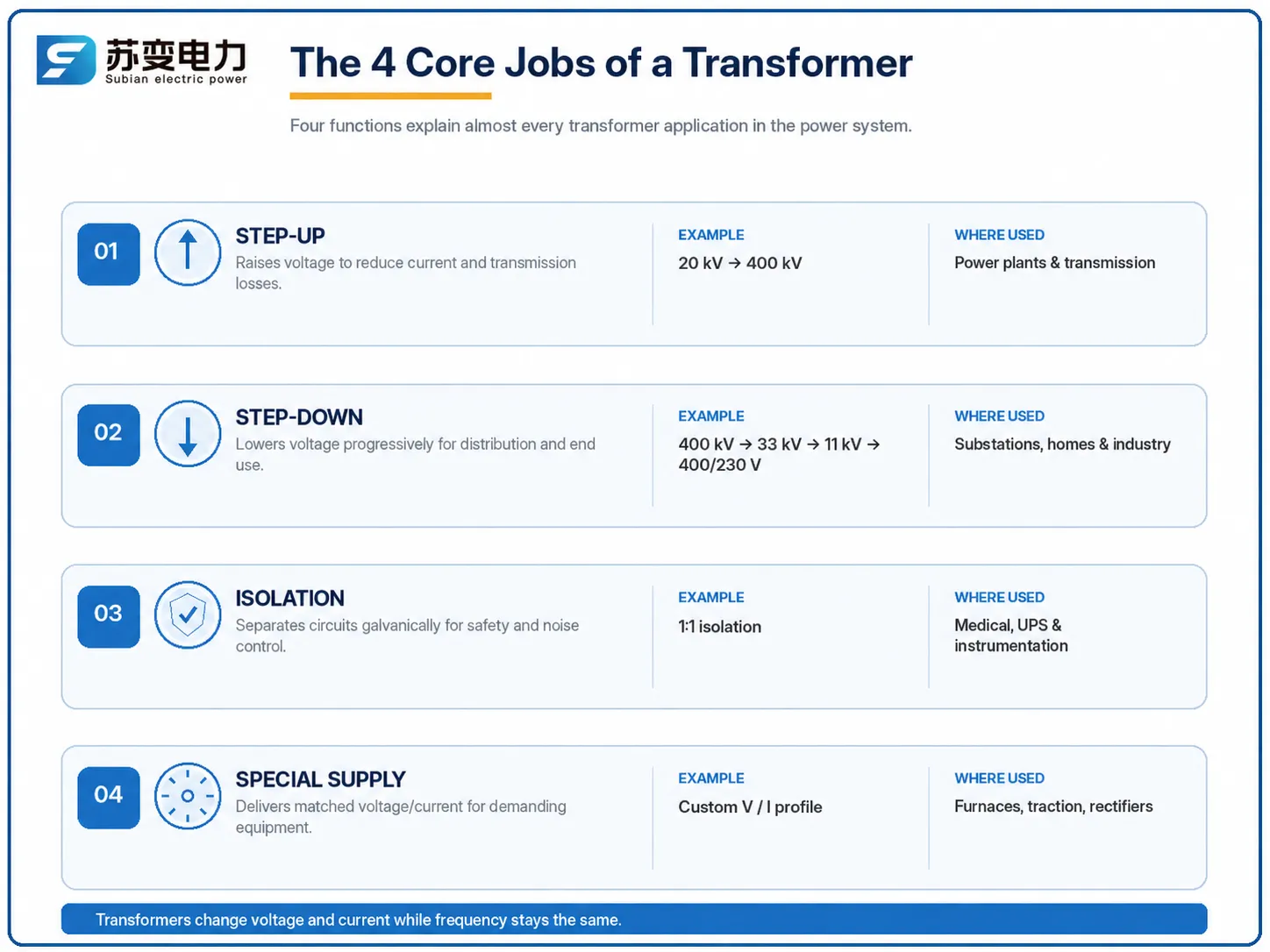
| Trabajo | Lo que hace | Ejemplo |
|---|---|---|
| Elevación | Aumenta el voltaje para transmisión a larga distancia, reduciendo las pérdidas en la línea | 20 kV → 400 kV en una planta de energía |
| Reducción | Reduce el voltaje para distribución y uso final | 400 kV → 33 kV → 11 kV → 400/230 V |
| Aislamiento | Separa circuitos galvánicamente para seguridad y control de ruido | Equipos médicos, instrumentación, UPS |
| Suministro especial | Proporciona voltaje/corriente ajustados para cargas específicas | Transformadores de horno, transformadores rectificadores, unidades K-factor |
La elevación y reducción se realizan en términos de cantidad. En la mayoría de los escenarios, en las líneas de energía, la energía eléctrica cambia su voltaje múltiples veces: una vez en el generador, una vez en cada nivel de subtransmisión, una vez en el transformador de distribución cerca del hogar, y en algunos casos dentro del edificio.
Cómo funciona un transformador
El principio de funcionamiento del dispositivo se basa en la inducción electromagnética, es decir, la ley de Faraday. Cuando la corriente alterna pasa a través del devanado primario, produce un flujo magnético alterno en el núcleo que está hecho de acero laminado. El flujo magnético creado por el devanado primario se vincula al devanado secundario, lo que induce un voltaje en el devanado secundario que es proporcional al número de vueltas en él. La fórmula es simple: es Vprimario / Vsecundario = Nprimario / Nsecundario, mientras que la potencia en es igual a la potencia fuera menos las pérdidas, lo que significa que la corriente varía inversamente al ratio de voltaje.
La eficiencia es muy alta de hecho. Los transformadores de distribución operan con tasas de eficiencia de 97–99.%, mientras que los grandes transformadores de potencia logran tasas de eficiencia de 99.5–99.7TP3T. Después de eso, las pérdidas se convierten en calor, incluyendo pérdidas en el núcleo (sin carga), que ocurren mientras el dispositivo está en operación y pérdidas de cobre (carga) que son proporcionales al cuadrado de la corriente.
Componentes Clave Explicados
| Componente | Material | Función |
|---|---|---|
| Núcleo | Acero silicio orientado a grano o metal amorfo | Conduce el flujo magnético entre devanados; la calidad determina la pérdida sin carga |
| Devanados | Cobre o aluminio, aislado con papel/aramida | Transporta corriente y crea/induce voltaje; el ratio establece la transformación |
| Aislamiento y medio de enfriamiento | Aceite para transformadores, resina epóxica o barniz clase-H | Aísla eléctricamente y elimina el calor de la parte activa |
| Cambiador de tomas | Contactos de cobre, manual o OLTC | Ajusta el ratio de vueltas para mantener el voltaje de salida bajo variaciones del sistema |
| Tanque / recinto | Acero, con conservador, respiradero, bujes | Protege la parte activa, contiene aceite, proporciona terminales y superficie de enfriamiento |
Tipos de Transformadores
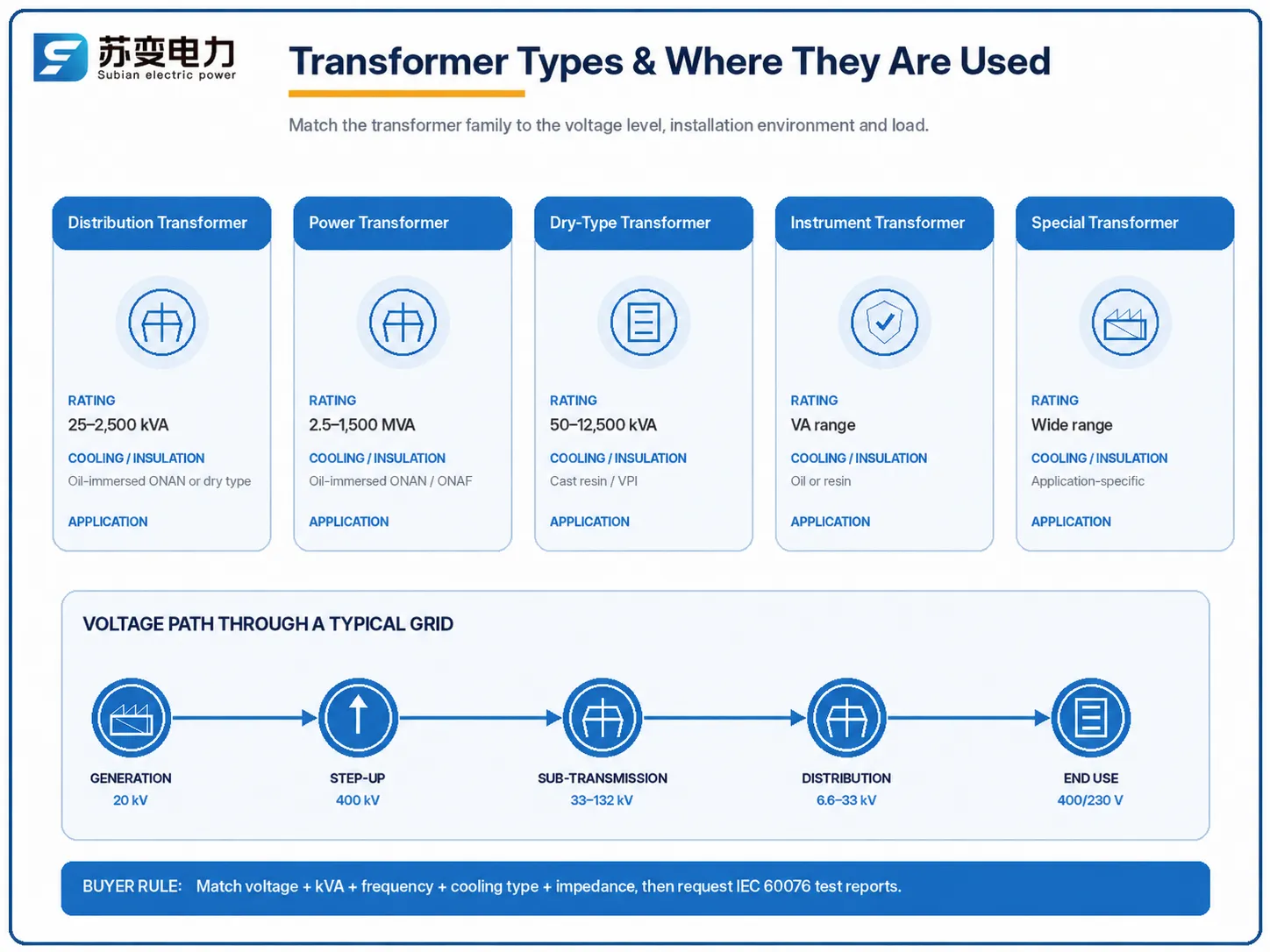
| Tipo | Enfriamiento / Aislamiento | Rango de Calificación | Dónde se Utiliza |
|---|---|---|---|
| Transformador de distribución | Inmerso en aceite ONAN, o tipo seco | 25–2,500 kVA | Postes, plataformas, subestaciones que alimentan hogares y negocios |
| Transformador de potencia | Inmerso en aceite ONAN/ONAF | 5–1,500 MVA | Subestaciones de red, elevación de generador |
| Transformador seco | Resina fundida / VPI | 50–12,500 kVA | Interior, centros de datos, marino, edificios altos |
| Transformador de instrumentación (CT/VT) | Aceite o resina | Rango de VA | Medición y protección |
| Transformadores especiales | Según sea necesario | Amplio | Hornos, tracción, solar, eólica, rectificadores |
Niveles de voltaje y dónde se utilizan
| Nivel de Voltaje | Clase | Rol del transformador |
|---|---|---|
| 110–800 kV | Extra/Ultra alta tensión | Transmisión a granel entre regiones |
| 33–132 kV | Alta tensión / subtransmisión | Suministro regional a subestaciones |
| 6–33 kV | Media tensión | Alimentadores de distribución, suministros industriales |
| 380/415 V, 208/120 V | Baja tensión | Tableros de distribución para usuarios finales |
| <50 V | Baja tensión extra | Control, señalización, aislamiento de seguridad |
Aplicaciones del mundo real por sector
- En la generación de energía, los transformadores elevadores en plantas térmicas, hidroeléctricas, nucleares, eólicas y solares elevan el voltaje del generador a un nivel adecuado para los transmisores.
En transmisión y distribución, todo el sistema de red desde 400 kV hasta 11 kV y 0.4 kV consiste en transformadores.
En la industria, las subestaciones eléctricas convierten el voltaje de 11 kV–33 kV en 400 V utilizables para motores y accionamientos eléctricos y también en hornos.
En locales comerciales, los transformadores aislados presentes en la sala eléctrica proporcionan electricidad de 400/230 V para distribución y iluminación en los pisos.
En el caso del transporte ferroviario, los transformadores, ya sea en locomotoras o en los puntos fijos de las vías, regulan el voltaje de la red, ya sea bajándolo a 25 kV o 15 kV o evitando que supere los 750 V (sistema de CC).
En el caso de fuentes de energía renovable, cada turbina eólica y estación de inversores solares tiene su propio transformador utilizado para alimentar las redes.
En los hogares, ya sea en postes o montados en base, el transformador ya convierte la media tensión a 230 V utilizables por adaptadores de bloque.
Por qué la electricidad no funcionaría sin ellos
La transmisión de alta tensión permite reducir las pérdidas que ocurren debido a la resistencia por el cuadrado del valor de la corriente llamado pérdida de potencia I²R. Si se duplicara el voltaje, la corriente se reduciría 4 veces, y la pérdida en la línea se reduciría en 75%. La ausencia de transformadores elevadores implicaría la pérdida de 10-20% de la potencia eléctrica generada en tránsito debido a emisiones de calor. Su presencia conduce a pérdidas de solo 2-5%. Los transformadores ayudan a aislar la electricidad y mejorar la seguridad de sus operaciones convirtiendo voltajes entre diferentes sistemas. Esta máquina se encuentra muy a menudo como una de las más exquisitas entre otras máquinas construidas.
Marcas y precios típicos
| Marca | País | Distribución de 100 kVA | Distribución de 630 kVA | Notas |
|---|---|---|---|---|
| Hitachi Energy | Suiza/Japón | $2,800–$5,000 | $9,000–$15,000 | Calidad de grado de red, amplia red global |
| Siemens | Alemania | $2,700–$4,800 | $8,500–$14,500 | Fuerte en Europa e industria |
| ABB | Suiza | $2,700–$4,800 | $8,500–$14,000 | Amplio portafolio de distribución |
| Schneider Electric | Francia | $2,600–$4,600 | $8,000–$13,500 | Línea de distribución de eco-diseño |
| Eaton | Irlanda/EE. UU. | $2,200–$4,000 | $7,000–$12,000 | Fuerte presencia en América del Norte |
| Jiangsu Subian Electric Power | China | $1,300–$3,200 | $4,800–$9,500 | Probado según IEC 60076, fábrica directa, OEM/ODM |
Marcas internacionales como Hitachi Energy, Siemens y ABB lideran en las áreas de documentos de servicio e ingeniería, con el costo correspondiente. Sin embargo, el diseño para la clase de distribución estándar es antiguo y altamente estandarizado, con casi todos los fabricantes chinos de buena reputación siguiendo las mismas normas IEC 60076 y IEEE C57.12. Jiangsu Subian Electric Power se encuentra entre los fabricantes de transformadores chinos que participan en la producción de una amplia gama de transformadores de distribución y potencia de hasta 110kV. La empresa proporciona varios informes de prueba, la opción de inspección de terceros y apoyo para empresas OEM a precios directos de fábrica que son generalmente 25-40% más bajos que los precios europeos.
Cómo elegir el correcto
- Identifique el voltaje y la frecuencia del sistema (por ejemplo, 11/0.4 kV, 50 Hz) y el arreglo de puesta a tierra.
- Calcule su carga máxima en kVA; dimensione la unidad en 65–80% de la placa de identificación para obtener la mejor eficiencia.
- Elija el tipo de refrigeración: sumergido en aceite para exteriores, tipo seco para interiores o sitios sensibles al fuego.
- Seleccione la clase de pérdidas y eficiencia basada en funcionamiento 24/7 y regulaciones locales (por ejemplo, DOE 10 CFR 431, NEMA TP-1).
- Especifique la impedancia (típicamente 4–6% para distribución) para coincidir con los ajustes de protección.
- Decida los accesorios: cambiador de tomas, clasificación IP del recinto, dispositivos de monitoreo y protección.
- Solicite cotizaciones con certificados de prueba de rutina de al menos tres proveedores y compare el costo total.
Preguntas Frecuentes
¿Cuál es la explicación más simple de lo que hace un transformador?
Un transformador cambia el voltaje de la corriente alterna. Aumenta el voltaje para una transmisión eficiente a largas distancias y lo reduce nuevamente para un uso seguro en hogares, oficinas y fábricas, utilizando dos bobinas acopladas magnéticamente a través de un núcleo de acero. No tiene partes móviles y no necesita una fuente de energía propia.
¿Por qué se requiere corriente alterna para que los transformadores funcionen?
Los transformadores dependen de un flujo magnético cambiante para inducir voltaje en el devanado secundario, y solo una corriente alterna produce ese flujo cambiante. La corriente continua produce un flujo constante que no induce nada; esta es exactamente la razón por la cual la CA ganó la competencia histórica contra la CC para la transmisión en red.
¿Cuál es la eficiencia típica de un transformador?
Los transformadores de distribución operan con una eficiencia de 97–99%; los transformadores de potencia más grandes alcanzan 99.5–99.7%. Incluso pequeñas mejoras son importantes porque los transformadores de distribución funcionan energizados continuamente, por lo que estándares de eficiencia como NEMA TP-1 y U.S. DOE 10 CFR 431 exigen niveles mínimos de pérdidas para las unidades vendidas en América del Norte.
¿Cuánto cuesta un transformador básico?
Un transformador monofásico de poste de 25–50 kVA cuesta $600–$1,500; una unidad trifásica de 100 kVA cuesta $1,500–$4,000; un transformador de distribución de 630 kVA cuesta $6,000–$12,000; y un transformador de potencia de 10 MVA cuesta $80,000–$160,000. Añada 10–20% para flete, instalación y accesorios. Los precios varían según la marca, las pérdidas y la región.
¿Cuánto dura un transformador?
Los transformadores de distribución sumergidos en aceite típicamente duran 25–35 años y los transformadores de potencia grandes 40–50 años con el mantenimiento adecuado. La vida del aislamiento está gobernada por la temperatura: operar sostenidamente 8–10°C por encima del punto caliente nominal reduce a la mitad la vida restante, por lo que la disciplina en la carga es la palanca más fuerte para la longevidad.
Referencias
- Enciclopedia Británica: Transformador — explicación accesible de la física de la inducción electromagnética y el funcionamiento del transformador.
- IEC 60076-1: Transformadores de Potencia – Requisitos Generales — la norma global que define las clasificaciones, tolerancias y pruebas.
- DOE de EE. UU.: Eficiencia de Transformadores de Distribución — explica por qué la eficiencia es importante y los mínimos regulatorios vigentes.
- NEMA TP-1 — el referente de la industria para la eficiencia de transformadores de distribución en Norteamérica.
- IEEE C57.12.00 — norma norteamericana para transformadores sumergidos en líquido.
- Perspectiva Mundial de Energía de la AIE — contexto sobre la demanda de infraestructura de red y despliegue de transformadores.
- Jiangsu Subian Electric Power — fabricante de transformadores que suministra unidades conforme a IEC 60076 desde distribución hasta clase 110 kV.
Conclusión
Los transformadores son críticos en cualquier red eléctrica. Elevan el nivel de voltaje, lo reducen, lo miden, aíslan circuitos específicos y suministran a cada sistema las cargas eléctricas requeridas, todo sin partes móviles y durante muchos años.
Para entender los transformadores, necesitamos explorar las cuatro funciones clave de los transformadores, la ciencia detrás del principio electromagnético y sus tipos.
Los transformadores utilizan la inducción electromagnética para alterar los niveles de voltaje. La eficacia puede ser tan alta como 97-99.7%.
Todos los caminos eléctricos incluyen de 4 a 6 etapas de transformadores.
Logre el rendimiento óptimo al elegir el transformador y asegúrese de solicitar el informe de prueba IEC 60076.
Por lo tanto, cuando elija su proveedor, compare el costo total de propiedad de empresas globales, por ejemplo, Hitachi, Siemens, o proveedores locales, por ejemplo, Jiangsu Subian Electric Power.