


En Bangladesh, la factura de servicios públicos del gerente de operaciones de un parque textil presentó el mismo problema durante el sexto mes consecutivo. Los cuatro transformadores de 1,000 kVA del parque habían estado funcionando a una carga promedio de 40% durante varios años, lo que resultó en pérdidas en el núcleo, que son pérdidas en vacío que ocurren a la misma frecuencia, siendo más costosas que $18,000–$26,000 por año por el uso innecesario y no productivo de electricidad. La auditoría energética reveló que había dos transformadores de distribución que datan de la década de 1990 con características de pérdida de los modelos actuales más avanzados. El verdadero dilema no era si el gerente tenía que tomar acción, sino qué tipo de acciones tomar. El gerente había recibido un mensaje de una sola frase de sus consultores diciendo que una modernización energética era la opción más rápida en toda la planta.
Esta publicación trata sobre el concepto de modernización energética en relación con los transformadores de potencia, cómo se compara con el reemplazo, el tipo de prácticas de operación económica, los costos involucrados y las formas de calcular el período de recuperación con precisión.
El término modernización energética de transformadores generalmente denota el reemplazo de los núcleos o bobinas que consumen mucha energía por otros más eficientes o, en la mayoría de los casos, el cambio completo del transformador por un nuevo tipo que ahorra energía según la norma GB 20052 o de acuerdo con la clasificación IEC. Si bien la modernización puede costar entre 60-80% de un nuevo transformador, el rendimiento no es mejor que el de un nuevo transformador, lo que hace que tal solución sea poco común para proyectos de ahorro energético. Sin embargo, medidas de operación económica como el dimensionamiento correcto, la gestión de carga, los ajustes de tomas y la captura de pérdidas pueden recuperar las inversiones en menos de un año.
Lo que significa la modernización energética de transformadores
El término modernización energética se refiere a cualquier cambio realizado o reemplazo que reduce las pérdidas del transformador. Hay dos tipos de pérdidas: la primera son las pérdidas en vacío que ocurren cuando el transformador está cargado de una forma u otra y no se ven afectadas por la carga, y las pérdidas de carga se basan en el cuadrado de la carga. En el caso de los transformadores, ambos tipos de pérdidas tienen un valor, aunque su valor es diferente ya que depende en gran medida de la forma en que opera el transformador.
La modernización incluye las siguientes acciones: la primera forma es comprar un nuevo transformador, la segunda es bobinar o cambiar el núcleo del transformador existente, la tercera es agregar técnicas de gestión de carga o refrigeración, y la última es reingeniería del punto de operación (que impulsa la necesidad de cargas o trabajar en paralelo o de otra manera).
Comprendiendo las pérdidas de los transformadores: Pérdidas en vacío vs Pérdidas de carga
Esto se denomina pérdida en vacío (o pérdida de hierro) ya que la pérdida ocurre al magnetizar el núcleo solo. Ya sea que esté funcionando a plena carga o no, esta pérdida de energía ocurre durante 8760 horas cada año, convirtiéndola en el factor más importante en los esfuerzos de ahorro de energía. La pérdida de carga (o pérdida de cobre) ocurre debido al paso de corriente a través de los devanados y varía con el cuadrado de la corriente, o en otras palabras, cuando el transformador trabaja a 50% de carga, solo se registra 25% de pérdida de carga nominal.
| Tamaño del transformador | Pérdida en vacío de diseño antiguo | Moderno GB 20052-2 grado 2 | Núcleo amorfo (grado 1) |
|---|---|---|---|
| 100 kVA | 270–350 W | 130–180 W | 60–90 W |
| 400 kVA | 800–1,100 W | 400–520 W | 180–260 W |
| 1,000 kVA | 1,500–2,100 W | 700–1,100 W | 350–500 W |
| 2,500 kVA | 3,200–4,500 W | 1,600–2,400 W | 800–1,200 W |
Como se demuestra, la pérdida del núcleo del transformador antiguo es generalmente dos veces mayor que la de los modelos modernos, y de tres a cinco veces en comparación con los modelos de núcleo amorfo. Dado que estas pérdidas ocurren 24/7, la variación anual en costos es significativa: a una tarifa de kWh igual a 0.10, la diferencia total de pérdidas asciende a $876 anualmente en el caso de las pérdidas en vacío.
Retrofit en el lugar vs Reemplazo completo
Rebobinar y recorear un transformador existente es una posibilidad para los fabricantes y puede incluso ser lo correcto si el tanque y los accesorios están en buenas condiciones y el transformador tiene una clasificación peculiar o si los códigos de la red o las limitaciones del sitio no permiten realizar un reemplazo uno a uno.
Pero en la mayoría de los casos, los números estarán en contra de esta decisión.
- Rebobinar en el lugar cuesta alrededor de 60-80% del nuevo transformador, pero aún terminas con una unidad con un tanque viejo, juntas viejas, bujes y aceite sin ninguna reducción de fallas pasadas.
- Reemplazar por una unidad moderna significa obtener todos los beneficios de eficiencia del acero moderno, nuevo tanque, aislamiento, garantía y costos de mantenimiento reducidos.
- Los estándares están cambiando: un transformador comprado en 2005 no puede cumplir con GB 20052 ya que el estándar moderno es diferente, y ni hablar de los transformadores adquiridos en 1995 y antes. No es posible cumplir con el estándar con un núcleo viejo, que aún mostrará pérdidas de alrededor de 1.8 kW en lugar de los 0.9 kW requeridos.
Una regla práctica sería hacer un retrofit solo si no puedes hacer un reemplazo por razones físicas o limitaciones del sitio. De lo contrario, necesitas reemplazarlo por la clase de eficiencia más alta que se te permita.
| Opción | Costo vs nueva unidad | Resultado de pérdida en vacío | Garantía | Mejor cuando |
|---|---|---|---|---|
| Rebobinado en el lugar | 60–80% del nuevo | El núcleo viejo permanece; poco beneficio | Solo rebobinado | Clasificación inusual, restricciones fijas del sitio |
| Recorte en el lugar | 70–90% del nuevo | Nuevo núcleo, pero tanque/bujes viejos | Solo núcleo | Rara vez económico |
| Reemplazo completo, grado 2 | 100% | Reducido a la mitad en comparación con unidades de los años 90 | Unidad completa, 12–24 meses | Caso de recuperación estándar |
| Reemplazo completo, núcleo amorfo | 120–140% | 60–70% por debajo de lo convencional | Unidad completa, 12–24 meses | Aplicaciones cargadas 24/7 |
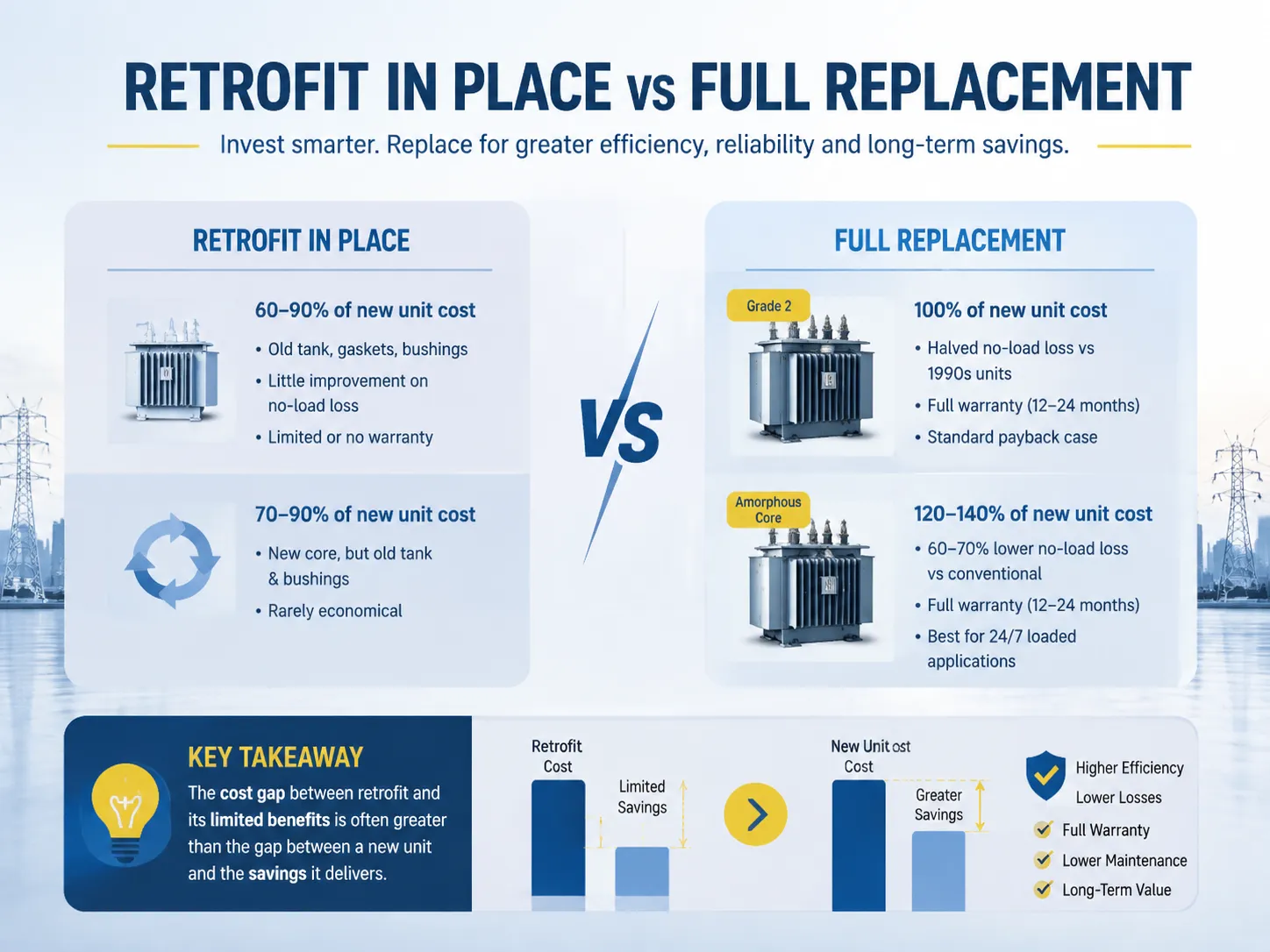
La razón por la cual los consultores abogan por reemplazar sistemas se ilustra en el gráfico; la diferencia entre el costo de un retrofit y lo que logra es típicamente mayor que la diferencia entre el costo de una nueva unidad y los ahorros que genera.
Tecnologías de Ahorro de Energía a Especificar
Cuando compras un nuevo transformador para el ahorro de energía, cuatro opciones tecnológicas son importantes:
| Tecnología | Ahorro típico de pérdidas en vacío | Costo inicial adicional | Mejor condición de recuperación de inversión |
|---|---|---|---|
| GOES de alta permeabilidad (0.23 mm) | 15–25% vs grado estándar | +3–6% | Casi siempre positivo en TCO |
| Núcleo de metal amorfo | 60–70% vs núcleo convencional | +20–40% | Factor de carga alto, operación 24/7 |
| Diseño de bobinado de baja pérdida (mayor masa de cobre) | 10–20% menor pérdida por carga | +2–5% | Transformadores con carga pesada |
| Aceite de éster natural (vegetal) | Igual que el aceite mineral eléctricamente | +10–15% | Prioridades de seguridad contra incendios y sostenibilidad |
La aleación amorfa debe ser examinada muy cuidadosamente cuando consideramos aplicaciones de 24 horas como centros de datos, hospitales o plantas de procesos continuos porque el transformador estará bajo carga todo el tiempo. Los costos iniciales más altos se compensan a través de ahorros generados por menores pérdidas en el núcleo; en promedio, un transformador de núcleo amorfo de 1,000 kVA tarda de 4 a 8 años en recuperar sus costos adicionales en comparación con cualquier transformador de alta eficiencia estándar.
Operación Económica: Optimizando Lo Que Ya Posees
La operación económica se trata de gestionar los transformadores que uno posee de la manera más efectiva. Implica muy poco costo y a menudo tiene un período de recuperación medido en términos de meses:
- Identificar una flota de tamaño óptimo: analizar el patrón de carga y considerar reemplazar dos transformadores con carga inferior a 40% por uno. Los costos operativos de los transformadores disminuyen.
- Controlar la operación en paralelo: en caso de que haya dos transformadores operando al mismo tiempo, no tiene mucho sentido mantener el primer transformador funcionando en caso de carga ligera del segundo transformador.
- Ajustar los tomas correctamente: elegir la posición del toma que mantenga el voltaje en el límite inferior del área aceptable resulta en una disminución de la corriente de magnetización y de la corriente de excitación.
- Mantener el transformador operando a bajas temperaturas: esto es importante porque los radiadores obstruidos elevan la temperatura del aceite y aceleran el envejecimiento del aislamiento.
- Observar las pérdidas de los transformadores con un plan de medición: medir la pérdida en vacío durante un período de apagado y la pérdida de carga durante el pico, luego usarlo en un modelo de capitalización de pérdidas.
Las empresas de distribución que logran apagar uno de cada dos transformadores operativos durante la noche suelen ahorrar 40-60% en pérdidas debido al proceso; así, queda claro que cambiar un interruptor puede ahorrar miles de dólares.
| Medida de operación económica | Costo de capital | Ahorro típico | Recuperación de la inversión |
|---|---|---|---|
| Apagar unidad paralela redundante en carga ligera | Ninguno | 40–60% de pérdidas en vacío del banco durante la noche | Inmediato |
| Optimizar posiciones de tomas para el rango de voltaje | Ninguno | 1–3% de pérdidas del transformador | Inmediato |
| Limpiar radiadores, restaurar refrigeración | Mano de obra de mantenimiento | Menor envejecimiento en puntos calientes, vida extendida | <1 año |
| Reemplazar dos unidades con carga ligera por una | Nueva unidad | Pérdida en vacío de una unidad eliminada | 3–8 años |
| Agregar medición de pérdidas y revisión de tendencias | $500–$2,000 | Problemas de pérdidas identificados por valor de $1,000s/año | <1 año |
Se ha observado que el mismo patrón es consistente: las medidas operativas pueden recuperarse de inmediato. Sin embargo, las medidas de capital siguen el patrón de capitalización de pérdidas. Una instalación que aplica ambos enfoques obtiene beneficios completos.
Cálculo del Retorno de Inversión y Capitalización de Pérdidas
La capitalización de pérdidas es un enfoque profesional para evaluar alternativas: se deben realizar cálculos para obtener el valor presente de cada vatio de pérdida en vacío y pérdida de carga que ocurre durante la vida de un transformador, luego se añadirá el costo inicial, y se seleccionará el costo total más bajo. Las fórmulas proporcionadas se pueden utilizar para ese propósito:
- Costo anual de pérdida en vacío = pérdida en vacío (kW) × 8,760 h × tarifa ($/kWh).
- Costo anual de pérdida de carga = pérdida de carga (kW) × horas en un año × factor de carga² × tarifa.
- El valor presente para 20 años debería ser aproximadamente igual al costo anual multiplicado por 9.8 (a la tasa de descuento de 8%).
Como ejemplo, sería posible comparar una unidad GB 20052 grado 2 de 1,000 kVA (con pérdida en vacío de 1,000 W y pérdida de carga de 10,000 W) con el uso de una unidad amorfa grado 1 (con pérdida en vacío de 500 W y pérdida de carga de 10,000 W) y con la tarifa de $0.10/kWh al factor de carga de 40%. En esta situación, se puede afirmar que la unidad grado 1 ayudará a ahorrar $438 en términos de pérdida en vacío solamente; así, el valor presente ascenderá a alrededor de $4,300 en 20 años, mientras que el costo inicial será de aproximadamente $2,000-3,000, lo que demuestra las evidentes ventajas de la unidad amorfa en caso de operación.
Un Proceso de Modernización Paso a Paso
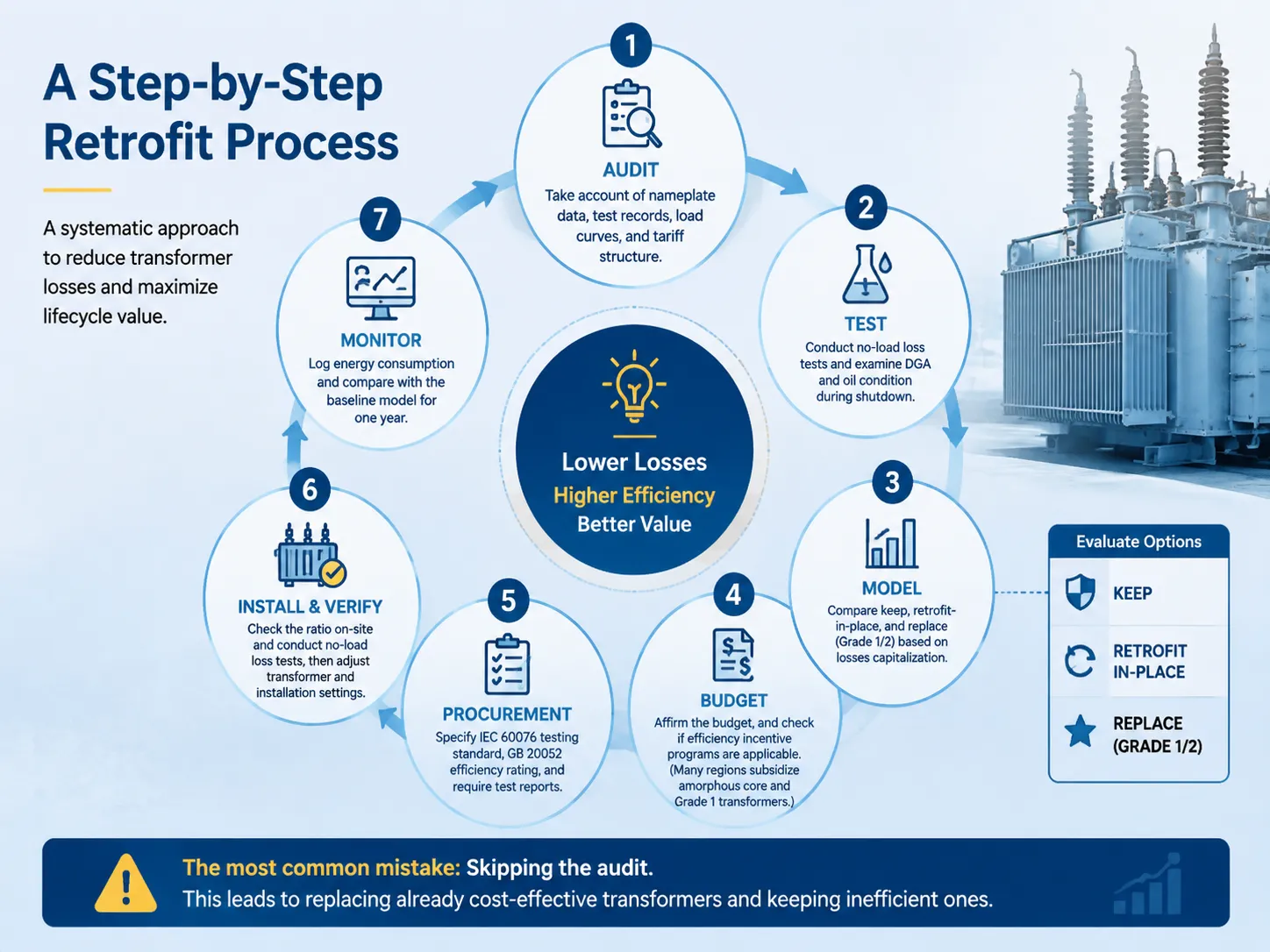
- Auditoría: Tener en cuenta los datos de la placa de identificación, registros de pruebas, curvas de carga y estructura tarifaria del transformador.
- Prueba: Donde sea aplicable, realizar pruebas de pérdida en vacío y examinar DGA y la condición del aceite durante la parada.
- Modelo: Hacer una comparación entre mantener, modernizar en su lugar y reemplazar con métodos de grado 1/2 en términos de capitalización de pérdidas.
- Presupuesto: Confirmar el presupuesto y verificar si los programas de incentivos de eficiencia son aplicables (muchas regiones subsidian los transformadores de núcleo amorfo y grado 1).
- Adquisición: Especificar los requisitos de la norma de prueba IEC 60076, la norma GB 20052 para la clasificación de eficiencia y requerir informes de prueba.
- Instalar y verificar: Comprobar la relación en el sitio y realizar pruebas de pérdida en vacío, luego ajustar la configuración del transformador y la configuración de instalación.
- Monitorear: Hacer registros del consumo de energía y compararlo con el modelo base durante un año.
La falta de realizar el paso de auditoría es el error más común cometido por las organizaciones, ya que la práctica conduce a cambiar los transformadores cuyas operaciones ya son rentables y al mismo tiempo mantiene las unidades ineficientes en su lugar.
Costos por Marca y Clase de Eficiencia
Precios para un transformador de distribución de ahorro energético de 1,000 kVA 10/0.4 kV, FOB por marca y clase de eficiencia:
| Marca | Origen | Eficiencia estándar | Alta eficiencia (grado 1 / amorfo) |
|---|---|---|---|
| Hitachi Energy | Japón/Global | $8,500–$12,000 | $12,000–$17,000 |
| ABB | Suiza/Global | $8,000–$11,500 | $11,500–$16,500 |
| Siemens Energy | Alemania/Global | $7,500–$11,000 | $11,000–$15,500 |
| Schneider Electric | Francia/Global | $7,000–$10,500 | $10,500–$15,000 |
| Jiangsu Subian Electric Power | China | $4,000–$6,500 | $5,500–$8,500 |
Las cotizaciones de precios pueden variar debido a la clase de pérdidas, cambiadores de tomas, accesorios, precios del cobre y condiciones de entrega. Trátalas como rangos de planificación, no como cotizaciones firmes.
Las marcas bien conocidas demuestran su calidad a través de redes de servicio global y pruebas de tipo extensas. El argumento a favor del nivel chino es que sus productos tienen los mismos resultados de prueba según IEC 60076 y la misma eficiencia según GB 20052 pero 40%-50% más baratos en el costo inicial. Jiangsu Subian Electric Power es un fabricante chino de transformadores sumergidos en líquido con grados de eficiencia de GB 20052 con capacidad de hasta 63 MVA. Subian ha suministrado actualizaciones de ahorro energético a servicios públicos y parques industriales en Asia, África y Oriente Medio, y su gama está documentada en subian-electric.com.
Preguntas Frecuentes
¿Cuánto cuesta un transformador de ahorro energético?
Un transformador de alta eficiencia de 400 kVA cuesta entre $2,500 y $4,500, y un transformador de 1,000 kVA cuesta de $4,000 a $8,500, entregado franco a bordo (FOB) de proveedores en China. Este último incluye transformadores con rendimiento intermedio, mientras que los modelos de mejor calidad (núcleo amorfo de clase 1) cuestan más. Los transformadores europeos y japoneses suelen costar entre un 50 y un 80 por ciento más que los fabricados en China. Los costos de los transformadores varían según sus clases de pérdidas y accesorios, así como los precios de las materias primas.
¿Es más barato volver a bobinar un transformador viejo o comprar uno nuevo?
La bobina normalmente cuesta entre el 60 y el 80 por ciento de lo que cuesta una nueva unidad, pero proporciona el mismo rendimiento o peor que la unidad vieja utilizando juntas y bujes viejos y sin nueva garantía aparte del proceso de rebobinado. A menos que no se pueda instalar un nuevo transformador por razones técnicas, cambiarlo por uno moderno de baja pérdida generalmente resultará ser una opción económica más viable.
¿Cuánta electricidad desperdicia un transformador viejo?
Generalmente, una unidad de 1,000 kVA de los años 90 tiene pérdidas en el rango de 1,500-2,100 W en situaciones de no carga, resultando en 13,000-18,000 kWh anuales, valorados en $1,050-$1,800 (suponiendo una tarifa eléctrica en el rango de $0.08-$0.10/kWh). Una unidad de grado 2 moderna reduciría esas pérdidas a la mitad, lo que se puede reducir una vez más con un diseño de núcleo amorfo.
¿Cuál es un buen período de recuperación para reemplazar un transformador?
Por lo general, el tiempo para el reemplazo de un equipo convencional antiguo por uno nuevo y eficiente en energía es de 3 a 8 años en modo de operación. Este tiempo puede ser determinado por tarifas de costos y factores de carga. Técnicas de gestión económica como el dimensionamiento de equipos, operaciones en paralelo y derivaciones suelen devolver la inversión en 1-2 años, con una inversión de capital mínima o nula necesaria.
¿Cómo sé qué grado de eficiencia comprar?
Realice la capitalización de pérdidas basada en la tarifa actual y el factor de carga. En sitios de alta carga y alto factor de carga, elija el mejor producto disponible (GB 20052-2 clase 1 o núcleo amorfo). En sitios de carga ligera y estacionales, la clase 2 es a menudo la mejor opción porque la diferencia en la pérdida en vacío no justifica la diferencia de precio.
Referencias
- IEA Eficiencia Energética 2023 — Contexto global sobre la eficiencia de transformadores y política de reducción de pérdidas.
- IEC 60076-1: Transformadores de potencia – General — Base de calificación y pruebas para la verificación de pérdidas.
- GB 20052: Grados de eficiencia energética para transformadores de potencia (China) — El estándar de grado de eficiencia utilizado en todo el sector.
- Programa de eficiencia de transformadores del DOE de EE. UU. — Reglas de eficiencia de América del Norte y economía de pérdidas.
- Portafolio de transformadores de Hitachi Energy — Referencia para ofertas de transformadores de ahorro energético premium.
- Sitio oficial de Jiangsu Subian Electric Power — Rango de transformadores de ahorro energético y núcleo amorfo con informes de prueba.
Conclusión
Las actualizaciones energéticamente eficientes de los transformadores y su explotación efectiva están entre los proyectos energéticos más rentables para los productores de energía y las empresas industriales. No debido a que esta tecnología sea complicada, sino más bien porque los transformadores obsoletos están trabajando horas extras, descargando electricidad mientras son apenas notados. Al examinar la tecnología a un nivel estructural, el enfoque de capitalización de pérdidas y la operación eficiente en energía, se puede lograr fácilmente un período de recuperación de 3 a 8 años para el reemplazo y de 1 a 2 años para modificaciones operativas.
Las principales conclusiones que se pueden extraer de aquí son las siguientes:
- Las pérdidas en vacío suman 8,760 horas/año, y cambiar un transformador fabricado en los años 90 por una unidad de última generación de baja pérdida generalmente permite lograr una reducción del 50 por ciento en las pérdidas.
- Las modificaciones in situ difícilmente pueden lograr un TCO más bajo que el reemplazo.
- El período de recuperación más rápido de las inversiones se puede lograr mediante el uso de operación eficiente en energía sin inversión.
- Los transformadores de núcleo amorfo tienen un buen retorno de inversión en caso de que el equipo esté en alta demanda.
Si su instalación está evaluando una modernización de ahorro energético, Jiangsu Subian Electric Power suministra transformadores de grado 1-2 GB 20052 con resultados de pruebas documentadas de pérdida en vacío, incluidos diseños de núcleo amorfo, a precios amigables para la exportación. Comience con la auditoría: el rango está en subian-electric.com.