


En una planta de procesamiento de alimentos en el Medio Oeste, uno de los ingenieros había instalado recientemente un transformador montado en base nuevo con una capacidad de 200 kVA que estaba destinado a apoyar la expansión de un congelador. Sin embargo, en un lapso de tres semanas después de la instalación, el transformador enfrentó un disparo debido a sobrecarga térmica durante las horas de producción y el usuario terminó con facturas eléctricas excesivas que anularon todos los beneficios anticipados que se esperaba que proporcionara el transformador. El problema no está en el transformador en sí, sino en el hecho de que antes de la instalación, nadie verificó si el transformador tenía la capacidad adecuada para la carga eléctrica, particularmente en términos de corrientes de arranque y cargas armónicas y teniendo en cuenta futuras expansiones en la carga. Tales situaciones ocurren a diario, de hecho, cada año tienen lugar en entornos industriales y comerciales y en servicios públicos.
En este documento, proporcionaré instrucciones paso a paso sobre cómo determinar si un transformador enfrenta los requisitos de carga utilizando la información de su placa de identificación, cálculos de kVA, análisis de factor de carga y pruebas en el sitio.
Puede averiguar si un transformador puede soportar sus necesidades de capacidad calculando primero la demanda real: sume las calificaciones de kVA de todas las cargas conectadas, tenga en cuenta el factor de diversidad de 0.7-0.85 y finalmente multiplique el número que ha alcanzado por un margen de crecimiento de 10-20%. Compare los resultados de viabilidad con el kVA de la placa de identificación del transformador y utilice el cálculo del factor de carga: las cargas constantes no deben exceder más del 80-90% de la calificación para transformadores de tipo seco y 70-80% para los de aceite.
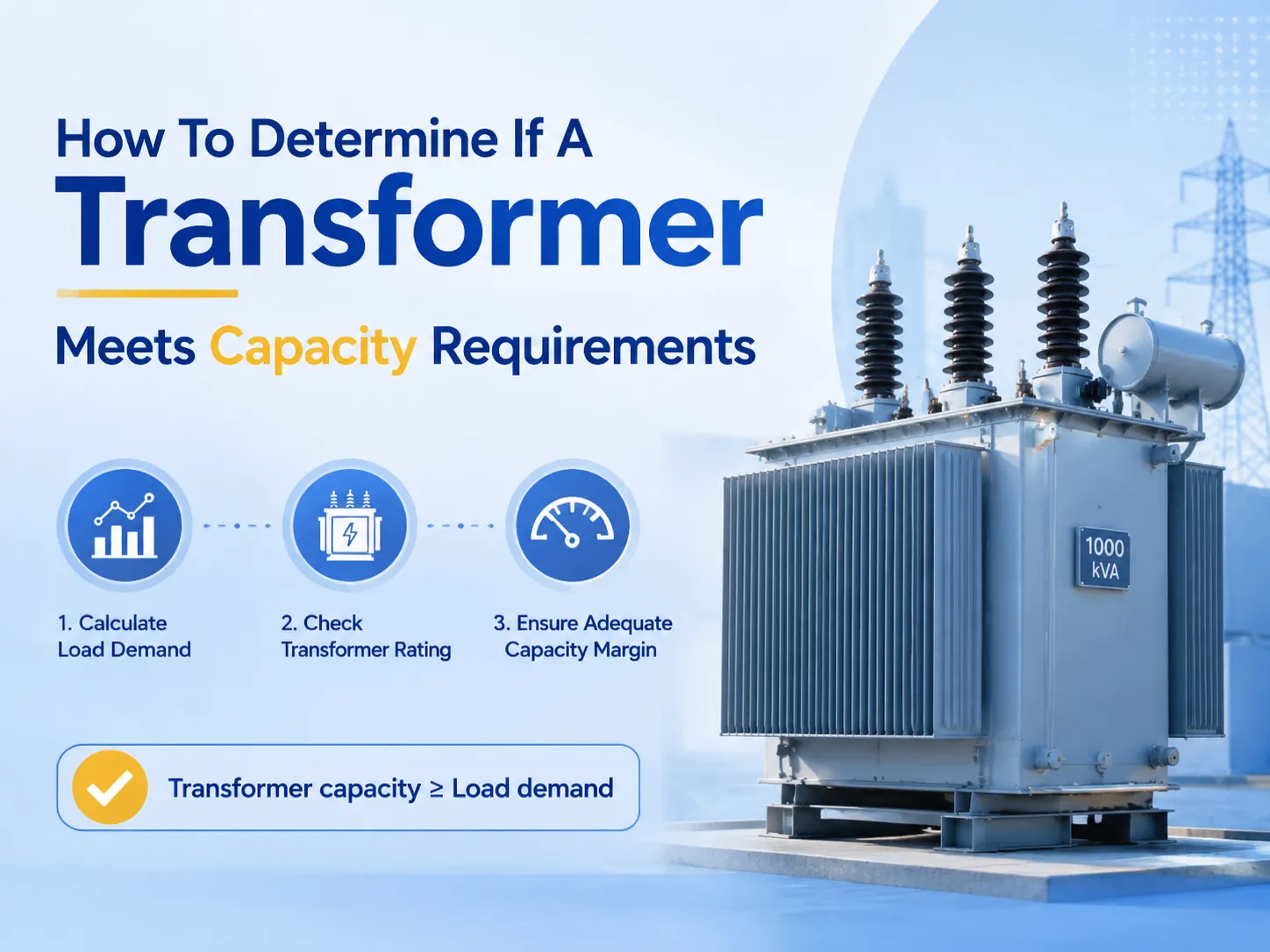
¿Qué significa “Requisitos de Capacidad” para un Transformador?
La capacidad de un transformador es su potencia aparente de salida declarada en kVA o MVA bajo condiciones de enfriamiento específicas. El fabricante establece esta calificación de acuerdo con IEC 60076-1 o IEEE C57.12.00, siendo la potencia aparente máxima de salida del dispositivo que puede utilizarse continuamente sin superar los límites de aumento de temperatura: generalmente 65 °C de aumento promedio en el devanado para transformadores sumergidos en aceite y 100–150 °C para tipos secos dependiendo de la clase de aislamiento correspondiente.
Cuando se trata de cumplir con los “requisitos de capacidad”, significa que el transformador es capaz de soportar la carga instantánea aumentada siempre que haya suficiente margen para tres parámetros que los ingenieros deben tener en cuenta: la corriente de arranque causada por el inicio de un motor (esto podría alcanzar 5–8 de la corriente nominal), las corrientes armónicas que aparecen debido a variadores de frecuencia y las perspectivas de aumento de carga futura. En un par de años, el transformador que se calcula correctamente hoy puede fácilmente quedar mal dimensionado si se agrega alguna carga a la operación de la instalación de lo contrario.
Hay dos razones por las cuales aparecen las discrepancias mencionadas. En primer lugar, es probable que los compradores confundan kVA (potencia aparente) con kW (potencia real), perdiendo de vista que la carga que opera con un factor de potencia de 0.8 requiere 25% más kVA en comparación con kW. Además, los compradores pueden sumar las calificaciones de placa de cada dispositivo sin aplicar el factor de diversidad necesario, lo que les lleva a sobrestimar la capacidad del transformador en aproximadamente 30–50% sin necesidad real de pagar por circuitos que pueden no ser utilizados más adelante.
Paso 1: Calcular la Carga Conectada Real
En primer lugar, es necesario hacer listas de todas las (cargas) que son suministradas por el transformador y agruparlas. Una buena clasificación es la siguiente:
- Cargas continuas — iluminación, HVAC y equipos de proceso que funcionan durante un largo período de tiempo.
- Cargas intermitentes — bombas, compresores, grúas que se encienden y apagan.
- Cargas de motor — amperaje a plena carga, corriente de arranque y si el equipo está utilizando arrancadores suaves, VFDs o no (cuántas corrientes está utilizando).
- Cargas no lineales — VFDs, rectificadores y sistemas UPS que tienen corriente armónica.
Ahora debes sumar kVA de todos los tipos de carga. No calcules solo los valores de kW para cada carga. Si solo tienes kW y factor de potencia, encuentra kVA usando la fórmula a continuación. Una vez que tengas los datos brutos como suma de todas las cargas, necesitas aplicar el factor de diversidad.
| Categoría de Carga | Factor de Diversidad Típico | Margen de Demanda Recomendado |
|---|---|---|
| Comercial general (minorista, oficina) | 0.60–0.75 | 10–15% |
| Plantas de proceso industrial | 0.70–0.85 | 10–20% |
| Hospitales, infraestructura crítica | 0.90–1.00 | 15–25% |
| Centros de datos (alta densidad) | 0.95–1.00 | 20–30% |
| Escuelas, edificios municipales | 0.50–0.70 | 10% |
Aumenta la demanda diversificada en 10% a 20%, ya que este margen asegurará que la unidad se mantenga dentro de sus límites térmicos durante las cargas máximas de verano y también después de cualquier futura renovación. Este margen es la forma más rentable de seguro disponible en el momento de la selección.
Paso 2: Aplicar las Fórmulas de Cálculo de kVA
Ahora convierte todo a kVA para compararlo con la calificación especificada. Se necesitan tres ecuaciones en este caso, que se forman sobre la base de las leyes de la potencia de CA.
En el caso de monofásico: kVA = (Volts × Amps) ÷ 1000
En el caso de trifásico: kVA = (√3 × Volts × Amps) ÷ 1000
En el caso de conversión de kW a kVA: kVA = kW ÷ factor de potencia
Ejemplo de cálculo: En el caso de una línea trifásica operando a 480 V con 240 A de corriente, la demanda es (1.732 × 480 × 240) ÷ 1000 = 199.5 kVA. En caso de tener en cuenta el factor de potencia igual a 0.85, esto significa que la energía real consumida es igual a 170 kW.
| Voltaje de Línea Nominal (V) | Corriente a Plena Carga (A) | Demanda Calculada (kVA) | Calificación Estándar Más Cercana (kVA) |
|---|---|---|---|
| 240 (monofásico) | 100 | 24.0 | 25 |
| 480 (trifásico) | 120 | 99.8 | 112.5 |
| 480 (trifásico) | 240 | 199.5 | 225 |
| 480 (trifásico) | 480 | 399.1 | 500 |
| 13,800 (trifásico) | 25 | 597.5 | 750 |
| 13,800 (trifásico) | 42 | 1003.8 | 1250 |
Siempre elija la siguiente clasificación estándar IEC más alta (25, 50, 100, 160, 250, 400, 500, 630, 800, 1000, 1250, 1600, 2000, 2500 kVA) en lugar de intentar obtener la potencia mínima disponible. Esto se debe a que las clasificaciones estándar IEC están diseñadas para ajustarse a los diseños estándar de transformadores, tamaños de núcleo e instrumentos de prueba; las clasificaciones especiales costarán más — de hecho, entre un 15 y un 30 por ciento más — y tardarán más en ser entregadas.
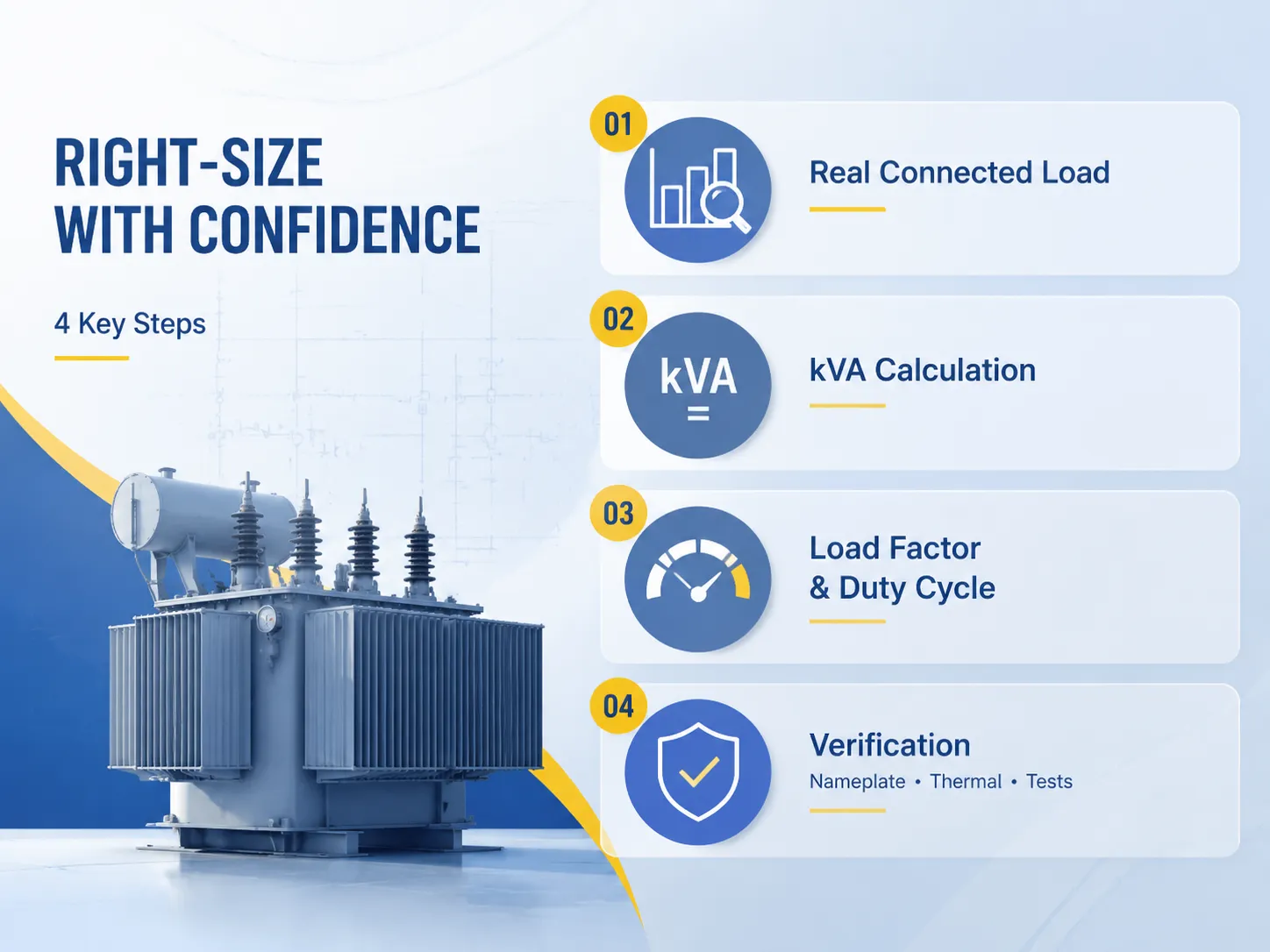
Paso 3: Verificar el Factor de Carga y el Ciclo de Trabajo
La capacidad general se determina no solo por el volumen máximo, sino también por la duración de las operaciones de alta tensión. Así, el factor de carga se define como la relación entre el consumo promedio y el consumo máximo en un cierto momento en la fórmula a continuación:
Factor de carga = Consumo promedio ÷ Consumo máximo
Una planta que consume 400 kVA durante media hora solo por la mañana y tiene un consumo promedio de 150 kVA tiene un factor de carga alrededor de 0.375. Esta situación es ventajosa para el uso de un transformador con baja inercia térmica, ya que un transformador lleno de aceite puede soportar sobrecargas temporales de 1.3 a 1.5 veces la capacidad nominal durante varias horas de acuerdo con la IEC 60076-7 respecto a cargas cíclicas. Por otro lado, un transformador que operó bajo carga 85% continuamente sufre de envejecimiento prematuro del aislamiento.
La vida útil del aislamiento según la ley de Arrhenius se reduce a la mitad con cada aumento de 6-8°C en el punto alto de funcionamiento continuo. Por ejemplo, cuando un transformador está cargado por 90% y tiene un aumento de menos de 65°C, la temperatura del punto caliente es superior a 105 C° durante bastante tiempo. Por eso, el criterio de carga 80% no es solo un truco de marketing.
Paso 4: Métodos de Verificación (Placa de identificación, Térmico, Pruebas)
Después de que el transformador ha sido instalado, necesitas evaluar la capacidad en tres niveles diferentes. Primero, necesitas verificar el aspecto administrativo: debes comprobar la clasificación de la placa, el nivel de impedancia, el grupo vectorial y la clase de refrigeración ONAN, ONAN/ONAF, AN/AF utilizando las especificaciones de compra y el estudio de carga. El segundo aspecto a verificar es el aspecto operativo donde necesitas comprobar la corriente secundaria, el voltaje y la temperatura del devanado.
Es importante solicitar al fabricante el informe de fábrica para transformadores nuevos. Según la IEC 60076-1, se deben realizar pruebas de rutina en relación con la resistencia del devanado, la relación, las pérdidas en vacío, las pérdidas activas y las pruebas de aumento de temperatura. Esta es la única evidencia basada en laboratorio en la que puedes confiar para demostrar que el transformador puede operar a la kVA nominal de forma continua sin exceder el límite de temperatura del aislamiento.
| Método de Verificación | Lo que Confirma | Costo / Esfuerzo Típico |
|---|---|---|
| Revisión de placa de identificación vs. estudio de carga | Coincidencia de clasificación, impedancia, clase de refrigeración | Sin costo, 1 hora |
| Registro de demanda de una semana | kVA pico vs. clasificación bajo carga real | $200–$600 (alquiler de registrador) |
| Termografía infrarroja | Puntos calientes en el buje, tanque y conexiones de cable | $300–$800 por encuesta |
| Análisis de gases disueltos (DGA) | Fallas térmicas/arcos tempranas en unidades de aceite | $80–$200 por muestra |
| Informe de prueba de rutina de fábrica | Prueba de relación, pérdidas, aislamiento, aumento de temperatura | Incluido en la compra |
Para unidades que parecen estar sobrecargadas, primero realiza un DGA y una encuesta de temperatura, luego considera comprar cualquier otra cosa. A menudo, el problema real es una mala conexión o un bloqueo de las aletas de refrigeración en lugar del núcleo en sí; reemplazar o mejorar estos puede restaurar la función completa a un costo menor que comprar un nuevo transformador.
Clasificaciones de Capacidad Comunes y Sus Límites de Carga
La tabla proporcionada indica las clasificaciones estándar recomendadas y la carga máxima sostenida para todas las tecnologías de refrigeración en consideración, que se basa en necesidades diversificadas y circunstancias climáticas normales de 30 grados Celsius (temperatura promedio).
| kVA nominal | Clase de Voltaje Típica | Carga Sostenida Máxima — Tipo Seco (AN) | Carga Sostenida Máxima — Sumergido en Aceite (ONAN) | Rango de Precio Típico (FOB China) |
|---|---|---|---|---|
| 100 | 4/0.4 kV, 11/0.4 kV | 80–90 kVA | 70–80 kVA | $2,500–$6,000 |
| 250 | 11/0.4 kV | 200–225 kVA | 175–200 kVA | $4,500–$11,000 |
| 500 | 11/0.4 kV, 33/0.4 kV | 400–450 kVA | 350–400 kVA | $8,000–$18,000 |
| 1000 | 10/0.4 kV, 35/10 kV | 800–900 kVA | 700–800 kVA | $15,000–$32,000 |
| 1600 | 35/10 kV, 33/0.4 kV | 1,280–1,440 kVA | 1,120–1,280 kVA | $24,000–$48,000 |
| 2500 | 35/10 kV | 2,000–2,250 kVA | 1,750–2,000 kVA | $38,000–$75,000 |
Cabe señalar que los límites de suministro continuos asumidos se aplican bajo las condiciones de un suministro limpio y un factor de potencia en los terminales del transformador casi igual a uno. Sin embargo, si se tienen en cuenta las armónicas, la situación se vuelve bastante diferente. Por ejemplo, una distorsión armónica total de 20-% de la corriente causa un aumento en la carga térmica efectiva de 5 a 10%, y un aparato que ya está en funcionamiento puede encontrarse bajo una sobrecarga aunque su kVA parezca estar dentro de los límites normales.
Especificaciones que afectan la capacidad
Además de la clasificación en kVA, varias otras especificaciones de la placa de identificación afectan la capacidad real proporcionada por el transformador en su aplicación:
- Clasificación de enfriamiento (IEC 60076-2): Un transformador ONAN se enfría por sí mismo hasta su plena capacidad. Un transformador ONAN/ONAF tiene ventiladores activos adicionales, proporcionando alrededor de 20% a 30% más que su clasificación estándar.
- Aumento de temperatura (K): Un transformador clasificado para 65 K tiene más capacidad que un transformador clasificado para 55 K del mismo tamaño, pero someterá su aislamiento a más desgaste.
- Tensión de impedancia (uk%): Generalmente está alrededor del cuatro al diez por ciento para transformadores de distribución. Un valor de impedancia más alto reduce la corriente de falla, pero tiene peores características de caída de tensión.
- Grupo vectorial (Dyn11, Yyn0, Yd11): Necesita adaptarse al sistema para prevenir problemas con corrientes circulantes.
- Reducción de capacidad debido a la altitud y temperatura: A medida que la altitud supera los 1000 m y la temperatura excede los 40 °C, de acuerdo con IEC 60076-1, los transformadores deben ser descalificados (generalmente 0.5 % a 1 % cada 100 m por encima de 1000 m).
- Material utilizado para los devanados: Los devanados de cobre tienen alrededor de 15% a 25% más capacidad de cortocircuito que los devanados de aluminio, pero también son aproximadamente 20% a 40% más caros.
Marcas y rangos de precios para unidades clasificadas por capacidad
Cuando se trata de productos del extranjero, la validación de capacidad es de suma importancia, ya que la diferencia entre las especificaciones de rendimiento y el rendimiento real aumenta cuando los clientes no pueden examinar físicamente el producto en la fábrica. Las marcas internacionales cobran más por su capacidad de placa de identificación, mientras que los productores chinos ofrecen casi la misma capacidad validada a precios mucho más bajos.
| Marca | Rango Típico | Posición notable | Precio indicativo (500 kVA) |
|---|---|---|---|
| ABB | Distribución a 50+ MVA | Líder global, fuerte red de servicios | $18,000–$30,000 |
| Siemens | Distribución a transmisión | Opciones de núcleo amorfo de alta eficiencia | $18,000–$32,000 |
| Schneider Electric | Distribución de tipo seco | Integración profunda de baja tensión | $15,000–$28,000 |
| Hitachi Energy | Utilidad e industrial | Experiencia en fortalecimiento de red y HVDC | $17,000–$30,000 |
| Eaton | Distribución, montado en base | Fuerte presencia en América del Norte | $14,000–$26,000 |
| CG Power, TBEA | Utilidad e industrial | Fabricantes de gran volumen | $10,000–$18,000 |
| Jiangsu Subian Electric Power | 10 kVA–100 MVA | Certificado IEC 60076, informes de prueba de fábrica completos, devanados de cobre estándar | $8,000–$16,000 |
Los precios anteriores son solo estimaciones, basadas en FOB China / ex-works, para la unidad de clase de 500 kVA. Las variaciones en el precio dependerán de los requisitos del cliente y los casos de uso. Las marcas internacionales enumeradas anteriormente son solo una selección de muchos competidores en el mercado con años de experiencia. ¿Qué hace que Jiangsu Subian Electric Power sea especial para alguien con requisitos de capacidad? Todas las unidades vienen con el informe IEC 60076 para pruebas de rutina, así como devanados de cobre como estándar. Esencialmente, un comprador sabe exactamente lo que recibe con la unidad. Esta información facilita el proceso de toma de decisiones, ya que los requisitos de capacidad se presentan en el informe. En caso de dudas sobre los parámetros, el cliente siempre puede verificar las cifras del informe de fábrica con respecto al cálculo en este estudio.
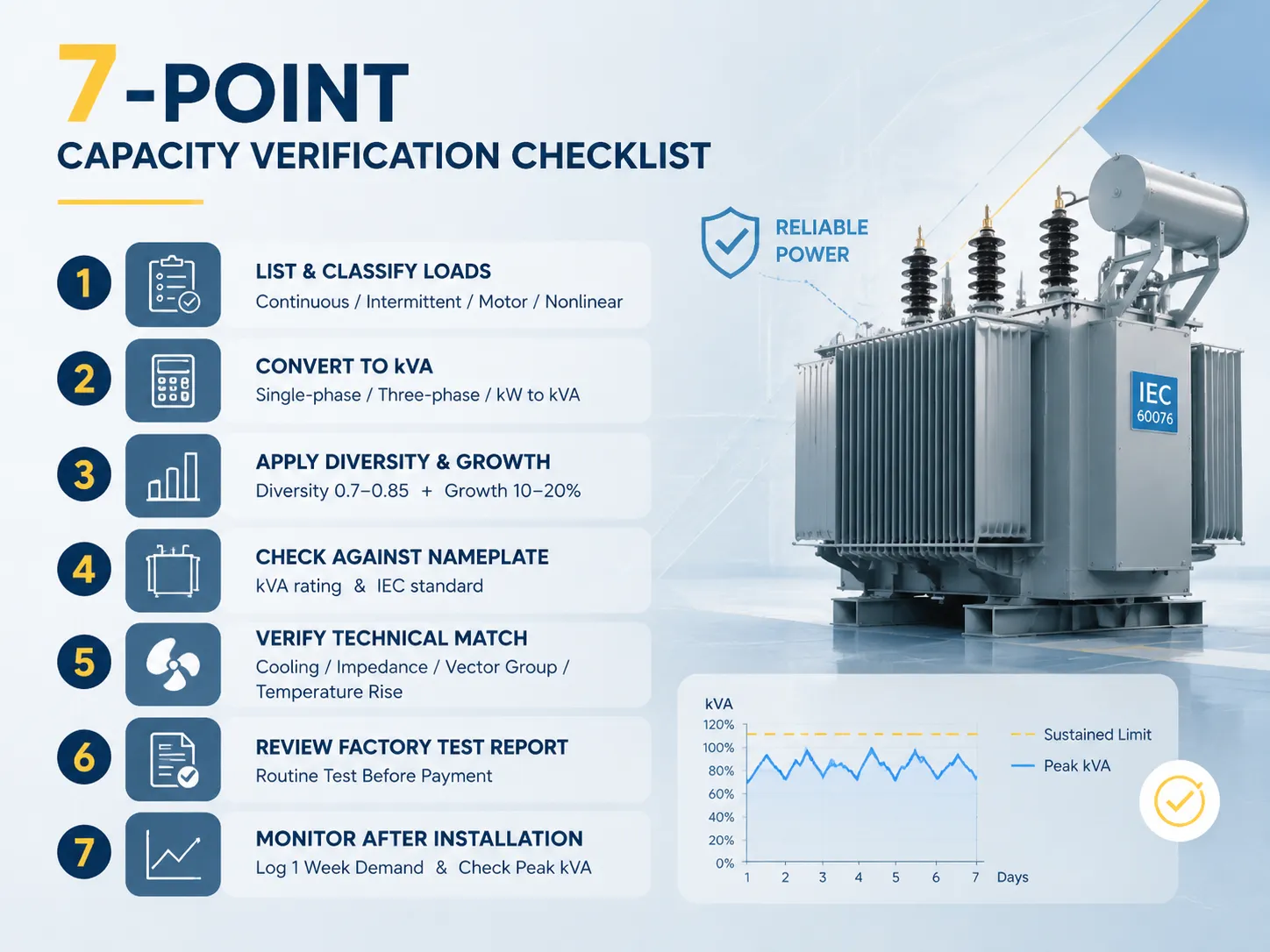
Una lista de verificación de verificación de capacidad de 7 puntos
- Debe compilar una lista completa de todas las cargas y agruparlas como continuas, intermitentes, de motor o no lineales.
- Necesita convertir cada carga en kVA basado en la fórmula de conversión de fase única, trifásica o de kW a kVA.
- Debe aprovechar un factor de diversidad (que generalmente se encuentra en el rango de 0.7 a 0.85 para plantas industriales) y un factor de crecimiento de aproximadamente 10 a 20 por ciento.
- Una vez que haya obtenido estas cifras, puede verificarlas con respecto a los kVA de la placa de identificación y asegurarse de que se encuentren dentro del rango de valores estándar de IEC.
- Asegúrese de confirmar que la clase de enfriamiento, la impedancia, el grupo vectorial y el aumento de temperatura cumplan con los estándares del sistema.
- Para confirmar que todo está bien, debe solicitar y leer los informes de pruebas de rutina de la fábrica antes de realizar cualquier pago.
- Después de haber instalado el sistema, monitoree su demanda durante una semana y establezca que el kVA máximo no exceda el nivel prescrito.
Preguntas Frecuentes
¿Cómo sé si mi transformador está sobrecargado?
Compare la demanda promedio de los últimos 15 minutos con la capacidad nominal del transformador. Si el promedio excede 80% de la capacidad para transformadores de tipo aceite o 90% para tipos secos de manera constante, esto significa que el dispositivo está, de hecho, sobrecargado. Entre los signos de sobrecarga que se pueden observar están la temperatura del aceite por encima de 90°C (se puede usar papel de clase A), lecturas de puntos calientes que superan los 105°C, ruido en el tanque y análisis de composición de gases como hidrógeno y etileno. Se podría hacer frente al problema en caso de reequilibrar la carga, enfriarla o reemplazar el transformador por el siguiente estándar superior al actual.
¿Cuál es la diferencia entre kW y kVA en la capacidad del transformador?
kW representa la potencia real, mientras que kVA representa la potencia aparente. kW se puede calcular utilizando la fórmula kVA = kW ÷ factor de potencia. Por ejemplo, cuando el factor de potencia es 0.8, la potencia de 100 kW requiere transformadores con capacidad de 125 kVA. La placa del transformador siempre está en kVA porque toda la capacidad térmica del transformador depende del devanado. Si el factor de potencia es menor que uno, el transformador podría no cumplir con los requisitos cuando se calcula solo con la ayuda de kW.
¿Qué factor de carga debo usar al dimensionar un transformador?
Utilice el verdadero factor de diversidad de las cargas en la instalación: 0.6–0.75 (para edificios de oficinas), 0.7–0.85 (para sitios industriales), 0.9–1.0 (para hospitales o centros de datos). No confunda estos factores: el factor de diversidad y el factor de carga (promedio ÷ demanda máxima). Si está tratando con una nueva instalación, utilice un factor de amenaza de 0.75 con un margen de crecimiento de 15–20%. En caso de que esté trabajando con una instalación existente y tenga todas las facturas de servicios públicos de los últimos 12 meses, solo necesita calcular su factor de carga.
¿Puede un transformador funcionar por encima de su kVA nominal temporalmente?
Sí, puede, se permite hacerlo solo bajo circunstancias estrictas. Según la IEC 60076-7, el transformador sumergido en aceite con sistema de refrigeración ONAN puede manejar hasta 1.3 de su carga eléctrica nominal siempre que no exceda 70% y la temperatura de calentamiento se mantenga por debajo de 120°C. Cada hora de uso de sobrecarga acortaría significativamente la vida útil del aislamiento; por ejemplo, el aislamiento a una temperatura de 110°C funcionaría solo durante unos pocos años en lugar de varias décadas si se utiliza correctamente.
¿Cuánto cuesta un margen adicional de 10% de capacidad?
Si el transformador tiene una capacidad de 500 kVA, obtener el nuevo transformador con una capacidad de 630 kVA le costaría 15–25% más (lo que significa alrededor de $2,000–4,000). Si considera reemplazar el transformador después de que haya fallado, debe estar preparado para pagar por el nuevo dispositivo $8,000–18,000 y esperar hasta 1–4 semanas para recibirlo. Si puede evitar apagar la carga solo una vez durante 20 años, su inversión en un margen de 10–20% ya habría valido la pena.
Referencias
- IEC 60076-1: Transformadores de Potencia — General — la norma internacional que define las clasificaciones de transformadores, capacidad y requisitos de prueba.
- IEC 60076-7: Transformadores de Potencia — Guía de Carga para Transformadores Inmersos en Aceite — la guía autorizada para sobrecargas cíclicas y límites de temperatura.
- IEEE C57.12.00: Requisitos Generales para Transformadores de Distribución, Potencia y Regulación Inmersos en Líquido — el marco de capacidad y pruebas equivalente en América del Norte.
- Electrical4U — Factor de Carga y Eficiencia de Transformadores — una explicación clara del factor de carga, diversidad y curvas de eficiencia.
- Eaton — Guía de Dimensionamiento de Transformadores — tablas de cálculo práctico de kVA y ejemplos de dimensionamiento utilizados en la industria.
- Fluke — Imágenes Térmicas de Transformadores — orientación de campo sobre verificación infrarroja de carga y conexiones.
- Wikipedia — Transformador — antecedentes sobre la teoría de transformadores, clasificaciones y clasificaciones de refrigeración.
Conclusión
Saber si la capacidad de su transformador es suficiente no es una cuestión de suposiciones especulativas sobre la demanda. El proceso implica cuatro pasos sencillos: determinar la demanda máxima, calcular la demanda en kVA, determinar el factor de carga y verificar los datos de la placa de identificación respaldados por los resultados de pruebas proporcionados por la fábrica. Seguir la regla de permitir un aumento de 10–20% y mantener el factor de carga por debajo de 80% para transformadores llenos de aceite es bastante económico hoy en día y puede prevenir fallas costosas en el futuro.
- Realice los cálculos en kVA y utilice un factor de diversidad entre 0.7 y 0.85 para cargas industriales mixtas.
- Verifique la capacidad con el informe IEC 60076 — esa es la única prueba, no el catálogo.
- Proporcione un margen de 10-20% para necesidades futuras — esa es la forma más económica de seguro en la etapa de adquisición.
- Elija al proveedor en función de la capacidad probada y el nivel de transparencia, en lugar del precio por kVA.