


Un ingeniero de servicios públicos ubicado en el norte de Canadá está diseñando una especificación para un transformador de 25 MVA que operará en una subestación con niveles de temperatura que bajan de -40°C durante el mes de enero. Los transformadores tienen grandes dispositivos de enfriamiento, su tanque está especialmente construido para soportar las fuertes cargas de viento y nieve, por lo que lo único que preocupa al ingeniero es el tipo de aceite utilizado para el tanque. La persona sabe lo que significa seleccionar el incorrecto aceite de transformador para operar en clima frío. El aceite se espesará cuando las temperaturas bajen, la bomba comenzará a cavitar y el aceite dejará de fluir a través de los dispositivos de enfriamiento, por lo que los devanados se calentarán incluso si la temperatura exterior es de -30°C. El transformador que ha pasado sus pruebas con éxito funcionará como un generador de alarma en la primera temporada de invierno.
Este artículo discute todo lo que debe saber un comprador o ingeniero de especificaciones sobre la selección de aceite de transformador en transformadores llenos de aceite para áreas de clima frío, incluyendo las principales características, normas, ventajas y desventajas del uso de aceites parafínicos y nafténicos, diferencias de precios y el algoritmo de selección de aceite.
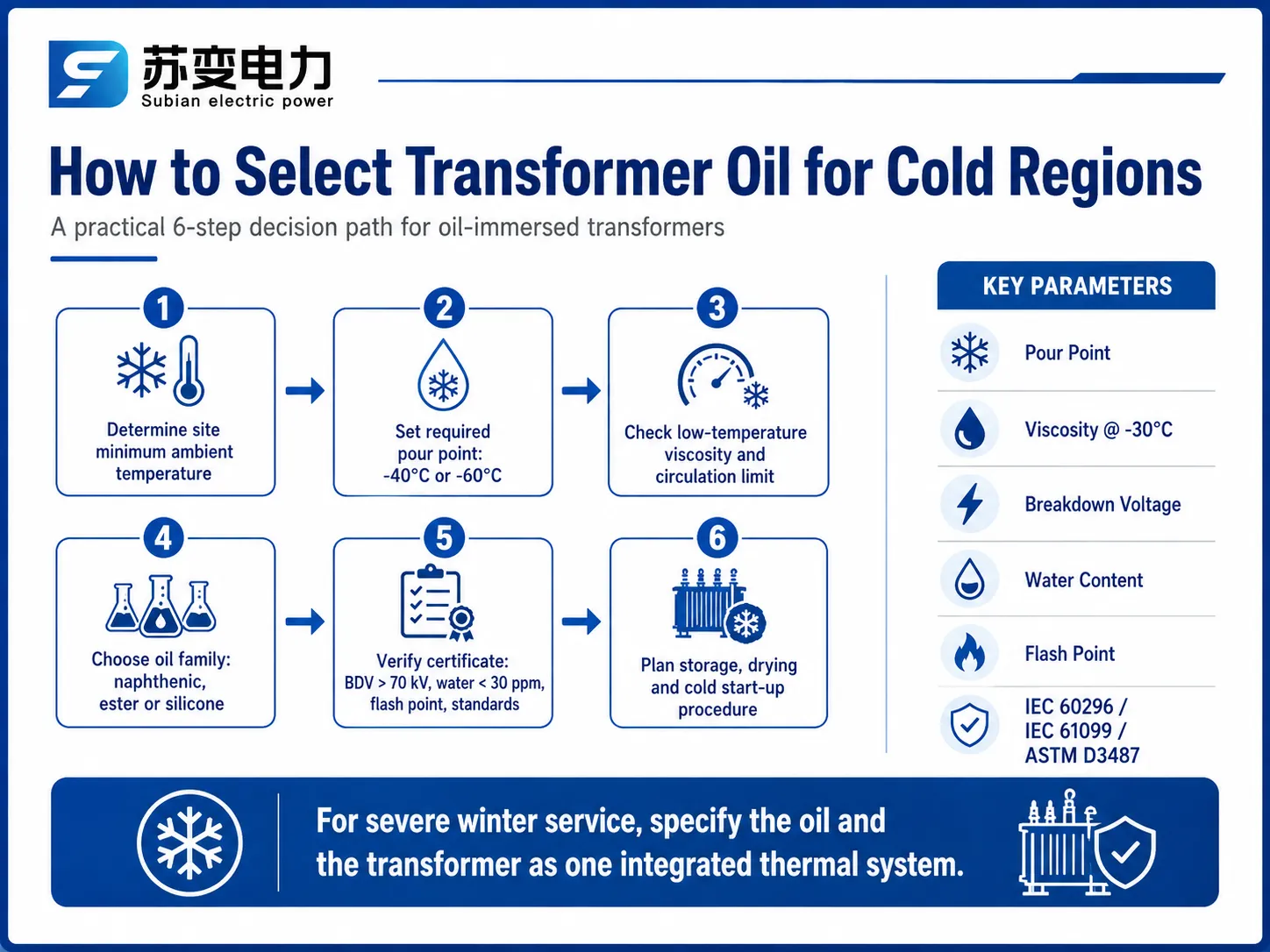
Por qué el aceite para transformadores se vuelve problemático
El aceite de transformador tiene dos propósitos principales: enfría los devanados del transformador mediante la eliminación de calor hacia las paredes del tanque y aísla los devanados del estrés eléctrico. Aunque ambas funciones dependen de la capacidad del aceite para fluir, en climas fríos la viscosidad del aceite aumentará y la circulación se ralentizará, lo que resulta en el calentamiento de los devanados del transformador mientras la temperatura exterior es baja. Durante temperaturas muy bajas, el aceite mineral puede alcanzar su punto de fluidez, la temperatura a la que el aceite deja de fluir completamente, lo que significa que el enfriamiento se detiene.
Hay un desafío más relacionado con el aceite en invierno: la condensación de humedad. El aceite en un transformador con conservador se mueve durante su operación, y cuando el aire que es más cálido y húmedo entra a través del tanque frío, el agua se enfriará y se unirá al aceite. El agua en el aceite de transformador destruye las propiedades dieléctricas del aceite; varios cientos de partes de agua disminuirán la tensión de ruptura del aceite de 60 kV a menos de 30 kV, por lo que los desafíos de la selección de aceite de transformador para clima frío consisten en entender tanto la fluidez como la gestión de la humedad.
La última característica peculiar de la operación en invierno es el arranque. El aceite que se utiliza en el transformador debe ser energizado a la temperatura de congelación del aceite sin calentarlo primero, porque inmediatamente después de energizar, el aceite debe circular y crear las condiciones de temperatura necesarias en cada parte del transformador.
Propiedades clave a baja temperatura
| Propiedad | Lo que mide | Objetivo para regiones frías | Grado estándar (templado) |
|---|---|---|---|
| Punto de fluidez | La temperatura más baja a la que fluye el aceite | -40°C a -60°C | -30°C |
| Viscosidad cinemática @ 40°C | Fluidez base a temperatura de operación | 8-12 mm²/s | 9-12 mm²/s |
| Viscosidad cinemática @ -30°C | Fluidez en frío; el número clave de baja temperatura | Por debajo de 1,500 mm²/s (límite típico) | No especificado |
| Punto de inflamación | Seguridad contra incendios; más alto es mejor | > 135°C (mineral), > 250°C (éster) | > 135°C |
| Tensión de ruptura (BDV) | Resistencia dieléctrica después del acondicionamiento | > 70 kV (nuevo, IEC 60156) | > 70 kV |
| Contenido de agua | Nivel de humedad; debe ser mínimo | < 30 ppm (aceite nuevo) | < 30 ppm |
Cuando se trata de zonas de clima frío, el punto de fluidez y la viscosidad a baja temperatura juegan un papel importante. Un valor de -30 grados Celsius es apropiado para climas con temperaturas de -10 grados Celsius; sin embargo, es completamente ineficaz a temperaturas de -40 grados Celsius. El aceite en cuestión debe permanecer por encima de su punto de fluidez, incluso a la temperatura mínima registrada.
Tipos de aceite para regiones frías
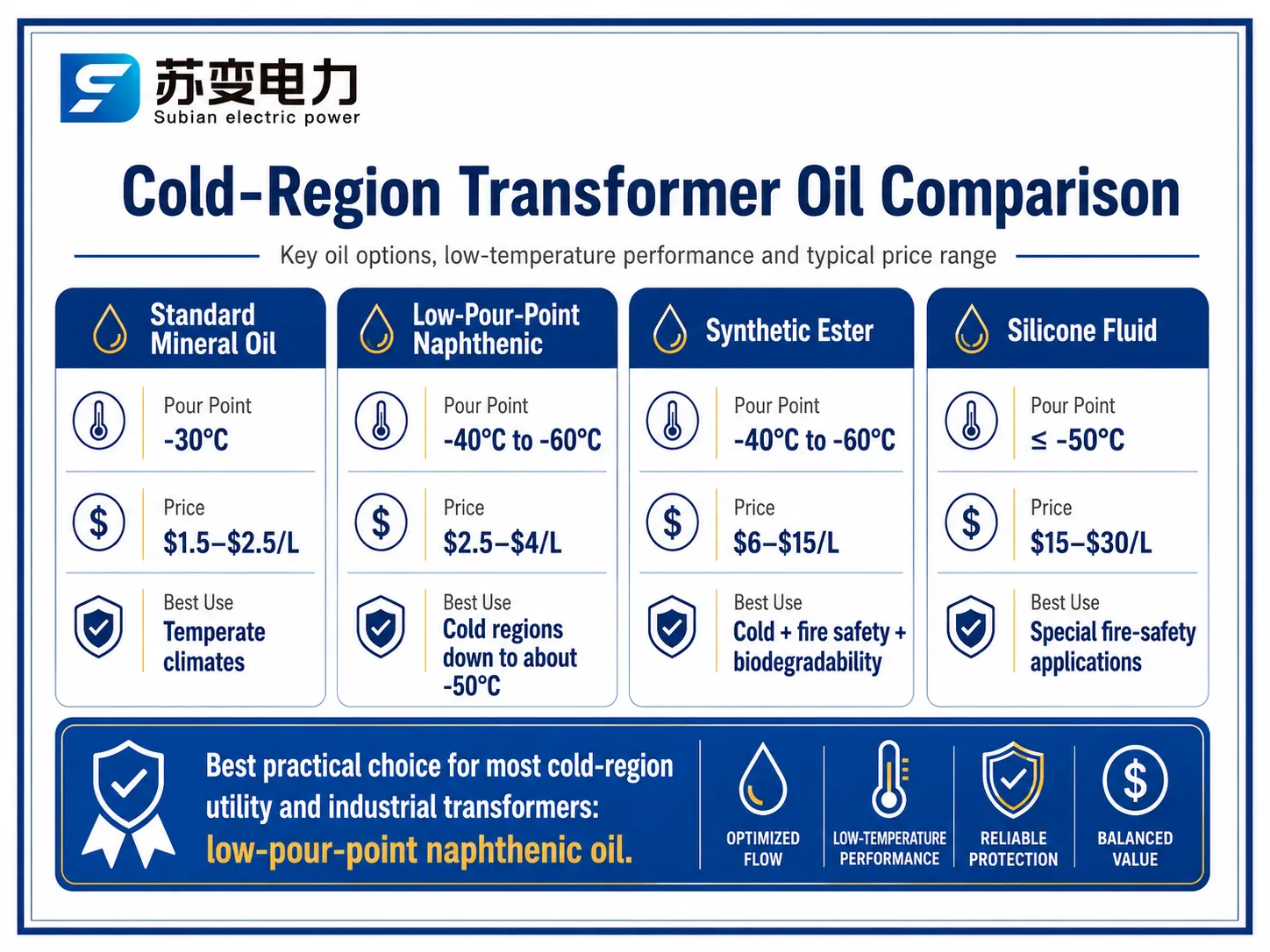
| Tipo de aceite | Punto de fluidez | Punto de inflamación | Precio por litro | Mejor uso |
|---|---|---|---|---|
| Aceite mineral estándar (IEC 60296) | -30°C | > 135°C | $1.5-$2.5 | Climas templados |
| Aceite mineral nafténico de bajo punto de fluidez | -40°C a -60°C | > 135°C | $2.5-$4 | Regiones frías hasta -50°C |
| Hidrocarburo de alto peso molecular | Varía | > 250°C | $4-$8 | Sitios propensos a incendios y fríos |
| Éster sintético (IEC 61099) | -40°C a -60°C | > 250°C | $6-$15 | Frío + seguridad contra incendios + biodegradabilidad |
| Fluido de silicona | -50°C o inferior | > 300°C | $15-$30 | Aplicaciones especiales de seguridad contra incendios |
En la mayoría de los procesos industriales y de servicios públicos en regiones frías, los aceites minerales nafténicos con bajo punto de fluidez representan el caballo de batalla. Proporcionan la fluidez necesaria a aproximadamente la mitad del precio de los ésteres sintéticos. Los ésteres sintéticos se utilizan cuando es necesario en respuesta a los códigos de incendios y la legislación ambiental que rige el rendimiento en frío y proporciona un punto de inflamación superior a 300°C. El fluido de silicona representa la opción que ofrece un alto rendimiento a un costo muy alto.
Aceite nafténico vs. Aceite parafínico
| Característica | Aceite nafténico | Aceite parafínico |
|---|---|---|
| Contenido de cera | Muy bajo | Más alto; forma cristales de cera en frío |
| Punto de fluidez | Naturalmente bajo (alcanzable de -40°C a -60°C) | Más alto; necesita desparafinado pesado |
| Fluidez a baja temperatura | Excelente | Se degrada bruscamente cerca del punto de fluidez |
| Estabilidad a la oxidación | Buena | Buena (base ligeramente mejor) |
| Comportamiento de absorción de gas | Mejor absorción de gas | Generalmente bien, pero la cera es el problema |
| Disponibilidad en grados fríos | Estándar para especificaciones de regiones frías | Rara vez utilizado para regiones frías |
Hay un acuerdo prominente entre los ingenieros respecto al uso de aceites nafténicos en zonas frías. El hecho de que los aceites parafínicos contengan cera causa un problema importante en invierno, ya que la cera se solidifica cuando hace frío, lo que lleva a un aumento de la viscosidad y a la posterior incapacidad del aceite para fluir, que es precisamente el problema que hace que la refrigeración de transformadores sea ineficaz en invierno. La baja temperatura de vertido del aceite nafténico y su buena capacidad para trabajar en condiciones frías lo hacen formalmente aceptado para cada especificación seria en regiones frías, con muchos fabricantes de transformadores especificando realmente el grado nafténico preferido en el dibujo del sistema de aceite.
Parámetros y límites de especificación
es esencial incluir los siguientes valores:
Normas: IEC 60296 para aceites minerales; IEC 61099 para ésteres sintéticos; ASTM D3487 para América del Norte.
Punto de fluidez: Mínimo -40°C para temperaturas alrededor de -30°C; mínimo -60°C para temperaturas por debajo de -35°C.
Viscosidad cinemática a 40°C: 8 a 12 mm²/s y verificar la viscosidad a -30 °C para asegurar que esté por debajo del límite máximo de circulación establecido por los fabricantes; este límite suele ser alrededor de 1,500 mm²/s.
Punto de inflamación: Superior a 135 °C para aceites minerales; consulte el valor exacto indicado en el certificado.
Resistencia a la ruptura dieléctrica: Superior a 70 kV para aceite nuevo según las normas IEC 60156.
Contenido de agua: 30 ppm máx; la descarga de aceite debe cumplir con este requisito.
Resistencia dieléctrica y concentración de ácido: Cumplir con las propiedades establecidas en IEC 60296 para aceites nuevos.
No olvide mencionar el punto de fluidez en los contratos. “Aceite de región fría” no es lo suficientemente claro. El aceite de región fría a veces se denomina aceite de baja temperatura, y podría terminar comprando aceite de grado estándar de -30°C sin que el contrato mencione el punto de fluidez.
La siguiente matriz puede ayudarle a decidir sobre la temperatura mínima para el sitio específico:
| Sitio Mínimo Extremo | Punto de Fluidez Requerido | Familia de Aceite | Precio aproximado por litro | Notas |
|---|---|---|---|---|
| Superior a -20°C | -30°C | Mineral estándar (IEC 60296) | $1.5-$2.5 | El grado estándar es suficiente |
| -20°C a -35°C | -40°C | Neflínico de bajo punto de vertido | $2.5-$3.5 | Especificación más común para regiones frías |
| -35°C a -50°C | -50°C a -60°C | Neflínico o éster sintético | $3.5-$15 | Verificar la viscosidad a baja temperatura |
| Por debajo de -50°C | -60°C o inferior | Éster sintético o silicona | $8-$30 | Confirmar las calificaciones de la bomba y la junta |
El Proceso de Selección
Determinar la temperatura más baja en el sitio. Tener en cuenta la temperatura extrema más baja en lugar de la temperatura media invernal, también añadir un margen de seguridad de 10 o 15 K.
Determinar el punto de vertido requerido. En caso de una temperatura en el sitio de -40°C, especificar aceite con punto de vertido de -55°C o -60°C para que el aceite permanezca líquido.
Verificar la viscosidad a baja temperatura. Consultar al fabricante del transformador sobre la viscosidad del aceite en caso de -30°C, ya que esta es la información que garantizará la efectividad del sistema de refrigeración.
Elegir el tipo de aceite. Si la economía es el objetivo, usar aceite mineral neflínico; éster sintético en caso de regulaciones contra incendios y medioambientales; y silicona solo por obligación.
Verificar la compatibilidad del transformador. Asegurarse de que las juntas, bombas y respiraderos sean compatibles con el aceite y soporten la temperatura extrema; para el sitio de -40°C, puede ser necesario elegir juntas especiales diseñadas para tales bajas temperaturas.
Asegurarse de obtener el certificado. Debe cubrir el punto de vertido, viscosidad, BDV, contenido de agua y punto de inflamación según sus requisitos.
Aplicación por Región y Clima
- Norte de China, Mongolia, áreas en el norte de EE. UU. (-30°C a -40°C): aceite neflínico de bajo punto de vertido con punto de vertido de -40°C.
Canadá, Siberia, Escandinavia del norte (por debajo de -40°C): aceites con puntos de vertido de -55°C a -60°C utilizados, a menudo ésteres sintéticos para los sitios más fríos.
Ubicaciones de gran altitud (Andes, Tíbet, Alpes): combinación de ambiente frío y menos refrigeración a altitudes, requiriendo reducción de potencia y uso de aceite de clase fría.
Condiciones marinas frías y en alta mar: uso de aceites neflínicos y ésteres con control estricto de humedad.Las altitudes añaden dificultades por frío: a 3,000 metros, la densidad del aire es aproximadamente un 30 por ciento más baja, lo que hace que sea menos eficiente enfriar transformadores de forma natural, que deben ser reducidos o asignados a una etapa de refrigeración más alta antes de que se empiece a abordar la temperatura.
Comparación de marcas y precios
| Marca | Origen | Ofertas para Regiones Frías | Precio aproximado por litro |
|---|---|---|---|
| Shell | Países Bajos/Reino Unido | Diala S4 ZX-I, Diala AX (neflínico de bajo punto de vertido) | $2-$4 |
| ExxonMobil | EE. UU. | Mobil 3910-60 (parafínico, punto de vertido -60°C), Unvolt | $2.5-$4.5 |
| Nynas | Suecia | Nytro Libra, Nytex 620 (especialistas en neflínicos) | $2-$4 |
| Ergon | EE. UU. | Hyvolt III, aceites neflínicos de grado frío | $2-$3.5 |
| MIDEL (M&I Materials) | Reino Unido | MIDEL 7131 éster sintético (punto de vertido -56°C) | $8-$15 |
| Jiangsu Subian Electric Power (con aceite de marca) | China | Transformadores suministrados llenos con aceite de grado frío especificado | Aceite agrupado; unidades con precios competitivos |
La industria del petróleo está dominada por empresas globales especializadas en lubricantes y ésteres, incluyendo Shell, ExxonMobil, Nynas, Ergon y MIDEL, cuyos productos fríos se han utilizado en todo el mundo. En el caso del transformador, el tipo de aceite suele especificarse en el contrato, y empresas como Jiangsu Subian Electric Power proporcionan el transformador con el aceite frío especificado según el contrato e indican el llenado de aceite en el certificado. De hecho, esto es crítico para lugares fríos porque el aceite no es un artículo consumible y no puede ser reemplazado; es parte del diseño térmico del transformador. Los transformadores de regiones frías de Subian se suministran con el certificado que indica el punto de congelación y la viscosidad del aceite, y los precios del transformador lleno suelen ser 40-60% menos que los precios cotizados para unidades similares producidas por fabricantes europeos.
Cómo Elegir el Aceite Adecuado
Aplique la temperatura mínima de suposición del peor caso del sitio más la tolerancia para elegir el requisito del punto de congelación.
Seleccione aceites nafténicos para entornos fríos y evite productos parafínicos a menos que hayan sido desparafinizados para cumplir con el parámetro del punto de congelación.
Indique el límite de viscosidad a bajas temperaturas para asegurar que el sistema de enfriamiento esté operativo.
Encuentre la familia de aceites que cumpla con los códigos de fuego y medio ambiente, no solo con el termómetro.
Verifique si los materiales de la junta y la bomba son apropiados para las condiciones extremas de temperatura.
Exija el certificado que muestre el punto de congelación, viscosidad, BDV, contenido de agua y punto de inflamación.
Manejo, Almacenamiento y Arranque en Frío
El manejo de aceite en regiones frías tiene una disciplina particular propia. Los tambores, tanques y tuberías de transferencia de calor deben estar ubicados por encima del punto de congelación del aceite para que el aceite permanezca bombeable; muchos sitios recurren al almacenamiento y líneas de transferencia calentadas. Antes de llenar, el aceite debe ser desgasificado al vacío y secado a menos de 30 ppm de contenido de agua debido a que el aire frío contiene muy poca humedad mientras que el aceite caliente que proviene del almacenamiento la condensaría. Por lo general, se instalarían filtros de 1-5 micrones y un secador al vacío mientras se llenan transformadores con aceite en regiones frías.
Al iniciar el equipo en condiciones frías, es muy importante seguir la secuencia: encender el transformador y dejar que el aceite circule durante 10-30 minutos antes de aplicar una carga significativa para evitar la formación de puntos calientes en el aceite frío estancado. Algunos operadores mantienen las bombas en funcionamiento durante las noches más frías en lugar de configurar el sistema de control en la temperatura del aceite que se bombea. Las reglas de operación deben incluirse en el manual de mantenimiento del sitio, no solo en sus especificaciones.
Preguntas Frecuentes
¿Qué aceite de transformador es apropiado para ubicaciones frías?
Para su uso en aplicaciones en regiones frías, utilizar aceite mineral nafténico de bajo punto de fluidez aprobado por IEC 60296 es la mejor opción: el aceite permanece líquido a temperaturas de -40°C a -60°C y cuesta aproximadamente $2.5-$4 por litro. Los ésteres sintéticos, con un precio de aproximadamente $8-$15 por litro, ofrecen tanto una mejor seguridad contra incendios como biodegradabilidad, pero con los mismos niveles de rendimiento en el frío. El aceite estándar, con un punto de fluidez de -30°C, no es suficiente para sitios que experimentan temperaturas por debajo de aproximadamente -25°C.
¿Qué se entiende por punto de fluidez del aceite de transformador?
El punto de fluidez se define como la temperatura a la cual el aceite sigue fluyendo. A esta temperatura, la circulación se detiene y, en consecuencia, el transformador no se enfría, lo que resulta en un sobrecalentamiento del devanado independientemente del clima frío. El aceite estándar del transformador tiene un punto de fluidez de -30°C; el aceite para regiones frías está clasificado en -40°C, -45°C o -60°C dependiendo del sitio.
¿Es mejor el aceite de transformador nafténico o parafínico para el invierno?
Definitivamente nafténico. Los aceites parafínicos contienen parafina que se cristaliza a temperaturas frías, aumentando la viscosidad hasta el punto de impedir que el aceite fluya, lo que significa que el transformador no puede enfriarse a estas temperaturas. El aceite nafténico tiene un bajo punto de fluidez de forma natural y fluye bien en el frío, razón por la cual las especificaciones del aceite para regiones frías casi siempre requieren aceite de grado nafténico.
¿Cuánto cuesta el aceite de transformador para regiones frías?
El aceite mineral estándar tiene un precio de $1.5-$2.5 por litro, el aceite nafténico de bajo punto de fluidez cuesta $2.5-$4 por litro, los ésteres sintéticos cuestan $6-$15 por litro, y el aceite de silicona cuesta $15-$30 por litro. La diferencia de precio del aceite es de alrededor de $10,000–$20,000 para un transformador de 10,000 litros, lo cual no es grande en comparación con el costo de fallas invernales.
¿Puedo usar aceite de transformador estándar si solo derroto el transformador?
La reducción de potencia ayuda con el calor, no con la fluidez en frío. Si el punto de fluidez del aceite está por encima del mínimo del sitio, el aceite dejará de fluir independientemente de cuánta carga lleve el transformador. La especificación debe estar determinada por la temperatura del sitio, y el transformador y el aceite seleccionados como un solo sistema térmico. El aceite de grado frío no es opcional para sitios realmente fríos.
Referencias
- IEC 60296 — Fluidos para Aplicaciones Electrotécnicas, Aceites Aislantes Minerales No Utilizados — El estándar maestro para grados de aceite mineral de transformador y puntos de fluidez.
- IEC 61099 — Ésteres Orgánicos Sintéticos para Propósitos Eléctricos — La norma para aceites aislantes de éster sintético.
- ASTM D3487 — Especificación Estándar para Aceite Mineral Aislante Usado en Aparatos Eléctricos — Especificación de aceite mineral de América del Norte.
- IEC 60156 — Líquidos Aislantes, Determinación de la Tensión de Ruptura — El método de prueba dieléctrica para BDV.
- IEEE C57.106 — Guía para la Aceptación y Mantenimiento de Aceite Mineral Aislante — Criterios de aceptación del aceite y límites de humedad.
- Nynas — Soluciones de Aceite para Transformadores — Grados de aceite nafténico especializados y orientación sobre aplicaciones.
- M&I Materials — Fluidos de Éster MIDEL — Productos de éster sintético con datos publicados de baja temperatura.
Conclusión
Esto significa que, aunque comprar aceite para transformadores para condiciones frías no se trata solo del lubricante en sí, tiene que ver con el diseño térmico. El punto de congelación, la viscosidad a baja temperatura y el contenido de agua determinan si el sistema de enfriamiento funcionará durante la noche más fría, mientras que el tipo de aceite define el riesgo de incendio y ambiental. Con la información correcta en papel, el transformador servirá durante años; de lo contrario, se pagará caro en invierno.
- Especificar el punto de congelación desde el mínimo extremo del sitio más un margen, no desde un valor predeterminado del catálogo.
- Elegir aceite nafténico para regiones frías; usar ésteres solo donde el fuego o el medio ambiente lo exijan.
- Verificar la viscosidad a baja temperatura contra el límite de circulación del fabricante.
- Comprar el aceite y el transformador como un solo sistema, y poner el certificado en el contrato.
Para transformadores sumergidos en aceite llenos con el aceite de grado frío correcto y certificados según IEC 60296, contactar Jiangsu Subian Electric Power en www.subian-electric.com — especificar la temperatura mínima de su sitio y el requisito del punto de congelación, y ellos cotizarán la unidad llena con el certificado incluido.