


Les transformateurs industriels sont les équipements qui déterminent si une usine fonctionnera ou non. Ils sont également le dernier équipement auquel on pense jusqu'à ce qu'il tombe en panne. Les transformateurs industriels reçoivent la tension de la compagnie d'électricité et la convertissent en la tension requise par les composants de la machinerie. De plus, les transformateurs déterminent le courant de défaut, le schéma de protection, et une grande partie du coût de l'électricité pour les trente prochaines années.
En bref, un transformateur industriel réduit et augmente les tensions entre l'alimentation et le système de distribution d'une usine. Les transformateurs de tension industriels sont généralement classés à 11 kV ou 33 kV vers 400 V, 480 V ou 690 V. Les principaux types de transformateurs sont les transformateurs immergés dans l'huile, les types secs en résine moulée, et les postes de transformation unitaires. Une unité unique d'un transformateur sec de 1 000 kVA coûtera environ 18 000 à 45 000 à prix départ usine, tandis qu'une unité immergée dans l'huile avec la même puissance nominale sera environ 25 % à 40 % moins chère à l'achat mais coûtera plus cher à installer.
Il y aura certains principes et réglementations que vous ne pourrez pas modifier par la suite. Les plus importants sont le rapport de tension, l'impédance, le groupe vectoriel, et l'élévation de température. La dernière section concerne la place d'un fournisseur d'usine et d'autres cas où les fournisseurs d'usine ne sont pas inclus.
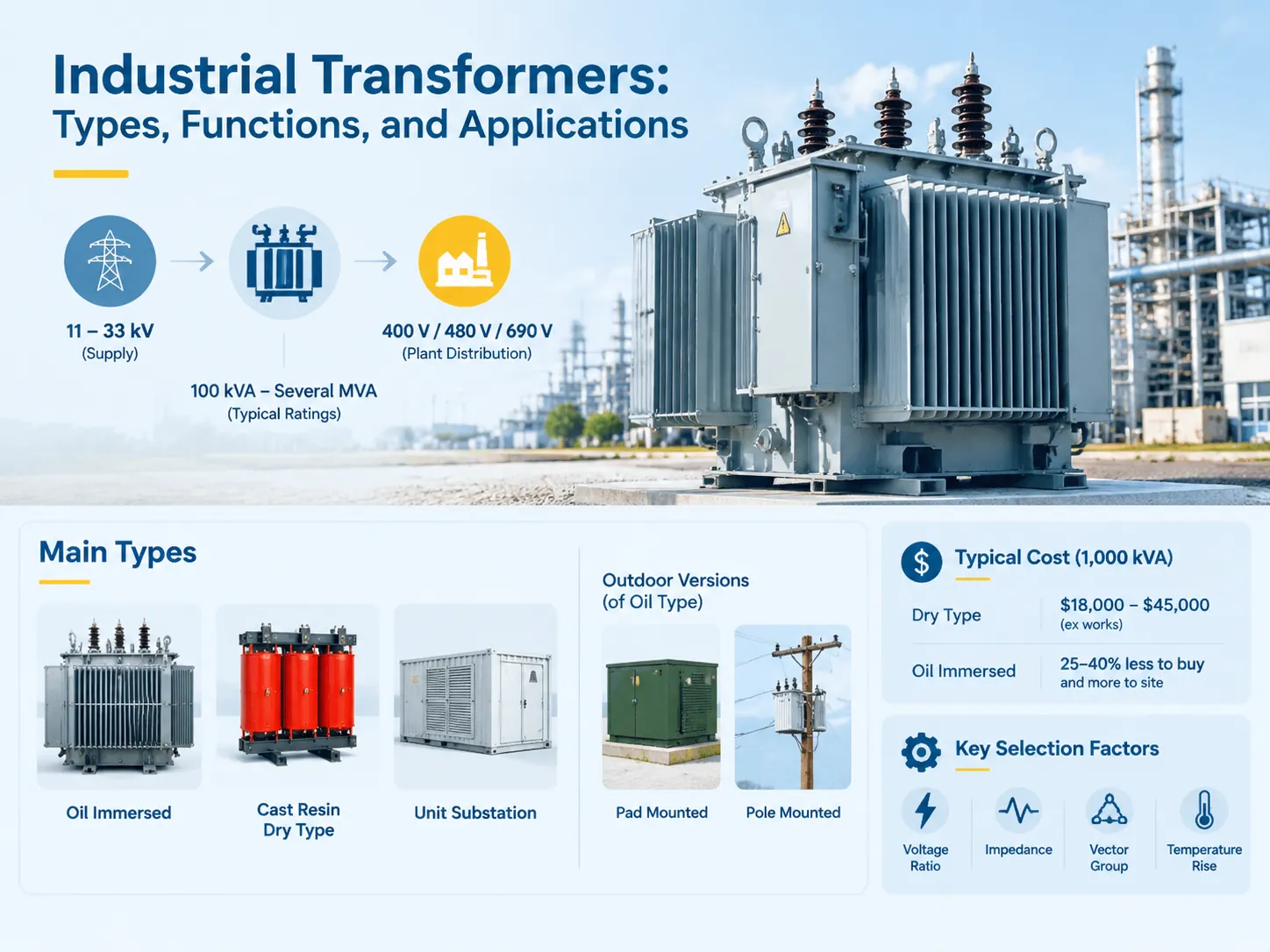
Qu'est-ce qu'un transformateur industriel ?
C'est l'un des dispositifs statiques qui fonctionnent sans pièces mobiles. Cet appareil transfère l'énergie électrique d'un circuit à un autre en utilisant des champs magnétiques. Dans l'usage industriel, le terme transformateur industriel désigne les transformateurs utilisés dans les usines, les centrales électriques et les industries. Il diffère donc du transformateur de transmission ou du transformateur de distribution sur un poteau.
La capacité de charge commence à partir de 100 kVA pour un centre de machines unique jusqu'à 20 MVA ou plus pour un transformateur de poste industriel. La tension côté primaire dépend de l'alimentation fournie par le réseau ou de l'alimentation interne en anneau. Normalement, elle est d'environ 11, 13,8, 20, 22, 33 ou 34,5 kV. Côté secondaire, la tension sera égale à la tension du réseau, qui est généralement de 400 V dans la plupart des pays, 480 V aux États-Unis et 690 V pour les systèmes de moteurs lourds.
Le transformateur industriel se distingue des transformateurs commerciaux selon trois facteurs. Tout d'abord, il a été conçu pour un fonctionnement continu sous charge similaire. Ensuite, il inclut des charges harmoniques qui créent certaines exigences pour la conception de ses enroulements et de son neutre. Enfin, le transformateur industriel doit avoir un facteur K requis pour assurer sa plateforme contre les violations harmoniques.
Comment fonctionne le transformateur : 3 fonctions clés d'un transformateur
Lorsque le circuit de la bobine primaire reçoit un courant alternatif, la bobine primaire crée un champ magnétique fluctuant à l'intérieur du noyau, et en raison de ce champ magnétique, une tension est induite sur la bobine secondaire. La bobine primaire et la bobine secondaire ont un certain nombre de spires, ce qui crée un rapport de tension spécifique dans le transformateur. C'est pourquoi il est vrai qu'un transformateur ayant 1000 spires primaires et 100 spires secondaires réduirait les 11 k volts à 1,1 k volts.
Il convertit la tension et le courant en proportion inverse. La puissance ne peut jamais être générée par un transformateur. Lorsqu'on parle d'un transformateur de puissance, avec une puissance nominale de 1000 kVA et une entrée de 11 k volts, il peut tirer environ 52 ampères du côté primaire et fournir des centaines d'ampères à 400 volts.
Il assure l'isolation entre les circuits. Il n'y a aucun moyen d'établir une connexion électrique entre les circuits. Seul un champ existe entre eux. C'est pourquoi l'installation électrique peut mettre à la terre le neutre secondaire indépendamment et de la même manière, il peut être utilisé avec un transformateur d'isolement afin de supprimer les bruits haute fréquence.
Il établit également la relation de phase. La manière de connecter les enroulements (type triangle ou étoile) établit un décalage de phase entre la tension d'entrée et la tension de sortie.
La chaleur produite dans le noyau est due à la perte d'énergie causée par l'inversion du flux et aux pertes dans les enroulements lorsque le courant est tiré. Ces pertes sont abordées dans la section traitant de l'efficacité et sont également les principaux contributeurs au coût total de maintenance des transformateurs.
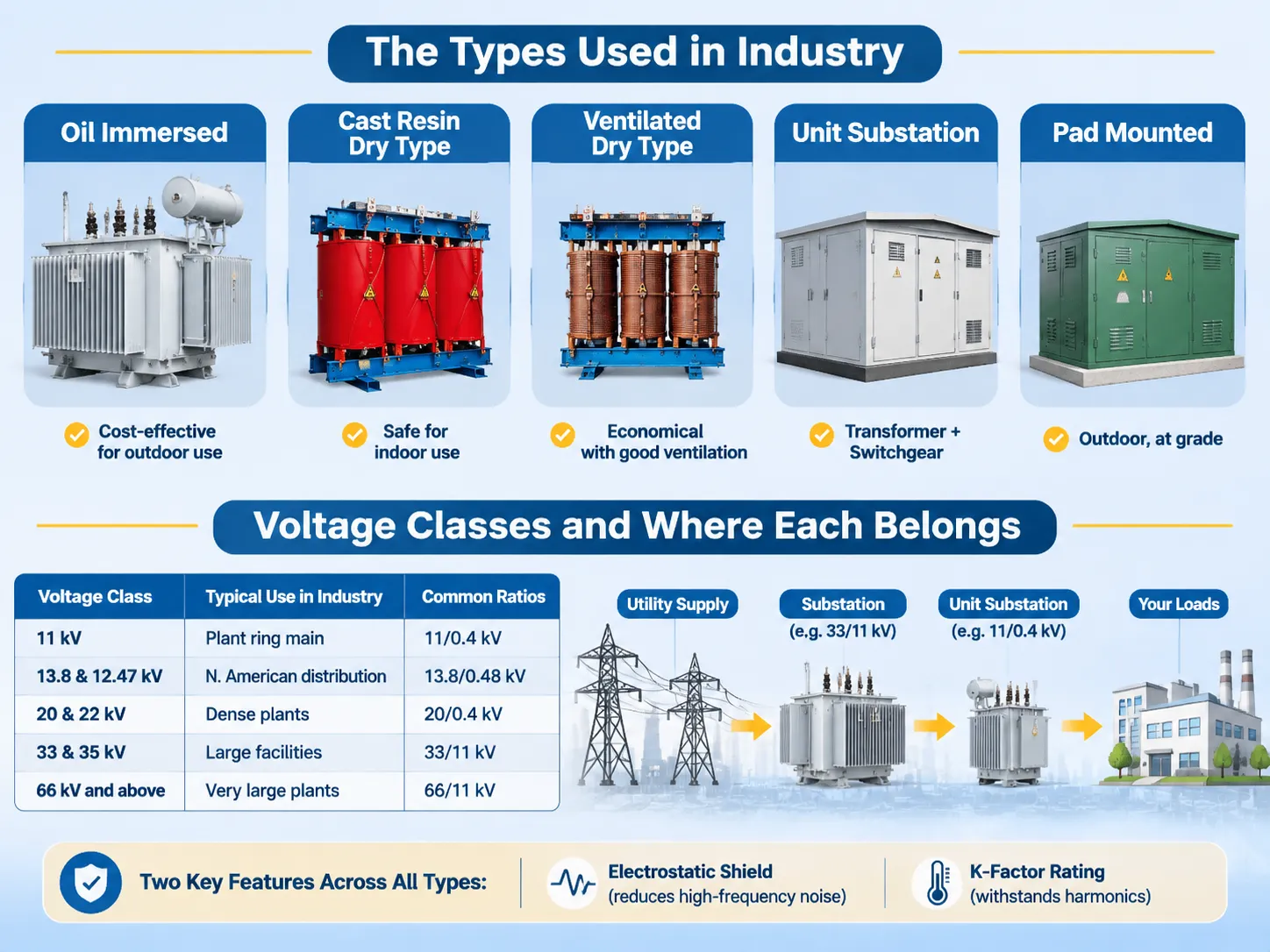
Les types utilisés dans l'industrie
Il existe cinq types de transformateurs utilisés dans l'industrie, qui dépendent des conditions où le transformateur est monté et exploité.
- Transformateurs immergés dans l'huile ont les enroulements placés dans de l'huile minérale, qui circule par convection, éliminant ainsi l'excès de chaleur via un radiateur. Cependant, ce type fonctionne mieux lorsque la puissance requise dépasse 500 kVA en raison du faible coût d'exploitation et de meilleures caractéristiques thermiques. Il faut toutefois garder à l'esprit que ce type de transformateur ne peut pas être placé à l'intérieur d'un bâtiment occupé sans enceinte coupe-feu..
- Transformateurs à résine moulée ont les enroulements encapsulés dans une résine époxy afin qu'il n'y ait pas de liquide contenu et de risque d'incendie. Ce type est utilisé dans les pays tropicaux et subtropicaux. L'inconvénient des transformateurs à résine est leur coût initial plus élevé et leurs limites thermiques faibles. Un exemple de cette série est un transformateur à résine moulée 10 kV avec noyau et capacité d'enroulement fabriqués en usine à l'aide d'outillage et dont l'enceinte est développée au moment de la commande.
- Type sec ventilé. Les enroulements sont ouverts et refroidis par air. Ils sont moins chers que les transformateurs à résine moulée à faible puissance ; ils sont très populaires dans les salles de machines ventilées. Ils sont sensibles à la poussière et à l'humidité ; par conséquent, ils doivent être maintenus propres dans un espace sec, à l'écart de toute zone de lavage.
- Poste de transformation unité. Un transformateur qui est boulonné directement à la section pour recevoir l'alimentation de la ligne moyenne tension et de la section de distribution basse tension dans une seule unité. Cela permet d'économiser du câble et de l'espace et est préférable lorsque toutes les charges sont situées dans une même zone et qu'il n'y a pas de problème de coordination dans l'installation.
- Monté sur socle. Ce type se compose d'un transformateur à huile dans une unité fermée, qui repose au niveau du sol avec des connexions séparables et des fusibles sur le réservoir, qui ne nécessitent pas d'ouverture. En utilisant ce type d'unité, il n'est pas nécessaire d'avoir une zone clôturée. Il est principalement utilisé lorsqu'une installation reçoit une alimentation à haute puissance et nécessite une distribution en extérieur.
Les cinq types ont une caractéristique commune, à savoir le blindage électrostatique entre le primaire et le secondaire, ce qui permet d'utiliser n'importe quel type d'unité comme transformateur d'isolement, afin de réduire l'impact du bruit haute fréquence dû aux variateurs/redresseurs. Le facteur K, généralement indiqué comme K-4 ou K-13, signifie que l'unité est équipée de la capacité appropriée pour gérer le chauffage harmonique.
Classifications de tension et applications
Les entités utilisent les classifications de tension pour déterminer la consommation d'eau et d'électricité dans votre usine. La classification de tension déterminera l'ampleur de la capacité électrique et hydraulique utile pour votre installation avant de commander des transformateurs pour l'équipement à l'intérieur de votre installation.
| Applications de classification | Utilisation dans l'industrie | Rapports typiques |
|---|---|---|
| 11 kV | Anneaux d'usine 11 kV et alimentation entrante utilisés par la majorité des services publics dans le monde. | 11/0,4 kV, 11/0,415 kV |
| 13,8 kV et 12,47 kV | Utilisation dans les environnements industriels en Amérique du Nord. | 13,8/0,48 kV, 13,8/4,16 kV |
| 20 kV et 22 kV | Provenant d'applications denses en Europe et en Chine. | 20/0,4 kV ou 22/0,4 kV |
| 33 kV et 35 kV | Sous-transmission dans de grandes usines où votre rapport de charge de tension n'affectera pas vos opérations. | 33/11 kV ou 33/0,4 kV. |
| 66 kV et plus | Très grandes opérations telles que les centrales de production captive. | 66/11 kV or 110/33 kV. |
It can be shown that the factory receives the electric power it needs at one voltage level, distributes the electricity according to its lower voltage class which is below the voltage classification being drawn by the utility and the final voltage used for the voltages that supply loads.
Current flows similarly, but in reverse. For instance, a 2,000 kVA transformer will take in approximately 105 A at 11 kV and will deliver approximately 2,887 A at 400 V from the low voltage busbars, not cables. If a specification only states the kVA without the voltage ratio, the statement is incomplete because it does not provide the necessary kW rating.
Where voltage ratings are 20 kV or 22 kV, the 20 kV oil immersed transformer unit tends to be the model specified for most facilities because this rating covers both the feed supply as well as the internal circuit in a single voltage.
Losses, Efficiency and Cost Over Ownership
Once a transformer is energized regardless of whether or not production is taking place it will incur losses with the differential between the two losses indicating which system will be the most cost effective over the span of twenty years.
No load loss is always present once the first line is connected at full power. It is a result of the magnetization of the core as well as the eddy currents flowing through the laminations and it will remain unchanged by load levels. Pertes en charge on the other hand happens due to resistance in the windings and increases with the square of the current. For example, the operation of a unit at only a 25% load will be dictated by no load loss while a unit operating at full capacity is driven by load loss.
Knowing these principles has practical implications for pricing structure. When a plant runs just slightly above no load loss, a low no load loss configuration should be specified although at a higher price. On the other hand at full capacity a low load loss configuration featuring more copper as its characteristic will be required.
For instance, a unit with a capacity of around 1,000 kVA consumes about 1.2% and 1.8% of its capacity in no load losses which is equal to 105,000 kWh and 158,000 kWh, respectively, in a year based on 8,760 hours of operation. If an industrial consumer pays kVA at the real tariff rate, the buyer will have a payback period of about four to seven years in spite of paying a premium price of 10% to 15% for its designs allowing for a reduction of 20% in no load losses. This is the reason utilities and large consumers have loss evaluation formulas and small consumers incur higher cost of their units without giving consideration to no load losses.
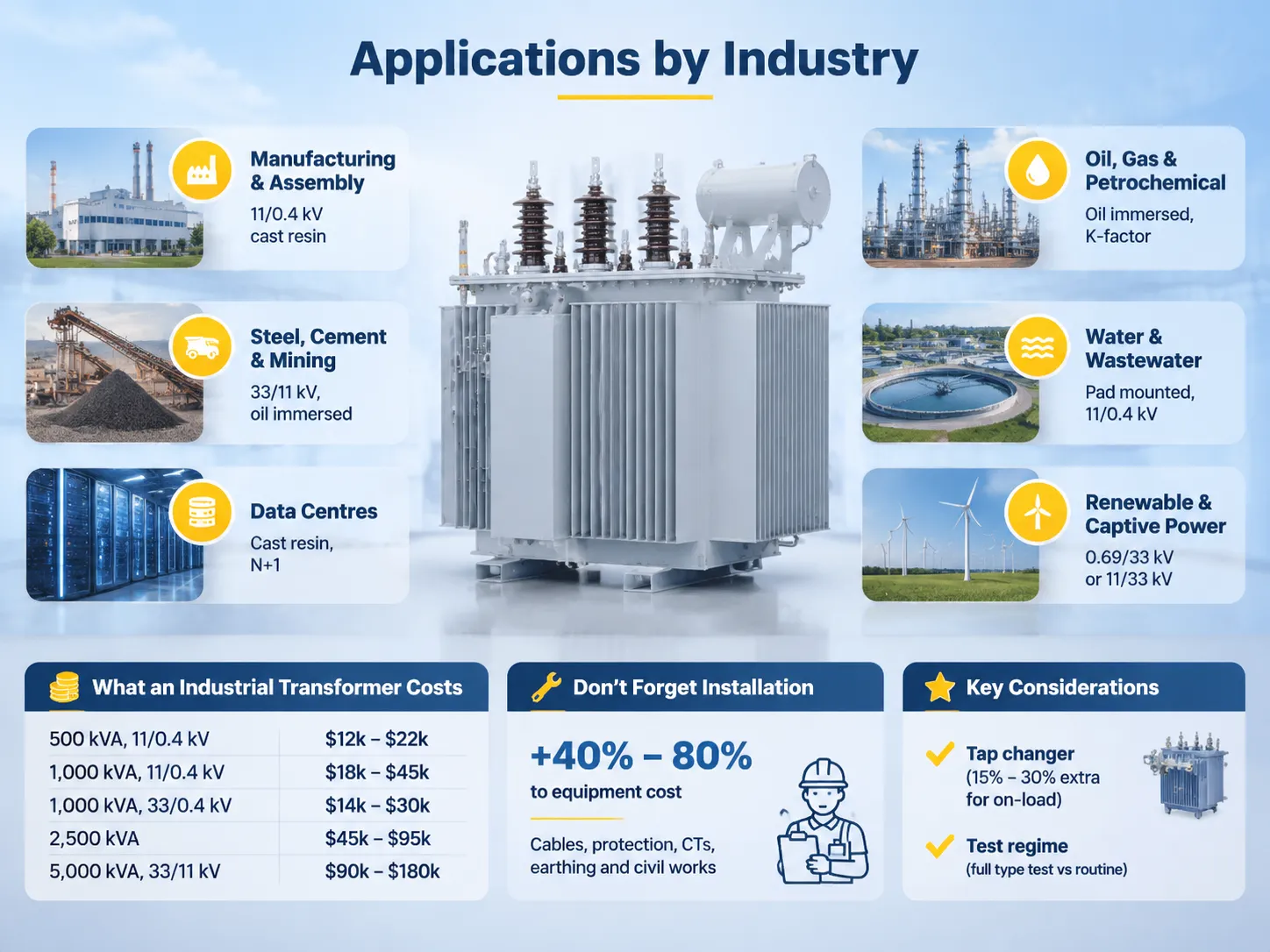
Industry Applications
The application provides information on types, enclosures and impedances for six sectors of the market.
| Sector | Regular structure | Justification |
|---|---|---|
| Production and assembly | 11/0.4 kV transformers, resin insulated indoors | Different locations for different load centers in the plant. Fire load to be considered. |
| Steel, cement and minerals extraction | 33/11 kV and 11/0.69 kV, immersed in oil outside | Large motor load, high fault level, and dusty environment. |
| Centres de données | Resins insulated multiple transformer units in parallel, N+1 | Redundancy, low fire loads and impedance matching. |
| Oil and gas and petrochemical | Immersed in oil with enhanced safety; a k-factor where there is predominance of drives | Hazardous area classification and harmonic load. |
| Water and sewage | Pad mounted oil transformers, 11/0.4 kV | For outdoor plants with periodic pumping loads and for maintenance from a distance. |
| Renewable and/or captive power generation | Step-up transformers 0.69/33 kV or 11/33 kV; assemblage of generation. |
There is a clear trend of using dry insulated transformers in the case of indoor installation, whereas the outdoor plants generally use oil insulated transformers for reasons of cost. Exception is an installation involving a high harmonic load requiring the use of k-rated transformers.
In an installation requiring supply of the complete medium voltage distribution system rather than just one transformer, the conversation will begin at the medium voltage power distribution system. It will most likely be in the context of a new plant, since the interfaces between transformers, cubicles and relay become the focus of commissioning issues.
What Is the Price of an Industrial Transformer?
The pricing provided here are ex works prices in the year 2026 and are influenced by conductor type, impedance, housing, and testing regimes. The price differences between different manufacturers tend to reflect the variations that occur between their quotations for the same specifications. In general, Western manufacturers charge 30 to 50 percent more than Asian manufacturers.
Transformer specifications will drive pricing in the following ways:
| Transformer Specifications | Plage de prix |
|---|---|
| 500kVA Cast Resin Transformer, 11/0.4 kV | $12,000 to $22,000 |
| 1000kVA Cast Resin Transformer, 11/0.4 kV | $18,000 to $45,000 |
| 1000kVA Oil-filled Transformer, 33/0.4 kV | $14,000 to $30,000 |
| 2500kVA Oil-filled or Cast Resin Transformer | $45,000 to $95,000 |
| 5000kVA Oil-filled Transformer, 33/11 kV | $90,000 to $180,000 |
The installation components surprise buyers. When the cost of terminations of medium voltage cables, protection relays, current transformers, lightning protection systems, grounding systems, and construction services are added together, 40 to 80 percent may be added to the price of the other electrical equipment purchased.
There are two items that should be priced during the proposal phase. The first component is the type of tap changer that is used. An off-circuit tap changer is included in all standard units, but an on-load tap changer will be an additional cost that ranges between 15 to 30 percent of the cost of the generator. The second item is the test procedure that is performed on the transformer. A full type testing program conducted on the new transformer will cost more than the routine testing that would be conducted on subsequent units produced.
Specified Manufacturers
Due to logistical considerations of transporting a three-ton unit, the market is regionally constrained, and the manufacturers to be listed below reflect that limitation.
SGB-SMIT Group boasts the title of being the largest independent transformer group in Europe. It has manufacturing facilities in Germany, the Netherlands, the Czech Republic, India, and the United States and produces goods that range from small distribution units to large power transformers. It is strong because it can provide a very long list of voltage combinations.
Spain’s Ormazabal offers the medium voltage network as a package that includes switchgear, transformers, and substations that work in unison when installed in conjunction with each other. This integration makes their pitch to plant owners that want a single point of contact for the entire installation.
Hammond Power Solutions is the North American dry-type specialist whose published design specifications and distribution network allows for cast resin units to be procured off a catalogue rather than being custom engineered for a specific project.
Hitachi Energy and Siemens Energy supply the upper end of the market and the utility sector with the type test facilities and service organizations that support it. For 132 kV equipment, they represent a top-level provider; they also work for distribution transformers up to 1000 kVA.
The Chinese manufacturers are responsible for more than half of the global transformer production market today, and approximately ¥64.6 billion in exports was recorded for 2025, representing a massive 36% growth over last year. The reputable companies have IEC type testing certificates and, when applicable, UL or CSA certifications and letters of reference within the destination country.
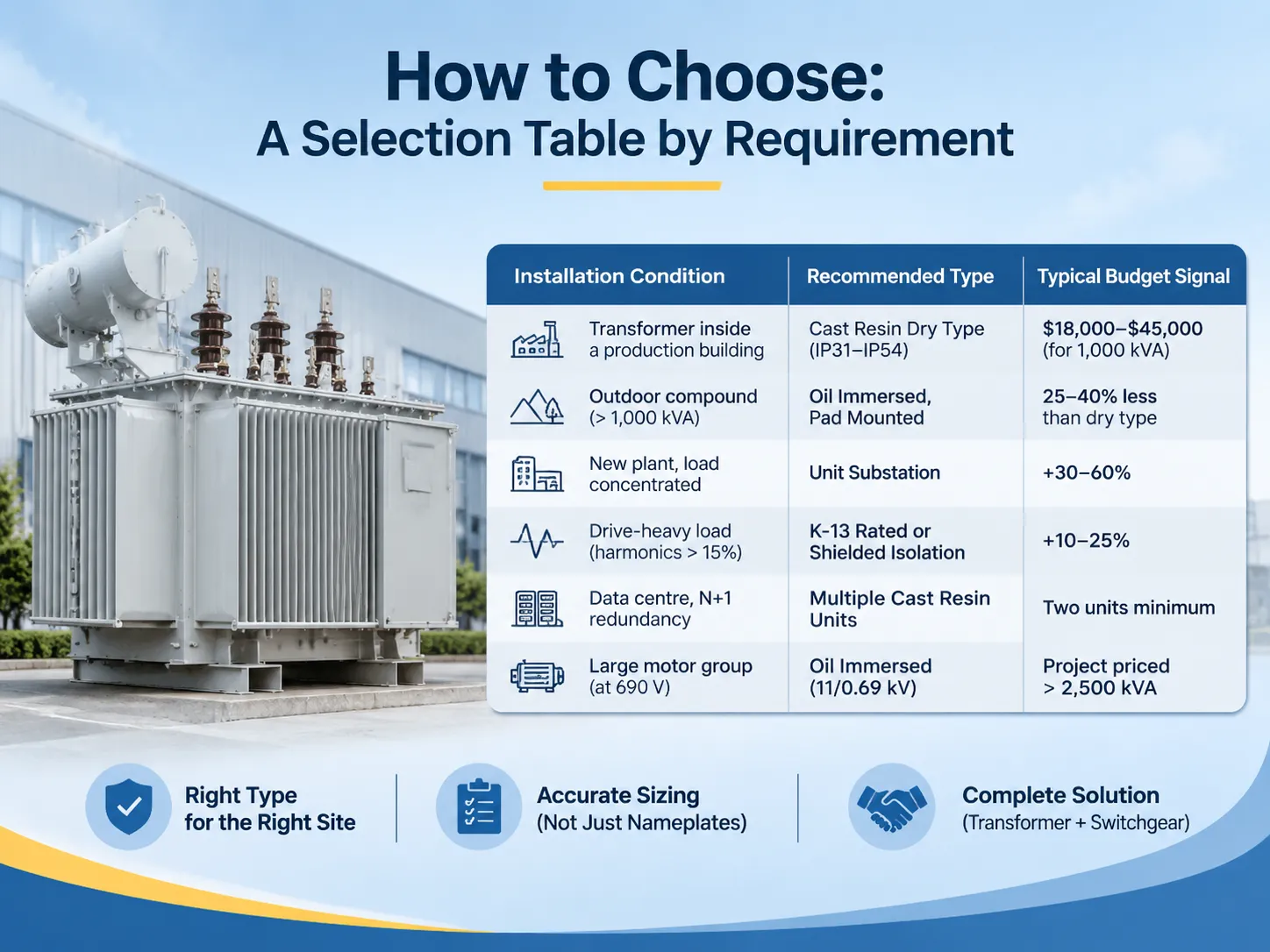
When Picking: A Selection Chart According to Specification
| If you’re in this position | The type of transformer needed | The pricing range |
|---|---|---|
| Transformer located within a manufacturing plant, considerations of fire load | cast resin, dry type, IP31 to IP54 | $18,000 to $45,000 for 1,000 kVA |
| Transformer installed outdoor, rating of over 1,000 kVA – | Oil immersed, pad-mounted | 25-40 percent less than dry type |
| New plant and concentrated load and want one delivery | Unit substation with MV application and LV distribution | 30-60 percent more than a bare transformer |
| Drive-heavy load with distortion over 15 percent | K-13 rated or shielded isolation transformer | 10-25 percent more |
| Data centre with N+1 redundancy | Several cast resin transformers with matched impedance | Minimum of two transformers with an impedance within 10 percent |
| Big motor group at 690 V | Oil immersed 11kV/0.69kV with high impedance | pricing exceeds 2,500 kVA |
Is it best to read this chart by first beginning with installations needing specification, then move on to the rating, because the type decision regarding the transformer is generally made due to the installation and not due to the load. The discussion of power transformer versus distribution transformer shows the different reasons these units are sized and priced differently which becomes essential when a plant must make a decision regarding whether to purchase one large unit or numerous smaller units.
By far, the major specification error with transformers in this category is sizing to the sum of connected nameplates rather than to a diversified load. Transformers wired in this way will run at 30 percent load constantly wasting no load losses every hour. Because of this, the proper choice should usually be one size below and a plan for another transformer when load rises.
Where SUBIAN Fits
We manufacture distribution and power transformers that range from 10kVA to around 20MVA, with the majority in the range of 30kVA to 2,500kVA at 10, 20, 33, and 35kV, and with both oil immersed and cast resin types. The end customers utilize our transformers as either an EPC contractor, distributor, or plant that requires a standard product.
For the purpose of discussing our products, our output in this sector is the indoor end of that spectrum in cast resin and outdoor work in oil immersed products; we carry standard core and coil designs in stock; however, the enclosure, IP rating, temperature rise, and vector group are based on the customer’s specifications. The oil immersed transformers will include pad mounted and outdoor units for values above 500 kVA.
There are three specific reasons why buyers will be inclined to work with us:
- we will always provide quotes according to a single line diagram, which will indicate the vector group, tap range, and impedance.
- We will provide the routine test report prior to shipping, which includes all information, including no-load and load losses
- we will inform the customers right away when the project is outside of our scope (i.e., above 35kV).
For a project requires the transformers, the switchgear and the protection together at one, the distribution transformer and substation range can meet your demand, which is usually much cheaper to buy a plant substation, since it will be the problem of one supplier to solve the interfaces, not three of them.
FAQ
What does industrial transformer do?
Industrial transformer usually involves voltage transformation between supply, and plant distribution system isolated magnetically. A typical industrial transformer takes 11 kV or 33 kV from the utility or plant ring main and provides 400 V, 480 V or 690 V to the electrical distribution system of the industrial plant. The industrial transformer also determines the amount of fault current available down below, defines the phase relationship between primary and secondary, and identifies the earthing arrangement for the low voltage system.
How much does the industrial transformer cost?
For example, the cost of a 500 kVA of cast resin unit may run from $12,000 to $22,000 ex works, while a 1,000 kVA unit may cost you anywhere between $18,000 and $45,000 and a 2,500 kVA unit will fall into the $45,000 – $95,000 range. On the other hand, oil immersed unit for the same rating may cost you 25 to 40 percent less to purchase. Installation constitutes an addition of 40 to 80 percent expenditure in case of a single unit project, and more than that in case of a new substation building or medium voltage cable installation.
What are the major types of transformers used in the industry?
The major types of transformers that are employed in the industry are oil immersed, cast resin dry type, and unit substation.
The first category pertains to the outdoor and substation services above 500 kVA; the second refers to the indoor installations where the fire load becomes significant; while the third category deals with installations that comprise the transformer’s assembly along with transmission of MV from the incoming power lines followed by the distribution of LV. The first two categories also provide two types of transformers known as pad-mounted and ventilated types.
What are the types of transformers?
Voltage-wise, there are four types of transformers namely the step-up transformer, step-down transformer, isolation transformer, and autotransformer. A step-up transformer is used to increase the voltage for electrical transmission; a step-down transformer is used to decrease the voltage for distribution; an isolation transformer passes a 1:1 ratio between circuits while separating the circuits; while the autotransformer has only one winding with tapped connection. There are four types of transformers based upon materials such as oil-immersed transformer, dry transformers, gas-insulated transformers, and cast resin transformers. While using industrial transformers, one should keep in mind the second classification affects mostly the installation process.
Référence
- SGB-SMIT Group- Power and Distribution Transformers
- Hammond Power Solutions- Dry Type Transformer Design Data
- Ormazabal- MV Networks and Substations
- US Energy Information Administration-Today in Energy
- Hitachi Energy- Transformers and Grid Equipment
Conclusion
The industrial transformers are selected based on four parameters that cannot be changed once the transformer gets manufactured. They are the voltage ratio, and the impedance, vector group, and temperature rise. The category is determined by the position of the transformer and the price depends on the category of the items and the test regime employed on the equipment.