


Essere un ingegnere elettrico incaricato di aggiornare un impianto industriale con una capacità di 15 MW, essendo stato detto di fermare l'inizio dell'installazione delle macchine fino al cambiamento della tensione di alimentazione da 33 kV a quella di 400 V causa una serie di inconvenienti. Avere le specifiche del trasformatore a portata di mano e possedere preventivi forniti dai fornitori per la gamma tra $42.000 e $86.000, non hai tempo da perdere, poiché il tuo capo richiede risultati entro venerdì. Nel campo dell'ingegneria elettrica, determinare il tipo corretto di trasformatore non significa cercare la soluzione più economica. Ciò che implica è abbinare tutti i parametri, comprese le valutazioni nominali, le perdite, i metodi di raffreddamento, gli standard e i profili di carico.
In breve, quando si decide sul trasformatore di potenza per il lavoro di ingegneria, il primo passo è trovare il kVA di progetto che dipende dal carico totale relativo ai fattori di diversità e crescita. Il passo successivo richiede di selezionare la classe di raffreddamento (ONAN o ONAF per unità riempite d'olio e AN o AF per trasformatori asciutti) e identificare i prodotti che conformano allo standard IEC 60076.
Il Metodo di Selezione in Sei Passi
Ogni acquisto di trasformatore, dal modello di distribuzione da 250 kVA al trasformatore di sottostazione da 60 MVA, dovrebbe seguire queste procedure. Seguendo questi passaggi, non ti ritroverai né con un'unità sovradimensionata e sovraprezzata né con una sottodimensionata che fallirà durante l'estate:
- Determina il profilo di carico. Analizza ogni carico con il suo fattore di potenza e programma operativo. Calcola il carico di picco in kW e converti in kVA con l'aiuto del fattore di potenza.
- Prevedi la crescita e la contingenza. Moltiplica il carico di picco per 1.1-1.25 per garantire un margine per la futura crescita del carico e converti nella valutazione kVA standard venduta sul mercato.
- Trova l'interfaccia di tensione. Assicurati di controllare le tensioni, il gruppo vettoriale e se è necessario un controllo della tensione.
- Seleziona il tipo di costruzione. Scegli tra design a immersione d'olio e tipo secco considerando la sicurezza antincendio, la posizione e il fattore di carico.
- Esamina le perdite. Confronta i preventivi delle perdite da cablaggio con i preventivi delle perdite a vuoto valutando le formule di perdita capitalizzate.
- Controlla gli standard e i test. Verifica la conformità di questi trasformatori con gli standard IEC 60076 o IEEE C57.12 prima di ordinarlo.
Cosa Significa “Trasformatore Giusto” nell'Ingegneria Elettrica
Il trasformatore può essere considerato efficace se soddisfa quattro criteri contemporaneamente: fornisce la quantità richiesta di energia, opera senza superare i limiti massimi di temperatura, fornisce la necessaria regolazione della tensione per la rete elettrica e i suoi clienti, ha le perdite energetiche più basse e soddisfa i requisiti e gli standard regionali per i trasformatori.
Nell'ingegneria elettrica, il trasformatore è frequentemente la macchina più costosa in qualsiasi impianto e il suo funzionamento difettoso porta a perdite significative per il suo proprietario. In termini di affidabilità, i dati provenienti da varie fonti come CIGRÉ e il gruppo di lavoro IEEE suggeriscono che un livello normale di malfunzionamento dei trasformatori di distribuzione è intorno allo 0,5 – 2 percento all'anno, con i problemi più comuni legati ai sistemi di isolamento e accoppiamento.
Calcolo del carico: Quanta kVA hai realmente bisogno?
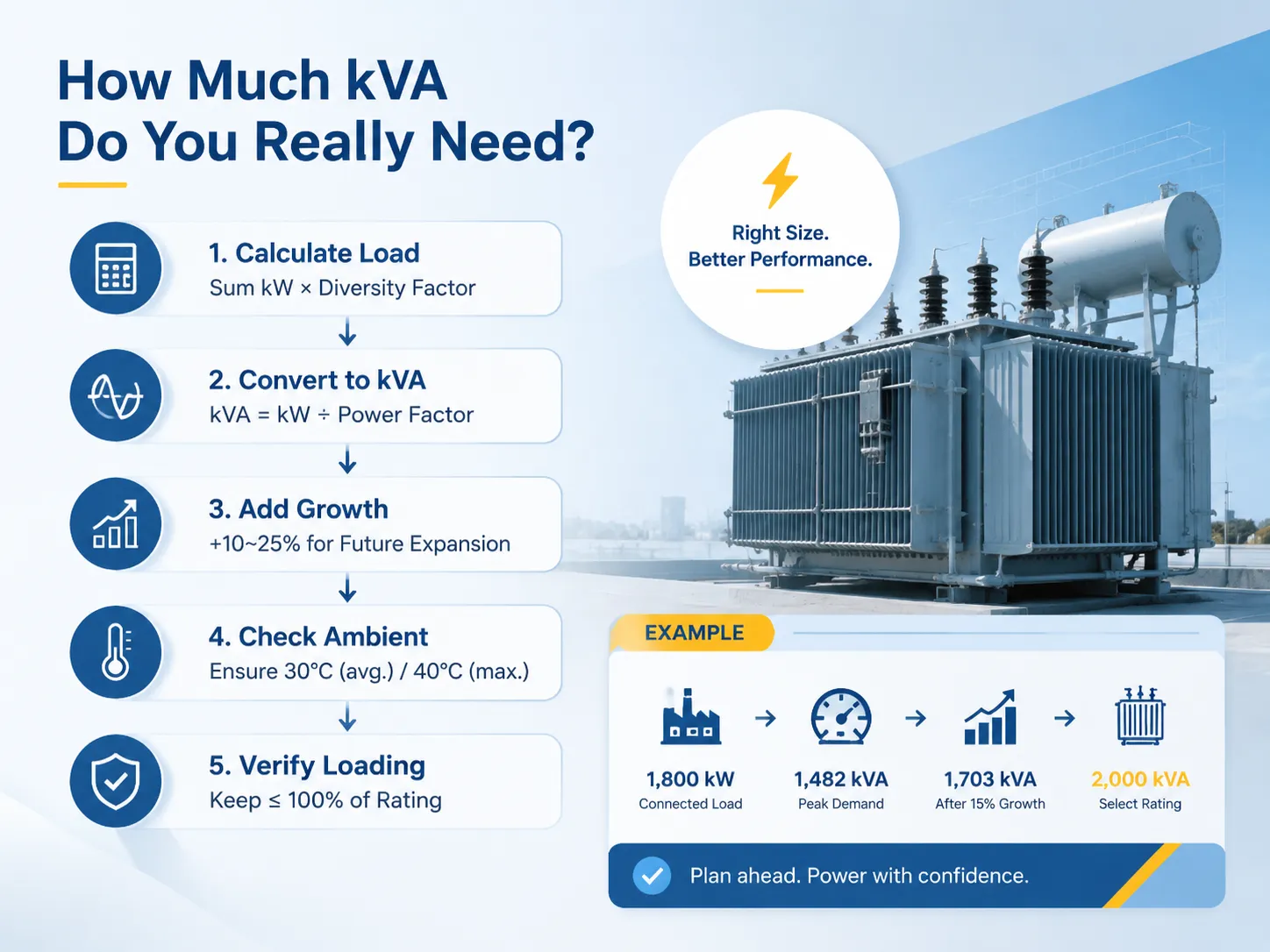
L'errore di selezione che si verifica più frequentemente è la stima errata del carico. Utilizza invece il metodo qui sotto:
- Somma i kW di targa del carico(i) sul feeder a valle, e poi applica il fattore di diversità. Le sedi industriali operano solitamente tra il 60 e l'85 percento della somma dei valori di targa, poiché i motori e le attrezzature di solito non operano al carico massimo contemporaneamente.
- Per trovare kVA, basta convertire kW in kVA: kVA = kW ÷ fattore di potenza. Il fattore di potenza tipico è compreso tra 0,8 e 0,9; se il fattore di potenza è inferiore a 0,7, indica che il trasformatore lavora con potenza reattiva mentre dovrebbe lavorare con potenza attiva.
- Per tenere conto dell'espansione, utilizza un fattore di crescita del 10-25 percento e arrotonda il numero al valore nominale più vicino (cioè, 630, 800, 1.000, 1.250 e 1.600 kVA).
- Per considerare la temperatura, misura la temperatura ambiente. Secondo gli standard IEC 60076-2, la temperatura media annuale è assunta essere di circa 30℃ mentre la temperatura massima non supera i 40℃. Nei luoghi tropicali, dovrebbe essere utilizzata una derating o una valutazione più alta poiché un aumento di temperatura di 10 gradi porta a una significativa diminuzione della vita dell'isolamento.
- Studia il fattore di carico in base al ciclo di lavoro. Se il trasformatore lavora continuamente caricando l'80 percento della sua capacità, le perdite totali e le temperature dei punti caldi saranno accettabili. Allo stesso tempo, se il trasformatore è caricato fino al 100 percento, è necessario controllare le curve di sovraccarico secondo IEC 60076-7.
Come esempio, una fabbrica ha 1.800 kW di carico motore connesso. Il suo fattore di diversità è 0,7 e il suo fattore di potenza è 0,85. La domanda di picco può essere calcolata come segue: 1.260 kW / 0,85 = 1.482 kVA. Considerando il fattore di crescita del 15 percento, la domanda sarà di 1.703 kVA. Pertanto, l'arrotondamento porterà a una valutazione del trasformatore di 2.000 kVA.
Comprendere le perdite e le valutazioni di efficienza
Le perdite nei trasformatori consistono di due componenti che sono fornite in IEC 60076-1 e testate in fabbrica.
| Tipo di perdita | Definizione | Funziona | Valori tipici | Valore capitalizzato |
|---|---|---|---|---|
| Perdita a vuoto (ferro) | Perdita del nucleo da magnetizzazione; presente 24/7 | Sempre, anche a carico zero | 1,5–4 kW per MVA (es. 10 MVA: 15–40 kW) | $2.000–$6.000 per kW |
| Perdita da carico (rame) | Perdita da avvolgimento da corrente di carico | Proporzionale al carico al quadrato | 6–13 kW per MVA a carico massimo | $400–$1.200 per kW |
| Perdita totale e efficienza | Efficienza = output/input | — | 98,5–99,8% per unità di distribuzione/potenza | — |
I numeri di efficienza sembrano impressionanti fino a quando non si fa il calcolo. Un trasformatore da 1.000 kVA con un'efficienza del 98,8 percento perde 12 kW continuamente. A $0.12/kWh e con un carico medio dell'80 percento, ciò equivale a circa 12 × 0.8² × 8.760 ore × $0.12 ≈ $10.700 all'anno in perdite. Nel corso di 25 anni, le perdite energetiche possono raggiungere il 60–90 percento del prezzo di acquisto del trasformatore, motivo per cui la valutazione delle perdite del trasformatore è una prassi standard per gli acquirenti di utility. I nuclei in lega amorfa riducono le perdite a vuoto del 60–70 percento rispetto all'acciaio al silicio orientato a grano convenzionale, con un sovrapprezzo di acquisto di circa il 10–25 percento.
Trasformatore Immerso in Olio vs. Tipo Secco: Una Tabella Decisionale
La decisione di costruzione più importante è tra il tipo immerso in liquido e il tipo secco. La tabella sottostante riassume i compromessi per i tipici progetti di ingegneria elettrica:
| Criteri | Immerso in Olio (Olio Minerale) | Tipo Secco (Resina Fusa / VPI) |
|---|---|---|
| Gamma di potenza tipica | 25 kVA – 300+ MVA | 50 kVA – 20 MVA |
| Efficienza / perdite | Migliore per grandi unità | Buono; perdite leggermente superiori a grandi dimensioni |
| Rischio di incendio | Olio infiammabile; richiede contenimento | Autoestinguente (classe F1), carico di incendio basso |
| Interno / esterno | Tipico esterno; interno necessita di una cassaforte | Preferito interno; esterno necessita di un involucro con grado di protezione IP |
| Manutenzione | Test dell'olio, respiratori, DGA | Minimo; avvolgimenti puliti |
| Prezzo tipico (1.000 kVA) | $6.000–$14.000 | $10.000–$24.000 |
| Migliore applicazione | Sottostazioni, utility, grande industria | Edifici, centri dati, tunnel, offshore |
Tipicamente, gli standard di sicurezza antincendio e i requisiti assicurativi influenzano questa scelta. Ad esempio, i codici di sicurezza antincendio e le normative locali richiedono solitamente trasformatori asciutti o trasformatori a liquido ritardante di fiamma (esteri) in edifici, ospedali, tunnel e impianti industriali. Al contrario, le sottostazioni e i sistemi utility all'aperto utilizzano tipicamente olio minerale a causa del suo costo inferiore e della maggiore efficienza. Nel caso in cui la sostenibilità sia una priorità, i trasformatori a estere naturale (olio vegetale) possono essere una soluzione adatta con un alto punto di infiammabilità, mentre il loro costo è circa il 5–15 percento superiore rispetto al costo dei trasformatori a olio minerale convenzionali.
Classificazioni dei trasformatori per applicazione
Gli acquirenti di ingegneria elettrica incontrano diverse famiglie di trasformatori. Sapere quale il tuo progetto necessita previene confusione nella specifica:
| Classificazione | Valutazione tipica | Uso Primario | Note |
|---|---|---|---|
| Trasformatore di distribuzione | 25–2.500 kVA | Passaggio finale di tensione ai consumatori LV | Perdite più basse per kVA possibili; accessori semplici |
| Trasformatore di potenza | 2,5–300 MVA | Sottostazioni, trasmissione, generazione | OLTC, raffreddamento complesso, testato per tipo |
| Passo unità / generatore | 100–1.200 MVA | Interconnessione della centrale elettrica | Massimi requisiti di affidabilità |
| Trasformatore per forno / rettificatore | Personalizzato | Forni ad arco elettrico, elettrolisi, HVDC | Alta corrente, avvolgimenti speciali |
| Trasformatore di messa a terra | 100–2.000 kVA | Messa a terra neutra, zig-zag | Funzionamento a breve durata |
| Tipo asciutto / resina colata | 100–10.000 kVA | Commerciale, industriale, marittimo | Sicuro contro il fuoco, bassa manutenzione |
Specifiche chiave che gli acquirenti devono verificare
Inserisci i seguenti parametri nel tuo documento di richiesta e chiedi a tutti i fornitori di quotarli. La mancanza di parametri è la ragione più comune per cui le quotazioni dei fornitori non sono comparabili.
| Parametro | Requisito | Perché è importante |
|---|---|---|
| Potenza nominale | kVA calcolati arrotondati a dimensione standard | Definisce dimensione, prezzo e perdite |
| Tensioni e gruppo vettoriale | ad es. 33/11 kV, Dyn11, 50 Hz | Interfaccia di rete e funzionamento parallelo |
| Tensione di impedenza | 4–12.5% | Livelli di guasto, caduta di tensione, funzionamento parallelo |
| Classe di raffreddamento | ONAN, ONAF, OFAF / AN, AF | Capacità continua vs. ciclica |
| Perdite a vuoto / perdite a carico | Valori massimi dichiarati | Costo energetico e classe di efficienza |
| Livello di isolamento | BIL ad es. 170 kV per classe 33 kV | Resistenza a fulmini e manovre |
| Commutatore di derivazione | DETC ±2×2.5% o OLTC ±8×1.25% | Requisiti di regolazione della tensione |
| Livello di rumore | 55–85 dB(A) | Permessi ambientali |
| Normative | Serie IEC 60076 o IEEE C57.12 | Base di accettazione e garanzia |
Conformità agli standard: IEC, IEEE e Codici di rete locali
Seleziona la tua famiglia abituale prima di iniziare a guardare i preventivi. La IEC 60076 domina al di fuori del Nord America, mentre IEEE C57.12.00 e IEEE C57.12.90 determinano negli USA e in Canada. Tra i documenti IEC, IEC 60076-1 (generale), IEC 60076-2 (aumento di temperatura), IEC 60076-3 (livelli di isolamento), IEC 60076-5 (resistenza ai cortocircuiti) e IEC 60076-11 (tipo secco) sono significativi.
Anche gli operatori di rete locali impongono i propri standard, ovvero linee guida nazionali per la connessione di generazione distribuita che determinano le corrette gamme di tensione e il contenuto armonico che influenzeranno la scelta del commutatore di derivazione e dell'impedenza. Richiedi il documento che descrive le condizioni tecniche richieste dal tuo operatore di rete prima di decidere sulle specifiche e sui rapporti di prova di tipo che dimostrano la conformità. Un trasformatore che ha fallito l'ispezione di connessione alla rete è diventato un peso cartaceo molto costoso.
Opzioni di marca e benchmark di prezzo realistici
Il mercato comprende sia attori internazionali che fornitori locali a prezzi competitivi. Le cifre menzionate di seguito mostrano intervalli FOB indicativi per un trasformatore di distribuzione da 1.000 kVA e un trasformatore di potenza da 10 MVA 33/11 kV; le cifre dipendono dalle specifiche e dai costi delle materie prime.
| Marca | Origine | Distribuzione 1.000 kVA | 10 MVA 33/11 kV | Forza |
|---|---|---|---|---|
| ABB | Svizzera | $15.000–$28.000 | $180.000–$320.000 | Servizio globale, riferimenti di rete |
| Siemens Energy | Germania | $16.000–$30.000 | $200.000–$350.000 | Trasformatore digitale, profondità ingegneristica |
| Schneider Electric | Francia | $14.000–$26.000 | $170.000–$310.000 | Soluzioni pacchetto e portafoglio MV |
| Hitachi Energy | Svizzera/Giappone | $15.000–$27.000 | $190.000–$340.000 | Esperienza in trasformatori di grande potenza |
| Grandi aziende coreane (Hyundai, ILJIN) | Corea del Sud | $12.000–$22.000 | $150.000–$280.000 | Qualità costante, laboratori di prova solidi |
| OEM cinesi (TBEA, ecc.) | Cina | $7.000–$14.000 | $90.000–$180.000 | Leadership in capacità e costi |
| Esportatori cinesi di fascia media (ad es. Jiangsu Subian Electric Power) | Cina | $6.000–$12.000 | $80.000–$150.000 | Ingegneria personalizzata, tempi di consegna rapidi |
I produttori internazionali possono applicare prezzi più elevati basati sulla loro storia, reti di servizio consolidate e investimenti in ricerca e sviluppo, che è estremamente importante in caso di beni energetici di alto valore. D'altra parte, i produttori cinesi rappresentano quasi tutta la produzione globale e operano in conformità con gli standard IEC 60076 utilizzando l'infrastruttura per la certificazione delle esportazioni. Jiangsu Subian Electric Power è un'azienda cinese con sede nella provincia di Jiangsu, che offre soluzioni conformi alle normative IEC per trasformatori con tensioni fino a 110 kV in diverse regioni. I principali vantaggi dei prodotti Subian sono la flessibilità nella progettazione, i brevi tempi di consegna e l'apertura nei test. La Cina consente di risparmiare 20-40% rispetto al prezzo dei produttori europei, poiché la qualità dei prodotti cinesi non è inferiore.
Errori comuni di selezione e come evitarli
- Sovradimensionamento per essere al sicuro. L'intervallo operativo più efficace del trasformatore è dal 40 all'80 percento di carico. Un trasformatore troppo grande significa perdita di investimento e riduzione dell'efficienza; pertanto è necessario misurare i dati di carico e calcolare la dimensione del trasformatore.
- Mancanza di considerazione degli armonici. I variatori di velocità creano corrente armonica, portando a perdite e riscaldamento aggiuntivi (carico k-factor). Per varie installazioni di grandi drive, la classificazione k-factor dovrebbe essere scelta o il trasformatore derated.
- Confronto di preventivi con ambito diverso. Se un preventivo include il cambiavalute, un altro potrebbe non farlo. È necessario confrontare l'ambito effettivo del preventivo.
- Disregard dell'altitudine e dell'ambiente. Avendo installato il trasformatore a un livello di altitudine superiore a 1000 m, il corretto derating secondo IEC 60076-1 dovrebbe essere effettuato.
- Acquisto prima della valutazione delle perdite. Dispositivi apparentemente simili potrebbero differire di $10000 nelle perdite.
La checklist finale dell'acquirente
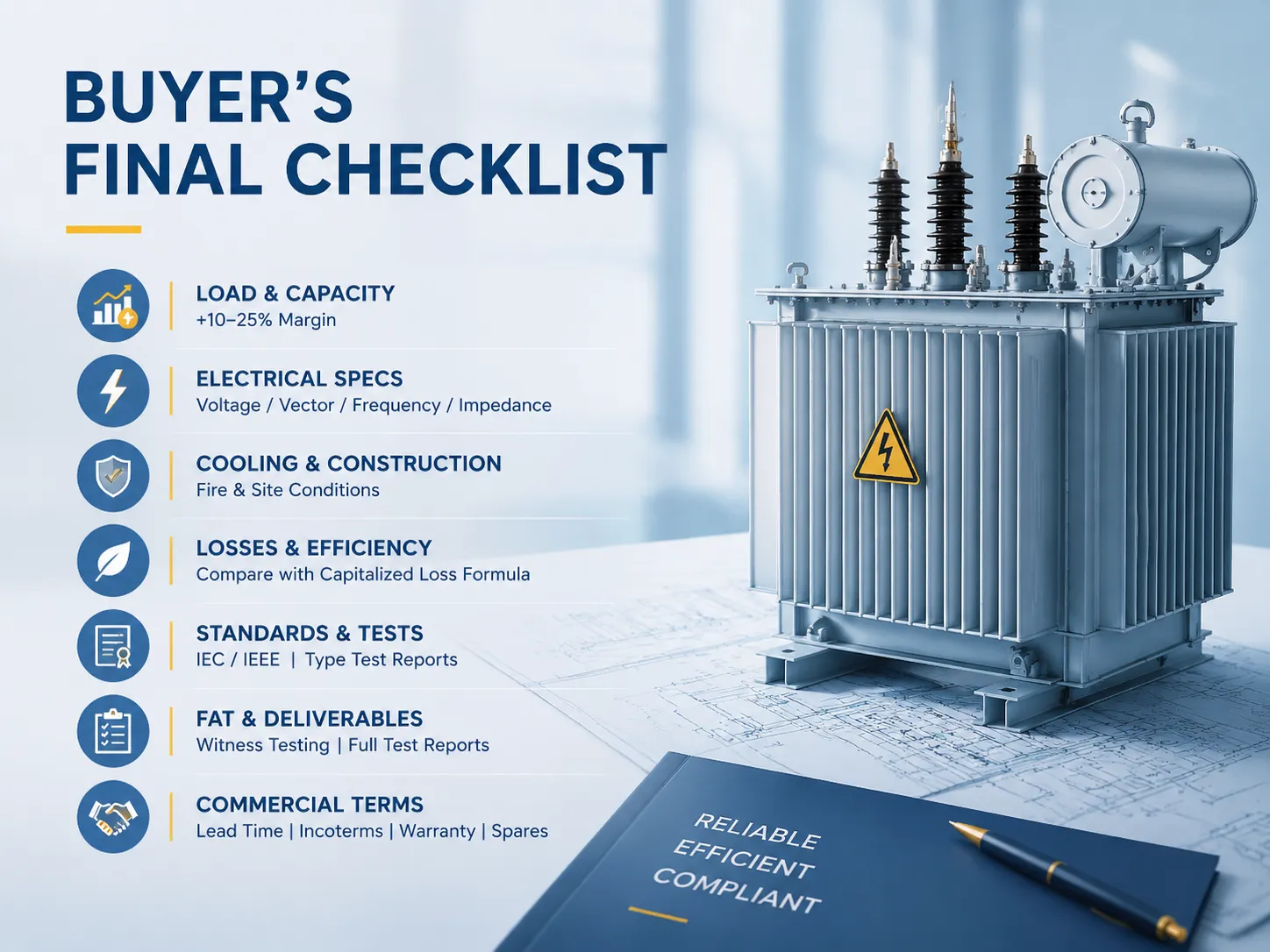
- Il calcolo del profilo di carico è stato condotto e il kVA è stato regolato con un margine aggiuntivo del 10-25 percento.
- La tensione, il gruppo vettoriale, la frequenza e l'impedenza sono stati determinati.
- Il tipo di raffreddamento e il tipo di costruzione sono stati scelti in base alle condizioni di incendio e alle condizioni del sito.
- Le perdite sono state stimate secondo la formula delle perdite capitalizzate.
- La famiglia standard è stata verificata (IEC 60076 o IEEE C57.12) e il rapporto di prova di tipo è stato richiesto.
- L'ambito del FAT è stato concordato, il quale includeva la procedura per il collaudo e la consegna del rapporto di prova completo.
- I tempi di consegna, gli Incoterms e la garanzia (12 -60 mesi) sono stati confermati.
Domande frequenti
Come calcolo la classificazione kVA di cui il mio progetto ha bisogno?
Per calcolare la capacità del trasformatore richiesta, basta sommare il totale del carico connesso in kilowatt, applicare il fattore di diversità (generalmente 0.6-0.85 per carichi industriali), dividere quel numero per il fattore di potenza per convertire i kilowatt in kilovolt-ampere, quindi aggiungere 10-25% per la crescita e arrotondare. Ad esempio, 800 kW con un fattore di potenza di 0.85 utilizzando un fattore di diversità di 0.8 risulta in circa 753 kVA, che può essere arrotondato a 1.000 kVA con crescita.
Qual è l'efficienza tipica di un trasformatore di potenza moderno?
Di solito, i trasformatori di distribuzione raggiungono efficienze di circa il 98 percento al 99.5 percento, mentre i grandi trasformatori di potenza possono raggiungere efficienze di circa il 99.5 percento al 99.8 percento. Tuttavia, non sono le cifre di efficienza relative a essere significative, ma i valori assoluti. Ad esempio, per un trasformatore da 10 MVA, la perdita sarà da 30 kW (a carico massimo) a 70 kW. Dato il prezzo dell'elettricità ($0.12/kWh), le perdite ogni anno possono accumularsi in un importo piuttosto significativo.
Quanto costa un trasformatore da 1.000 kVA nel 2025–2026?
Tipicamente, un trasformatore con una classificazione di 1.000 kVA costerebbe tra $6.000 e $14.000 da un fornitore in Cina e circa $15.000 a $28.000 se il trasformatore proviene da un produttore europeo. Il costo finale del trasformatore includerà anche le spese di consegna, assicurazione e logistica che ti costeranno un ulteriore 8% a 15%. Dovresti anche controllare come i prezzi attuali del rame e del petrolio influenzano i prezzi, quindi non dimenticare di ottenere preventivi ufficiali validi per 60-90 giorni.
Dovrei scegliere un trasformatore immerso in olio o di tipo secco per il mio progetto?
Seleziona il tipo immerso in olio per installazioni all'aperto o dove predominano carichi di utility e grandi industrie, a condizione che ciò sia conforme ai codici di sicurezza antincendio. Seleziona il tipo secco per installazioni che avvengono al chiuso, o in edifici, tunnel, centri dati o altre aree dove ci sono restrizioni derivanti da rischi di incendio o problemi di manutenzione. Il costo dei trasformatori di tipo secco tende ad essere superiore del 40-80 percento rispetto a quello dei trasformatori immersi in olio con la stessa capacità, ma evitano l'intero processo di gestione dell'olio.
Quanto dovrei pagare in più per perdite inferiori?
La valutazione delle perdite capitalizzate produce circa $2,000–6,000 di benefici evitati per perdite a vuoto per kW, e $400–1,200 per kW evitati nelle perdite di carico. Se viene pagato un premio compreso tra il 5 e il 15 percento del prezzo di acquisto, di solito è giustificato se comporta una riduzione delle perdite a vuoto del 15-20 percento o più.
Riferimenti
- IEC 60076-1: Trasformatori di Potenza — Generale — Lo standard fondamentale per la classificazione, le perdite e i requisiti generali.
- IEC 60076-2: Aumento di Temperatura — Definisce i limiti di aumento di temperatura e le regole della classe di raffreddamento per la capacità di carico.
- IEC 60076-7: Guida al Carico per Trasformatori Immersi in Olio — Il riferimento per il carico ciclico e di emergenza oltre la targa.
- IEC 60076-5: Capacità di resistere a cortocircuiti — Requisiti di verifica del design e di prova per la robustezza ai cortocircuiti.
- IEEE — Pubblica i dati della serie C57.12 e del gruppo di lavoro sulla affidabilità utilizzati nell'acquisto di trasformatori e nella valutazione delle perdite.
- NEMA — Associazione commerciale nordamericana che fornisce guida sull'efficienza e sull'applicazione dei trasformatori.
- Jiangsu Subian Energia Elettrica — Produttore di trasformatori conforme a IEC 60076 che supporta gli acquirenti ingegneristici in tutto il mondo.
Conclusione
Il processo di selezione dei trasformatori nell'ingegneria elettrica si basa su decisioni calcolate piuttosto che su congetture casuali. Per questo, è necessario determinare il carico netto e poi aggiungere una percentuale appropriata per una possibile crescita. Calcolando le perdite economiche derivanti dal funzionamento del trasformatore, scegliendo un tipo adeguato del suo design conforme ai requisiti del sito e di sicurezza antincendio, nonché confermando la conformità dell'attrezzatura con i corrispondenti standard, i calcoli di design possono essere considerati validi.
- Stima la dimensione in base alle misurazioni ottenute e alla dimensione richiesta con un margine del dieci al venticinque percento.
- Valuta le perdite che possono variare da $2,000 a $6,000/kW senza carico e da $400 a $1,200/kW con carico.
- Scegli il tipo di design in conformità con le condizioni di installazione e le normative di sicurezza antincendio.
- Controlla che il trasformatore sia conforme agli standard IEC 60076 o IEEE C57.12 con l'aiuto di rapporti di prova di tipo.
- Confronta le quotazioni ottenute per i trasformatori secondo le regole stabilite tenendo conto dei dettagli e del FAT.