


In Nord America, è diventato difficile acquisire trasformatori di potenza rispetto ad altre apparecchiature di rete. Vari fattori causano questa situazione: le aziende di servizi stanno rinnovando le loro vecchie flotte di trasformatori, i data center richiedono enormi fonti di energia e nuovi progetti di generazione e trasferimento cercano tutti di acquisire trasformatori in grado di aumentare e diminuire i livelli di tensione. Inoltre, sul mercato ci sono sempre stati pochissimi produttori di trasformatori, il che implica che i prodotti vengono importati. I fornitori hanno sempre affrontato un problema con alcune materie prime chiave soggette a dazi, causando così problemi di approvvigionamento.
In breve, secondo MarketsandMarkets, Il mercato dei trasformatori nordamericano è stato valutato approssimativamente a 8,6 miliardi di dollari nel 2025 e si prevede che raggiungerà 11,9 miliardi entro il 2030, corrispondente a una crescita annua di circa il 6,7 percento. Gli Stati Uniti costituiscono circa l'87 percento di questo mercato. La domanda è guidata dalla tecnologia di sostituzione della rete, dall'elettrificazione, dalle installazioni di energie rinnovabili e dalla domanda di trasformatori di potenza nei data center AI, mentre l'offerta è penalizzata dalla dipendenza dalle importazioni, dalla disponibilità limitata di ferro a livello nazionale e dai tempi pluriennali di costruzione degli stabilimenti. I principali produttori hanno annunciato più di un miliardo di dollari di nuove capacità in Nord America, tuttavia, diversi grandi stabilimenti non inizieranno la produzione prima del 2027-2029.
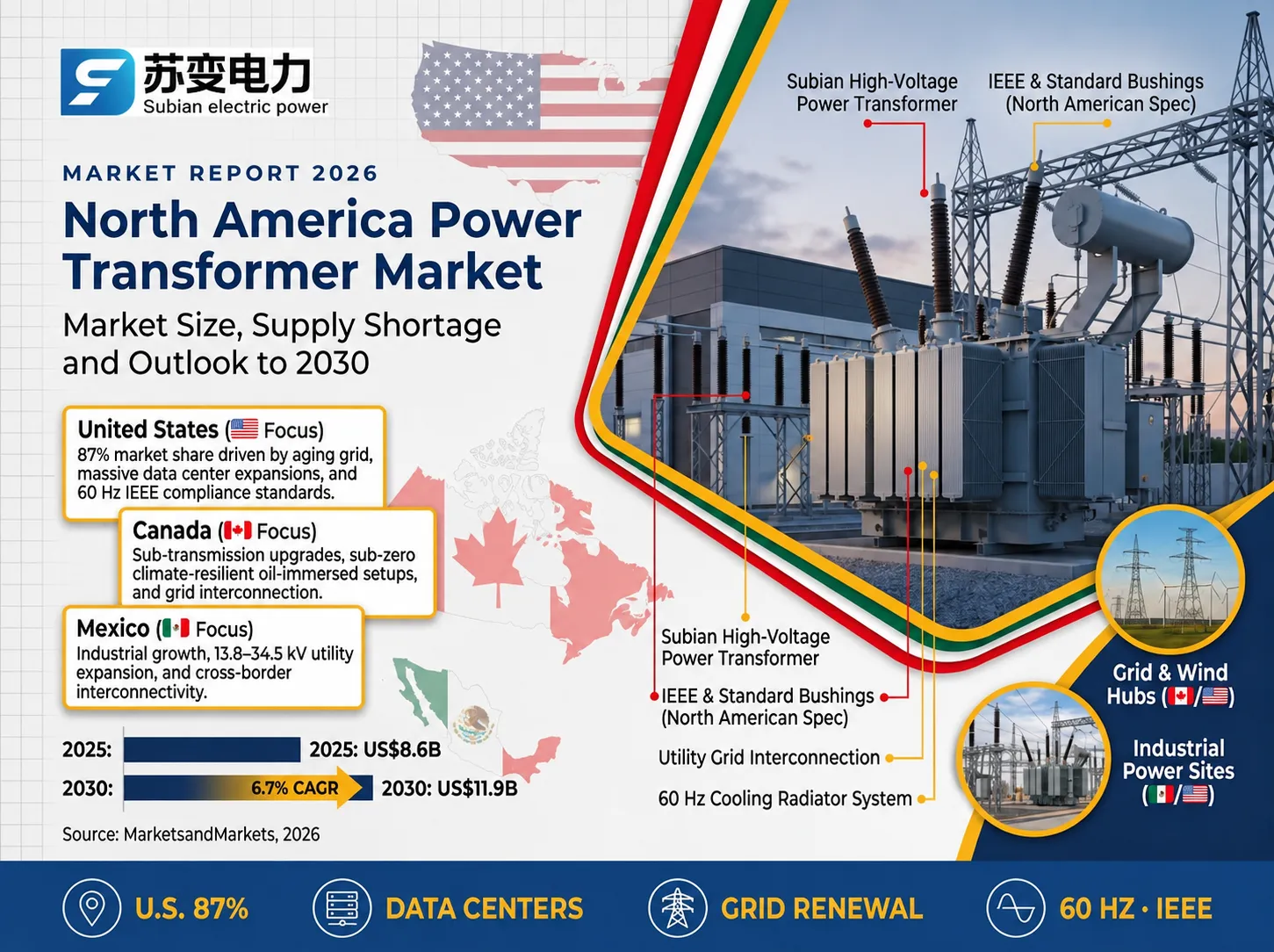
I nomi dei marchi menzionati in questo articolo appartengono ai rispettivi proprietari. Subian Electric è un produttore indipendente di trasformatori e non è affiliato a nessuna delle aziende qui citate.
Quanto è grande il mercato dei trasformatori di potenza in Nord America?
Il valore base del 2025 e la previsione per il 2030
MarketsandMarkets, in un rapporto pubblicato nell'agosto 2026, stima il mercato dei trasformatori di potenza in Nord America a US$8.590,5 milioni nel 2025 e prevede US$11.880,6 milioni entro il 2030, con un tasso di crescita annuale composto di circa il 6,7 percento. Le cifre per paese che compongono questo totale sono riportate di seguito.
| Paese | 2025 estimate | Previsione 2030 | Tasso di crescita, 2025–2030 | Quota del totale 2025 |
|---|---|---|---|---|
| Stati Uniti | US$7.441,7 milioni | US$10.349,9 milioni | 6,8 percento | Circa l'87 percento |
| Canada | US$744,0 milioni | US$1.000,4 milioni | 6,1 percento | Circa il 9 percento |
| Messico | US$404,7 milioni | US$530,3 milioni | 5,6 percento | Circa il 5 percento |
| Nord America | US$8.590,5 milioni | US$11.880,6 milioni | 6,7 percento | 100 percento |
Un dettaglio vale la pena di essere segnalato per chiunque citi questi numeri. Nella pagina di riepilogo regionale, il grafico di confronto tra paesi mostra gli Stati Uniti a US$10.349,9 milioni con l'etichetta 2025. Tale cifra è infatti la previsione per gli Stati Uniti nel 2030, come conferma il rapporto dedicato agli Stati Uniti, e le tre stime per paese sopra riportate sommano al totale regionale entro l'arrotondamento. Utilizzare i rapporti a livello di paese, non il grafico riepilogativo, quando si cita un singolo anno.
Why Market Size Estimates Differ
Altre società di ricerca raggiungono totali diversi perché definiscono il mercato in modo differente.
| Fonte | Stima | Note di ambito |
|---|---|---|
| MarketsandMarkets (2026) | US$8,59 miliardi nel 2025, US$11,88 miliardi entro il 2030 | Stati Uniti, Canada e Messico; trasformatori di potenza |
| Strategic Revenue Insights (2026) | US$6,85 miliardi nel 2025, US$13,11 miliardi entro il 2035 | Include i paesi dell'America Centrale; i segmenti più grandi del 2025 erano unità da 100–500 MVA e trasformatori di innalzamento per collettori rinnovabili |
Alcuni rapporti coprono i trasformatori di distribuzione mentre altri considerano solo unità sopra specifiche classificazioni MVA e ci sono alcuni che includono America Centrale e Caraibi nei loro rapporti. Esistono rapporti molto più ampi sul ‘mercato dei trasformatori’ che coprono anche trasformatori di distribuzione, trasformatori a secco e trasformatori strumentali. Tuttavia, questi numeri non devono essere sommati o mediati. Il risultato complessivo è coerente in tutti i rapporti ed è circa una crescita del 6-7% ogni anno, che è un tasso elevato per un settore maturo.
Trasformatori di Potenza vs Trasformatori di Distribuzione
I trasformatori di potenza sono utilizzati nelle stazioni di generazione, trasmissione e sottotrasmissione, solitamente a 69 kV e oltre e da circa 10 MVA a diverse centinaia di MVA. I grandi trasformatori di potenza sono generalmente considerati quelli da 100 MVA in su, realizzati su misura, in grado di pesare diverse centinaia di tonnellate e che richiedono trasporto speciale su rotaia o strada. I trasformatori di distribuzione, invece, abbassano la media tensione per uso residenziale e commerciale e sono prodotti in grandi volumi e tramite catene di fornitura completamente diverse. Entrambi i tipi di trasformatori sono attualmente scarsi, ma le ragioni e i tempi di consegna coinvolti sono differenti.
Quali fattori stanno guidando la domanda di trasformatori di potenza in Nord America?
Infrastruttura di Rete Obsoleta
Gran parte dell'infrastruttura di rete nordamericana è stata installata tra gli anni '60 e '90, e molti dei loro trasformatori di sottostazione hanno superato la loro vita utile prevista. Studi condotti dal U.S. National Renewable Energy Laboratory hanno rivelato che circa la metà dei trasformatori di distribuzione negli Stati Uniti ha più di 33 anni, situazione simile a quella dei grandi trasformatori di potenza. Di conseguenza, le utility sostituiscono costantemente questi dispositivi per evitare guasti costosi che comportano lunghi tempi di inattività.
Elettrificazione e Rinascita della Manifattura
Veicoli elettrici, pompe di calore e la ripresa della manifattura ad alta intensità energetica, come impianti di batterie, semiconduttori e acciaierie, continuano ad aumentare la domanda di energia dopo anni di stagnazione. Pertanto, qualsiasi impianto industriale moderno richiede sottostazioni ad alta tensione.
Soluzioni Rinnovabili, Stoccaggio e Sviluppo della Trasmissione
Ogni progetto eolico, solare e di batterie su scala utility richiede trasformatori di raccolta e di innalzamento per generatori, oltre a una nuova linea di trasmissione per connettersi alla rete elettrica. Pertanto, i trasformatori di innalzamento per rinnovabili così come le sottostazioni con potenze nominali da 100 a 500 MVA rappresentano un segmento importante del mercato.
In che modo la domanda di trasformatori è influenzata dai data center AI?
Data centers have emerged as the most significant recent source of transformer demand. A report from Lawrence Berkeley National Laboratory for the U.S. Department of Energy concluded that data centers consumed around 4.4 percent of U.S. electrical energy in 2023, with the possibility of them consuming between 6.7 and 12 percent of it by 2028, mostly as a result of the influence of AI.
Load Concentration
A large AI facility may demand several hundred megawatts at one location, which is often more energy than a middle-sized town. The load arrives at a single point in the grid, thus the facility usually needs a dedicated transmission substation with several large power transformers.
Multiplication of Equipment due to Redundancy
Data centers are indeed built to be highly reliable, with N+1 or 2N backup typically included. Hence, the facility that has an electricity need of 200 MVAs may install much more transformer capacity than is required at a time of peak demand, and several medium voltage transformers in its internal structure. The EV charging market has undergone a similar development.
Connection Needs in Terms of the Grid
Because it takes years for power companies to construct new transmission power stations, many data center owners are treating transformer availability as a selection factor when choosing a site. Some companies have even begun to purchase the equipment with a long lead time in order to get a place in a factory to produce transformers.
Why Is the United States Facing a Power Transformer Shortage?
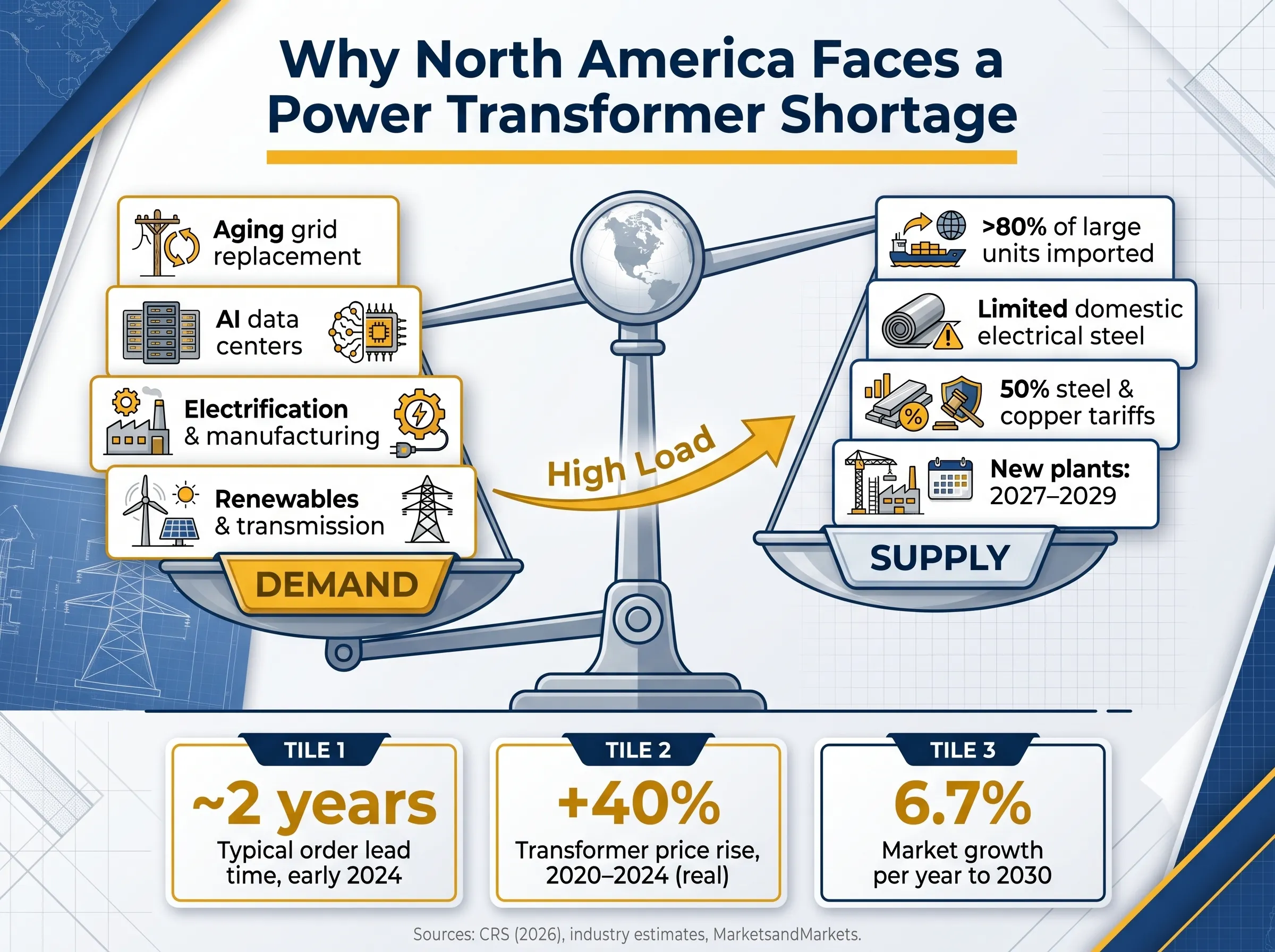
Il power transformer shortage in the USA is the result of demand growing faster than a highly specialized supply chain can respond. The graphic below sums up both sides of the balance, and the table that follows sets out the evidence behind each constraint.
| Constraint | What the evidence shows |
|---|---|
| Import dependence | More than 80 percent of large power transformers used in the U.S. are imported, according to industry estimates cited by Siemens Energy. About 25 to 30 percent of finished distribution transformers were imported in 2023. |
| Electrical steel | The U.S. has one dominant domestic producer of grain-oriented electrical steel, and between half and three-quarters of the cores used in domestically assembled transformers are imported. |
| Tariffs | Section 232 tariffs on steel were raised to 50 percent in June 2025 and extended in August 2025 to derivative products including electrical cores and laminations; a 50 percent tariff also applies to certain copper products, including winding wire. |
| Prices | U.S. producer price data show transformer prices rose roughly 40 percent from 2020 to 2024 after inflation. |
| Lead times | Orders took about two years to fill in early 2024, roughly four times pre-2022 levels. Distribution transformer waits have since eased, but large custom units remain the longest-lead items. |
| Manufacturing and transport | Large units need skilled hand labor, heavy cranes, high-voltage test bays and special rail cars, so capacity cannot be added quickly. |
These figures come from a Congressional Research Service review of transformer supply published in April 2026 and from manufacturer statements. The overall picture is clear: even with strong investment, supply will take several years to catch up with demand.
Which Power Transformer Manufacturers Are Expanding in North America?
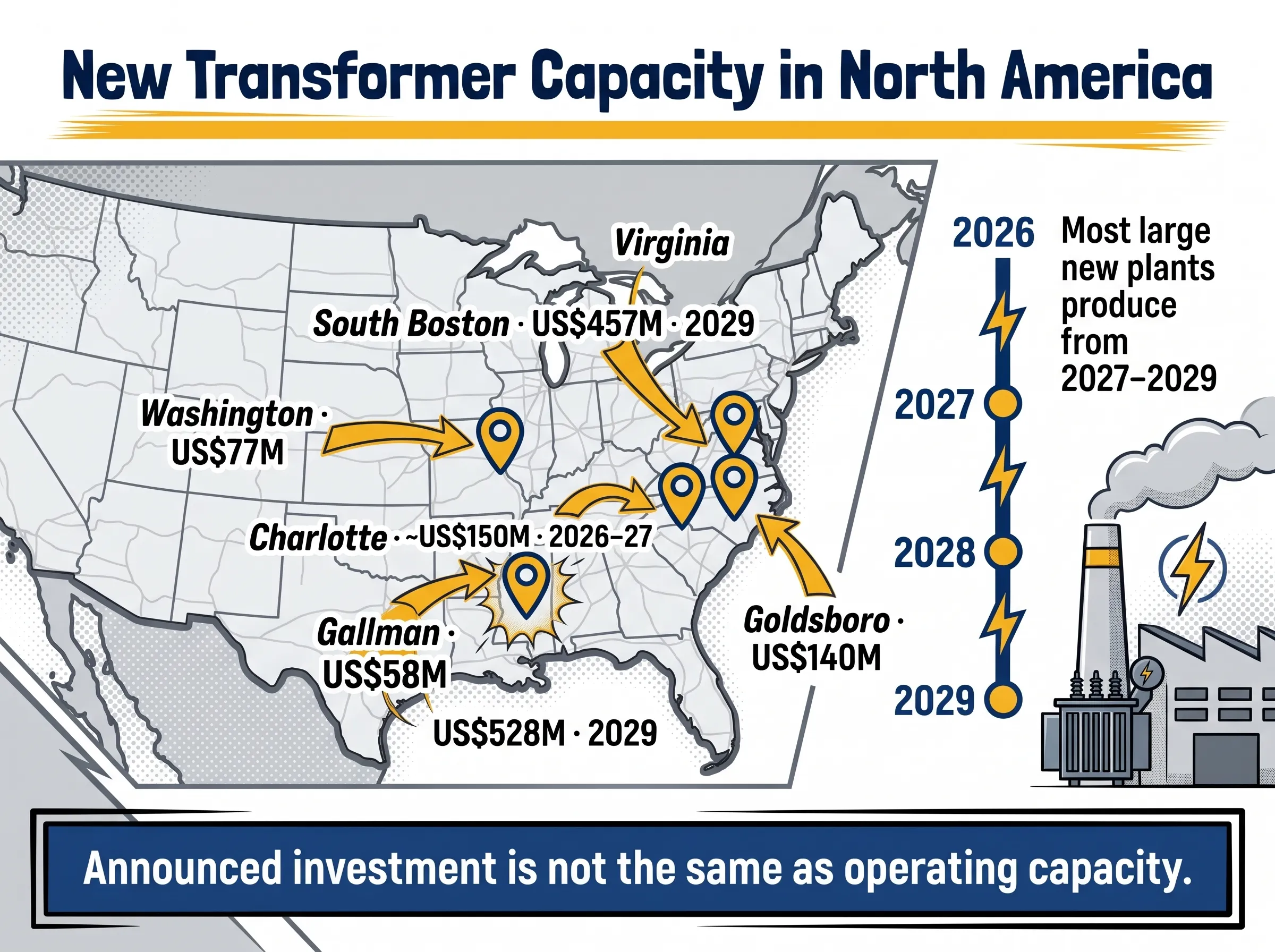
The leading power transformer manufacturers in North America have responded with a wave of investment. It is important to separate announced investment from operating capacity: several of the largest projects are still under construction. The map shows where the main projects are located and when they are expected to produce; the table gives the details.
| Produttore | Progetto | Investimento | Status and timeline |
|---|---|---|---|
| Hitachi Energy | Large power transformer plant expansion, South Boston, Virginia | US$457 million, about 825 jobs | Ground broken June 2026; completion targeted for 2029 |
| Hitachi Energy | New power transformer factory, Gallman, Mississippi | US$528 million, more than 700 jobs | Announced September 2026; construction from late 2026, production planned for 2029 |
| Siemens Energy | Large power transformer factory, Charlotte, North Carolina | About US$150 million, 559 jobs | Announced February 2024; production originally targeted for early 2026, with later reports pointing to 2027 |
| Prolec GE | Goldsboro, North Carolina expansion | US$140 million, 330 jobs | Part of more than US$300 million of recent U.S. and Mexico investment; GE Vernova agreed in October 2025 to buy the remaining 50 percent of Prolec GE for about US$5.3 billion |
| WEG | Specialty transformer plant, Washington, Missouri | US$77 million, 50 jobs | Announced 2025; focused on 1–10 MVA units, planned 50 percent capacity increase |
Hitachi Energy describes the Virginia and Mississippi projects as part of a U.S. manufacturing program of roughly US$1.5 billion. For more detail on WEG’s North American range and factories, see our guide to WEG transformers and WEG Transformers USA.
The timing matters. If the largest new plants start producing in 2027 to 2029, then much of the demand growth forecast for 2025 to 2030 will have to be met by existing factories, imports and refurbishment before new domestic capacity arrives.
Comparison of the Markets in USA, Canada, and Mexico
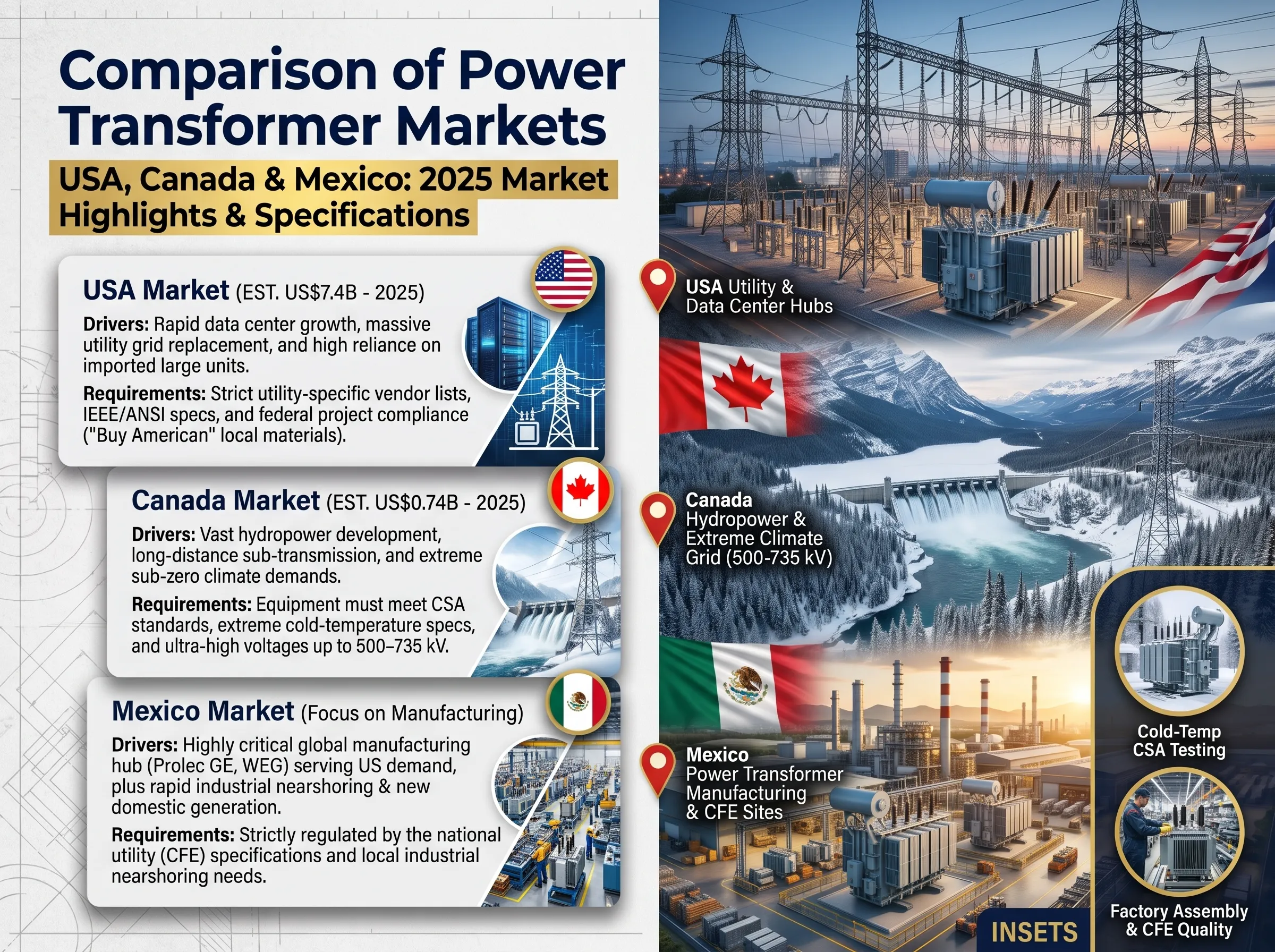
USA
The power transformer market in the United States is leading the estimated value of about US$7.4 billion in the year of 2025, because of the great replacement requirements for the USA power transformers, allowing for fast growth of data centers and dependency on the imported large products. The utilities purchase power transformers according to the specifications and vendor lists, while there are also some federal projects whose requirements might include the use of locally manufactured materials.
Canada
The power transformer market in Canada is estimated to be approximately US$ 0.74 billion in the year of 2025, mainly due to the development of a huge hydropower system, long-distance electricity transmission, and severe climate conditions. The utilities from the provinces such as Quebec, Ontario, and British Columbia are using the high voltage level of even 500-735 kV, where their equipment is compliant with CSA standards and extremely low-temperature specifications.
Messico
The situation in the Mexican power transformer market is slightly different as it is less developed in comparison with the USA, but very important as a manufacturing center for transformers. It produces the transformers for such companies as Prolec GE and WEG, using the United States as a market for its products. The domestic market for transformers is associated with the national utility company named CFE, industrial nearshoring, and the need for new power plants to be built. The projects are subject to the local regulations such as utility requirements and national standards from CFE for power transformers.
Which Power Transformer Types Are in Highest Demand?
| Transformer type | Valutazione tipica | Principali fattori di domanda |
|---|---|---|
| Large power transformers and autotransformers | 100 MVA and above, 230 to 765 kV | Transmission expansion, interconnections, data center substations |
| Generator step-up transformers | Decine a centinaia di MVA | Gas, nuclear uprates, wind, solar and storage |
| Trasformatori di potenza per sottostazioni | 10 to 100 MVA, 69 to 161 kV | Utility load growth, industrial campuses, sub-transmission |
| Collector and medium power transformers | 5 to 50 MVA, up to 46 kV | Renewable collector systems, battery storage, data center medium-voltage distribution |
| Distribution transformers (related segment) | Up to about 10 MVA | Housing, commercial loads, electrification |
According to the U.S. report by MarketsandMarkets, oil-cooled units are the leading cooling segment as well as the air-cooled units being the fastest growing one. Both oil-filled types still lead above a few MVA installations, while dry types have proved their superiority in indoor, urban and data center environments where fire safety is of high importance.
North American Transformer Standards and Procurement Requirements
Buyers sourcing from outside the region, or comparing suppliers who usually build to IEC standards, should understand how North American requirements differ.
| Voce | North American practice | Typical IEC practice |
|---|---|---|
| Frequenza | 60 Hz | 50 Hz in most markets |
| Transmission voltages | 115, 138, 161, 230, 345, 500 and 765 kV; 735 kV in Quebec | 110, 132, 220, 330, 400 and 500 kV |
| Principali standard | IEEE C57.12.00 and C57.12.90 in the U.S.; CSA standards in Canada; CFE and NOM requirements in Mexico | Serie IEC 60076 |
| Aumento di temperatura | 65 °C average winding rise, often with ONAN/ONAF/ONAF ratings | 65 °C winding and 60 °C top oil |
| Insulation levels | BIL values tied to North American voltage classes | Lightning impulse levels tied to IEC voltage classes |
| Approval | Utility specifications, design reviews and approved vendor lists | rapporti di prova di tipo e approvazione da parte di utilità o consulenti |
A transformer designed for 110 kV or 132 kV at 50 Hz cannot simply be offered for a 115 kV or 138 kV, 60 Hz substation. Voltage ratio, impedance, BIL, tap range, bushings, cooling stages and accessories all need to be engineered to the project specification, and test reports must follow the applicable standard.
Forecast of Power Transformer Market in North America until 2030
The analyses have nearly arrived at the same conclusion regarding the annual market growth of approximately 6%-7% until at least 2030. The following factors will determine whether forecasts hold true.
Timely availability of newly constructed capacity: several largest domestic power transformer plants will become operational by 2027-2029 while at least one of them has missed the deadlines.
Import and export regulations: the supply of steel and copper, tariffs, or trade rules adjustment will affect expenses for the units produced domestically or imported.
Pace of large-load connections: establishing data centers and industrial projects can be postponed, resized, or cancelled, thus significantly altering demand.
Market forecasts are models and not actual orders. They let the buyers understand the direction of the market but the planning must rely on confirmed capacities of suppliers and real delivery dates rather than sensational rates of market development.
What Should Transformer Buyers Check Before Sourcing?
With long lead times and limited factory slots, a clear specification and an early start matter more than ever.
| Categoria | Cosa confermare |
|---|---|
| Electrical data | MVA rating and cooling stages, voltage ratio, frequency, impedance, BIL, vector group, tap changer type and range |
| Normative | IEEE C57 or CSA requirements, utility specifications and any Mexican CFE or NOM requirements |
| Perdite | Guaranteed no-load and load losses, evaluated on total owning cost |
| Design review | Short-circuit withstand, sound level, transport dimensions and weights |
| Test | Routine, type and special tests; witness testing; factory acceptance test plan |
| Approval | Whether the supplier is on the utility’s approved vendor list or needs qualification |
| Consegna | Confirmed factory slot, shipping route, heavy-haul transport and site installation support |
| Commerciale | Warranty, spare parts, domestic content requirements and tariff exposure |
Where Subian Electric Fits
Subian Electric builds oil-immersed and dry-type transformers and prefabricated substations at its factory in Xuzhou, China, mainly to IEC standards for international projects. Relevant product families include 110–132 kV oil-immersed transformers, 35 kV-class oil-immersed power transformers e trasformatori montati su basamento trifase. These are IEC-based designs, and Subian does not claim existing North American utility approval. For any North American enquiry, the design would need to be engineered to the project’s 60 Hz voltage ratios, BIL, standards and utility specification, with test documentation reviewed before award. For a view of a fast-growing market in South America, see our Brazil power transformer market analysis.
Domande frequenti
How big is the North America power transformer market?
MarketsandMarkets estimates the market at about US$8.59 billion in 2025, rising to about US$11.88 billion by 2030, a growth rate of about 6.7 percent a year. Other firms using different scopes report different totals.
What is driving power transformer demand in the United States?
Replacement of aging equipment, electrification, new manufacturing plants, renewable and storage connections, transmission expansion and the rapid growth of AI data centers.
Why are large power transformers in short supply?
Most large units used in the U.S. are imported, domestic electrical steel supply is limited, tariffs have raised material costs, and building and testing large units requires specialized factories that take years to add.
Who are the major power transformer manufacturers in North America?
Major suppliers include Hitachi Energy, Siemens Energy, Prolec GE, WEG and others, along with importers. Several are building or expanding North American plants scheduled to produce between 2026 and 2029.
How long does it take to get a large power transformer?
Lead times vary by supplier and rating. In early 2024 orders were taking about two years, and large custom units remain among the longest-lead items in the power sector.
What is the difference between power and distribution transformers?
Power transformers serve generation and transmission substations, usually at 69 kV and above. Distribution transformers step medium voltage down for end users and are produced in much higher volumes.
Does North America use 50 Hz or 60 Hz transformers?
The United States, Canada and Mexico all operate 60 Hz grids, so transformers must be designed and tested for 60 Hz.
Can imported transformers meet U.S. utility requirements?
Yes, imports already supply most U.S. large power transformers. They must meet the utility’s specification and IEEE standards, pass the required tests and, in many cases, come from a supplier on the utility’s approved vendor list.
Riferimenti
- MarketsandMarkets: North America Power Transformer Market, 2025–2030
- MarketsandMarkets: US Power Transformer Market, 2025–2030
- Congressional Research Service: Electricity Distribution Transformers, Supply, Tariffs and Policy Options (2026)
- ENR: Hitachi breaks ground on US$457M Virginia transformer plant expansion
- Interesting Engineering: Hitachi Energy US$528M Mississippi transformer plant
- Manufacturing Dive: Siemens Energy large power transformer facility in Charlotte
- T&D World: GE Vernova to acquire remaining 50 percent stake of Prolec GE
The North American market is growing steadily, but the real constraint for most projects is not demand; it is getting the right transformer, built to the right specification, delivered on time. Jiangsu Subian Electric Power Equipment Co., Ltd. designs and builds trasformatore di distribuzione immerso in olio da 6-10 kV, dry-type transformers and prefabricated substations for international projects, engineered to each project’s frequency, voltage and standard. For private-label or distributor supply, see our programma OEM e ODM. Send your specification through our pagina di contatto, and our engineers will review the requirements and reply with a technical proposal and factory quotation.