


商業プロジェクトに利用される配電用変圧器とは対照的に、データセンター用変圧器は特別な役割を持っています。これらは、サポートする負荷の近くに配置され、高効率で継続的に運転し、正弦波負荷とは異なる形の負荷に対応する必要があります。したがって、点火のリスクと変圧器の三つの特性(高調波性能、熱的余裕、部分放電)のために、油変圧器を使用することは不可能です。.
要するに、データセンターを接続するための電力には、クラスH(180 °C)熱絶縁、Kファクター評価がK-13以上(通常はK-20)、6%インピーダンス、UPS入力用のDyn11ベクトルグループ、1.1×定格電圧での部分放電試験値が10 pC以下、性能に関してDOE 2016またはEUエコデザインTier 2に準拠したキャストレジン乾式変圧器を選択するのが適切です。データセンター用変圧器の典型的な電力定格は、10 kVおよび35 kVでそれぞれ500 kVAから3,750 kVAの間です。.
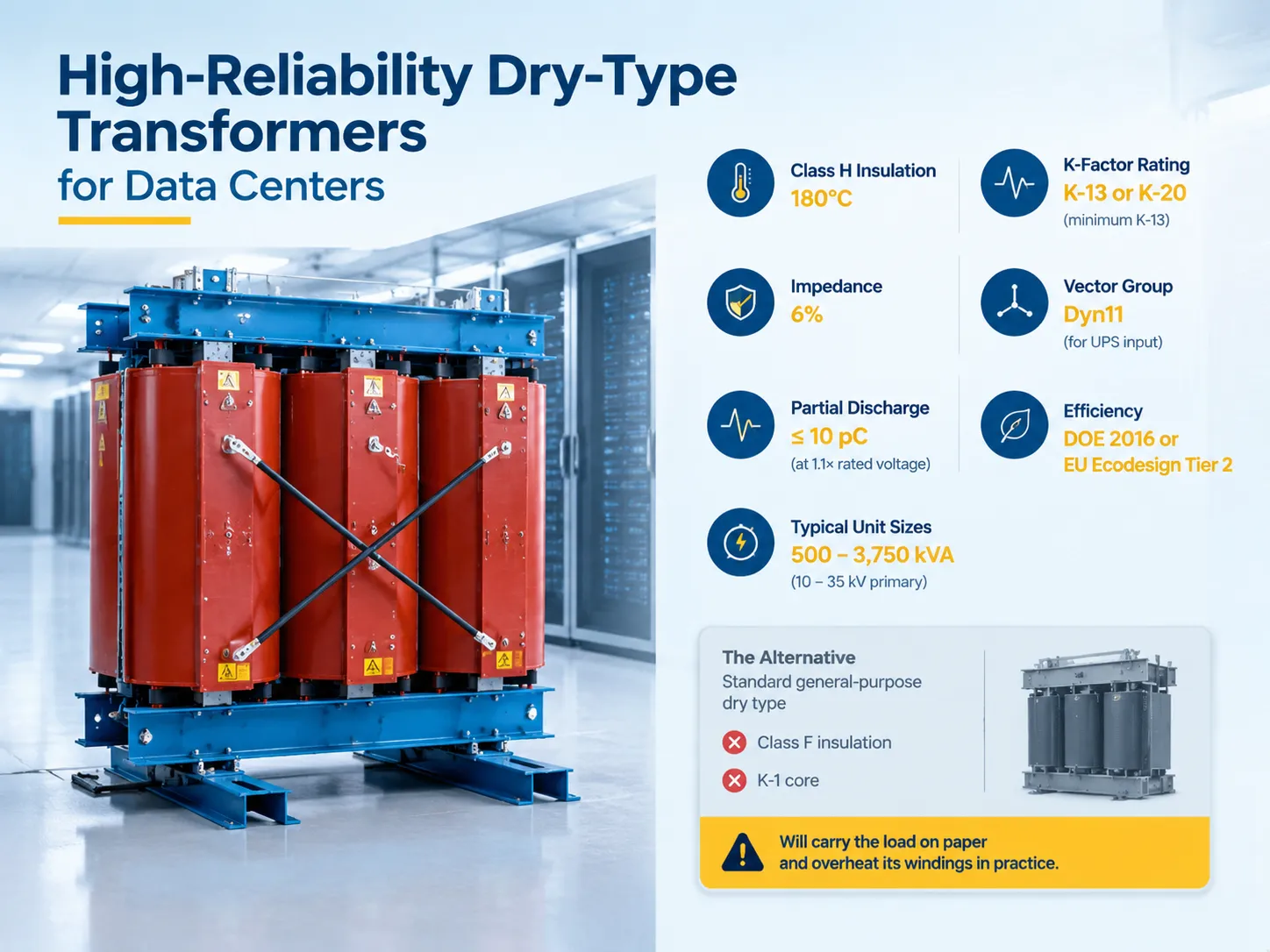
なぜデータセンターは最初に乾式タイプを使用するのか
主な要因は、システムの火災安全性です。キャストレジン巻線は自己消火性があり、可燃性液体を含まないため、変圧器はサービスされる負荷の近くに建物内に配置できます。したがって、油ピット、安全壁、または優れた耐火特性を持つ特別なコンパートメントは必要ありません。変圧器は、ホワイトスペースの価値が高いコロケーションまたはエンタープライズデータセンター内のIT機器の近くに配置されるため、低電圧配線の距離が短縮されます。.
次の推進要因は、メンテナンス要件です。油のレベル、ガスリレー、またはブリーザーの乾燥を監視する必要はありません。その代わりに、部分放電と温度のみを監視すればよく、これは流体化学プロセスと比較して簡単です。.
一方、乾式変圧器は熱に対して耐性がありません。油は移動し、巻線から熱を取り除くのを助けますが、樹脂はそれを行いません。したがって、乾式変圧器の場合、絶縁クラス、温度上昇、高調波が非常に重要になります。通常の運転と絶縁損傷の間の距離が大幅に小さくなるためです。.
すべてを決定する三つの仕様
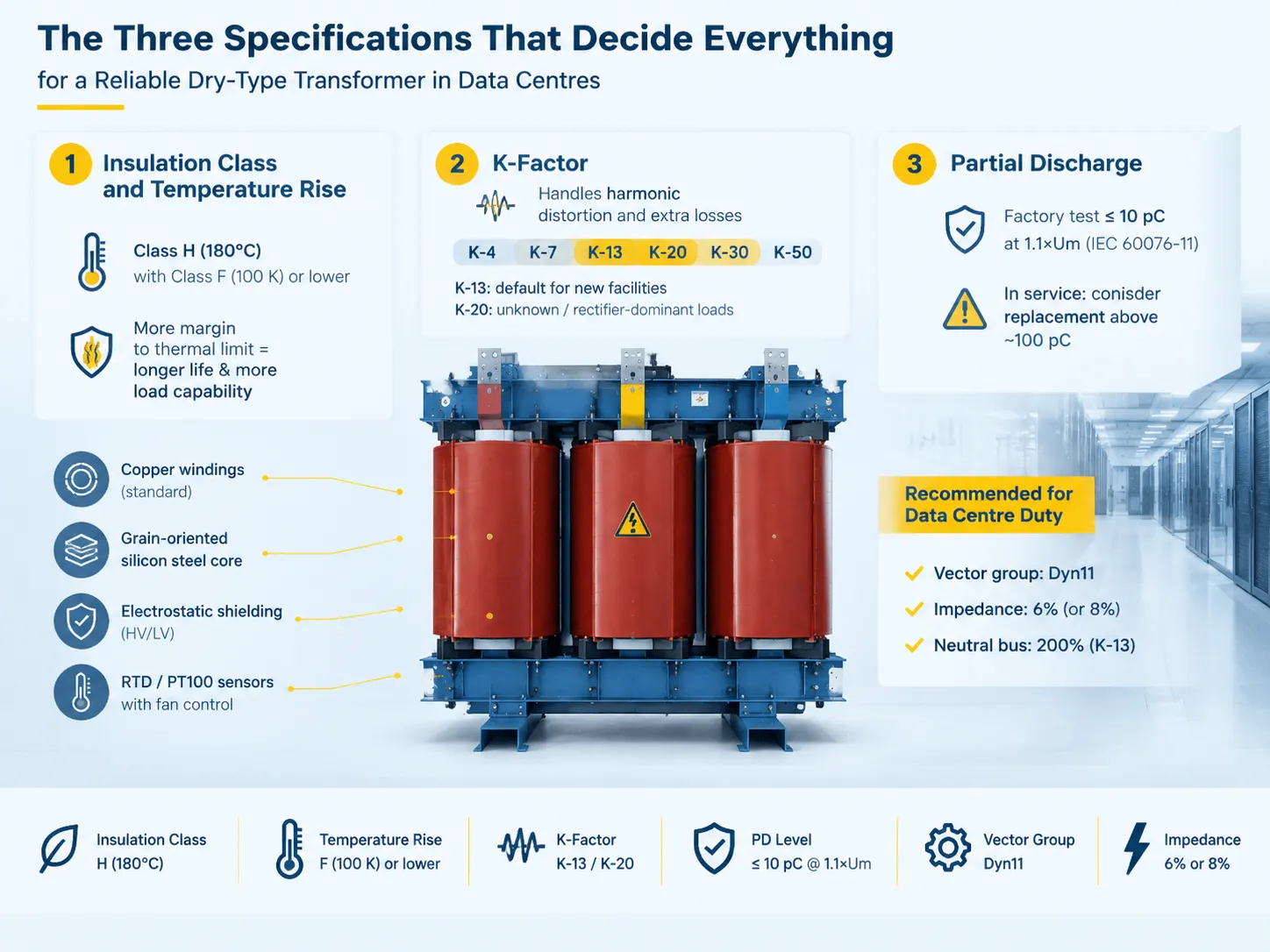
絶縁クラスと温度上昇
ANSI/IEEE C57.12.01によれば、乾式変圧器は通常、220℃の絶縁システムに対して、40℃の環境で80、115、または150Kの温度上昇で定格されています。したがって、同じ機器での温度上昇が低いほど、熱的制約に対する余裕が大きくなり、絶縁寿命が延び、過負荷に対する容量が生まれます。.
IECの観点から、絶縁クラスはクラスF(155℃)およびクラスH(180℃)に対応し、定格負荷中に観察されるクラスB温度上昇(80℃)を伴います。データセンターの使用においては、クラスFのクラスB温度上昇を伴うクラスH絶縁を要求するのが標準的な慣行であり、これは変圧器の運転中に観察される温度よりもかなり高い温度で特徴付けられる絶縁を意味し、運転中に生成される高調波損失を放散する余地を残します。.
これは、入札のためにその価値を下げるために最も頻繁に修正される仕様であり、8年後に失敗する製品です。.
Kファクター
Kファクター評価は、変圧器が熱的制限を違反することなく放散できる損失のレベルを決定します。これは、IEEE C57.110出版に従って計算されます。UL 1561は、Kファクター加熱評価、K-1、K-4、K-9、K-13、K-20、K-30、K-40、およびK-50評価を認識しています。.
選択は実際の負荷特性に依存します:
| 負荷プロファイル | 推奨Kファクター | 一般的な高調波成分 |
|---|---|---|
| ƒ‘ルスUPS整流器を備えたレガシーサーバー | K-13 | 30–40% THD |
| ƒ‘ルスまたはIGBT整流器を備えた最新のサーバー | K-7 | 15–25% THD |
| アクティブ高調波フィルターで完全に最適化 | K-4 | 10% THD未満 |
| 混合負荷、高密度、未知の将来の成長 | K-20 | 最大マージン |
高調波分析を受けていない新しい設置の場合、K-13は慎重な標準と見なされ、負荷の混合が不明な場合はK-20が義務的な数値とされます。K-20は整流器負荷のみに対して最も一般的に指定される値でもあります。.
K評価の変圧器は、単に重いコア以上のものを含みます。高調波フラックスのために低いフラックス密度を利用し、より大きなニュートラルを持っています。K-13変圧器は、トリプル高調波がニュートラルで相殺されるのではなく、ニュートラルに合計されるため、200%の相評価に対してニュートラルバスが評価されています。.
K評価の変圧器がない場合の結果は明らかです。高調波電流は渦電流損失を増加させ、その結果、温度が上昇し、絶縁劣化が加速します。高調波フラックスはまた、ピーク電圧を高めるため、すべての高調波値が合計されると、定格ピークの1.25-1.5を超えるピーク値が発生し、部分放電の発生の非常に高い確率につながります。.
部分放電
部分放電は、高標準のキャストレジン変圧器と経済的に製造されたものを区別するために定義されます。IEC 60076-11によれば、PD率は、湿気の多いまたは屋外の変圧器に適用される環境カテゴリE2のために、定格電圧の1.1倍の動作電圧で最大10 pCであるべきです。テスト電圧1.1×Umで10 pCを超えるPD読み取りを示す工場報告は受け入れられません。.
操作に関しては、しきい値が変化します。PD値が運転電圧で約100 pCを超えると、絶縁がすでに損傷しており、交換の必要性が問われることになります。PDの進行性と、問題が外部からは見えないという事実は、購入時に工場試験を要求し、その後も監視する必要があることを示唆しています。.
データセンターの電源ユニットの仕様は以下のようにすべきです:
- 絶縁、クラスH(180 °C)、温度上昇、Fクラス(100 K)以下。.
- Kファクター、少なくともK-13、または整流器または不明な負荷の場合はK-20、調和負荷での工場受入れによって確認されること。.
- ベクトルグループDyn11はUPS入力標準として。.
- インピーダンスは、強化電源用に6%、または短絡電流を減少させることを目的とする場合は8%であるべきです。.
- 静電シールドは、高電圧コイルと低電圧コイルの間に配置され、ゼロシーケンス高調波の循環を避ける必要があります。.
- PDはIEC 60076-11規格に従って工場で試験され、確認されるべきです。.
- 巻線材料は銅、コア材料はシリコン鋼、温度測定装置はRTDまたはPT100で冷却システムを備えています。.
この要件のセットは、最も安価な入札ではなく、施設が次回の更新を予定しているときにもまだ稼働しているユニットを生み出します。バイヤーが仕様を書く前に考慮すべき理由は、このガイドに示されています。 データセンター用の乾式変圧器を選択する際の重要な指標と落とし穴, 、入札書類が出される前に読む価値があります。.
データセンターの業務に適した乾式ユニットの種類
商業的に関連する構造のタイプは3つあります。.
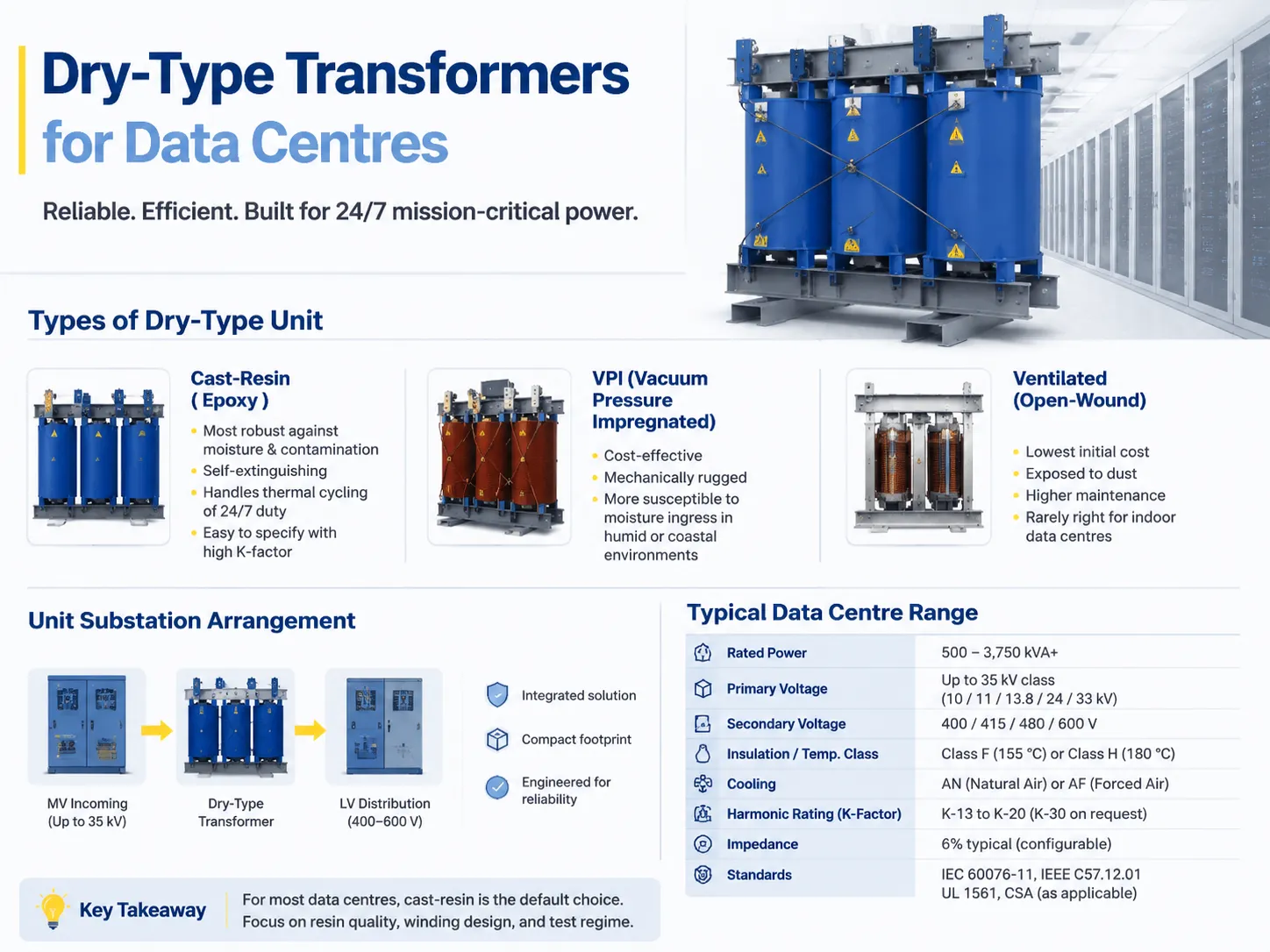
- キャストレジン(エポキシ)乾式タイプ。巻線はキャストエポキシ樹脂で封入されています。これは、湿気や汚染に対する最大の耐性を持ち、自己消火能力と2427の動作サイクルの熱サイクルに耐える能力を持つため、データセンターにとって最良の選択です。さらに、高Kファクターを使用することで仕様が最も簡単です。.
- 真空圧浸漬(VPI)。巻線は真空下でワニスに浸漬されています。これはキャストレジンよりも安価で機械的に耐性がありますが、湿度や海に近い条件では湿気の浸透に対してより脆弱です。.
- 通気性のあるオープンワウンド。最も安価です。この決定がデータセンターの内部にとって十分良いことは稀です。.
It comes down usually to the choice of cast resin and the difference in quality of the resin, the winding design and the testing process.
The Unit Substation Arrangement
Data centres are increasingly opting to purchase the complete power chain as one integrated, engineered product instead of acquiring the system as a series of components, such as the medium-voltage incoming section, cast resin transformer and low-voltage distribution system.
The pros of this approach include simplification of the interface and saving space. The cons are the issue of price comparison on single-source products and the fact that specifications of all parts involved become more important when welded into one component.
| パラメータ | Typical data centre range |
|---|---|
| 定格電力 | 500–3,750 kVA, larger for hyperscale |
| 主電圧 | Up to 35 kV class — commonly 10, 11, 13.8, 24 or 33 kV |
| 副電圧 | 400, 415, 480 or 600 V |
| Phases and frequency | Three-phase, 50 or 60 Hz |
| Insulation / temperature class | Class F (155 °C) or Class H (180 °C) |
| 冷却 | AN natural air, or AF forced air adding roughly 33–50% capacity |
| Harmonic rating | K-13 to K-20, K-30 on request |
| インピーダンス | 6% typical, configurable |
| 効率 | DOE 2016 / EU Ecodesign / NRCan minimums |
| 規格 | IEC 60076-11, IEEE C57.12.01, UL 1561, CSA as applicable |
Before using forced-air cooling in design, it is essential to get a proper understanding of how this process works. Forced-air cooling stage helps increase kVA output, but it does this by drawing heat away from the device and not by enhancing the insulation. In a setup with N+1 cooling configuration, this is acceptable. However, in case of using a single fan setup, it is important to understand that an AF value will not be important as soon as one of the devices fails.
This means that the list with kVA output of 500, 630, 800, 1000, 1250, 1600, 2000, and 2500 should not be treated as just a menu that one can simply pick the required value from. The selection follows the load calculation, and a cast-resin platform covering the 6–10 kV distribution ratings — the SCB-series dry-type distribution transformer range is a typical example — will usually have the right frame available in the ladder, which is a consideration when the alternative is a custom build and a longer lead time.
Redundancy and Where the Transformers Sit
Selecting the data centre transformer is closely linked to the fault-tolerant topology that it is designed to support. The rating of the transformer is determined by the topology of the setup that is either Tier III or Tier IV based on N+1 or 2N arrangement of transformers.
- N+1- A spare transformer or an ability to lose 1 transformer from a group without tripping the load. This is the usual arrangement in Tier III facilities.
- 2N- Two fully rated but independent paths of supply. This means there can be 2 transformers feeding the same group of servers, which is common in Tier IV setups.
- Block redundancy/distributed redundancy- the power supply from transformers is shared by blocks, which leads to less kVA being installed.
When calculating the transformer size, it must consider the actual IT load instead of connected load. Remember that the physically selected size of the transformer affects the PUE, because even if the transformer is working below its capacity, it still results in significant losses that the facility will have to pay for. The possibility of using a number of small transformers instead of one large unit should be carefully evaluated. This is a design decision, not merely specification.
Where a facility is configured around a defined critical infrastructure topology, the arrangement of incoming supply, transformer and distribution is the part that decides whether a single failure is survivable, and the configuration options are set out in this look at power distribution solutions for data centre and critical infrastructure.
Efficiency Regulation Is Not Optional
The efficiency requirements are obligatory in major markets and forces equipment to be different in size as well.
- USA: Development of the 2016 Department of Energy (DOE) efficiency regulation, based on NEMA TP-1, refers to the distribution transformers. In this case, more core materials and conductors will be needed to manufacture equipment that satisfies current regulations.
- European Union: Regulation EC 548/2014 defines the minimum efficiency requirements for transformers with capacity higher than 1 kVA for 50 Hz circuits. Tier 1 requirements entered into force on July 1, 2015, while Tier 2 ones came into force on July 1, 2021. Tier 2 defines maximum no-load and load losses in watts for medium-sized dry transformers and establishes minimum efficiency for the rated capacity above 3,150 kVA.
- Canada: It sets the necessary minimum efficiency requirements for similar classes of transformers.
There can be two consequences of this requirement. Firstly, the compliance transformer should be larger in size and weight compared to the non-compliance transformer of the same rating. As a result, the construction space may be exposed to some changes. Secondly, efficiency requirement and K-factor pressure are directed in the same way in relation to manufacturing, which means that the compliance transformer is heavier in terms of conductive materials.
Installation Notes Specific to Data Centre Work
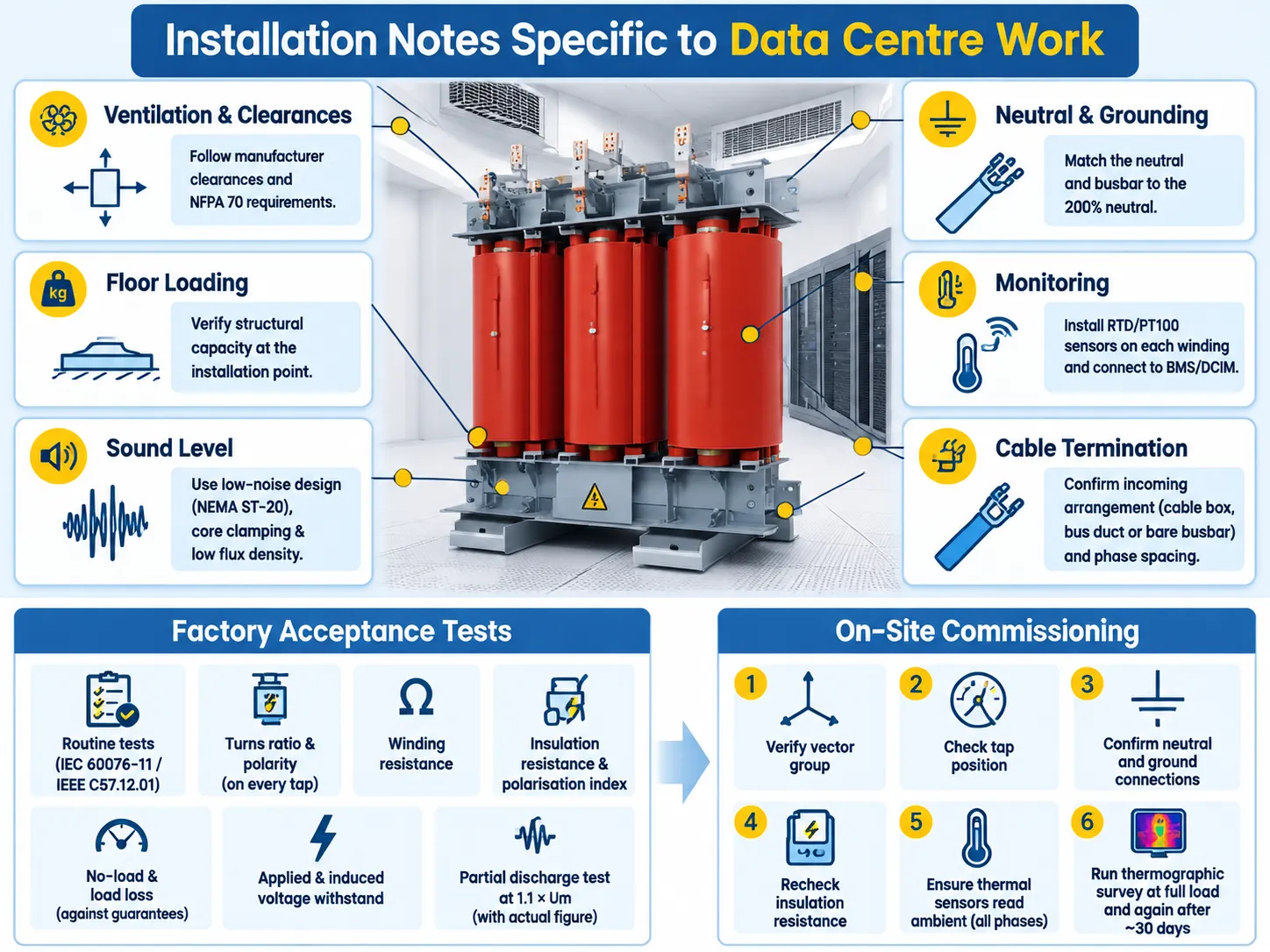
- Ventilation and clearances – be sure to check with the manufacturer for minimum clearances in all directions and above as well as against NFPA 70 installation requirements. Because a cast resin transformer dissipates the losses in the room, the air handling system must be sized to handle the losses.
- Floor loading – 2000 kVA of a cast resin transformer and enclosure means heavy equipment. It is important to confirm capacity of installation location, not just that of the entrance.
- Noise rating – quiet version per NEMA ST-20 is important if the transformer is located near occupied space. This is about core clamping and low flux density design.
- Grounding and neutral – A K-rated transformer with 200 % neutral means that the conductor and bus bar need to be sized accordingly for the downstream portion of the installation. This means that choosing the transformer and undersizing the neutral bar is bad practice.
- Monitoring – install RTD or PT100 sensors to all windings and connect them to the building management system or DCIM. This is the cheapest predictive maintenance you can get in dry-type transformers.
- Termination of cables – confirm whether this is cable box, bus duct or open busbar arrangement at the place of connection and check the phase distance at that point instead of a delivery site.
Acceptance Testing: What to Ask For
The factory acceptance test documentation must include at least the following elements: ordinary tests as required by IEC 60076-11/IEEE C57.12.01, turns ratio and polarity information for each tap, winding resistance value, insulation resistance value and polarization index value, values of no load and load losses from guaranteed numbers, results of the applied voltage withstand test and the induced voltage withstand test, result for the partial discharge test with 1.1 times Um indicated in the document as actual number.
If the transformer is K-rated, it is important to indicate some information on harmonics loading as per chosen K-factor value. Moreover, in cast resin transformers that operate in data centers, some checks must be conducted to ensure that there are no voids, cracks, or incomplete resin fill in the winding encapsulation.
At the installation site, before energizing the transformer and starting operation: confirm the vector group, tap position, neutral, and ground connection, insulation resistance as well as reading temperature in all the three phases. In addition, it is recommended to conduct a thermographic test at full load and to repeat it in a month afterward to check the ongoing temperature reading of both phases.
A structured commissioning sequence is worth following rather than improvising, and the routine tests that a dry-type unit should go through on arrival are set out in this seven-step routine test programme for dry-type transformers. Skipping the tests that are awkward to repeat after energisation is how a defective unit reaches full load before anyone knows.
Brands and How the Range Maps
The market for dry-type data center facilities can be divided into two groups: first is the construction of the entire power train and integration of the transformer into the overall design by global electrical companies, and second is the manufacturing of the transformer on specialized manufacturers’ facilities according to their specifications.
In the case of the specialized option, the key aspect would be whether the supplier has its whole production area for this purpose. Suppliers who can do cast resin dry-type projects from 6-10 kV to 35 kV with pre-tested DC solution would be working with the entire project from the same manufacturing premises instead of sourcing from different producers every time. This holds more value with phased projects than with one-time orders since the next batches of transformers produced have to work together. Subian fits this model as it is a Chinese company with dry-type and oil-immersed transformers fulfilling electrical, high-voltage and amorphous alloy transformers for international projects.
Speaking about the competitive analysis, SCB13 and its equivalents in cast resin technology is the platform on which all data center buyers compare the offers of local markets since the parameters used for each type are very similar even though the certification, methods of production may be different. That comparison is worked through in this note on how SCB13 dry-type transformers compare with international cast-resin designs, including where the differences are real and where they are documentation.
Normal price positioning works in a usual way: global brands at the top, specialist producers significantly below and the gap is becoming wider with the increase of kVA rating and the amount of customisation involved. What a buyer should not do is to compare a fully specified K-13 Class H unit with a K-1 Class F catalogue cost and thus surmise that that the cheaper product is indeed a bargain.
よくある質問
Why do data centres use dry-type instead of oil-filled transformers?
Fire safety and site. Cast-resin winding does not burn and has no combustible liquids, so this equipment can be installed indoors and near the load without an oil containment facility. Maintenance is easier since there is no oil testing or gas relay or breather. This implies lower temperature tolerance that makes insulation type, temperature rise and K-factor more important for dry-type data centres than for oil-filled distribution devices.
What K-factor do I need for a data centre transformer?
K-13 is the conservative option for a facility with no harmonic study and is appropriate for legacy servers using 6-pulse UPS rectifiers with THD of 30–40%. K-20 is the correct option for loads dominated by rectifiers or loads that may grow in the future. K-7 is appropriate for new installations using 12-pulse or IGBT rectifiers with THD of 15–25%, while K-4s are used only where active harmonic filters have brought down the THD to 10% or below. Always round up to the next standard rating.
How do I size a transformer for a data centre?
Consider the actual load of the IT equipment, as well as that of the UPS design. Apply redundancy through either an N+1 or a 2N system. Air caching solutions are required only for those areas where it is redundant. An excessively loaded device will have high no-load losses, thus smaller transformers with high efficiency in partial load operation can be better than one larger device in terms of capital expenditure and efficiency measures (PUE).
What partial discharge level is acceptable?
According to the stipulations of IEC 60076-11, at Environmental Category E2, the allowed PD level is not above 10 pC at 1.1 of the rated voltage. Any factory certificate indicating a higher value must be invalidated. Under operating conditions, values above approximately 100 pC at the nominal operating voltage means the insulation condition must be considered unsatisfactory and that the insulation will have to undergo further evaluation and likely replacement.
参考文献
- UL Solutions — UL 1561 for dry-type general purpose and power transformers, including recognised K-factor ratings
- Eaton — dry-type transformer application guidance, K-factor selection and harmonic loss explanation
- Schneider Electric — dry-type transformer specification data, temperature rise classes and efficiency compliance
- US Energy Information Administration — data centre electricity consumption and load growth analysis
- US Department of Energy — transformer efficiency standards and distribution transformer energy conservation rulemaking
- Uptime Institute — data centre tier classification, redundancy topologies and availability research
- ASHRAE — thermal guidelines and technical resources for data processing environments
- International Electrotechnical Commission — IEC 60076-11 for dry-type power transformers and IEC 60076-1 general requirements
結論
A dry-type transformer chosen for a data center has three key elements: the insulation category that exceeds significantly the temperature range of the transformer; the K factor that classifies the level of harmonic distortion for the operating load; and partial discharge testing. Properly adjusted insulation with a combination of thermal monitoring, energy efficiency, and extensive factory testing should ensure that the dry transformer will work for twenty years without failures. Any problems that might arise will become apparent only after eight years as a winding fault and by this time all savings provided by the contract will have been spent already.