


Ser um engenheiro elétrico comissionado para atualizar uma instalação industrial com uma capacidade de 15 MW, sendo instruído a interromper o início da instalação de máquinas até que a mudança da tensão de fornecimento de 33 kV para 400 V cause uma série de inconvenientes. Tendo as especificações do transformador em mãos e possuindo cotações fornecidas por fornecedores para a faixa entre $42.000 e $86.000, você não tem tempo a perder, pois seu chefe exige resultados até sexta-feira. No campo da engenharia elétrica, determinar o tipo correto de transformador não significa buscar a solução mais barata. O que isso implica é combinar todos os parâmetros, incluindo classificações nominais, perdas, métodos de resfriamento, normas e perfis de carga.
Em resumo, ao decidir sobre o transformador de potência para o trabalho de engenharia, o primeiro passo é encontrar o kVA de projeto que depende da carga total relacionada aos fatores de diversidade e crescimento. O próximo passo requer selecionar a classe de resfriamento (ONAN ou ONAF para unidades preenchidas com óleo e AN ou AF para transformadores secos) e identificar produtos que estejam em conformidade com a norma IEC 60076.
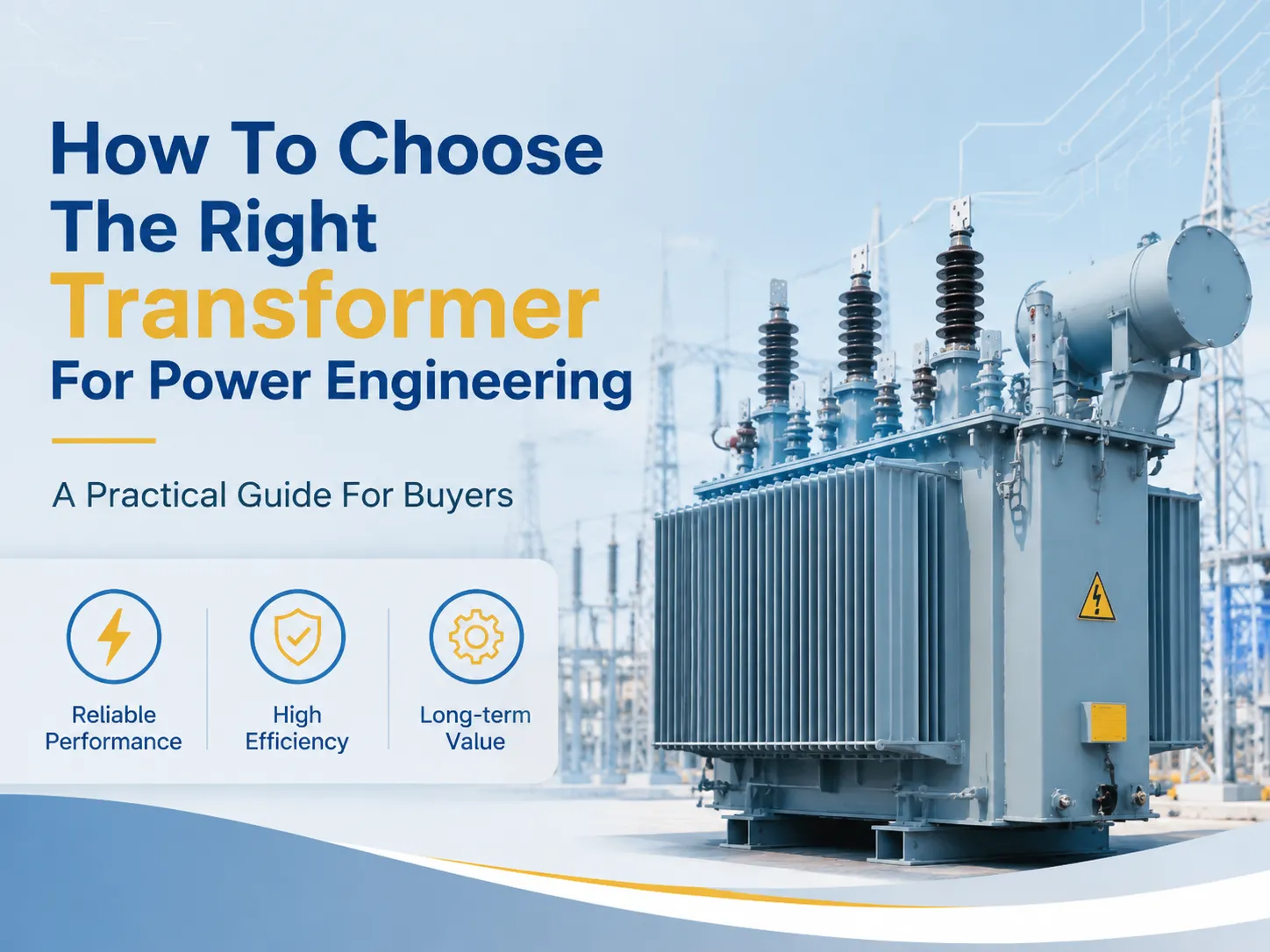
O Método de Seleção em Seis Passos
Cada compra de transformador, desde o modelo de distribuição de 250 kVA até o transformador de subestação de 60 MVA, deve seguir esses procedimentos. Ao seguir esses passos, você não acabará com uma unidade superdimensionada e cara ou uma unidade subdimensionada que falhará durante o verão:
- Determine o perfil de carga. Analise cada carga com seu fator de potência e cronograma de operação. Calcule a carga de pico em kW e converta-a para kVA com a ajuda do fator de potência.
- Preveja o crescimento e a contingência. Multiplique a carga de pico por 1,1-1,25 para garantir uma margem para o crescimento futuro da carga e converta-a para a classificação kVA padrão vendida no mercado.
- Encontre a interface de tensão. Certifique-se de verificar as tensões, o grupo vetorial e se o controle de tensão é necessário.
- Selecione o tipo de construção. Escolha entre design imerso em óleo e tipo seco considerando a segurança contra incêndios, localização e fator de carga.
- Examine as perdas. Compare as cotações de perda de fiação com as cotações de perda em vazio avaliando as fórmulas de perda capitalizada.
- Verifique as normas e testes. Verifique a conformidade deste transformador com as normas IEC 60076 ou IEEE C57.12 antes de encomendá-lo.
O que “Transformador Certo” Significa em Engenharia Elétrica
O transformador pode ser considerado eficaz se cumprir quatro critérios simultaneamente: fornece a quantidade necessária de energia, opera sem ultrapassar os limites máximos de temperatura, fornece a regulação de tensão necessária para a rede elétrica e seus clientes, tem as menores perdas de energia e atende aos requisitos e normas regionais para transformadores.
Na engenharia elétrica, o transformador é frequentemente a máquina mais cara em qualquer instalação e seu funcionamento defeituoso leva a grandes perdas para seu proprietário. Em termos de confiabilidade, os dados de várias fontes, como CIGRÉ e grupos de trabalho da IEEE, sugerem que um nível normal de falhas em transformadores de distribuição é em torno de 0,5 – 2 por cento por ano, com os problemas mais comuns relacionados a sistemas de isolamento e acoplamento.
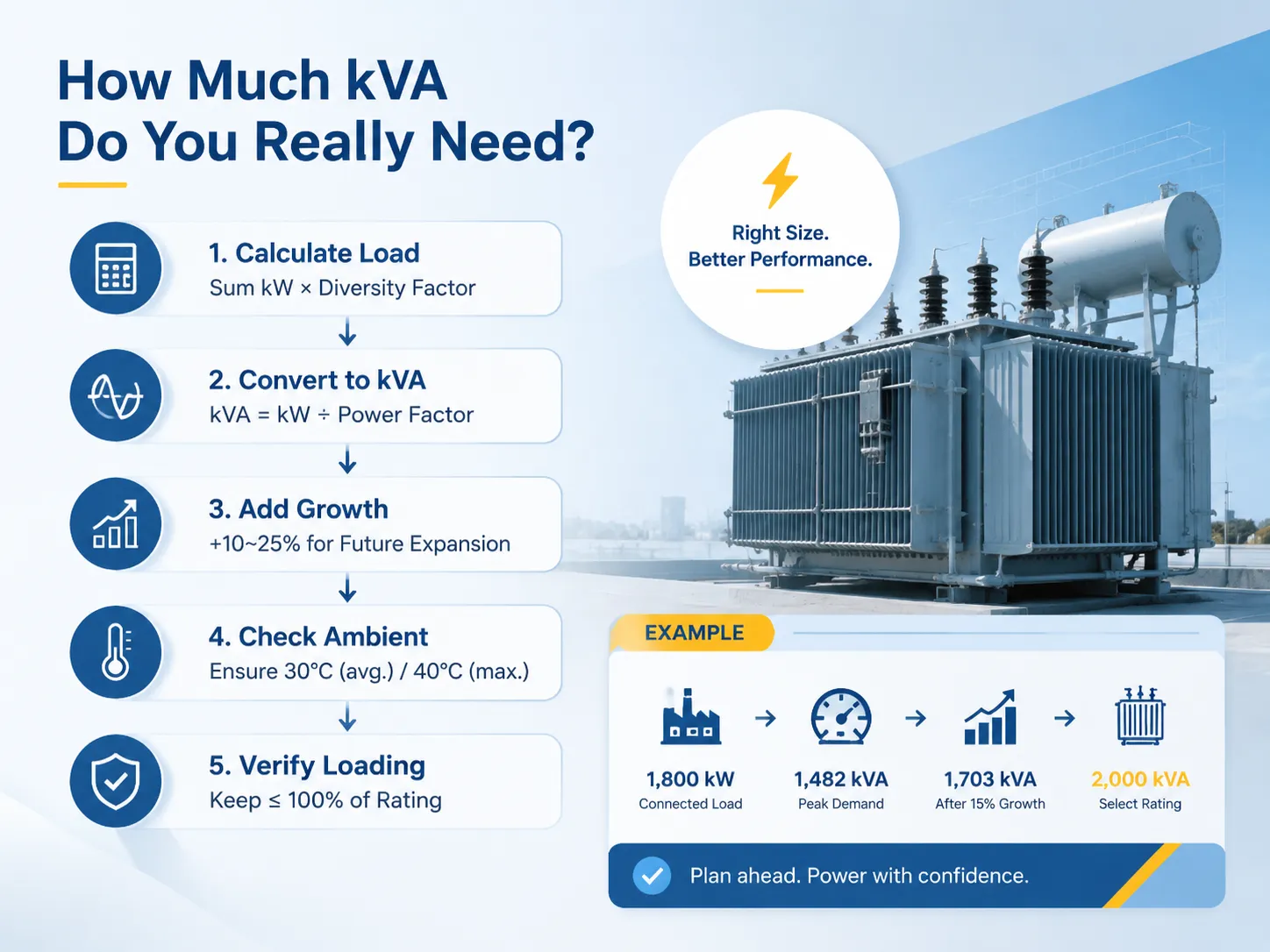
Cálculo de Carga: Quanto kVA Você Realmente Precisa?
O erro de seleção que ocorre com mais frequência é estimar a carga incorretamente. Use o método abaixo em vez disso:
- Some os kW de placa dos carregamentos no alimentador a jusante e, em seguida, aplique o fator de diversidade. Locais industriais geralmente operam entre 60 a 85 por cento da soma dos valores de placa, já que motores e equipamentos geralmente não operam na carga máxima ao mesmo tempo.
- Para encontrar kVA, basta converter kW em kVA: kVA = kW ÷ fator de potência. O fator de potência típico está entre 0,8 e 0,9; se o fator de potência for inferior a 0,7, isso indica que o transformador está operando com potência reativa enquanto deveria estar operando com potência ativa.
- Para contabilizar a expansão, use um fator de crescimento de 10-25 por cento e arredonde o número para a classificação mais próxima (ou seja, 630, 800, 1.000, 1.250 e 1.600 kVA).
- Para levar a temperatura em consideração, meça a temperatura ambiente. De acordo com as normas IEC 60076-2, a temperatura média anual é considerada em torno de 30℃, enquanto a temperatura máxima não deve exceder 40℃. Em locais tropicais, deve-se usar desclassificação ou classificação mais alta, pois um aumento de 10 graus na temperatura leva a uma diminuição significativa na vida útil do isolamento.
- Estude o fator de carga de acordo com o ciclo de trabalho. Se o transformador operar continuamente com 80 por cento de sua capacidade, as perdas totais e as temperaturas de pontos quentes estarão adequadas. Ao mesmo tempo, se o transformador estiver carregado até 100 por cento, é necessário verificar as curvas de sobrecarga da IEC 60076-7.
Como exemplo, uma fábrica tem 1.800 kW de carga de motor conectada. Seu fator de diversidade é 0,7 e seu fator de potência é 0,85. A demanda de pico pode ser calculada da seguinte forma: 1.260 kW / 0,85 = 1.482 kVA. Considerando o fator de crescimento de 15 por cento, a demanda será de 1.703 kVA. Portanto, o arredondamento levará a uma classificação de transformador de 2.000 kVA.
Compreendendo Perdas e Classificações de Eficiência
As perdas em transformadores consistem em dois componentes que são fornecidos na IEC 60076-1 e testados na fábrica.
| Tipo de Perda | Definição | Funciona | Valores Típicos | Valor Capitalizado |
|---|---|---|---|---|
| Perda a vazio (ferro) | Perda do núcleo devido à magnetização; presente 24/7 | Sempre, mesmo em carga zero | 1,5–4 kW por MVA (por exemplo, 10 MVA: 15–40 kW) | $2.000–$6.000 por kW |
| Perda de carga (cobre) | Perda de enrolamento devido à corrente de carga | Proporcional ao quadrado da carga | 6–13 kW por MVA em carga total | $400–$1.200 por kW |
| Perda total e eficiência | Eficiência = saída/entrada | — | 98,5–99,8% para unidades de distribuição/potência | — |
Os números de eficiência parecem impressionantes até que você faça a aritmética. Um transformador de 1.000 kVA com 98,8 por cento de eficiência perde 12 kW continuamente. A $0,12/kWh e com uma carga média de 80 por cento, isso equivale a aproximadamente 12 × 0,8² × 8.760 horas × $0,12 ≈ $10.700 por ano em perdas. Ao longo de 25 anos, as perdas de energia podem atingir 60–90 por cento do preço de compra do transformador, razão pela qual a avaliação de perdas de transformadores é uma prática padrão para compradores de utilidades. Núcleos de liga amorfa reduzem a perda em vazio em 60–70 por cento em comparação com o aço silício orientado por grão convencional, com um prêmio de preço de compra de aproximadamente 10–25 por cento.
Imerso em Óleo vs. Tipo Seco: Uma Tabela de Decisão
A maior decisão de construção é entre imerso em líquido e tipo seco. A tabela abaixo resume as compensações para projetos típicos de engenharia de potência:
| Critérios | Imerso em Óleo (Óleo Mineral) | Tipo Seco (Resina Fundida / VPI) |
|---|---|---|
| Faixa de classificação típica | 25 kVA – 300+ MVA | 50 kVA – 20 MVA |
| Eficiência / perdas | Melhor para unidades grandes | Bom; perdas ligeiramente maiores em tamanhos grandes |
| Risco de incêndio | Óleo inflamável; requer contenção | Auto-extinguível (classe F1), baixa carga de incêndio |
| Interno / externo | Típico externo; interno precisa de cofre | Preferido interno; externo precisa de invólucro com classificação IP |
| Manutenção | Teste de óleo, respiradores, DGA | Mínimo; enrolamentos limpos |
| Preço típico (1.000 kVA) | $6.000–$14.000 | $10.000–$24.000 |
| Melhor aplicação | Subestações, utilitários, grande indústria | Edifícios, centros de dados, túneis, offshore |
Normalmente, normas de segurança contra incêndio e requisitos de seguro influenciam essa escolha. Por exemplo, códigos de segurança contra incêndio e regulamentos locais geralmente exigem transformadores secos ou transformadores de líquido retardante de chama (éster) em edifícios, hospitais, túneis e plantas industriais. Em contraste, sistemas de subestações e utilitários externos normalmente usam óleo mineral devido ao seu custo mais baixo e maior eficiência. Caso a sustentabilidade seja uma prioridade, transformadores de éster natural (óleo vegetal) podem ser uma solução adequada com um alto ponto de fulgor, enquanto seu custo é cerca de 5–15 por cento maior do que o custo de transformadores convencionais de óleo mineral.
Classificações de Transformadores por Aplicação
Compradores de engenharia elétrica encontram várias famílias de transformadores. Saber qual o seu projeto precisa evita confusão na especificação:
| Classificação | Classificação Típica | Uso Primário | Observações |
|---|---|---|---|
| Transformador de distribuição | 25–2.500 kVA | Passo de tensão final para consumidores de LV | Menores perdas por kVA possíveis; acessórios simples |
| Transformador de potência | 2,5–300 MVA | Subestações, transmissão, geração | OLTC, resfriamento complexo, testado em tipo |
| Unidade / gerador de aumento | 100–1.200 MVA | Interconexão de usinas | Maiores requisitos de confiabilidade |
| Transformador de forno / retificador | Personalizado | Fornos de arco elétrico, eletrólise, HVDC | Alta corrente, enrolamentos especiais |
| Transformador de aterramento | 100–2.000 kVA | Aterramento neutro, zig-zag | Dever de curta duração |
| Tipo seco / resina fundida | 100–10.000 kVA | Comercial, industrial, marinho | Seguro contra incêndio, baixa manutenção |
Principais Especificações que os Compradores Devem Verificar
Coloque os próximos parâmetros em seu documento de consulta e peça a todos os fornecedores que citem para eles. A falta de parâmetros é a razão mais comum para cotações de fornecedores não serem comparáveis.
| Parâmetro | Requisito | Por que isso é importante |
|---|---|---|
| Potência nominal | kVA calculado arredondado para tamanho padrão | Define tamanho, preço e perdas |
| Tensões e grupo vetorial | ex. 33/11 kV, Dyn11, 50 Hz | Interface de rede e operação em paralelo |
| Tensão de impedância | 4–12.5% | Níveis de falha, queda de tensão, operação paralela |
| Classe de resfriamento | ONAN, ONAF, OFAF / AN, AF | Capacidade contínua vs. cíclica |
| Perdas sem carga / carga | Valores máximos declarados | Custo de energia e classe de eficiência |
| Nível de isolamento | BIL, por exemplo, 170 kV para classe de 33 kV | Resistência a raios e manobras |
| Comutador de derivação | DETC ±2×2.5% ou OLTC ±8×1.25% | Requisitos de regulação de tensão |
| Nível de ruído | 55–85 dB(A) | Licenças ambientais |
| Normas | Série IEC 60076 ou IEEE C57.12 | Base de aceitação e garantia |
Conformidade com normas: IEC, IEEE e Códigos de Rede Locais
Selecione sua família habitual antes de começar a olhar as cotações. A IEC 60076 domina fora da América do Norte, enquanto a IEEE C57.12.00 e a IEEE C57.12.90 determinam nos EUA e no Canadá. Entre os documentos da IEC, IEC 60076-1 (geral), IEC 60076-2 (aumento de temperatura), IEC 60076-3 (níveis de isolamento), IEC 60076-5 (resistência a curto-circuito) e IEC 60076-11 (tipo seco) são significativos.
Operadores de rede locais também impõem seus próprios padrões, ou seja, diretrizes nacionais de conexão para geração distribuída que determinam as faixas de tensão corretas e o conteúdo harmônico que determinará a escolha do comutador de derivação e da impedância. Solicite o documento que descreve as condições técnicas exigidas ao seu operador de rede antes de decidir sobre as especificações e os relatórios de teste de tipo que demonstram conformidade. Um transformador que falhou na inspeção de conexão à rede tornou-se um peso de papel muito caro.
Opções de marca e referências de preço realistas
O mercado abrange tanto players internacionais quanto fornecedores locais com preços competitivos. Os números mencionados abaixo mostram faixas FOB indicativas para um transformador de distribuição de 1.000 kVA e um transformador de potência de 10 MVA 33/11 kV; os números dependem das especificações e dos custos de matérias-primas.
| Marca | Origem | Distribuição de 1.000 kVA | 10 MVA 33/11 kV | Força |
|---|---|---|---|---|
| ABB | Suíça | $15.000–$28.000 | $180.000–$320.000 | Serviço global, referências de grau de rede |
| Siemens Energy | Alemanha | $16.000–$30.000 | $200.000–$350.000 | Transformador digital, profundidade de engenharia |
| Schneider Electric | França | $14.000–$26.000 | $170.000–$310.000 | Soluções em pacote e portfólio MV |
| Hitachi Energy | Suíça/Japão | $15.000–$27.000 | $190.000–$340.000 | Especialização em transformadores de grande potência |
| Grandes empresas coreanas (Hyundai, ILJIN) | Coreia do Sul | $12.000–$22.000 | $150.000–$280.000 | Qualidade consistente, laboratórios de teste robustos |
| OEMs chineses (TBEA, etc.) | China | $7.000–$14.000 | $90.000–$180.000 | Liderança em capacidade e custo |
| Exportadores chineses de médio porte (por exemplo, Jiangsu Subian Electric Power) | China | $6.000–$12.000 | $80.000–$150.000 | Engenharia personalizada, prazos de entrega rápidos |
Fabricantes internacionais podem cobrar preços mais altos com base em sua história, redes de serviço estabelecidas e investimentos em pesquisa e desenvolvimento, o que é extremamente importante em caso de ativos de energia de alto valor. Por outro lado, fabricantes chineses representam quase toda a produção global e operam de acordo com os padrões IEC 60076, utilizando a infraestrutura para certificação de exportações. A Jiangsu Subian Electric Power é uma empresa chinesa com sede na Província de Jiangsu, que oferece soluções em conformidade com as regulamentações IEC para transformadores com classificação de até 110 kV em diferentes regiões. As principais vantagens dos produtos Subian são flexibilidade em engenharia, prazos de entrega curtos e transparência em testes. A China possibilita uma economia de 20-40% em comparação com o preço dos fabricantes europeus, uma vez que a qualidade dos produtos chineses não é inferior.
Erros Comuns de Seleção e Como Evitá-los
- Superdimensionamento para estar no lado seguro. A faixa de operação mais eficaz do transformador é de 40-80 por cento de carga. Um transformador muito grande significa perda de investimento e redução da eficiência; assim, é necessário medir os dados de carga e calcular o tamanho do transformador.
- Falha em considerar harmônicos. Drives de velocidade ajustável criam corrente harmônica, levando a perdas adicionais e aquecimento (carga k-factor). Para várias instalações de drive pesado, a classificação k-factor deve ser escolhida ou o transformador deve ser desclassificado.
- Comparação de cotações com escopos diferentes. Se uma cotação inclui o trocador de tomadas, outra pode não incluir. É necessário comparar o escopo real da cotação.
- Desconsideração da altitude e do ambiente. Tendo instalado o transformador a uma altitude superior a 1000 m, a declassificação adequada de acordo com a IEC 60076-1 deve ser realizada.
- Compra antes da avaliação das perdas. Dispositivos aparentemente semelhantes podem diferir em $10000 em perdas.
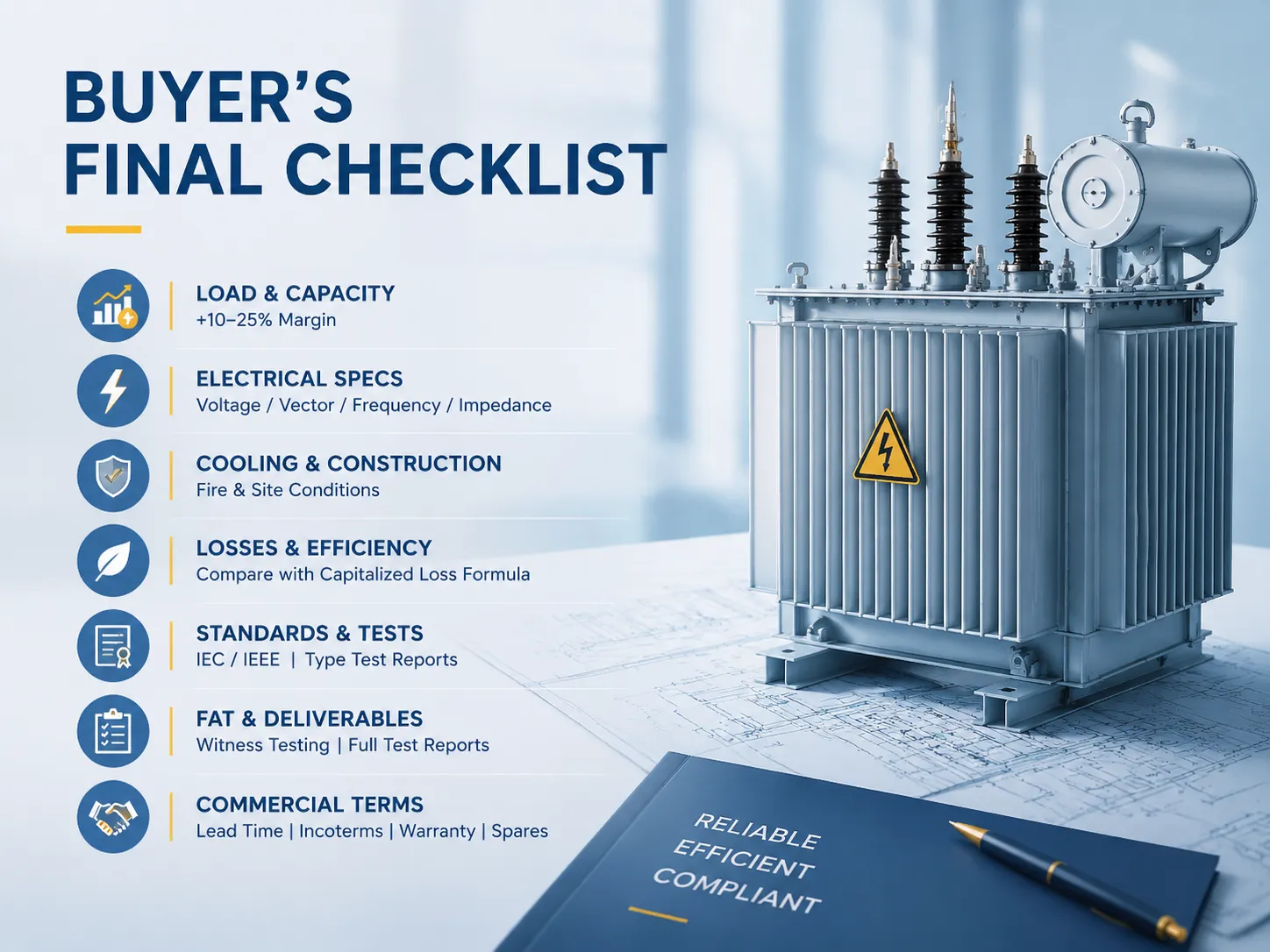
A Lista Final do Comprador
- O cálculo do perfil de carga foi realizado e o kVA foi ajustado por um adicional de 10–25 por cento de margem.
- A tensão, grupo vetorial, frequência e impedância foram determinadas.
- O tipo de resfriamento e o tipo de construção foram escolhidos com base nas condições de incêndio e nas condições do local.
- As perdas foram estimadas de acordo com a fórmula de perda capitalizada.
- A família padrão foi verificada (IEC 60076 ou IEEE C57.12), e o relatório de teste de tipo foi solicitado.
- O escopo do FAT foi acordado, o que incluiu o procedimento para testes e entrega do relatório de teste completo.
- O prazo de entrega, Incoterms e garantia (12 -60 meses) foram confirmados.
Perguntas Frequentes
Como calculo a classificação de kVA que meu projeto precisa?
Para calcular a capacidade de transformador necessária, basta somar o total da carga conectada em quilowatts, aplicar o fator de diversidade (geralmente 0,6-0,85 para cargas industriais), dividir esse número pelo fator de potência para converter quilowatts em quilovolt-amperes, e então adicionar 10-25% para crescimento e arredondar para cima. Por exemplo, 800 kW com fator de potência de 0,85 usando um fator de diversidade de 0,8 resulta em cerca de 753 kVA, que pode ser arredondado para 1.000 kVA com crescimento.
Qual é a eficiência típica de um transformador de potência moderno?
Normalmente, transformadores de distribuição alcançam eficiências de aproximadamente 98 por cento a 99,5 por cento, enquanto grandes transformadores de potência podem atingir eficiências de aproximadamente 99,5 por cento a 99,8 por cento. No entanto, não são os números de eficiência relativa que são significativos, mas os valores absolutos. Por exemplo, para um transformador de 10 MVA, a perda será de 30 kW (em carga total) a 70 kW. Dado o preço da eletricidade ($0,12/kWh), as perdas a cada ano podem somar uma quantia bastante significativa de dinheiro.
Quanto custa um transformador de 1.000 kVA em 2025–2026?
Normalmente, um transformador de 1.000 kVA custaria entre $6.000 a $14.000 de um fornecedor na China e cerca de $15.000 a $28.000 se o transformador for de um fabricante europeu. O custo final do transformador também incluirá entrega, seguro e encargos logísticos, que custarão um adicional de 8% a 15%. Você também deve verificar como os preços atuais do cobre e do óleo alteram os preços, então não se esqueça de obter cotações de preços oficiais válidas por 60-90 dias.
Devo escolher imerso em óleo ou tipo seco para meu projeto?
Selecione imerso em óleo para instalações que são ao ar livre ou onde cargas de utilidade e grandes indústrias predominam, desde que isso esteja em conformidade com os códigos de segurança contra incêndio. Selecione tipo seco para instalações que ocorrem em ambientes internos, ou em edifícios, túneis, centros de dados ou outras áreas onde há restrições decorrentes de riscos de incêndio ou problemas de manutenção. O custo dos transformadores tipo seco tende a ser 40-80 por cento maior do que o dos transformadores imersos em óleo com a mesma classificação de capacidade, mas eles evitam todo o processo de manuseio de óleo.
Quanto devo pagar a mais por perdas menores?
A avaliação de perda capitalizada produz aproximadamente $2.000–6.000 em benefícios de perda a vazio evitados por kW, e $400–1.200 por kW evitados em perdas de carga. Se um prêmio de entre 5–15 por cento do preço de compra for pago, geralmente é justificado se resultar em uma redução de perdas a vazio de 15–20 por cento ou mais.
Referências
- IEC 60076-1: Transformadores de Potência — Geral — O padrão fundamental para classificação, perdas e requisitos gerais.
- IEC 60076-2: Aumento de Temperatura — Define limites de aumento de temperatura e regras de classe de resfriamento para capacidade de carga.
- IEC 60076-7: Guia de Carga para Transformadores Imersos em Óleo — A referência para carga cíclica e de emergência além da placa de identificação.
- IEC 60076-5: Capacidade de Suportar Curto-Circuito — Verificação de projeto e requisitos de teste para robustez contra curto-circuito.
- IEEE — Publica dados da série C57.12 e do grupo de trabalho de confiabilidade usados na aquisição de transformadores e avaliação de perdas.
- NEMA — Associação comercial norte-americana que fornece orientação sobre eficiência e aplicação de transformadores.
- Jiangsu Subian Electric Power — Fabricante de transformadores em conformidade com IEC 60076 que apoia compradores de engenharia em todo o mundo.
Conclusão
O processo de seleção de transformadores em engenharia de potência baseia-se em decisões calculadas em vez de conjecturas aleatórias. Para isso, deve-se determinar a carga líquida e, em seguida, adicionar uma porcentagem apropriada para possível crescimento. Ao calcular as perdas econômicas resultantes da operação do transformador, escolhendo um tipo adequado de seu projeto em conformidade com os requisitos do local e de segurança contra incêndios, bem como confirmando a conformidade do equipamento com os cálculos de design de normas correspondentes, pode-se considerar a validade dos cálculos.
- Estime o tamanho de acordo com as medições obtidas, bem como a margem de tamanho necessária de dez a vinte e cinco por cento.
- Avalie as perdas que podem variar de $2.000 a $6.000/kW sem carga e de $400 a $1.200/kW com carga.
- Escolha o tipo de projeto de acordo com as condições de instalação e regulamentos de segurança contra incêndios.
- Verifique se o transformador está em conformidade com as normas IEC 60076 ou IEEE C57.12 com a ajuda de relatórios de teste de tipo.
- Compare as cotações obtidas para transformadores de acordo com as regras estabelecidas, levando em conta detalhes e FAT.