


Se você visitar a sala de comutação entre as duas extremidades de um túnel urbano de rodovia no meio da temporada de verão e ver sua condição, você teria a resposta. O transformador de 800kVA, que é a principal fonte de energia do sistema de ventilação e iluminação do túnel, está localizado dentro de uma sala com nível de umidade acima de 85% por meses. Todas as noites, a condensação se forma na superfície do tanque. As paredes da sala mostram manchas causadas por depósitos de sal devido aos materiais de descongelamento descarregados da pista. O histórico de manutenção relata três casos de desconexão dos relés este ano devido a problemas que causam a formação de curtos-circuitos nas barras coletoras de baixa tensão devido à umidade. O teste do óleo mostra que contém 42 ppm de água, o que está acima da taxa permitida de 30 ppm e causa degradação da isolação feita de papel.
Túneis são alguns dos lugares mais difíceis para usar transformadores devido à umidade que possuem. Este artigo apresenta 3 questões importantes que você deve ter em mente ao selecionar transformadores para túneis: proteção de isolamento e invólucro, seleção de materiais e proteção contra corrosão, e controle de ventilação e condensação.
A resposta breve é apresentada aqui: Ao selecionar um transformador para túneis úmidos, três coisas devem ser consideradas: (1) Proteção por invólucro e isolamento – para os tipos secos de transformadores, invólucros classificados como IP54 e IP55 devem ser especificados. No caso de transformadores imersos em óleo, tanques selados feitos de materiais resistentes à corrosão devem ser especificados; (2) Materiais resistentes à corrosão – invólucros feitos de aço inoxidável ou materiais revestidos a pó de alta resistência, acabamentos classificados para a classe de corrosividade C3/C4 de acordo com a ISO 12944, isolamentos tropicalizados com altos níveis de umidade; (3) Ventilação e prevenção de condensação – troca controlada de ar, aquecedores anti-condensação; controladores de umidade.
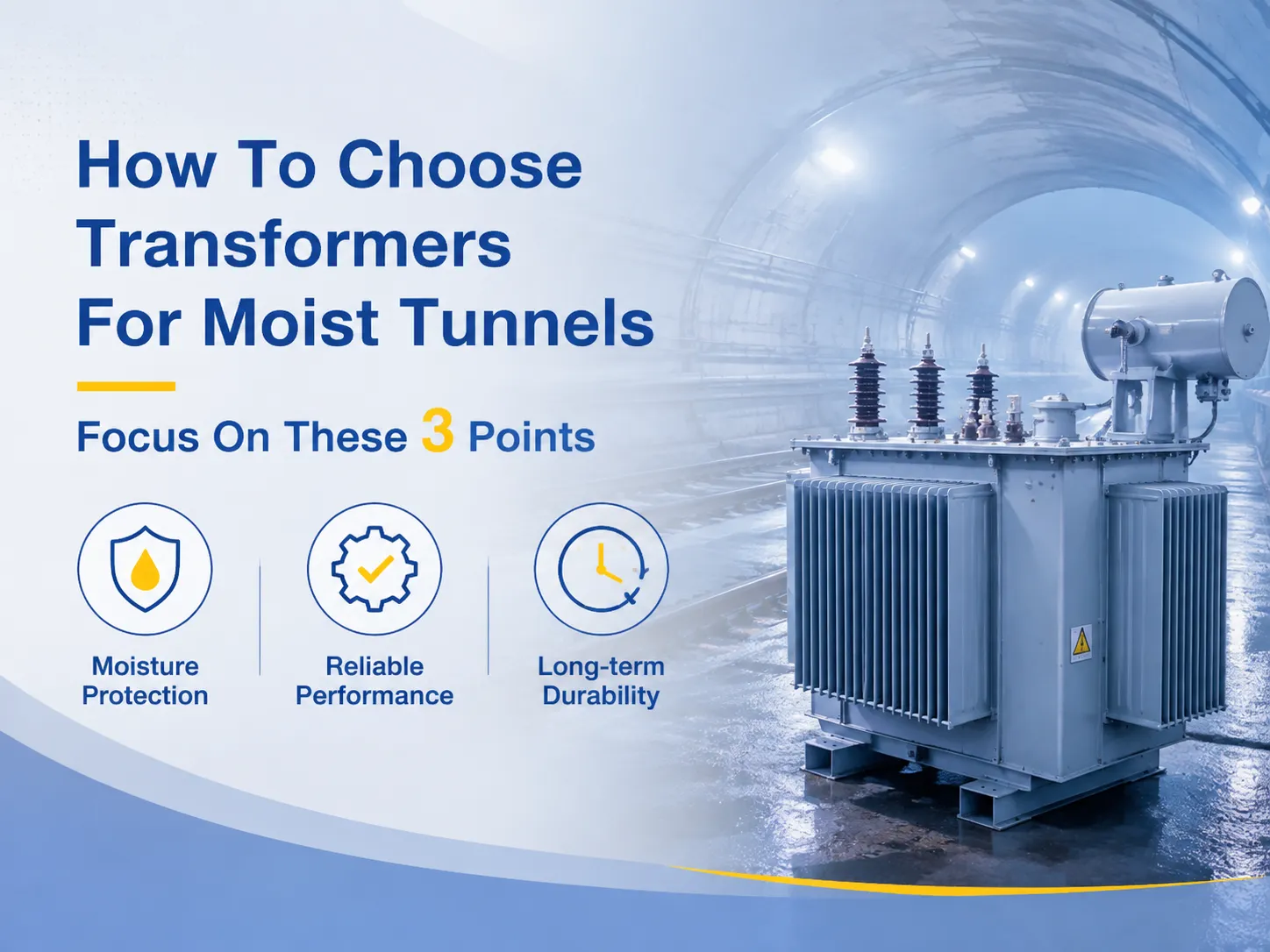
Por que Túneis Úmidos Destruem Transformadores
A falha de um transformador em ambientes úmidos não é geralmente um acidente elétrico instantâneo — em vez disso, é um processo químico e físico gradual. Aqui estão as principais causas:
- Umidade no isolamento: Em transformadores imersos em óleo, a umidade entra através de respiradouros, juntas e condensação. Níveis de umidade acima de 30 ppm no óleo do transformador aceleram o envelhecimento do isolamento de papel, reduzindo a vida pela metade a cada umidade duas vezes maior que o normal. Em 50–60 ppm, a formação de bolhas pode ocorrer durante sobrecarga e levar a uma falha dielétrica.
- Rastreamento de superfície e creepage: Em enrolamentos e buchas de tipo seco, a umidade junto com poeira ou sal cria canais condutivos ao longo da superfície que levam a descargas parciais e flashover.
- Corrosão de tanque, acessórios e conexões: O condensado contendo sal ataca tanques, aletas de radiadores, acessórios de cabos e conexões aparafusadas, aumentando a resistência de contato e, finalmente, causando juntas quentes.
- Condensação dos compartimentos de controle e baixa tensão: Flutuações de temperatura fazem com que a água se condense sobre os barramentos e módulos eletrônicos e apenas um incidente de condensação pode levar a um arco elétrico fase a fase.
E as estatísticas confirmam a física: transformadores em locais costeiros e de túneis apresentam uma taxa de falha 2–3 vezes maior em comparação com as unidades em áreas secas do interior, sendo o envelhecimento do isolamento induzido pela umidade a principal causa de falha encontrada em investigações forenses. A solução não é manutenção — é a especificação correta durante a aquisição.
Ponto 1: Proteção de Invólucro e Isolamento
A questão principal é como prevenir que a umidade impacte o isolamento. Em termos de linguagem de especificação, é importante ser preciso:
| Elemento | Norma / Requisito | Especificação de Grau de Túnel |
|---|---|---|
| Invólucro de tipo seco | Classificação IP da IEC 60529 | IP54 mínimo; IP55 onde a pulverização de água é possível |
| Tanque imerso em óleo | IEC 60529 + design selado | Tanque selado com sistema de preservação de óleo (cobertura de nitrogênio ou tipo de adsorção de gás) |
| Buchas e terminações | IEC 60529 / creepage conforme IEC 60076 | Distâncias de creepage estendidas, abrigos de silicone ou epóxi, caixas de cabos IP54 |
| Compartimentos de controle / LV | IEC 60529 | Compartimentos IP55 com portas vedadas e filtros de respiradores |
| Sistema de isolamento | IEC 60076-11 (seco), IEC 60076-1 (óleo) | Isolamento tropicalizado, limites de teor de umidade especificados na ficha técnica |
O erro usual é especificar invólucros IP23 ou IP31 — enquanto podem ser adequados para uso industrial em ambientes internos, não funcionarão em casos expostos a condições constantes de umidade de um túnel. Cada porcentagem de melhoria de IP geralmente custa cerca de 400–1.500 dólares por unidade, e ainda é precisamente a distinção entre IP31 e IP55 que determina se um transformador de túnel durará cinco anos.
Ponto 2: Resistência à Corrosão e Materiais
O segundo ponto importante na tomada de decisão é a escolha do material. Em um ambiente úmido de túnel, o acabamento da superfície e a qualidade do metal são igualmente essenciais quanto ao design dos sistemas elétricos. A norma aplicável é a ISO 12944 (tintas e revestimentos para construções de aço), que divide a corrosividade atmosférica em categorias de C1 (interiores ventilados) a C5-X (muito forte). Os túneis com respingos de carros são geralmente reconhecidos como C3 ou C4, enquanto túneis ricos em sal podem alcançar a categoria C5-I.
| Componente | Especificação Padrão | Especificação de Grau de Túnel |
|---|---|---|
| Revestimento de tanque e invólucro | ISO 12944 C2/C3, camada única | Sistema de revestimento C4 ou C5, espessura mínima de filme seco de 120–240 µm |
| Material da carcaça do invólucro | Aço laminado a frio, pintura | Aço inoxidável (304/316) ou galvanizado a quente + revestimento em pó pesado |
| Fixadores e acessórios | Aço zincado | Fixadores de aço inoxidável, conectores de cabo de latão ou inoxidável |
| Radiadores / aletas de resfriamento | Aço carbono padrão | Aletas revestidas ou margem de resfriamento aumentada para compensar a perda de revestimento |
| Respiradores de gel de sílica | Padrão | Gel de sílica de grau reagente com indicador de cor, volume maior |
O impacto no custo existe, mas é limitado; a mudança do revestimento C2 para C4 geralmente resulta em custos adicionais que variam de $600 a $2.500 por unidade. Adicionar uma carcaça de aço inoxidável a uma unidade do tipo seco com uma classificação de 1.000 kVA leva a custos de $3.000 a $8.000. Ao lidar com infraestrutura crítica de túnel que não pode ser retirada de serviço para repintura, esse custo é a forma mais barata de seguro disponível.
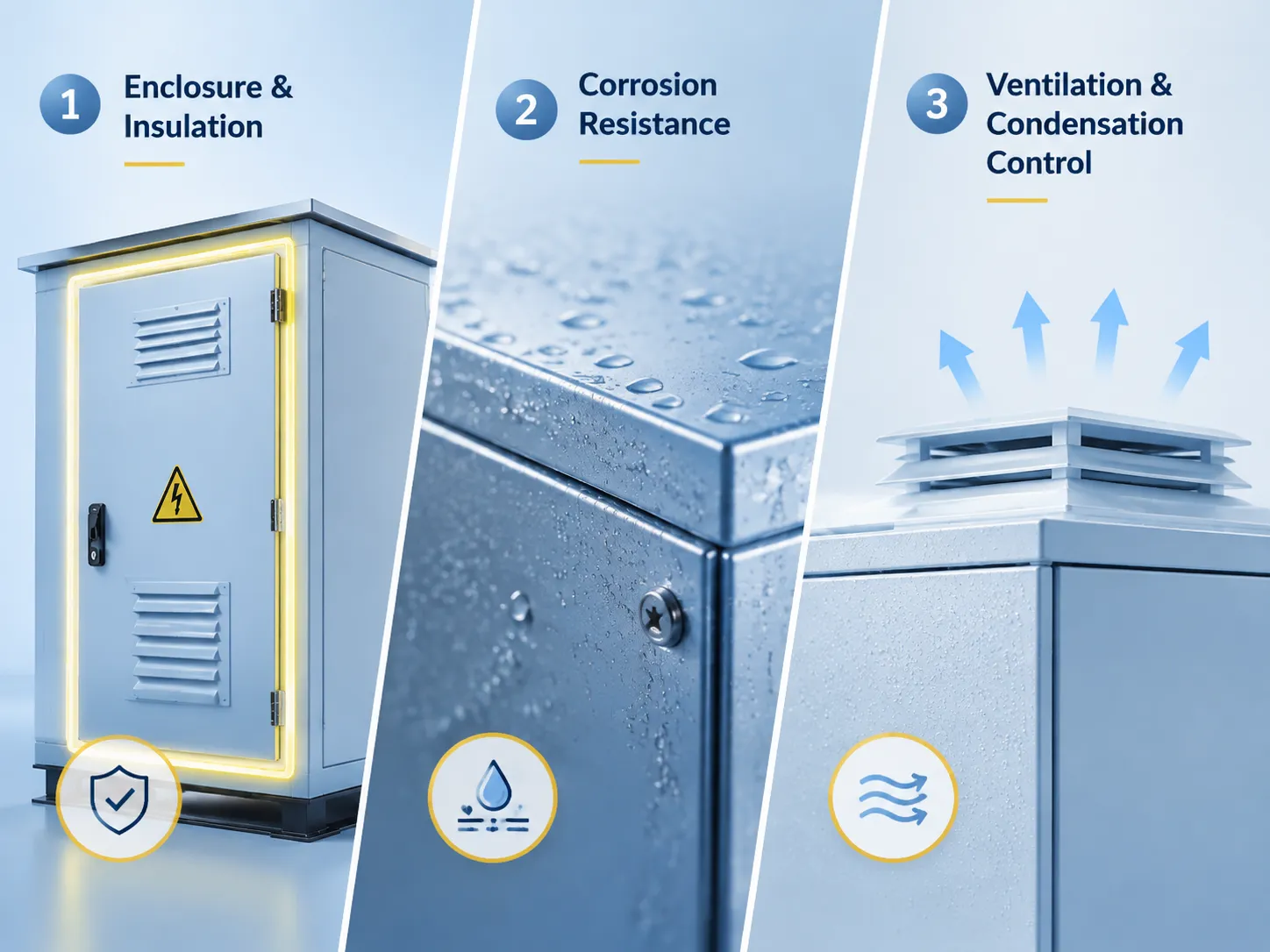
Ponto 3: Controle de Ventilação e Condensação
O terceiro critério é o controle ambiental na sala do transformador ou no invólucro. Quando o ar circundante se condensa, não importa quão eficaz seja o invólucro IP55, ele não salvará o transformador de danos. As possíveis soluções para esse problema, listadas em ordem de eficácia, são as seguintes:
- Aquecedores anti-condensação: de 150–300 W por compartimento e regulados por termostato, os aquecedores anti-condensação permitem que as superfícies permaneçam 3–5 °C acima do ponto de orvalho. O preço varia entre $200 e $600 por compartimento.
- Ventilação controlada: em um túnel úmido, mesmo um sistema de ventilação natural não é útil; é necessário um sistema de ventilador que seja ativado apenas quando o ar externo estiver mais seco. Custa de $1.500 a $5.000.
- Desumidificação: em salas críticas, um pequeno desumidificador garante que o nível de umidade seja inferior a 60%. Nesse caso, custa de $1.000 a $3.500.
- Ventiladores aquecidos e sistemas de óleo selados: essa solução exclui o risco de entrada de umidade para equipamentos imersos em óleo. O preço é coberto pela opção mencionada acima.
A tarefa de engenharia é simples e direta: deve-se manter o nível de umidade na zona de equipamentos acima de 60% e as temperaturas das superfícies acima do ponto de orvalho. Essas medidas devem ser incluídas no pacote de especificações do transformador e não devem ser tratadas como obras civis adicionais, pois o fabricante do transformador deve ser responsável pela prevenção de umidade.
Tipos de Transformadores para Dever de Túnel
Ambas as principais famílias de transformadores podem ser adequadas para túneis, mas a escolha afeta custo, espaço e segurança contra incêndios:
| Tipo | Forças em Túneis | Fraquezas | Preço típico, 1.000 kVA (USD) |
|---|---|---|---|
| Transformador seco (resina fundida) | Sem risco de vazamento de óleo, seguro contra incêndio, baixa manutenção, bom desempenho em umidade com invólucro adequado | Custo mais alto, sensível à umidade alta sustentada sem invólucro | $18.000–$32.000 |
| Selado imerso em óleo | Custo mais baixo, comprovado, tanque selado resiste à entrada | Considerações sobre contenção de óleo e incêndio; risco de corrosão do tanque se o revestimento falhar | $12.000–$22.000 |
| Tipo seco em aço inoxidável | Máxima resistência à corrosão, melhor para túneis de sal | Custo mais alto | $25.000–$40.000 |
No caso de túnel ferroviário e túnel rodoviário, o transformador seco é geralmente a melhor opção em salas à prova de fogo, pois em caso de incêndio no túnel, o transformador pode representar um perigo e não há muitas possibilidades para as pessoas escaparem. No caso de dutos de utilidade e túneis subterrâneos onde o risco de incêndio é gerenciado de forma diferente, a melhor escolha será transformadores imersos em óleo.
Transformadores a Seco vs. Imersos em Óleo para Túneis
A decisão entre as duas famílias em um túnel úmido se resume a cinco fatores, resumidos abaixo:
| Fator | Tipo Seco (Resina Fundida) | Imerso em Óleo Selado |
|---|---|---|
| Manuseio de Umidade | Bom com invólucro IP54+; umidade do isolamento recuperável por secagem | Tanque selado resiste à entrada; umidade do óleo deve ser monitorada |
| Segurança contra incêndio | Autoextinguível, fumaça mínima | Risco de incêndio em óleo; necessita de sala com classificação de incêndio e contenção |
| Manutenção | Baixo; limpeza periódica e termografia | Maior; amostragem de óleo, DGA, serviço de respirador |
| Custo (1.000 kVA) | $18.000–$32.000 | $12.000–$22.000 |
| Uso típico em túneis | Estações rodoviárias/ferroviárias e salas de equipamentos | Dutos de utilidade, cofres remotos, locais de mineração |
Não há um vencedor definitivo. A seleção depende dos critérios de segurança contra incêndio e da capacidade de reparo. O que é importante é que qualquer sistema que você escolher atenda a todos os três critérios mencionados acima: boa proteção do invólucro, propriedades de resistência à corrosão e remoção de qualquer condensação que possa ocorrer.
Lista de Verificação de Especificação
- Confirme as condições do túnel: níveis de umidade, quantidades de sal, ventilação e produtos químicos aplicados.
- Invólucros e compartimentos devem cumprir pelo menos com IP54 (recomenda-se cumprir com IP55 se água for pulverizada no túnel).
- O revestimento ISO 12944 C4 (ou C5 para túneis de sal) deve ser especificado com espessura de filme seco no contrato.
- Carcaças de aço inoxidável ou pesadamente revestidas devem ser usadas se ocorrer corrosão severa.
- A preservação de óleo selado deve ser aplicada a equipamentos imersos em óleo, enquanto a construção seca deve ser utilizada em áreas de risco de incêndio.
- Aquecedores anti-condensação, ventilação controlada por umidade com unidades desumidificadoras devem ser integrados ao projeto.
- O teor de umidade também deve ser listado na ficha técnica.
- Adicione monitoramento: sensor de umidade do óleo, sensor de temperatura do enrolamento e sensor de vazamento/condensação.
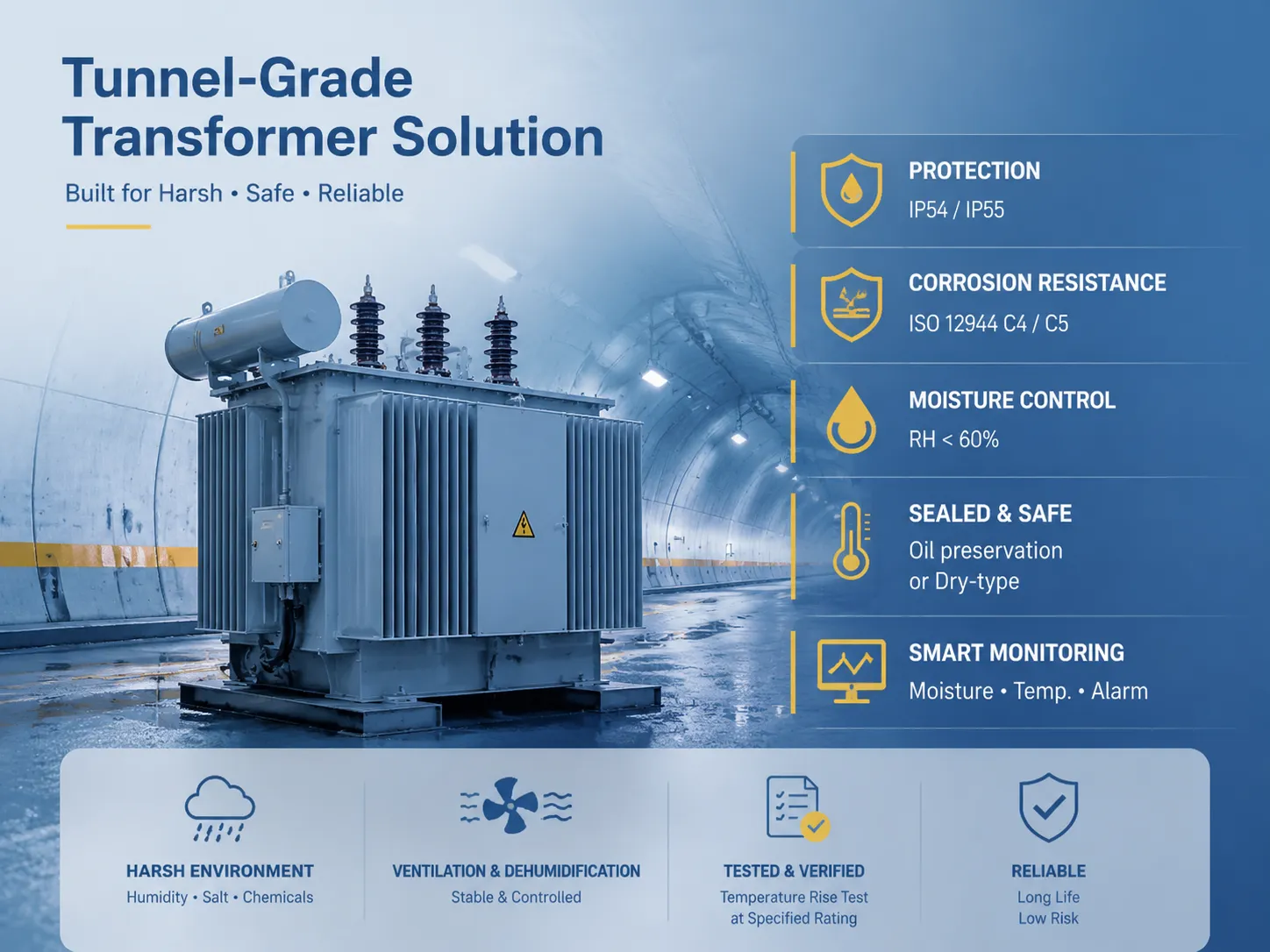
Principais Marcas & Comparação de Preços
Fabricantes de transformadores de grau túnel incluem tanto líderes internacionais quanto produtores dedicados. A tabela fornece preços para transformadores secos de 1.000 kVA de 10/0,4 kV com um invólucro de grau túnel IP54+ e tratamento C4; transformadores do tipo óleo serão aproximadamente 35-45 por cento mais baratos.
| Marca | País | Forças Relevantes para Túneis | Preço Indicativo (USD) |
|---|---|---|---|
| Schneider Electric | França | Portfólio forte de transformadores a seco e invólucros IP55 | $22.000–$34.000 |
| Siemens | Alemanha | Referências de infraestrutura de túnel, monitoramento digital | $23.000–$36.000 |
| ABB | Suíça | Faixa de resina fundida e tanque selado | $22.000–$35.000 |
| Eaton | EUA | Profundidade de tipo seco industrial, gabinetes personalizados | $20.000–$32.000 |
| Hitachi Energy | Japão/Suíça | Especialização em transformadores de grande infraestrutura | $24.000–$38.000 |
| Jiangsu Subian Electric Power | China | Unidades compatíveis com IEC 60076 com IP54/55, revestimento C4, opções em aço inoxidável | $15.000–$26.000 |
Fabricantes internacionais oferecem práticas de construção excepcionais e expertise em documentação abrangente, que são requisitos chave para projetos que possuem certificações e requisitos de seguro rigorosos. A Jiangsu Subian Electric Power é um participante ativo neste campo e fabrica transformadores de tipo seco e imersos em óleo compatíveis com IEC 60076 que atendem às especificações específicas da empresa, como gabinete IP55, revestimento C4/C5, opções em aço inoxidável, sistemas de aquecimento anti-condensação e monitoramento de umidade, com um preço 45-60% inferior ao de seus concorrentes europeus ou americanos. Quando se trata da avaliação das opções para a construção de várias salas de transformadores para ventilação, iluminação e drenagem, a Subian se apresenta como uma alternativa digna às empresas internacionais devido à sua flexibilidade na produção de produtos personalizados e um excelente sistema de testemunho de testes de fábrica.
Perguntas Frequentes
Qual classificação IP eu preciso para um transformador em um túnel?
A classificação IP mínima aceitável para um transformador é IP54, mas IP55 é preferível se o transformador estiver exposto à água devido à limpeza ou vazamentos de água. O significado de uma classificação IP54 é que é à prova de poeira e protege contra respingos de água de qualquer direção. Em contraste, IP55 protege contra jatos de água usados para limpeza. Instalar equipamentos que operam com uma classificação IP superior a IP23 custa pelo menos $400–$1,500 a mais.
Quanto custa um transformador de grau túnel em comparação com um padrão?
O custo de um transformador de tipo seco padrão de 1000 kVA pode chegar a $13,000–$18,000. O custo de um transformador de grau túnel com um gabinete IP54/55, revestimento C4 e controles de condensação é de $18,000–$32,000, o que significa um prêmio de 15–30%. Além disso, carcaças de aço inoxidável adicionam um extra de $3,000–$8,000. No entanto, este é um pequeno prêmio quando os custos totais são comparados com os custos de sua substituição em meio de vida para uma infraestrutura crítica de túnel.
Um transformador de tipo seco ou imerso em óleo é melhor em um túnel úmido?
Para túneis rodoviários e ferroviários onde a proteção contra incêndio é sensível, o transformador de tipo seco (resina fundida) é a escolha preferida, pois é autoextinguível e não apresenta risco de derramamento de óleo. Por outro lado, transformadores imersos em óleo são mais econômicos para dutos de utilidade, trabalhos de mineração e cofres de não acesso. Assim, é importante entender que a proteção contra incêndio, o acesso para manutenção e os custos são as principais questões determinantes na escolha do tipo de transformador.
Qual nível de umidade no óleo do transformador é aceitável?
Considera-se que o teor de umidade no óleo do transformador durante o período de entrega não deve exceder 15-20 ppm. Em operação, o teor de umidade do óleo é aceitável se não exceder 30 ppm. Se variar de 30 a 50 ppm, mais monitoramento é necessário. Quando o nível de umidade excede 50 ppm, há um risco potencial de formação de bolhas de ar durante a operação do transformador.
Os aquecedores anti-condensação realmente previnem falhas no transformador?
Sim, e eles estão entre as melhores medidas de custo-eficiência mencionadas neste artigo. Esses aquecedores operam usando um termostato e custam $200-$600.
Referências
- IEC 60529 — Graus de proteção fornecidos por invólucros (Código IP) — o padrão que define as classificações IP para invólucros e compartimentos de transformadores.
- Série IEC 60076 — Transformadores de potência — padrões de design, teste e isolamento base para todas as especificações de transformadores de túnel.
- ISO 12944 — Tintas e vernizes: Proteção contra corrosão de estruturas de aço — a classificação de corrosividade (C2–C5) usada para especificações de revestimento de túnel.
- IEEE C57.106 — Guia para Aceitação e Manutenção de Óleo Mineral Isolante — orientação autoritativa sobre limites de umidade no óleo e interpretação.
- IEC 60076-11 — Transformadores de potência do tipo seco — requisitos de umidade e invólucro para unidades de resina fundida em ambientes úmidos.
- Manual AREMA para Engenharia Ferroviária — orientação sobre infraestrutura elétrica e de ventilação de túneis usada em projetos ferroviários da América do Norte.
- Jiangsu Subian Electric Power — site oficial — fabricante de transformadores de grau túnel IP54/55, revestidos C4 para projetos de infraestrutura.
Conclusão
A umidade pode danificar um transformador, mas você pode reduzir as chances de esse problema ocorrer seguindo algumas recomendações. A primeira recomendação é instalar o transformador dentro de um invólucro selado (IP54 ou superior) com instalação à prova d'água. A segunda sugestão é revestir as partes de aço do transformador com materiais que possam resistir à corrosão e à umidade (preferencialmente, o revestimento de classificação ISO 12944 C4 será apropriado). A terceira recomendação é fornecer ventilação, sistemas de aquecimento e controle de umidade (desumidificadores).
Pontos-chave:
- Invólucros IP23/IP31 não são bons para operação em túneis; IP54/IP55 é imprescindível.
- Assegure-se de usar revestimento C4 (C5 para túneis de sal) para proteger o transformador contra corrosão de acordo com a ISO 12944.
- Você ainda precisa pagar um adicional de 15–30% por um transformador classificado para operação em túnel ao comprá-lo; assim você terá a garantia de que terá um dispositivo confiável por 25 anos em vez de um que falhe em apenas 5 anos.
- Forneça ao transformador aquecimento e controle de umidade: isso ajudará a evitar problemas relacionados à umidade durante a operação do transformador.