


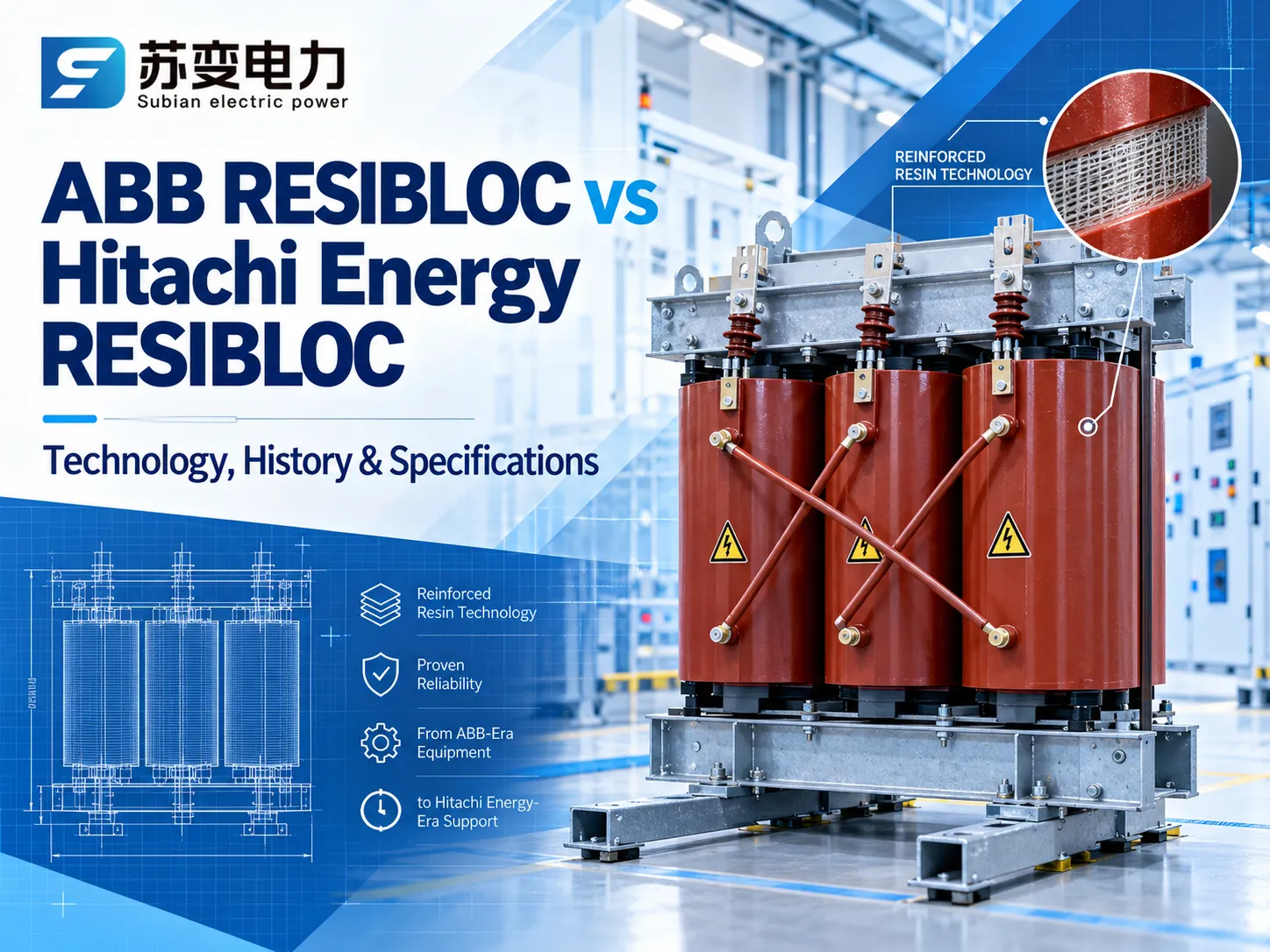
There are few names that are as esteemed in engineering circles when it comes to dry-type transformers as RESIBLOC. If you’ve been looking for ABB RESIBLOC transformer equipment and have ended up on the Hitachi Energy website, you should know that you’re not alone and that there is no mistake there—this model is still the same reputable product line; the difference is only in ownership reflected in the new catalog. Hence, if you’re currently specifying Hitachi RESIBLOC transformer, or you’re already using ABB equipment, the importance of this background is undeniable.
This article will clarify the essence of RESIBLOC transformers, the underlying technology of glass-fiber reinforced resin making it unique from other types of dry-type transformers, and how the ownership has changed from ABB to Hitachi Energy. The article provides information about what is included in published specifications for these devices in order to answer the question whether the only possible solution for the procurement team looking for heavy-duty dry-type transformers is a reputable company like Hitachi or any suitable manufacturer would fit.
What Is a RESIBLOC Transformer?
RESIBLOC is actually a line of modern dry-type cast resin transformers, the main distinguishing feature of which is its windings, which are fortified by high amounts of glass fiber incorporated in epoxy resin. While a standard cast resin transformer relies on the body made of resin exclusively, a RESIBLOC dry-type transformer is designed as robust block that consists of reinforced windings, which makes it immune to cracking and enables it to withstand high mechanical, thermal, and short-circuit loads.The strength of the technology has been the reason for its association with the most difficult operating conditions, including those in ships, mines, manufacturers, cold regions, and railway systems.
Glass Fiber Reinforced Epoxy Resin Technology
The signature of the range is its glass fiber reinforced epoxy resin insulation. In the process of making coils, glass-fiber roving is added into the coil together with epoxy resin, while the electronic coil manufactured is used to achieve proper results during installation. Unlike other techniques, this technology ensures that the winding will be formed in such a way that no mold will be required, resulting not only in design flexibility but also providing much higher strength against cracks and damages because of proper use of fiberglass. Throughout numerous studies, the insulation data indicates that the percentage of fiberglass present in the insulation is rather high, which makes it possible for units to demonstrate effectiveness in sub-zero temperatures and make it from cold start to full load.
Where RESIBLOC Transformers Are Used
Because of the mechanical strength, the RESIBLOC dry-type transformer has become the choice when standard dry-type transformers may not work as expected. Its applications include offshore installations and extreme colds, as well as harsh conditions in heavy industries, nuclear installations, states prone to earthquakes, and railway traction covered by RESIBLOC Rail option. The product line was also updated with rectifier transformers and products used for medium voltage regulation, which confirms that the brand has a long history of development.
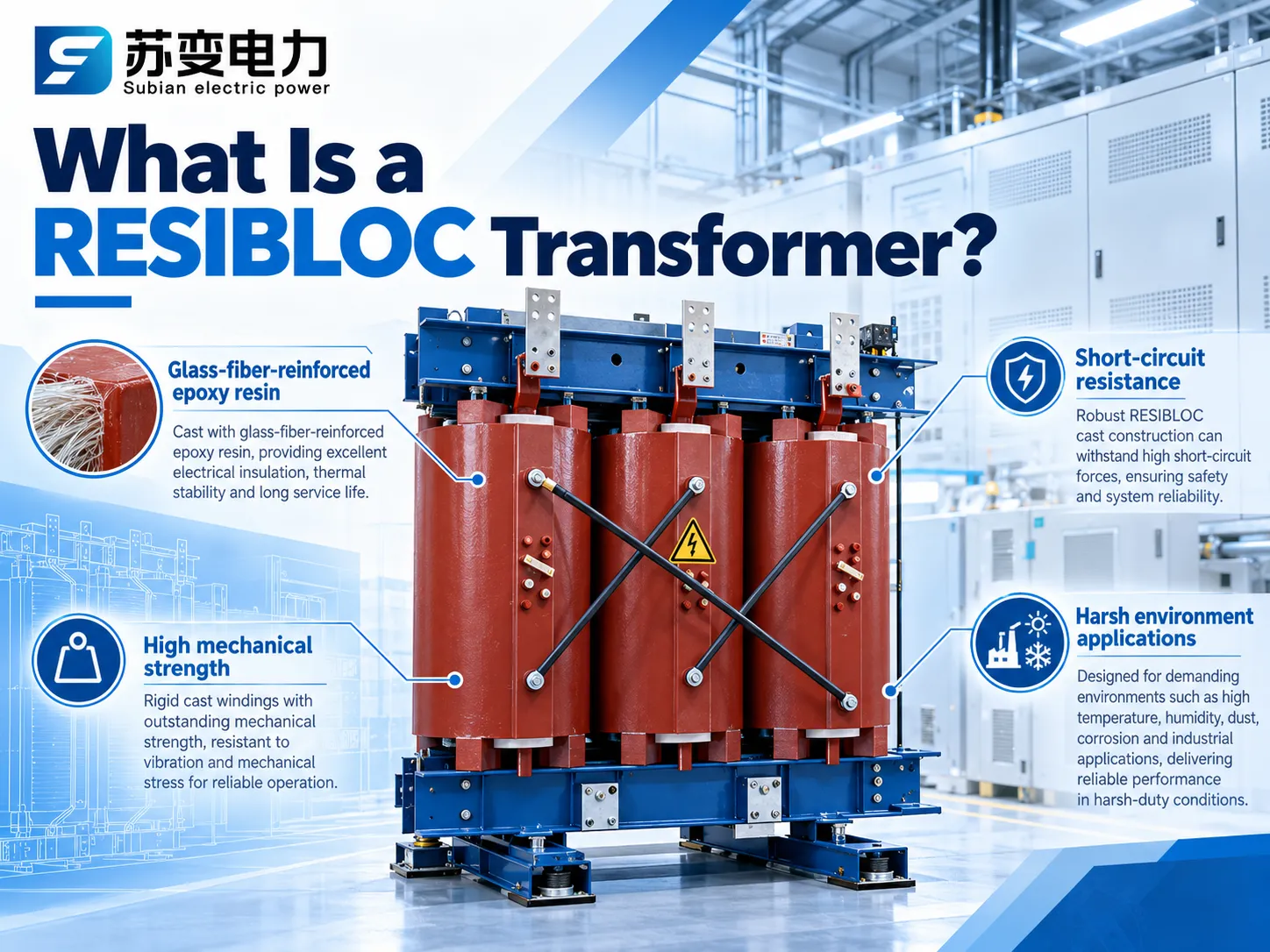
ABB and Hitachi Energy: The Origins of the Name
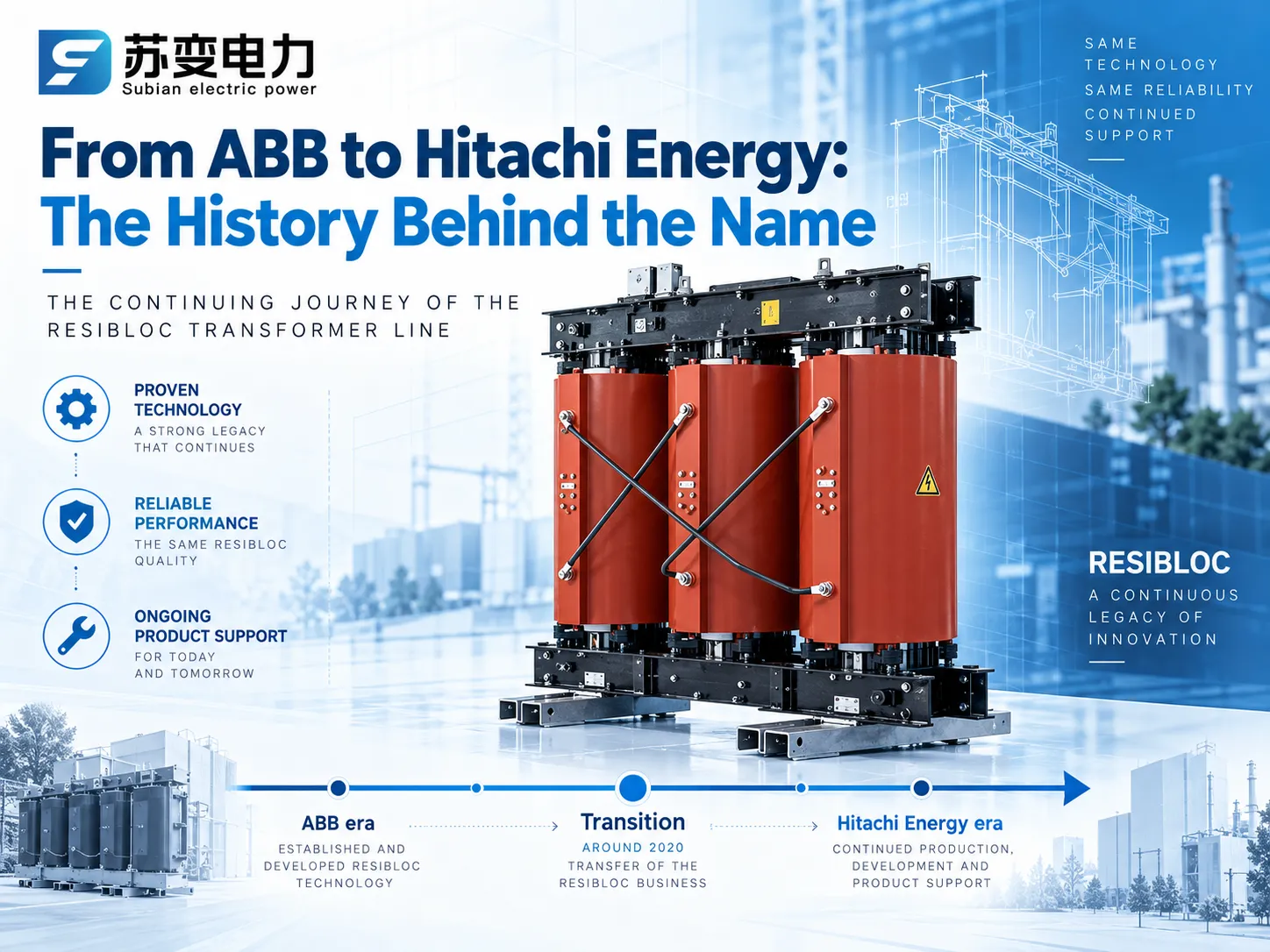
Two names can be found in search engines: ABB RESIBLOC and Hitachi RESIBLOC. Their presence is explained rather by corporate reasons than technical ones.The technology was developed and launched in 1974, in one of the oldally established factories producing transformers, which was later acquired by the ABB group, turning into a global center for the production of RESIBLOC transformers. For many years, ABB RESIBLOC has been marketed under the ABB trade mark, and many transformers have an ABB brand to this day.
2020 changes
In 2020, ABB sold the Power Grids division as a joint venture with Hitachi, which initially operated as Hitachi ABB Power Grids, later renamed as Hitachi Energy. The manufacture of RESIBLOC transformers has been included in the business of the new venture. Therefore, currently, all catalogs, documents, and support for the series belong to Hitachi Energy, while the previous products still have ABB brand name. The most useful information regarding the product for buyers is the following: ABB RESIBLOCPotential customers should be aware that Hitachi RESIBLOC transformer represents the latest in the long legacy of the transformer rather than being a new design.
Implications of the brand change for users and customers
If you have an existing installed ABB RESIBLOC unit, all documentation, spare parts supply, and technical support are done through Hitachi Energy today. If you are choosing equipment, you will quote Hitachi Energy specifications even if your internal specification is still ABB. Please remember that the name change does not change a requirement, namely a rugged type of cast resin transformer designed per the IEC 60076-11 standard that can be specified based on its characteristics.
RESIBLOC specifications: What the range covers
Reservations for RESIBLOC specifications indicate a general envelope, but the accuracy of these numbers depends on the exact variant and catalog issue and should be checked against the current Hitachi Energy data when working on a real project.
RESIBLOC Specifications: What the Range Covers
Published specifications for the line describe a broad envelope, and exact figures depend on the specific variant and the edition of the catalog, so the values below should be confirmed against current Hitachi Energy documentation for any live project.
Voltage, power, and classes
RESIBLOC distribution transformers are typically rated for voltages of up to 36 kV but, in general, RESIBLOC technology has been historically available with the primary voltage up to 72.5 kV and power from several hundred kVA up to tens of MVA. This transformer is a versatile solution available for 50 Hz, 60 Hz, and 16⅔ Hz rail frequencies, with cooling options you may choose starting from natural air through forced air cooling systems, and up to water cooling.According to IEC 60076-11 definitions, the insulation material meets environmental performance class ratings up to E4 and the insulation thermal class F1, and the insulation thermal class can be of higher grade. These classes are what make the RESIBLOC insulation material capable of being applied under extreme environmental conditions and fire-resistant.
How RESIBLOC differs from other cast resin ranges
Compared with vacuum-cast, mold-based ranges such as the Schneider Trihal and Siemens GEAFOL cast resin transformers, the RESIBLOC approach trades the quartz-filled, molded resin body for a glass-fiber-reinforced, mold-less winding. The benefit of this design is that it provides the transformer with a high level of mechanical and short circuit strength, as well as high reliability in extreme weather conditions. All the aforementioned technologies are created as genuine cast resin transformed according to the IEC 60076-11; however, each of the technologies is aimed at achieving different advantages, and the choice of the specific technological solution depends on the priorities of the project in question. For the customer, it means that all devices produced by different manufacturers under the same IEC 60076-11 standard can be measured against the same set of parameters.
Application of RESIBLOC in extreme conditions
The best way to understand the reason why the RESIBLOC dry type transformer is of a higher price is to analyze the environments where this particular transformer operates. The glass-fiber reinforced winding has been developed for extreme conditions where traditional insulation does not work, and the installed base of this technology confirms that.
The winding has enough glass-fiber content to allow it to withstand the tension of continuous expansion and compression without damage, which is the reason why the technology finds applications in ice, mountain and heavily-used industrial installations where thermal impacting is a daily routine.
Marine, mining, heavy industry
Some offshore oil stations, ships, mines, smelters and ironworks combine such hazards as vibrations, moisture, dust, and thermal impact like nowhere else. A dry type transformer of resin type reinforced with glass-fiber will withstand mechanical wear and penetration of impurities into the winding. It also features explosion and fire safety while in case of oil, neither fire nor containment safety can be guaranteed.
Railway traction
A special RESBLOC Rail variant applies the technology to the traction equipment of rolling stock. It shows greater requirements for weight, vibration and explosion safety compared with other types of equipment in railways. The existence of railway, rectifier and voltage regulating variants proves that this technology produces several versions of equipment, which, however, should be chosen correctly according to their needs.
Choosing This Class of Transformer: What Is Important
The RESIBLOC reputation has been earned, but one should keep in mind that the transformer does not install itself; it is the specification.Regardless of whether you ultimately choose a premium brand item or a unit direct from the factory, the same engineering specifications are what determine whether a cast resin dry-type transformer will meet the requirements of the project.
Determine duty before brand
Rated power and primary/secondary voltages, including whether the supply is 11 kV, 22 kV, 33 kV, or uses the convention of 10/20/35 kV.
Requirements for short-circuit withstand, in which regard glass fiber reinforced designs are strong, and the requirements for mechanical and seismic impacts on the site.
Ambient temperature ranges and whether starting or heavy cycling will take place.
IEC 60076-11 environmental, climatic and fire ratings at the installation site.
Guaranteed load losses and no-load losses, confirmed by routine test reports.
Cooling mode, enclosure IP rating, and altitude.
Once written down in such detail, the importance of duty makes it unnecessary to care about the brand; qualified manufacturers can easily come into the picture.
When Premium Range Makes Sense and When It doesn’t
Premium cast resin dry-type transformers are worth the money when the duty is exceptionally demanding such as operating in conditions of extremely high short-circuit withstand, very cold temperatures, heavy cycling, marine and seismic effects, or demanding applications such as traction or rectifier. Under such conditions, the engineering reserve and proven history of the products like RESIBLOC look like a good insurance that it makes sense to pay for when failure may be expensive or dangerous.
However, when it comes to the huge number of standard indoor medium-voltage installations, duty is well within the capabilities of many qualified manufacturers. For commercial premises, regular factories, solar and storage sites, or regular substations, a fire safe, low-loss epoxy resin dry-type transformer according to IEC 60076-11 is required, while a flagship brand is not essential at all. In this case paying premium prices in relation to ordinary duty does not bring any significant advantage; all it does is buying a name. It is important to treat premium as something that may be used only where it is really needed and to obtain the rest based on actual specifications and tests.
Sourcing a Rugged Cast Resin Transformer from China
In numerous projects, RESIBLOC’s challenging reputation implies the necessity of having an efficient, fire resistant, mechanically efficient epoxy resin dry type transformer at a price that can be defended. A competent producer from China can satisfy such demand in a large number of conventional cases concerning medium-voltage operations. A good example of such independent manufacturer is Subian Electric. Let it be clear that neither ABB nor Hitachi Energy has any affiliation with Subian Electric or gives any authorization to the latter; it should be stressed that RESIBLOC itself is a brand name owned by its owner and referred to only as a comparison marker.
For mainstream indoor medium-voltage distribution, Subian’s 6–10 kV SCB series epoxy resin cast dry-type transformer and 20–35 kV SCB series epoxy resin dry-type transformer are vacuum-cast units built to IEC 60076-11 and Chinese GB standards, offering low partial discharge, flame-retardant construction, and maintenance-free operation. Where ultra-low standby loss is the priority, the SCBH amorphous alloy dry-type transformer is the efficiency-focused option. The sound procurement method is unchanged: define the duty, request test reports, and compare candidates on documented evidence rather than on brand heritage alone.
Frequently Asked Questions
Is an ABB RESIBLOC transformer the same as a Hitachi RESIBLOC transformer?
Certainly, this is true in all relevant respects. The technology of RESIBLOC is one unbroken line and was previously promoted as ABB RESIBLOC transformer until ABB’s Power Grids division turned into a joint venture between Hitachi and ABB back in 2020. New equipment and ongoing assistance are now marketed as Hitachi Energy while the existing solutions are still referred to as ABB.
What makes RESIBLOC different from other cast resin transformers?
The key characteristic of this product is that glass fiber reinforced epoxy resin coils are manufactured without using any mold this gives an outstanding mechanical and short circuit strength along with high crack resistance due to very low temperatures. In comparison, other series of cast resin dry type transformers usually consist of a quartz reinforced resin body manufactured using a mold.
What voltage and power range does RESIBLOC cover?
RESIBLOC distribution units are typically mentioned up to 36 kV while the extended range is stated up to 72.5 kV in addition to tens of MVA. As always, check the particular rating against the current documentation from Hitachi Energy as values differ for different model variations and editions of the catalogs.
I have an old ABB RESIBLOC unit. Who supports it now?
Hitachi Energy takes care of support, spare parts and replacements for ABB RESIBLOC transformer. In case you need replacement for a similar transformer namely, then you are requested to provide the codes for the present-day Hitachi Energy range or similar dry type transformers.
Can a Chinese cast resin transformer meet the same specification?
For many conventional medium-voltage applications called for by IEC 60076-11 classes, a cast-resin dry-type transformer built to the same rated class may perform a similar role. For duties that go beyond normal conditions, equivalence shall be verified through test reports, and, if applicable, by type-test evidence. This should never rely on the datasheet alone.
Why is RESIBLOC used in ships and offshore platforms?
Because of the glass fiber reinforced epoxy resin windings, the device can withstand vibration, heat, and moisture. The unit is free from oil leakage and explosive materials; hence, it is less prone to catching fire, making it suitable for use in confined and safety critical areas of marine and offshore sites with casting resin dry type transformer which is better than oil-filled transformers because it avoids leakage and fire hazards.
Is a premium RESIBLOC unit always necessary?
The engineering margin is not important in extreme duty applications; however, in normal indoor medium voltage distribution applications, a cast resin dry type transformer produced by a reputable company and complying with IEC 60076-11 categories can provide the same performance for a lower price. You should consider the specific duty and check the testing results before you choose any other option.
References
- IEC 60076-11 — Power transformers, Part 11: Dry-type transformers
- Wikipedia — Hitachi Energy (formerly ABB Power Grids)
- Wikipedia — Transformer types (dry-type and cast resin)
Talk to Subian Electric
In case you need the kind of dry-type transformer that works well for tough applications with fire-safety features that characterize RESIBLOC transformers, you should also check whether there is a factory-direct transformer that can match these standards for a better price. Subian Electric is an independent company from China that manufactures epoxy-resin dry-type and cast-resin dry transformers with voltage ratings from 6 kV to 35 kV. The products are manufactured according to IEC 60076-11 with all testing documents and OEM/ODM support provided. If you share with us your requirements for voltage, capacity, duration of short circuit, power loss and IEC class, our engineering specialists will recommend you an SCB or SCB-H model and send you the test documents for comparing against the similar models of other manufacturers.