


If you’re looking for a compact MV/LV substation for a project in Europe, you’ll likely end up with names like Schneider Electric, Siemens, Ormazabal, ZPUE, Efacec, and Lucy Electric on your list. These names are not all equal, however. One offers steel kiosks for the British distribution networks, another provides concrete structures for the public power distribution, while another one is engaged in promoting large modular power rooms that do not comprise of substations at all.
This guide compares the most significant prefabricated substation suppliers in Europe by the most important aspect for customers – the types of equipment they manufacture, their application scopes, compliance with the factors of the IEC 62271-202 that each project requires and when to consider using factory-direct suppliers from outside Europe in your RFQ. The names mentioned in this guide are property of their owners, while Subian Electric has no relations to any of those companies.
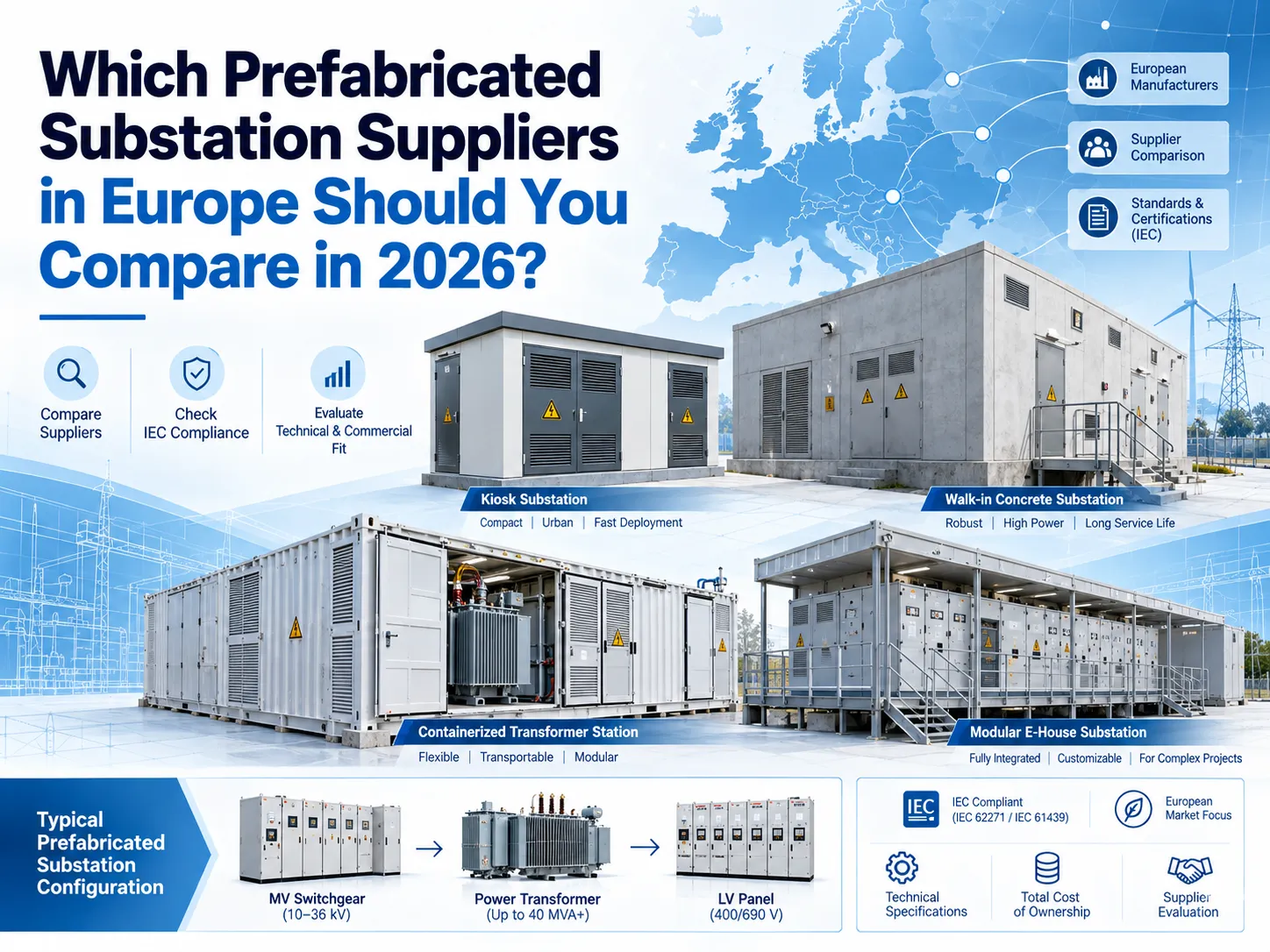
What Is a Prefabricated Substation?
A prefabricated substation is a complete medium voltage and low voltage, prefabricated in a factory and sent to its installation site as a singular or a small number of transportable units. The only work that needs to be done on site is building a foundation, connecting and earthing the cables. Therefore, if we compare a prefabricated substation with a traditional one constructed of bricks, we will find that it occupies less space, requires less time for an installation, and its capacities have been proven by prior type tests.
Main Components: MV Switchgear, Transformer and LV Panel
Almost every device uses the same three components. The medium-voltage section, which is usually implemented as a ring main unit or a load-break switch protected by fuses or circuit-breakers, acts as a connection to the incoming electricity supply. The distribution transformer either uses oil-immersed or dry-transformer technology to decrease the voltage from the level of medium voltage. The low-voltage board subsequently divides the supply into outgoing feeders. The differences between suppliers consist of how exactly these units are selected, integrated, and housed.
Compact Kiosk vs E-House vs Containerized Substation
Customers are known to throw around these comparisons, which often results in incorrect quotes. First of all, a compact kiosk refers to the small outdoor unit that operates and serves the customers with the capacity not exceeding 1,600 kVA. Meanwhile, a walk-in or containerized station can be described as the station with the internal corridor that allows for the installation of additional equipment, including the switchgear and sometimes two transformers. Another type of station is the E-House that is a special design engineering solution suitable for industrial plants, mining or data centers and usually has many items of MV switchgear as well as motor control devices and drives. All three can be called prefabricated electrical substation solutions, but you would not ask the same supplier for all of them.
Leading Prefabricated Substation Suppliers in Europe
Following are seven companies that provide information on what they offer, where they have the competitive edge, and what things must be checked before making a purchase. This is only a part of the players in the market; other organizations such as ABB and Hitachi Energy are active too, however. The mentioned players do mostly provide products you are going to meet.
1. Schneider Electric (France): MDS and Package Substations
For buyers from the UK and Ireland, Schneider is known to provide the Metalclad Distribution Substation (MDS). This is a prefabricated outdoor substation that can deliver between 200 and 2,000 kVA at 11,000/433 V in one lift. The technology used for the MDS type, which is manufactured and assembled in Leeds, is IEC 62271-202 compliant and has an internal arc-breaking device of up to 21 kA. There are also package substations available, which can have liquid-filled transformers with the rating of up to 4,000 kVA at 11 kV.
Best fit: utilities, commercial products, EV charging stations, locations where a factory-based type-tested solution is much more important than the price. You should check whether you get the MDS product family, since it is made according to 11 kV requirements, which means that in case your network operates in 20 kV or even 33 kV you may need to seek other alternative.
2. Siemens (Germany): Modular E-House Solutions
On many supplier lists, Siemens has its HVAC technologies. Siemens’ main prefabricated solution is E-House, meaning a factory manufactured containerized electrical unit that serves for integration of different voltage levels switchgears. This provides practical activities in various strongly industrial markets such as oil and gas, mining, or data centers on premises where the whole unit is removed from site and this makes the construction process much less risky.
Best fit: complicated distribution systems with tons of feed points and potential automation tasks. You should double-check the customer needs before purchasing E-House units; you may find that you only need a cheap station that produces 630kVA output, and that the E-House is unsuitable in this case.
3. Ormazabal (Spain): Compact Transformer Substations
Ormazabal specializes in the secondary distribution technologies and proposes one of the largest prefabricated transformer station range on the European market. The “miniBLOK,” which is a small kiosk substation, can be installed at ground level and be supervised from outside, while the underground variant for the streets is called the miniSUB. The technology for the ormaSET-M substation allows using it for units rated up to 1000 kVA with IAC-B classification at 16 kA.
Best fit: The technology of the company suits best for utility networks, urban projects, and renewable energy projects. Anyway, it is recommended to double-check the specifications of the manufacturer, because more than 1000 kVA is over the limits for this manufacturer.
4. ZPUE (Poland): Container Transformer Stations
ZPUE is a producer of container transformer substations and switchgear in Włoszczowa, Poland. The company was founded in 1988 and has become one of the leading manufacturers in Central Europe. In terms of products offered, concrete-made substations of various types, as well as other types of transformers are manufactured. ZPUE’s products are used in solar power projects in the Netherlands, which proves high demand for company’s products abroad.
Concrete substations are primarily used by corporations in charge of transmission systems, industrial parks, and other businesses that value sturdiness of their equipment.
5. Efacec (Portugal): Pucbet and Pucmet
Efacec presents complete solutions for compact substations with voltage ratings of up to 36 kV and power ratings of up to 1,600 kVA. The company incorporates its own medium-voltage switchgears into the substations. Pucbet uses a prefabricated building made of reinforced concrete, which is adaptable to using dry or oil transformers, as well as air and gas-insulated switchgear and has been tested for seismic resistance. Pucmet has been manufactured from welded metal. It has been crafted from stainless steel and includes separate rooms for each of the devices (MV switchgear, transformer, and LV switchgear) as well as anti-condensation ventilation system. The design has a special shape and dimensions which enable it to be transported in the containers of standard sizes (20’ or 40’).
Expected scope: projects that prefer to use either concrete or stainless steel with one supplier which works in harsh environments and coastal areas. Note: make sure to compare the internal arc ratings and enclosures classes of specific models and not the entire list.
6. Lucy Electric (UK): Package Substation Solutions
Miguel Electric’s package substation merges its very own cable advance unit, which is the Sabre or the SF6-free SabreEcoTec for twelve Dewey systems, with a fluid-filled revenue transformer and a revenue transformer mounting cabinet from its AcuLok or AcuTec ranges. The distinguishing factor in this context for buyers is that this product is not limited to the solutions by just one transformer manufacturer as well as the fact that Miguel Electric has transformer stock in the UK to minimize kinetic intervals. It can be seen from its long-term experience of cooperation with UK distribution companies.
Keywords: UK systems, independent system operators, EV charging system. Classification: Please note that package Installation is an open-type facility, check if you will need some GRP steel casing.
7. Subian Electric (China): Factory-Direct Alternative for European Projects
Subian Electric is not a European brand, but we have made an exception for it on this list as a brand for customers who are interested in obtaining a factory quotation in addition to European brands! The YB series prefabricated substation manufactured by the company comprises of HV switchgear, distribution transformer and LV panel. The standard 10/0.4 kV model is designed for a capacity of between 50 and 1,600 kVA. However, in the case of project configurations, the capacity goes up to 2,500 kVA with more HV ratings including 6, 10, 12, 24, or 35 kV and LV outputs including 0.4 or 0.69 kV. Subian also builds 33/11 kV and 33/0.4 kV compact substations in weatherproof steel enclosures rated IP43 to IP54.
Best customers: EPC contractors, solar energy developers and industrial users and suppliers that want a possibility of controlling their own specification. Make sure to ask for approvals, factory test results and technical documentation.
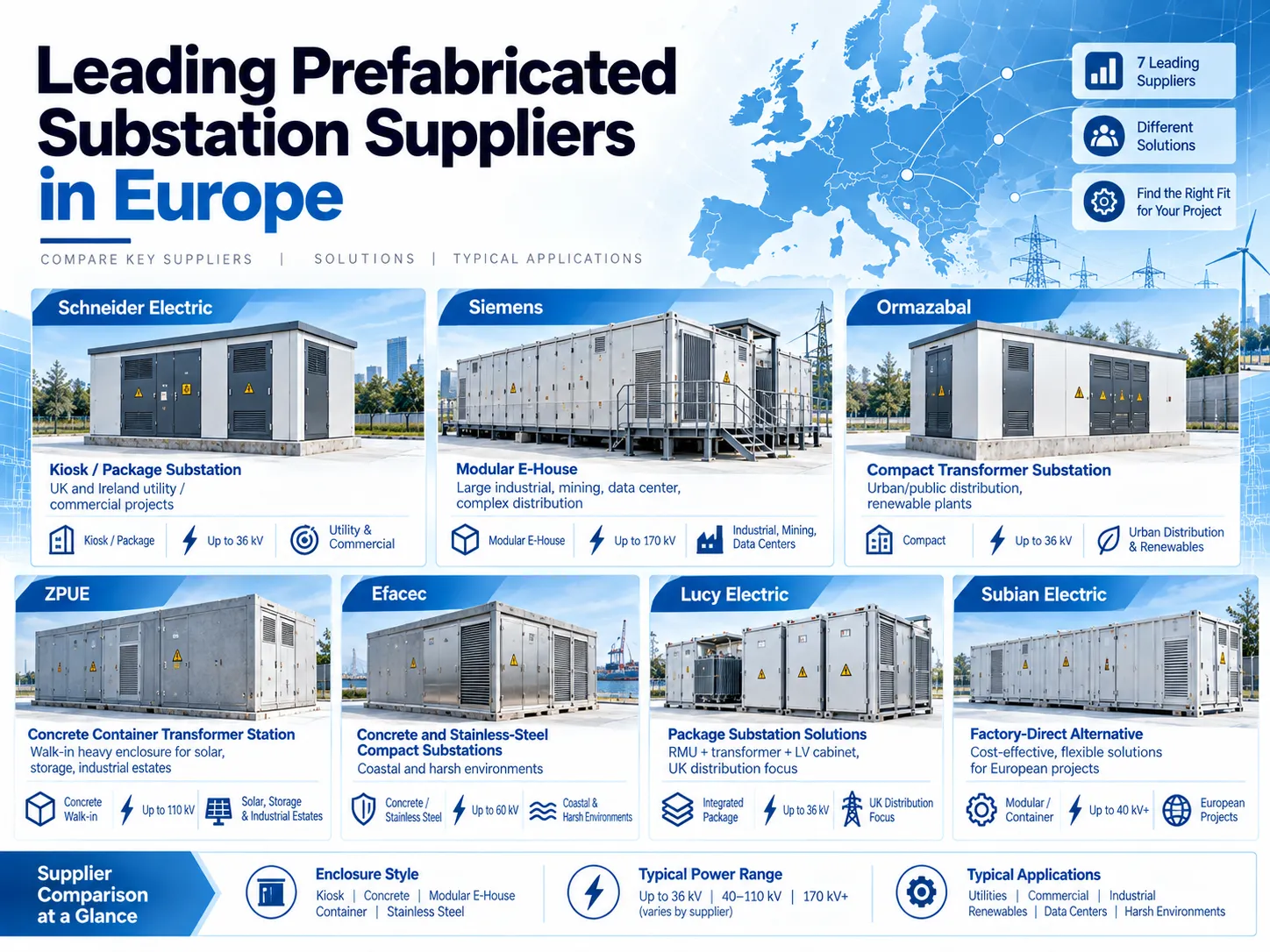
How the Seven Suppliers Compare
When examining the two systems closely, it becomes apparent how they are different. The following summary details the manufacturers’ product information, which you can use for your own inquiry, but which does not substitute for the specific information needed for your project.
• Schneider Electric: clever and exceptionally durable steel station, capable of handling up to 2,000 kVA (11 kV).
• Siemens: E-House consisting of a complex and modular system ensuring that the total dimensions of the unit are custom-made according to the client’s needs and demands.
• Ormazabal: substations made of concrete and metal with a top voltage of 36 kV and rated for 1,000 kVA.
• ZPUE: substations made of concrete and can provide walk-in or kiosk solutions which run very effectively in energy distribution, as well as in renewables.
• Efacec: substations made of concrete (Pucbet) or stainless steel (Pucmet) rated for 1,600 kVA and a maximum voltage of 36 kV.
• Lucy Electric: substations designed using the RMUs and LV cabinets for the UK network and covering all types of energy conversion.
• Subian Electric: substations where metal or non-metal integrated units are employed rated for 50 to 2,500 kVA at 6 to 35 kV.
Enclosure Materials and Installation Style
uppliers like Efacec, Ormazabal and ZPUE offer concrete enclosures for their weight and strength, as well as for their thermal properties and thermal insulation, which makes them a preferred option for most public networks. Steel and stainless steel enclosures, meanwhile, are also a great option due to their weight, ease of storage and compactness. Usage of underground and semi-buried enclosures prevents planning difficulties arising from urban density. If your project brief mentions prefabricated electrical substation buildings, it usually means walk-in concrete or steel housings rather than compact kiosks, so make that distinction explicit in your enquiry.
Transformer Capacity and MV Voltage Class
The voltage levels in Europe can vary greatly, for instance, machines can work at 10, 11, 15, 20, or 33 kV. Thus, the 20 kV equipment will require devices rated at 24 kV, while the 33 kV needs machines rated at 36 kV. Most of the compact solutions can operate in the range of 630-1000 kVA. Hence, the loads that exceed 1600 kVA would most likely force customers to either use walk-in stations or package substations or build custom machines.
Local Engineering Support and Grid Approval
European suppliers deliver local engineers and spare parts to the site where they are needed, and mostly have a certificate with the network operator. This service is effective when it comes to utility-owned properties. In case of private networks such as, for example, solar plants, factories or logistics parks, the buyer or EPC contractor usually has the specification and the correct documents and does not pay much attention to the brand of the device.
IEC 62271-202 Requirements for European Projects
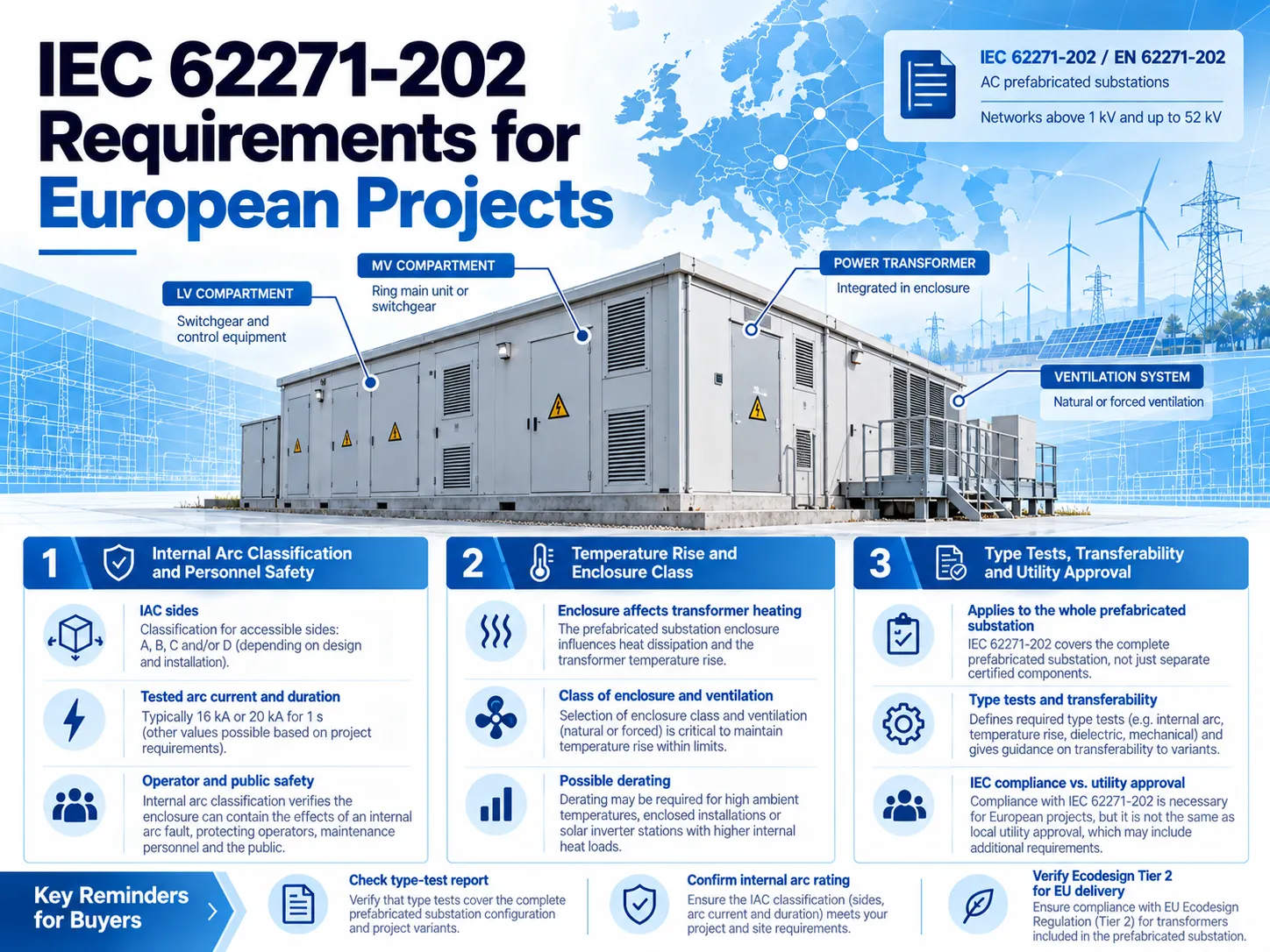
Regardless of which supplier is selected, one has to conform to the IEC 62271-202 standard for the equipment to be used. The standard currently in force, the third edition, was released in 2022 and is applicable to prefabricated substations that involve cables connected to electrical networks with voltage exceeding 1 kV and not more than 52 kV. It should be highlighted that the applicability of the standard extends over the substation as such. Hence, a transformer complying with IEC 60076 and switchgear complying with IEC 62271-200 does not provide any evidence to which extent the substation is likely to comply with the desired standard.
Internal Arc Classification and Personnel Safety
Prefabricated substations are usually located in areas accessible to the public, therefore, internal arc classification is an essential parameter provided in technical specification. This is the measure allowing to define safe surfaces of the equipment for the personnel and bystanders during the internal faults. Internal arc classification gives such an example as IAC-AB rating of 20 kA with the time of internal arc equal to one second. Make sure that the rated current is equal or exceeds to the fault level of your grid.
Temperature Rise and Enclosure Class
A transformer runs warmer when placed in an enclosure than when utilizing free airflow. IEC 62271-202 looks at this via the enclosure class, which expresses this extra temperature rise in kelvins. The 2022 issue also refers to the rating power of the substation as a triplet instead of a value only in kVA. What this means in practice is that a unit that works perfectly well with a capacity of 800 kVA in Northern Europe could require derating, better ventilation or bigger housing in hotter climates or in load-heavy cases of solar inverter stations.
Type Tests, Transferability and Utility Approval
Reports on type testing are the cornerstones of any claim for compliance, yet they are relevant for a design that has been tested. It is important to question how type tests have been rolled forward in the event that the vendor alters the transformer, switchgear or enclosures from the tested configuration. IEC TR 62271-312 provides some assistance with this. Further, transformers sold in the EU must conform to certain Ecodesign losses, which are set at Tier 2 currently. It is also important to understand that an IEC standard is not the sole source of requirements because the network operator’s own specifications, local earth rules, and acceptance procedures are applicable as well.
European Suppliers vs Chinese Manufacturers: What Changes for Buyers?
The honest answer is that both routes can deliver a compliant, reliable substation. The trade-offs are about risk, documentation, logistics and how much engineering effort you are prepared to put into the specification.
When a European Supplier Is the Safer Choice
Select a European brand when the asset requires to be used by a public network operator with a closed approved equipment list, when local service and very quick response times are requisite according to the contract, or when there is almost no time for technical clarifications. In these circumstances, the premium payment ensures that the certainty is difficult to duplicate.
When Factory-Direct Supply Makes Commercial Sense
Factory-direct production makes sense for private networks, bulk orders, and low-budget projects, such as large solar power and battery installations or expanding a manufacturing line. In such cases, prospects include contacting engineers directly, branding and shape flexibility, and inspecting the substation before shipment. However, there are also secrets of this approach: longer transoceanic shipping, complication of the documentation procedures, and taking responsibility for verifying the compliance of the offered equipment and the results of lab tests. It is possible to deal with Chinese manufacturers as carefully as with firms from Europe by asking for concrete confirmation.
How to Choose a Prefabricated Substation Supplier
The top best shortlists can be formed from a precise and comprehensive brief. Make sure to create a single line diagram, the voltage of the network, the value of the fault level, transformer rating as well as the vector group, the LV feeder schedule, the conditions of the project and the country of the delivery. Communicate the same requirements for every supplier, irrespective of whether they are European or not.
The type test report to IEC 62271-202 corresponding to the design provided. The transformer test reports along with the approval of the compliance with the rules of Ecodesign Tier 2. The type and brand of the components inside the switchgear. The general arrangement drawings along with the foundation drawings and materials.
The plan for acceptance testing, with the opportunity to attend the test personally or via video broadcasting. The delivery time, packing type of the equipment, Incoterms, and provisions for the project startup activities.
The important examples of similar projects carried out and guarantees.
When the supplier replies to the request, all of the supplies need to be compared. If there is no type test report with a smaller price or if the brand that is being used is not the same as indicated in the type test report, then the offers cannot be compared and considered equal.
Frequently Asked Questions
Who are the main prefabricated substation suppliers in Europe?
The well-known prefabricated substation manufacturers in Europe include Schneider Electric, Siemens, Ormazabal, ZPUE, Efacec and Lucy Electric, as well as other companies like ABB and Hitachi Energy. They concentrate on various forms of solutions including steel kiosks, concrete substations, packaged substations and E-Houses .
Which standard applies to prefabricated substations in Europe?
IEC 62271-202, which formally appears as EN 62271-202, deals with AC prefabricated substations operating in the voltage ranges from 1 kV to 52 kV. The transformers used in these substations must comply with both IEC 60076 and the Ecodesign number of losses stipulated by the European Union. In addition, the conditions set by the network operator have to be met.
What is the difference between a prefabricated substation and an E-House?
A prefabricated substation is mainly a compact MV/LV transformer station. An E-House is a larger modular electrical room that can contain MV and LV switchgear, motor control, drives and automation for an industrial site.
Can I buy a prefabricated substation from China for a European project?
Yes, as long as the supplier submits proof of type-testing in accordance with IEC 62271-202 for the proposed design of ecodesign compliant transformers and all relevant documentation, and provided that the equipment has been approved by the network operator. This is usually most effective for private networks and renewable power plants.
Which voltages and ratings are typical for European projects?
Common network voltages are 10, 11, 15, 20 and 33 kV, using 12, 24 or 36 kV-rated equipment. Compact units typically range from 250 to 1,600 kVA, with larger or two-transformer configurations available as walk-in or custom designs.
References
Comparing European brands is the right way to start, and adding a factory-direct option to the same evidence-based comparison is a smart way to finish. Jiangsu Subian Electric Power Equipment Co., Ltd. designs and builds integrated prefabricated substations, including the YB series and 33 kV compact substations, together with the transformers and switchgear inside them, at its own factory in Xuzhou. For OEM branding, custom layouts or distributor supply, see our OEM and ODM programme. Send us your single-line diagram, network voltage and site conditions through our contact page, and our engineers will reply with drawings, test documentation and a factory quotation you can compare line by line with any supplier on your list.