


Brazil is currently undergoing one of the largest transmission expansion programs ever. New transmission lines are under auction to transport renewable energy from Northeastern to Southeastern Brazil. Old concessions are being renewed, while domestic manufacturers are ramping up production to meet requirements. All of these developments translate into a booming market with its own metrics for selling and buying transformers: 60 Hz frequency, Brazilian voltage classifications, ABNT parameters, and INMETRO mandatory energy efficiency specifications for some products.
Short answer: the Brazil power transformer market is being driven by transmission expansion, renewable energy integration and rising peak demand. In 2026 alone, ANEEL’s two transmission auctions contracted about 2,660 km of new lines and nearly 14,850 MVA of new substation transformation capacity. Planners expect around R$120 billion of transmission investment through 2035. The grid needs everything from 500 kV and 345 kV substation transformers to 138 kV sub-transmission units and 13.8 kV and 34.5 kV distribution transformers, all designed for 60 Hz and checked against Brazilian standards and utility specifications.
The current paper aims to shed light on the real figures of this growth, which regions are the most popular,
who makes transformers in Brazil and what technical aspects buyers should check prior to making the order. All mentioned trademarks are property of their legal owners. Subian Electric is an independent company and has no relation to them.

Brazil’s Transformer Market at a Glance
| Indicator | Figure | Source or context |
|---|---|---|
| Transmission auction 01/2026 (27 March 2026) | 5 lots, about 798 km of lines, 2,150 MVA of transformation capacity | ANEEL auction results |
| Transmission auction 04/2026 (30 October 2026) | 8 lots, about R$8.9 billion, 1,866 km of new lines, 12,694 MVA of new transformation capacity | ANEEL auction held at B3 |
| Planned transmission investment | About R$120 billion through 2035 | Ten-Year Energy Expansion Plan (PDE 2035) |
| Additional substation capacity planned to 2030 | About 24,300 MVA, with 5,300 km of new lines | ONS grid expansion plan (PAR/PEL 2025) |
| Expected peak demand in 2030 | About 129 GW, 17 percent above 2025 | ONS projection |
| Grid frequency | 60 Hz | National interconnected system |
How Big Is the Brazil Power Transformer Market?
Why Market Size Estimates Differ
Published estimates for the Brazil transformer market vary widely because research firms define the market differently. Two examples show the gap:
| Research firm | 2025 estimate | Forecast | What it measures |
|---|---|---|---|
| Grand View Research | About US$1,198 million | About US$1,991 million by 2033, 6.6 percent a year | Brazil power transformer revenue; shell-type cores hold the largest share, about 47 percent |
| DataM Intelligence | About US$1.72 billion | About US$1.82 billion by 2031, under 1 percent a year | Low- and medium-voltage transformers only |
One projection anticipates a rate of expansion above six percent per year while another predicts just over one percent, and they are working on quite different pieces of equipment. Some reports consider only items with voltage levels higher than 69 kV, other reports include distribution transformers, and still others provide information on dry-type, specialized or instrument transformers. Those numbers should not be averaged up. By all means, they can serve their purpose as reference figures illustrating the market size in the range of one to two billion US dollars annually, but the official grid statistics provide a clearer idea of where the demand originates from.
Power Transformers in Contrast to Distribution Transformers
This allows us to divide the market into two sectors. Power transformers are applied in transmission and sub-transmission stations at 69kV and above, usually being custom made items weighing from tens to hundreds of tons. Manufacturing process may take over a year. Distribution transformers reduce medium voltage of 13.8 kV or 34.5 kV to low voltage level supplied to the users. They are manufactured in large quantities being procured at utility tenders of standard efficiency ratings, effective in Brazil. Both segments share the name being fundamentally different in some points like customers, suppliers, time periods and approval procedures.
Investments and Sales of Transformers Are Not the Same Thing
One of the most typical mistakes made by many people is the coverage of investments made in auction’s total amount. For example, R$ 8.9 billion contracted out in October 2026 is a payment for the following: lines, towers, substations, switchgears, civil works and engineering companies, which means that this money is not dedicated to transformers only.
Transmission Auctions Are the Clearest Demand Signal
The transmission grid in Brazil largely expands via tendering held by the electricity regulator ANEEL. In return for an authorized annual revenue, the assets of the successful bidders are constructed, owned, and operated by them. Since each lot mentions power lines, transformer stations, and power transmission capacity, the bidding process serves as the best public indicator of future demand for transformers in Brazil.
| Auction | Date | Lots | New lines | New transformation capacity | Main states |
|---|---|---|---|---|---|
| 01/2026 | 27 March 2026 | 5 | About 798 km | 2,150 MVA | São Paulo, Rio de Janeiro, Minas Gerais, Paraná, Santa Catarina, Rio Grande do Norte, Ceará, Mato Grosso, Pará |
| 04/2026 | 30 October 2026 | 8 | 1,866 km | 12,694 MVA | Bahia, Goiás, Mato Grosso do Sul, Paraíba, Paraná, Rondônia, São Paulo |
The two lots from the auction in October illustrate this process in the real world. Lot 3 features the new substation Santana 500/345 kV, which has a transformation capacity of 3,600 MVA, meaning that there will be very big autotransformer banks. Lot 4, which costs approximately R$4.1 billion, will create 1,167 kilometers of new lines in the state of Mato Grosso do Sul and upgrade some of the state’s grid to the voltage level of 500 kV, which will also require new transformation capacity in some substations. The average percentage discount for the bidders was approximately 50%, which is an indicator of the very intense competition for investors in this branch.
The national plans are identical looking beyond 2026. As far as PDE 2035 is concerned, about R$120 billion will be invested in transmission by that year, including a link that is supposed to connect the Northeast and São Paulo/Paraná regions that will cost approximately R$26.5 billion. The operator of the grid ONS states that there will be around 24,300 MVA of additional demanding substations by the year 2030.
What Other Factors Influence Transformer Demand in Brazil?
Renewable Energy in the Northeast
Most of Brazil’s new wind and solar energy installations are located in the Northeast part of the country, particularly in Bahia, Rio Grande do Norte, Ceará, Piauí, and Paraíba, which are situated far from the Southeast, where most demand occurs. According to ONS, there will be around 60 GW of centralized wind solar energy in the total energy capacity in 2030, which means that every produced electricity would need transformer equipment, and energy transmission would require new transmission facilities.
Increased Peak Demand and New Large Loads
According to ONS forecast, peak demand is estimated to reach 129 GW by 2030, which is about 17 percent above the projected demand by 2025. Moreover, planners are currently working on issues of connecting big consumers of energy such as data centers and green hydrogen manufacturing plants.
Distribution networks
Brazil distribution utilities serve tens of millions of customers using 13.8 kV and 34.5 kV networks. The replacement of older equipment, new customers, loss reduction projects, and renewal of distribution concessions mean a steady flow of demand for transformers. Utilities usually purchase equipment through competitive tenders on the basis of their own technical specifications.
Industries, Mining, and Agriculture
Mining industry in Minas Gerais and Pará, heavy industries in the South states of Brazil and agribusiness in the Central-West region require their own substations, often operating on 69 kV or 138 kV. Those private consumers use engineering contractors to specify their transformer requirements instead of using utility tenders.
Where Is Transformer Demand Concentrated?
Rather than rank states on guesswork, the table below summarizes where 2026 auction projects and published plans put new capacity.
| Region | What is driving demand | Typical equipment |
|---|---|---|
| Southeast (São Paulo, Minas Gerais, Rio de Janeiro) | Load centers, grid reinforcement, receiving end of long-distance lines | 500/345 kV and 345/138 kV substation transformers, 138 kV industrial units |
| Northeast (Bahia, Paraíba, Rio Grande do Norte, Ceará) | Wind and solar integration, export of renewable power | Generator step-up and collector transformers, 230 and 500 kV substation units |
| Center-West (Mato Grosso do Sul, Goiás, Mato Grosso) | Network upgrades from 230 kV to 500 kV, agribusiness | 500 and 230 kV substation transformers, 138 kV and 34.5 kV units |
| South (Paraná, Santa Catarina) | Transmission reinforcement and industry | 230 and 138 kV substation units, distribution transformers |
| North (Rondônia, Pará) | Long-distance connections and mining | Substation transformers for remote networks, industrial units |
Who Are the Power Transformer Manufacturers in Brazil?
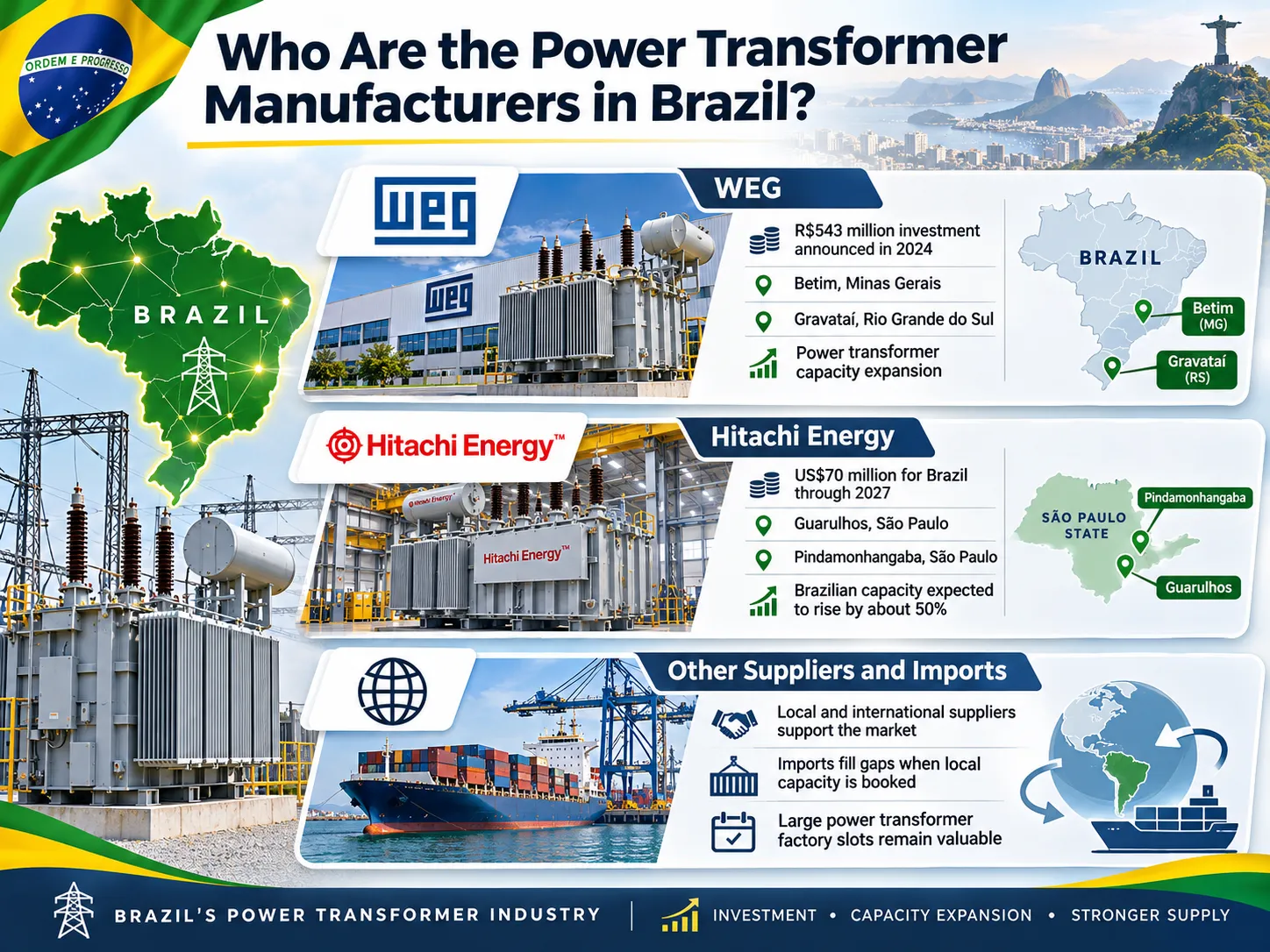
Brazil has a well-established local transformer industry, and several of the largest power transformer manufacturers in Brazil are expanding capacity in response to demand.
WEG
WEG is a Brazilian power equipment firm that declared investment of R$543 million in the transformer sector in the two-year period beginning from September 2024. The main amount of this investment has been allocated to the transformer production facility located in Betim, Minas Gerais, while additional funds will be directed to the facility in Gravataí, Rio Grande do Sul.
Hitachi Energy
In March 2026 the company Hitachi Energy reported an investment of US$150 million in the production of transformers in Latin America, with US$70 million for Brazil through 2027. This investment follows the agreement for the investment of US$200 million initiated in 2024, which aimed at the modernization of the existing plant in Guarulhos and the construction of a new plant in Pindamonhangaba, both located in São Paulo state. As a result, the organization anticipates at least a 50% increase in its transformer production capacity and supplying transformers to both local and export markets.
Other Suppliers and Imports
In spite of the significant presence of several international players on the market, still, Brazilian companies in this sector operate successfully, especially with regard to the production of medium-power and distribution transformers. However, some imports take place if local production has run out of capacity and/or when a project requires a unique technological solution. Importantly, local companies expand their production capabilities since demand is high, and the available capacity of local plants for the production of large transformers remains limited.
Which Transformers Does Brazil’s Grid Actually Need?
Brazil’s network uses its own ladder of voltages, which differs from both the Chinese 10, 35 and 110 kV system and the European 20 kV system. Getting these values right is the first step of any specification.
| Network level | Common system voltages | Typical transformer type |
|---|---|---|
| Transmission | 230, 345, 440, 500 and 765 kV, plus HVDC links | Large power transformers and autotransformers, often single-phase banks at 500 kV |
| Sub-transmission | 69, 88 and 138 kV | Substation power transformers, commonly with on-load tap changers |
| Medium-voltage distribution | 13.8 kV and 34.5 kV, with some 11.9 and 23.1 kV networks | Pole-mounted and pad-mounted distribution transformers, compact substations |
| Low voltage | 220/127 V and 380/220 V, depending on the utility | Secondary side of distribution transformers |
Big Power Transformers for Transmission
The power transformers for transmission like those used in the Santana substation, that have ratings of 500/345 kV or 500/230 kV are considered to be the most demanding in the market. These units are built according to specifications and put through rigorous testing in factories. Only a small number of certified manufacturers can provide such products.
Substation Transformers of 138 kV and 69 kV Ratings
This is the segment where most of the volume is generated as the transformers in this market segment are required by utilities, industries, and renewables. The 138 kV transformer provided for industrial sites and wind farms varies between 10 and 60 MVA and has an on-load tap changer to manage voltage. Since the 500 kV transformers are large and not standardized it makes them the most difficult to compete with other manufacturers.
Distribution Transformers and Compact Substations
At 13.8 kV and 34.5 kV, buyers need pole-mounted units for overhead networks, pad-mounted units and compact substations for urban and commercial sites, and step-up transformers for distributed solar plants. Our compact substation guide explains how factory-built units combine the switchgear, transformer and low-voltage board for these applications.
Designing for Brazil’s 60 Hz Grid
Most transformers produced by Asian and European manufacturers are usually built for the 50 Hz frequency. But in Brazil, which implements the 60 Hz frequency, it becomes impossible to easily adapt a transformer that was manufactured for 50 Hz use. The comparison below presents the main differences between the typical products designed for export and the Brazilian project.
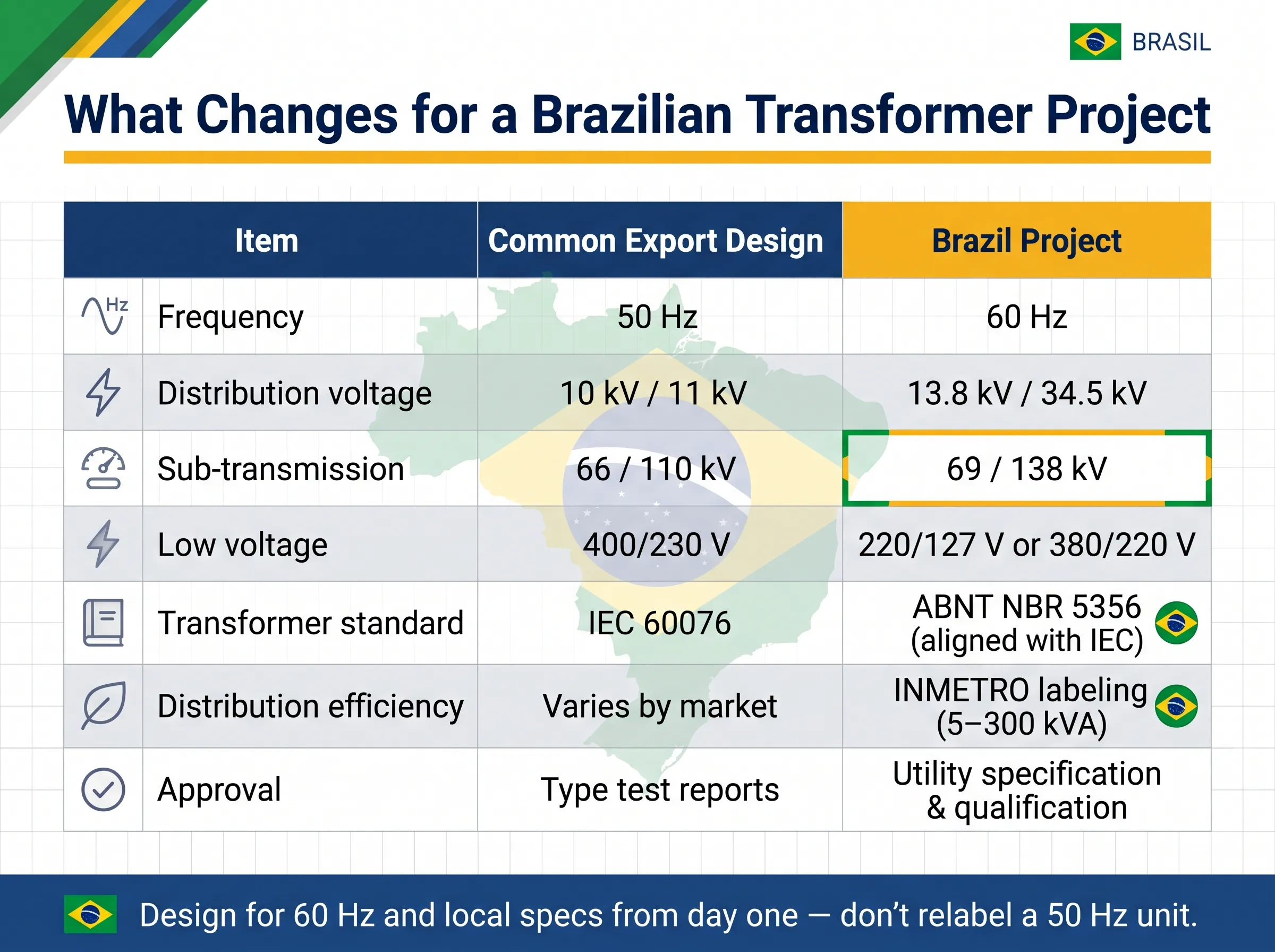
- Winding and core design: at the frequency of 60 Hz the core has a somewhat smaller cross-section and thus the particularities of designing the transformer for the 60 Hz frequency cannot be obtained just by copying anything from the structure created for the 50 Hz frequency.
Ratio of voltages: the primary and secondary voltages ought to satisfy Brazil standards, like 13.8 kV, 34.5 kV or 138 kV, as well as secondary voltages such as 220/127 V or 380/220 V series.
Insulation levels: the basic insulation levels and test voltages used in the manufacturing process should follow the Brazilian classes, as for example in 15, 24.2 and 36.2 kV voltage classes which are used in the process of distribution.
The vector group and range of taps: there are certain specifications in terms of the vector group, and as it happens in case of switching and tap changers on load in accordance with the requirements of utility companies.
Factory tests: testing in the factory would include measuring the losses and conducting impulse tests at the given frequency or adjusting the loss according to the measurement and reporting it in the format which is required by the customer.
Introduction of ABNT, INMETRO and IEC
ABNT NBR 5356 and IEC 60076
Power transformers are regulated according to the ABNT NBR 5356 series in Brazil and IEC 60076 series in the international sphere. The two have similar structure and many common requirements, but they should not be considered identical. Buyers and suppliers should verify the exact edition referenced in each project and any Brazilian-specific provisions.
ABNT NBR 5440 for Overhead Distribution Transformers
The ABNT NBR 5440 standard applies to distribution transformers for overhead networks, which requires some specifications on ratings, construction and performance.
INMETRO Efficiency Requirements
Brazil applies measures for regulating losses of common liquid-immersed distribution transformers through the implementation of its energy efficiency program. The measures apply to single-phase transformers from 5 to 100 kVA and three-phase transformers from 15 to 300 kVA of 15, 24.2 and 36.2 kV classes, regardless of whether they are manufactured in Brazil or imported. All models must obtain INMETRO approval and a national efficiency mark before they can be sold to the market, and importers must prove compliance with the regulations to receive an import license. The bigger power transformers are not covered by this program but are typically bound by loss warranties in the purchase agreement.
Utility Specifications and Qualification
Brazilian distribution utilities and transmission concessionaires prepare their technical specifications, and many also require qualifying suppliers or testing models prior to signing contracts with them. These specifications are often more important for day-to-day procurement than national standards, so they should be requested early in the procurement process.
Can Overseas Manufacturers Supply Brazil?
Yes, and many already do, but the decision should be made project by project. The table below compares the main factors buyers weigh when choosing between transformer suppliers in Brazil and overseas factories.
| Factor | Local manufacturer | Overseas manufacturer |
|---|---|---|
| Standards and utility approval | Often already qualified with local utilities | Must demonstrate compliance and may need qualification or prototype tests |
| Lead time | Short transport, but factory slots may be booked | Factory capacity may be available sooner, plus sea freight and customs |
| Logistics | Domestic road transport | Ocean freight, port handling and heavy-haul transport for large units |
| Import duties and taxes | Not applicable | Must be included in the total cost comparison |
| Efficiency labeling | Established INMETRO process | Required for covered distribution transformers before import |
| After-sales service | Local teams | Needs a clear plan for commissioning, spare parts and warranty support |
Overseas sourcing is preferable for certain privately owned schemes like wind and solar farms, industrial substations and mineral extraction sites, where the design specifications are dictated by the owner or the engineering, procurement and construction contractor, as well as in the case of products that do not fall under the INMETRO protocol. In contrast, it is much more difficult for utility tenders requiring prior approval. In every case, lower ex-works prices become important only when technical compliance, freight, taxes, and services have already been accounted for.
Where Subian Electric Fits
Subian Electric manufactures oil-immersed and dry-type transformers, prefabricated substations and switchgear at its factory in Xuzhou, China, and supplies projects in more than 50 countries. For the Brazilian market, the most relevant products are:
- Medium-voltage distribution transformers, including 6–10 kV and 20 kV oil-immersed distribution transformers, which can be engineered to 13.8 kV, 60 Hz project requirements.
- 35 kV-class oil-immersed power transformers as a basis for 34.5 kV renewable and industrial applications.
- 66 kV and 110–132 kV oil-immersed transformers as a starting point for 69 kV and 138 kV substation projects, subject to design confirmation.
- photovoltaic step-up substations and YB series prefabricated substations for solar, wind and industrial sites.
To be clear about the limits: Subian’s standard catalog designs are built mainly for 50 Hz IEC networks. Brazilian projects require a dedicated 60 Hz design, confirmation of voltage ratios, insulation levels and vector group, and review against the applicable ABNT standards and utility specifications. Subian does not claim existing INMETRO authorization or Brazilian utility qualification; these would be addressed project by project where required.
Frequently Asked Questions
How large is the Brazil power transformer market?
As per estimates, published numbers show potential repeat for 2025 and numbers vary from US$1.2 billion to US$1.7 billion, depending on whether they are related to power transformer business or distribution transformer business or both. The official numbers are far more relevant because the transmission auctions in Brazil alone will secure around 14,850 MVA of new transformer capacity in 2026.
Who are the main power transformer manufacturers in Brazil?
WEG and Hitachi Energy are among the largest, and both are expanding Brazilian capacity. Other international groups and local companies also supply power and distribution transformers.
Does Brazil use 50 Hz or 60 Hz transformers?
Brazil’s national grid runs at 60 Hz, so transformers must be designed and tested for 60 Hz rather than adapted from 50 Hz catalog models.
What transformer voltage ratings are common in Brazil?
Transmission uses 230, 345, 440, 500 and 765 kV; sub-transmission uses 69, 88 and 138 kV; and distribution mostly uses 13.8 kV and 34.5 kV, with low voltages of 220/127 V or 380/220 V.
Can Chinese transformers be imported into Brazil?
As long as they meet the technical specifications of the project, adhere to the relevant ABNT standards, and possess the INMETRO efficiency authorization and label on liquid-filled distribution transformers, the distributors are also expected to reply back if they have been invited by the utility.
What does INMETRO regulate for transformers?
INMETRO enforces maximum loss limits and efficiency labeling for liquid-immersed distribution transformers, covering single-phase units of 5 to 100 kVA and three-phase units of 15 to 300 kVA in the 15, 24.2 and 36.2 kV classes.
Are power transformers and distribution transformers the same market?
No. Power transformers serve transmission and sub-transmission at 69 kV and above and are mostly built to order. Distribution transformers serve 13.8 kV and 34.5 kV networks, are produced in volume and are bought through utility tenders.
References
- B3: ANEEL transmission auction 04/2026 results
- InfoMoney: Results of transmission auction 01/2026
- eixos: R$120 billion transmission investment projected in PDE 2035
- Ministry of Mines and Energy: Efficiency program for liquid-immersed distribution transformers
- Electricity sector in Brazil, Wikipedia
Brazil’s grid expansion is creating steady demand across every voltage level, from 500 kV substations to 13.8 kV distribution networks, and the projects that succeed will be the ones that specify 60 Hz designs, Brazilian voltage classes and local standards from the start. Jiangsu Subian Electric Power Equipment Co., Ltd. designs and builds oil-immersed transformers, prefabricated substations and switchgear for international projects, engineered to each project’s frequency, voltage and specification. For private-label or distributor supply, see our OEM and ODM programme. Send your single-line diagram, voltage ratings and technical specification through our contact page, and our engineers will review the design requirements and reply with drawings and a factory quotation.