


Each buyer raises the same question first. In an honest factory, the answer is the same every time: it depends, but let’s look at the numbers. Hence, the website provides the numbers. The numbers shown below are derived from the market data and quotations made in 2026, not from a fanciful wishlist.
One word of caution before the tables: the transformer prices are unstable in 2026; many producers raised their prices by 10%-20% in their fresh offers with regard to the late 2025 prices. A number of producers made changes to their past orders. It is noteworthy that the amount you used to agree on in the past may not be the amount you have to pay in actuality. Thus, it is reasonable to have some reserve and state it in writing.
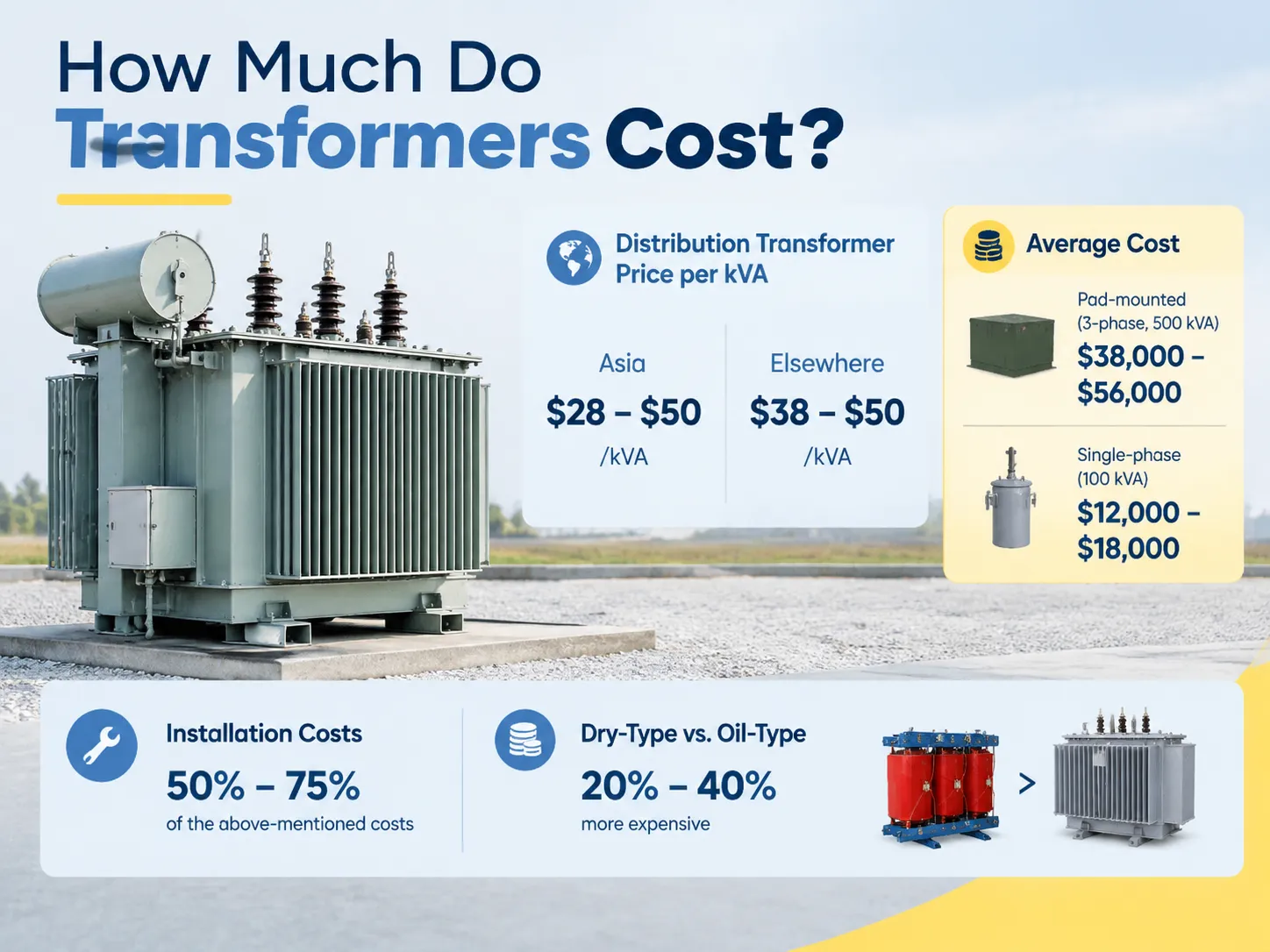
In conclusion, distribution transformer expenses fluctuate between $28/kVA and $50/kVA in Asia while elsewhere prices range from $38/kVA to $50/kVA. Therefore, prices for an average pad-mounted three-phase transformer of 500 kVA is approximately $38,000-$56,000 and of a standard single-phase transformer of 100 kVA $12,000-$18,000. Moreover, installation expenses range from 50%-75% of the above-mentioned costs and it can be inferred that dry-type transformers are usually 20%-40% more costly than oil-type devices.
The Short Answer, in Numbers
Almost all inquiries can be solved with the help of three reference points.
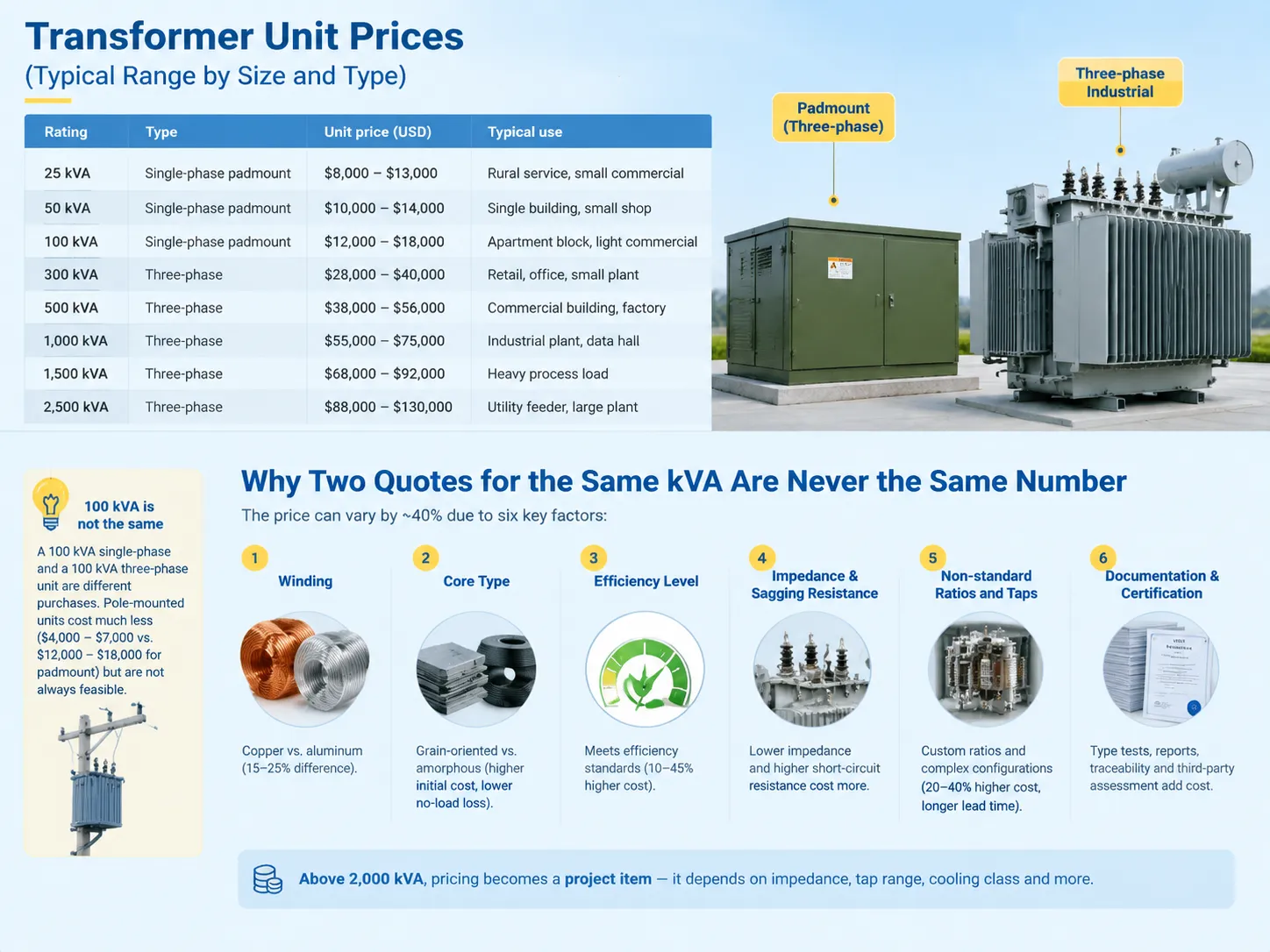
Buying a 25 kVA single-phase padmount unit gives you a bid between $8,000 and $13,000. A slightly larger three-phase padmount unit rated at 500 kVA would be listed at $38,000 to $56,000. Finally, a very big 2,500 kVA three-phase padmount could be bought for $88,000 to $130,000. These prices do not include transportation, a pad and a crane.
If prices per kVA are calculated, it becomes clear that liquid-immersed padmounts have been sold in the range of $25 to $70 per kVA of capacity. Also, the average price of a 1,000 kVA padmount is between $40,000 and $55,000. Being geographically situated in Asia means that padmount prices quoted there range from $38 to $50 per kVA, whereas in North America and Europe this figure is $38 to $50.
If you are pricing a single rating and not a whole range, the line-by-line breakdown for a 100 kVA transformer and what drives its price is worth reading before you request quotes, because it shows how much of the number is core steel and copper, not assembly.
Unit Prices Across the Size Range
Unless specified for single-phase applications, the table below refers to three-phase pad mount as well as industrial distribution. Consider it as being given as a budget category, and anticipate that the quotation will be provided as an amount between the bounds instead of the mid-range mark.
| Rating | Type | Unit price (USD) | Typical use |
|---|---|---|---|
| 25 kVA | Single-phase padmount | 8,000 to 13,000 | Rural service, small commercial |
| 50 kVA | Single-phase padmount | 10,000 to 14,000 | Single building, small shop |
| 100 kVA | Single-phase padmount | 12,000 to 18,000 | Apartment block, light commercial |
| 300 kVA | Three-phase | 28,000 to 40,000 | Retail, office, small plant |
| 500 kVA | Three-phase | 38,000 to 56,000 | Commercial building, factory |
| 1,000 kVA | Three-phase | 55,000 to 75,000 | Industrial plant, data hall |
| 1,500 kVA | Three-phase | 68,000 to 92,000 | Heavy process load |
| 2,500 kVA | Three-phase | 88,000 to 130,000 | Utility feeder, large plant |
There are two entries in that table that are frequently misunderstood. A unit rated at 100 kVA in single-phase and a unit rated at 100 kVA in three-phase are completely different purchases due to the three-phase version having two more wound limbs. The cost of a pole-mounted unit that is rated the same is significantly lower than the price of a padmount unit, while the former costs only about $4,000 to $7,000 whereas the latter costs $12,000 to $18,000 at 100 kVA, since it does not require any enclosure, nor does it have the dead-front design or need for oil containment. Despite this, most of the new developments still use the padmount units because the new standard is underground distribution, and the pole design might not always be a feasible option.
Above 2,000 kVA the table stops being useful. A 1,750 kVA unit is already a project item, built to a specification with a drawing approval cycle, and the price depends on impedance, tap range, cooling class and whether the buyer wants a factory acceptance test witnessed.
Why Two Quotes for the Same kVA Are Never the Same Number
When you send the same requirements to five factories, you will receive five quotations that differ from each other by about 40%. This price difference does not imply fraud or represent all profit; it comes from six sources.
- Winding. If you compare copper to aluminum, the deviation in the price of the same rating is from 15% to 25%. Aluminum will require about 1.6 times more area to achieve the same resistance, but its cost is cheaper and its weight is lower. The real gain as per the published project calculation equals about $28,000 for a 500 kVA unit working at 75% for 25 years, which allowed recovering the first expenses for copper in less than 6 years. Although you may never recover these expenses with a standby unit running 40 hours per year.
- Core type. Grain-oriented silicon steel has different thicknesses and grade of losses, whereas amorphous cores cost more in the beginning while significantly reducing loss when there is no load at the same time. Ordering “high efficiency” without naming the method of testing and its definition is meaningless.
- Efficiency level. The cost of a machine complying with the efficiency requirements is from 10% to 45% higher than the cost of a standard machine. The difference between these machines will be seen in the loss test results, so it is better to request the measurements instead of guarantees.
- Impedance and sagging resistance. Low impedance design complying with the high requirements to the short-circuit resistance will require more spending for bracing and conductors. By skipping this requirement, you will definitely save money until the first accident.
- Non-standard ratios and taps. Custom ratios, complicated switch configuration and operating frequency will increase the price by 20%-40% and will take much longer, meaning that if you can order a standard ratio, do it.
- Documentation and certification. Type test reports, regular test reports, material traceability reports, and third-party assessment will require some effort and funds to prepare the papers.A quote without them is cheaper because something was left out, and the difference between a distribution transformer and a power transformer in this respect is set out in this comparison of power and distribution transformer duty, which decides how much test evidence a project expects.
Low Voltage, Medium Voltage and High Voltage Behave Differently
The term “cost of transformers” actually encompasses three different markets.
Low voltage refers to the 600V and below category, which represents the most commoditized end of the market. These products consist of standard catalog units, availability is particularly good, quotes are very competitive and se costs per kVA are among lowest possible. Dry-type dominates indoors because there is no oil to contain, and a 150 kVA step-down unit is the size most small industrial enquiries actually need.
Medium voltage which is approximately 1 kV to 35 kV remains the level where industrial and power provisioning processes are usually employed. The price per kVA gets increased since insulation, clearances, bushings, tap changers, and tank making get significant costs, and the unit is constructed according to the utility requirement or according to the specification of the power system instead of a catalog. Moreover, a 12 kV unit or a 33 kV transformer imposes additional testing obligations which are not present for a 480 V unit.
High voltage transformers have higher ratings than 35 kV and turn from being a product into the engineered asset. There are no reasonable sources which can define the price per kVA for this kind of machines, as a 132 kV machine will have costs that are conditioned by a lengthy specification which includes many junctions like the quality of sound produced, seismic strength, installation limitations and some more characteristics, that can be agreed upon during the purchase. Those who want to be able to make a purchase in that area must adequately prepare for long periods of quotation processes and long shipping periods.
The position of the borderline has cost implications. If a transformer can be used at the 12kV level instead of the 33 level, the costs for transformer, switchgear, and other equipment will go down proportionally. The decision on the question should be made before starting searching for transformers any way.
Installation and Removal Usually Cost What the Unit Cost
This is where people tend to get surprised when budgeting for their projects. With small distribution units, the installation price can come close to that of the equipment. For larger units, the percentage goes down because the civil works and labour costs remain more or less the same regardless of the power rating of equipment.
| Rating | Unit price | Installation | Total installed |
|---|---|---|---|
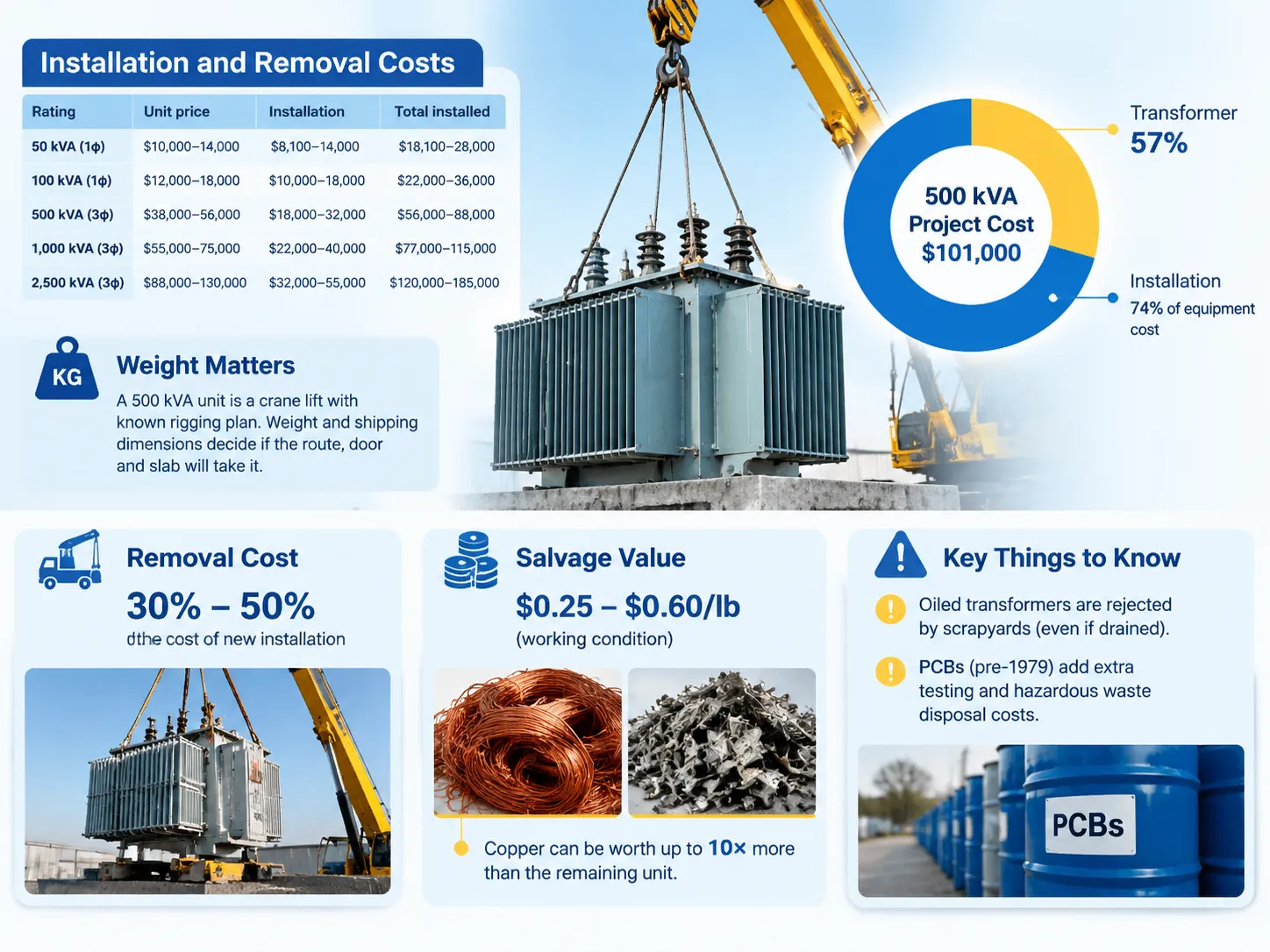
| 50 kVA (1φ) | 10,000 to 14,000 | 8,100 to 14,000 | 18,100 to 28,000 |
| 100 kVA (1φ) | 12,000 to 18,000 | 10,000 to 18,000 | 22,000 to 36,000 |
| 500 kVA (3φ) | 38,000 to 56,000 | 18,000 to 32,000 | 56,000 to 88,000 |
| 1,000 kVA (3φ) | 55,000 to 75,000 | 22,000 to 40,000 | 77,000 to 115,000 |
| 2,500 kVA (3φ) | 88,000 to 130,000 | 32,000 to 55,000 | 120,000 to 185,000 |
A documented 500kVA business retrofit renders the math clear. The device cost $58000. The concrete base, including oil containment, amounted to $6200, the main cable (15kV 3 conductor URD) cost $8500 for a distance of 400 ft, the terminations amounted to $1800, the secondary cable – $4200, grounding – $1600, using a 20-ton crane for 6 hours cost $2800, using 3 laborers for 4 days $7200 and civil work together with repairing the pavement amounted to $5500, permits together with coordination with the electrical company – $3700 and tests – $1500. Therefore, the sum is $101000. The transformer accounted for 57% of the project cost and the installation made the 74% of the price of equipment.
Weight drives several of these lines and users forget to include it in the tender.A 500 kVA oil-immersed unit is a crane lift with a known rigging plan, and the weight and shipping dimensions of a 500 kVA transformer decide whether the route, the door and the slab will take it. Discovering that on delivery day is expensive.
The cost of removal is frequently provided as a separate line item in proposals and can typically be about 30% to 50% of the cost of new installation because old unit removal requires deactivating machinery, disconnecting it, lifting it out, and disposing of it. For oil-filled equipment that was manufactured before 1979, the cost of testing for PCBs is always an additional expense that the removal subcontractor ranks as hazardous waste disposal costs instead of scrap credit.
What a Transformer Is Worth When It Dies
Salvage value may be small in relation to the purchase price, however, it is not zero and is worth enquiring about before one pays someone to take it away.
Transformers that are in working condition currently trade for approximately between $0.25 to $0.60 per pound, with an average of $0.35 indicating that those containing aluminum trade for between $0.10 and $0.20. For example, a drained unit has a typical sale price of between $50 to $300. The sale price of industrial three-phase transformers is higher, possibly reaching four figures, but that is not a copper price.
Where the money lies is between the whole-unit and stripped pricing. #2 copper rates were around $3.50 to $4.00 at the end of 2026 meaning that it is possible to almost make 10 times what the remaining unit would by removing the copper winding. Whether that is meaningful or not depends on availability and whether one has the possibility to safely separate the windings. Most owners do not, which is why the whole-unit sale prevails.
There are two things that make a salvage payoff impossible to obtain: oiled transformers are rejected by scrapyards and some scrap yards charge even if the unit has been drained. The same goes for PCBs because a transformer manufactured before 1979 may contain oil with PCBs.
Reading a Quotation Line by Line
One cannot compare a quote received as one number with anything else. Inquire for the above lines and look for a vendor with knowledge of the product.
- Core and windings reveal the steel grade, as well as the type of wire used.
- Tank, housing and painting system with corrosion classification.
- Cooling class (ONAN, ONAF, AN, AF) and whether fans are presumed operational in the rating.
- Tap changer is either on-load or off-load.
- Losses, no-load and load losses, verified.
- Accessories: Buchholz relay, pressure release system, temperature gauges, surge arrestors, blowers and controls.
- Tests: routine tests included, type tests optional, witnessed FAT at extra cost.
- Documentation: all drawings, test reports, O&M manual, materials traceability.
- Shipping and insurance handling, to a specific location and as per unloading responsibilities.
- Lead time and validity with price escalation clause if applicable.
Most frequently missing from all two lines are tests and documentation, which determine whether the transformer can be charged according to schedule. When a transformer arrives without a routine test certificate, it’s just sitting there until the papers catch up with it.
When Waiting Costs More Than the Premium
Currently, lead time is an important cost item by itself. Basic delivery times are within the range of 16 to 24 weeks and the urgency options incur a premium of 10%-25% in the unit price. In projects using liquidated damage clause, knee jerk premium is often cheaper than a delay penalty, while in projects with float on the schedule it becomes a waste.
There are four legitimate ways to cut costs without compromising the specifications. Cut the size down instead of making it oversized as making the oversized unit is the most costly mistake in electrical transformer procurement which leads to lower loads and a drop in efficiency. Instead of custom design insist on the standard configuration. Order multiple units, since the minimum bulk discounts are 5%-15%. Finally, place the order ahead of time so that you will never pay the rush fee.
One more idea is to remember that efficiency rarely offsets a lightly operated unit. High-efficiency units cost more and provide savings only when used in high-load operations. The return on investment depends on the hours of operation, average loading and energy price and neither factory can calculate it without knowing those three factors.
FAQ
How much does a transformer cost?
The price range for a 25 kVA padmount is around $8,000 to $13,000; for a 500 kVA three-phase padmount, it goes for $38,000 to $56,000; a 2,500 kVA three-phase padmount usually costs $88,000 to $130,000. Installation costs for a retrofit work can increase by anywhere up to 75% of these costs; less if it is a new-build with civils in place.
What is the average price of a transformer?
The average rate in terms of per kVA has more significance. Distribution units in the Asian market are priced between $28 and $35 per kVA, while from North American and European producers, the price varies between $38 and $50 kVA in 2026. Thus, a mid-range 500 kVA three-phase unit would be worth around $47,000.
How much are transformers worth?
Copper units have scrap value of $0.25 to $0.60 per pound and aluminium units will yield around $0.10 to $0.20 per pound making a drained pole mount worth anything from $50 to $300. In operation, the value of a pole mount is determined by its remaining lifespan as a pole mount in good condition with clean oil tests and documented test losses is definitely more valuable than just the metal value
How much does a brand new transformer cost?
Fresh stock is charged as built-to-order items, except for the fact that the time taken between placing the order and receiving the equipment is shorter, and there is a premium attached to the price of stock items. There will be an additional charge of anything from 5% to 15% above factory price for similar specifications, although it still might be lower than the 10% to 25% expedited fee for new orders.
Does dry-type cost more than oil-filled?
Indeed, normally 20 percent to 40 percent at the same rating. You’re essentially paying for the lack of oil, which is important in areas such as indoors, hospitals, basements, or anywhere where spillage will cause a containment issue. If the unit is placed outside and space is not an issue, oil is often the cheaper solution.
References
- U.S. Energy Information Administration — Today in Energy
- International Energy Agency — Electricity 2026
- Hitachi Energy — Transformers and Grid Equipment
- SGB-SMIT Group — Transformer Ratings and Technical Data
- Hammond Power Solutions — Dry-Type Transformer Selection
Conclusion
The unit price is an important number, although it is not the most crucial one. The amount you will have to invest depends on the installed cost, and the location materials are responsible for the installed cost of a power installation. The location materials include pads, cables, and cranes, and the number of permits needed that will help the unit go through the door.
You are requested to provide the missing components. The last two components that we have not received include testing and documentation, which are the two major things that prevent the transformer from being commissioned on the day of arrival. Please specify the voltage rating and the specifications of the installation site enabling us to prepare a calculation regarding the transformer and its installation costs.