


During the morning shift meeting, a maintenance engineer at a medium-sized food processing plant enters with the log of faults: three unplanned shutdowns occurred in the last four months, there were two damaged motor windings on the packaging line, and the arc flash incident report from the compressor room that almost hurt a technician. The plant has a Delta-type and ungrounded MV system, and up to now its system has never raised doubts among anyone.This is the classic situation where a grounding transformer stops being an optional accessory and becomes the difference between a nuisance fault and a dangerous, production-stopping event.
In this article, the definition and functioning principles of grounding transformer are given; what makes ungrounded or corner-delta systems precipitate the sabotage of equipment; and how it is possible to fix the damage. It also considers zigzag and wye-delta methods as well as compares them to other forms of grounding methods. It lists the grounding criteria for purchasing. If you have delta connection service, pay for it, and suffer single-phase failures, read this article before you sign any papers.
Quick answer: A grounding transformer is a three-phase transformer used to create a neutral point on an otherwise ungrounded system, so that the system can be effectively grounded. The two standard designs are the zigzag (ZN) transformer and the wye-delta grounding transformer. Typical ratings range from 100 kVA in a small industrial application to more than 2,000 kVA for large utility substations; these ratings are considered continuous ratings for neutral applications, as well as short-time ratings (10 sec, 30 sec, 1 min) for fault circuitry. The cost of a 100-300 kVA unit lies between $2,000 and $6,000, with a 500-1,000 kVA unit costing between $6,000 and $15,000 and a large 1,500-3,000 kVA installation setting back $15,000-$40,000, as prices vary according to voltage class, impedance, and brand. Grounding properly allows for the control of the line-to-ground fault currents being limited, thus ensuring that certain relay elements act selectively while protecting the system from voltage surges as high as 4-5 times the normal phase voltages in case of ungrounded setup.
What Is a Grounding Transformer?
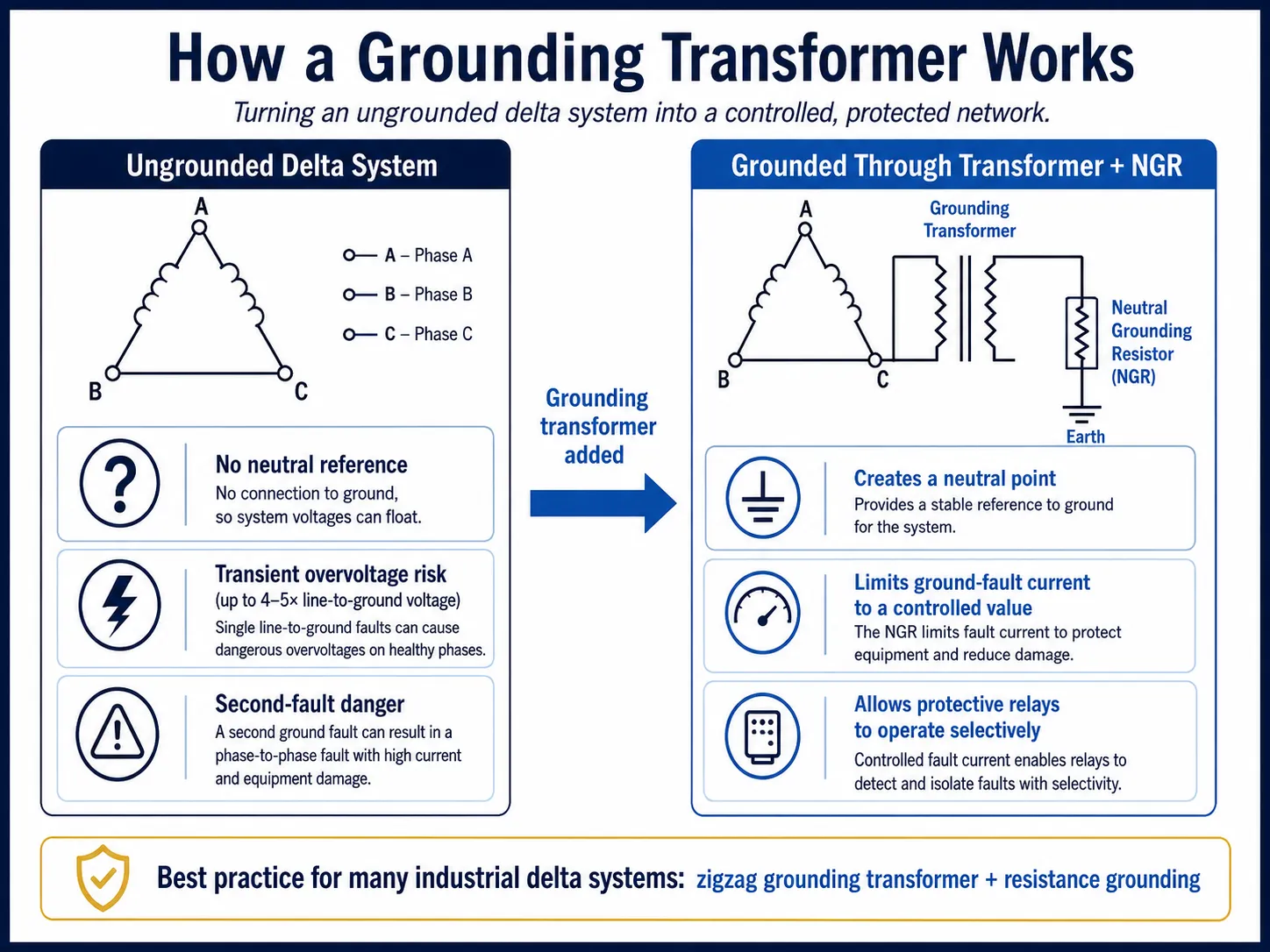
A grounding transformer is a type of three-phase transformer that is designed specifically to create a neutral point in a power system that otherwise would not have one. In systems with transformer windings connected in the delta configuration or delta-connected windings in the generator, there cannot be a neutral point for grounding. The grounding transformer provides the essential neutral ground so that it can be connected to earth via the grounding impedance such as low-resistance resistor known as neutral grounding resistor (NGR), reactors, etc., or via direct type grounding in case of solidly grounded systems.
It is quite important to understand the limitations of the grounding transformer. It does not bring normal load currents into operation. During the normal operation, the currents in the windings are practically zero. It serves only the purpose of carrying the unbalanced zero-sequence current resulting from a line-to-ground fault and establishing the neutral potential of the system. This is the reason that the grounding transformer is rated for the continuous operation (either by thermal rating – kVA) and short time fault rating (10 sec or 30 sec at some rated current).
Why Your Facility May Be Operating Ungrounded
In many industrial settings, a delta system without ground is used due to its low installation cost and ability to withstand single-phase faults. However this is deceiving, as due to the absence of a return path after a single line-to-ground fault in an ungrounded delta system, the system does not shut down, but keeps running with the two other voltages rising from normal to the line-to-line level. Should another fault occur on a different phase prior to clearing the first fault, a double line-to-ground fault occurs resulting into a phase-to-phase short circuit with the fault currents amounting to 10-25 kA of the usual size of medium voltage power systems.
The most severe indirect effect of this kind of systems is due to transients. In fact, since the presence of restriking ground faults in the ungrounded systems can cause voltage levels exceeding normal line-to-ground voltage by 4-5 times, cable insulation effectiveness is broken down, transformer windings suffer from severe stress and motor insulation is damaged many years ahead of schedule. Power system engineers and insurers push different users towards efficient grounding partly due to the understanding of these faults.
How a Grounding Transformer Works
Grounding transformers are applicable when the currents operating under balanced three-phase conditions sum to zero thus consuming only the minimal magnetizing current in the transformer. A special function of the transformer is revealed when faults occur. A zero-sequence current needs to be returned back to the ground each time one of the phases suffers from faults like a line-to-ground fault. Grounding transformer is capable of providing the return flow path.
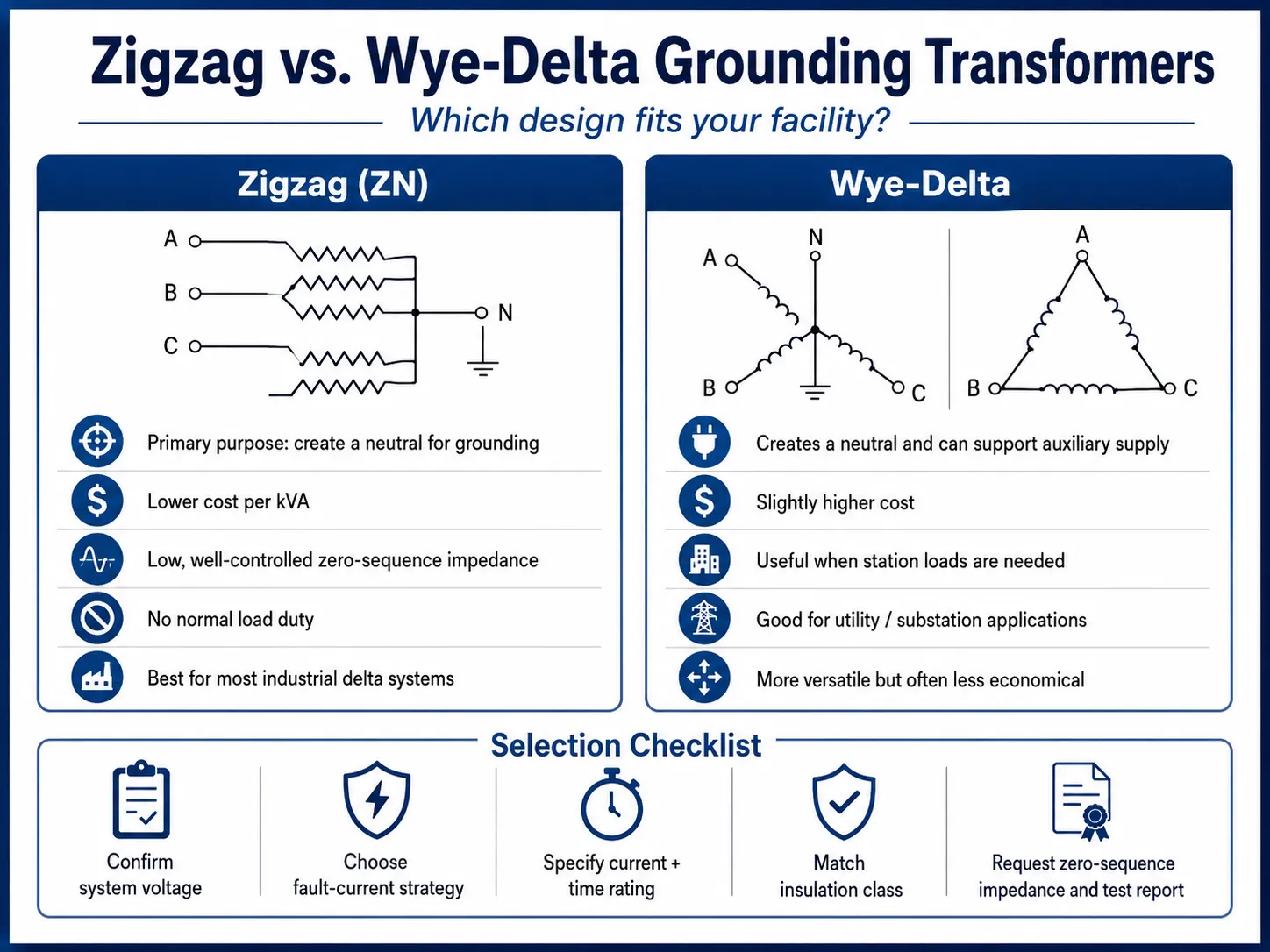
As for zigzag transformers, they consist of two equal windings applied on each leg in an opposite manner. This means that now the two halves cancel out each other resulting in zero phase-to-phase fluxes and zero linkage. Although the transformer is passive under balanced loads, the presence of zero-sequence currents creates a net magnetomotive force, making the transformer act as a very low path.
Zigzag vs. Wye-Delta Grounding Transformers
| Characteristic | Zigzag (ZN) Grounding Transformer | Wye-Delta Grounding Transformer |
|---|---|---|
| Winding arrangement | Six equal windings, two per leg, opposite halves | Three wye-connected windings plus a closed delta tertiary |
| Primary purpose | Create a neutral for grounding | Create a neutral and optionally supply auxiliary load |
| Zero-sequence impedance | Low and well controlled (5-10% typical) | Can be adjusted via the tertiary; slightly higher |
| Normal load duty | No-load duty only | Can carry a small auxiliary load via the delta or wye |
| Cost | Lower per kVA | Slightly higher |
| Typical application | Industrial delta systems, generator neutrals | Utility substations needing auxiliary supply |
Most of the facilities should use this zigzag pattern. The additional cost of wye-delta equipment would be justified only when there is a need for stable single-phase supply for auxiliary loads in the station, such as lighting, battery chargers, and minor appliances.
Grounding Methods Compared
| Method | Ground Fault Current | Overvoltage Protection | Relay Selectivity | Relative Cost |
|---|---|---|---|---|
| Ungrounded (no ground reference) | Capacitive only, but double-fault risk | Poor; transients up to 4-5× phase voltage | Poor | Lowest |
| Solid grounding (wye) | Highest (can exceed 10 kA) | Excellent | Good but high energy | Low |
| Resistance grounding via NGR | Controlled, e.g., 100-400 A | Good, transient-free | Excellent for detection | Moderate |
| Reactance grounding | Moderate, engineered | Good | Good | Moderate |
| Grounding transformer (zigzag) | Enables any of the above on delta systems | Restores proper clamping | Enables selective relaying | $2,000-$40,000 |
The important point here is that it is not the grounding transformer that determines the value of the fault current but rather the neutral grounding resistor or reactor that connects the neutral terminal with the earth. Many industrial installations use resistance grounding through zigzag transformers with a limit of 200 A which is considered the ideal solution since the fault current is sufficient to ensure reliable fault detection and clearance and at the same time is not high enough to create the problems associated with large arc-flash energies.
Key Specifications and Ratings
| Parameter | Typical Value | Notes |
|---|---|---|
| Continuous rating | 100-3,000 kVA | Set by unbalanced load and system duty |
| Fault current rating | 400-1,200 A for 10 s / 30 s | Must match the relay clearing time |
| Voltage class | 480 V to 35 kV | Match the system line-to-line voltage |
| Zero-sequence impedance | 5-10% typical on 10 s basis | Controls how the neutral is established |
| Insulation class | Class B / F / H (dry), oil-immersed per IEC | Same logic as a power transformer |
| Standards | IEC 60076-1, IEEE C57.12.00, IEEE C57.32 | Plus IEEE 142 (grounding practices) |
Be accurate in specifying the duty cycle while writing the specification. A zigzag transformer rated for 10 seconds at a current of 1,000 A is totally different than one rated for 1 minute at the same current, and manufacturers price them differently. The fault-time rating must be compatible with the maximum clearing time of the protection system so that the transformer is never asked to carry fault current beyond its rated capacity.
Where Grounding Transformers Are Installed
- Manufacturing plants featuring delta-linked systems: food production, chemicals, cement, and mining plants wherein the leading transformer winding is delta and there is no neutral wire.
Neutral grounding of generators: diesel and natural gas generators whose windings are delta-connected to make it possible to perform resistance grounding and earth fault detection successfully.
Marine and offshore installations: places where the ungrounded system was used traditionally but modern-day practices require presence of a reference.
Utility transformer substations: providing a neutral point for three-wire distribution feeders and providing auxiliary load of the station (wye-delta connection).
Buildings with 480 V delta: electrification having loads being equal to 277 V which cannot be achieved by the delta secondary output.
Renewable energy facilities: farms using inverters with delta transformers where ground transformer provides earth fault protection.If the connection on your transformer plate is either Dd0 or Dyn11 and there is no neutral available and your loads include some single-phase equipment you may be an appropriate candidate for ground transformer even before the fault log is getting worse.Here are grounding transformer sizes according to the standard systems configuration (in case of resistance-grounded neutral and duration of the fault being 10 seconds):
| System Voltage | Service Size | Typical Zigzag Rating (Continuous) | Typical Fault Rating | Indicative Price |
|---|---|---|---|---|
| 480 V delta | 500-1,500 kVA | 100-150 kVA | 400 A / 10 s | $1,500-$3,500 |
| 3.3 kV / 6.6 kV | 1-5 MVA | 150-300 kVA | 400-600 A / 10 s | $2,500-$6,000 |
| 11 kV | 2-10 MVA | 250-500 kVA | 600-800 A / 10 s | $4,000-$10,000 |
| 22 kV / 33 kV | 10-30 MVA | 500-1,000 kVA | 800-1,200 A / 10 s | $8,000-$20,000 |
Brands and Price Comparison
| Brand | Origin | Specialization | Approx. Price Range |
|---|---|---|---|
| ABB | Switzerland/Sweden | Complete grounding transformer and NGR packages | $5,000-$30,000+ |
| Siemens | Germany | Distribution and grounding transformers for utilities | $6,000-$35,000+ |
| Hitachi Energy | Switzerland | Large grounding units for substations | $8,000-$40,000+ |
| Schneider Electric | France | Zigzag transformers for LV/MV industrial systems | $4,000-$20,000 |
| GE / Eaton | USA | LV grounding transformers for 480 V services | $2,500-$15,000 |
| Jiangsu Subian Electric Power | China | Zigzag and wye-delta grounding transformers, IEC 60076 tested | $1,800-$12,000 |
International suppliers such as ABB, Siemens, Hitachi Energy, and Schneider Electric manufacture high-quality grounding transformers, and they set the standard in quality and documentation. However, their pricing reflects the high manufacturing costs and long delivery times of bespoke zigzag transformers. Jiangsu Subian Electric Power provides zigzag and wye-delta transformers that meet IEC 60076-1 standards and are provided along with all routine test reports such as zero-sequence impedance, temperature rise, and fault-time performance. Subian delivers transformers worldwide, offers custom voltage classes ranging from 400 V to 35 kV, and usually has prices around 40-60% of prices for similar European products. As for any grounding equipment, it is better to purchase a cheap transformer from a manufacturer who is ready to provide test data than to skip this type of transformers altogether.
How to Select the Right Grounding Transformer
Check if the system is truly ungrounded. Confirm the connection group of the transformer used (Dyn11, Dd0). Ensure there is no neutral available.
After confirming the ungrounded system, determine the type of grounding to be implemented and expected fault current (100-400 A for resistance grounded industrial system).
Calculate the kVA rating of the unit taking into account the worst-case unbalanced load and neutral current during faults. Standard rating is typically 100-500 kVA.
Identify the fault rating, which must include current and time values (600 A for 10 seconds) and ensure that it corresponds to inverter maximum trip times.
Make sure voltage class and insulation requirement are fully met. A transformer for the 11 kV system must be tested at maximum BIL ratings.
Choose zigzag option unless the auxiliary power is required. In that case wye-delta should be used.
Request test report. Tests confirming the design based on zero-sequence impedance and temperature rise tests should be performed as per IEEE C57.12.90 and IEC 60076 standards.
Installation and Protection Notes
In normal operation, the transformer needs to be protected from overload because it does not pass much current. Fuses and circuit breakers are typically installed on the primary side and are rated to not operate under normal, balanced conditions, but rather to interrupt the current in case of an internal fault or prolonged overload. Furthermore, the neutral must be connected to ground via grounding impedance (whether resistor or reactor), and this connection should consist, according to the fault current, either of busbar or a thick cable.
Monitoring the temperature is important. Unlike in the case of a regular load transformer, due to the nature of zero sequence currents, the core and winding will be heated differently. Many systems add a temperature indicator with alarm contacts and set the required maintenance period so that the connections can be tested with infrared many times a year. The grounding resistor must be located in a weather-protected and ventilated enclosure and have a thermometer since the resistor is rated to work at a temperature of several hundred degrees Celsius.
Frequently Asked Questions
How much does a grounding transformer cost?
Pricing on a 100-300 kVA zigzag unit will be between $2000 and $6000 at a range of voltages, between 480 V and 11 kV. The price of 500-1,000 kVA units typically ranges between $6000 and $15,000. The cost for substation-type units from 1500-3000 kVA can be $15,000 and above. Prices vary depending upon the voltage rating, fault rating, and brand, and prices quoted by Chinese companies typically range between 40-60% cheaper than those priced by European companies for units with the same specifications.
What size grounding transformer do I need?
The determination of size should be based on the faults. With the fault current duty, the grounding transformer should therefore be suitable for the industrial service of 2000 kVA on 11 kV delta system. To be more precise, for an industrial service of 2000 kVA on 11 kV delta system and with a neutral grounding resistor rated 200 A, a zig-zag type of transformer rated 250-400 kVA and 200 A for 10 seconds is considered a generally viable equipment. As their engineer to confirm the zero-sequence duty, as the undersized transformer may lead to failures during the first fault.
Can a grounding transformer supply load current?
Ineffectively, in the zigzag unit. The zigzag transformer is nearly not under any electrical load in the absence of what is called an unbalanced current. If a neutral connection with a capability to carry the single-phase load is required it is possible to use a wye-delta grounding transformer, which has its primary designed in wye configuration and thus can supply auxiliary loads required for various purposes while delta configuration works as the zero sequence conductor.
What is the difference between a grounding transformer and a neutral grounding resistor (NGR)?
They are complementary, not alternatives. The grounding transformer creates the neutral point on a delta system; the NGR is the impedance connected between that neutral and earth that limits fault current to a design value. A 200 A NGR limits a ground fault to 200 A regardless of the system’s potential fault level, which protects equipment and limits arc-flash energy.
Is it safe to keep running an ungrounded system with occasional ground faults?
No, and this is the highest-priced error in grounding philosophy. The first ground fault does not reset on an ungrounded system but increases the voltage of the other two phases to line-to-line voltage and puts the insulation under 1.73 times the applied voltage. A second ground fault on a different phase creates phase-to-phase short via ground with current magnitude possibly of tens of kiloamps together with 4-5 times zero voltage transients; this is exactly the sequence of faults that damages motors and cable installations.
References
- IEEE 142 — Recommended Practice for Grounding of Industrial and Commercial Power Systems — The Green Book; the definitive guide to why and how to ground industrial systems.
- IEEE C57.32 — Requirements, Terminology, and Test Procedures for Neutral Grounding Devices — Covers NGRs, reactors, and their testing.
- IEC 60076-1 — Power Transformers, General Requirements — The test and rating baseline for grounding transformer designs.
- Eaton — Grounding and Ground Fault Protection — Practical guidance on grounding system design for low-voltage facilities.
- OSHA 3075 — Controlling Electrical Hazards — Workplace electrical safety context for grounding requirements.
- Hitachi Energy — Transformer Products — Reference specifications for grounding transformer offerings.
Conclusion
If you are running an ungrounded delta system, it should be clear to you that grounding transformers are not an insignificant purchase; it is an engineering solution designed to address a series of impending problems that will undoubtedly lead to massive system failure. The main things the grounding transformer does are providing a ground for your system, permitting restriction of incident current by a resistor, ensuring selectivity of protection, and eliminating peak voltage impact on all connected equipment.
Know your system’s connection group before you say you have neutral.
Use zigzag transformer for pure grounding and wye-delta transformer if there is need for extra load.
Choose dimensions based on fault ratings and compare the 10s rating with the relay trip duration.
Make sure to have zero sequence impedance specified in the test report.
For certified zigzag and wye-delta grounding transformers built to IEC 60076-1 with test reports and factory-direct pricing, contact Jiangsu Subian Electric Power via their website at www.subian-electric.com and send them your system voltage, fault-current target, and duty cycle.