


A transformer with a capacity of 5,000 kVA will trip on differential protection at exactly 11:20 a.m. on a Wednesday. When the plant’s electrician arrives, he finds a clear gas build-up in the Buchholz relay and a small bulge in the tank. The production manager, in the meanwhile, is already asking the electrician when it will be possible to return to the operation. This is the time when knowledge of common transformer failures and their reasons, as well as fast handling techniques, separates a calm reaction from a panic response. Most failures of transformers are not random; they fall into several groups of well-known transformer faults and types that can be easily recognized, understood, and technically rectified in a pre-defined way.
The article discusses how common transformer faults are classified, what causes differet faults, how to recognize common transformer issues, and what to do step-by-step. You will find some usual values, costs for damage repair versus new equipment purchase, and tips on how and when to get in touch with the manufacturers when the problem occurs.
According to common knowledge, the most common faults that occur in transformers are cause due to insulation failure and moisture penetration, transformer winding short circuit, core troubles (circulation due current and stakeholders loosened clamps), tap changer defect, busing malfunction, cooling system failures, and contamination of oil.
Transformer Fault Families: An Overview
IEEE working groups and CIGRÉ have continuously spread transformer failures over a few components in reliability surveys. Although failure statistics differ by voltage class, the primary contributors to transformer failures include insulation systems, tap changers, bushings, windings, and cooling/accessories. Knowing the prevailing pattern leads to better prevention and response:
| Fault Family | Typical Share of Failures | Development Speed | Primary Detection |
|---|---|---|---|
| Insulation system (winding, paper, oil) | 30–50% | Slow to medium | DGA, oil moisture, IR test |
| Tap changer (OLTC/DETC) | 10–25% | Medium | OLTC oil DGA, mechanical inspection |
| Bushings | 5–15% | Sudden | Visual, PD, tan delta |
| Winding short circuits / mechanical damage | 5–15% | Sudden (often after through-faults) | Differential protection, DGA, winding tests |
| Core and magnetic circuit | 3–8% | Slow | Noise, core ground current |
| Cooling system and accessories | 5–15% | Slow | Temperature trend, visual |
Data yields two important lessons. Firstly, majority of transformer faults are either avoidable or detectable since the largest families deteriorate slowly. Secondly, quick failures (bushings and winding shorts) often occur from some external factors such as lightning, switching disturbances, or through-elements, pointing that good practices of protection coordination as well as operation are essential for maintenance as much as for prevention.
Insulation Breakdown and Moisture Ingress
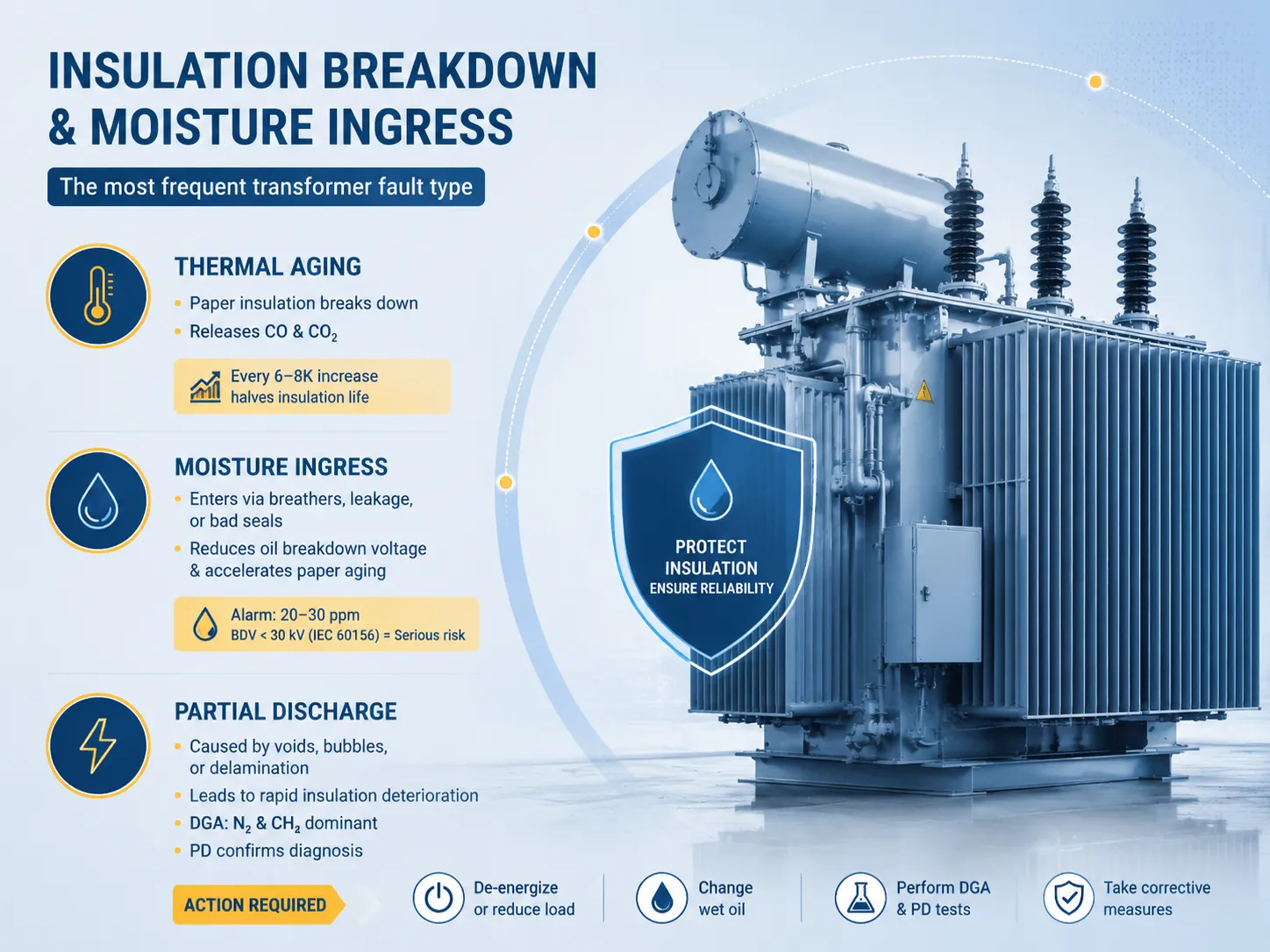
Insulation failure is the most frequent transformer fault type. The insulation system of an oil-filled transformer consists of oil, paper, and pressboard, while it suffers degradation due to three causes: thermal aging, moisture, and partial discharge.
- The heat causes breakdown of paper insulation, releasing CO and CO2 and weakening its mechanical sturdiness. For every increase of 6-8K in the temperature of the hottest part of the unit above the need for regular operation, the service life of the insulation is reduced by half. The equipment which has been in constant heating for several years can unexpectedly become fragile before breaking down.
- Water may enter the transformer through breathers, leakage, or a bad seal. This reduces the breakdown voltage of oil and speeds up the process of paper aging. The usual alarm values for oil moisture are within the range of 20-30 ppm, whereas the breakdown voltage below 30 kV according to the IEC 60156 standard indicates a serious threat.
- Air cavities, bubbles and layers create localized discharge which makes the insulation deteriorate over a short period of time. The resulting DGA readings are dominated by nitrogen and methane, while PD confirms the diagnosis.
Once the above-mentioned issue has been detected, the transformer should either be put out of service or its load reduced, the wet oil changed, and DGA and PD tests conducted, as the confirmation of insulation degradation calls for appropriate measures.
Winding Short Circuits and Mechanical Damage
Winding faults generally occur abruptly and brutally. The conventional activating factor of a winding fault is a through-fault; a short circuit on the LV side generates tremendous mechanical forces passing through windings of transformers, thus compressing, bending or shifting coils. If the clamping system is poor and if the insulation has been used for a long time, the through-fault results in windings failure and subsequent development of turn-to-turn short during the subsequent start-up. DGA analysis indicates raised levels of ethylene and, in many cases, acetylene, differential or overcurrent protection switches off.
Take action immediately after the trip. Do not start closing a switch immediately. It is necessary to observe the flagging of protections, take oil and gas samples, as well as measure winding resistance on each phase (any differences exceeding 2-3 % indicates turn failure). In case any defect is discovered, the transformer has to be taken out of service for inspection or rewinding or potentially replacement in case the core or tank is damaged as well.
Core Faults: Clamping, Circulating Currents, and Grounding
Core defects grow silently. Insufficient core clamps lead to shaking and mechanical wear, causing a change in the humming or “rattling” sound. Circulating currents in the core resulting from failure of the insulation between layers or unintentional dual grounding lead to overheating of the core along with gas formation, e.g., of methane and ethylene. Single-point grounding of the core is desirable and required, while grounding at two points creates a loop leading to heating.
In case the problem is suspected, it is necessary to measure the core grounding current (the normal value is milliamperes; if the value becomes equal to the current in amperes, it means that there is grounding at two points), perform DGA testing, and check the core clamping if the tank is opened. One should keep in mind that it may take a lot of time to fix a defect related to dual grounding since it may require removal of the core.
Tap Changer Failures
On-load tap changers are a moving part of the transformer and are one of the biggest causes of failures in transformers that are five years old or older. Common failure modes include wear and burning of contacts, jamming of the drive mechanism, oil contamination in the OLTC compartment, and out-of-sync phases. Symptoms of potential problems are voltage failures, noise during tap changing, and high gas concentrations in the OLTC oil.
If OLTC fails to operate correctly, it must be shut down, the driving motor current should be checked, and the oil sampled for testing separately using DGA. Normally, contacts need to be replaced or OLTC refurbished which costs $5000-$40,000 depending on the size of OLTC.
Bushing Failures
Bushings can fail at any time, and the consequences of bushing failures are quite severe; their explosion can lead to spraying of oil, fire, and problems in the adjacent phases. The reasons for the issues with bushings can be different and include moisture through cracks in porcelain, surface contamination leading to tracking, wrong capacitance grading, and thermal impacts from overload. Failures can remain hidden until the bushing explodes, which is the reason for suggesting regular PD diagnostics and tan-delta measurements on critical bushings.
You need to be quick: if a bushing is cracked or heavily contaminated, it should be replaced instantly (the cost of replacement is between $3,000 and $30,000 per phase). If there is damage, do not put off bushing replacement, as a violent failure may happen anytime.
Cooling System and Oil Contamination Faults
Cooling defects are the most frequent “slow” issue: clogged radiators, faulty fans, locked pumps, and insufficient oil content. They do not themselves damage the transformer, but their presence forces hot operation, thus hastening insulation deterioration and, on certain occasions, resulting in the protection being triggered in times of high power consumption. In the meantime, oil pollution hides water intrusion, sludge formation, acidity, and dissolved metals, which all have a negative impact on the insulation.
Immediate response: with cooling issues, fix the fan and pump, clean the radiators and check the oil level, and for oil pollution perform the suite of oil quality tests (breakdown voltage, moisture, acidity, IFT) and cleanse or change oil costing $2000-15000 depending on the volume. The true root cause of contamination, usually a leak, breather malfunction, or overheating, should always be detected and eradicated.
Frequency and Cost of Each Fault Family
When a fault is confirmed, the response cost depends heavily on the family and the speed of detection. The table below summarizes typical repair and replacement costs:
| Fault Family | Typical Repair Cost | Replacement Cost (20–60 MVA unit) | Cost Multiplier if Detection Delayed |
|---|---|---|---|
| Insulation / moisture (caught early) | $5,000–$30,000 (oil treatment, dry-out) | $250,000–$1.2M | 5–20x |
| Winding short circuit | $20,000–$150,000 (rewind) | $250,000–$1.2M | 2–4x if secondary damage |
| Core fault | $15,000–$80,000 | $250,000–$1.2M | 3–8x |
| Tap changer | $5,000–$40,000 | OLTC assembly $15,000–$60,000 | 2–5x |
| Bushing | $3,000–$30,000 per phase | — | 10x+ if bushing explosion |
| Cooling / oil contamination | $2,000–$15,000 | — | Indirect, via accelerated aging |
The pattern is global: early detection through DGA, temperature trending, and regular inspections cuts costs by a factor of ten compared with waiting until after a trip. This is the complete business case for condition monitoring.
Rapid Handling Strategy: The 6-Step Response
Whenever a transformer indicates a fault or trips, a certain procedure must be followed:
- Secure the equipment. Open the circuit breaker, lock it out, and put a tag on the equipment. It is extremely important not to power it again until the reason for the trip is established, except in the case of a known nuisance trip (external cause) where a confirmation must take place before performing the re-closure operation.
- Collect all the data. Record all the information including the flags registered by the protection relay, gas and oil readings, temperature at the time of the event, sounds, and notes from the operator. This data will become the backbone of the future analysis of the cause and consequences of the thing happened.
- Make a sample right away. Prepare oil and Buchholz gas samples as soon as possible after the event, instead of waiting for several days recuperating from the shock. DGA analysis is usually rather expensive (about $200-500) yet very fast and efficient in answering major “what happened” questions.
- Analyze according to the standards. Use IEEE C57.104 and IEC 60599 standards for fault classification.
- Perform necessary electric tests. These include winding resistance check and insulation resistance testing.
- Make a decision. Depending on the conclusions made from analytical procedures, monitoring, repairs, or replacement interventions must be selected.
Set response targets by severity so the sequence has time discipline:
| Severity | Indication | Response Target |
|---|---|---|
| Warning | TDCG 720–1,920 ppm, stable | Investigate within 1–2 weeks |
| Alert | Rising gas rate or acetylene > 35 ppm | Sample weekly, plan intervention |
| Emergency | Buchholz trip, acetylene > 80 ppm, tank bulge | Isolate now; decide within 48–72 hours |
Two important pieces of advice: if acetylene is present in concentrations greater than 35-50 ppm, treat the system as being in a potentially hazardous condition and investigate prior to restarting the equipment; if the Buchholz relay has tripped rather than only raised an alarm, then some internal damage is to be suspected and the unit may need to be opened.
Below is a simple troubleshooting chart that connects the fault description with the proper trouble-shooting test and recommended first action.
| Symptom | Likely Fault | Decisive Test | First Action |
|---|---|---|---|
| Buchholz gas alarm | Thermal or discharge fault | Gas + oil DGA | Sample within hours, classify |
| High hydrogen, low acetylene | Partial discharge | PD measurement | Monitor, inspect insulation |
| High ethylene, no acetylene | Thermal fault | DGA ratios, load check | Find overload or cooling cause |
| High acetylene | Arcing / discharge | DGA, winding tests | Do not re-energize; plan inspection |
| Tripped differential protection | Winding short circuit | Winding resistance, ratio | Isolate; internal inspection likely |
| Rising top-oil temperature | Cooling or overload fault | Load and fan check | Restore cooling, reduce load |
Repair vs. Replacement Decision
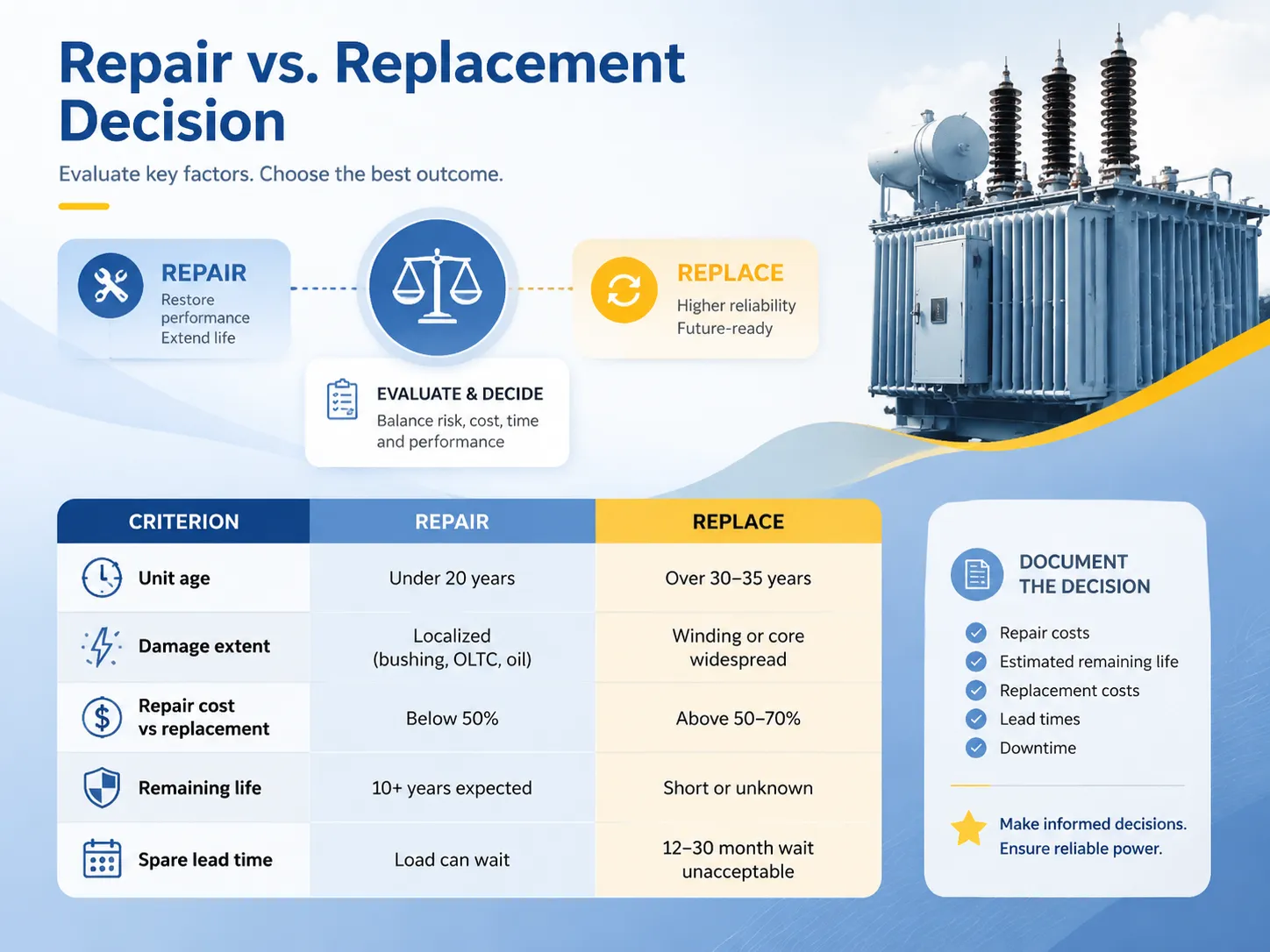
The decision of whether to repair or replace is a matter of both economics and technology. The following measures are to be considered:
- Age and condition: A unit that was built 35 years ago and is known to suffer from both paper aging and a winding defect should be replaced. A unit that is 10 years of age and has one of the OLTC defects or a bushings fault should be repaired.
- Extent of damage: A localized issue such as failure of one bushing, a tap changer, or presence of oil contamination is indicative of a repair and a fault which is more widespread (damage of both windings and the core) is an indication for replacement.
- Cost of repairs as a percent of replacement: As a rule of thumb, if repair costs exceed 50-70% of replacement costs, or if repairs will delay larger failures, replacing should become the preferred option.
- Availability: If lead times for replacement reach up to 30 months and an increase in the supply cannot wait, a repair with proper documentation regarding remaining lifespan would become the ideal option.
- Strategic considerations: While it is still possible to make repairs, improvement criteria, network development, and load predictions can suggest replacement as being preferable.
It is important to document such numbers as repair costs, estimated remaining life, replacement costs, lead times, and downtime. This would create a coherent case for the decision itself.The criteria mentioned when applied in order may serve as a quick filter.
| Criterion | Repair | Replace |
|---|---|---|
| Unit age | Under 20 years | Over 30–35 years |
| Damage extent | Localized (bushing, OLTC, oil) | Winding or core widespread |
| Repair cost vs replacement | Below 50% | Above 50–70% |
| Remaining life | 10+ years expected | Short or unknown |
| Spare lead time | Load can wait | 12–30 month wait unacceptable |
Frequently Asked Questions
What is the most common cause of transformer failure?
The standard cause of failure in electrical components is insulation breakdown, which accounts for approximately 30–50% of total failures in IEEE and CIGRÉ surveys. This damage is usually attributed to heat and moisture damage as well as partial discharge issues. Other minor causes include faults in tap changers, bushings, and windings. Majority of insulation failure cases are detected before the failure happens, because it happens over months or years.
How quickly should I respond to a transformer fault?
Isolate and lock out the unit as soon as possible; sample the oil and gas as soon as possible within hours. Carry out the DGA within 24 to 72 hours after the event; it will almost always identify the fault family and costs around $200-500. By diagnosing the issue within 24-72 hours, the total fault cost would typically be reduced by half compared to waiting for a second event to occur.
Can a transformer be repaired after a winding short circuit?
Certainly in most cases. The cost of rewinding a medium power transformer is in the range of $20,000 to $150,000 depending on its rating, while replacing it would cost between $250,000 and $1.2 million. The choice between the two depends on the condition of the core and tank, their age and the cost of rewinding as a percentage of replacement. Units below 20 years in age that have localized winding damage have a high chance of successful rewinding.
What does a high acetylene reading mean in DGA?
The presence of acetylene (C2H2) in the transformer signals an electric arc. As stated in IEEE C57.104, levels higher than 35 ppm will elevate the transformer into the caution level, and levels higher than 80 ppm will elevate the transformer into the urgent level requiring immediate action. Even the trace levels of acetylene require screening due to the risk of rapid escalation of an electric arc.
How much does a failed transformer cost to replace?
In the case of a 20–60 MVA transformer, it would take between $250,000 and $1.2 million value of the equipment alone to repair it. Emergency logistics, crane leasing, and downtimes have to be added. If it is a transformer above 100 MVA the price would range from $1.5 million to $4 million. Unplanned losses of outages will make you pay between $50,000 and $2 million depending on the load.
References
- IEEE C57.104: Guide for the Interpretation of Gases Generated in Oil-Immersed Transformers — The reference for classifying DGA results and setting response priorities.
- IEC 60599: Guide to the Interpretation of DGA in Mineral Oil-Impregnated Equipment — International gas interpretation framework used with ratio and Duval methods.
- IEC 60422: Supervision and Maintenance Guidance for Mineral Insulating Oils — Oil quality limits and maintenance practice for in-service transformers.
- IEC 60076-5: Ability to Withstand Short Circuit — Standard covering winding mechanical strength against through-faults.
- CIGRÉ — Technical brochures on transformer failure statistics and reliability (A2 committee).
- IEEE — Source of transformer reliability working group data and maintenance standards.
- Jiangsu Subian Electric Power — IEC 60076-compliant transformer manufacturer offering fault diagnosis support and replacement supply.
Conclusion
Faults in transformers can be classified into unique types, and all types demonstrate common symptoms, have known diagnostic tests, and are managed using standard procedures. What distinguishes the case that involves an investment of $5,000 from a case that entails an expense of $1 million is usually the speed and method of response: isolate, document, gather samples, interpret, test, and decide.
- Insulation problems prevail in statistics on failures and are detectable through DGA and testing of oil quality.
- Problems with bushings and windings appear unexpectedly and can be prevented through coordination and monitoring.
- Never energize transformers again after a Buchholz trip or if an indication of high acetylene exists without diagnosis.
- Run DGA within 24–72 hours of the incident at a cost of $200–$500 per sample.
- Make a decision concerning repair or replacement depending on the age and extent of damage.